How Many Voters Change Their Minds in the Month Preceding an Election?
Author(s): André Blais
Source: PS: Political Science and Politics, Vol. 37, No. 4 (Oct., 2004), pp. 801-803
Published by: American Political Science Association
Stable URL: http://www.jstor.org/stable/4488912
Accessed: 20-03-2017 16:12 UTC
JSTOR is a not-for-profit service that helps scholars, researchers, and students discover, use, and build upon a wide range of content in a trusted
digital archive. We use information technology and tools to increase productivity and facilitate new forms of scholarship. For more information about
JSTOR, please contact support@jstor.org.
Your use of the JSTOR archive indicates your acceptance of the Terms & Conditions of Use, available at
http://about.jstor.org/terms
American Political Science Association is collaborating with JSTOR to digitize, preserve and extend
access to PS: Political Science and Politics
This content downloaded from 200.27.188.114 on Mon, 20 Mar 2017 16:12:03 UTC
All use subject to http://about.jstor.org/terms
How Many Voters Change Their Minds in the
Month Preceding an Election?
Andre Blais, Universit6 de Montr6al
T his paper addresses a simple but
basic question: How many voters
change their mind during the month
preceding an election? The question is
simple and basic, yet the vast and rich
literature on voting and elections has
somehow managed to avoid it. Despite
all the talk about the impact of cam-
paigns, I have not come across esti-
mates of how many people vote for a
party other than the one they intended
to support at the beginning of the
campaign.'
The question is important. It makes a
big difference whether "only" 5% of the
voters change their mind in the month
preceding an election or whether as
many as 25% do. Our understanding of
the meaning of the vote and of elec-
tions is bound to be affected by esti-
mates of how many (or few) people
change their mind during election cam-
paigns or even on Election Day.
The purpose of the paper is to pro-
vide an estimate of the proportion of
voters who vote differently from how
they intended. The objective is not to
explain why some voters are more likely
to change their mind than others nor to
explain why the vote is more stable in
some countries than in others. The more
modest goal is to get the "facts"
straight. As indicated in the first para-
graph, we simply do not know how
many voters typically shift from one
party to another in the month preceding
the election, and we do not know
whether the proportion varies substan-
tially from one country to another. Es-
tablishing the facts, that is, the relative
magnitude of vote change and its varia-
tion across space, should help us formu-
late more plausible theories about the
factors that make voters more or less
prone to change their mind.
To address this question, I have as-
sembled all the election studies that I
could find that included a campaign/
post-election panel component; this al-
lows for a comparison of vote inten-
tions in the month (30 days) preceding
the election and actual vote choice (re-
ported in the post-election survey).
I have assembled a total of 27
election studies, conducted in five differ-
ent countries: Britain, Canada, the
Netherlands, New Zealand, and the
United States (see the Appendix for
some basic information on each study).
A total of 27,820 respondents,2 an aver-
age of 1,030 per study, had a vote inten-
tion in the month preceding an election
and an actual vote choice as reported in
the post-election survey.
An individual is defined as having
changed her mind if she said in the post-
election survey that she voted for a party
other than the one she had indicated she
intended to support in the campaign sur-
vey. And, of course, an individual is de-
fined as having not changed her mind if
she reported having voted for the party
she had mentioned supporting in the
campaign survey.3
All individuals who did not vote, did
not indicate a vote intention in the cam-
paign survey, or refused to say for
which party they voted, are dropped
from the analysis. I consider only peo-
ple who voted and indicated a vote in-
tention in the campaign. I am thus only
concerned about vote choice, and not
about the decision to vote or not to
vote. And I focus on those who already
had formed an intention during the
campaign. I wish to estimate the pro-
portion, among those with an opinion,
who change their mind. There is an ad-
ditional number of people who make up
their mind after being interviewed; these
people are not included in this study.
Vote intentions should firm as the
campaign progresses and voters become
more informed about party positions on
important issues (Gelman and King
1993), so that by Election Day very few
people should change their mind. I ex-
pect a quadratic relationship, that is, the
propensity to move from one party to
another should drop markedly in the
last week of the campaign. The propen-
sity to change one's mind is therefore
regressed on the number of days before
Election Day (DAY) and the same vari-
able squared (DAY2).
I also wish to determine whether
voters are more prone to change their
mind in some countries than in others.
Converse (1969) has argued that voters
are more likely to develop strong and
stable party loyalties when the party
system is stable and has been so for
some time. From that perspective, we
might expect voters in Britain and the
United States, where political life has
been dominated by the same two
major parties (for almost a century in
the case of Britain and almost a
century and a half in the case of the
United States), to be less volatile than
voters in the three other countries. I
created four country dummy variables
(Britain being the reference category)
to capture overall differences among
countries.
Table 1 presents the findings. They
confirm that the propensity to change
one's mind declines as the campaign
Table 1
The Propensity to Change
One's Vote: A Logit
Estimation
Independent variables Coefficients
Day 0.066*
(0.008)
Day2 -0.001*
(0.000)
USA -0.643*
(0.008)
Canada 0.406*
(0.003)
New Zealand 1.024*
(0.002)
Netherlands 0.363*
(0.007)
Constant -2.722*
(0.061)
Pseudo R2 = 0.050
N = (27820)
Table entries are logit coefficients;
standard errors are in parentheses.
*Significant at .01
Andre Blais is professor in the department of
political science at the Universit6 de Montr6al,
and fellow with CIREQ (Centre interuniversi-
taire de recherche en 6conomie quantitative)
and CIRANO (Centre interuniversitaire de
recherche en analyse des organisations). He is
the principal investigator of the Canadian Elec-
tion Study and he holds a Canada Research
Chair in Electoral Studies. He has published 12
books and more than 100 articles in journals
such as the American Journal of Political
Science and the British Journal of Political
Science.
PSOnline www.apsanet.org 801
This content downloaded from 200.27.188.114 on Mon, 20 Mar 2017 16:12:03 UTC
All use subject to http://about.jstor.org/terms
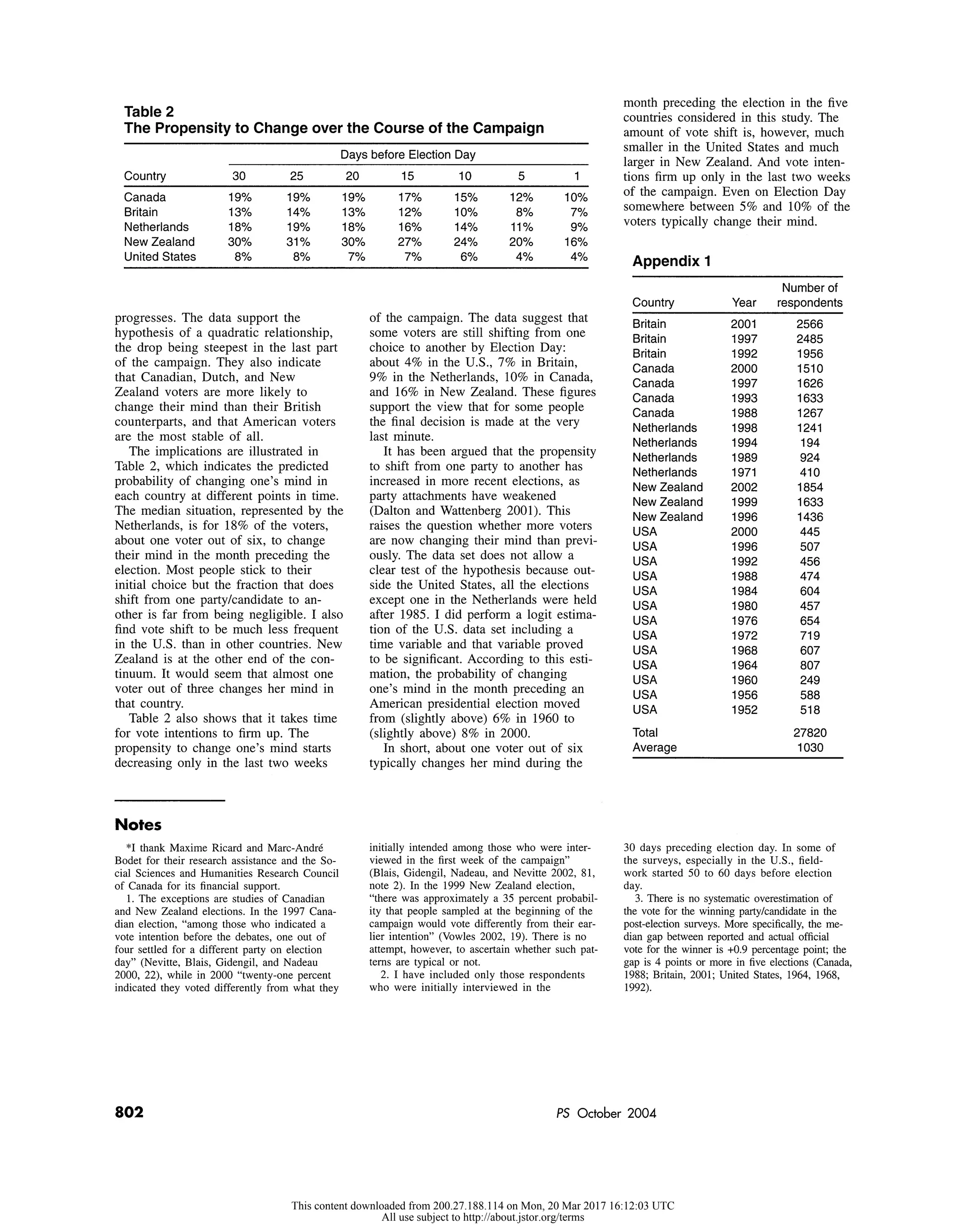
Table 2
The Propensity to Change over the Course of the Campaign
Days before Election Day
Country 30 25 20 15 10 5 1
Canada 19% 19% 19% 17% 15% 12% 10%
Britain 13% 14% 13% 12% 10% 8% 7%
Netherlands 18% 19% 18% 16% 14% 11% 9%
New Zealand 30% 31% 30% 27% 24% 20% 16%
United States 8% 8% 7% 7% 6% 4% 4%
progresses. The data support the
hypothesis of a quadratic relationship,
the drop being steepest in the last part
of the campaign. They also indicate
that Canadian, Dutch, and New
Zealand voters are more likely to
change their mind than their British
counterparts, and that American voters
are the most stable of all.
The implications are illustrated in
Table 2, which indicates the predicted
probability of changing one's mind in
each country at different points in time.
The median situation, represented by the
Netherlands, is for 18% of the voters,
about one voter out of six, to change
their mind in the month preceding the
election. Most people stick to their
initial choice but the fraction that does
shift from one party/candidate to an-
other is far from being negligible. I also
find vote shift to be much less frequent
in the U.S. than in other countries. New
Zealand is at the other end of the con-
tinuum. It would seem that almost one
voter out of three changes her mind in
that country.
Table 2 also shows that it takes time
for vote intentions to firm up. The
propensity to change one's mind starts
decreasing only in the last two weeks
of the campaign. The data suggest that
some voters are still shifting from one
choice to another by Election Day:
about 4% in the U.S., 7% in Britain,
9% in the Netherlands, 10% in Canada,
and 16% in New Zealand. These figures
support the view that for some people
the final decision is made at the very
last minute.
It has been argued that the propensity
to shift from one party to another has
increased in more recent elections, as
party attachments have weakened
(Dalton and Wattenberg 2001). This
raises the question whether more voters
are now changing their mind than previ-
ously. The data set does not allow a
clear test of the hypothesis because out-
side the United States, all the elections
except one in the Netherlands were held
after 1985. I did perform a logit estima-
tion of the U.S. data set including a
time variable and that variable proved
to be significant. According to this esti-
mation, the probability of changing
one's mind in the month preceding an
American presidential election moved
from (slightly above) 6% in 1960 to
(slightly above) 8% in 2000.
In short, about one voter out of six
typically changes her mind during the
month preceding the election in the five
countries considered in this study. The
amount of vote shift is, however, much
smaller in the United States and much
larger in New Zealand. And vote inten-
tions firm up only in the last two weeks
of the campaign. Even on Election Day
somewhere between 5% and 10% of the
voters typically change their mind.
Appendix 1
Number of
Country Year respondents
Britain 2001 2566
Britain 1997 2485
Britain 1992 1956
Canada 2000 1510
Canada 1997 1626
Canada 1993 1633
Canada 1988 1267
Netherlands 1998 1241
Netherlands 1994 194
Netherlands 1989 924
Netherlands 1971 410
New Zealand 2002 1854
New Zealand 1999 1633
New Zealand 1996 1436
USA 2000 445
USA 1996 507
USA 1992 456
USA 1988 474
USA 1984 604
USA 1980 457
USA 1976 654
USA 1972 719
USA 1968 607
USA 1964 807
USA 1960 249
USA 1956 588
USA 1952 518
Total 27820
Average 1030
Notes
*I thank Maxime Ricard and Marc-Andre
Bodet for their research assistance and the So-
cial Sciences and Humanities Research Council
of Canada for its financial support.
1. The exceptions are studies of Canadian
and New Zealand elections. In the 1997 Cana-
dian election, "among those who indicated a
vote intention before the debates, one out of
four settled for a different party on election
day" (Nevitte, Blais, Gidengil, and Nadeau
2000, 22), while in 2000 "twenty-one percent
indicated they voted differently from what they
initially intended among those who were inter-
viewed in the first week of the campaign"
(Blais, Gidengil, Nadeau, and Nevitte 2002, 81,
note 2). In the 1999 New Zealand election,
"there was approximately a 35 percent probabil-
ity that people sampled at the beginning of the
campaign would vote differently from their ear-
lier intention" (Vowles 2002, 19). There is no
attempt, however, to ascertain whether such pat-
terns are typical or not.
2. I have included only those respondents
who were initially interviewed in the
30 days preceding election day. In some of
the surveys, especially in the U.S., field-
work started 50 to 60 days before election
day.
3. There is no systematic overestimation of
the vote for the winning party/candidate in the
post-election surveys. More specifically, the me-
dian gap between reported and actual official
vote for the winner is +0.9 percentage point; the
gap is 4 points or more in five elections (Canada,
1988; Britain, 2001; United States, 1964, 1968,
1992).
802 PS October 2004
This content downloaded from 200.27.188.114 on Mon, 20 Mar 2017 16:12:03 UTC
All use subject to http://about.jstor.org/terms
References
Blais, Andre, Elisabeth Gidengil, Richard
Nadeau, and Neil Nevitte. 2002. Anatomy of
a Liberal Victory: Making Sense of the 2002
Canadian Election. Peterborough: Broadview
Press.
Converse, Philip E. 1969. "Of Time and Parti-
san Stability." Comparative Political Studies
2:139-171.
Dalton, Russ, and Martin Wattenberg. 2001.
Parties Without Partisans. New York:
Oxford University Press.
Gelman, Andrew, and Gary King. 1993. Why
Are American Presidential Election Cam-
paign Polls So Variable When Votes Are So
Predictable?" British Journal of Political
Science 23:409-451.
Nevitte, Neil, Andre Blais, Elisabeth Gidengil,
and Richard Nadeau. 2000. Unsteady State:
The 1997 Canadian Federal Election.
Toronto: Oxford University Press.
Vowles, Jack. 2002. "Did the Campaign
Matter?" In Proportional Representation on
Trial: The 1999 New Zealand Election and
the Fate of MMP, eds. Jack Vowles, Peter
Aimer, Jeffrey Karp, Susan Banducci,
Raymond Miller, and Ann Sullivan.
Auckland: Auckland University Press.
PSOnline www.apsanet.org 803
This content downloaded from 200.27.188.114 on Mon, 20 Mar 2017 16:12:03 UTC
All use subject to http://about.jstor.org/terms

Andre blais 1

  • 1.
    How Many VotersChange Their Minds in the Month Preceding an Election? Author(s): André Blais Source: PS: Political Science and Politics, Vol. 37, No. 4 (Oct., 2004), pp. 801-803 Published by: American Political Science Association Stable URL: http://www.jstor.org/stable/4488912 Accessed: 20-03-2017 16:12 UTC JSTOR is a not-for-profit service that helps scholars, researchers, and students discover, use, and build upon a wide range of content in a trusted digital archive. We use information technology and tools to increase productivity and facilitate new forms of scholarship. For more information about JSTOR, please contact support@jstor.org. Your use of the JSTOR archive indicates your acceptance of the Terms & Conditions of Use, available at http://about.jstor.org/terms American Political Science Association is collaborating with JSTOR to digitize, preserve and extend access to PS: Political Science and Politics This content downloaded from 200.27.188.114 on Mon, 20 Mar 2017 16:12:03 UTC All use subject to http://about.jstor.org/terms
  • 2.
    How Many VotersChange Their Minds in the Month Preceding an Election? Andre Blais, Universit6 de Montr6al T his paper addresses a simple but basic question: How many voters change their mind during the month preceding an election? The question is simple and basic, yet the vast and rich literature on voting and elections has somehow managed to avoid it. Despite all the talk about the impact of cam- paigns, I have not come across esti- mates of how many people vote for a party other than the one they intended to support at the beginning of the campaign.' The question is important. It makes a big difference whether "only" 5% of the voters change their mind in the month preceding an election or whether as many as 25% do. Our understanding of the meaning of the vote and of elec- tions is bound to be affected by esti- mates of how many (or few) people change their mind during election cam- paigns or even on Election Day. The purpose of the paper is to pro- vide an estimate of the proportion of voters who vote differently from how they intended. The objective is not to explain why some voters are more likely to change their mind than others nor to explain why the vote is more stable in some countries than in others. The more modest goal is to get the "facts" straight. As indicated in the first para- graph, we simply do not know how many voters typically shift from one party to another in the month preceding the election, and we do not know whether the proportion varies substan- tially from one country to another. Es- tablishing the facts, that is, the relative magnitude of vote change and its varia- tion across space, should help us formu- late more plausible theories about the factors that make voters more or less prone to change their mind. To address this question, I have as- sembled all the election studies that I could find that included a campaign/ post-election panel component; this al- lows for a comparison of vote inten- tions in the month (30 days) preceding the election and actual vote choice (re- ported in the post-election survey). I have assembled a total of 27 election studies, conducted in five differ- ent countries: Britain, Canada, the Netherlands, New Zealand, and the United States (see the Appendix for some basic information on each study). A total of 27,820 respondents,2 an aver- age of 1,030 per study, had a vote inten- tion in the month preceding an election and an actual vote choice as reported in the post-election survey. An individual is defined as having changed her mind if she said in the post- election survey that she voted for a party other than the one she had indicated she intended to support in the campaign sur- vey. And, of course, an individual is de- fined as having not changed her mind if she reported having voted for the party she had mentioned supporting in the campaign survey.3 All individuals who did not vote, did not indicate a vote intention in the cam- paign survey, or refused to say for which party they voted, are dropped from the analysis. I consider only peo- ple who voted and indicated a vote in- tention in the campaign. I am thus only concerned about vote choice, and not about the decision to vote or not to vote. And I focus on those who already had formed an intention during the campaign. I wish to estimate the pro- portion, among those with an opinion, who change their mind. There is an ad- ditional number of people who make up their mind after being interviewed; these people are not included in this study. Vote intentions should firm as the campaign progresses and voters become more informed about party positions on important issues (Gelman and King 1993), so that by Election Day very few people should change their mind. I ex- pect a quadratic relationship, that is, the propensity to move from one party to another should drop markedly in the last week of the campaign. The propen- sity to change one's mind is therefore regressed on the number of days before Election Day (DAY) and the same vari- able squared (DAY2). I also wish to determine whether voters are more prone to change their mind in some countries than in others. Converse (1969) has argued that voters are more likely to develop strong and stable party loyalties when the party system is stable and has been so for some time. From that perspective, we might expect voters in Britain and the United States, where political life has been dominated by the same two major parties (for almost a century in the case of Britain and almost a century and a half in the case of the United States), to be less volatile than voters in the three other countries. I created four country dummy variables (Britain being the reference category) to capture overall differences among countries. Table 1 presents the findings. They confirm that the propensity to change one's mind declines as the campaign Table 1 The Propensity to Change One's Vote: A Logit Estimation Independent variables Coefficients Day 0.066* (0.008) Day2 -0.001* (0.000) USA -0.643* (0.008) Canada 0.406* (0.003) New Zealand 1.024* (0.002) Netherlands 0.363* (0.007) Constant -2.722* (0.061) Pseudo R2 = 0.050 N = (27820) Table entries are logit coefficients; standard errors are in parentheses. *Significant at .01 Andre Blais is professor in the department of political science at the Universit6 de Montr6al, and fellow with CIREQ (Centre interuniversi- taire de recherche en 6conomie quantitative) and CIRANO (Centre interuniversitaire de recherche en analyse des organisations). He is the principal investigator of the Canadian Elec- tion Study and he holds a Canada Research Chair in Electoral Studies. He has published 12 books and more than 100 articles in journals such as the American Journal of Political Science and the British Journal of Political Science. PSOnline www.apsanet.org 801 This content downloaded from 200.27.188.114 on Mon, 20 Mar 2017 16:12:03 UTC All use subject to http://about.jstor.org/terms
  • 3.
    Table 2 The Propensityto Change over the Course of the Campaign Days before Election Day Country 30 25 20 15 10 5 1 Canada 19% 19% 19% 17% 15% 12% 10% Britain 13% 14% 13% 12% 10% 8% 7% Netherlands 18% 19% 18% 16% 14% 11% 9% New Zealand 30% 31% 30% 27% 24% 20% 16% United States 8% 8% 7% 7% 6% 4% 4% progresses. The data support the hypothesis of a quadratic relationship, the drop being steepest in the last part of the campaign. They also indicate that Canadian, Dutch, and New Zealand voters are more likely to change their mind than their British counterparts, and that American voters are the most stable of all. The implications are illustrated in Table 2, which indicates the predicted probability of changing one's mind in each country at different points in time. The median situation, represented by the Netherlands, is for 18% of the voters, about one voter out of six, to change their mind in the month preceding the election. Most people stick to their initial choice but the fraction that does shift from one party/candidate to an- other is far from being negligible. I also find vote shift to be much less frequent in the U.S. than in other countries. New Zealand is at the other end of the con- tinuum. It would seem that almost one voter out of three changes her mind in that country. Table 2 also shows that it takes time for vote intentions to firm up. The propensity to change one's mind starts decreasing only in the last two weeks of the campaign. The data suggest that some voters are still shifting from one choice to another by Election Day: about 4% in the U.S., 7% in Britain, 9% in the Netherlands, 10% in Canada, and 16% in New Zealand. These figures support the view that for some people the final decision is made at the very last minute. It has been argued that the propensity to shift from one party to another has increased in more recent elections, as party attachments have weakened (Dalton and Wattenberg 2001). This raises the question whether more voters are now changing their mind than previ- ously. The data set does not allow a clear test of the hypothesis because out- side the United States, all the elections except one in the Netherlands were held after 1985. I did perform a logit estima- tion of the U.S. data set including a time variable and that variable proved to be significant. According to this esti- mation, the probability of changing one's mind in the month preceding an American presidential election moved from (slightly above) 6% in 1960 to (slightly above) 8% in 2000. In short, about one voter out of six typically changes her mind during the month preceding the election in the five countries considered in this study. The amount of vote shift is, however, much smaller in the United States and much larger in New Zealand. And vote inten- tions firm up only in the last two weeks of the campaign. Even on Election Day somewhere between 5% and 10% of the voters typically change their mind. Appendix 1 Number of Country Year respondents Britain 2001 2566 Britain 1997 2485 Britain 1992 1956 Canada 2000 1510 Canada 1997 1626 Canada 1993 1633 Canada 1988 1267 Netherlands 1998 1241 Netherlands 1994 194 Netherlands 1989 924 Netherlands 1971 410 New Zealand 2002 1854 New Zealand 1999 1633 New Zealand 1996 1436 USA 2000 445 USA 1996 507 USA 1992 456 USA 1988 474 USA 1984 604 USA 1980 457 USA 1976 654 USA 1972 719 USA 1968 607 USA 1964 807 USA 1960 249 USA 1956 588 USA 1952 518 Total 27820 Average 1030 Notes *I thank Maxime Ricard and Marc-Andre Bodet for their research assistance and the So- cial Sciences and Humanities Research Council of Canada for its financial support. 1. The exceptions are studies of Canadian and New Zealand elections. In the 1997 Cana- dian election, "among those who indicated a vote intention before the debates, one out of four settled for a different party on election day" (Nevitte, Blais, Gidengil, and Nadeau 2000, 22), while in 2000 "twenty-one percent indicated they voted differently from what they initially intended among those who were inter- viewed in the first week of the campaign" (Blais, Gidengil, Nadeau, and Nevitte 2002, 81, note 2). In the 1999 New Zealand election, "there was approximately a 35 percent probabil- ity that people sampled at the beginning of the campaign would vote differently from their ear- lier intention" (Vowles 2002, 19). There is no attempt, however, to ascertain whether such pat- terns are typical or not. 2. I have included only those respondents who were initially interviewed in the 30 days preceding election day. In some of the surveys, especially in the U.S., field- work started 50 to 60 days before election day. 3. There is no systematic overestimation of the vote for the winning party/candidate in the post-election surveys. More specifically, the me- dian gap between reported and actual official vote for the winner is +0.9 percentage point; the gap is 4 points or more in five elections (Canada, 1988; Britain, 2001; United States, 1964, 1968, 1992). 802 PS October 2004 This content downloaded from 200.27.188.114 on Mon, 20 Mar 2017 16:12:03 UTC All use subject to http://about.jstor.org/terms
  • 4.
    References Blais, Andre, ElisabethGidengil, Richard Nadeau, and Neil Nevitte. 2002. Anatomy of a Liberal Victory: Making Sense of the 2002 Canadian Election. Peterborough: Broadview Press. Converse, Philip E. 1969. "Of Time and Parti- san Stability." Comparative Political Studies 2:139-171. Dalton, Russ, and Martin Wattenberg. 2001. Parties Without Partisans. New York: Oxford University Press. Gelman, Andrew, and Gary King. 1993. Why Are American Presidential Election Cam- paign Polls So Variable When Votes Are So Predictable?" British Journal of Political Science 23:409-451. Nevitte, Neil, Andre Blais, Elisabeth Gidengil, and Richard Nadeau. 2000. Unsteady State: The 1997 Canadian Federal Election. Toronto: Oxford University Press. Vowles, Jack. 2002. "Did the Campaign Matter?" In Proportional Representation on Trial: The 1999 New Zealand Election and the Fate of MMP, eds. Jack Vowles, Peter Aimer, Jeffrey Karp, Susan Banducci, Raymond Miller, and Ann Sullivan. Auckland: Auckland University Press. PSOnline www.apsanet.org 803 This content downloaded from 200.27.188.114 on Mon, 20 Mar 2017 16:12:03 UTC All use subject to http://about.jstor.org/terms