© 2012 Ipsos. All rights reserved. Contains Ipsos' Confidential and Proprietary information and
may not be disclosed or reproduced without the prior written consent of Ipsos.
SPEC Barometer
Press Release: General Media
Prepared by: Ipsos
Release date: 25th April 2015
 Most serious problem facing Kenya today
 Proportion stating that:
 They or someone in the household ever go to sleep hungry
 Everyone in the household gets enough to eat
 They experienced famine in their locality in the past year
 They expect that there will be famine in the coming year
 Poverty:
 Prevalence of poverty in the locality
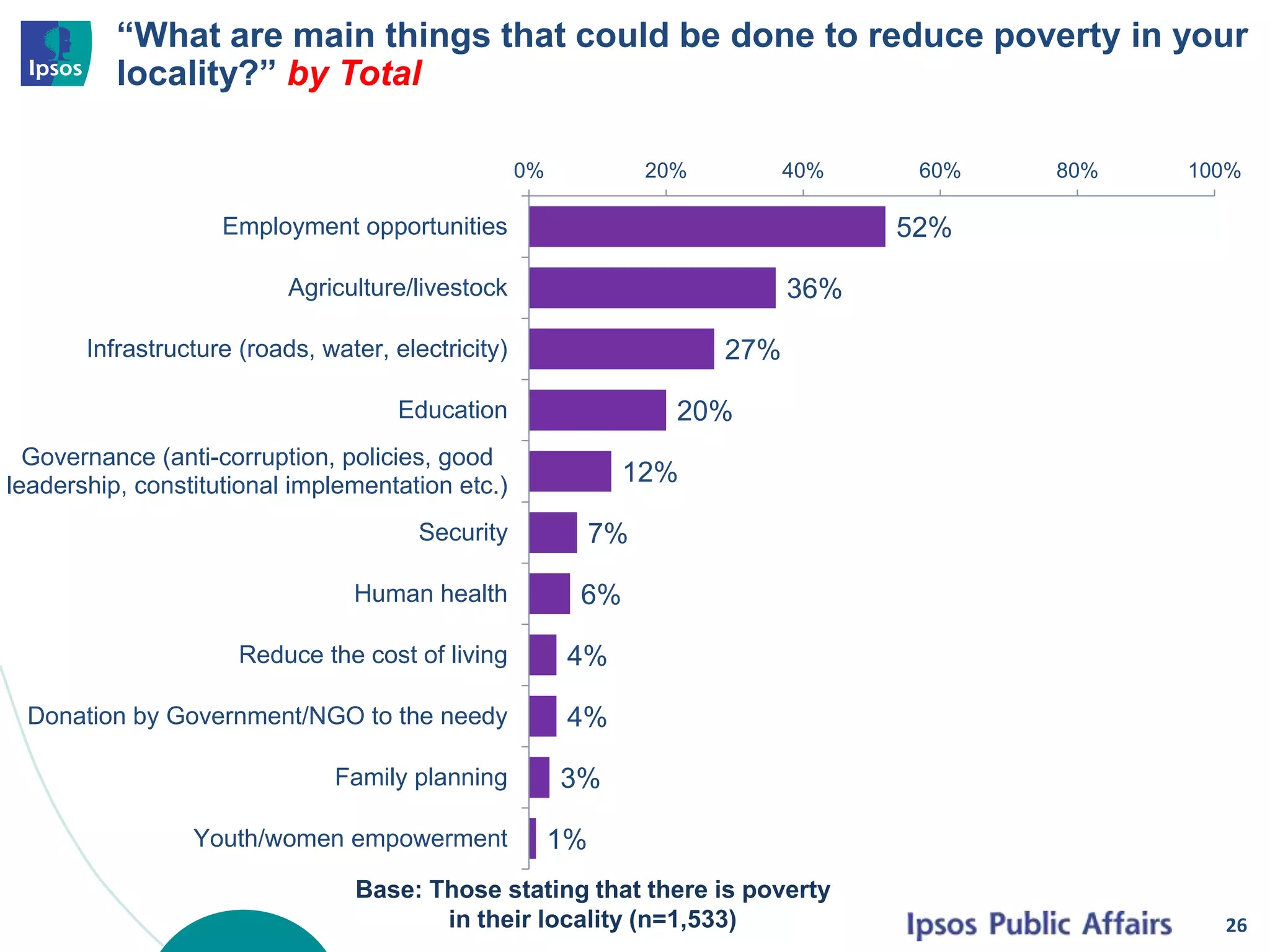
 Measures to reduce poverty in the locality
 Fuel Prices
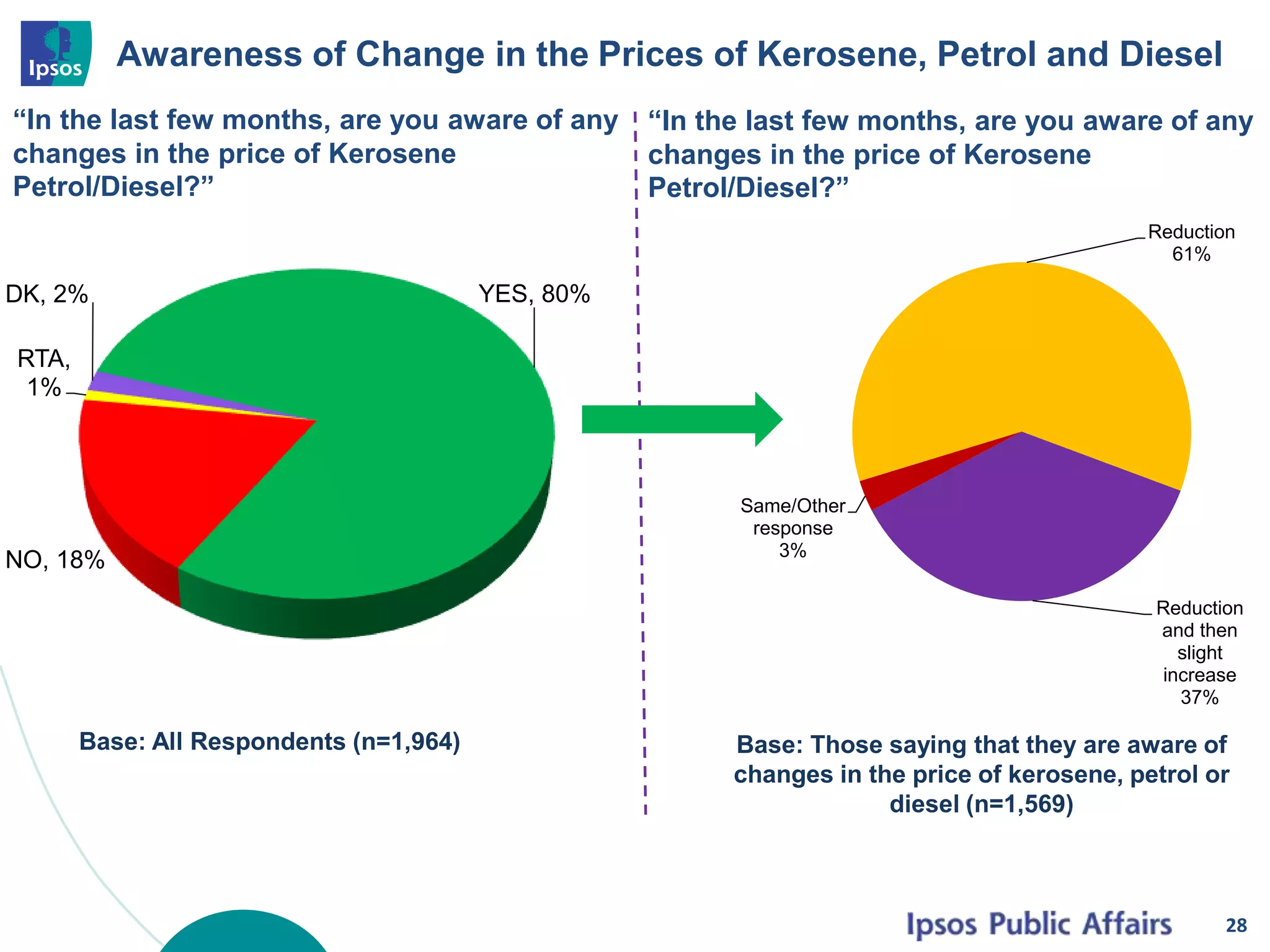
 Awareness of drop in fuel prices
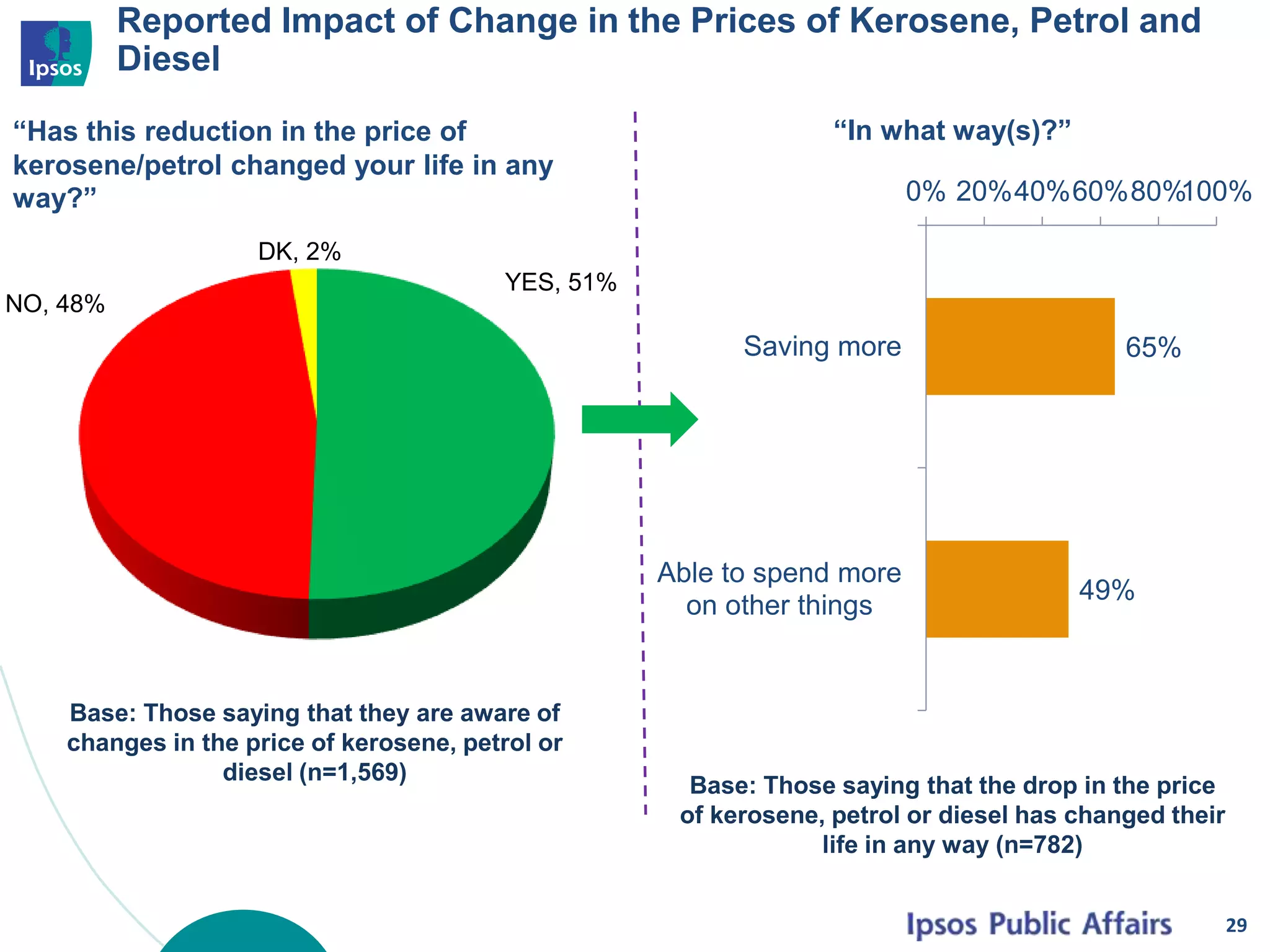
 Impact of drop in fuel prices
 Change in household’s economic position over the last 3 months
 Kenya’s direction:
 Country moving in the right/wrong direction
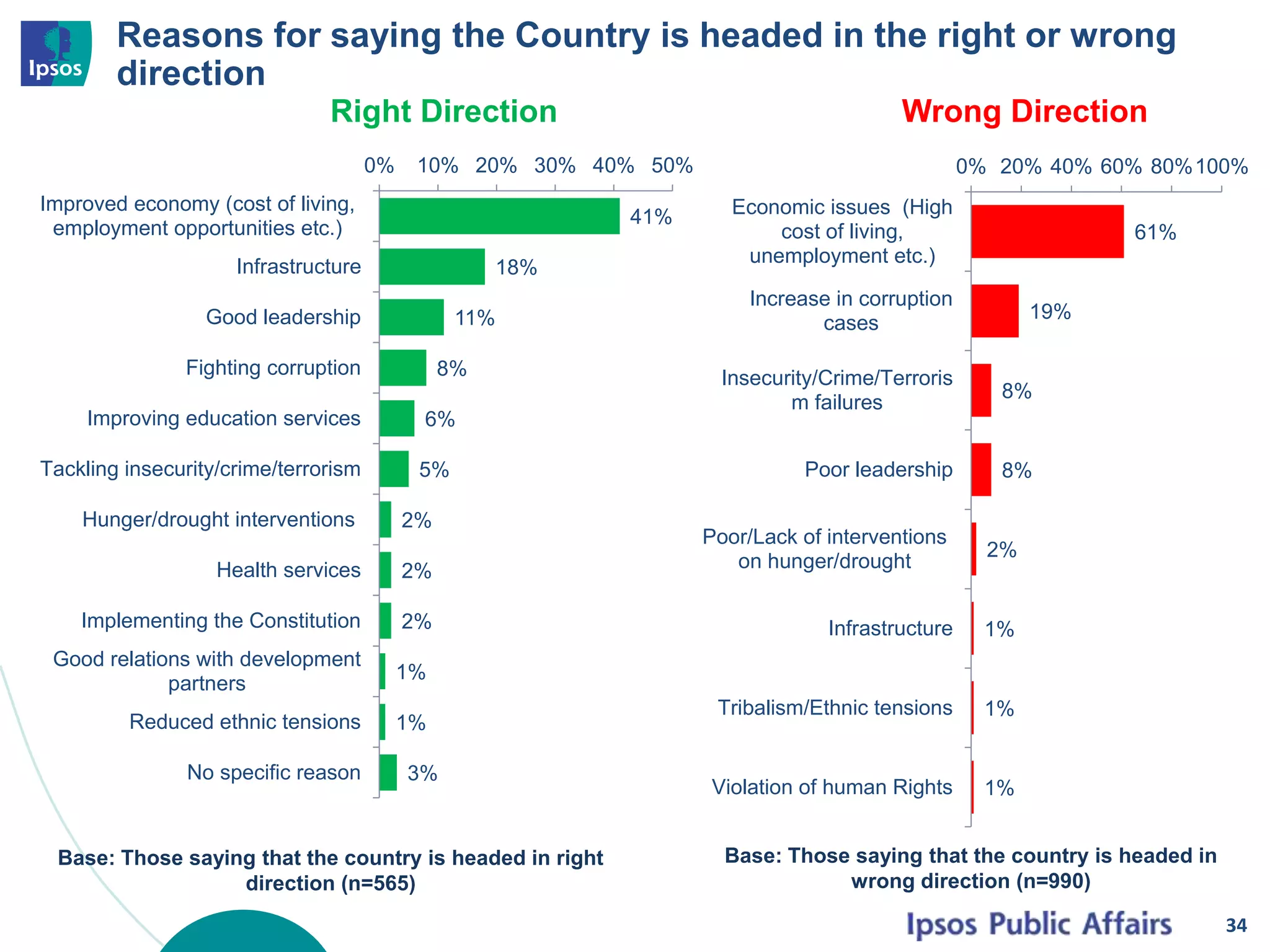
 Main reasons given for saying that Kenya is headed in the right/wrong direction
2
Contents
3
Methodology
Methodology
4
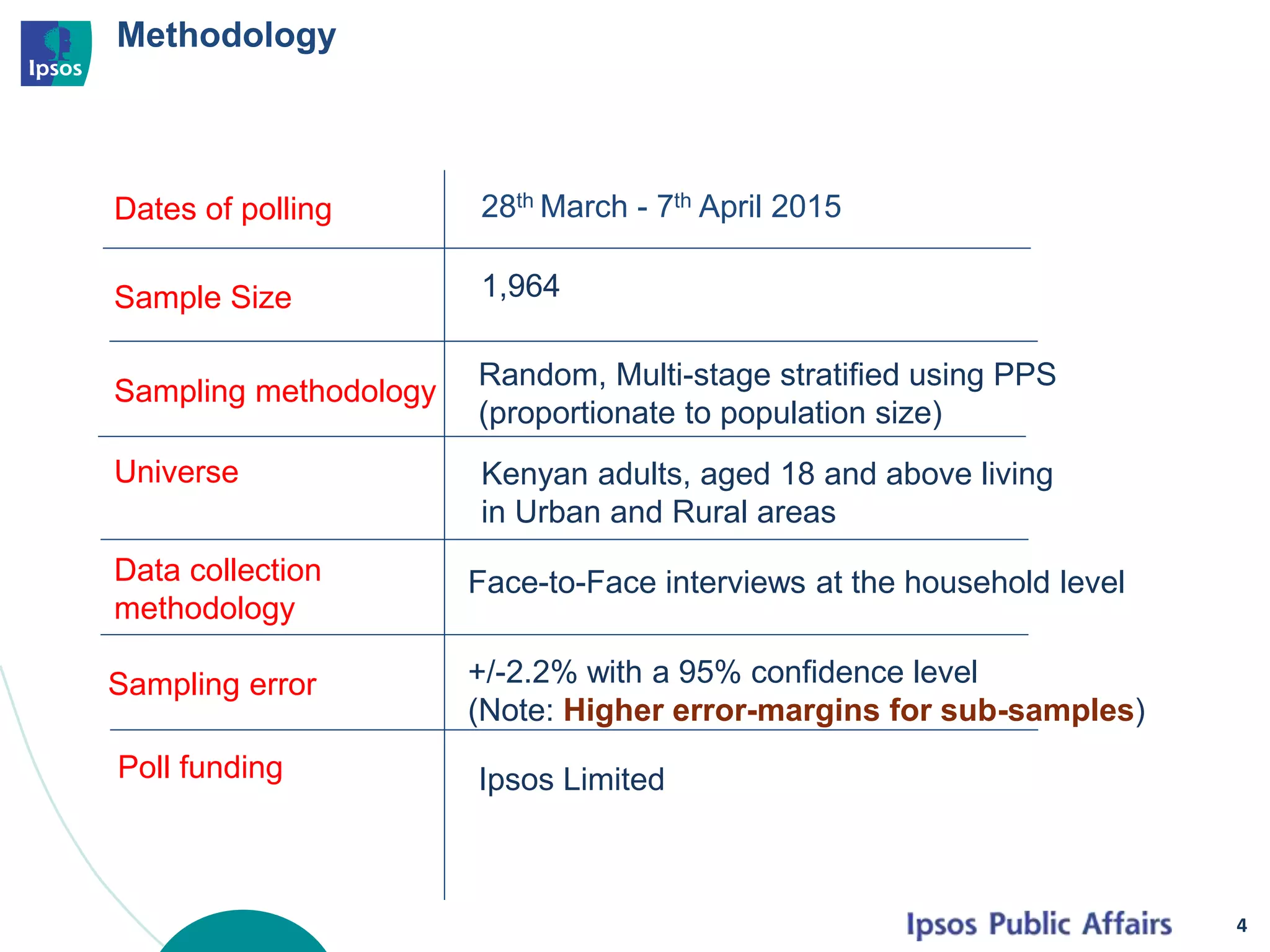
Dates of polling 28th March - 7th April 2015
Sample Size 1,964
Sampling methodology
Random, Multi-stage stratified using PPS
(proportionate to population size)
Universe
Data collection
methodology
Sampling error
Face-to-Face interviews at the household level
Poll funding Ipsos Limited
Kenyan adults, aged 18 and above living
in Urban and Rural areas
+/-2.2% with a 95% confidence level
(Note: Higher error-margins for sub-samples)
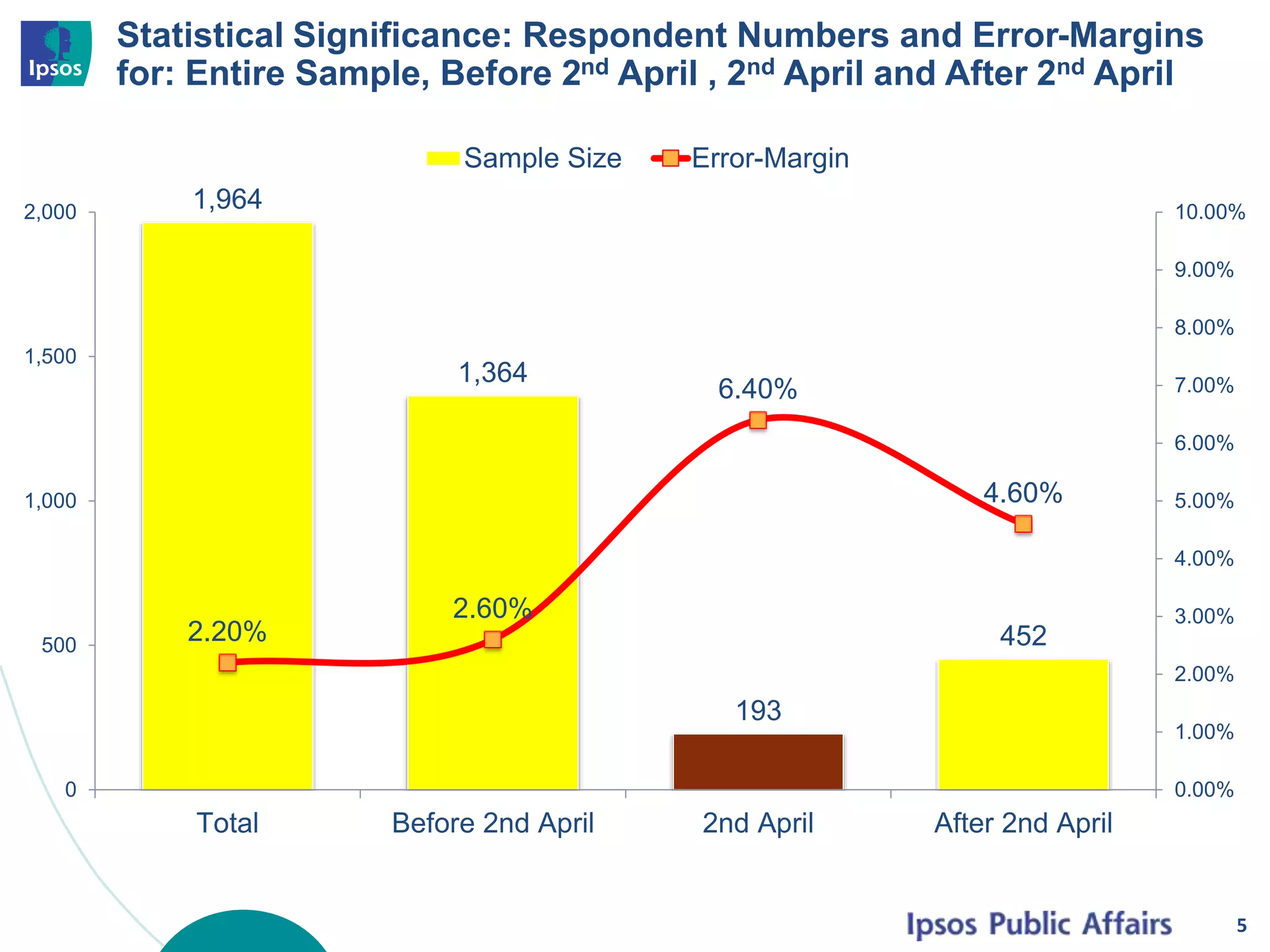
Statistical Significance: Respondent Numbers and Error-Margins
for: Entire Sample, Before 2nd April , 2nd April and After 2nd April
1,964
1,364
193
4522.20%
2.60%
6.40%
4.60%
0.00%
1.00%
2.00%
3.00%
4.00%
5.00%
6.00%
7.00%
8.00%
9.00%
10.00%
0
500
1,000
1,500
2,000
Total Before 2nd April 2nd April After 2nd April
Sample Size Error-Margin
5
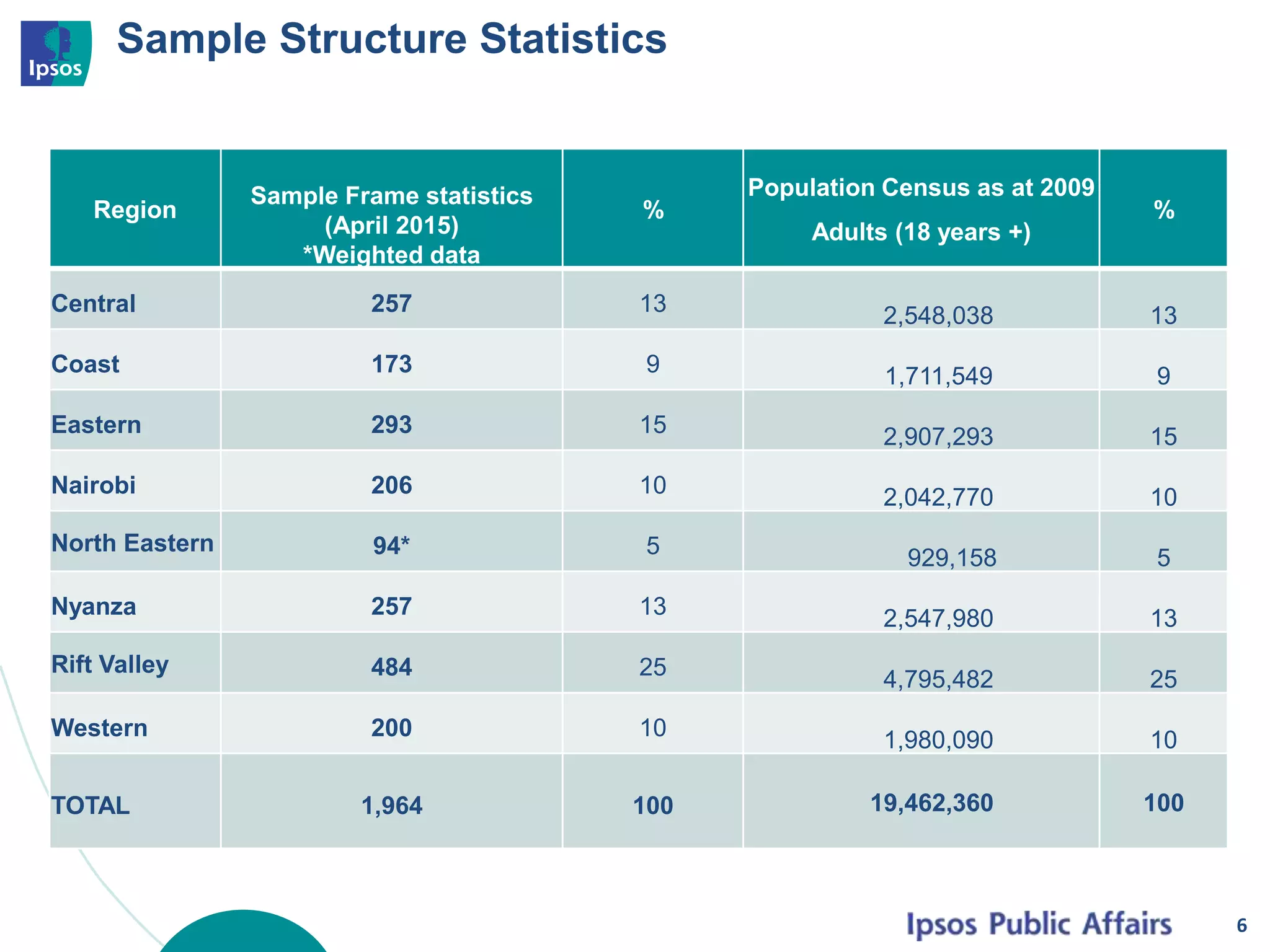
Sample Structure Statistics
6
Region
Sample Frame statistics
(April 2015)
*Weighted data
%
Population Census as at 2009
Adults (18 years +)
%
Central 257 13 2,548,038 13
Coast 173 9 1,711,549 9
Eastern 293 15 2,907,293 15
Nairobi 206 10 2,042,770 10
North Eastern 94* 5 929,158 5
Nyanza 257 13 2,547,980 13
Rift Valley 484 25 4,795,482 25
Western 200 10 1,980,090 10
TOTAL 1,964 100 19,462,360 100
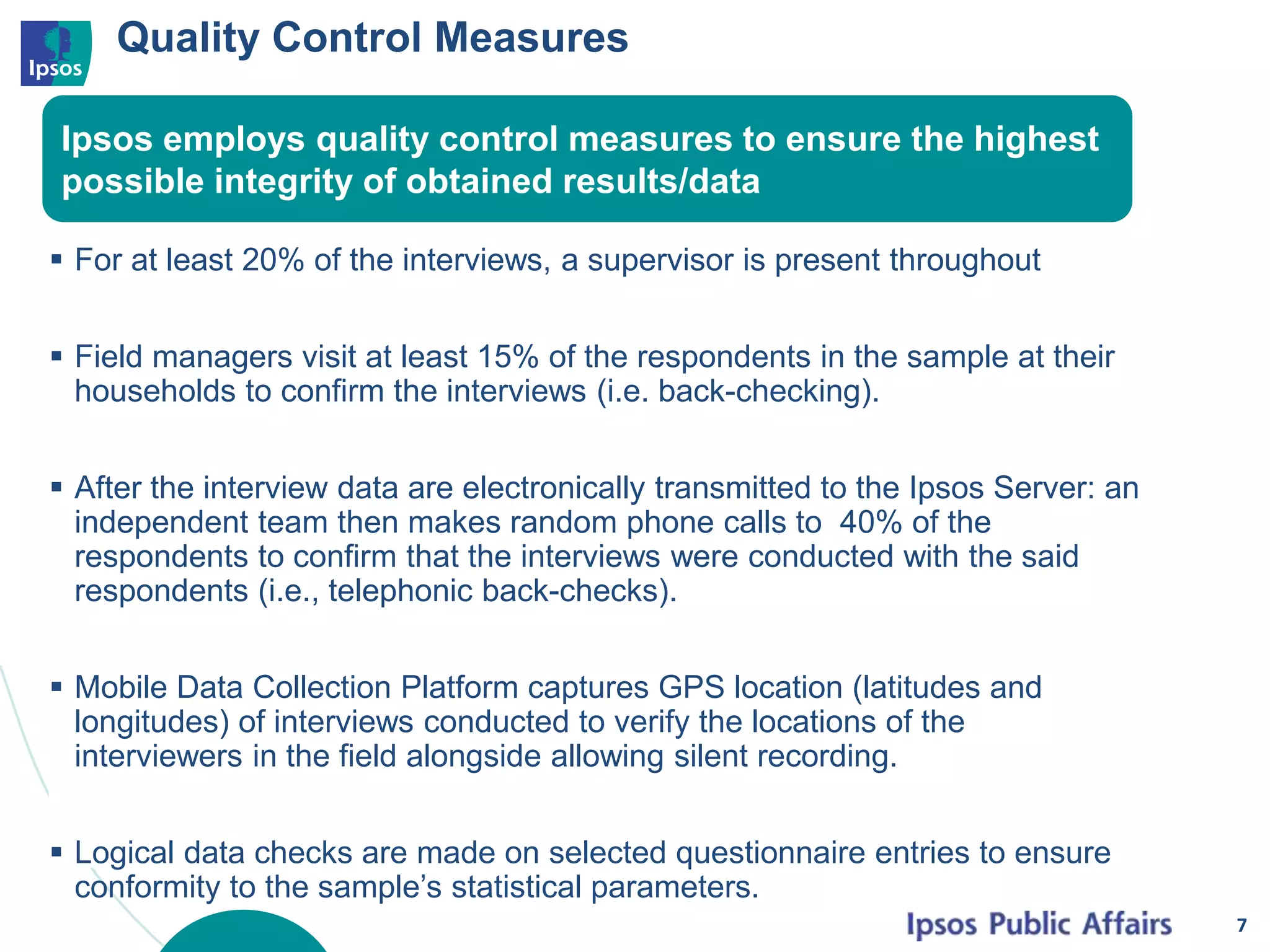
Quality Control Measures
 For at least 20% of the interviews, a supervisor is present throughout
 Field managers visit at least 15% of the respondents in the sample at their
households to confirm the interviews (i.e. back-checking).
 After the interview data are electronically transmitted to the Ipsos Server: an
independent team then makes random phone calls to 40% of the
respondents to confirm that the interviews were conducted with the said
respondents (i.e., telephonic back-checks).
 Mobile Data Collection Platform captures GPS location (latitudes and
longitudes) of interviews conducted to verify the locations of the
interviewers in the field alongside allowing silent recording.
 Logical data checks are made on selected questionnaire entries to ensure
conformity to the sample’s statistical parameters.
7
Ipsos employs quality control measures to ensure the highest
possible integrity of obtained results/data
8
Respondents’
Demographic Profile:
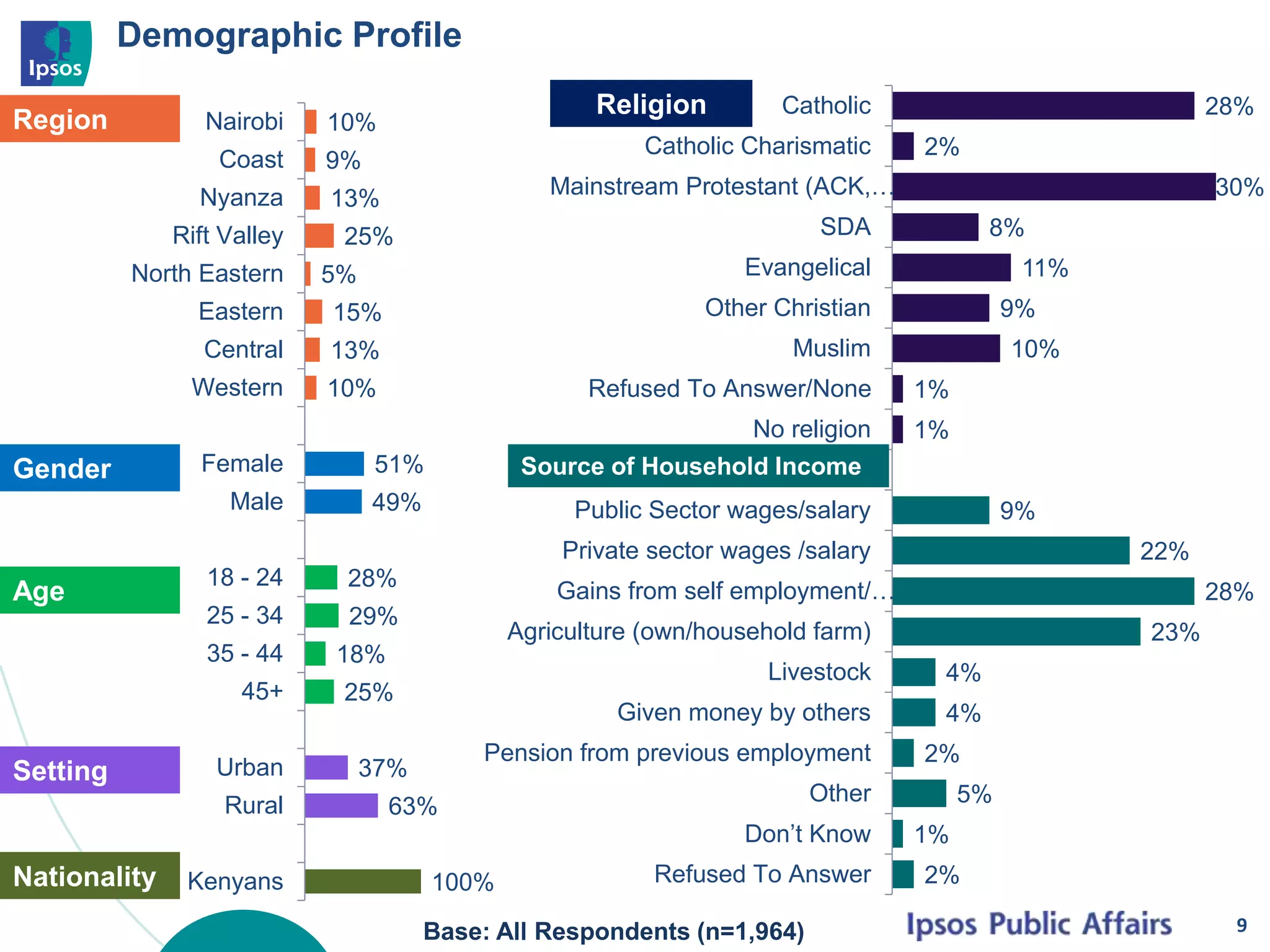
28%
2%
30%
8%
11%
9%
10%
1%
1%
9%
22%
28%
23%
4%
4%
2%
5%
1%
2%
Catholic
Catholic Charismatic
Mainstream Protestant (ACK,…
SDA
Evangelical
Other Christian
Muslim
Refused To Answer/None
No religion
Public Sector wages/salary
Private sector wages /salary
Gains from self employment/…
Agriculture (own/household farm)
Livestock
Given money by others
Pension from previous employment
Other
Don’t Know
Refused To Answer
Demographic Profile
10%
9%
13%
25%
5%
15%
13%
10%
51%
49%
28%
29%
18%
25%
37%
63%
100%
Nairobi
Coast
Nyanza
Rift Valley
North Eastern
Eastern
Central
Western
Female
Male
18 - 24
25 - 34
35 - 44
45+
Urban
Rural
Kenyans
9
Region
Gender
Age
Setting
Religion
Nationality
Source of Household Income
Base: All Respondents (n=1,964)
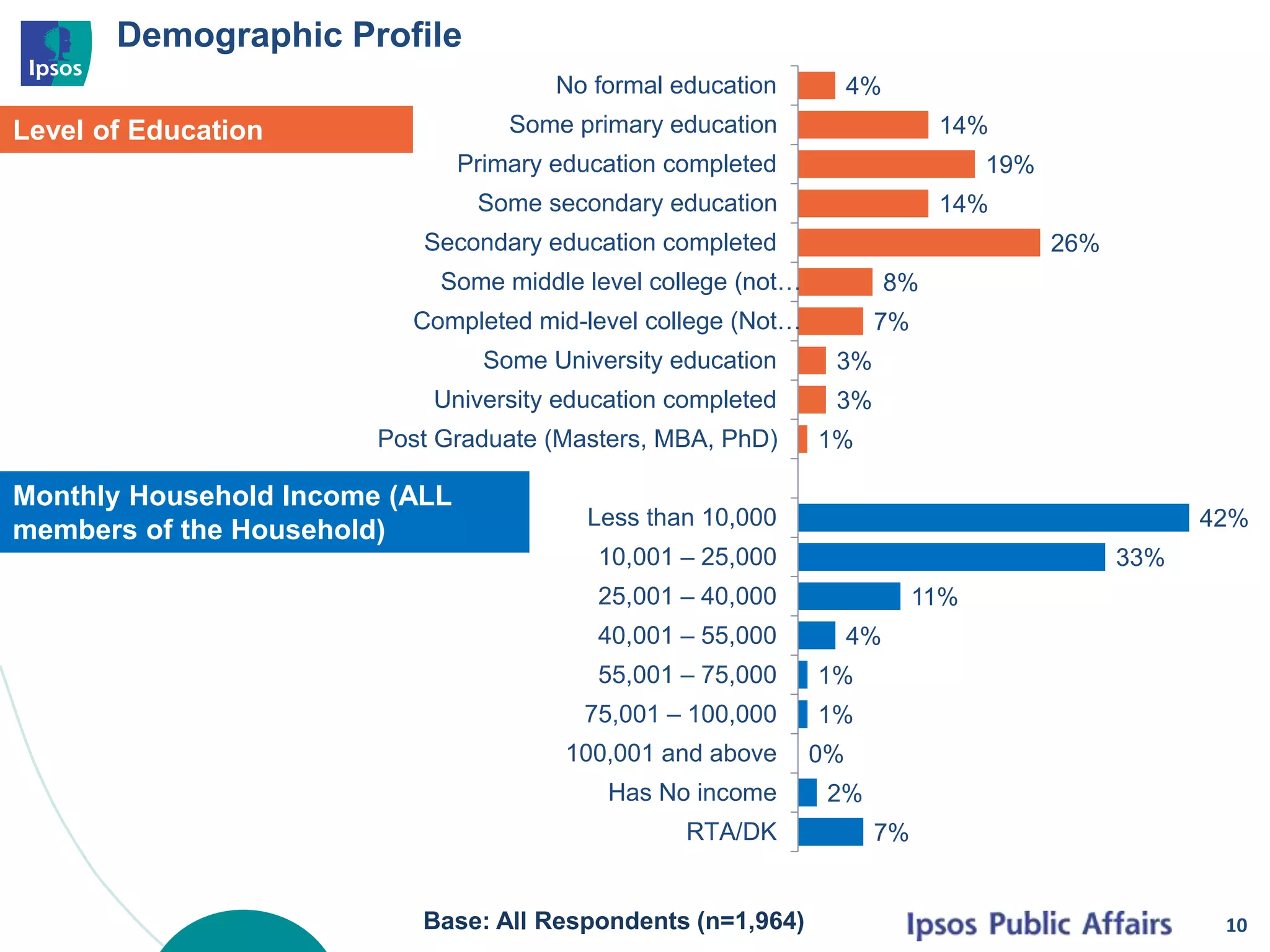
Demographic Profile
4%
14%
19%
14%
26%
8%
7%
3%
3%
1%
42%
33%
11%
4%
1%
1%
0%
2%
7%
No formal education
Some primary education
Primary education completed
Some secondary education
Secondary education completed
Some middle level college (not…
Completed mid-level college (Not…
Some University education
University education completed
Post Graduate (Masters, MBA, PhD)
Less than 10,000
10,001 – 25,000
25,001 – 40,000
40,001 – 55,000
55,001 – 75,000
75,001 – 100,000
100,001 and above
Has No income
RTA/DK
10
Level of Education
Monthly Household Income (ALL
members of the Household)
Base: All Respondents (n=1,964)
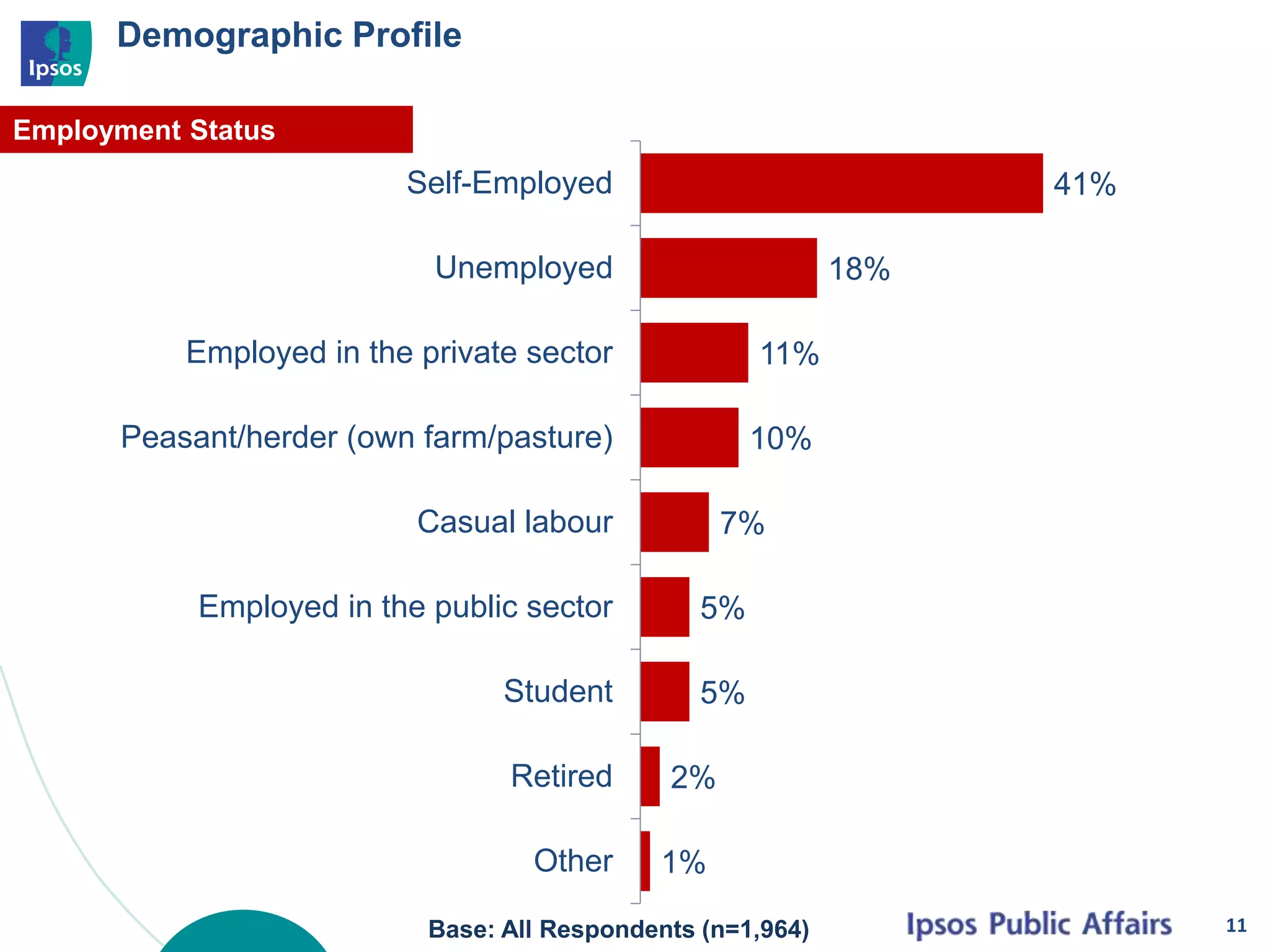
Demographic Profile
41%
18%
11%
10%
7%
5%
5%
2%
1%
Self-Employed
Unemployed
Employed in the private sector
Peasant/herder (own farm/pasture)
Casual labour
Employed in the public sector
Student
Retired
Other
11
Employment Status
Base: All Respondents (n=1,964)
12
Additional
Demographic Profiles
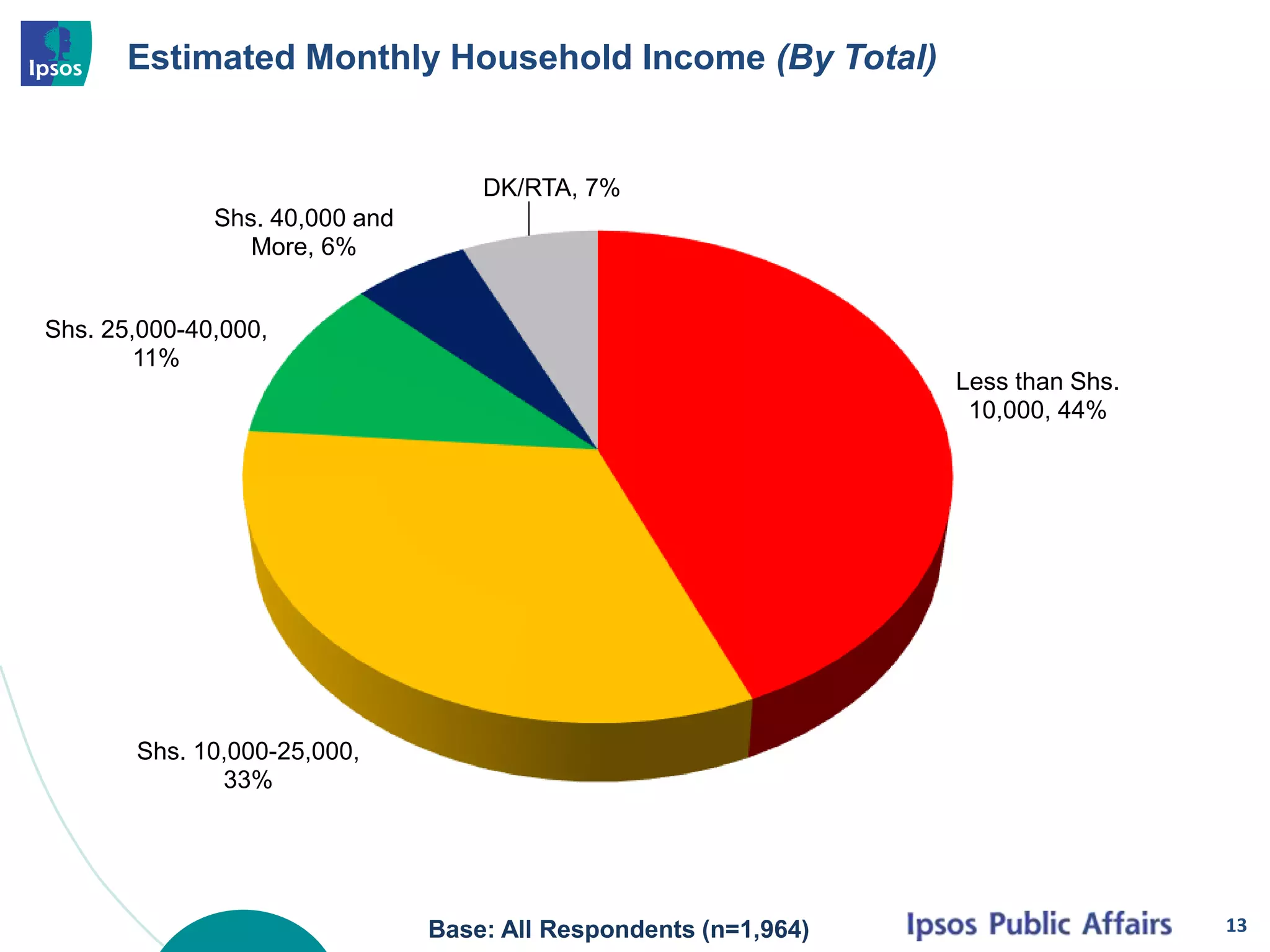
Estimated Monthly Household Income (By Total)
13
Less than Shs.
10,000, 44%
Shs. 10,000-25,000,
33%
Shs. 25,000-40,000,
11%
Shs. 40,000 and
More, 6%
DK/RTA, 7%
Base: All Respondents (n=1,964)
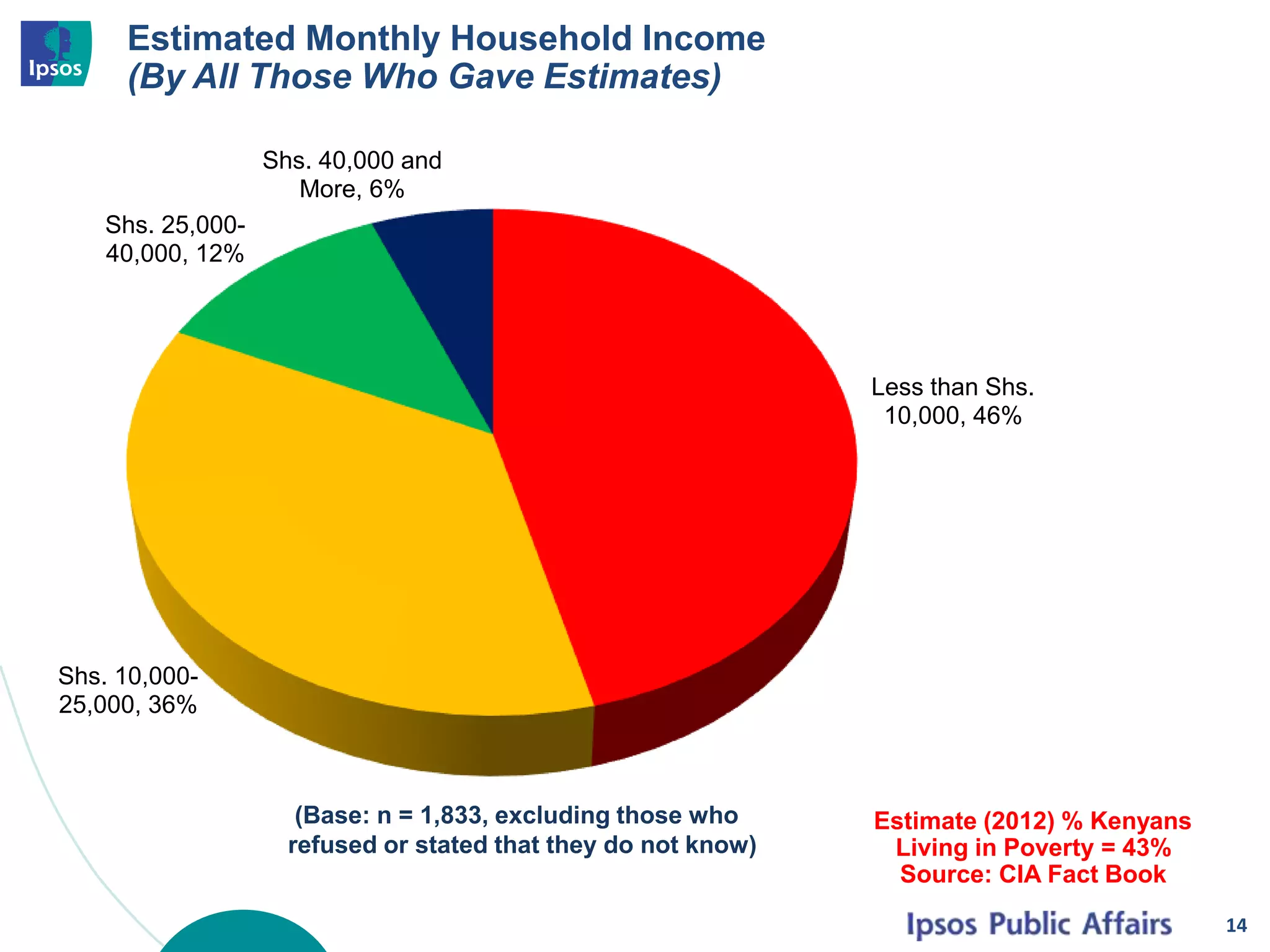
Estimated Monthly Household Income
(By All Those Who Gave Estimates)
14
Less than Shs.
10,000, 46%
Shs. 10,000-
25,000, 36%
Shs. 25,000-
40,000, 12%
Shs. 40,000 and
More, 6%
Estimate (2012) % Kenyans
Living in Poverty = 43%
Source: CIA Fact Book
(Base: n = 1,833, excluding those who
refused or stated that they do not know)
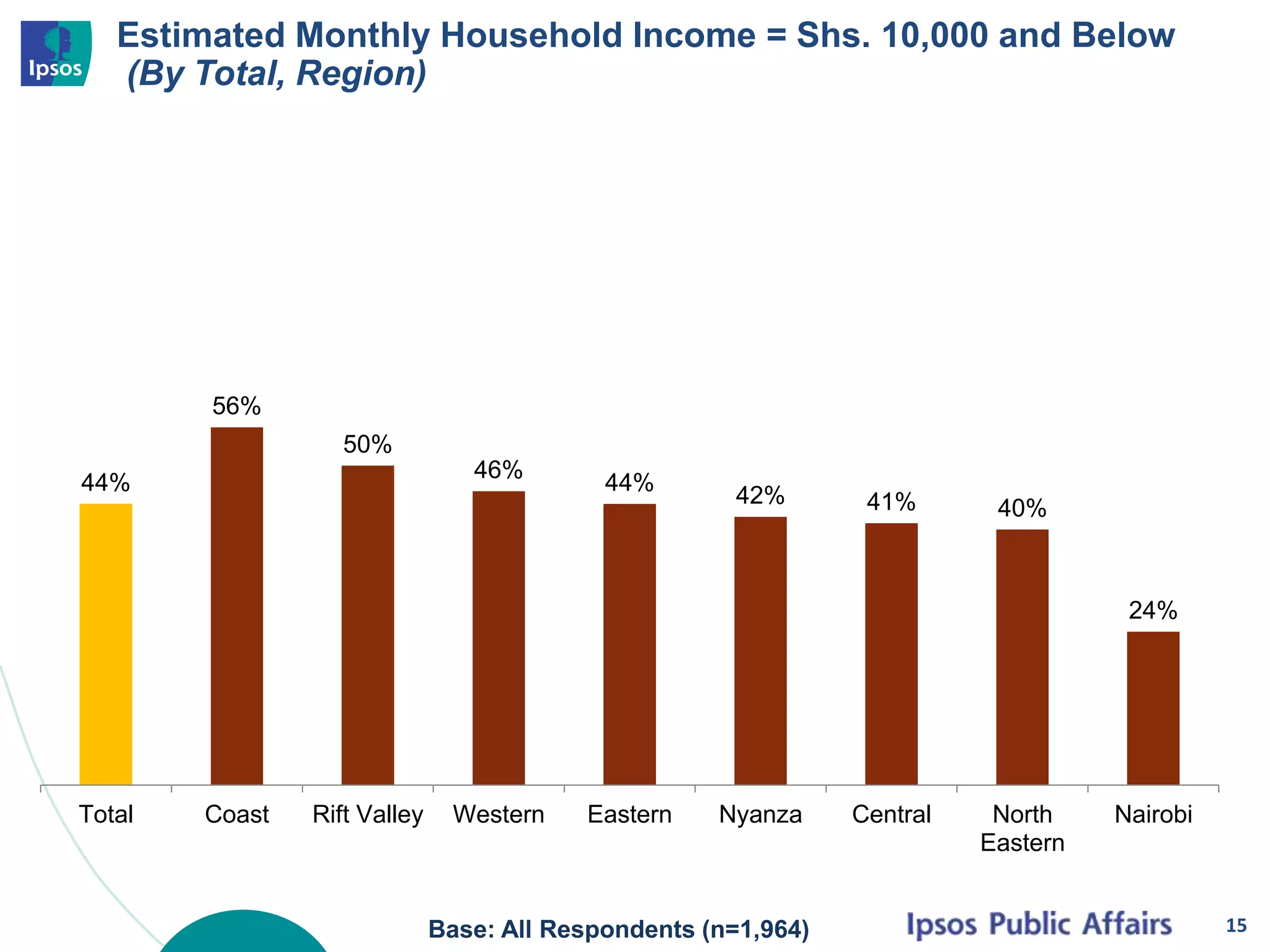
Estimated Monthly Household Income = Shs. 10,000 and Below
(By Total, Region)
15
44%
56%
50%
46%
44%
42% 41% 40%
24%
Total Coast Rift Valley Western Eastern Nyanza Central North
Eastern
Nairobi
Base: All Respondents (n=1,964)
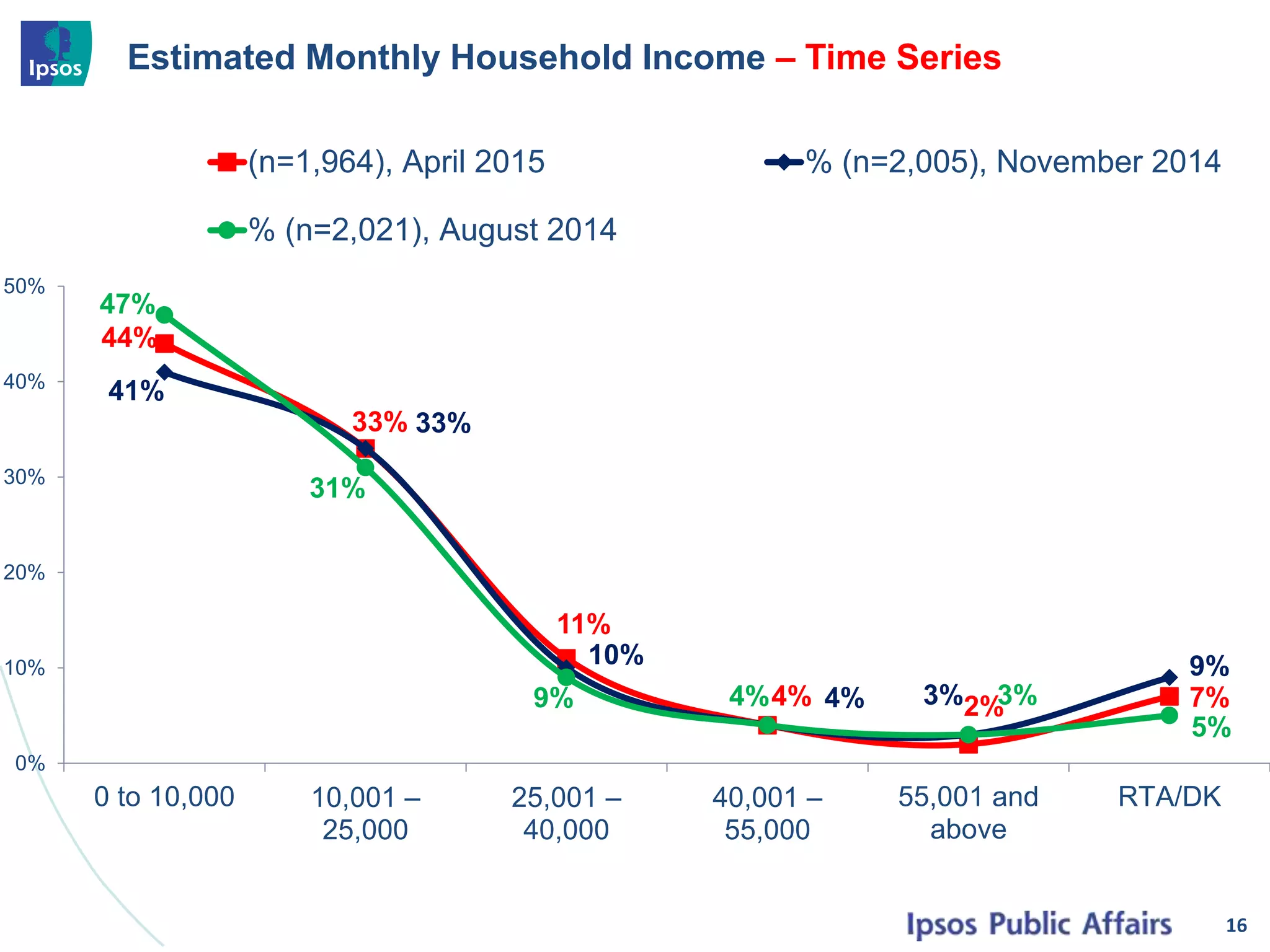
Estimated Monthly Household Income – Time Series
16
44%
33%
11%
4% 2% 7%
41%
33%
10%
4% 3%
9%
47%
31%
9% 4% 3%
5%
0%
10%
20%
30%
40%
50%
0 to 10,000 10,001 –
25,000
25,001 –
40,000
40,001 –
55,000
55,001 and
above
RTA/DK
(n=1,964), April 2015 % (n=2,005), November 2014
% (n=2,021), August 2014
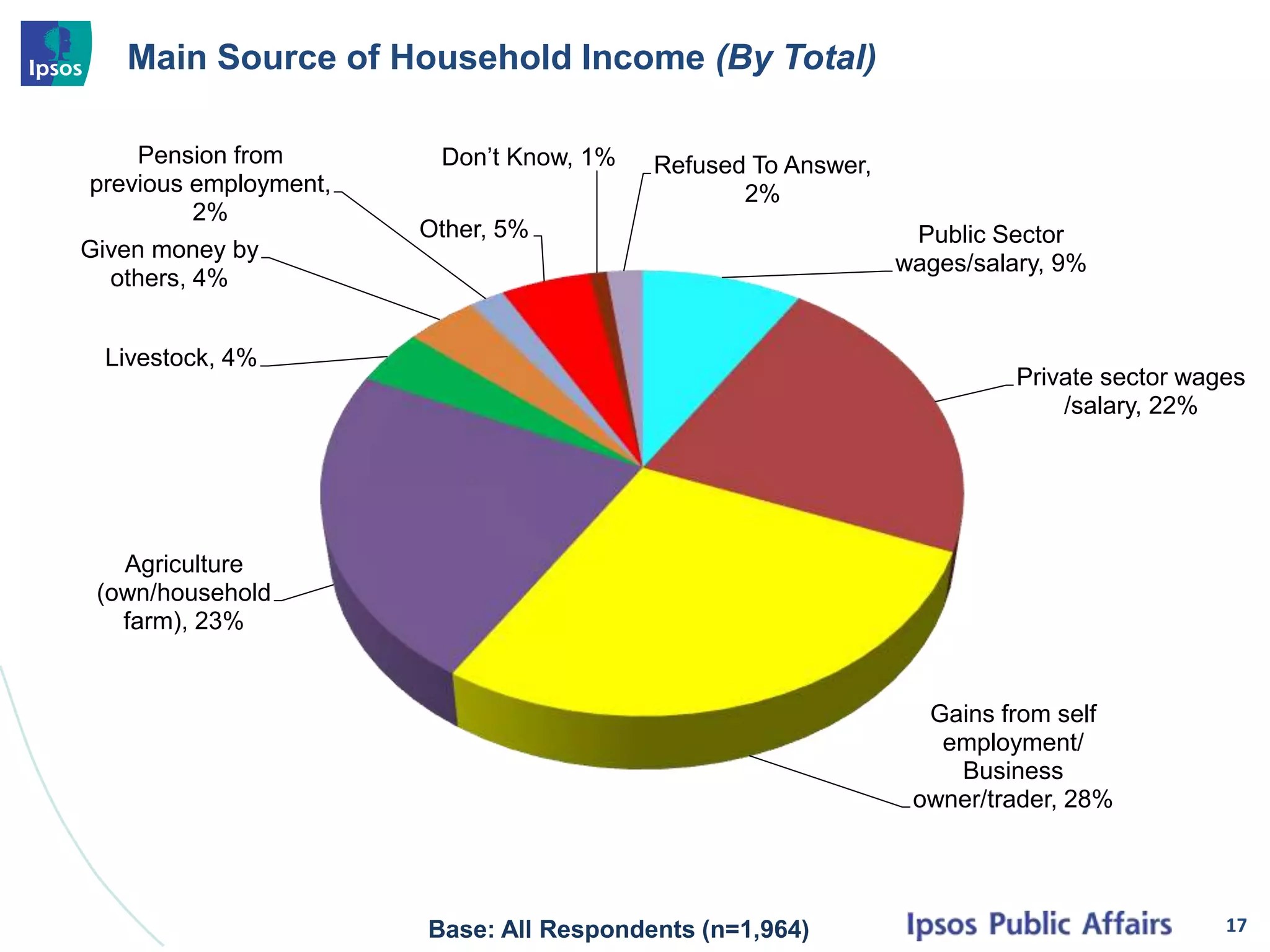
Main Source of Household Income (By Total)
17
Public Sector
wages/salary, 9%
Private sector wages
/salary, 22%
Gains from self
employment/
Business
owner/trader, 28%
Agriculture
(own/household
farm), 23%
Livestock, 4%
Given money by
others, 4%
Pension from
previous employment,
2%
Other, 5%
Don’t Know, 1% Refused To Answer,
2%
Base: All Respondents (n=1,964)
18
Economic Issues
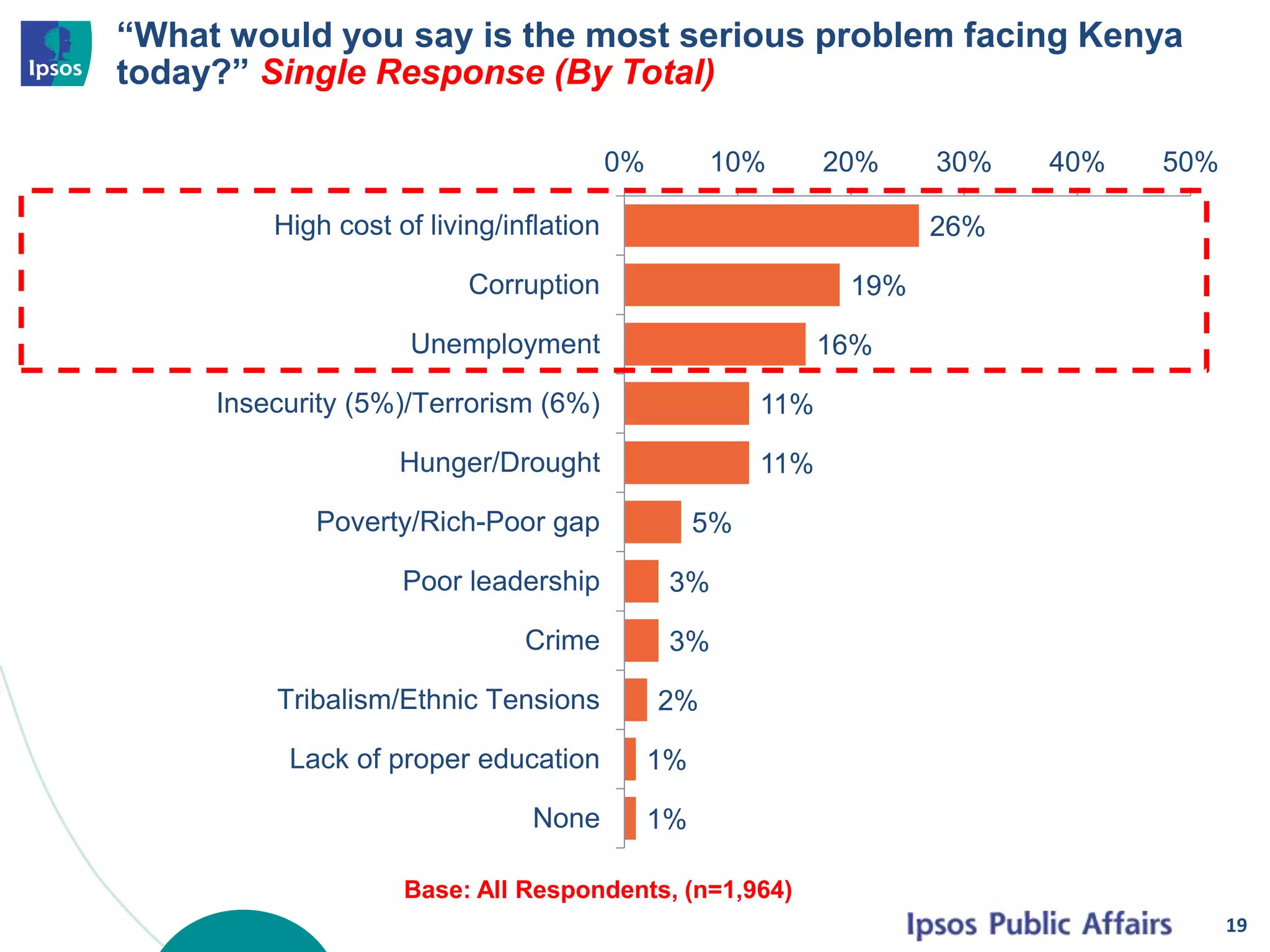
“What would you say is the most serious problem facing Kenya
today?” Single Response (By Total)
26%
19%
16%
11%
11%
5%
3%
3%
2%
1%
1%
0% 10% 20% 30% 40% 50%
High cost of living/inflation
Corruption
Unemployment
Insecurity (5%)/Terrorism (6%)
Hunger/Drought
Poverty/Rich-Poor gap
Poor leadership
Crime
Tribalism/Ethnic Tensions
Lack of proper education
None
19
Base: All Respondents, (n=1,964)
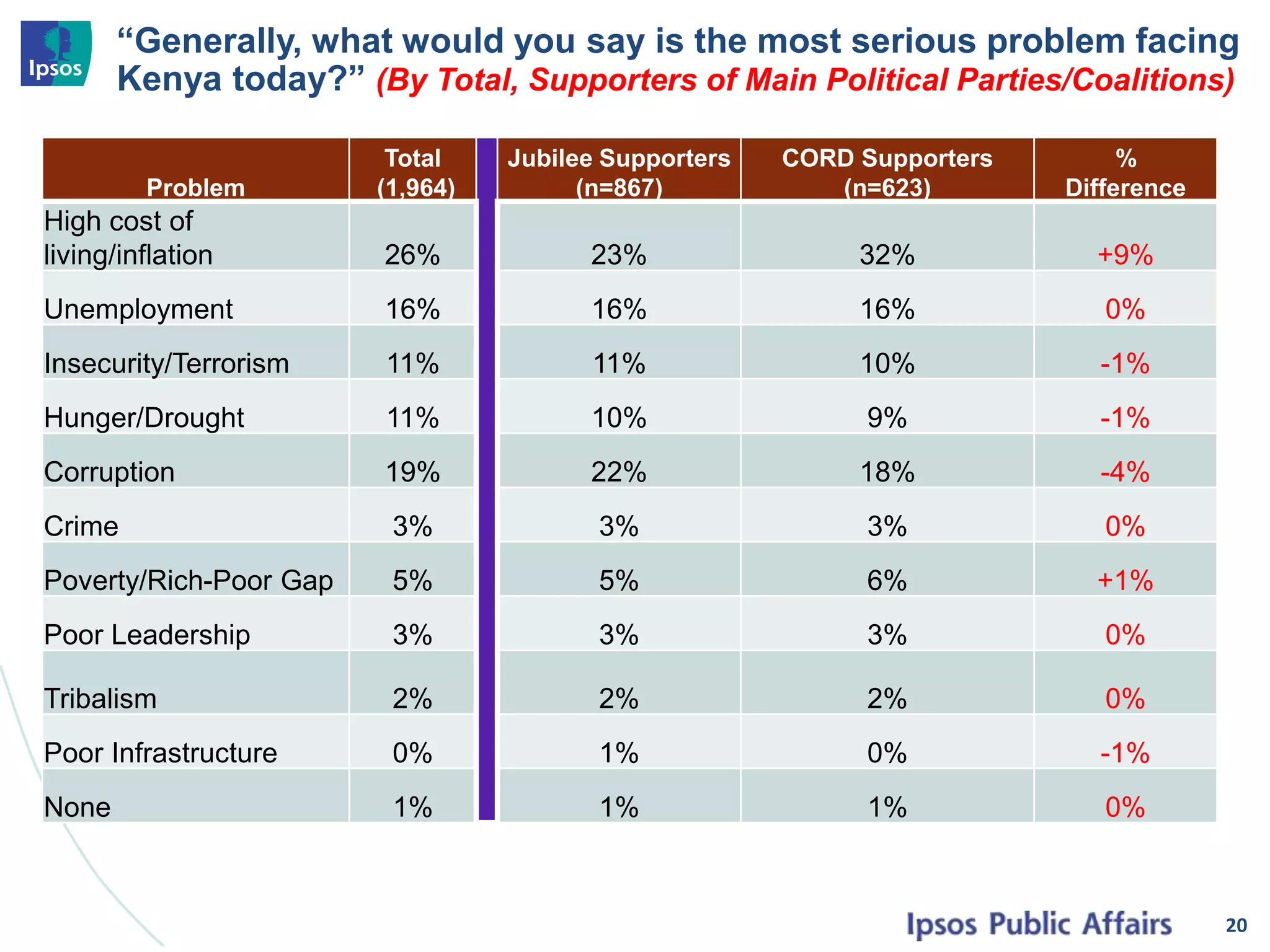
“Generally, what would you say is the most serious problem facing
Kenya today?” (By Total, Supporters of Main Political Parties/Coalitions)
Problem
Total
(1,964)
Jubilee Supporters
(n=867)
CORD Supporters
(n=623)
%
Difference
High cost of
living/inflation 26% 23% 32% +9%
Unemployment 16% 16% 16% 0%
Insecurity/Terrorism 11% 11% 10% -1%
Hunger/Drought 11% 10% 9% -1%
Corruption 19% 22% 18% -4%
Crime 3% 3% 3% 0%
Poverty/Rich-Poor Gap 5% 5% 6% +1%
Poor Leadership 3% 3% 3% 0%
Tribalism 2% 2% 2% 0%
Poor Infrastructure 0% 1% 0% -1%
None 1% 1% 1% 0%
20
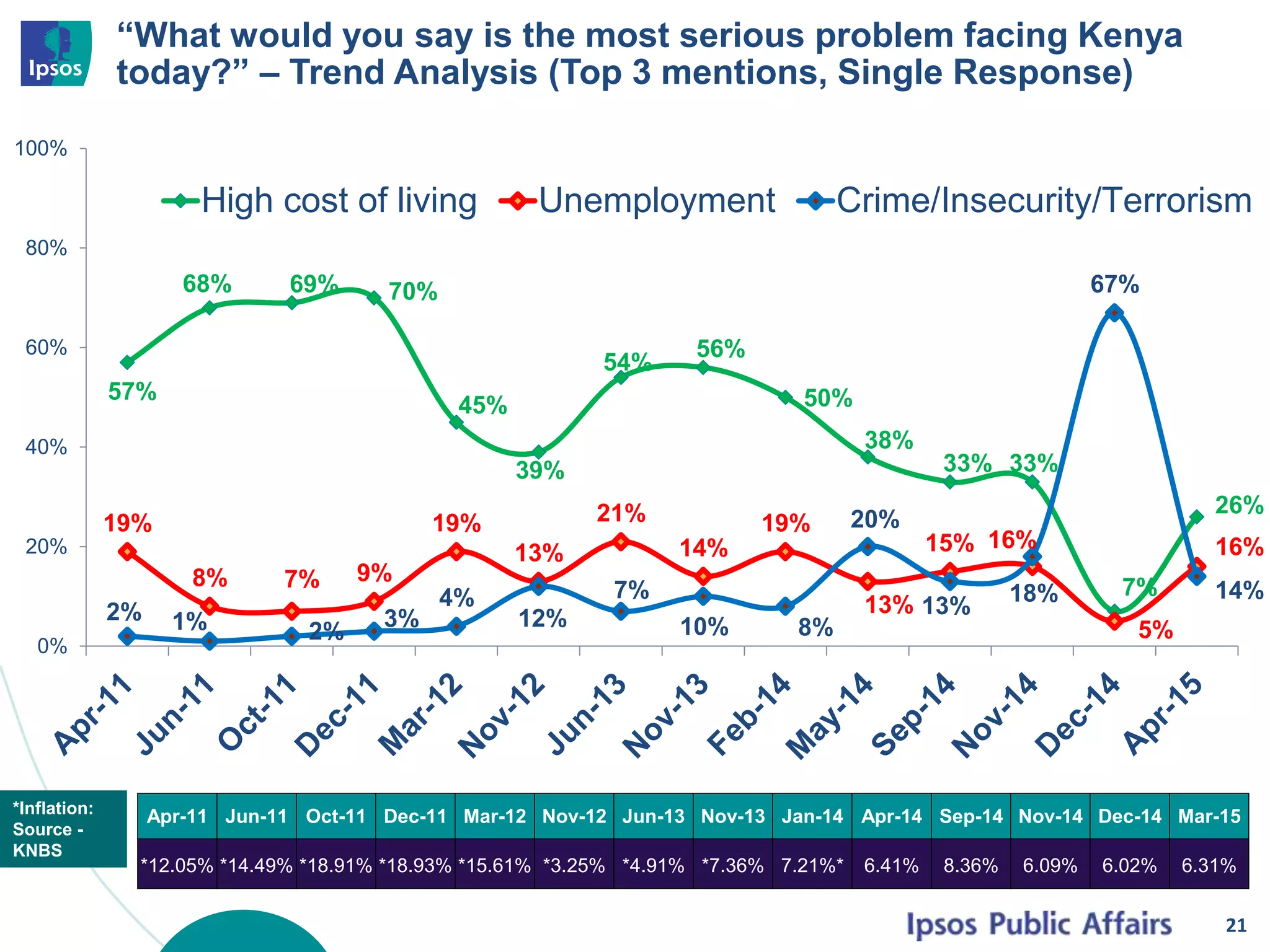
“What would you say is the most serious problem facing Kenya
today?” – Trend Analysis (Top 3 mentions, Single Response)
57%
68% 69% 70%
45%
39%
54%
56%
50%
38%
33% 33%
7%
26%
19%
8% 7% 9%
19%
13%
21%
14%
19%
13%
15% 16%
5%
16%
2% 1% 2%
3%
4%
12%
7%
10% 8%
20%
13%
18%
67%
14%
0%
20%
40%
60%
80%
100%
High cost of living Unemployment Crime/Insecurity/Terrorism
21
Apr-11 Jun-11 Oct-11 Dec-11 Mar-12 Nov-12 Jun-13 Nov-13 Jan-14 Apr-14 Sep-14 Nov-14 Dec-14 Mar-15
*12.05% *14.49% *18.91% *18.93% *15.61% *3.25% *4.91% *7.36% 7.21%* 6.41% 8.36% 6.09% 6.02% 6.31%
*Inflation:
Source -
KNBS
“What would you say is the most serious problem facing Kenya
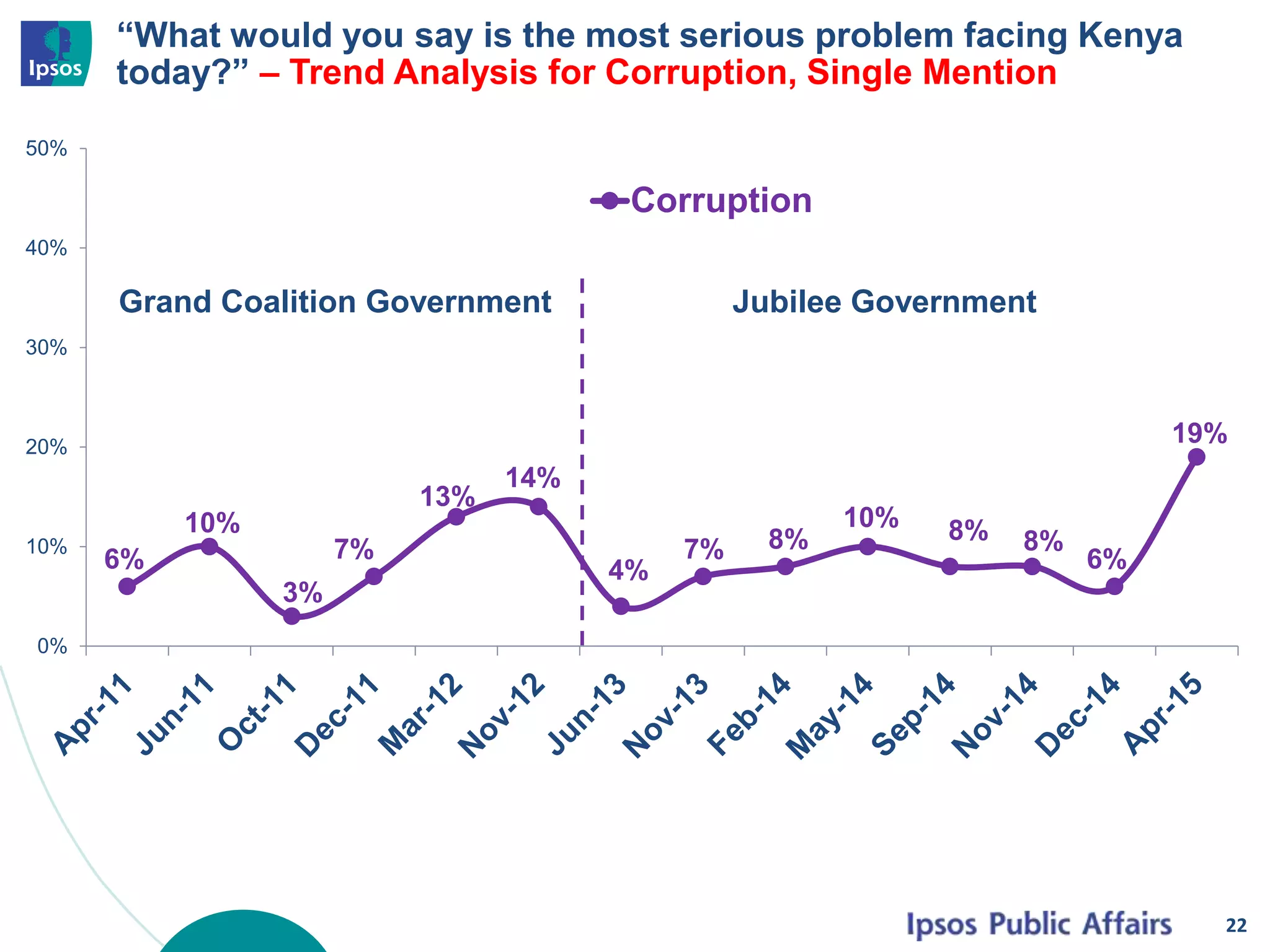
today?” – Trend Analysis for Corruption, Single Mention
6%
10%
3%
7%
13%
14%
4%
7% 8%
10% 8% 8%
6%
19%
0%
10%
20%
30%
40%
50%
Corruption
22
Jubilee GovernmentGrand Coalition Government
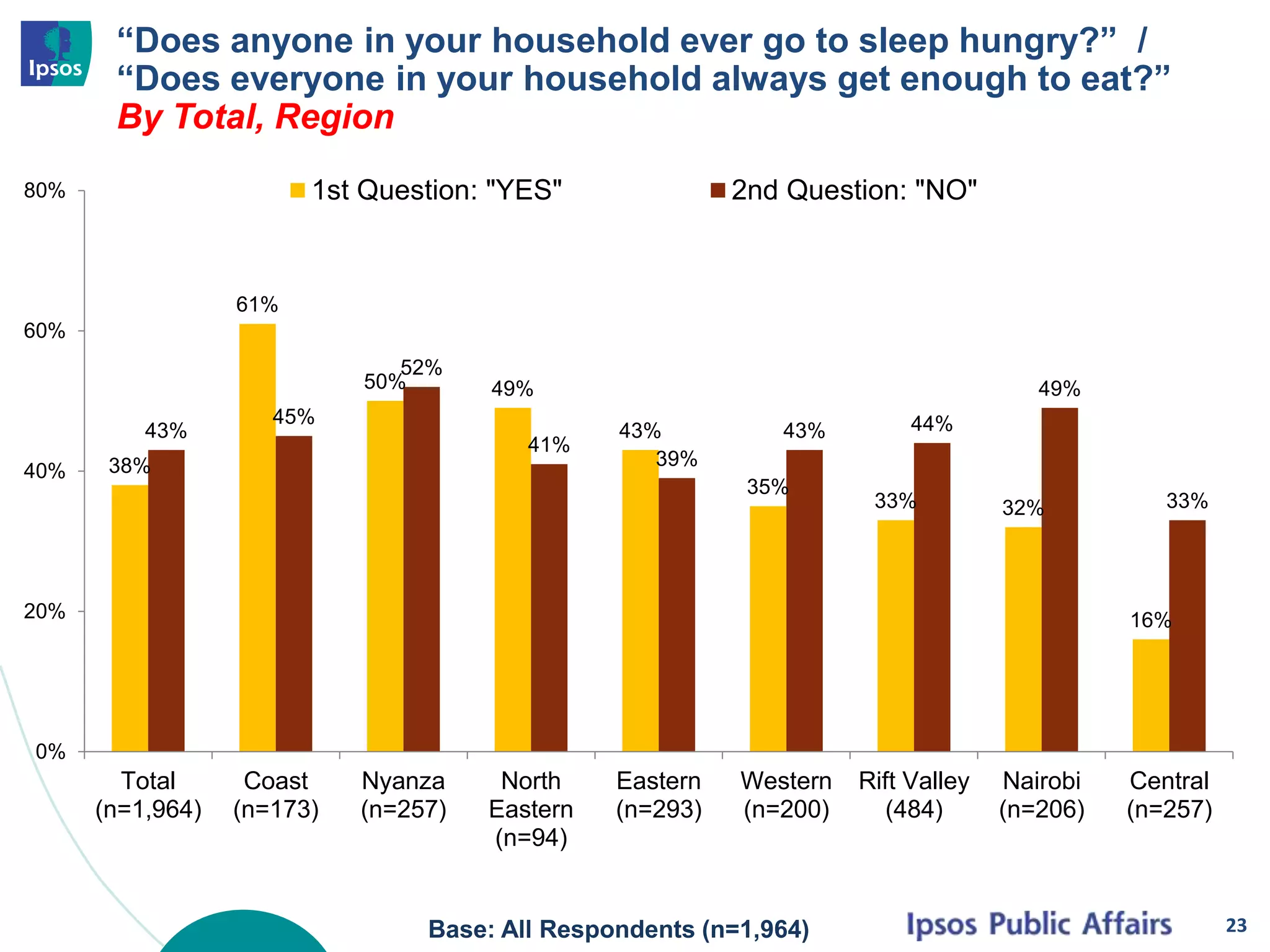
“Does anyone in your household ever go to sleep hungry?” /
“Does everyone in your household always get enough to eat?”
By Total, Region
23Base: All Respondents (n=1,964)
38%
61%
50% 49%
43%
35%
33% 32%
16%
43%
45%
52%
41%
39%
43% 44%
49%
33%
0%
20%
40%
60%
80%
Total
(n=1,964)
Coast
(n=173)
Nyanza
(n=257)
North
Eastern
(n=94)
Eastern
(n=293)
Western
(n=200)
Rift Valley
(484)
Nairobi
(n=206)
Central
(n=257)
1st Question: "YES" 2nd Question: "NO"
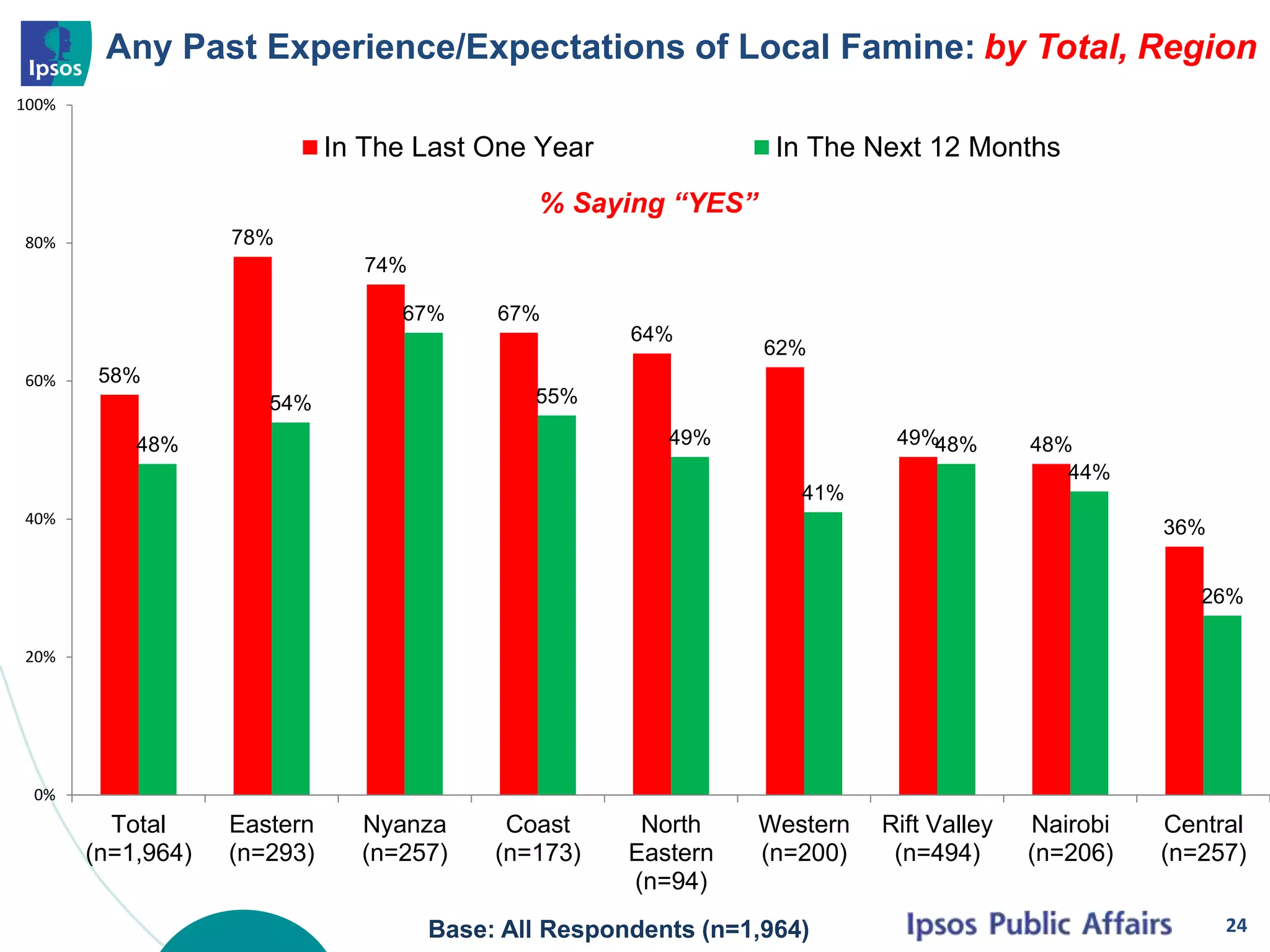
Any Past Experience/Expectations of Local Famine: by Total, Region
24Base: All Respondents (n=1,964)
58%
78%
74%
67%
64%
62%
49% 48%
36%
48%
54%
67%
55%
49%
41%
48%
44%
26%
0%
20%
40%
60%
80%
100%
Total
(n=1,964)
Eastern
(n=293)
Nyanza
(n=257)
Coast
(n=173)
North
Eastern
(n=94)
Western
(n=200)
Rift Valley
(n=494)
Nairobi
(n=206)
Central
(n=257)
In The Last One Year In The Next 12 Months
% Saying “YES”
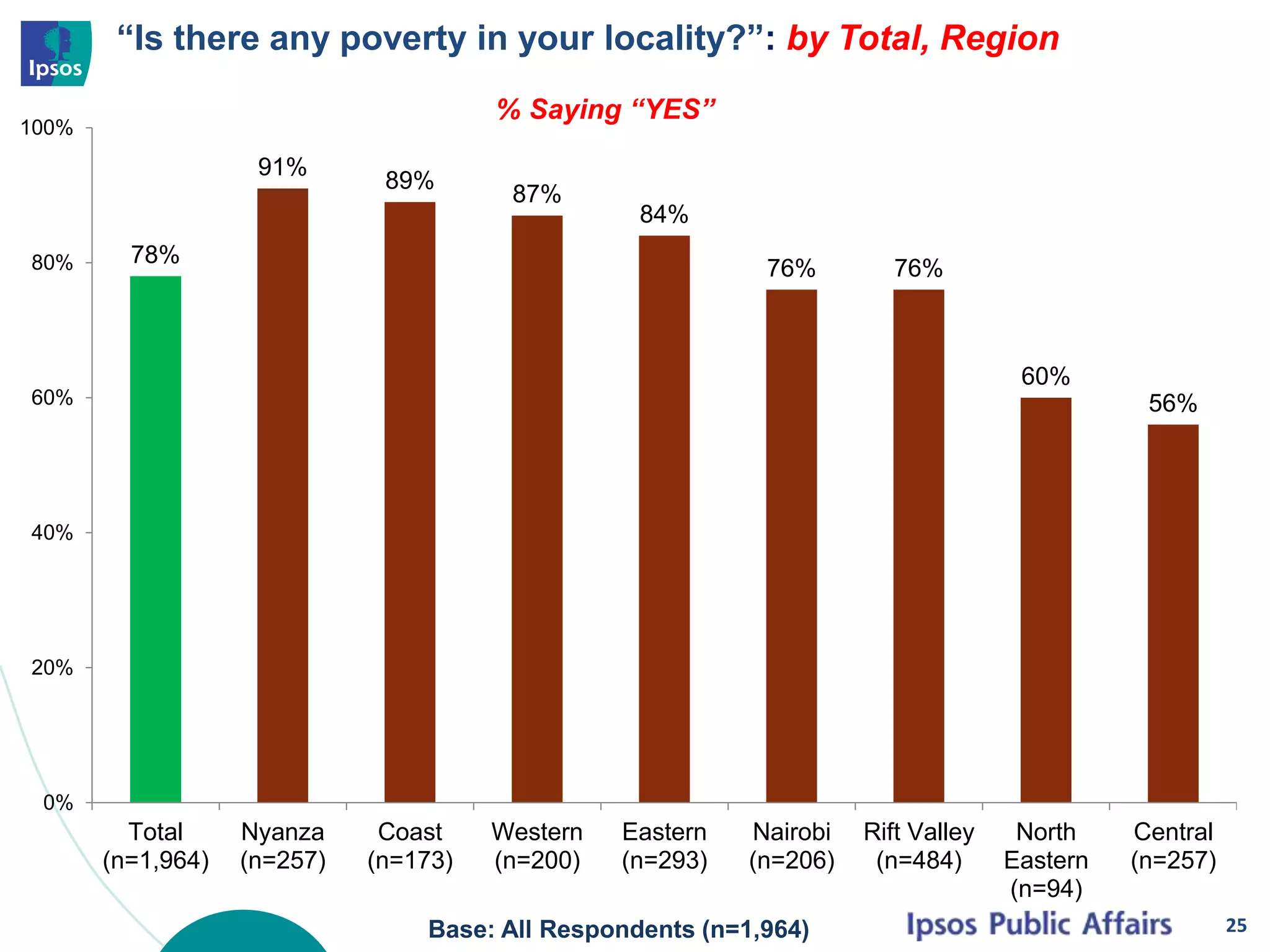
“Is there any poverty in your locality?”: by Total, Region
25Base: All Respondents (n=1,964)
78%
91%
89%
87%
84%
76% 76%
60%
56%
0%
20%
40%
60%
80%
100%
Total
(n=1,964)
Nyanza
(n=257)
Coast
(n=173)
Western
(n=200)
Eastern
(n=293)
Nairobi
(n=206)
Rift Valley
(n=484)
North
Eastern
(n=94)
Central
(n=257)
% Saying “YES”
“What are main things that could be done to reduce poverty in your
locality?” by Total
52%
36%
27%
20%
12%
7%
6%
4%
4%
3%
1%
0% 20% 40% 60% 80% 100%
Employment opportunities
Agriculture/livestock
Infrastructure (roads, water, electricity)
Education
Governance (anti-corruption, policies, good
leadership, constitutional implementation etc.)
Security
Human health
Reduce the cost of living
Donation by Government/NGO to the needy
Family planning
Youth/women empowerment
26
Base: Those stating that there is poverty
in their locality (n=1,533)
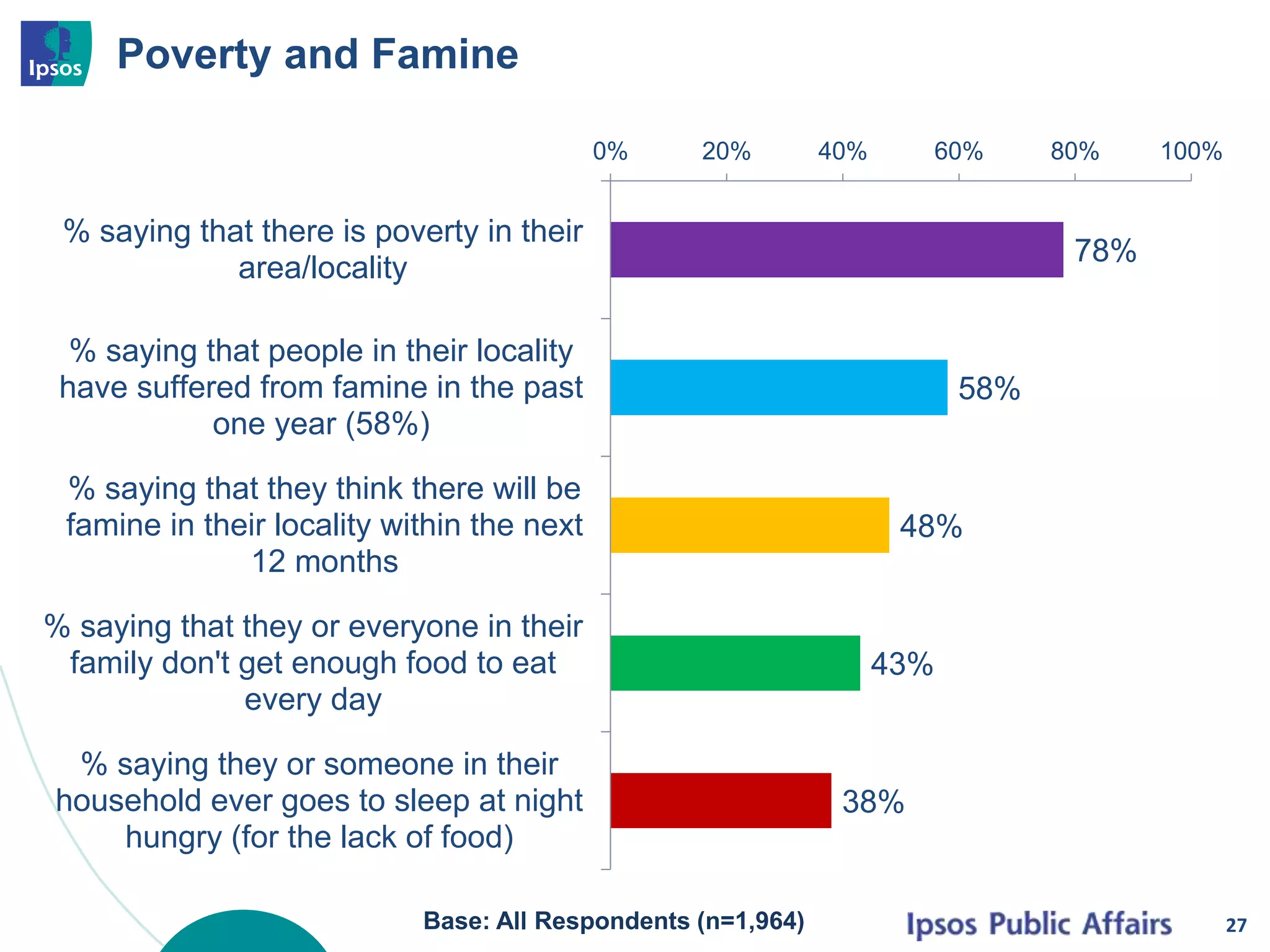
Poverty and Famine
78%
58%
48%
43%
38%
0% 20% 40% 60% 80% 100%
% saying that there is poverty in their
area/locality
% saying that people in their locality
have suffered from famine in the past
one year (58%)
% saying that they think there will be
famine in their locality within the next
12 months
% saying that they or everyone in their
family don't get enough food to eat
every day
% saying they or someone in their
household ever goes to sleep at night
hungry (for the lack of food)
27Base: All Respondents (n=1,964)
Awareness of Change in the Prices of Kerosene, Petrol and Diesel
28
YES, 80%
NO, 18%
RTA,
1%
DK, 2%
Base: All Respondents (n=1,964)
Reduction
61%
Reduction
and then
slight
increase
37%
Same/Other
response
3%
Base: Those saying that they are aware of
changes in the price of kerosene, petrol or
diesel (n=1,569)
“In the last few months, are you aware of any
changes in the price of Kerosene
Petrol/Diesel?”
“In the last few months, are you aware of any
changes in the price of Kerosene
Petrol/Diesel?”
29
YES, 51%
NO, 48%
DK, 2%
Base: Those saying that the drop in the price
of kerosene, petrol or diesel has changed their
life in any way (n=782)
Reported Impact of Change in the Prices of Kerosene, Petrol and
Diesel
“Has this reduction in the price of
kerosene/petrol changed your life in any
way?”
“In what way(s)?”
Base: Those saying that they are aware of
changes in the price of kerosene, petrol or
diesel (n=1,569)
65%
49%
0% 20%40%60%80%100%
Saving more
Able to spend more
on other things
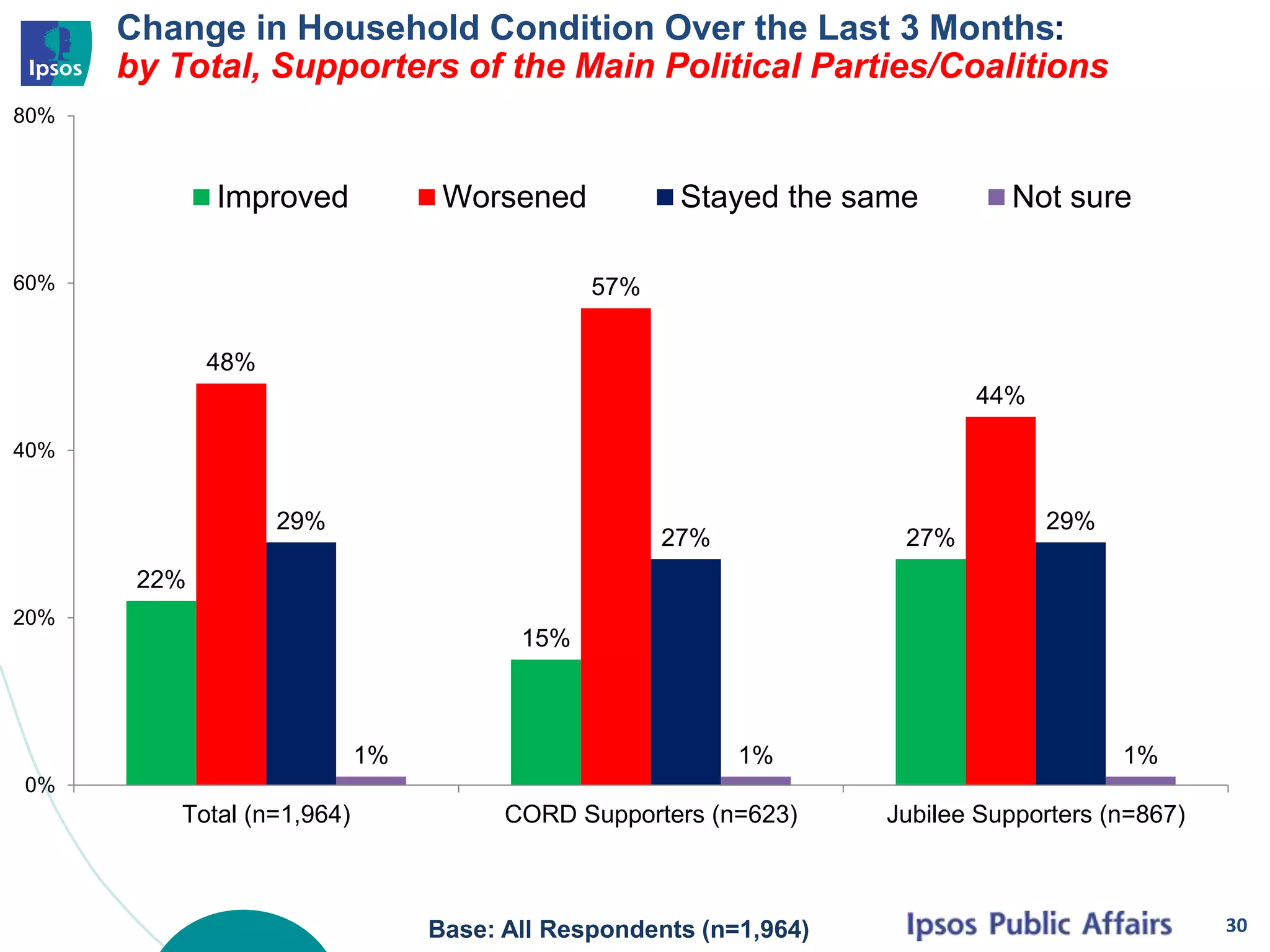
Change in Household Condition Over the Last 3 Months:
by Total, Supporters of the Main Political Parties/Coalitions
30Base: All Respondents (n=1,964)
22%
15%
27%
48%
57%
44%
29%
27%
29%
1% 1% 1%
0%
20%
40%
60%
80%
Total (n=1,964) CORD Supporters (n=623) Jubilee Supporters (n=867)
Improved Worsened Stayed the same Not sure
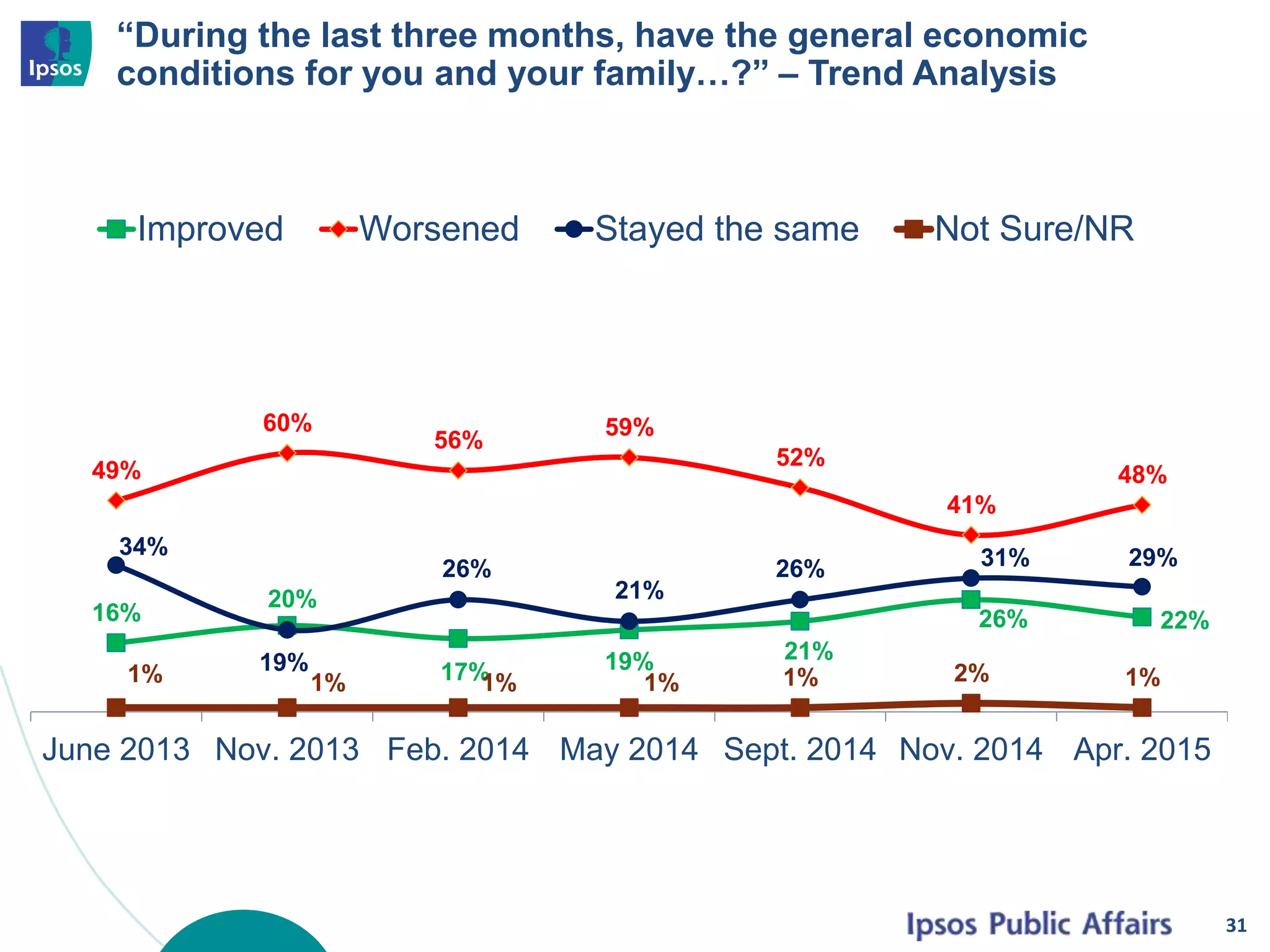
“During the last three months, have the general economic
conditions for you and your family…?” – Trend Analysis
31
16%
20%
17% 19% 21%
26% 22%
49%
60%
56%
59%
52%
41%
48%
34%
19%
26%
21%
26% 31% 29%
1% 1% 1% 1% 1% 2% 1%
June 2013 Nov. 2013 Feb. 2014 May 2014 Sept. 2014 Nov. 2014 Apr. 2015
Improved Worsened Stayed the same Not Sure/NR
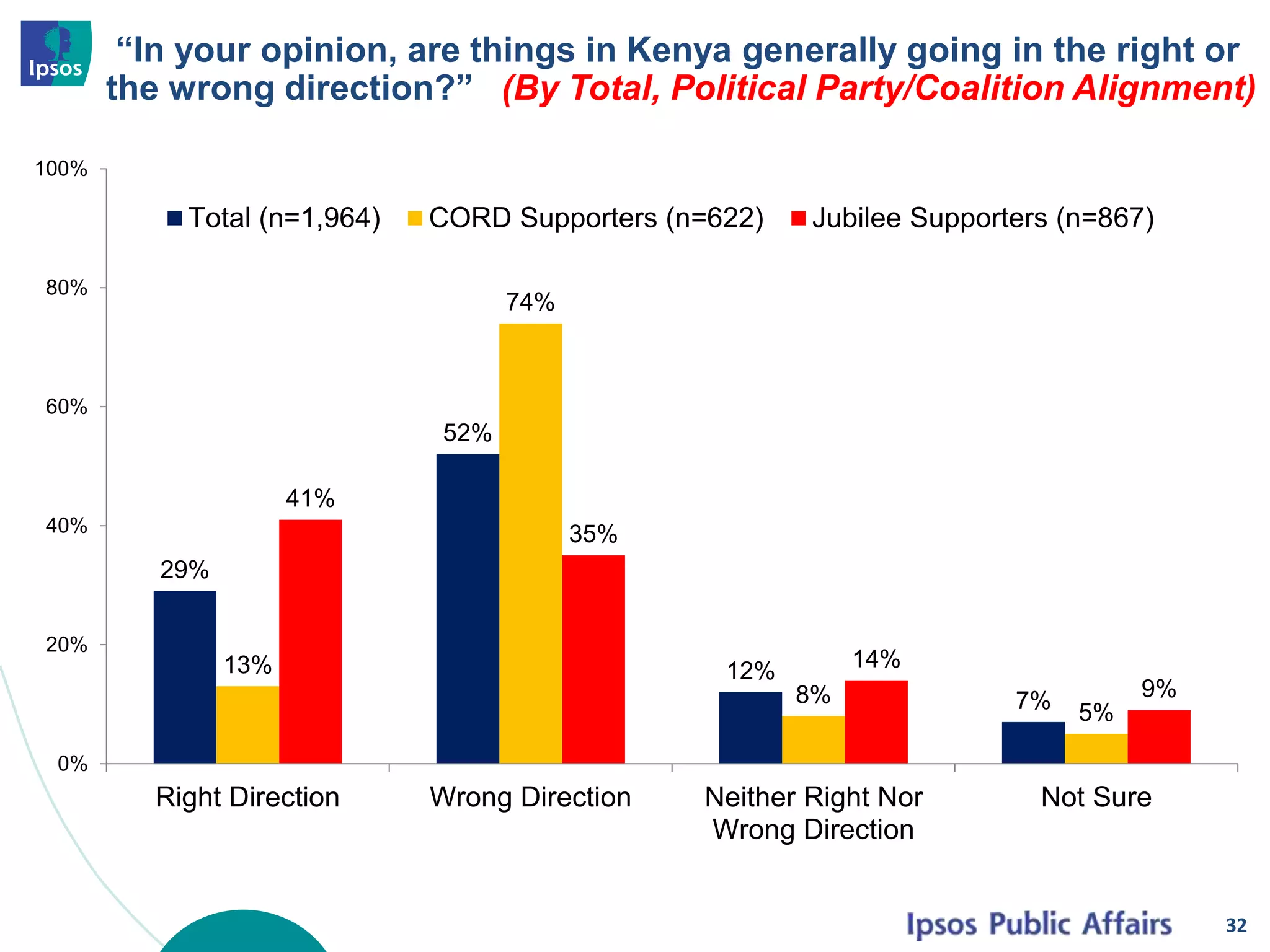
“In your opinion, are things in Kenya generally going in the right or
the wrong direction?” (By Total, Political Party/Coalition Alignment)
32
29%
52%
12%
7%
13%
74%
8%
5%
41%
35%
14%
9%
0%
20%
40%
60%
80%
100%
Right Direction Wrong Direction Neither Right Nor
Wrong Direction
Not Sure
Total (n=1,964) CORD Supporters (n=622) Jubilee Supporters (n=867)
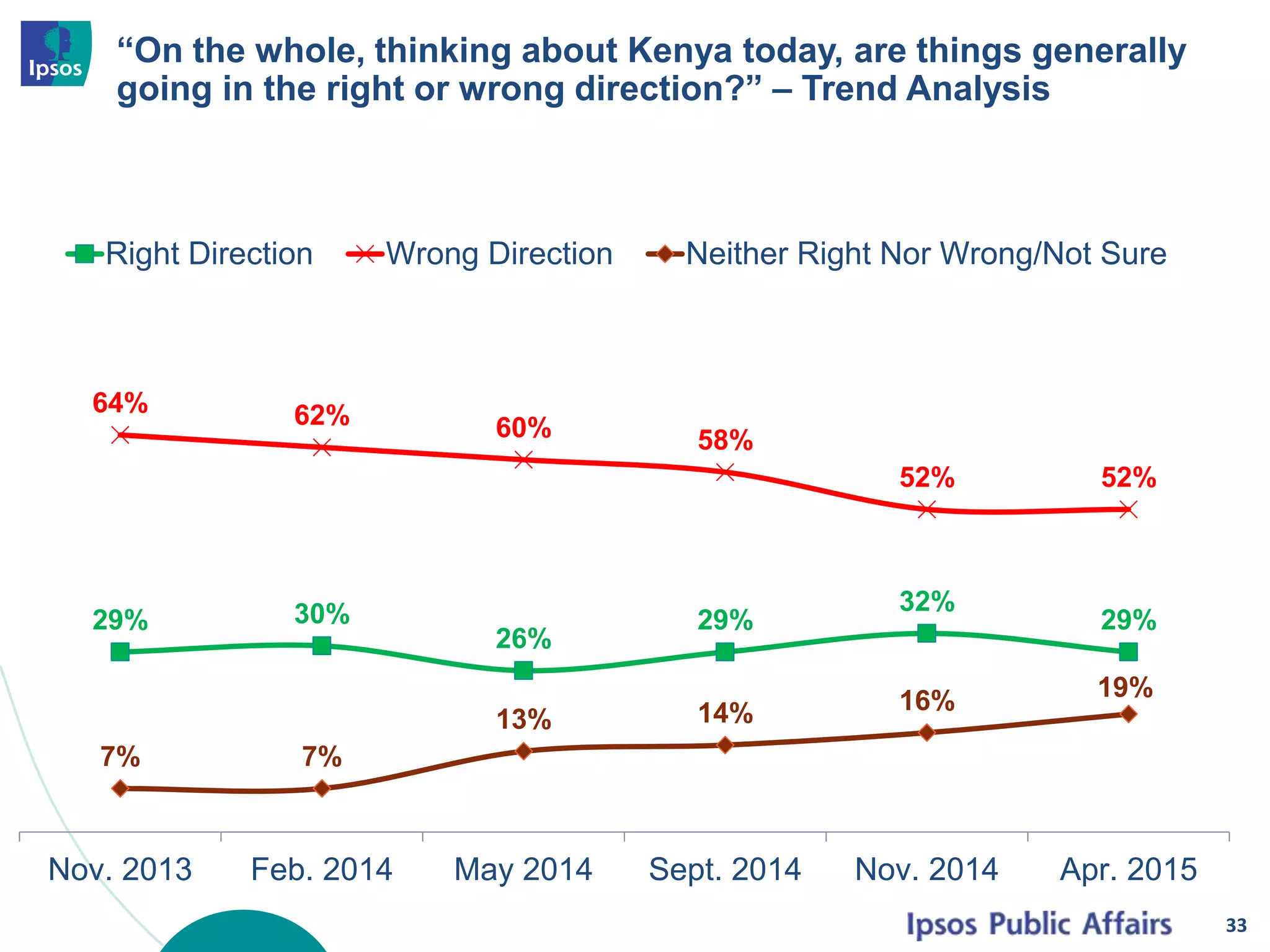
“On the whole, thinking about Kenya today, are things generally
going in the right or wrong direction?” – Trend Analysis
33
29% 30%
26%
29%
32%
29%
64% 62% 60% 58%
52% 52%
7% 7%
13% 14% 16% 19%
Nov. 2013 Feb. 2014 May 2014 Sept. 2014 Nov. 2014 Apr. 2015
Right Direction Wrong Direction Neither Right Nor Wrong/Not Sure
Reasons for saying the Country is headed in the right or wrong
direction
34
41%
18%
11%
8%
6%
5%
2%
2%
2%
1%
1%
3%
0% 10% 20% 30% 40% 50%
Improved economy (cost of living,
employment opportunities etc.)
Infrastructure
Good leadership
Fighting corruption
Improving education services
Tackling insecurity/crime/terrorism
Hunger/drought interventions
Health services
Implementing the Constitution
Good relations with development
partners
Reduced ethnic tensions
No specific reason
61%
19%
8%
8%
2%
1%
1%
1%
0% 20% 40% 60% 80%100%
Economic issues (High
cost of living,
unemployment etc.)
Increase in corruption
cases
Insecurity/Crime/Terroris
m failures
Poor leadership
Poor/Lack of interventions
on hunger/drought
Infrastructure
Tribalism/Ethnic tensions
Violation of human Rights
Base: Those saying that the country is headed in right
direction (n=565)
Base: Those saying that the country is headed in
wrong direction (n=990)
Wrong DirectionRight Direction
For further information contact:
Dr Tom Wolf
Research Analyst
tpwolf1944@gmail.com
Victor Rateng
Project Manager - Opinion Polls
victor.rateng@ipsos.com
Website: www.ipsos.co.ke
Follow us on twitter: @IpsosKe
35

The Kenyan Economy: Perceptions and Realities

  • 1.
    © 2012 Ipsos.All rights reserved. Contains Ipsos' Confidential and Proprietary information and may not be disclosed or reproduced without the prior written consent of Ipsos. SPEC Barometer Press Release: General Media Prepared by: Ipsos Release date: 25th April 2015
  • 2.
     Most seriousproblem facing Kenya today  Proportion stating that:  They or someone in the household ever go to sleep hungry  Everyone in the household gets enough to eat  They experienced famine in their locality in the past year  They expect that there will be famine in the coming year  Poverty:  Prevalence of poverty in the locality  Measures to reduce poverty in the locality  Fuel Prices  Awareness of drop in fuel prices  Impact of drop in fuel prices  Change in household’s economic position over the last 3 months  Kenya’s direction:  Country moving in the right/wrong direction  Main reasons given for saying that Kenya is headed in the right/wrong direction 2 Contents
  • 3.
  • 4.
    Methodology 4 Dates of polling28th March - 7th April 2015 Sample Size 1,964 Sampling methodology Random, Multi-stage stratified using PPS (proportionate to population size) Universe Data collection methodology Sampling error Face-to-Face interviews at the household level Poll funding Ipsos Limited Kenyan adults, aged 18 and above living in Urban and Rural areas +/-2.2% with a 95% confidence level (Note: Higher error-margins for sub-samples)
  • 5.
    Statistical Significance: RespondentNumbers and Error-Margins for: Entire Sample, Before 2nd April , 2nd April and After 2nd April 1,964 1,364 193 4522.20% 2.60% 6.40% 4.60% 0.00% 1.00% 2.00% 3.00% 4.00% 5.00% 6.00% 7.00% 8.00% 9.00% 10.00% 0 500 1,000 1,500 2,000 Total Before 2nd April 2nd April After 2nd April Sample Size Error-Margin 5
  • 6.
    Sample Structure Statistics 6 Region SampleFrame statistics (April 2015) *Weighted data % Population Census as at 2009 Adults (18 years +) % Central 257 13 2,548,038 13 Coast 173 9 1,711,549 9 Eastern 293 15 2,907,293 15 Nairobi 206 10 2,042,770 10 North Eastern 94* 5 929,158 5 Nyanza 257 13 2,547,980 13 Rift Valley 484 25 4,795,482 25 Western 200 10 1,980,090 10 TOTAL 1,964 100 19,462,360 100
  • 7.
    Quality Control Measures For at least 20% of the interviews, a supervisor is present throughout  Field managers visit at least 15% of the respondents in the sample at their households to confirm the interviews (i.e. back-checking).  After the interview data are electronically transmitted to the Ipsos Server: an independent team then makes random phone calls to 40% of the respondents to confirm that the interviews were conducted with the said respondents (i.e., telephonic back-checks).  Mobile Data Collection Platform captures GPS location (latitudes and longitudes) of interviews conducted to verify the locations of the interviewers in the field alongside allowing silent recording.  Logical data checks are made on selected questionnaire entries to ensure conformity to the sample’s statistical parameters. 7 Ipsos employs quality control measures to ensure the highest possible integrity of obtained results/data
  • 8.
  • 9.
    28% 2% 30% 8% 11% 9% 10% 1% 1% 9% 22% 28% 23% 4% 4% 2% 5% 1% 2% Catholic Catholic Charismatic Mainstream Protestant(ACK,… SDA Evangelical Other Christian Muslim Refused To Answer/None No religion Public Sector wages/salary Private sector wages /salary Gains from self employment/… Agriculture (own/household farm) Livestock Given money by others Pension from previous employment Other Don’t Know Refused To Answer Demographic Profile 10% 9% 13% 25% 5% 15% 13% 10% 51% 49% 28% 29% 18% 25% 37% 63% 100% Nairobi Coast Nyanza Rift Valley North Eastern Eastern Central Western Female Male 18 - 24 25 - 34 35 - 44 45+ Urban Rural Kenyans 9 Region Gender Age Setting Religion Nationality Source of Household Income Base: All Respondents (n=1,964)
  • 10.
    Demographic Profile 4% 14% 19% 14% 26% 8% 7% 3% 3% 1% 42% 33% 11% 4% 1% 1% 0% 2% 7% No formaleducation Some primary education Primary education completed Some secondary education Secondary education completed Some middle level college (not… Completed mid-level college (Not… Some University education University education completed Post Graduate (Masters, MBA, PhD) Less than 10,000 10,001 – 25,000 25,001 – 40,000 40,001 – 55,000 55,001 – 75,000 75,001 – 100,000 100,001 and above Has No income RTA/DK 10 Level of Education Monthly Household Income (ALL members of the Household) Base: All Respondents (n=1,964)
  • 11.
    Demographic Profile 41% 18% 11% 10% 7% 5% 5% 2% 1% Self-Employed Unemployed Employed inthe private sector Peasant/herder (own farm/pasture) Casual labour Employed in the public sector Student Retired Other 11 Employment Status Base: All Respondents (n=1,964)
  • 12.
  • 13.
    Estimated Monthly HouseholdIncome (By Total) 13 Less than Shs. 10,000, 44% Shs. 10,000-25,000, 33% Shs. 25,000-40,000, 11% Shs. 40,000 and More, 6% DK/RTA, 7% Base: All Respondents (n=1,964)
  • 14.
    Estimated Monthly HouseholdIncome (By All Those Who Gave Estimates) 14 Less than Shs. 10,000, 46% Shs. 10,000- 25,000, 36% Shs. 25,000- 40,000, 12% Shs. 40,000 and More, 6% Estimate (2012) % Kenyans Living in Poverty = 43% Source: CIA Fact Book (Base: n = 1,833, excluding those who refused or stated that they do not know)
  • 15.
    Estimated Monthly HouseholdIncome = Shs. 10,000 and Below (By Total, Region) 15 44% 56% 50% 46% 44% 42% 41% 40% 24% Total Coast Rift Valley Western Eastern Nyanza Central North Eastern Nairobi Base: All Respondents (n=1,964)
  • 16.
    Estimated Monthly HouseholdIncome – Time Series 16 44% 33% 11% 4% 2% 7% 41% 33% 10% 4% 3% 9% 47% 31% 9% 4% 3% 5% 0% 10% 20% 30% 40% 50% 0 to 10,000 10,001 – 25,000 25,001 – 40,000 40,001 – 55,000 55,001 and above RTA/DK (n=1,964), April 2015 % (n=2,005), November 2014 % (n=2,021), August 2014
  • 17.
    Main Source ofHousehold Income (By Total) 17 Public Sector wages/salary, 9% Private sector wages /salary, 22% Gains from self employment/ Business owner/trader, 28% Agriculture (own/household farm), 23% Livestock, 4% Given money by others, 4% Pension from previous employment, 2% Other, 5% Don’t Know, 1% Refused To Answer, 2% Base: All Respondents (n=1,964)
  • 18.
  • 19.
    “What would yousay is the most serious problem facing Kenya today?” Single Response (By Total) 26% 19% 16% 11% 11% 5% 3% 3% 2% 1% 1% 0% 10% 20% 30% 40% 50% High cost of living/inflation Corruption Unemployment Insecurity (5%)/Terrorism (6%) Hunger/Drought Poverty/Rich-Poor gap Poor leadership Crime Tribalism/Ethnic Tensions Lack of proper education None 19 Base: All Respondents, (n=1,964)
  • 20.
    “Generally, what wouldyou say is the most serious problem facing Kenya today?” (By Total, Supporters of Main Political Parties/Coalitions) Problem Total (1,964) Jubilee Supporters (n=867) CORD Supporters (n=623) % Difference High cost of living/inflation 26% 23% 32% +9% Unemployment 16% 16% 16% 0% Insecurity/Terrorism 11% 11% 10% -1% Hunger/Drought 11% 10% 9% -1% Corruption 19% 22% 18% -4% Crime 3% 3% 3% 0% Poverty/Rich-Poor Gap 5% 5% 6% +1% Poor Leadership 3% 3% 3% 0% Tribalism 2% 2% 2% 0% Poor Infrastructure 0% 1% 0% -1% None 1% 1% 1% 0% 20
  • 21.
    “What would yousay is the most serious problem facing Kenya today?” – Trend Analysis (Top 3 mentions, Single Response) 57% 68% 69% 70% 45% 39% 54% 56% 50% 38% 33% 33% 7% 26% 19% 8% 7% 9% 19% 13% 21% 14% 19% 13% 15% 16% 5% 16% 2% 1% 2% 3% 4% 12% 7% 10% 8% 20% 13% 18% 67% 14% 0% 20% 40% 60% 80% 100% High cost of living Unemployment Crime/Insecurity/Terrorism 21 Apr-11 Jun-11 Oct-11 Dec-11 Mar-12 Nov-12 Jun-13 Nov-13 Jan-14 Apr-14 Sep-14 Nov-14 Dec-14 Mar-15 *12.05% *14.49% *18.91% *18.93% *15.61% *3.25% *4.91% *7.36% 7.21%* 6.41% 8.36% 6.09% 6.02% 6.31% *Inflation: Source - KNBS
  • 22.
    “What would yousay is the most serious problem facing Kenya today?” – Trend Analysis for Corruption, Single Mention 6% 10% 3% 7% 13% 14% 4% 7% 8% 10% 8% 8% 6% 19% 0% 10% 20% 30% 40% 50% Corruption 22 Jubilee GovernmentGrand Coalition Government
  • 23.
    “Does anyone inyour household ever go to sleep hungry?” / “Does everyone in your household always get enough to eat?” By Total, Region 23Base: All Respondents (n=1,964) 38% 61% 50% 49% 43% 35% 33% 32% 16% 43% 45% 52% 41% 39% 43% 44% 49% 33% 0% 20% 40% 60% 80% Total (n=1,964) Coast (n=173) Nyanza (n=257) North Eastern (n=94) Eastern (n=293) Western (n=200) Rift Valley (484) Nairobi (n=206) Central (n=257) 1st Question: "YES" 2nd Question: "NO"
  • 24.
    Any Past Experience/Expectationsof Local Famine: by Total, Region 24Base: All Respondents (n=1,964) 58% 78% 74% 67% 64% 62% 49% 48% 36% 48% 54% 67% 55% 49% 41% 48% 44% 26% 0% 20% 40% 60% 80% 100% Total (n=1,964) Eastern (n=293) Nyanza (n=257) Coast (n=173) North Eastern (n=94) Western (n=200) Rift Valley (n=494) Nairobi (n=206) Central (n=257) In The Last One Year In The Next 12 Months % Saying “YES”
  • 25.
    “Is there anypoverty in your locality?”: by Total, Region 25Base: All Respondents (n=1,964) 78% 91% 89% 87% 84% 76% 76% 60% 56% 0% 20% 40% 60% 80% 100% Total (n=1,964) Nyanza (n=257) Coast (n=173) Western (n=200) Eastern (n=293) Nairobi (n=206) Rift Valley (n=484) North Eastern (n=94) Central (n=257) % Saying “YES”
  • 26.
    “What are mainthings that could be done to reduce poverty in your locality?” by Total 52% 36% 27% 20% 12% 7% 6% 4% 4% 3% 1% 0% 20% 40% 60% 80% 100% Employment opportunities Agriculture/livestock Infrastructure (roads, water, electricity) Education Governance (anti-corruption, policies, good leadership, constitutional implementation etc.) Security Human health Reduce the cost of living Donation by Government/NGO to the needy Family planning Youth/women empowerment 26 Base: Those stating that there is poverty in their locality (n=1,533)
  • 27.
    Poverty and Famine 78% 58% 48% 43% 38% 0%20% 40% 60% 80% 100% % saying that there is poverty in their area/locality % saying that people in their locality have suffered from famine in the past one year (58%) % saying that they think there will be famine in their locality within the next 12 months % saying that they or everyone in their family don't get enough food to eat every day % saying they or someone in their household ever goes to sleep at night hungry (for the lack of food) 27Base: All Respondents (n=1,964)
  • 28.
    Awareness of Changein the Prices of Kerosene, Petrol and Diesel 28 YES, 80% NO, 18% RTA, 1% DK, 2% Base: All Respondents (n=1,964) Reduction 61% Reduction and then slight increase 37% Same/Other response 3% Base: Those saying that they are aware of changes in the price of kerosene, petrol or diesel (n=1,569) “In the last few months, are you aware of any changes in the price of Kerosene Petrol/Diesel?” “In the last few months, are you aware of any changes in the price of Kerosene Petrol/Diesel?”
  • 29.
    29 YES, 51% NO, 48% DK,2% Base: Those saying that the drop in the price of kerosene, petrol or diesel has changed their life in any way (n=782) Reported Impact of Change in the Prices of Kerosene, Petrol and Diesel “Has this reduction in the price of kerosene/petrol changed your life in any way?” “In what way(s)?” Base: Those saying that they are aware of changes in the price of kerosene, petrol or diesel (n=1,569) 65% 49% 0% 20%40%60%80%100% Saving more Able to spend more on other things
  • 30.
    Change in HouseholdCondition Over the Last 3 Months: by Total, Supporters of the Main Political Parties/Coalitions 30Base: All Respondents (n=1,964) 22% 15% 27% 48% 57% 44% 29% 27% 29% 1% 1% 1% 0% 20% 40% 60% 80% Total (n=1,964) CORD Supporters (n=623) Jubilee Supporters (n=867) Improved Worsened Stayed the same Not sure
  • 31.
    “During the lastthree months, have the general economic conditions for you and your family…?” – Trend Analysis 31 16% 20% 17% 19% 21% 26% 22% 49% 60% 56% 59% 52% 41% 48% 34% 19% 26% 21% 26% 31% 29% 1% 1% 1% 1% 1% 2% 1% June 2013 Nov. 2013 Feb. 2014 May 2014 Sept. 2014 Nov. 2014 Apr. 2015 Improved Worsened Stayed the same Not Sure/NR
  • 32.
    “In your opinion,are things in Kenya generally going in the right or the wrong direction?” (By Total, Political Party/Coalition Alignment) 32 29% 52% 12% 7% 13% 74% 8% 5% 41% 35% 14% 9% 0% 20% 40% 60% 80% 100% Right Direction Wrong Direction Neither Right Nor Wrong Direction Not Sure Total (n=1,964) CORD Supporters (n=622) Jubilee Supporters (n=867)
  • 33.
    “On the whole,thinking about Kenya today, are things generally going in the right or wrong direction?” – Trend Analysis 33 29% 30% 26% 29% 32% 29% 64% 62% 60% 58% 52% 52% 7% 7% 13% 14% 16% 19% Nov. 2013 Feb. 2014 May 2014 Sept. 2014 Nov. 2014 Apr. 2015 Right Direction Wrong Direction Neither Right Nor Wrong/Not Sure
  • 34.
    Reasons for sayingthe Country is headed in the right or wrong direction 34 41% 18% 11% 8% 6% 5% 2% 2% 2% 1% 1% 3% 0% 10% 20% 30% 40% 50% Improved economy (cost of living, employment opportunities etc.) Infrastructure Good leadership Fighting corruption Improving education services Tackling insecurity/crime/terrorism Hunger/drought interventions Health services Implementing the Constitution Good relations with development partners Reduced ethnic tensions No specific reason 61% 19% 8% 8% 2% 1% 1% 1% 0% 20% 40% 60% 80%100% Economic issues (High cost of living, unemployment etc.) Increase in corruption cases Insecurity/Crime/Terroris m failures Poor leadership Poor/Lack of interventions on hunger/drought Infrastructure Tribalism/Ethnic tensions Violation of human Rights Base: Those saying that the country is headed in right direction (n=565) Base: Those saying that the country is headed in wrong direction (n=990) Wrong DirectionRight Direction
  • 35.
    For further informationcontact: Dr Tom Wolf Research Analyst tpwolf1944@gmail.com Victor Rateng Project Manager - Opinion Polls victor.rateng@ipsos.com Website: www.ipsos.co.ke Follow us on twitter: @IpsosKe 35