Introduction to Real-Time Operating Systems
Objectives Understanding Real-Time Operating Systems Types of Real-Time Operating System Requirements for Real-Time Operating System Difference between General Purpose Operating System (GPOS) and Real-Time Operating System (RTOS)
Objectives Conversion Linux kernel to support Real-Time operations Patching the linux kernel Major changes in patched kernel Hands-on labs  Conversion of Linux kernel to support real time Code a real time application (Audio Feedback removal)
Introduction Operating System (OS) Abstraction layer over the raw hardware Manages the hardware Multiplexes the resources using scheduling policies  Types of operating systems General purpose OS(GPOS) Optimized for throughput and fairness  Real-Time OS (RTOS) Optimized for handling tasks within timing limits
Types of RTOS Hard RTOS Strict timing requirements Optimized w.r.t. predictability and timing limits Does not share critical resources such as CPU Missing a single deadline cause system failure Examples of application under hard real time  Defense applications Fuel ignition controller for automobile engine Life supporting medical equipment Industrial control system
Types of RTOS Soft RTOS Relative tolerable timing deadlines Tolerance is defined as a part of policy Occasional deadline missing may not cause system failure Examples Audio processing Real-time video processing Network interface subsystem
GPOS and RTOS comparison Scheduling Locking mechanism  Hardware and software support
Scheduling Makes multitasking feasible Shares resources between tasks Follows a scheduling policy Task priority A number assigned to task according to its importance A higher priority task is preferred over a low priority task
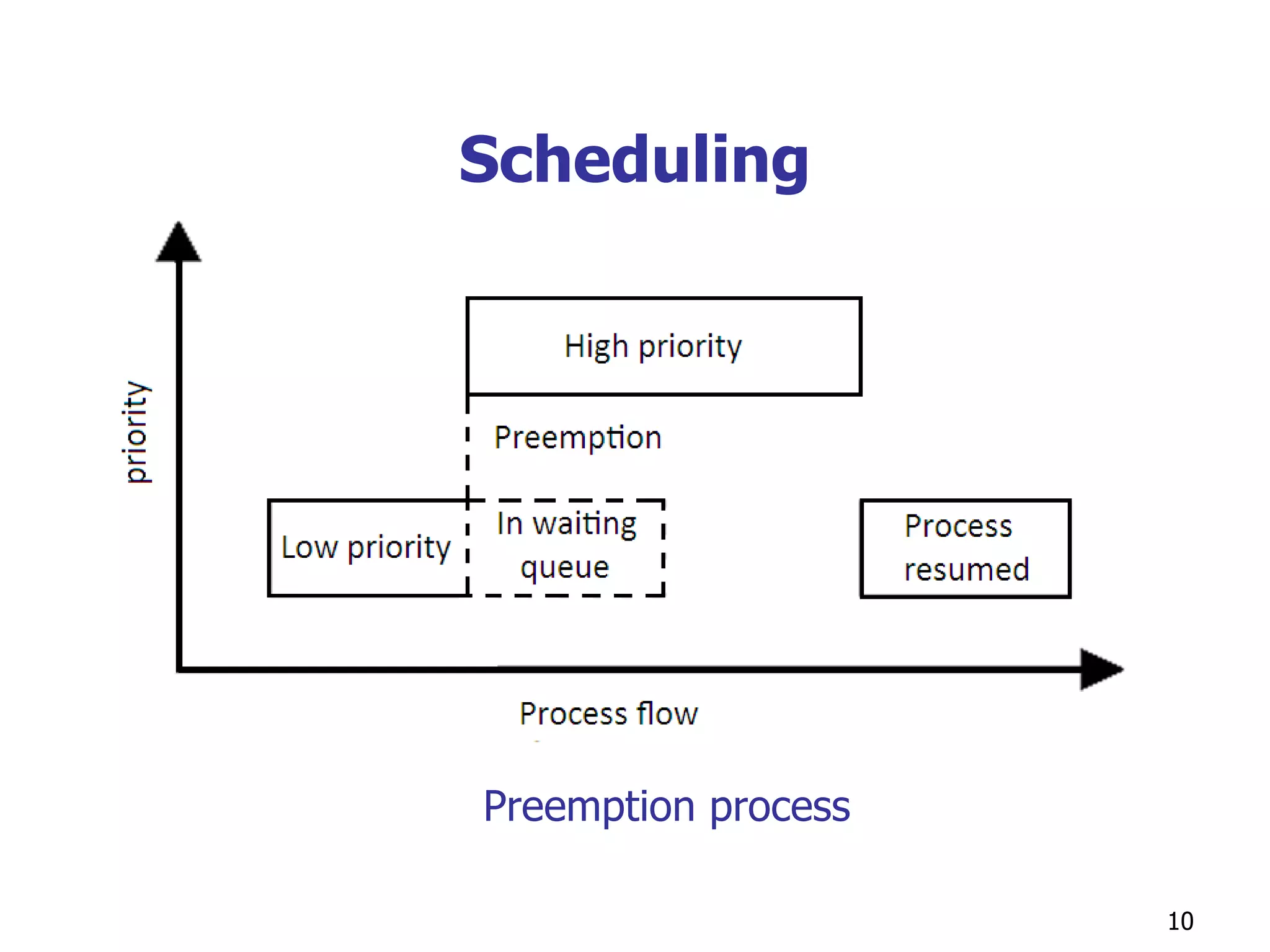
Scheduling Preemption Shift of resource control from low to high priority task  Responsibility of kernel Preemption limitations A code segment can not be preempted when it has acquire some lock which is acquired disabling interrupts A process can only be preempted after a specified task expiration. Tradeoffs between coarse and fine grained timer
Scheduling Preemption process
Scheduling Yielding Process itself give up the resources Responsibility of process Program designer has to take care of yielding Disadvantages  Unable to use available resources efficiently Real-time systems can not rely on voluntary giving up of the CPU Priority inversion A low priority task might cause high priority task to wait for execution
Kernel Locks Locks  Avoid a critical code section to be accessed by two active threads simultaneously Especially important in multicore machines  Effect of locks on real-time response Unpredictable delays for waiting threads Might cause priority inversion Some types of lock disables code preemptions
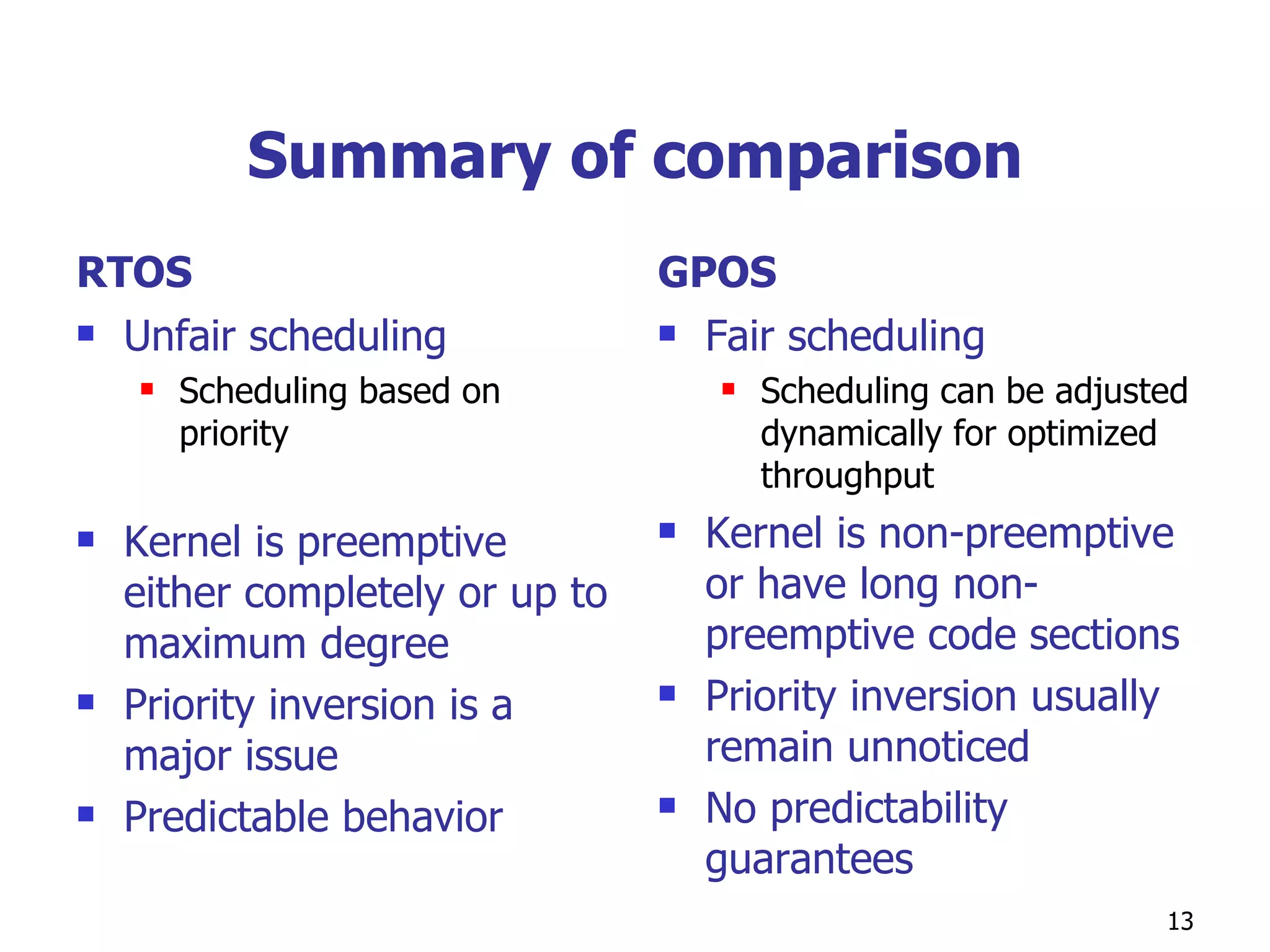
Summary of comparison RTOS Unfair scheduling Scheduling based on priority Kernel is preemptive either completely or up to maximum degree Priority inversion is a major issue Predictable behavior GPOS Fair scheduling Scheduling can be adjusted dynamically for optimized throughput Kernel is non-preemptive or have long non-preemptive code sections Priority inversion usually remain unnoticed No predictability guarantees
Limitations for RT applications System management interrupts DMA bus mastering On-demand CPU frequency scaling VGA text console Page faults Context switching
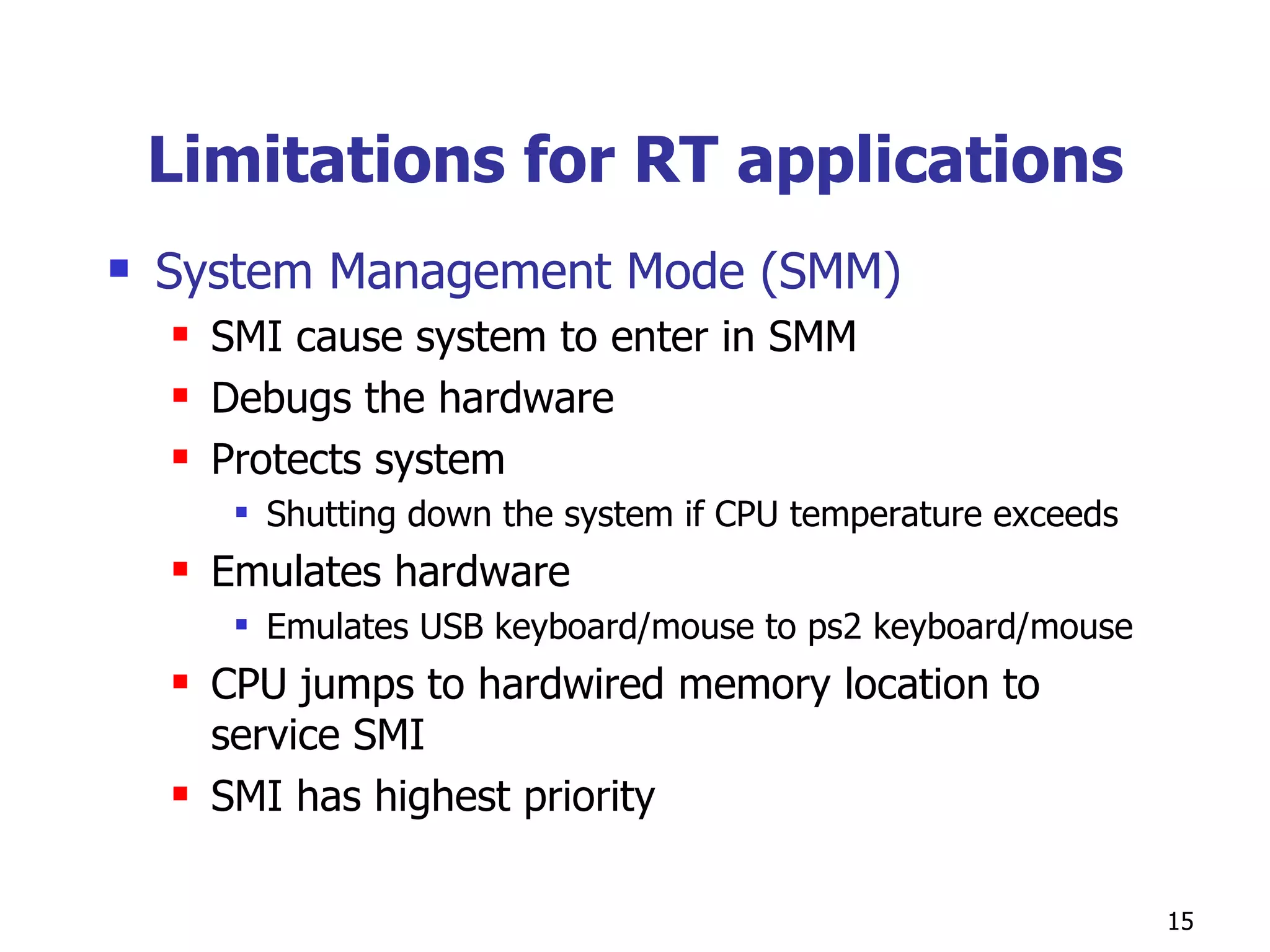
Limitations for RT applications System Management Mode (SMM) SMI cause system to enter in SMM Debugs the hardware Protects system Shutting down the system if CPU temperature exceeds Emulates hardware Emulates USB keyboard/mouse to ps2 keyboard/mouse CPU jumps to hardwired memory location to service SMI SMI has highest priority
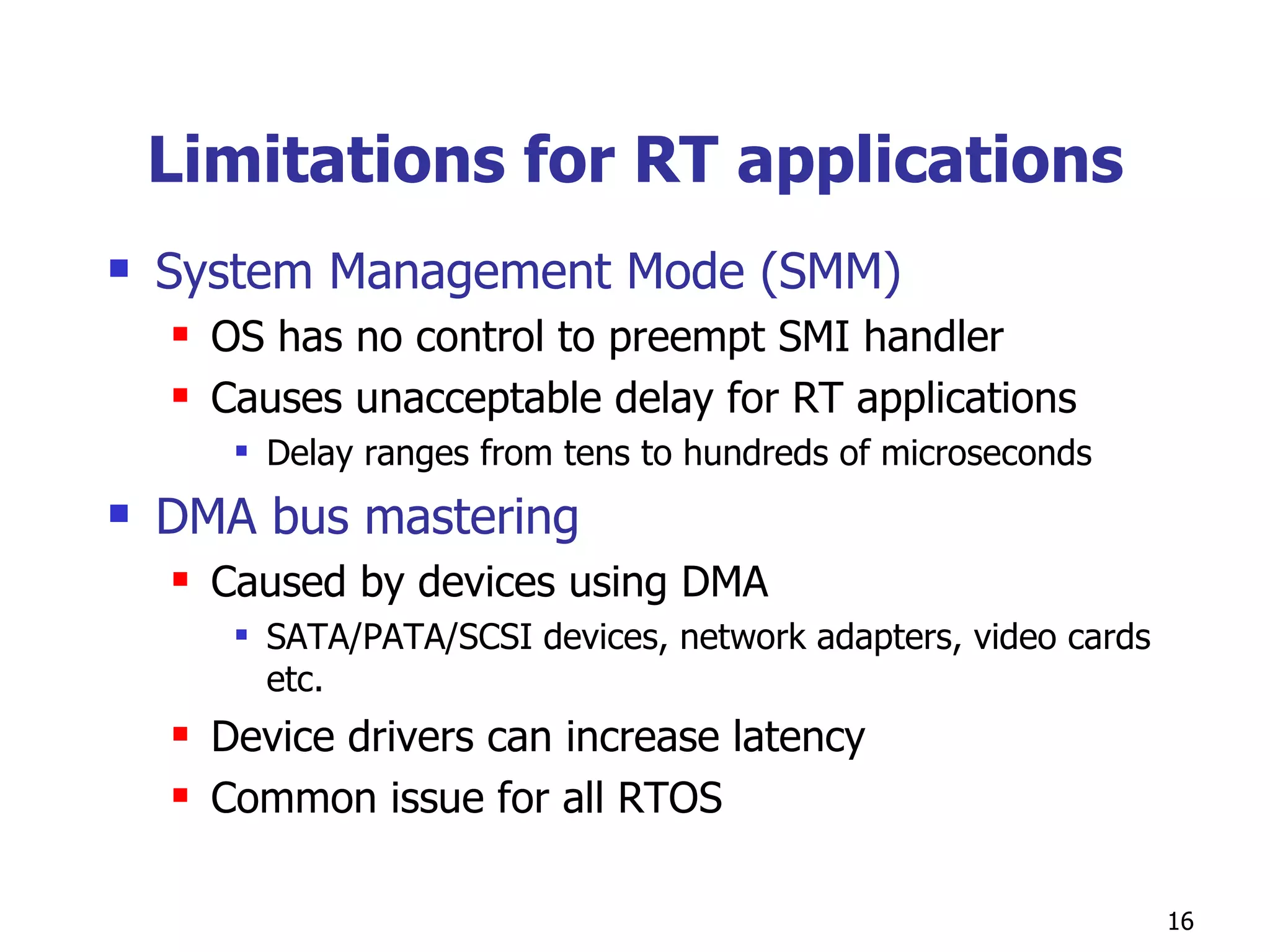
Limitations for RT applications System Management Mode (SMM) OS has no control to preempt SMI handler Causes unacceptable delay for RT applications Delay ranges from tens to hundreds of microseconds DMA bus mastering Caused by devices using DMA SATA/PATA/SCSI devices, network adapters, video cards etc. Device drivers can increase latency  Common issue for all RTOS
Limitations for RT applications On-demand CPU frequency scaling CPU is put in low power state after a period of inactivity Can cause unpredictable or longer delays
Limitations for RT applications Page faults Occurs when requested data is not available or its reference is absent from a TLB  Types of page faults Major/Hard page faults Minor/Soft page faults Major page faults Occurs when requested data has to be fetched from disk Can cause very large latencies RT application should be written to minimize Major page faults
Limitations for RT applications Page faults Minor page faults Occurs when requested data resides in the main memory but missing from TLB It does not involve IO operation to fetch data from disk Has negligible impact in RT performance Tips to avoid page faults Use mlockall() to load all the address space of the program and then lock it such that it cannot be swapped out
Limitations for RT applications Page faults Tips to avoid page faults Create all threads at startup time of the application because run time thread creation can cause latencies Avoid dynamic allocation and freeing of memory Minimize the use system calls that are known to generate page faults
Limitations for RT applications Context switching Flushed pipeline and branch prediction counters Can cause invalidation of cashes Changes the entries in Instruction and data TLBs Hence context switching might cause unacceptable behavior for some real-time application
Conversion of GPOS to RTOS RT support in stock Linux kernel Stock Linux kernel supports soft RT response Two RT scheduling policies in stock Linux kernel SCHED_FIFO SCHED_RR  Non-RT scheduling policy SCHED_NORMAL Static priority is implemented in RT scheduling sched_setschedular() can be used to manage scheduling policies
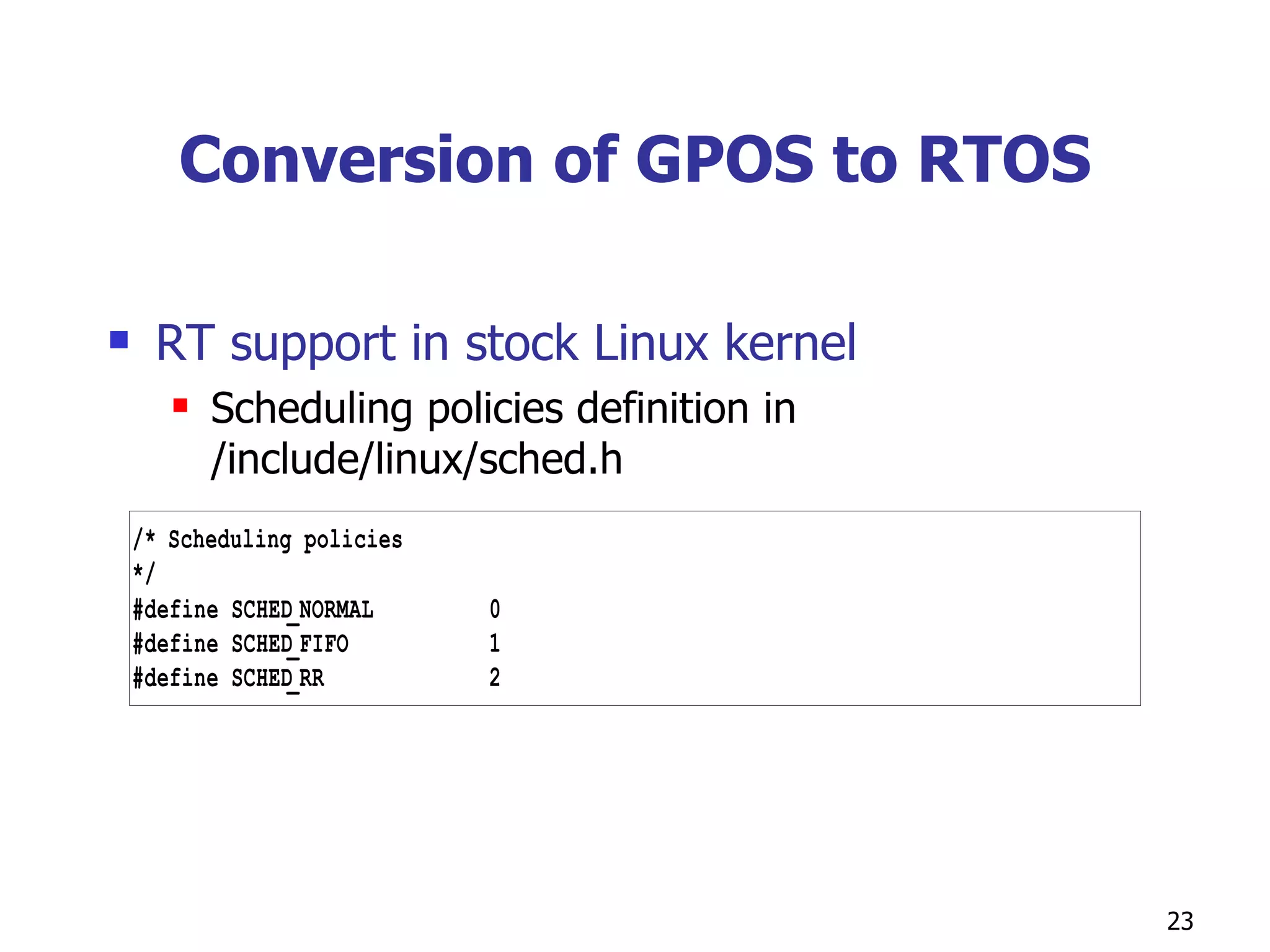
Conversion of GPOS to RTOS RT support in stock Linux kernel Scheduling policies definition in /include/linux/sched.h
Conversion of GPOS to RTOS SCHED_FIFO First-in-first-out scheduling policy Preempts all SCHED_NORMAL tasks Tasks under SCHED_FIFO cannot be preempted  Task itself can yield the resources Scheduling is not based on time slots Two SCHED_FIFO process are scheduled as ‘first come first served’ fashion
Conversion of GPOS to RTOS SCHED_RR Same as SCHED_FIFO but involves time slots Process are scheduled in round-robin fashion Share resources in allocated time slots Lower priority task cannot preempt higher priority task SCHED_RR process preempts SCHED_FIFO process
Conversion of GPOS to RTOS RT patch for stock Linux kernel CONFIG_PREEMPT_RT Adds support of hard RT in kernel Managed by Ingo Molnar Constantly developing patch A suitable patch is required to be selected corresponding to chosen kernel depending on the kernel version
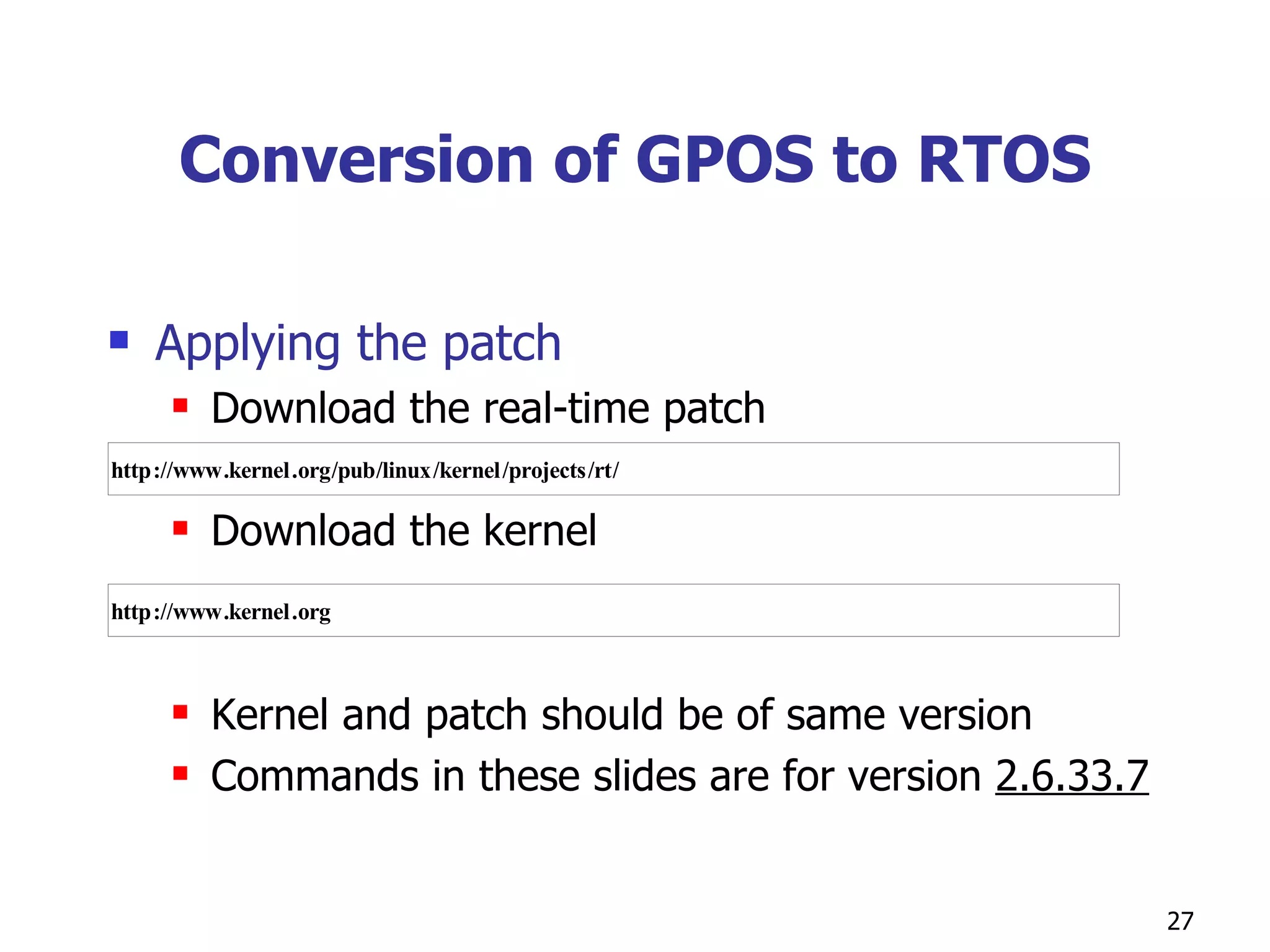
Conversion of GPOS to RTOS Applying the patch  Download the real-time patch Download the kernel Kernel and patch should be of same version Commands in these slides are for version  2.6.33.7
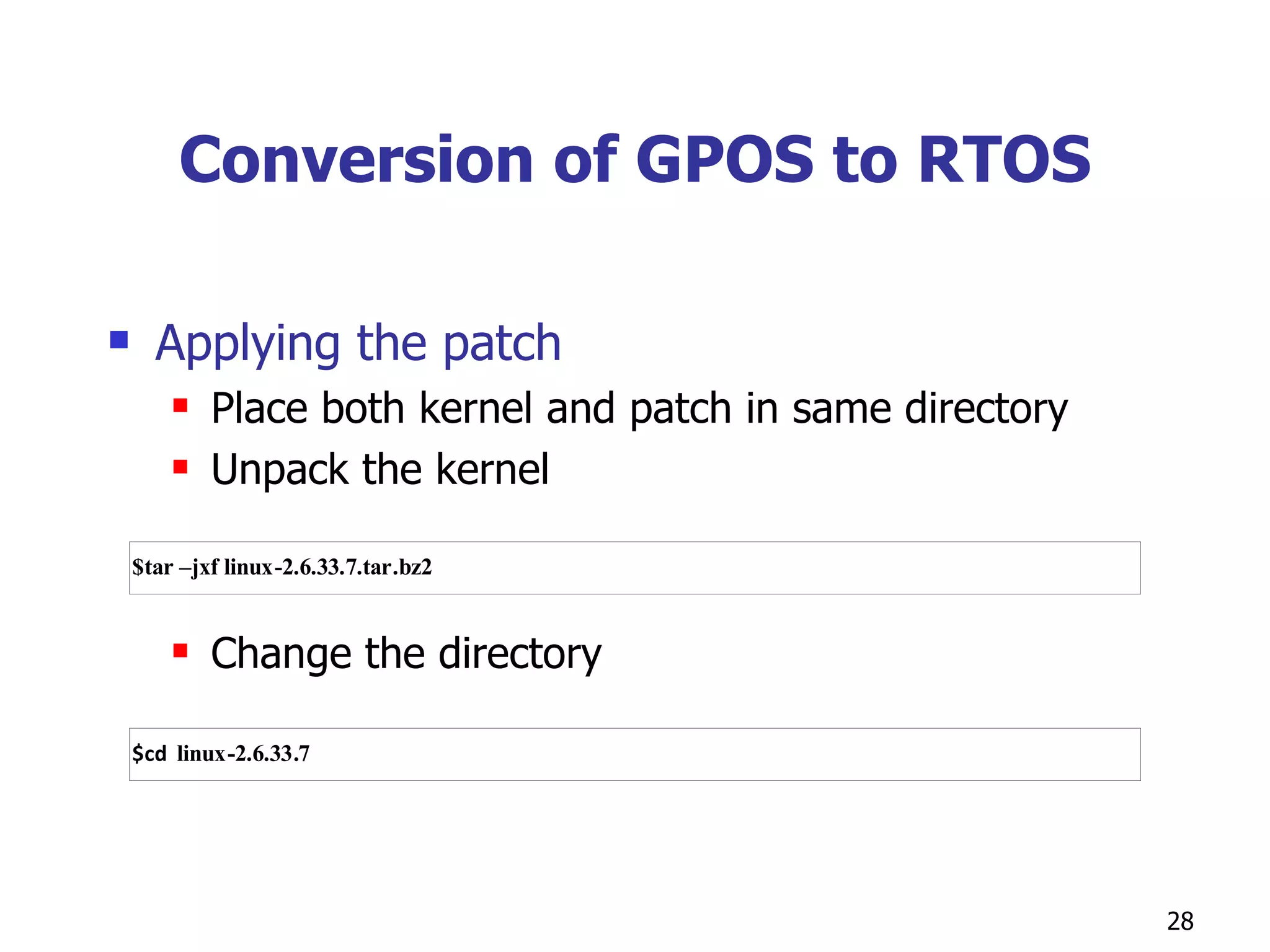
Conversion of GPOS to RTOS Applying the patch  Place both kernel and patch in same directory Unpack the kernel  Change the directory
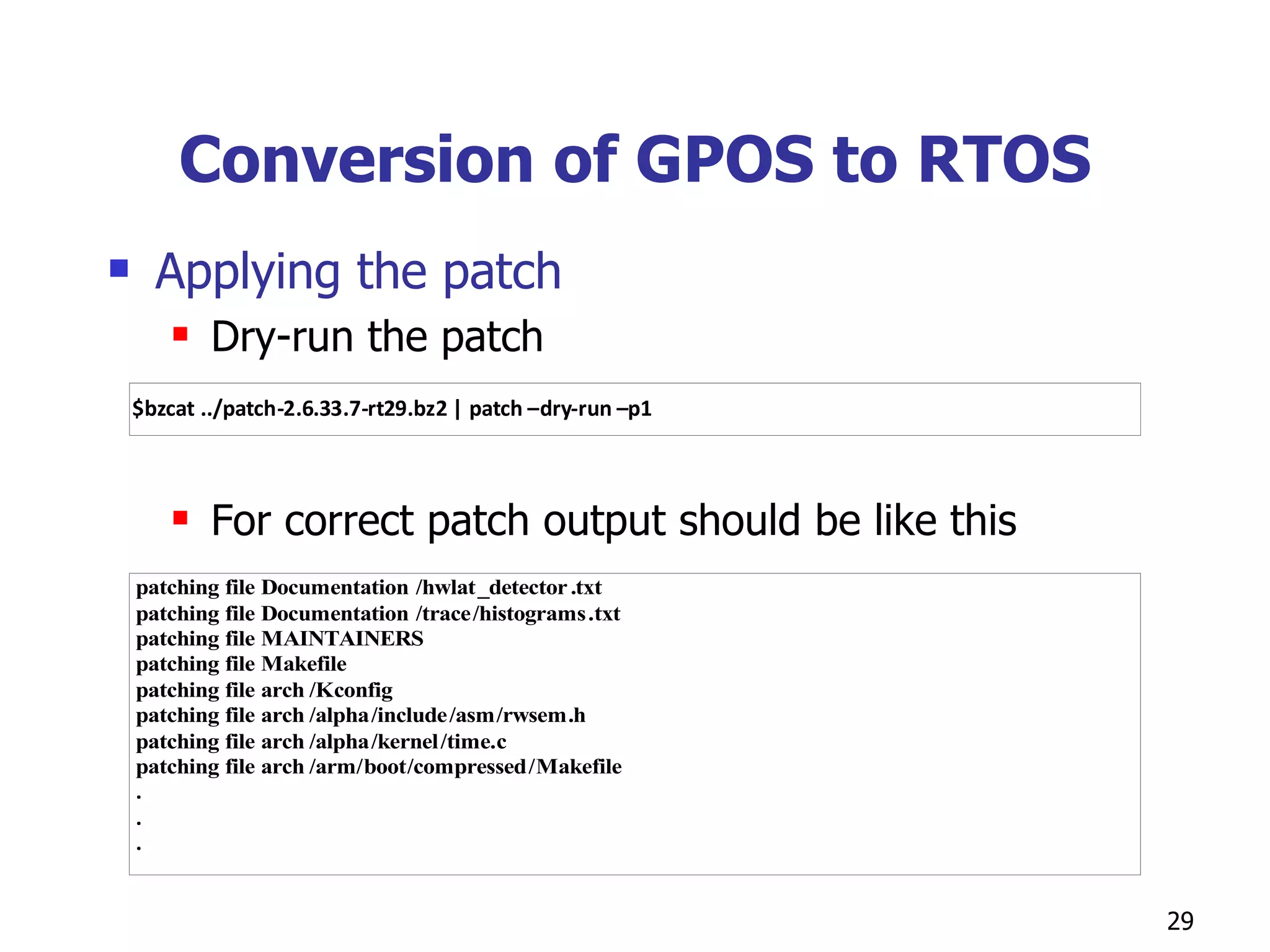
Conversion of GPOS to RTOS Applying the patch  Dry-run the patch For correct patch output should be like this
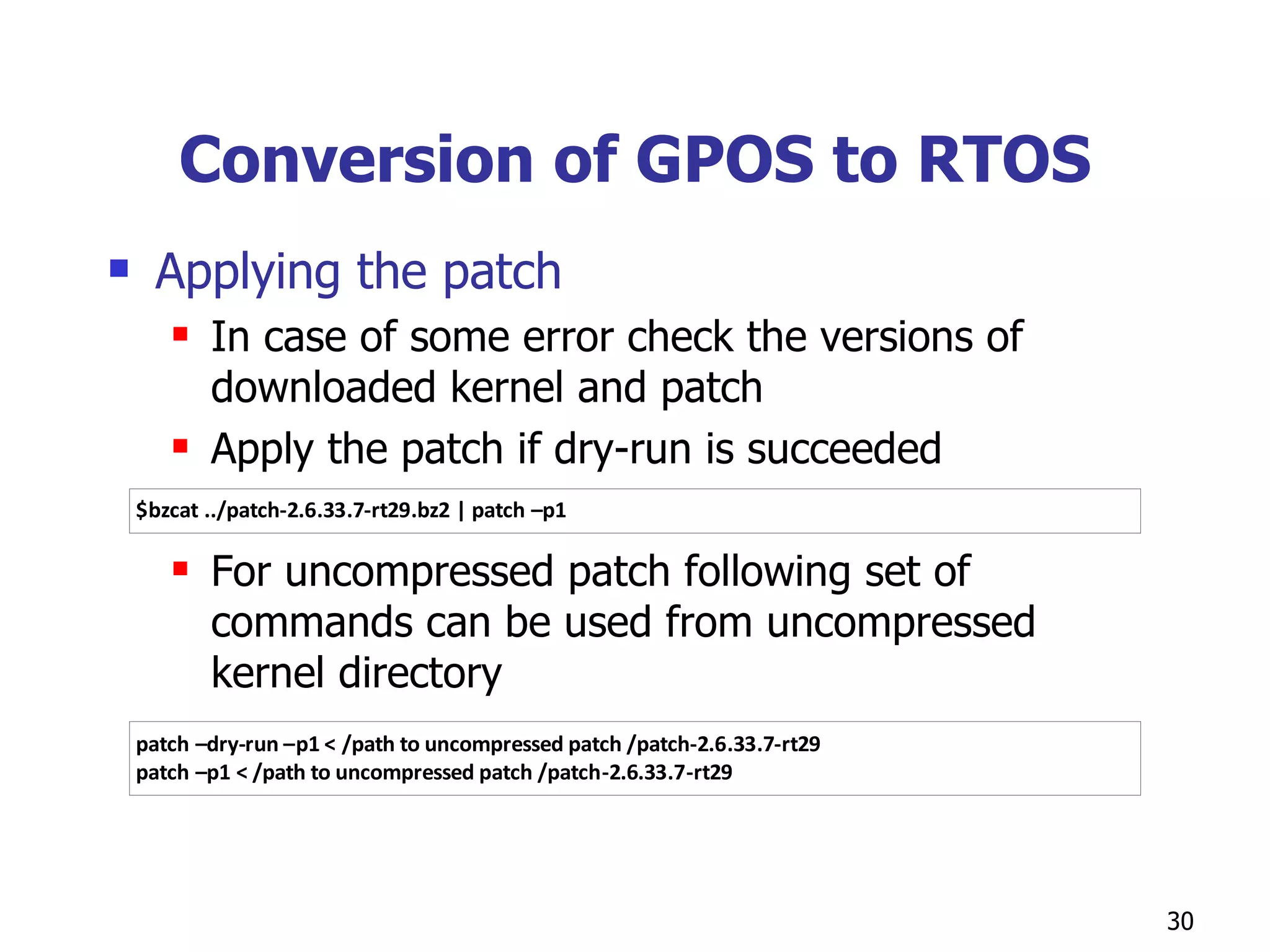
Conversion of GPOS to RTOS Applying the patch In case of some error check the versions of downloaded kernel and patch Apply the patch if dry-run is succeeded For uncompressed patch following set of commands can be used from uncompressed kernel directory
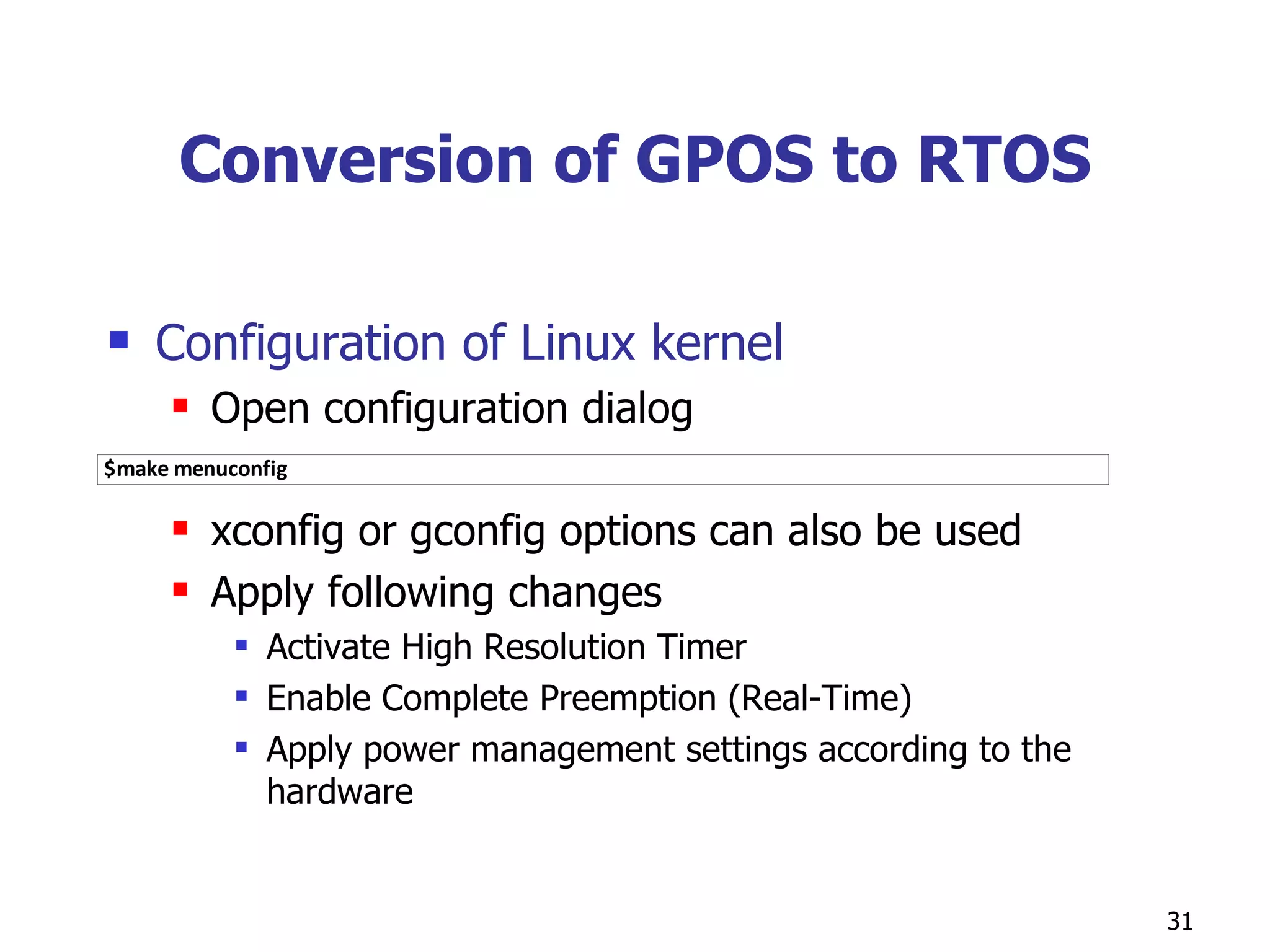
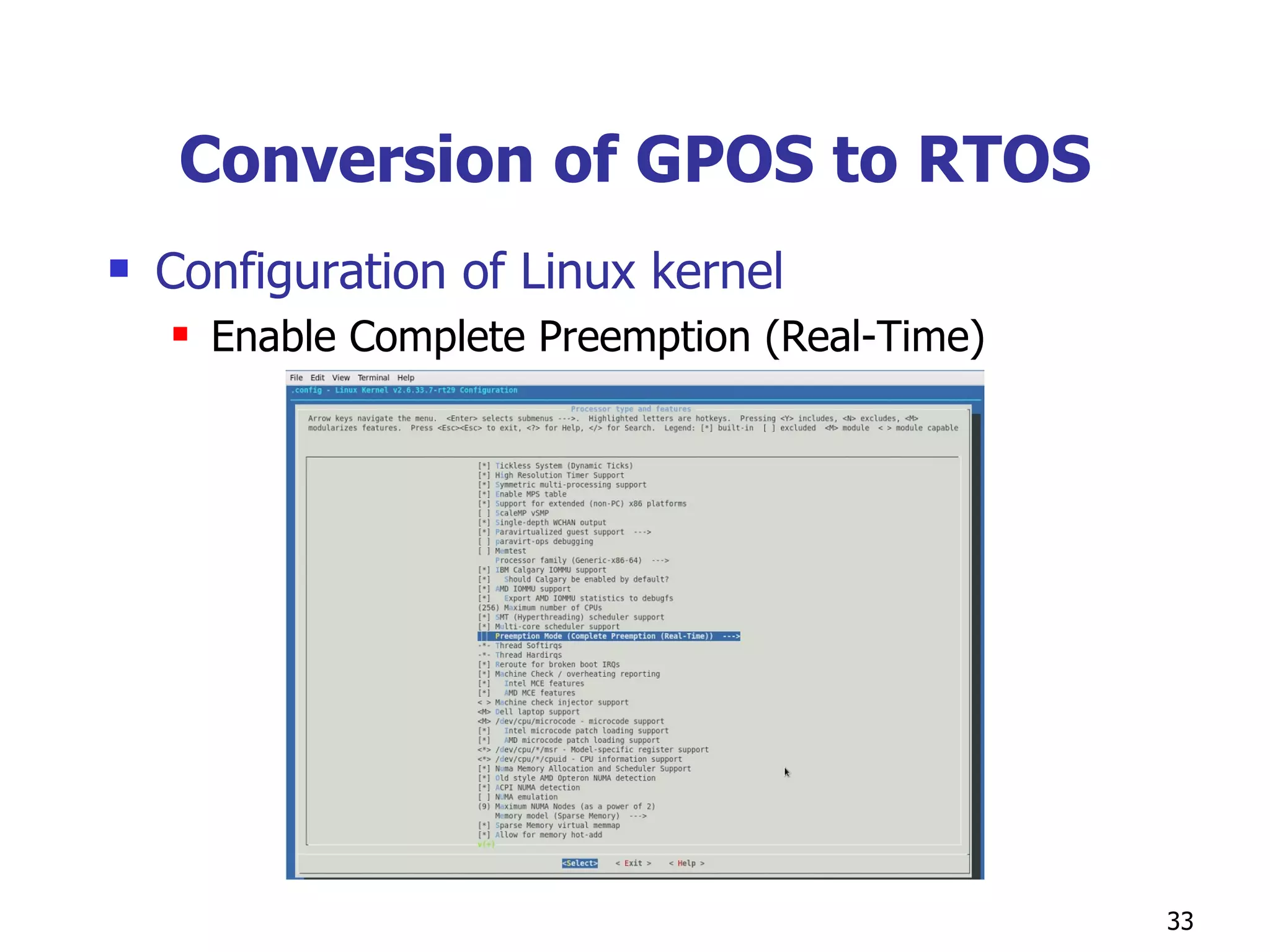
Conversion of GPOS to RTOS Configuration of Linux kernel Open configuration dialog xconfig or gconfig options can also be used Apply following changes Activate High Resolution Timer Enable Complete Preemption (Real-Time) Apply power management settings according to the hardware
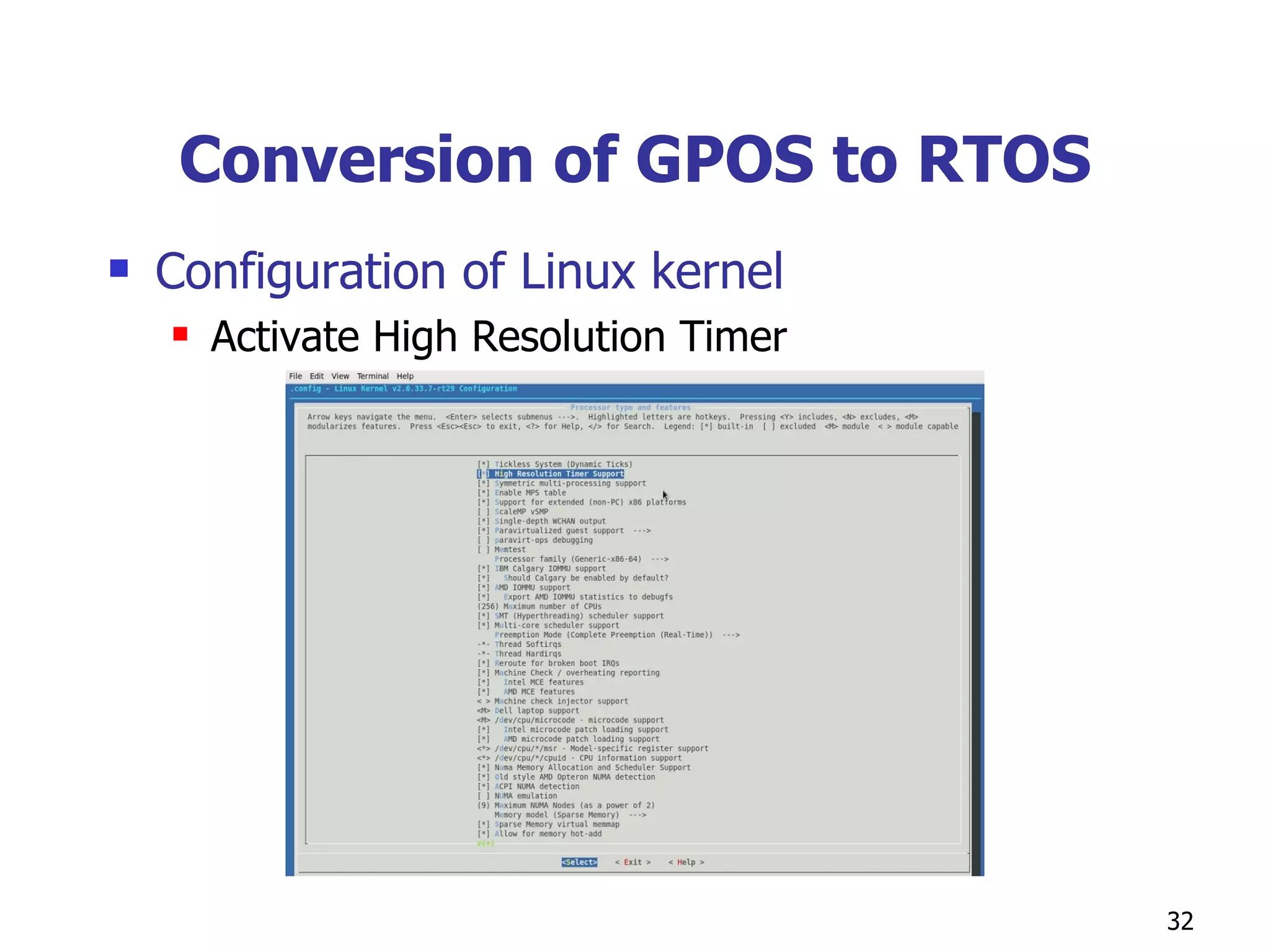
Conversion of GPOS to RTOS Configuration of Linux kernel Activate High Resolution Timer
Conversion of GPOS to RTOS Configuration of Linux kernel Enable Complete Preemption (Real-Time)
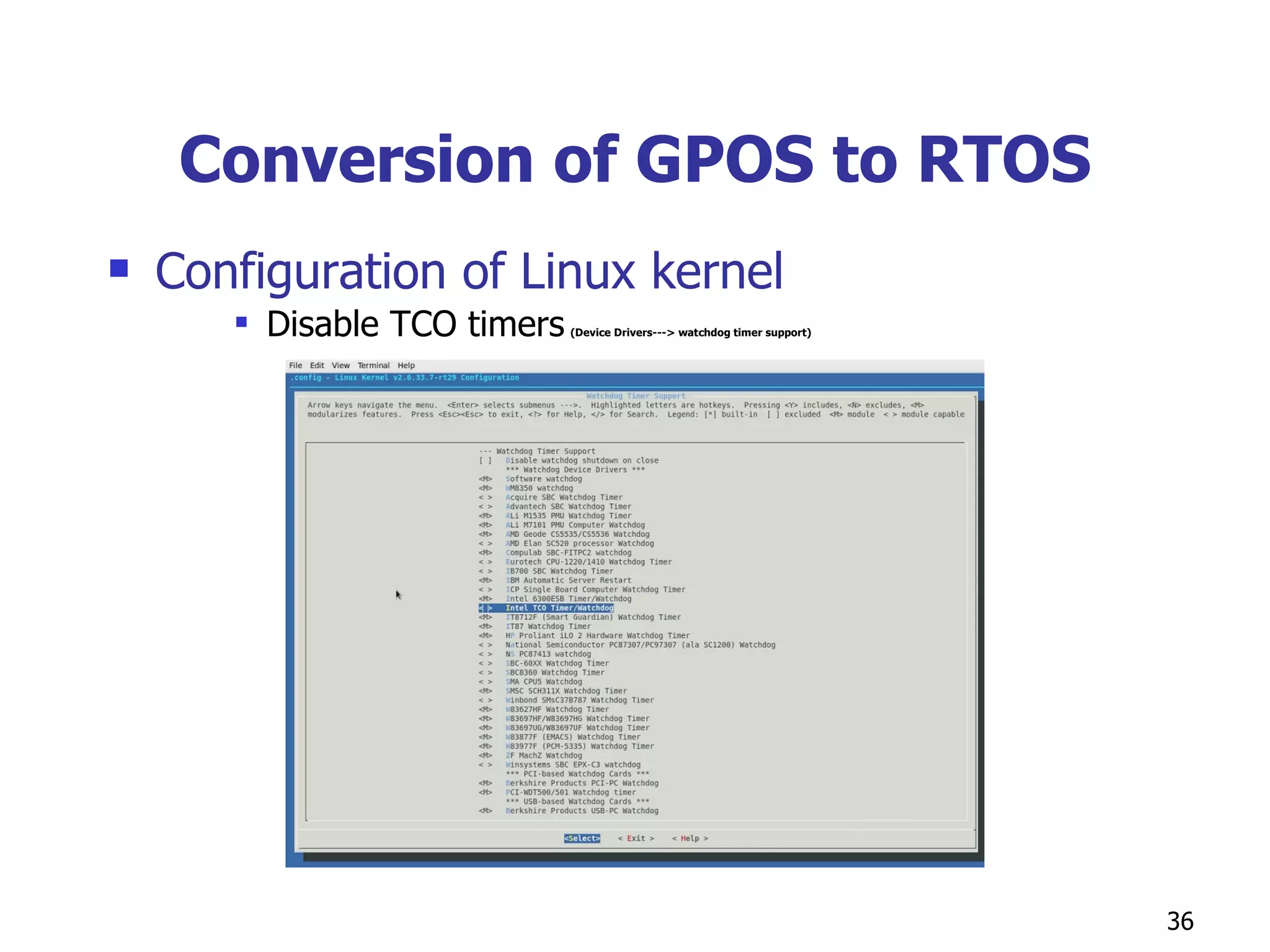
Conversion of GPOS to RTOS Configuration of Linux kernel Power management configuration Some power management options can raise SMI Disabling some options can cause system damage Read every option carefully  Disable optional or unnecessary options Disable CPU frequency scaling Disable USB mouse/keyboard from BIOS Use ps/2 keyboard/mouse Disable TCO timers
Conversion of GPOS to RTOS Configuration of Linux kernel Disable CPU frequency scaling  (Power Management and ACPI Options ->CPU Frequency scaling)
Conversion of GPOS to RTOS Configuration of Linux kernel Disable TCO timers   (Device Drivers---> watchdog timer support)
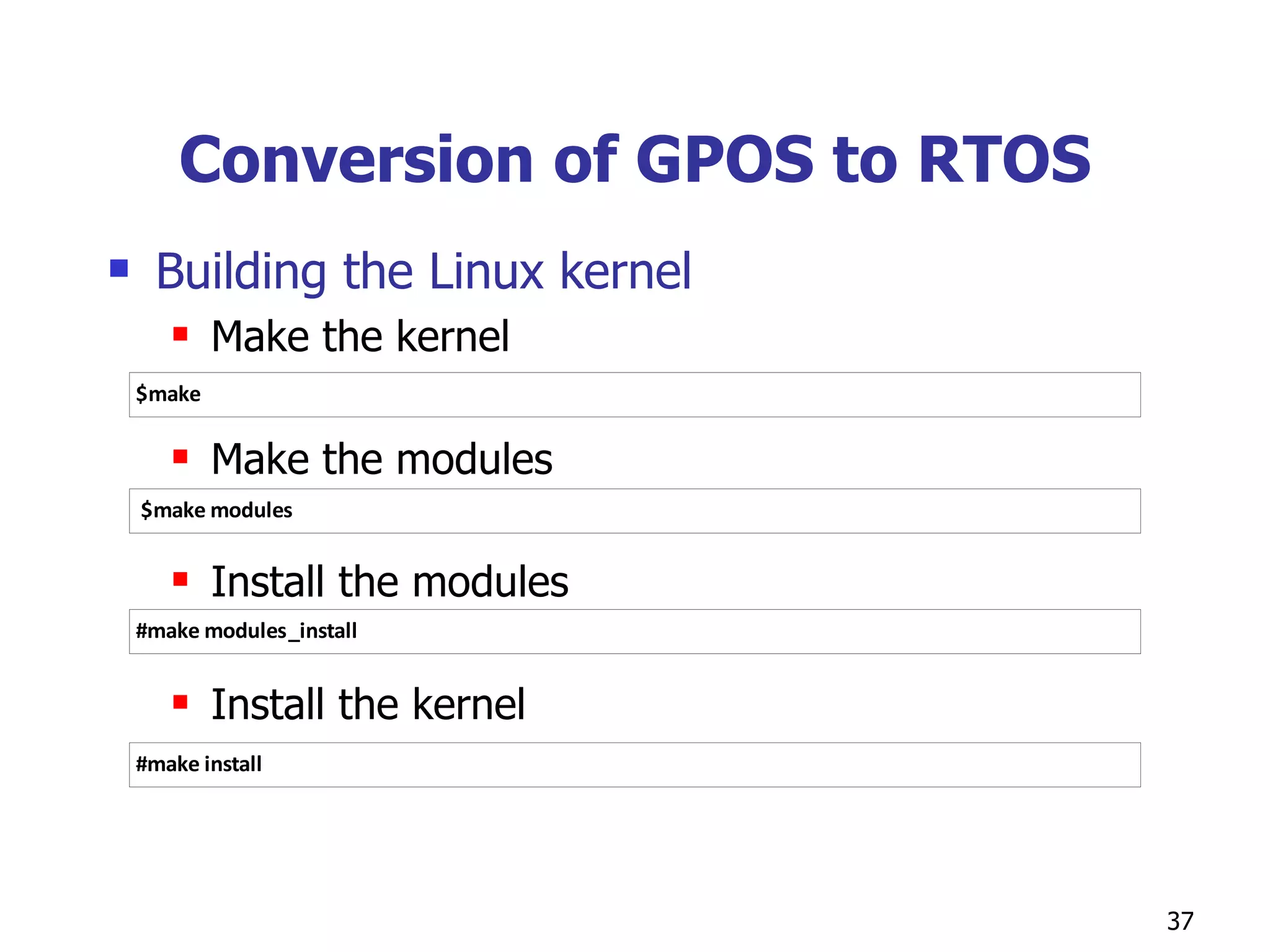
Conversion of GPOS to RTOS Building the Linux kernel Make the kernel Make the modules Install the modules Install the kernel
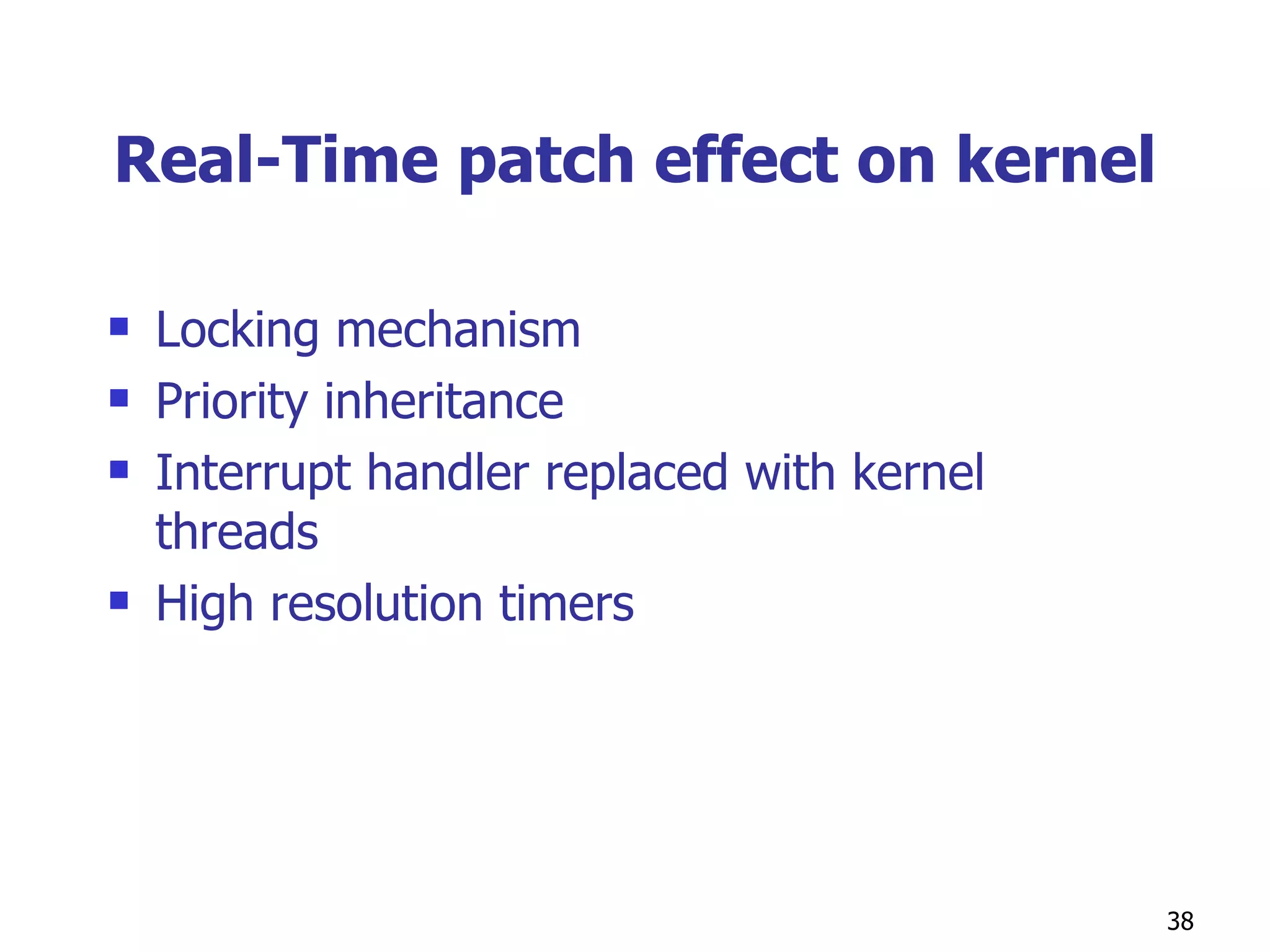
Real-Time patch effect on kernel Locking mechanism Priority inheritance Interrupt handler replaced with kernel threads High resolution timers
Locking mechanism Locks  Prevent the shared resources to be accessed by two active processes simultaneously. Simultaneous access to unprotected shared resources will cause races and Heisen bugs Types of locks  Spin locks Semaphores Readers/writer locks
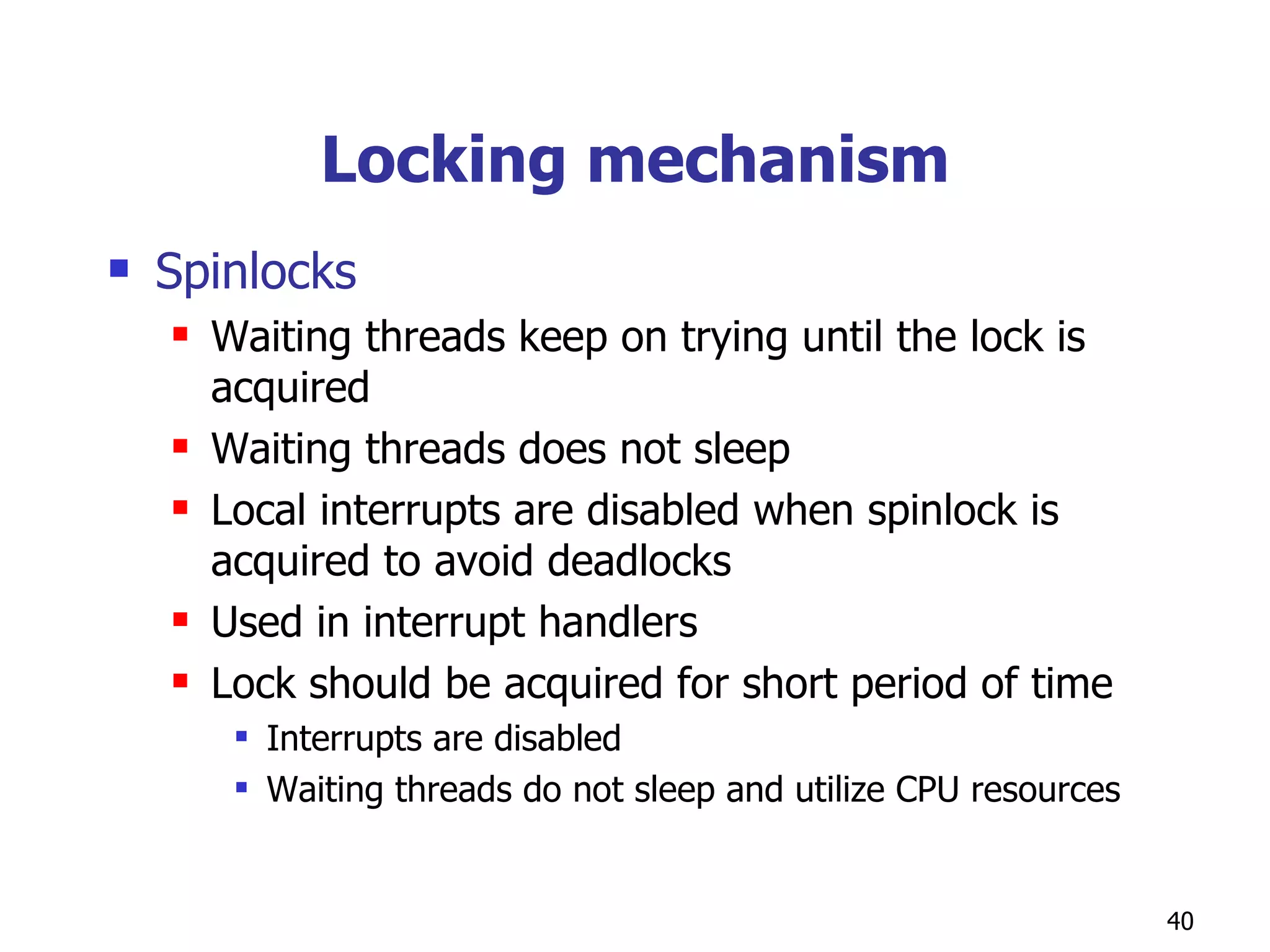
Locking mechanism Spinlocks Waiting threads keep on trying until the lock is acquired Waiting threads does not sleep Local interrupts are disabled when spinlock is acquired to avoid deadlocks Used in interrupt handlers Lock should be acquired for short period of time Interrupts are disabled Waiting threads do not sleep and utilize CPU resources
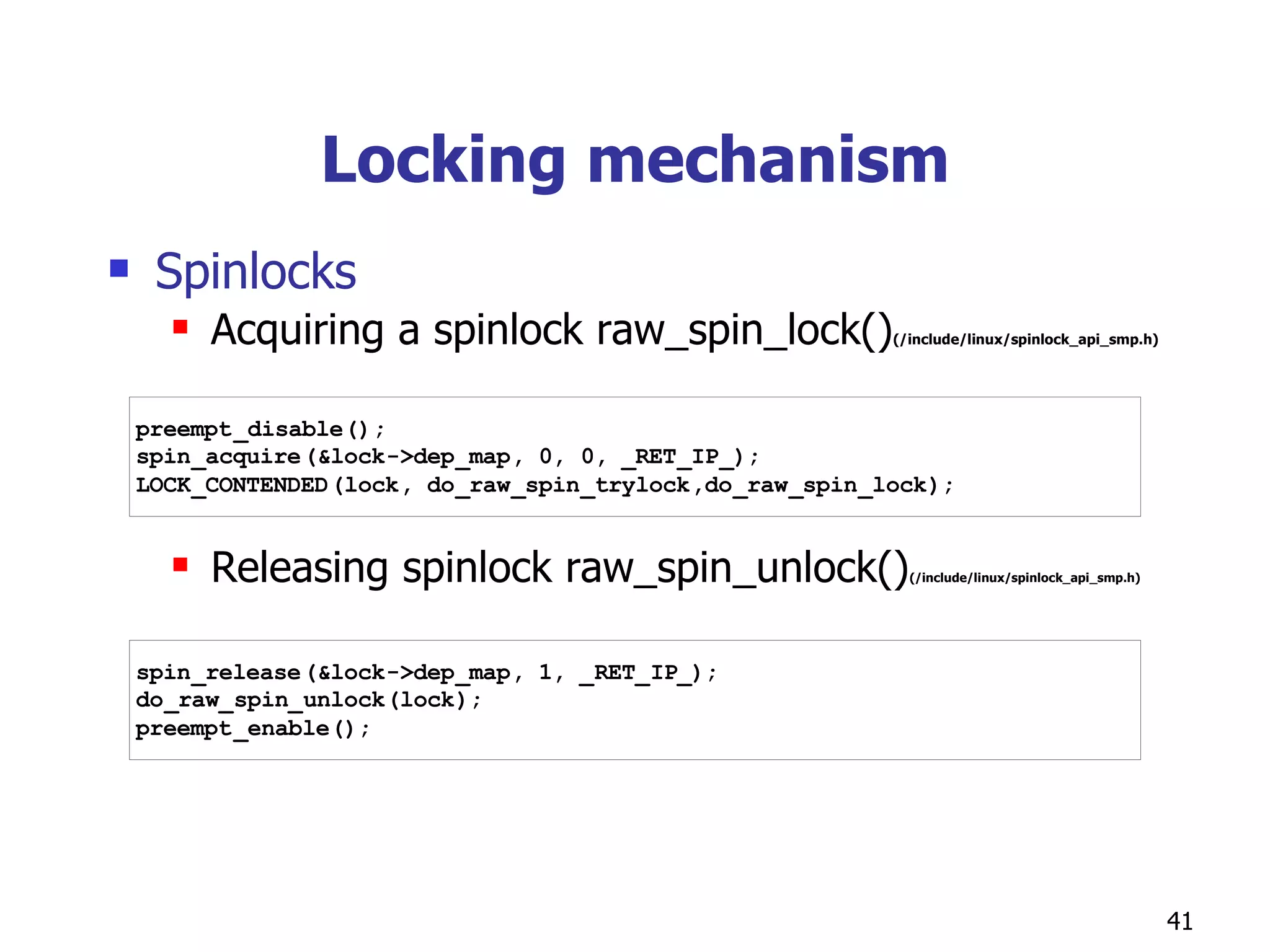
Locking mechanism Spinlocks Acquiring a spinlock raw_spin_lock() (/include/linux/spinlock_api_smp.h) Releasing spinlock raw_spin_unlock() (/include/linux/spinlock_api_smp.h)
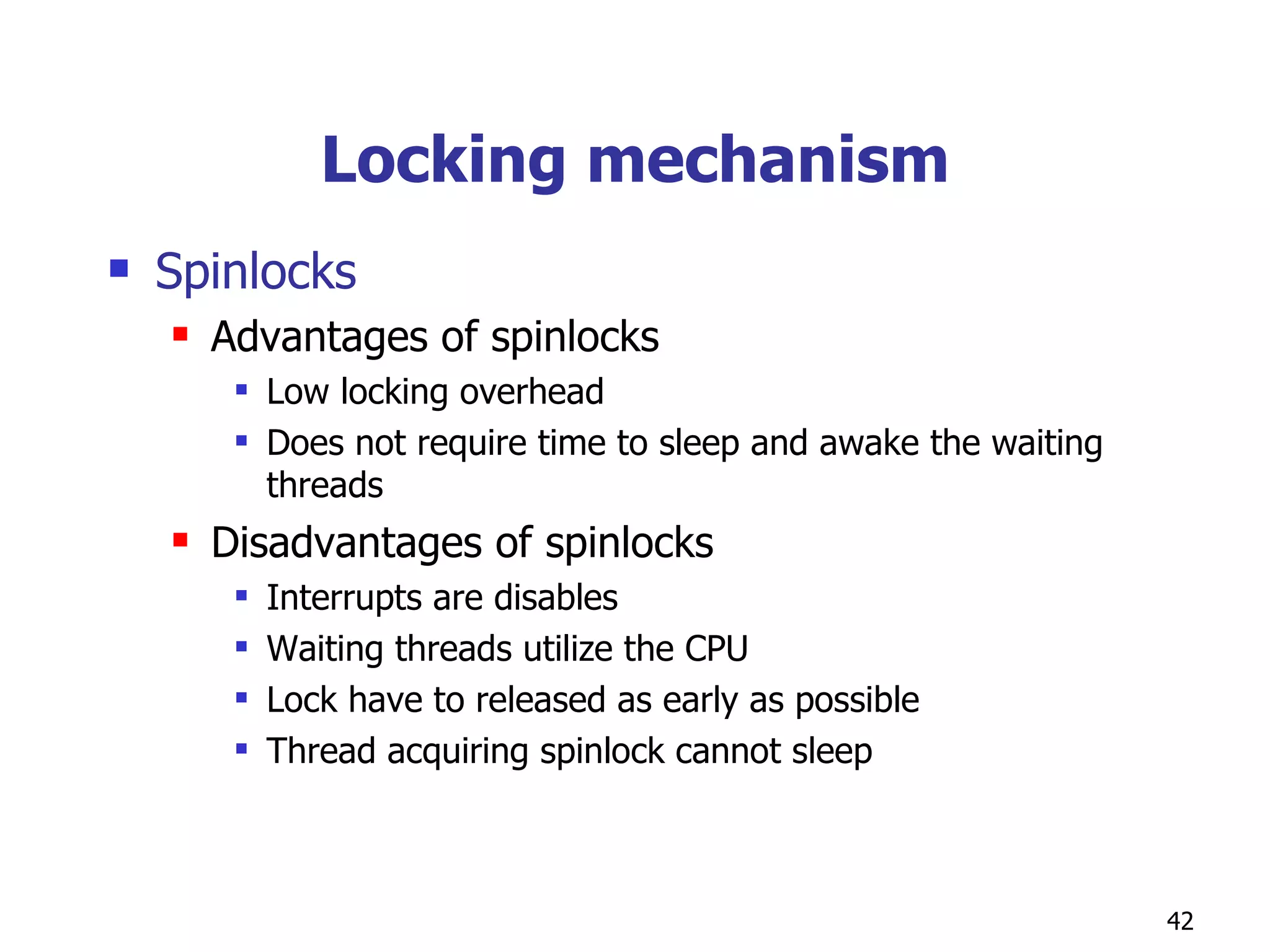
Locking mechanism Spinlocks Advantages of spinlocks Low locking overhead Does not require time to sleep and awake the waiting threads Disadvantages of spinlocks Interrupts are disables Waiting threads utilize the CPU Lock have to released as early as possible Thread acquiring spinlock cannot sleep
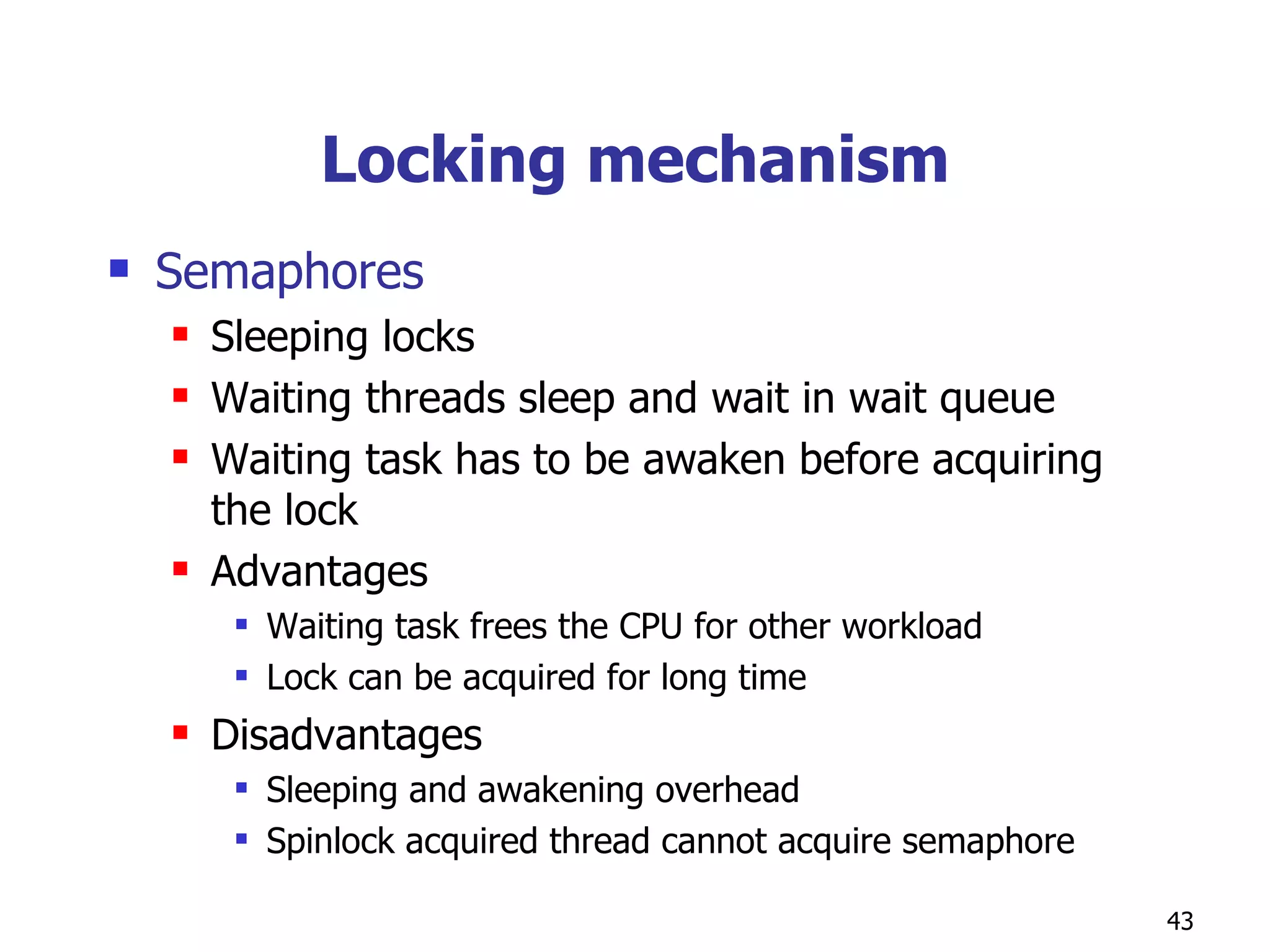
Locking mechanism Semaphores Sleeping locks Waiting threads sleep and wait in wait queue Waiting task has to be awaken before acquiring the lock Advantages Waiting task frees the CPU for other workload Lock can be acquired for long time Disadvantages Sleeping and awakening overhead Spinlock acquired thread cannot acquire semaphore
Locking mechanism Spinlock for RT application – A potential problem Unpredictable in nature Time to acquire lock for waiting thread is dependent on the thread that currently holds the lock OS cannot force the lock holder thread to release the lock Non-preemptive sections of Linux kernel Spinlocks disables local interrupts
Locking mechanism Solution for RT behavior Replace spinlock with mutex if possible Advantages Mutex is a binary semaphore Deterministic in nature Can be preempted by high priority task
Locking mechanism Spinlocks are unavoidable at low level Example: Implementation of mutex Spinlock usage in RT kernel is just a fraction to that of stock kernel Reduction in usage reduces probability to contend the same spinlock by two different threads
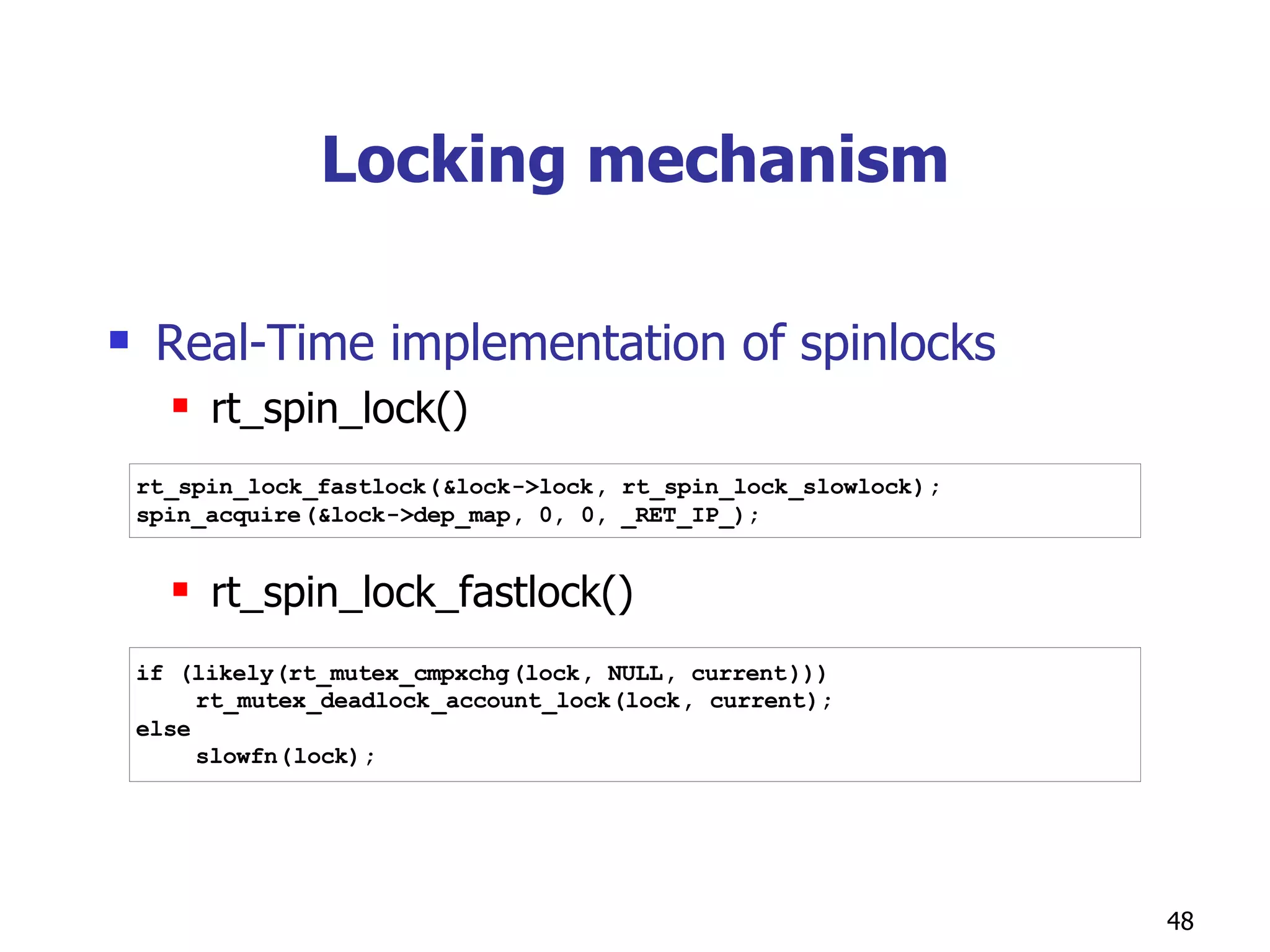
Locking mechanism Real-Time implementation of spinlocks rt_spin_lock() rt_spin_lock_fastlock()
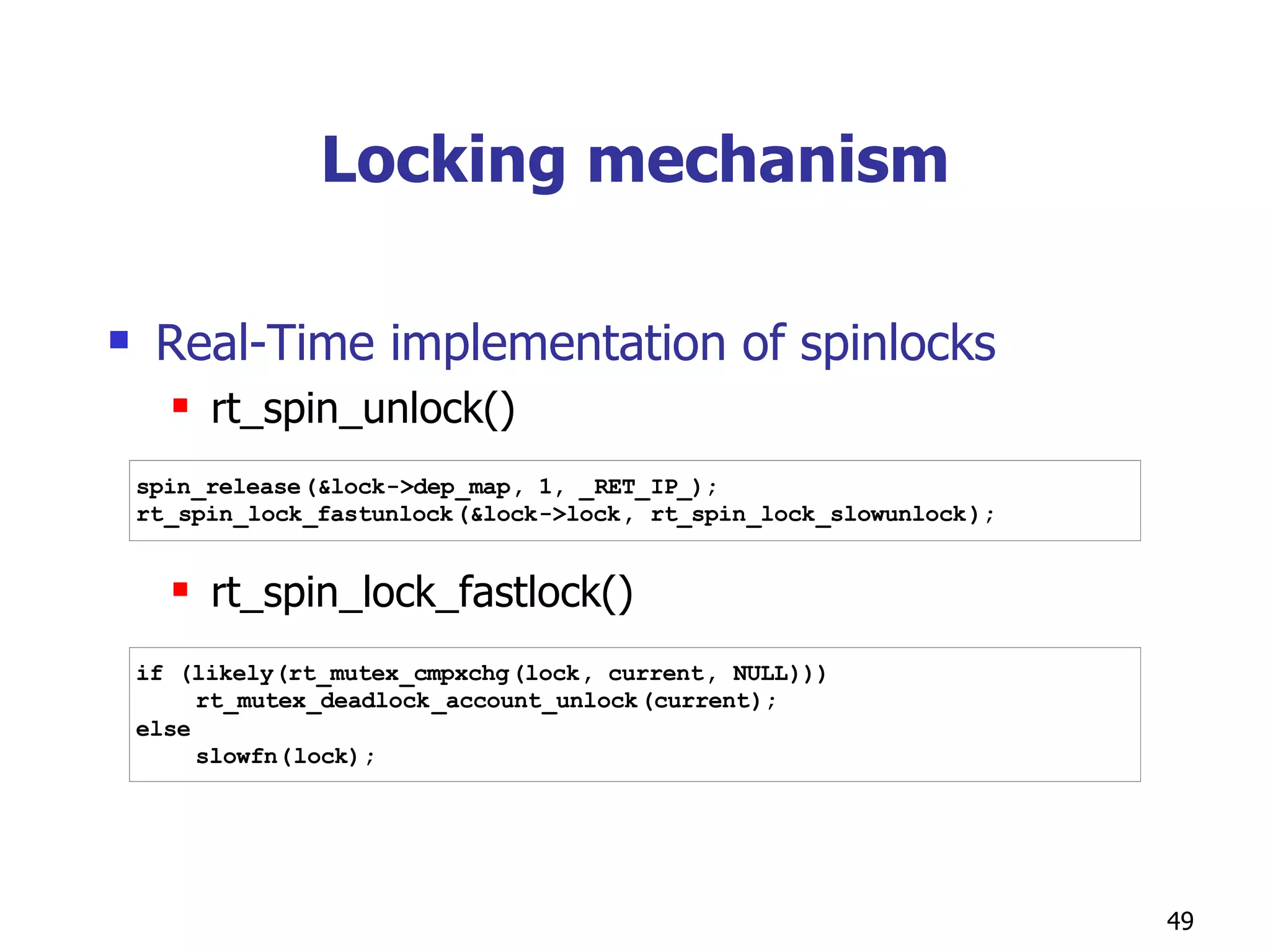
Locking mechanism Real-Time implementation of spinlocks rt_spin_unlock() rt_spin_lock_fastlock()
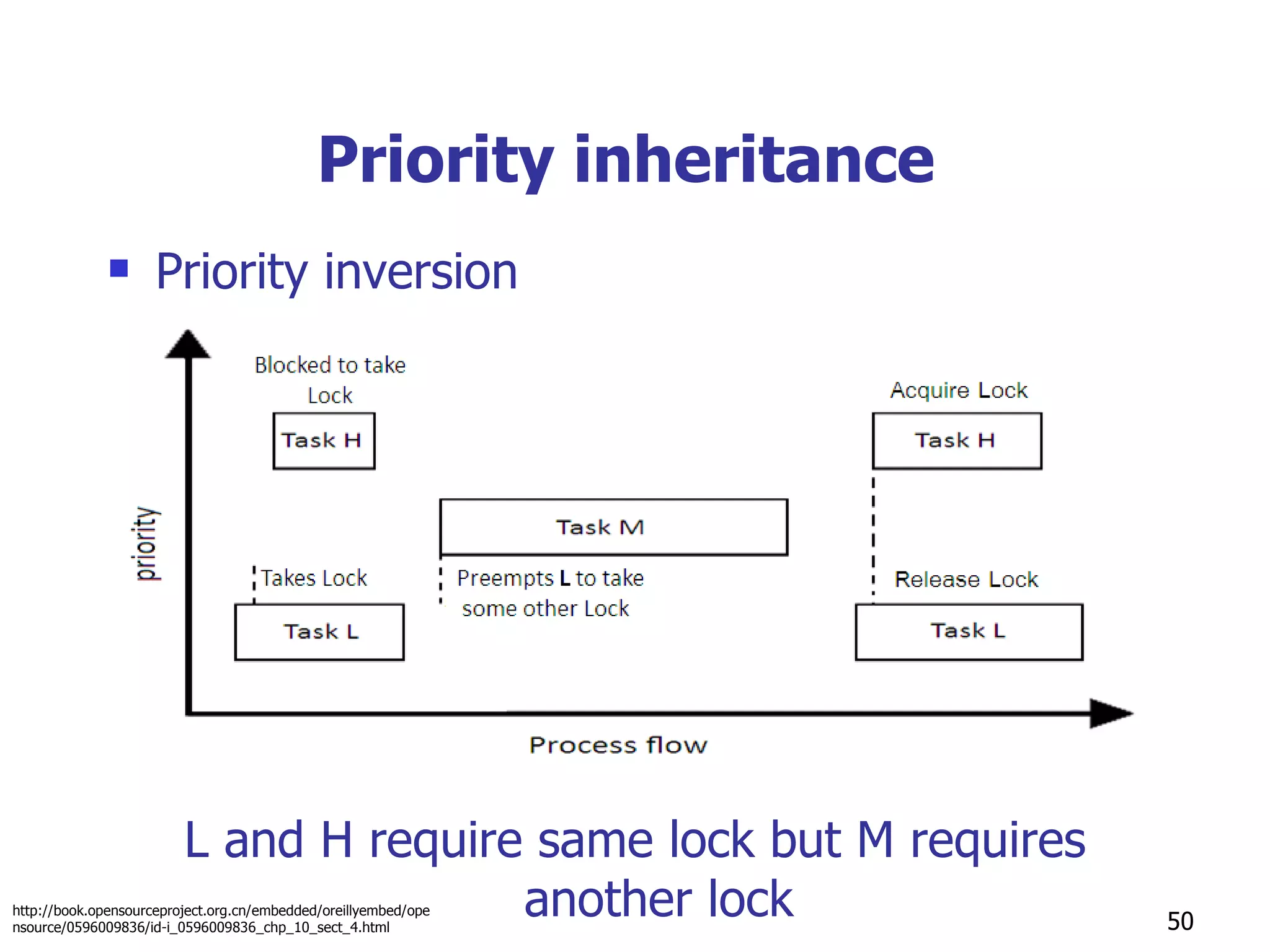
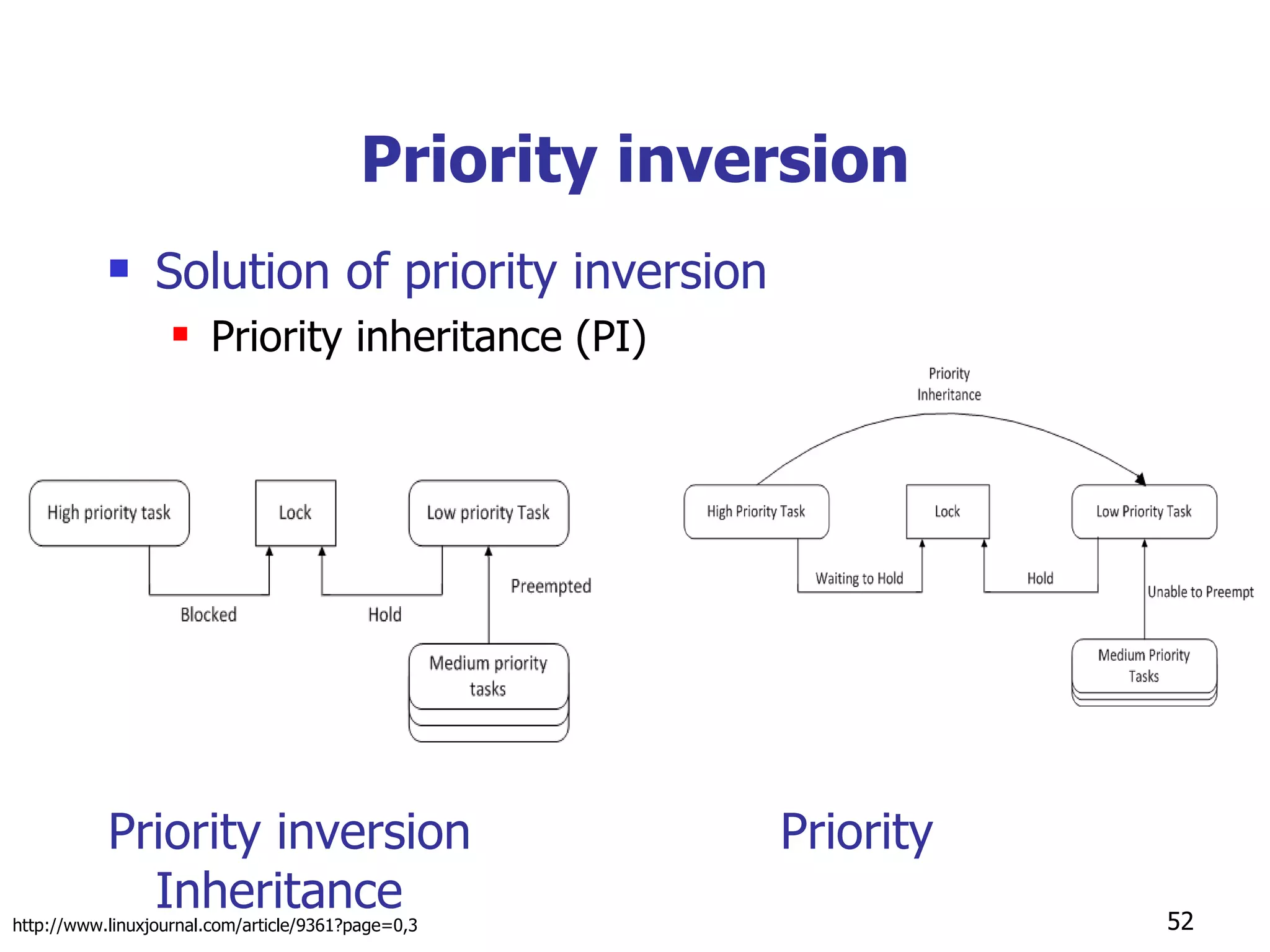
Priority inheritance  Priority inversion L and H require same lock but M requires another lock http://book.opensourceproject.org.cn/embedded/oreillyembed/opensource/0596009836/id-i_0596009836_chp_10_sect_4.html
Priority inheritance  Priority inversion Priority inversion may not be noticeable in GPOS High priority tasks may get starved of resources in GPOS due to priority inversion High priority task should be executed as early as possible
Priority inversion Solution of priority inversion Priority inheritance (PI)  Priority inversion  Priority Inheritance http://www.linuxjournal.com/article/9361?page=0,3
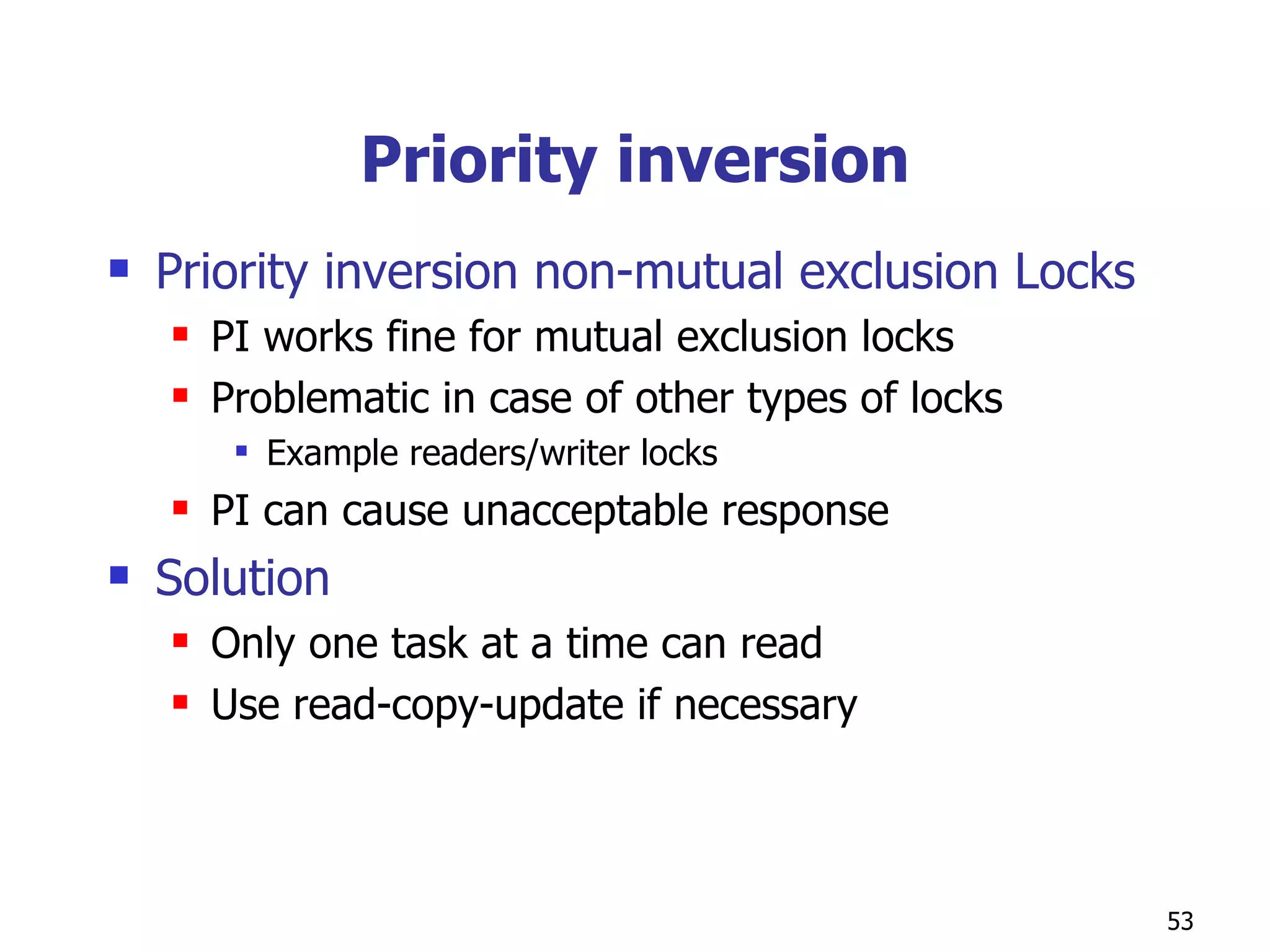
Priority inversion Priority inversion non-mutual exclusion Locks PI works fine for mutual exclusion locks Problematic in case of other types of locks  Example readers/writer locks PI can cause unacceptable response Solution Only one task at a time can read Use read-copy-update if necessary
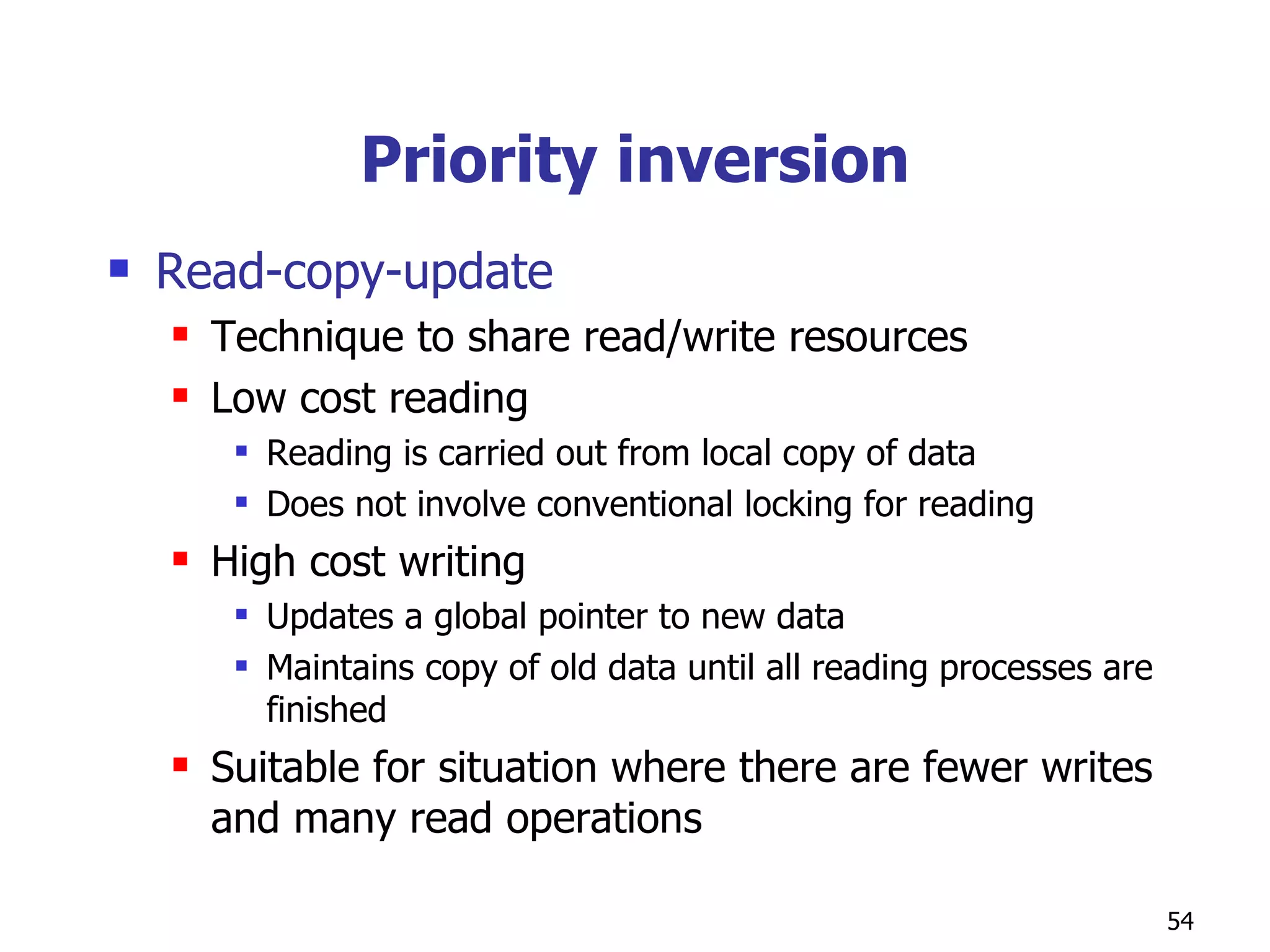
Priority inversion Read-copy-update Technique to share read/write resources Low cost reading Reading is carried out from local copy of data Does not involve conventional locking for reading High cost writing Updates a global pointer to new data Maintains copy of old data until all reading processes are finished Suitable for situation where there are fewer writes and many read operations
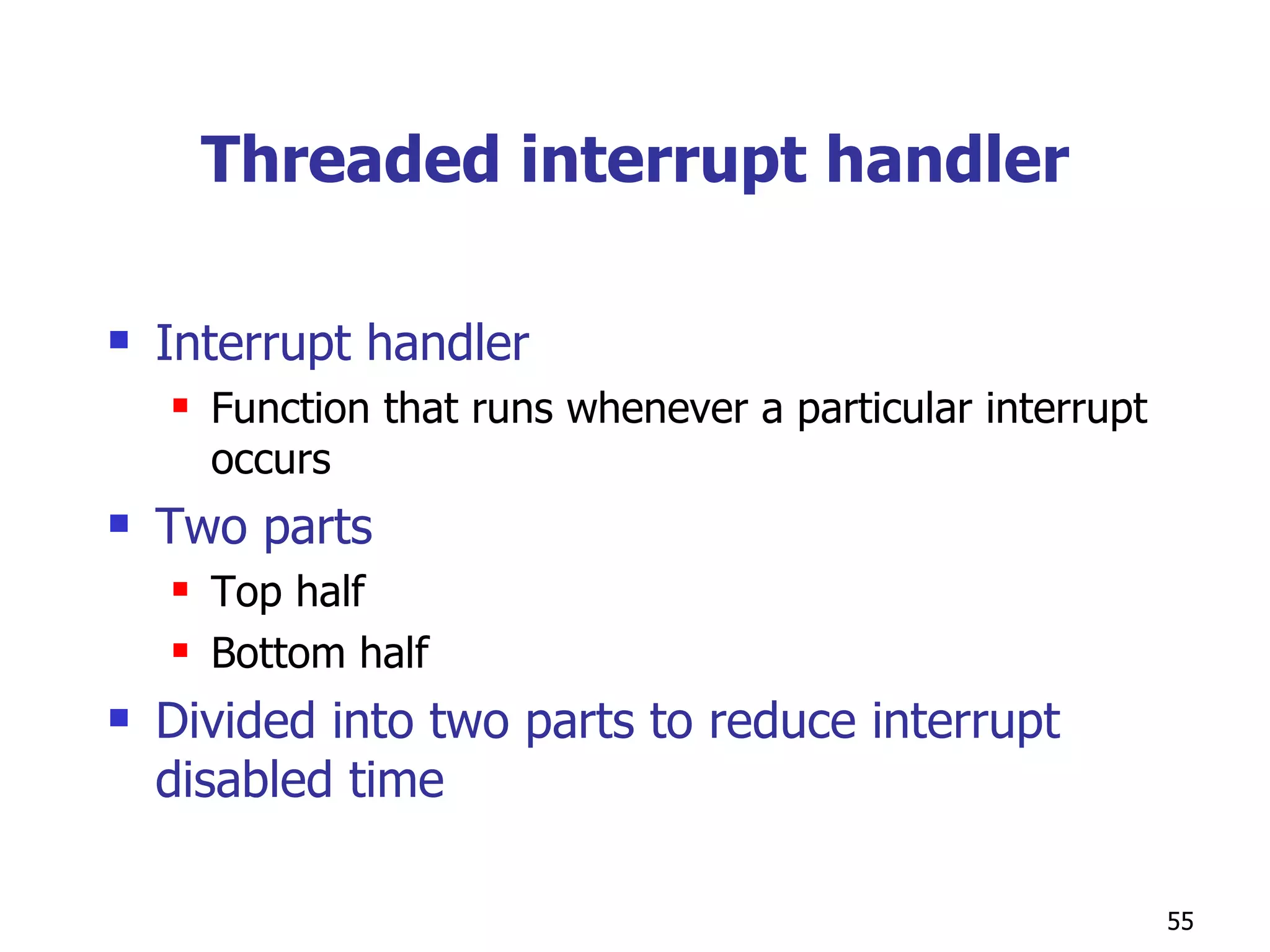
Threaded interrupt handler Interrupt handler Function that runs whenever a particular interrupt occurs Two parts Top half Bottom half Divided into two parts to reduce interrupt disabled time
Threaded interrupt handler Top half Performs essential services to hardware Works with interrupts disabled Gathers raw data Performs critical time sensitive work Bottom half Performs time consuming tasks Processes raw data
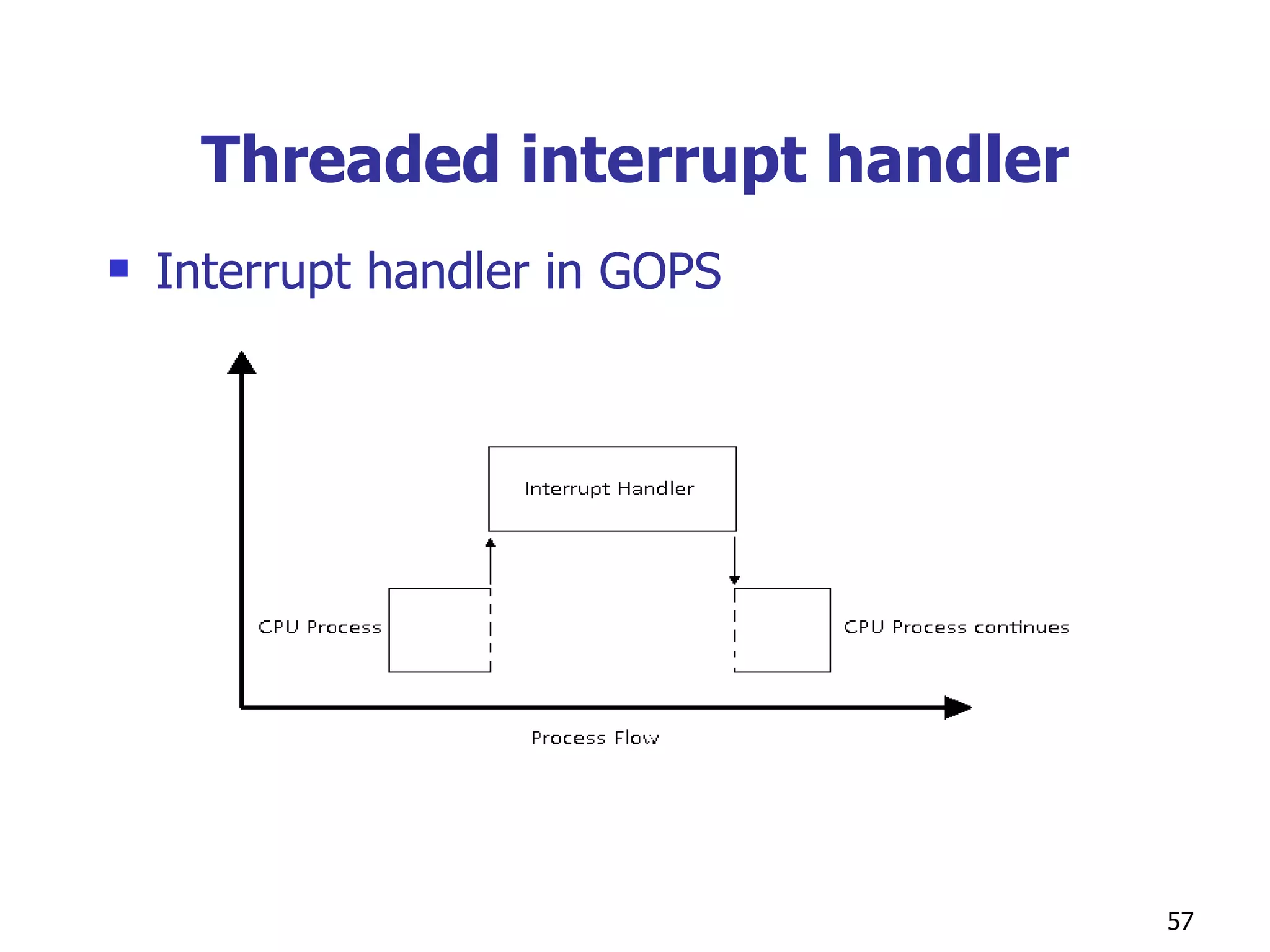
Threaded interrupt handler Interrupt handler in GOPS
Threaded interrupt handler Interrupt handler in GOPS Kernel identifies the interrupt Calls interrupt handler CPU jumps to a particular location Executes top half Raise softirq and returns to pre-interrupt position This behavior is not acceptable in RTOS Cause unpredictability and long latencies Local interrupts are disabled for longer time
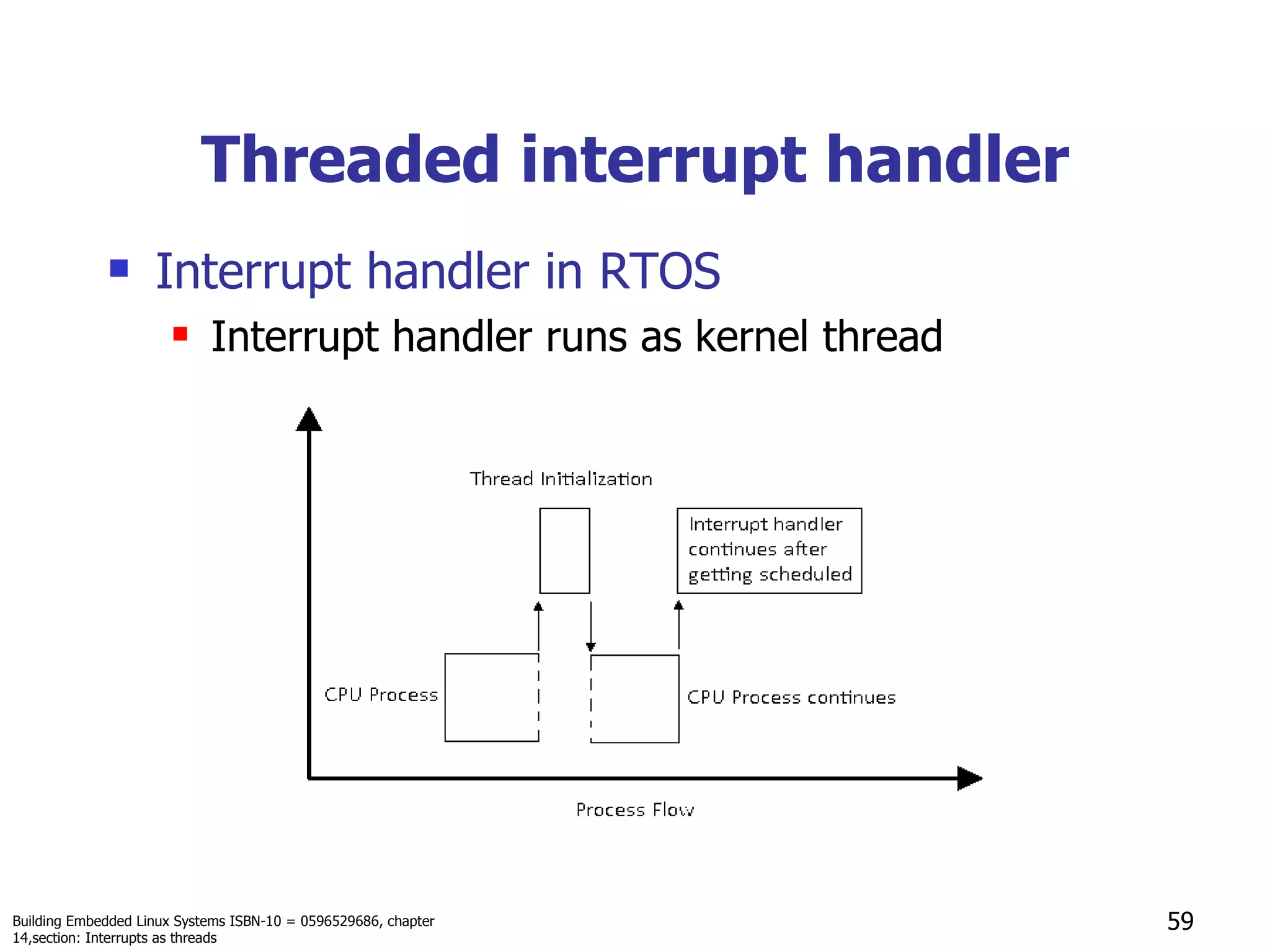
Threaded interrupt handler Interrupt handler in RTOS Interrupt handler runs as kernel thread Building Embedded Linux Systems ISBN-10 = 0596529686, chapter 14,section: Interrupts as threads
Threaded interrupt handler Interrupt handler in RTOS Top half identifies the interrupt Sends acknowledgement Initializes kernel thread Rest of task is performed as kernel thread A few interrupts are still handled conventionally Threaded interrupt handler are also available in stock Linux kernel
Threaded interrupt handler Advantages of conversion of handler to kernel thread Preemptable interrupt handler Reduces interrupt blocked time  Reduces probability of priority inversion Handlers scheduling can be controlled by assigning a priority number to it Reduces unpredictable latencies
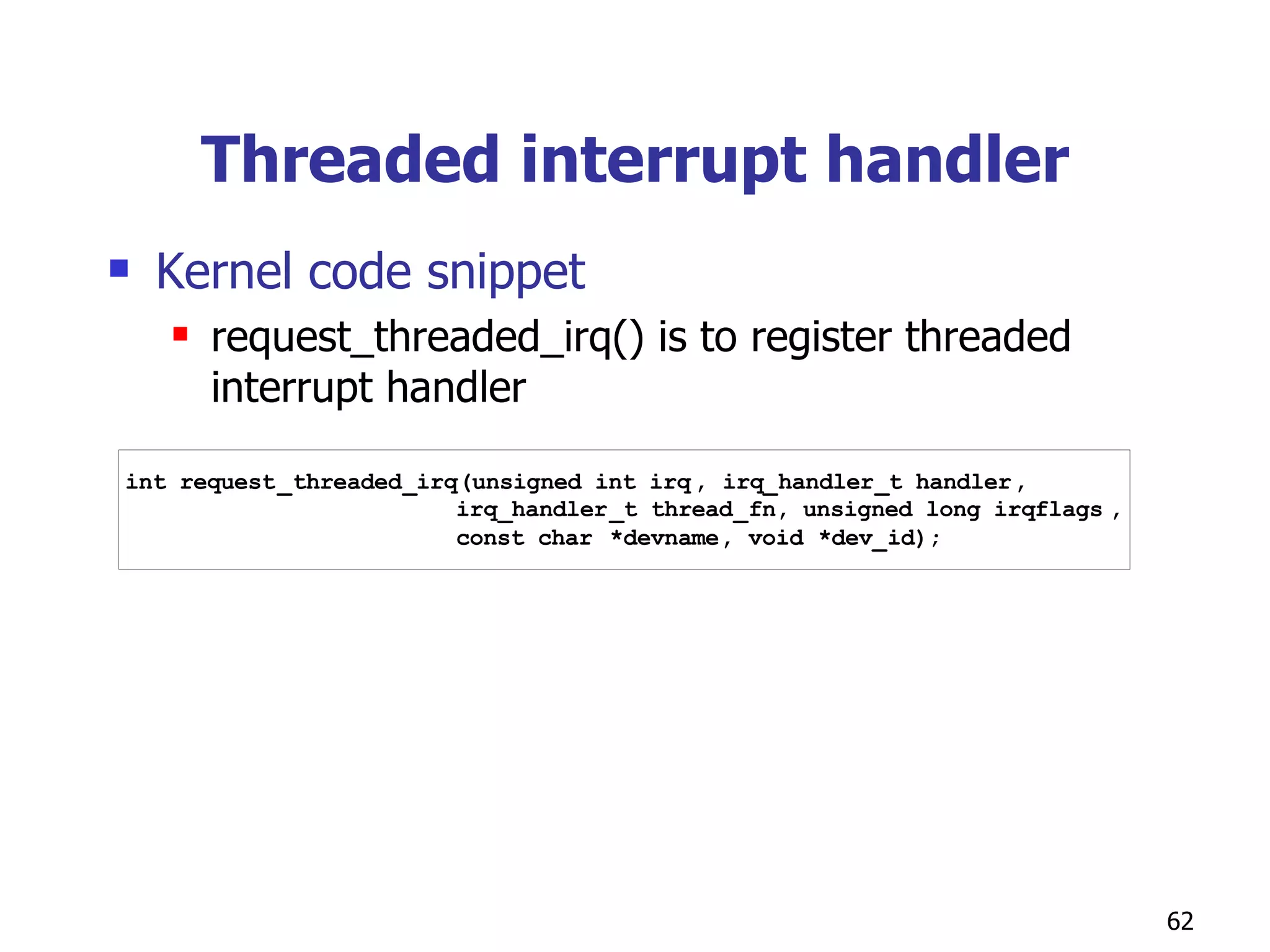
Threaded interrupt handler Kernel code snippet request_threaded_irq() is to register threaded interrupt handler
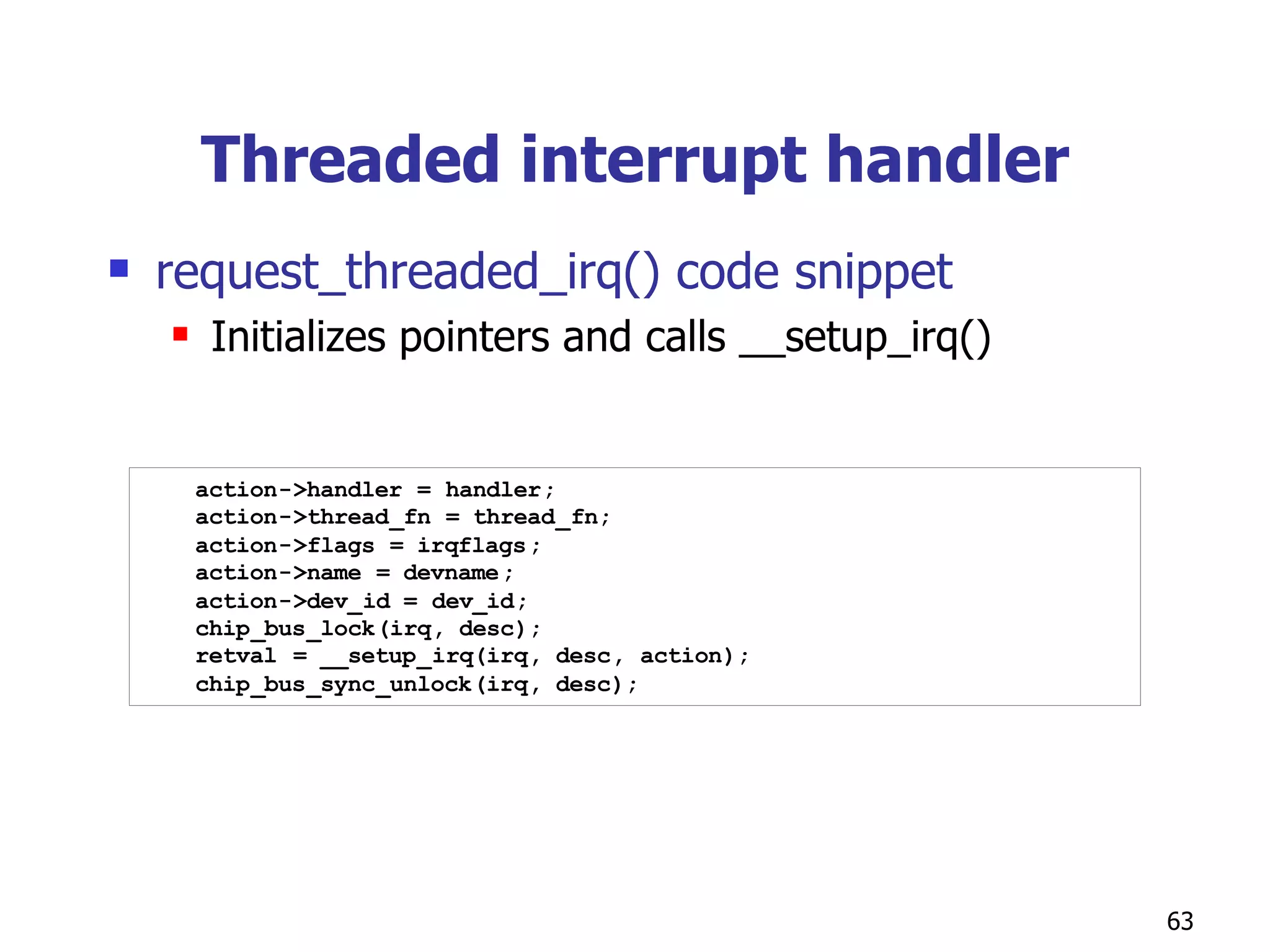
Threaded interrupt handler request_threaded_irq() code snippet Initializes pointers and calls __setup_irq()
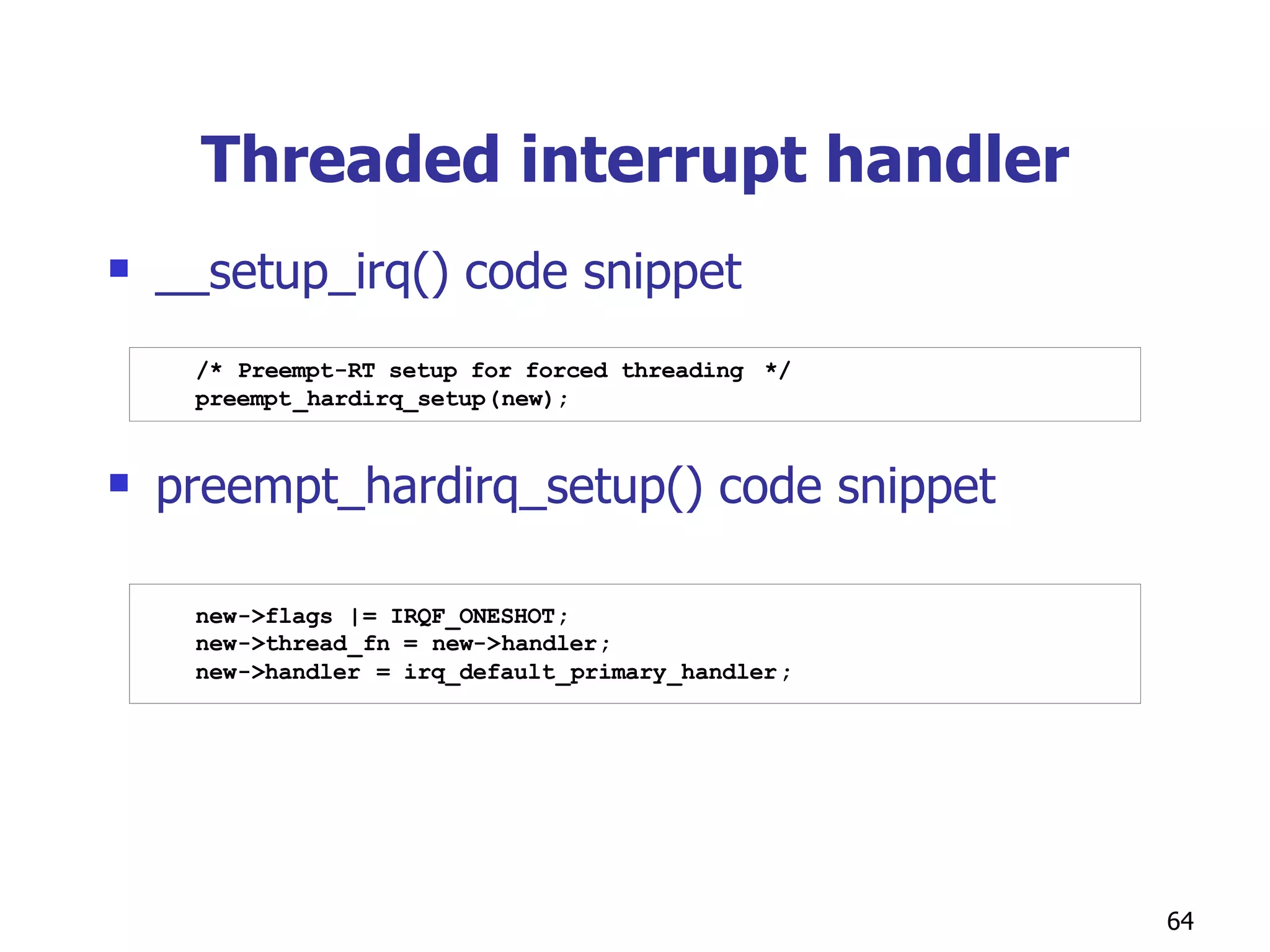
Threaded interrupt handler __setup_irq() code snippet preempt_hardirq_setup() code snippet
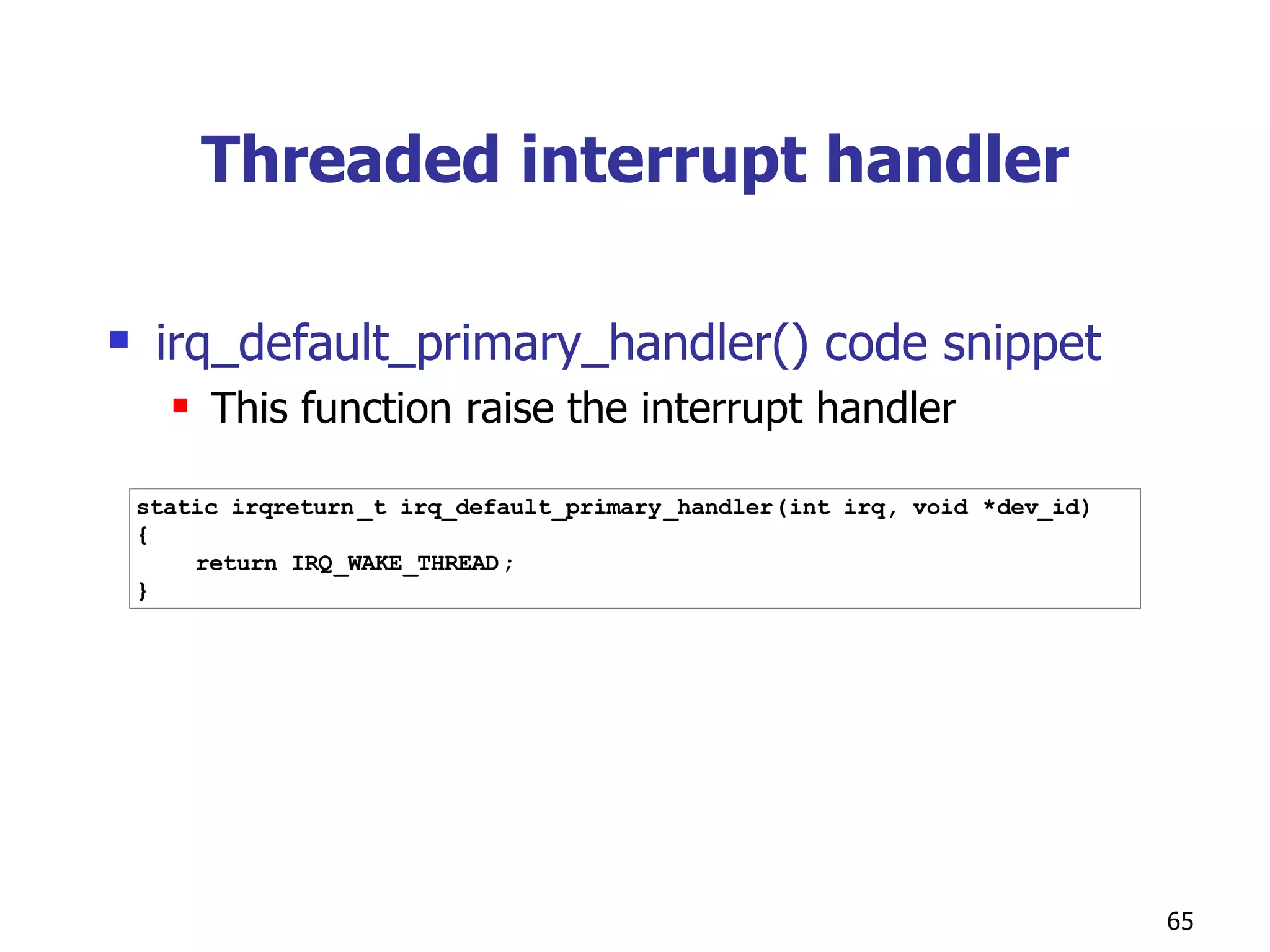
Threaded interrupt handler irq_default_primary_handler() code snippet This function raise the interrupt handler
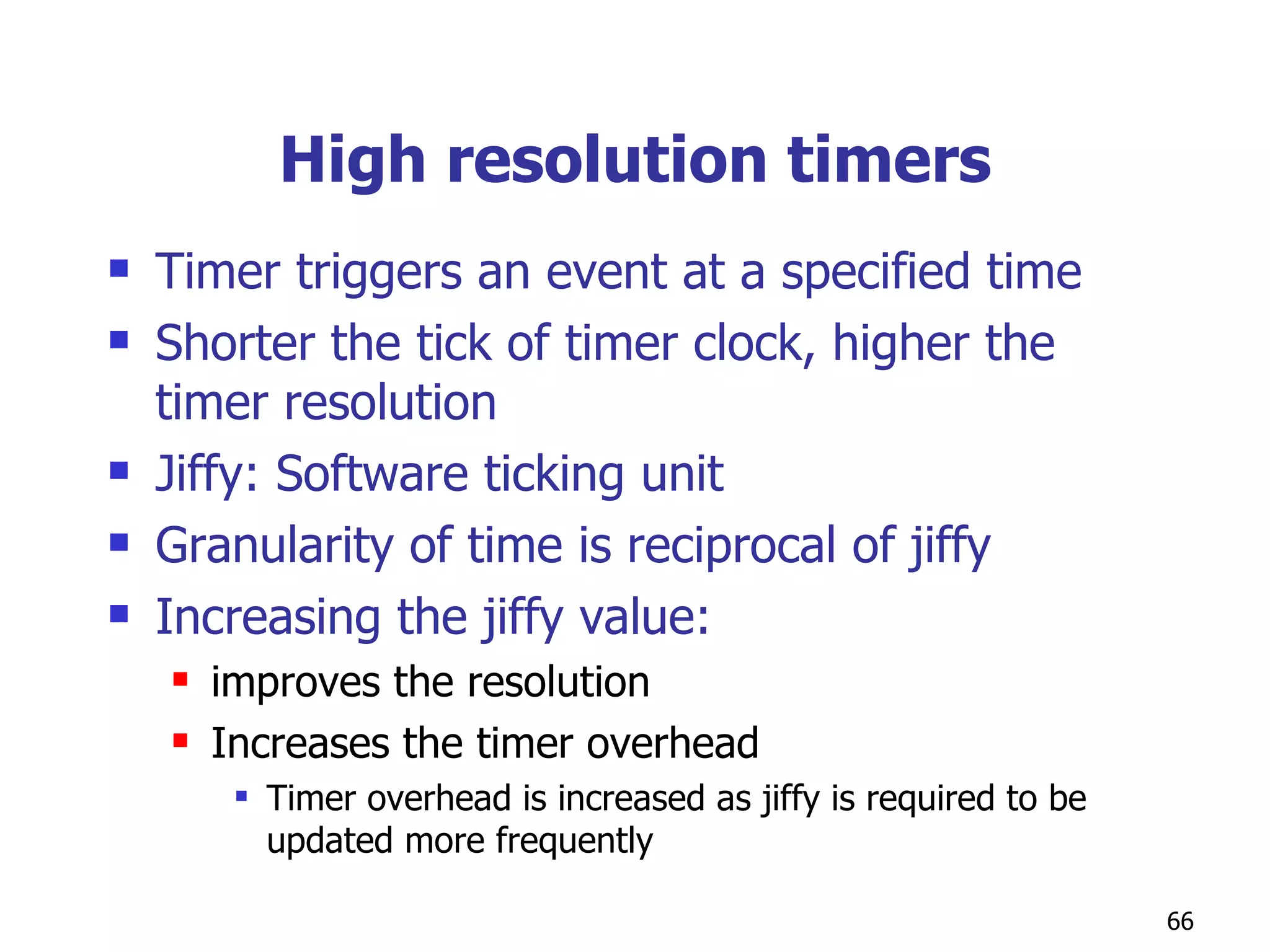
High resolution timers Timer triggers an event at a specified time Shorter the tick of timer clock, higher the timer resolution  Jiffy: Software ticking unit  Granularity of time is reciprocal of jiffy Increasing the jiffy value:  improves the resolution Increases the timer overhead Timer overhead is increased as jiffy is required to be updated more frequently
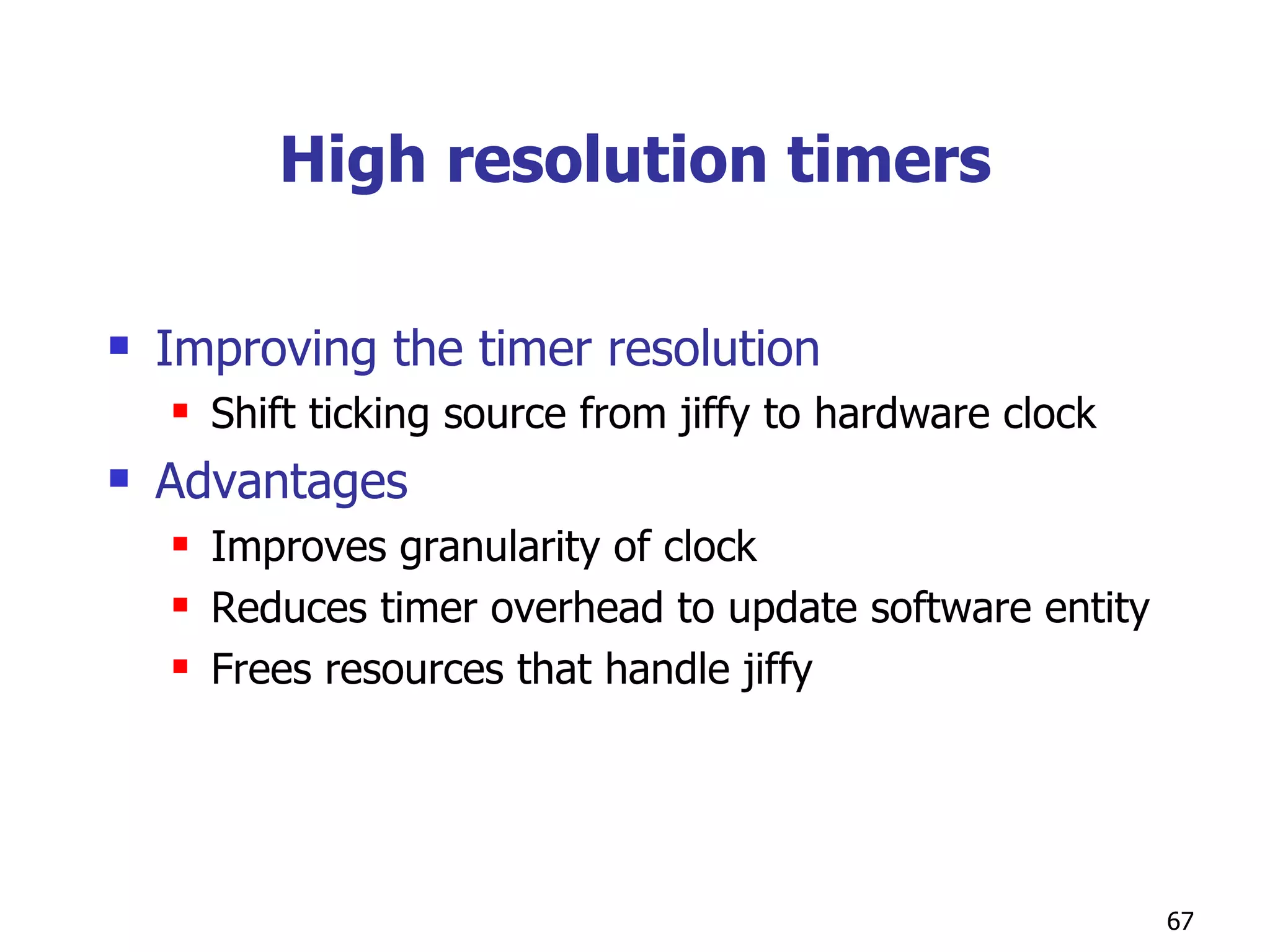
High resolution timers Improving the timer resolution Shift ticking source from jiffy to hardware clock Advantages Improves granularity of clock Reduces timer overhead to update software entity Frees resources that handle jiffy
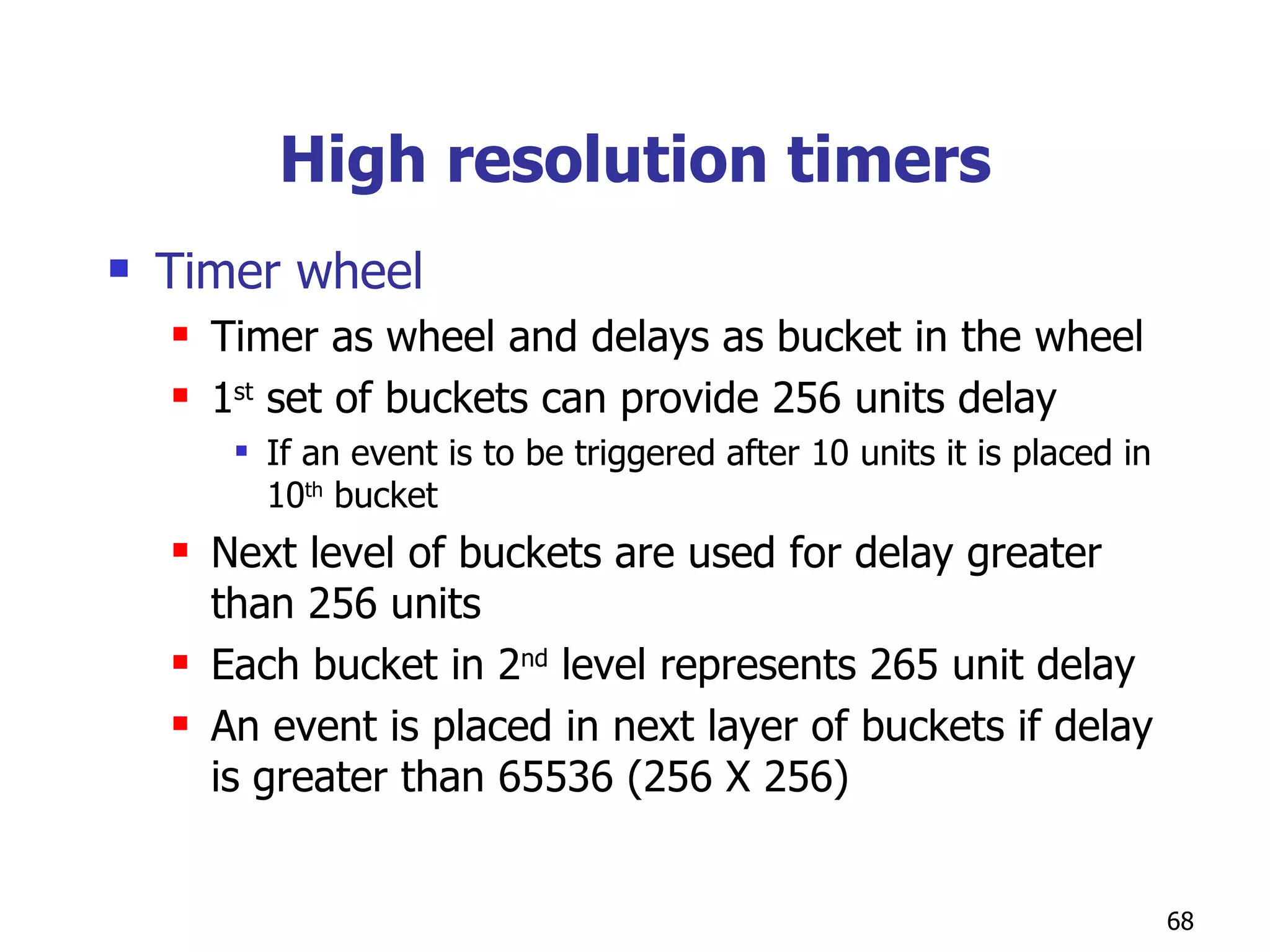
High resolution timers Timer wheel Timer as wheel and delays as bucket in the wheel 1 st  set of buckets can provide 256 units delay If an event is to be triggered after 10 units it is placed in 10 th  bucket Next level of buckets are used for delay greater than 256 units Each bucket in 2 nd  level represents 265 unit delay An event is placed in next layer of buckets if delay is greater than 65536 (256 X 256)
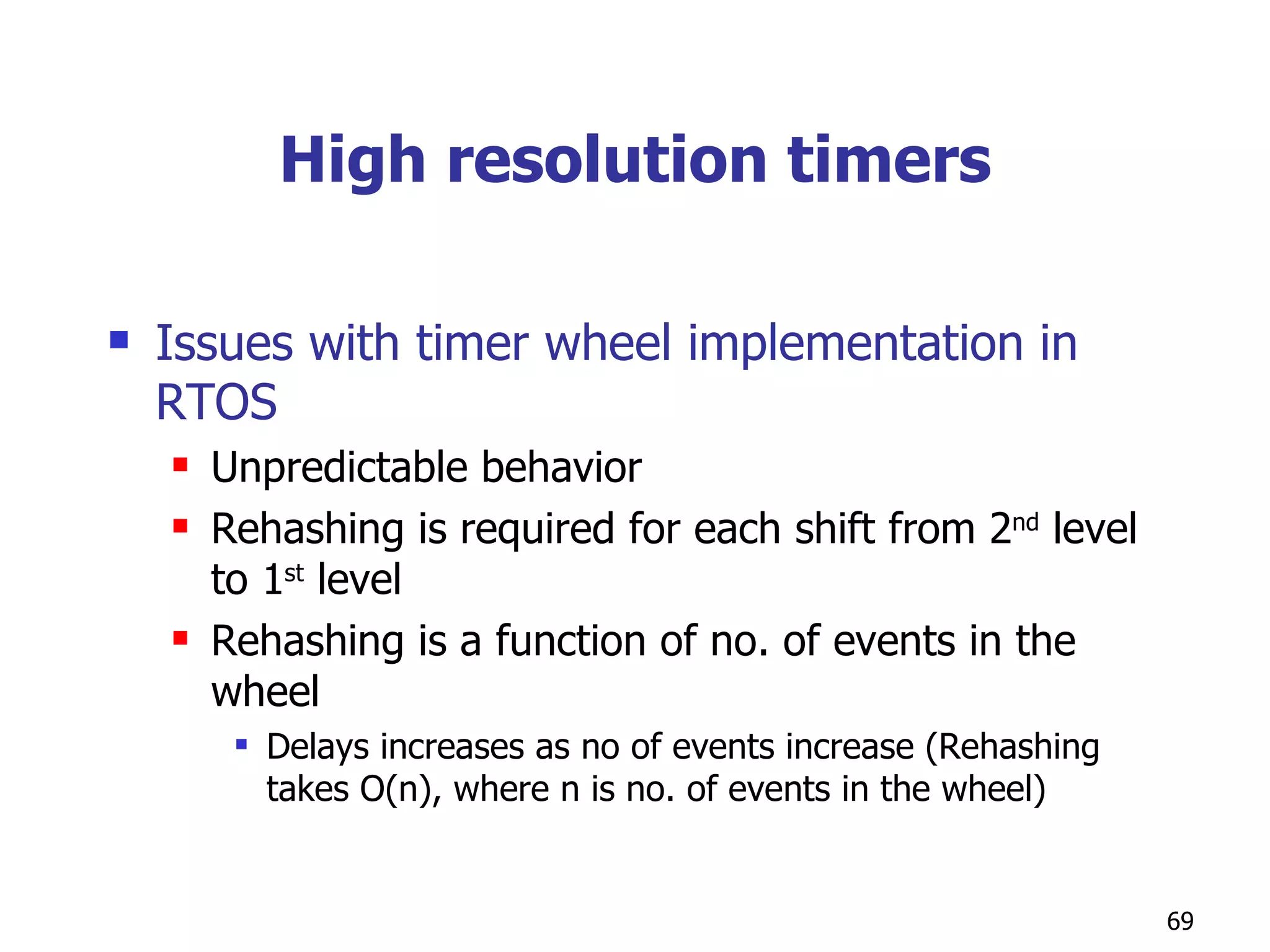
High resolution timers Issues with timer wheel implementation in RTOS Unpredictable behavior Rehashing is required for each shift from 2 nd  level to 1 st  level Rehashing is a function of no. of events in the wheel Delays increases as no of events increase (Rehashing takes O(n), where n is no. of events in the wheel)
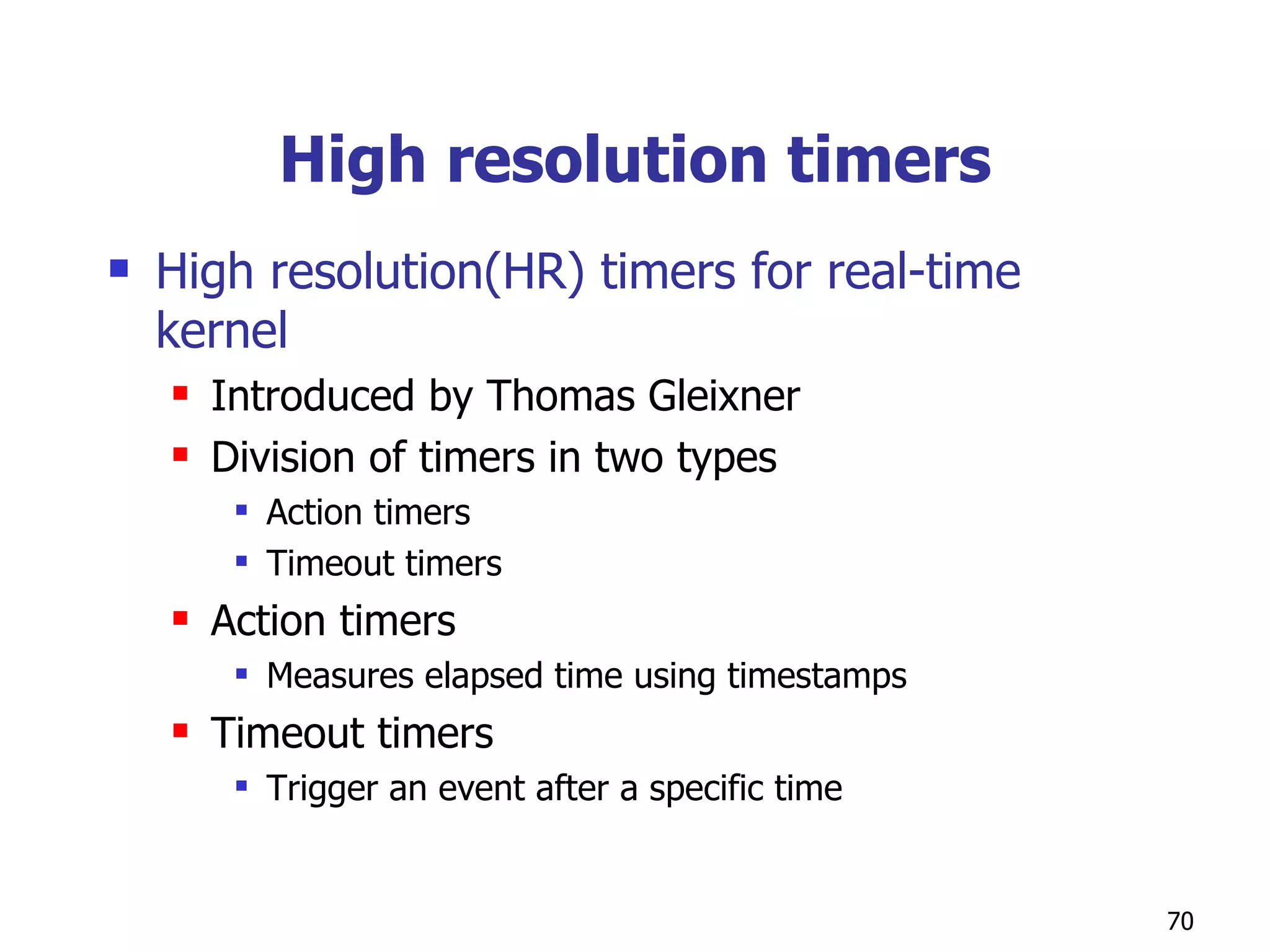
High resolution timers High resolution(HR) timers for real-time kernel Introduced by Thomas Gleixner  Division of timers in two types Action timers Timeout timers Action timers Measures elapsed time using timestamps Timeout timers Trigger an event after a specific time
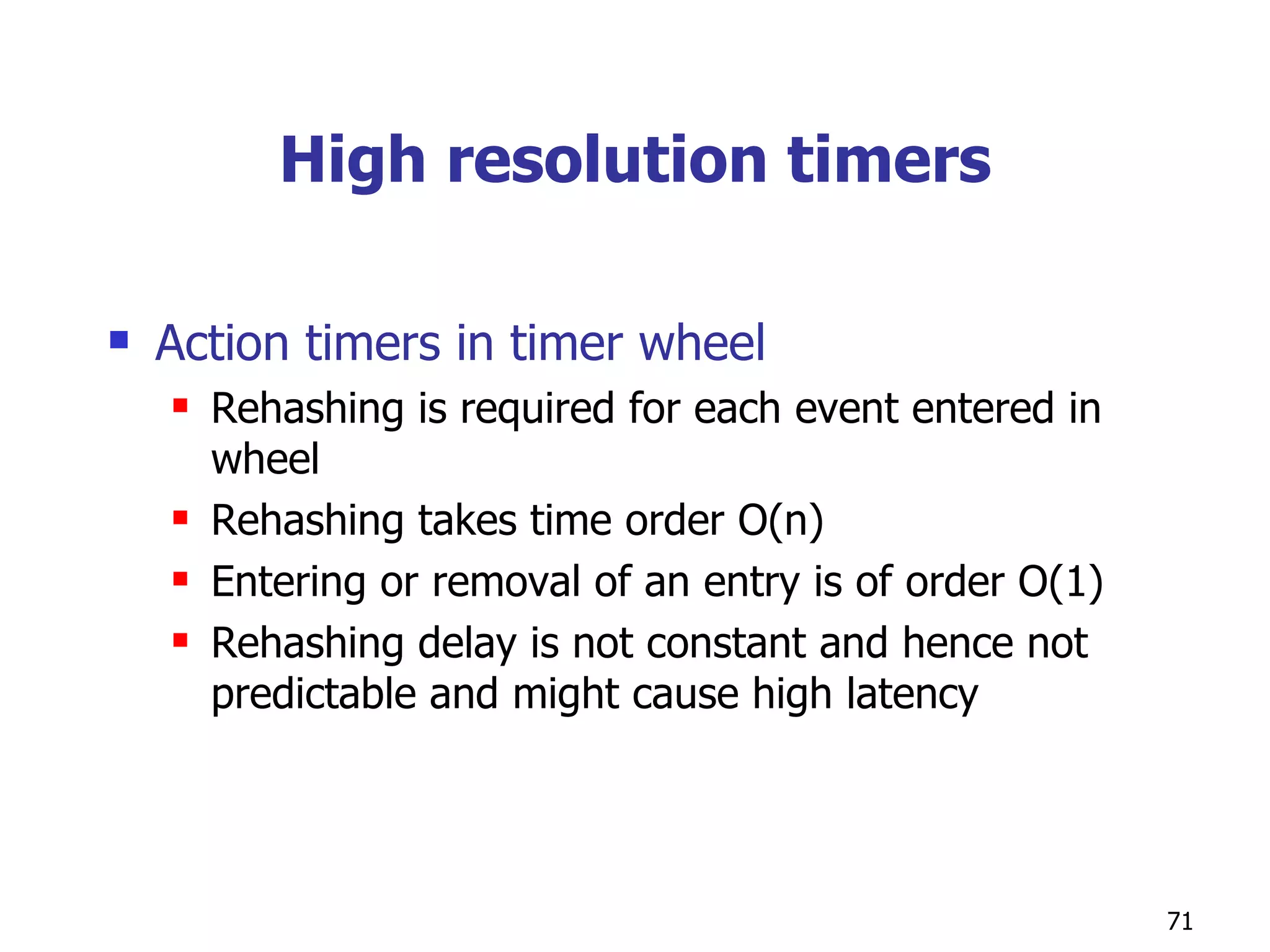
High resolution timers Action timers in timer wheel Rehashing is required for each event entered in wheel Rehashing takes time order O(n) Entering or removal of an entry is of order O(1) Rehashing delay is not constant and hence not predictable and might cause high latency
High resolution timers Timeout timers in wheel Does not require rehashing  Operating is of order O(1) Efficient and predictable HR timers majorly solves action timer problems
High resolution timers HR timers Implements timer in red/black trees Does not involve hash data structure Advantages Add or removes the node in order O(logn) Nodes in trees are already sorted performance improves form O(n) to O(logn) where n is usually a large value
Examples of RT application  Time bound is the basic characteristic for RT application Example  Control systems in industry Position and speed control system for synthetic aperture radars (SARs) Operating system for ebook reader e.g. Kindle Audio feedback cancellation is selected for detailed discussion
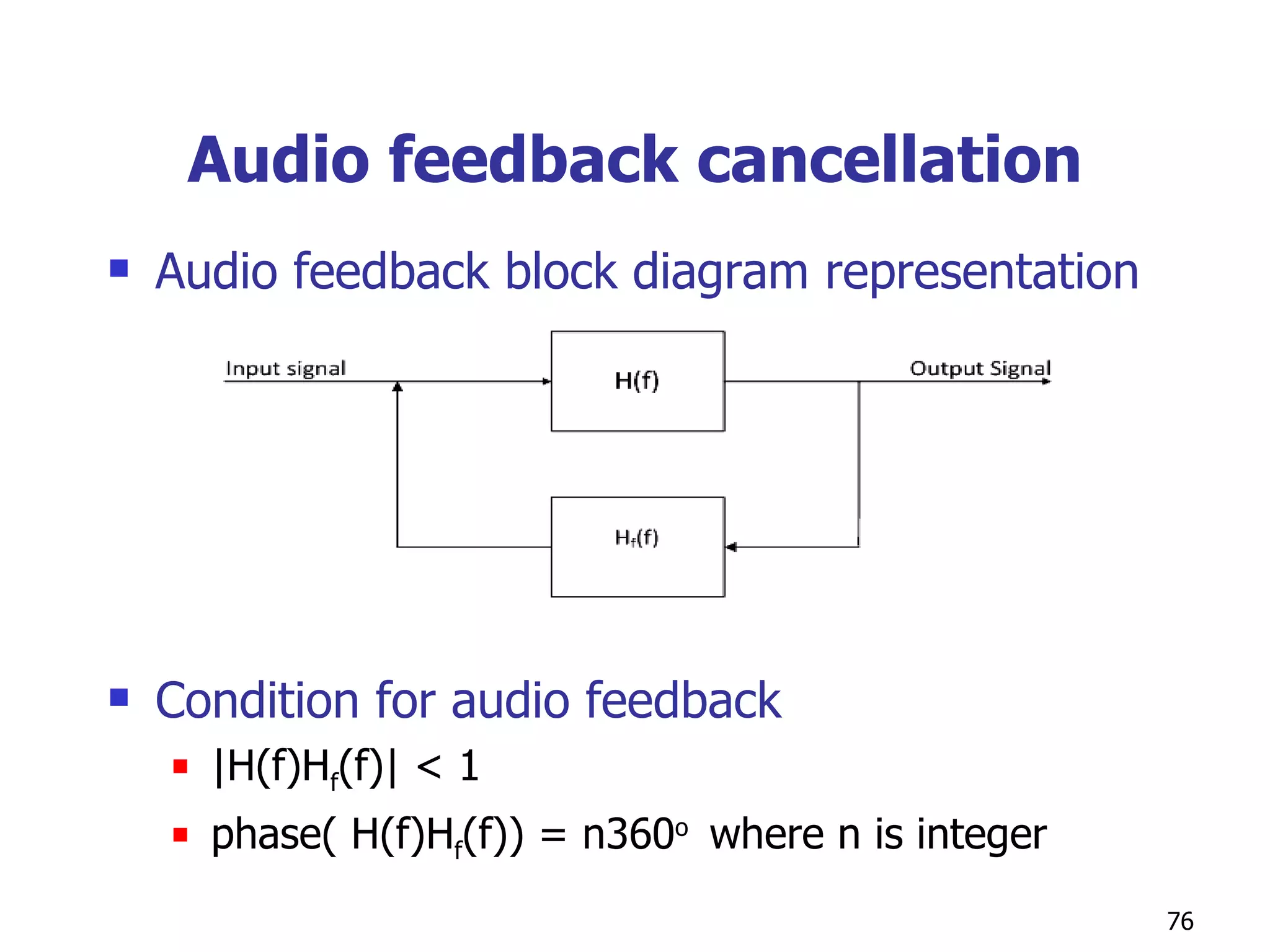
Audio feedback cancellation Output signal is fed back to input and amplified again Amplified signal includes both input and feedback resulting in noise and suppressing the original signal Usually undesirable and required to eliminate as feedback development is in process
Audio feedback cancellation Audio feedback block diagram representation Condition for audio feedback |H(f)H f (f)| < 1 phase( H(f)H f (f)) = n360 o  where n is integer
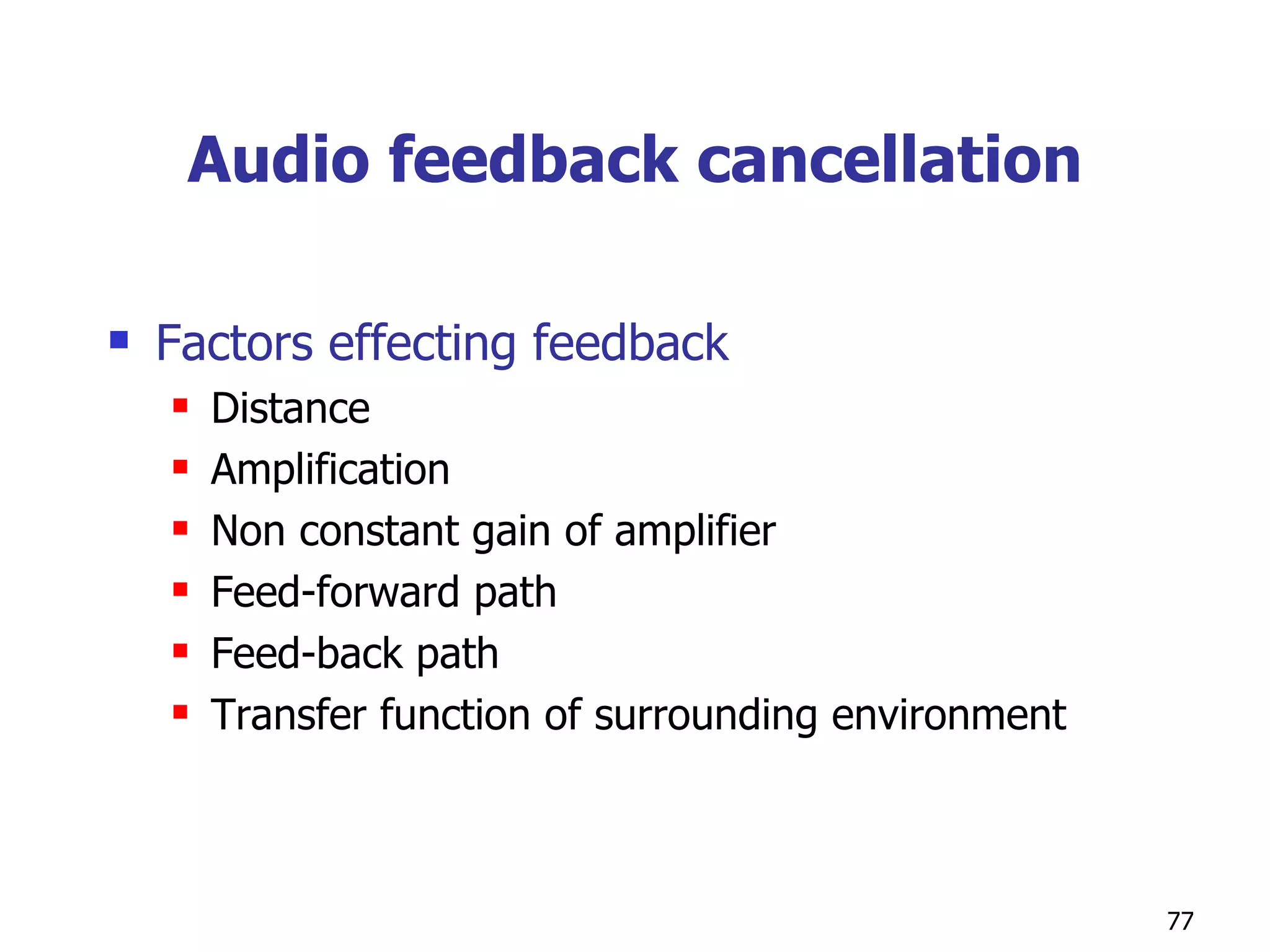
Audio feedback cancellation Factors effecting feedback Distance Amplification Non constant gain of amplifier Feed-forward path Feed-back path Transfer function of surrounding environment
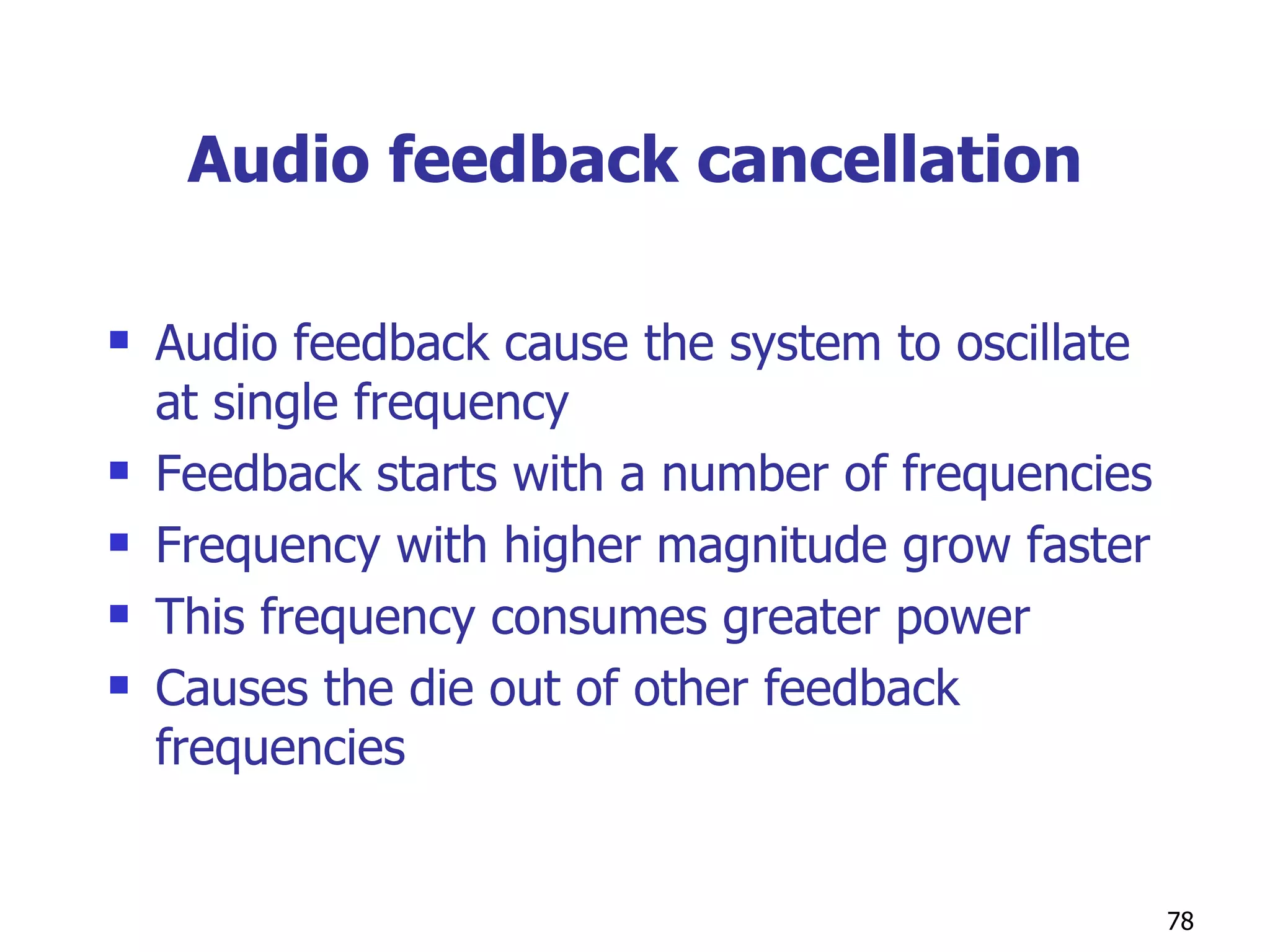
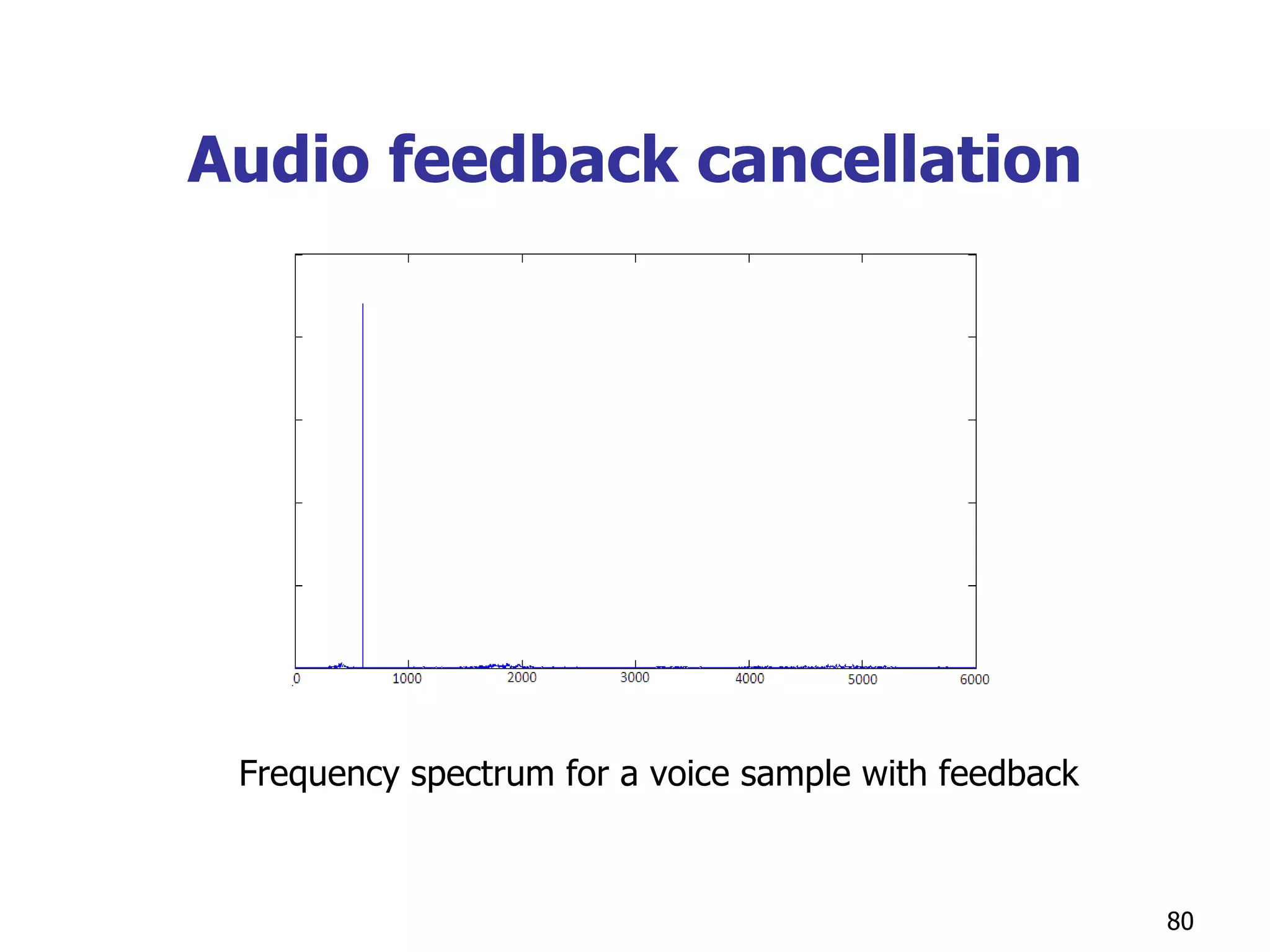
Audio feedback cancellation Audio feedback cause the system to oscillate at single frequency Feedback starts with a number of frequencies Frequency with higher magnitude grow faster This frequency consumes greater power  Causes the die out of other feedback frequencies
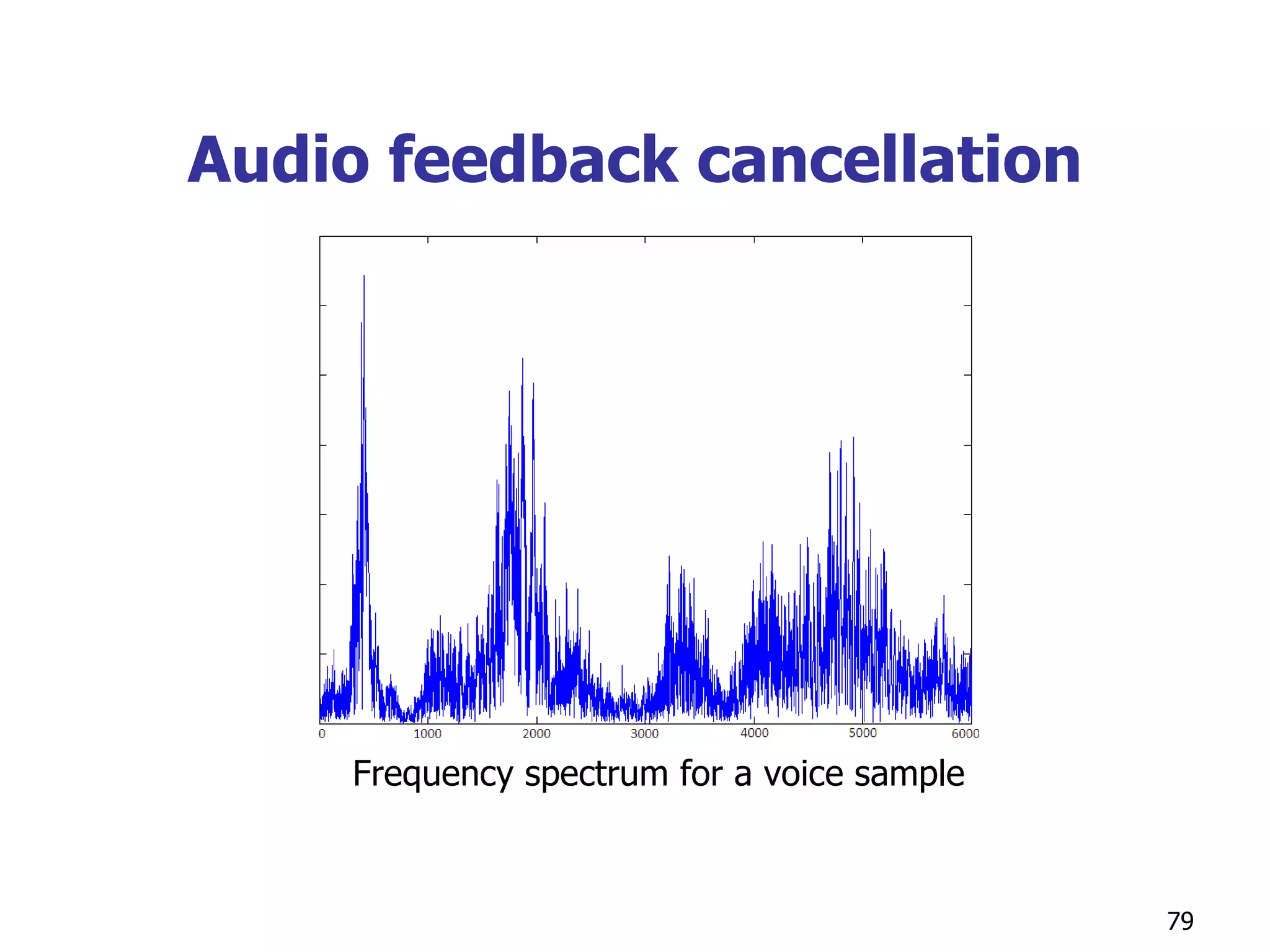
Audio feedback cancellation Frequency spectrum for a voice sample
Audio feedback cancellation Frequency spectrum for a voice sample with feedback
Audio feedback cancellation Methods of audio feedback cancellation Two major categories Manual feedback cancellation Automatic feedback cancellation Manual feedback methods are useful in static environment  In dynamic environments automatic feedback cancellation methods are preffered
Audio feedback cancellation Manual feedback cancellation Move the position of microphone Changes phase of the signal fed back to input Reduces magnitude of signal if mic is moved away Tuning the sound source (musical instruments) according to environment  Feedback frequencies attenuators can be sued if feedback frequencies are known
Audio feedback cancellation Automatic feedback cancellation Two major categories for automatic feedback cancellation Automatic equalization Frequency shifting
Audio feedback cancellation Automatic equalization Signal spectrum is observed all the time Adaptive filters are used to suppress the frequency buildup If feedback causes a particular frequency to increase, adaptive filters adopt themselves to suppress that typical frequency Filter response is critical
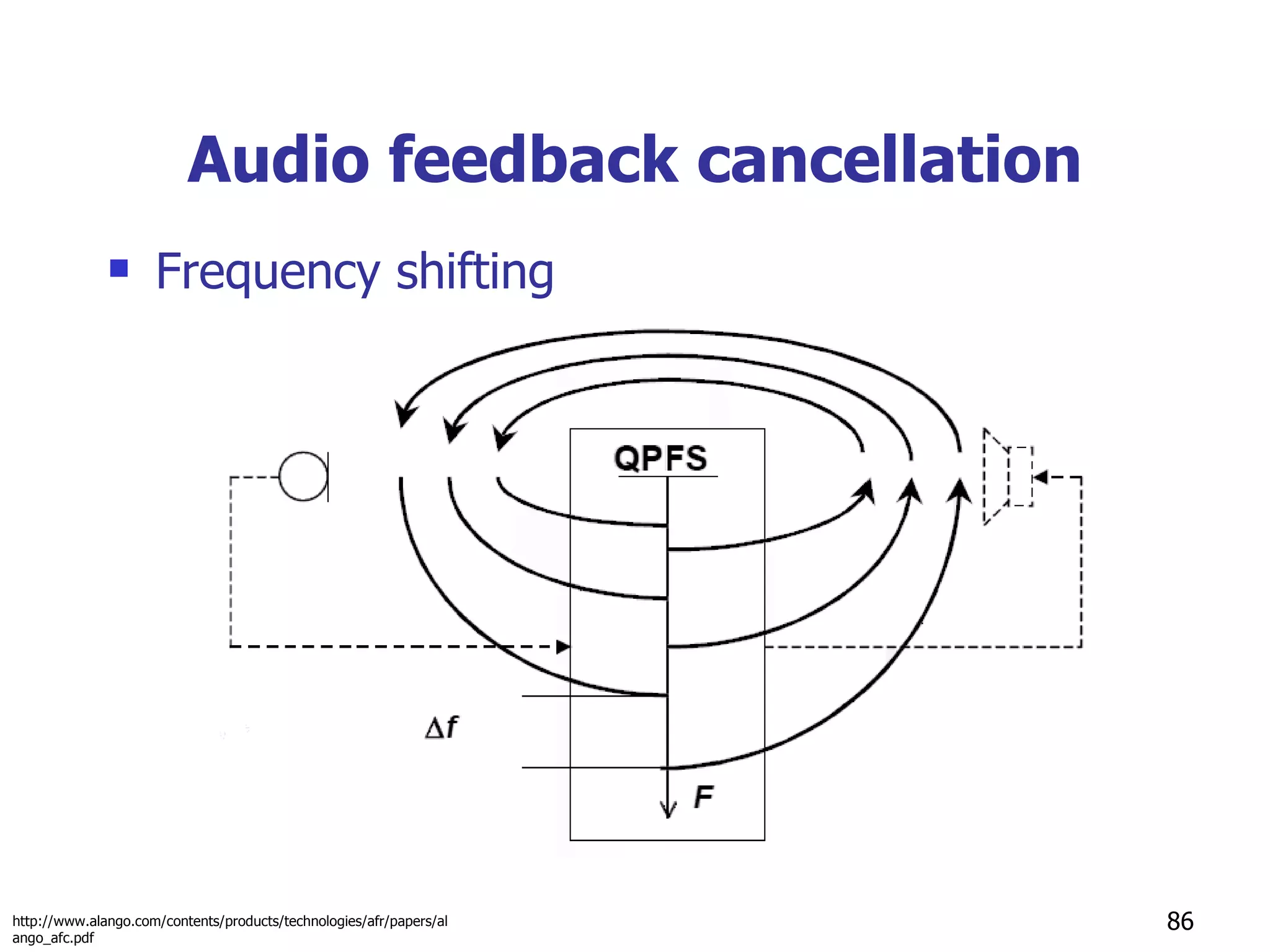
Audio feedback cancellation Frequency shifting  Shifts the input signal by a small frequency Breaks feedback path for a particular frequency Very effective method to remove feedback Disturbs the harmonic relationship between the signal components Frequency shift should be selected with care
Audio feedback cancellation Frequency shifting http://www.alango.com/contents/products/technologies/afr/papers/alango_afc.pdf
Audio feedback cancellation Implemented feedback removal technique Human voice is highly uncorrelated when sampled after reasonable time interval Feedback signal is a single tone present in the voice signal High value of correlation of two non-overlapping signals taken from voice sample indicates presence of feedback
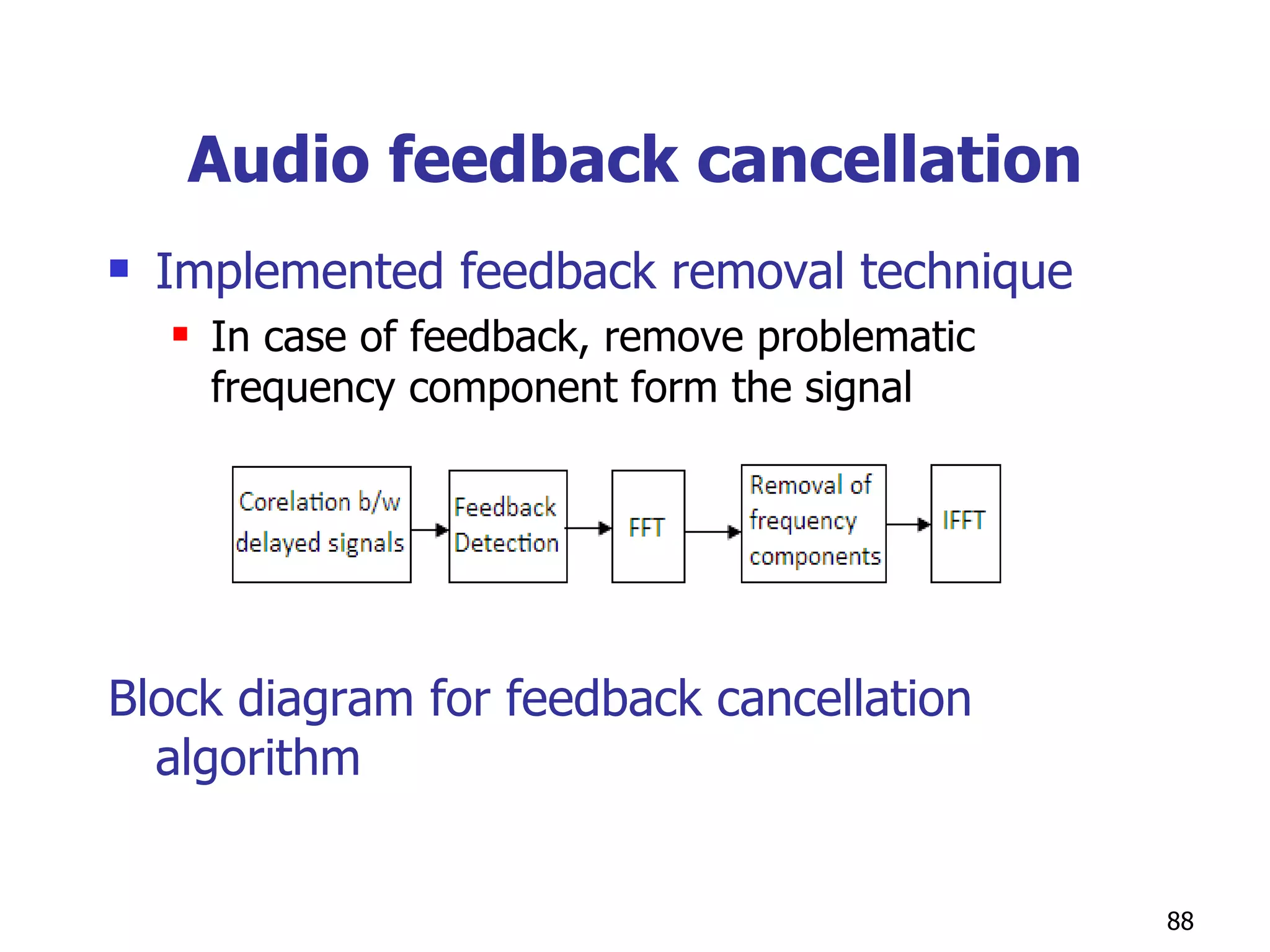
Audio feedback cancellation Implemented feedback removal technique In case of feedback, remove problematic frequency component form the signal Block diagram for feedback cancellation algorithm
Audio feedback cancellation Removing the feedback frequency Adaptive filters are used for removing the feedback Filter properties  Adaptive Quick to adopt to new frequency Very high Q as to remove a single frequency
Audio feedback cancellation Filter implementation Implementation of such a filter is very difficult Very large number of taps to get required response Low Q filter completely distort the signal  Frequency domain filter Procedure for frequency rectification Convert the signal to frequency domain  Detect the frequency that is to be removed Remove that frequency Convert the signal back to time domain
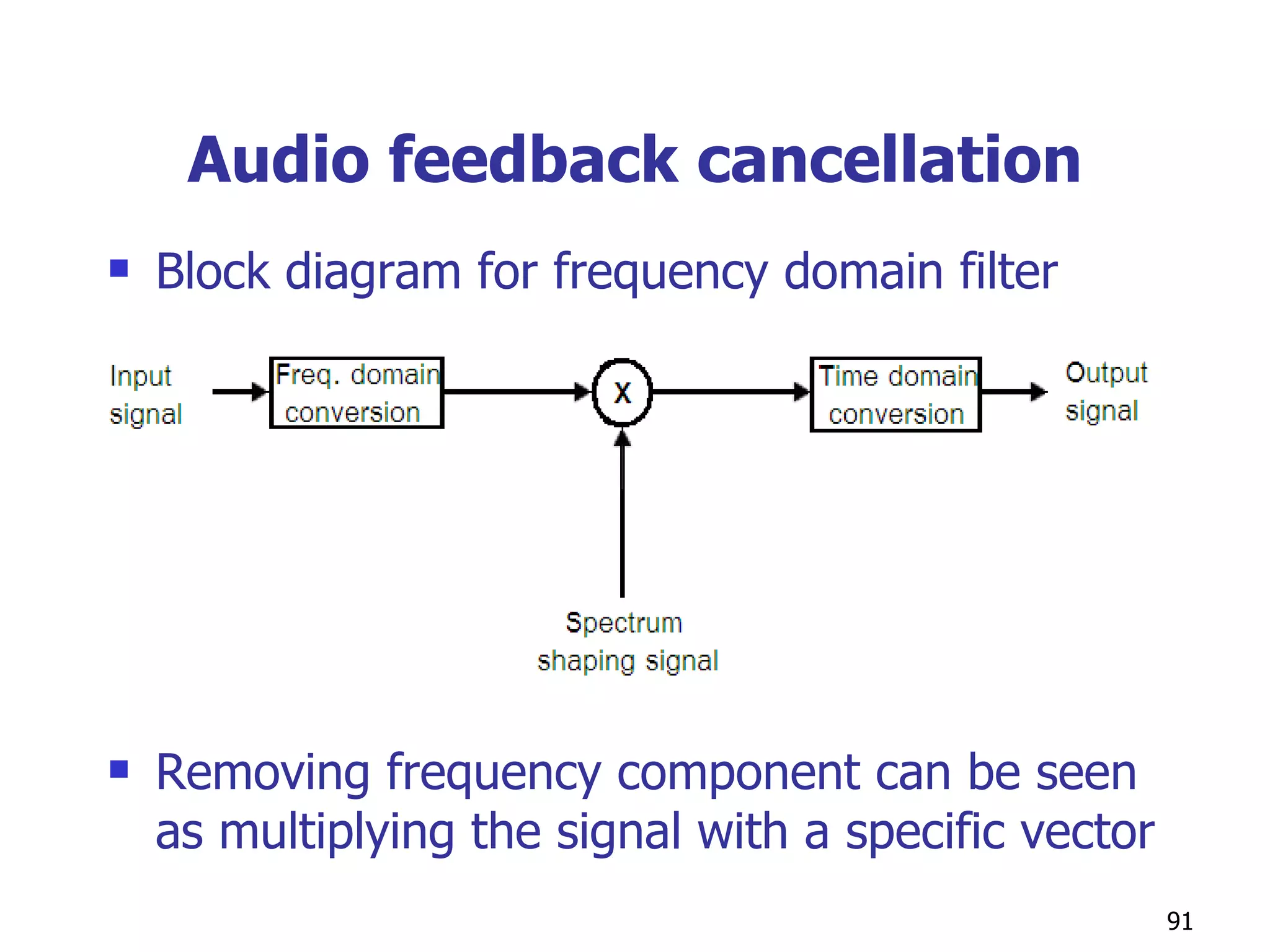
Audio feedback cancellation Block diagram for frequency domain filter Removing frequency component can be seen as multiplying the signal with a specific vector
Audio feedback cancellation Filter implementation Initially signal is converted to frequency domain using FFT Required frequency is removed by zeroing the appropriate elements of FFT output Signal is converted back to time domain using IFFT
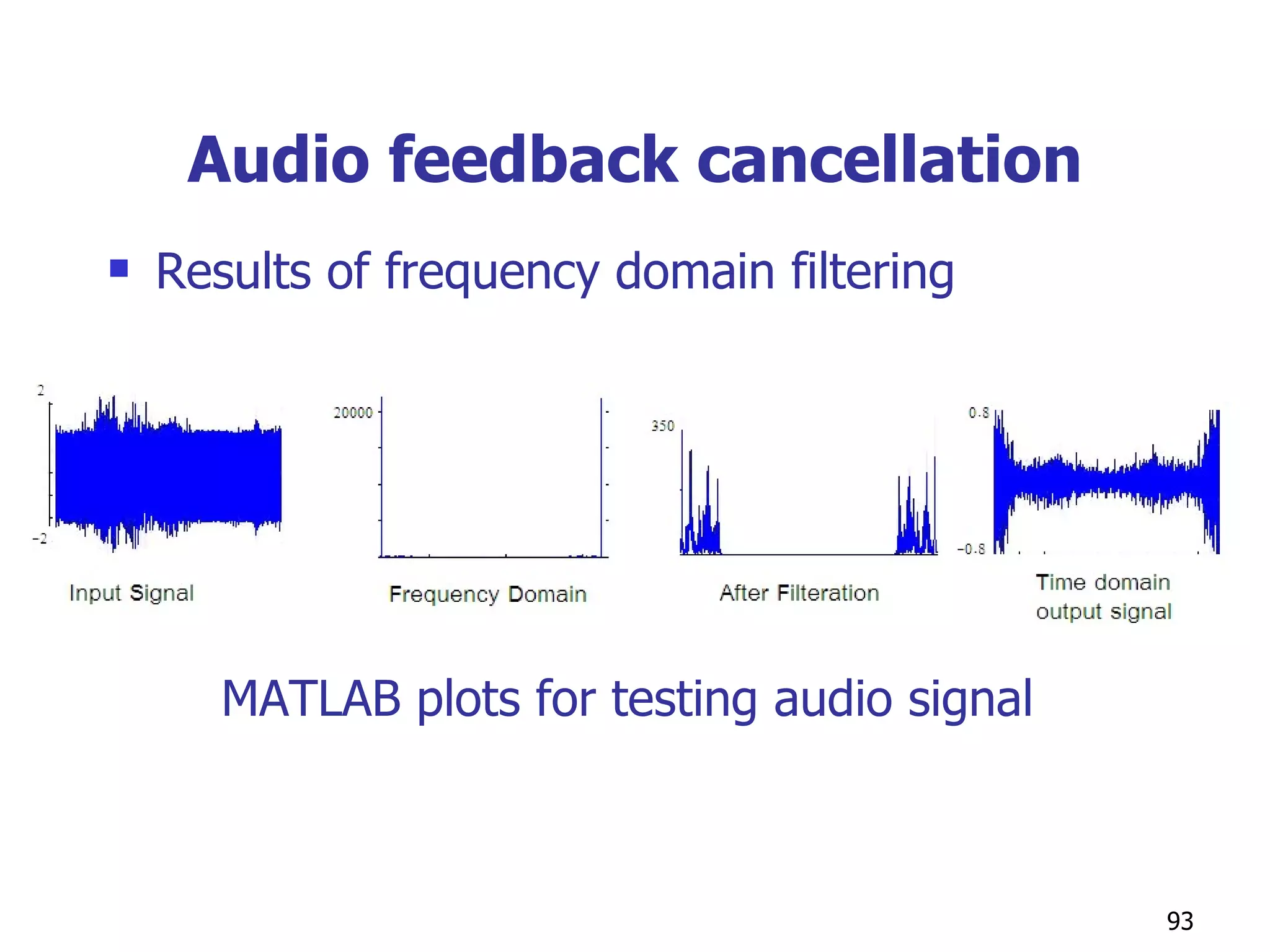
Audio feedback cancellation Results of frequency domain filtering MATLAB plots for testing audio signal
Audio feedback cancellation Parallelization of filter Major workload in filter is FFT and IFFT Parallelization of filter means to implement the FFT and IFFT in parallel In the sample code FFT and IFFT is carried out using FFTW library which is open source library that supports parallel implementation of FFT and IFFT. Parallelization improves the throughput of the system
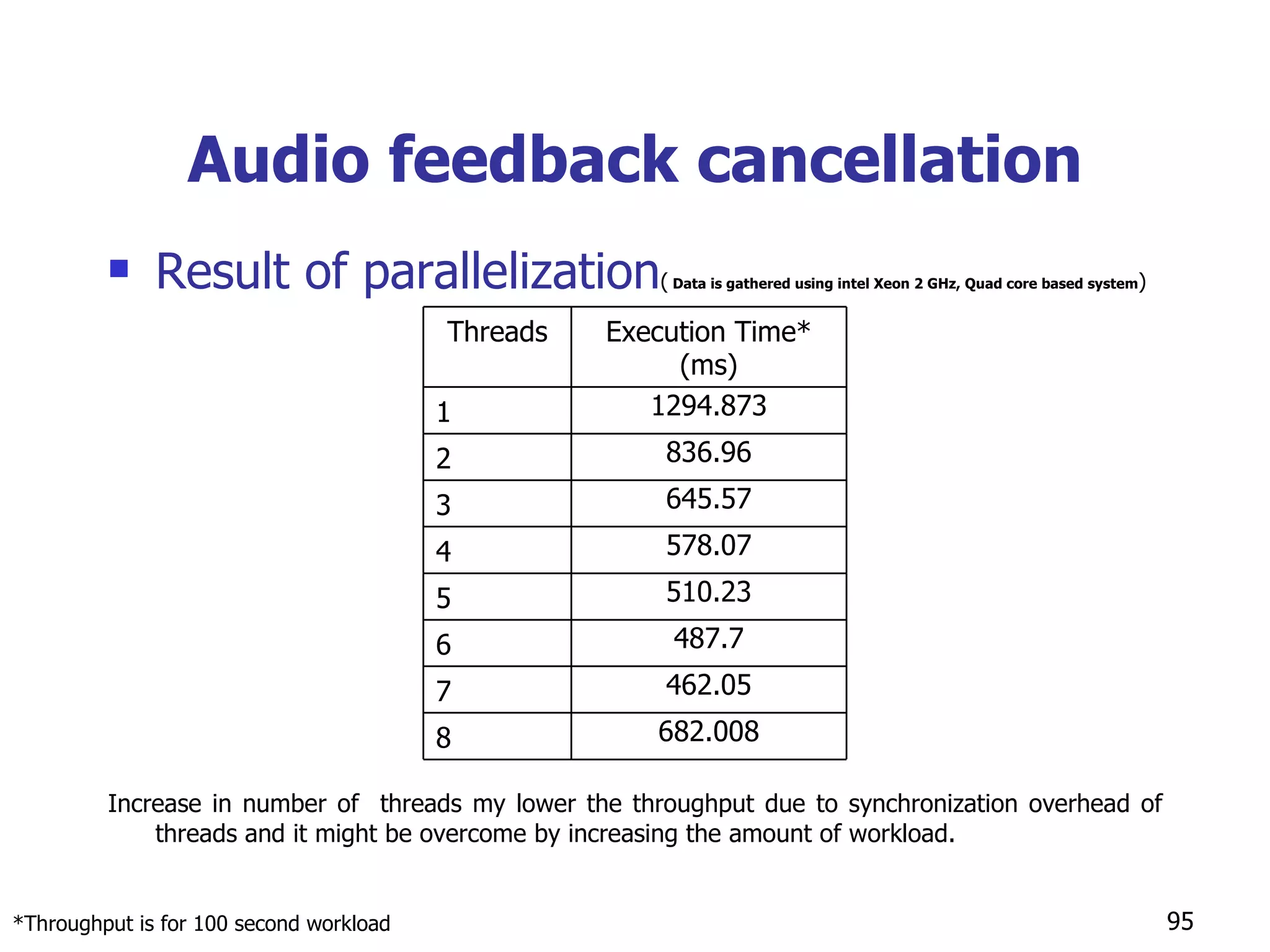
Audio feedback cancellation Result of parallelization (  Data is gathered using intel Xeon 2 GHz, Quad core based system ) Increase in number of  threads my lower the throughput due to synchronization overhead of threads and it might be overcome by increasing the amount of workload.  *Throughput is for 100 second workload Threads Execution Time* (ms) 1 1294.873 2 836.96 3 645.57 4 578.07 5 510.23 6 487.7 7 462.05 8 682.008
Labs Conversion of stock kernel to real time kernel Procedure to patch the kernel and to install it  Audio feedback cancellation  Algorithm and C implementation of removal of audio feedback

Introduction to Real-Time Operating Systems

  • 1.
    Introduction to Real-TimeOperating Systems
  • 2.
    Objectives Understanding Real-TimeOperating Systems Types of Real-Time Operating System Requirements for Real-Time Operating System Difference between General Purpose Operating System (GPOS) and Real-Time Operating System (RTOS)
  • 3.
    Objectives Conversion Linuxkernel to support Real-Time operations Patching the linux kernel Major changes in patched kernel Hands-on labs Conversion of Linux kernel to support real time Code a real time application (Audio Feedback removal)
  • 4.
    Introduction Operating System(OS) Abstraction layer over the raw hardware Manages the hardware Multiplexes the resources using scheduling policies Types of operating systems General purpose OS(GPOS) Optimized for throughput and fairness Real-Time OS (RTOS) Optimized for handling tasks within timing limits
  • 5.
    Types of RTOSHard RTOS Strict timing requirements Optimized w.r.t. predictability and timing limits Does not share critical resources such as CPU Missing a single deadline cause system failure Examples of application under hard real time Defense applications Fuel ignition controller for automobile engine Life supporting medical equipment Industrial control system
  • 6.
    Types of RTOSSoft RTOS Relative tolerable timing deadlines Tolerance is defined as a part of policy Occasional deadline missing may not cause system failure Examples Audio processing Real-time video processing Network interface subsystem
  • 7.
    GPOS and RTOScomparison Scheduling Locking mechanism Hardware and software support
  • 8.
    Scheduling Makes multitaskingfeasible Shares resources between tasks Follows a scheduling policy Task priority A number assigned to task according to its importance A higher priority task is preferred over a low priority task
  • 9.
    Scheduling Preemption Shiftof resource control from low to high priority task Responsibility of kernel Preemption limitations A code segment can not be preempted when it has acquire some lock which is acquired disabling interrupts A process can only be preempted after a specified task expiration. Tradeoffs between coarse and fine grained timer
  • 10.
  • 11.
    Scheduling Yielding Processitself give up the resources Responsibility of process Program designer has to take care of yielding Disadvantages Unable to use available resources efficiently Real-time systems can not rely on voluntary giving up of the CPU Priority inversion A low priority task might cause high priority task to wait for execution
  • 12.
    Kernel Locks Locks Avoid a critical code section to be accessed by two active threads simultaneously Especially important in multicore machines Effect of locks on real-time response Unpredictable delays for waiting threads Might cause priority inversion Some types of lock disables code preemptions
  • 13.
    Summary of comparisonRTOS Unfair scheduling Scheduling based on priority Kernel is preemptive either completely or up to maximum degree Priority inversion is a major issue Predictable behavior GPOS Fair scheduling Scheduling can be adjusted dynamically for optimized throughput Kernel is non-preemptive or have long non-preemptive code sections Priority inversion usually remain unnoticed No predictability guarantees
  • 14.
    Limitations for RTapplications System management interrupts DMA bus mastering On-demand CPU frequency scaling VGA text console Page faults Context switching
  • 15.
    Limitations for RTapplications System Management Mode (SMM) SMI cause system to enter in SMM Debugs the hardware Protects system Shutting down the system if CPU temperature exceeds Emulates hardware Emulates USB keyboard/mouse to ps2 keyboard/mouse CPU jumps to hardwired memory location to service SMI SMI has highest priority
  • 16.
    Limitations for RTapplications System Management Mode (SMM) OS has no control to preempt SMI handler Causes unacceptable delay for RT applications Delay ranges from tens to hundreds of microseconds DMA bus mastering Caused by devices using DMA SATA/PATA/SCSI devices, network adapters, video cards etc. Device drivers can increase latency Common issue for all RTOS
  • 17.
    Limitations for RTapplications On-demand CPU frequency scaling CPU is put in low power state after a period of inactivity Can cause unpredictable or longer delays
  • 18.
    Limitations for RTapplications Page faults Occurs when requested data is not available or its reference is absent from a TLB Types of page faults Major/Hard page faults Minor/Soft page faults Major page faults Occurs when requested data has to be fetched from disk Can cause very large latencies RT application should be written to minimize Major page faults
  • 19.
    Limitations for RTapplications Page faults Minor page faults Occurs when requested data resides in the main memory but missing from TLB It does not involve IO operation to fetch data from disk Has negligible impact in RT performance Tips to avoid page faults Use mlockall() to load all the address space of the program and then lock it such that it cannot be swapped out
  • 20.
    Limitations for RTapplications Page faults Tips to avoid page faults Create all threads at startup time of the application because run time thread creation can cause latencies Avoid dynamic allocation and freeing of memory Minimize the use system calls that are known to generate page faults
  • 21.
    Limitations for RTapplications Context switching Flushed pipeline and branch prediction counters Can cause invalidation of cashes Changes the entries in Instruction and data TLBs Hence context switching might cause unacceptable behavior for some real-time application
  • 22.
    Conversion of GPOSto RTOS RT support in stock Linux kernel Stock Linux kernel supports soft RT response Two RT scheduling policies in stock Linux kernel SCHED_FIFO SCHED_RR Non-RT scheduling policy SCHED_NORMAL Static priority is implemented in RT scheduling sched_setschedular() can be used to manage scheduling policies
  • 23.
    Conversion of GPOSto RTOS RT support in stock Linux kernel Scheduling policies definition in /include/linux/sched.h
  • 24.
    Conversion of GPOSto RTOS SCHED_FIFO First-in-first-out scheduling policy Preempts all SCHED_NORMAL tasks Tasks under SCHED_FIFO cannot be preempted Task itself can yield the resources Scheduling is not based on time slots Two SCHED_FIFO process are scheduled as ‘first come first served’ fashion
  • 25.
    Conversion of GPOSto RTOS SCHED_RR Same as SCHED_FIFO but involves time slots Process are scheduled in round-robin fashion Share resources in allocated time slots Lower priority task cannot preempt higher priority task SCHED_RR process preempts SCHED_FIFO process
  • 26.
    Conversion of GPOSto RTOS RT patch for stock Linux kernel CONFIG_PREEMPT_RT Adds support of hard RT in kernel Managed by Ingo Molnar Constantly developing patch A suitable patch is required to be selected corresponding to chosen kernel depending on the kernel version
  • 27.
    Conversion of GPOSto RTOS Applying the patch Download the real-time patch Download the kernel Kernel and patch should be of same version Commands in these slides are for version 2.6.33.7
  • 28.
    Conversion of GPOSto RTOS Applying the patch Place both kernel and patch in same directory Unpack the kernel Change the directory
  • 29.
    Conversion of GPOSto RTOS Applying the patch Dry-run the patch For correct patch output should be like this
  • 30.
    Conversion of GPOSto RTOS Applying the patch In case of some error check the versions of downloaded kernel and patch Apply the patch if dry-run is succeeded For uncompressed patch following set of commands can be used from uncompressed kernel directory
  • 31.
    Conversion of GPOSto RTOS Configuration of Linux kernel Open configuration dialog xconfig or gconfig options can also be used Apply following changes Activate High Resolution Timer Enable Complete Preemption (Real-Time) Apply power management settings according to the hardware
  • 32.
    Conversion of GPOSto RTOS Configuration of Linux kernel Activate High Resolution Timer
  • 33.
    Conversion of GPOSto RTOS Configuration of Linux kernel Enable Complete Preemption (Real-Time)
  • 34.
    Conversion of GPOSto RTOS Configuration of Linux kernel Power management configuration Some power management options can raise SMI Disabling some options can cause system damage Read every option carefully Disable optional or unnecessary options Disable CPU frequency scaling Disable USB mouse/keyboard from BIOS Use ps/2 keyboard/mouse Disable TCO timers
  • 35.
    Conversion of GPOSto RTOS Configuration of Linux kernel Disable CPU frequency scaling (Power Management and ACPI Options ->CPU Frequency scaling)
  • 36.
    Conversion of GPOSto RTOS Configuration of Linux kernel Disable TCO timers (Device Drivers---> watchdog timer support)
  • 37.
    Conversion of GPOSto RTOS Building the Linux kernel Make the kernel Make the modules Install the modules Install the kernel
  • 38.
    Real-Time patch effecton kernel Locking mechanism Priority inheritance Interrupt handler replaced with kernel threads High resolution timers
  • 39.
    Locking mechanism Locks Prevent the shared resources to be accessed by two active processes simultaneously. Simultaneous access to unprotected shared resources will cause races and Heisen bugs Types of locks Spin locks Semaphores Readers/writer locks
  • 40.
    Locking mechanism SpinlocksWaiting threads keep on trying until the lock is acquired Waiting threads does not sleep Local interrupts are disabled when spinlock is acquired to avoid deadlocks Used in interrupt handlers Lock should be acquired for short period of time Interrupts are disabled Waiting threads do not sleep and utilize CPU resources
  • 41.
    Locking mechanism SpinlocksAcquiring a spinlock raw_spin_lock() (/include/linux/spinlock_api_smp.h) Releasing spinlock raw_spin_unlock() (/include/linux/spinlock_api_smp.h)
  • 42.
    Locking mechanism SpinlocksAdvantages of spinlocks Low locking overhead Does not require time to sleep and awake the waiting threads Disadvantages of spinlocks Interrupts are disables Waiting threads utilize the CPU Lock have to released as early as possible Thread acquiring spinlock cannot sleep
  • 43.
    Locking mechanism SemaphoresSleeping locks Waiting threads sleep and wait in wait queue Waiting task has to be awaken before acquiring the lock Advantages Waiting task frees the CPU for other workload Lock can be acquired for long time Disadvantages Sleeping and awakening overhead Spinlock acquired thread cannot acquire semaphore
  • 44.
    Locking mechanism SemaphoresSleeping locks Waiting threads sleep and wait in wait queue Waiting task has to be awaken before acquiring the lock Advantages Waiting task frees the CPU for other workload Lock can be acquired for long time Disadvantages Sleeping and awakening overhead Spinlock acquired thread cannot acquire semaphore
  • 45.
    Locking mechanism Spinlockfor RT application – A potential problem Unpredictable in nature Time to acquire lock for waiting thread is dependent on the thread that currently holds the lock OS cannot force the lock holder thread to release the lock Non-preemptive sections of Linux kernel Spinlocks disables local interrupts
  • 46.
    Locking mechanism Solutionfor RT behavior Replace spinlock with mutex if possible Advantages Mutex is a binary semaphore Deterministic in nature Can be preempted by high priority task
  • 47.
    Locking mechanism Spinlocksare unavoidable at low level Example: Implementation of mutex Spinlock usage in RT kernel is just a fraction to that of stock kernel Reduction in usage reduces probability to contend the same spinlock by two different threads
  • 48.
    Locking mechanism Real-Timeimplementation of spinlocks rt_spin_lock() rt_spin_lock_fastlock()
  • 49.
    Locking mechanism Real-Timeimplementation of spinlocks rt_spin_unlock() rt_spin_lock_fastlock()
  • 50.
    Priority inheritance Priority inversion L and H require same lock but M requires another lock http://book.opensourceproject.org.cn/embedded/oreillyembed/opensource/0596009836/id-i_0596009836_chp_10_sect_4.html
  • 51.
    Priority inheritance Priority inversion Priority inversion may not be noticeable in GPOS High priority tasks may get starved of resources in GPOS due to priority inversion High priority task should be executed as early as possible
  • 52.
    Priority inversion Solutionof priority inversion Priority inheritance (PI) Priority inversion Priority Inheritance http://www.linuxjournal.com/article/9361?page=0,3
  • 53.
    Priority inversion Priorityinversion non-mutual exclusion Locks PI works fine for mutual exclusion locks Problematic in case of other types of locks Example readers/writer locks PI can cause unacceptable response Solution Only one task at a time can read Use read-copy-update if necessary
  • 54.
    Priority inversion Read-copy-updateTechnique to share read/write resources Low cost reading Reading is carried out from local copy of data Does not involve conventional locking for reading High cost writing Updates a global pointer to new data Maintains copy of old data until all reading processes are finished Suitable for situation where there are fewer writes and many read operations
  • 55.
    Threaded interrupt handlerInterrupt handler Function that runs whenever a particular interrupt occurs Two parts Top half Bottom half Divided into two parts to reduce interrupt disabled time
  • 56.
    Threaded interrupt handlerTop half Performs essential services to hardware Works with interrupts disabled Gathers raw data Performs critical time sensitive work Bottom half Performs time consuming tasks Processes raw data
  • 57.
    Threaded interrupt handlerInterrupt handler in GOPS
  • 58.
    Threaded interrupt handlerInterrupt handler in GOPS Kernel identifies the interrupt Calls interrupt handler CPU jumps to a particular location Executes top half Raise softirq and returns to pre-interrupt position This behavior is not acceptable in RTOS Cause unpredictability and long latencies Local interrupts are disabled for longer time
  • 59.
    Threaded interrupt handlerInterrupt handler in RTOS Interrupt handler runs as kernel thread Building Embedded Linux Systems ISBN-10 = 0596529686, chapter 14,section: Interrupts as threads
  • 60.
    Threaded interrupt handlerInterrupt handler in RTOS Top half identifies the interrupt Sends acknowledgement Initializes kernel thread Rest of task is performed as kernel thread A few interrupts are still handled conventionally Threaded interrupt handler are also available in stock Linux kernel
  • 61.
    Threaded interrupt handlerAdvantages of conversion of handler to kernel thread Preemptable interrupt handler Reduces interrupt blocked time Reduces probability of priority inversion Handlers scheduling can be controlled by assigning a priority number to it Reduces unpredictable latencies
  • 62.
    Threaded interrupt handlerKernel code snippet request_threaded_irq() is to register threaded interrupt handler
  • 63.
    Threaded interrupt handlerrequest_threaded_irq() code snippet Initializes pointers and calls __setup_irq()
  • 64.
    Threaded interrupt handler__setup_irq() code snippet preempt_hardirq_setup() code snippet
  • 65.
    Threaded interrupt handlerirq_default_primary_handler() code snippet This function raise the interrupt handler
  • 66.
    High resolution timersTimer triggers an event at a specified time Shorter the tick of timer clock, higher the timer resolution Jiffy: Software ticking unit Granularity of time is reciprocal of jiffy Increasing the jiffy value: improves the resolution Increases the timer overhead Timer overhead is increased as jiffy is required to be updated more frequently
  • 67.
    High resolution timersImproving the timer resolution Shift ticking source from jiffy to hardware clock Advantages Improves granularity of clock Reduces timer overhead to update software entity Frees resources that handle jiffy
  • 68.
    High resolution timersTimer wheel Timer as wheel and delays as bucket in the wheel 1 st set of buckets can provide 256 units delay If an event is to be triggered after 10 units it is placed in 10 th bucket Next level of buckets are used for delay greater than 256 units Each bucket in 2 nd level represents 265 unit delay An event is placed in next layer of buckets if delay is greater than 65536 (256 X 256)
  • 69.
    High resolution timersIssues with timer wheel implementation in RTOS Unpredictable behavior Rehashing is required for each shift from 2 nd level to 1 st level Rehashing is a function of no. of events in the wheel Delays increases as no of events increase (Rehashing takes O(n), where n is no. of events in the wheel)
  • 70.
    High resolution timersHigh resolution(HR) timers for real-time kernel Introduced by Thomas Gleixner Division of timers in two types Action timers Timeout timers Action timers Measures elapsed time using timestamps Timeout timers Trigger an event after a specific time
  • 71.
    High resolution timersAction timers in timer wheel Rehashing is required for each event entered in wheel Rehashing takes time order O(n) Entering or removal of an entry is of order O(1) Rehashing delay is not constant and hence not predictable and might cause high latency
  • 72.
    High resolution timersTimeout timers in wheel Does not require rehashing Operating is of order O(1) Efficient and predictable HR timers majorly solves action timer problems
  • 73.
    High resolution timersHR timers Implements timer in red/black trees Does not involve hash data structure Advantages Add or removes the node in order O(logn) Nodes in trees are already sorted performance improves form O(n) to O(logn) where n is usually a large value
  • 74.
    Examples of RTapplication Time bound is the basic characteristic for RT application Example Control systems in industry Position and speed control system for synthetic aperture radars (SARs) Operating system for ebook reader e.g. Kindle Audio feedback cancellation is selected for detailed discussion
  • 75.
    Audio feedback cancellationOutput signal is fed back to input and amplified again Amplified signal includes both input and feedback resulting in noise and suppressing the original signal Usually undesirable and required to eliminate as feedback development is in process
  • 76.
    Audio feedback cancellationAudio feedback block diagram representation Condition for audio feedback |H(f)H f (f)| < 1 phase( H(f)H f (f)) = n360 o where n is integer
  • 77.
    Audio feedback cancellationFactors effecting feedback Distance Amplification Non constant gain of amplifier Feed-forward path Feed-back path Transfer function of surrounding environment
  • 78.
    Audio feedback cancellationAudio feedback cause the system to oscillate at single frequency Feedback starts with a number of frequencies Frequency with higher magnitude grow faster This frequency consumes greater power Causes the die out of other feedback frequencies
  • 79.
    Audio feedback cancellationFrequency spectrum for a voice sample
  • 80.
    Audio feedback cancellationFrequency spectrum for a voice sample with feedback
  • 81.
    Audio feedback cancellationMethods of audio feedback cancellation Two major categories Manual feedback cancellation Automatic feedback cancellation Manual feedback methods are useful in static environment In dynamic environments automatic feedback cancellation methods are preffered
  • 82.
    Audio feedback cancellationManual feedback cancellation Move the position of microphone Changes phase of the signal fed back to input Reduces magnitude of signal if mic is moved away Tuning the sound source (musical instruments) according to environment Feedback frequencies attenuators can be sued if feedback frequencies are known
  • 83.
    Audio feedback cancellationAutomatic feedback cancellation Two major categories for automatic feedback cancellation Automatic equalization Frequency shifting
  • 84.
    Audio feedback cancellationAutomatic equalization Signal spectrum is observed all the time Adaptive filters are used to suppress the frequency buildup If feedback causes a particular frequency to increase, adaptive filters adopt themselves to suppress that typical frequency Filter response is critical
  • 85.
    Audio feedback cancellationFrequency shifting Shifts the input signal by a small frequency Breaks feedback path for a particular frequency Very effective method to remove feedback Disturbs the harmonic relationship between the signal components Frequency shift should be selected with care
  • 86.
    Audio feedback cancellationFrequency shifting http://www.alango.com/contents/products/technologies/afr/papers/alango_afc.pdf
  • 87.
    Audio feedback cancellationImplemented feedback removal technique Human voice is highly uncorrelated when sampled after reasonable time interval Feedback signal is a single tone present in the voice signal High value of correlation of two non-overlapping signals taken from voice sample indicates presence of feedback
  • 88.
    Audio feedback cancellationImplemented feedback removal technique In case of feedback, remove problematic frequency component form the signal Block diagram for feedback cancellation algorithm
  • 89.
    Audio feedback cancellationRemoving the feedback frequency Adaptive filters are used for removing the feedback Filter properties Adaptive Quick to adopt to new frequency Very high Q as to remove a single frequency
  • 90.
    Audio feedback cancellationFilter implementation Implementation of such a filter is very difficult Very large number of taps to get required response Low Q filter completely distort the signal Frequency domain filter Procedure for frequency rectification Convert the signal to frequency domain Detect the frequency that is to be removed Remove that frequency Convert the signal back to time domain
  • 91.
    Audio feedback cancellationBlock diagram for frequency domain filter Removing frequency component can be seen as multiplying the signal with a specific vector
  • 92.
    Audio feedback cancellationFilter implementation Initially signal is converted to frequency domain using FFT Required frequency is removed by zeroing the appropriate elements of FFT output Signal is converted back to time domain using IFFT
  • 93.
    Audio feedback cancellationResults of frequency domain filtering MATLAB plots for testing audio signal
  • 94.
    Audio feedback cancellationParallelization of filter Major workload in filter is FFT and IFFT Parallelization of filter means to implement the FFT and IFFT in parallel In the sample code FFT and IFFT is carried out using FFTW library which is open source library that supports parallel implementation of FFT and IFFT. Parallelization improves the throughput of the system
  • 95.
    Audio feedback cancellationResult of parallelization ( Data is gathered using intel Xeon 2 GHz, Quad core based system ) Increase in number of threads my lower the throughput due to synchronization overhead of threads and it might be overcome by increasing the amount of workload. *Throughput is for 100 second workload Threads Execution Time* (ms) 1 1294.873 2 836.96 3 645.57 4 578.07 5 510.23 6 487.7 7 462.05 8 682.008
  • 96.
    Labs Conversion ofstock kernel to real time kernel Procedure to patch the kernel and to install it Audio feedback cancellation Algorithm and C implementation of removal of audio feedback