IOSR Journal of Applied Chemistry (IOSR-JAC)
e-ISSN: 2278-5736. Volume 3, Issue 4 (Jan. – Feb. 2013), PP 74-80
www.iosrjournals.org

   Ammonium chloride catalyzed microwave-assisted Claisen-
 Schmidt reaction between ketones and aldehydes under solvent-
                        free conditions
                                             Rammohan Pal
Department of Chemistry, Acharya Jagadish Chandra Bose College, 1/1B, A. J. C. Bose Road, Kolkata 700020,
                                           West Bengal, India

Abstract: It has been found that ammonium chloride, which is a very inexpensive and readily available
reagent, can efficiently catalyzed Claisen-Schmidt reaction between ketones and aldehydes. α,α'-
Bis(arylmethylene)cycloalkanones, α,α'-bis(cinnamylidene)cycloalkanones, α-cinnamylideneacetophenones and
chalcones were afforded by reaction of ketones and aldehydes under microwave assisted solvent-free conditions
in presence of ammonium chloride in good to excellent yields.
Keywords: Claisen-Schmidt reaction, Ammonium chloride, Microwave irradiation, Solvent-free conditions,
Eco-friendly

                                            I.      Introduction
          It is well known that α,α'-bis(arylmethylene)cycloalkanones, chalcones and related compounds are used
as starting materials for synthesis of a variety of other interesting compounds 1-3 and exihibit a wide range of
biological activities such as antibacterial and antitumor properties4. The principal synthetic routes avenues to
these compounds comprise the base, protic and Lewis acid catalyzed reaction of ketomethyl or ketomethylene
compounds with aldehydes. In view of that, several synthetic methods for the preparation of such compounds
have been reported by using catalysts such as: solid NaOH5, BF3.OEt26, InCl37, InCl3/TMSCl8, TiCl3(SO3CF3) 9,
TMSCl/NaI10, Yb(OTf)311, Cu(OTf)212, RuCl313, FeCl314, SmI315, silica surfuric acid16, KF/inorganic solid
support17, Co(II)-bipyridyl18, Molecular Iodine19 and SOCl220. Microwave irradiation methods were also
reported using KF-Al2O321, NaOH22, acidic alumina23, Na2CO3-TBAB (PTC condition)24 and bis(p-
methoxyphenyl)telluroxide25 as catalysts. Most of these methods suffer from various disadvantages such as long
reaction periods [e.g. 10 hrs using Cp2ZrH2/NiCl226], use of expensive Lewis acids [e.g. amberlyst-1527 and
B2O3/ZrO2 or SO42-/ZrO228], use of hazardous catalyst [e.g. iodine19]. Moreover, none of these methods is
environmentally friendly, since always an excess of solvent and often toxic or hazardous chemicals are
employed. Due to these problems, development of an efficient and versatile method for the preparation of α,α'-
bis(arylmethylene)cycloalkanones, chalcone and related compounds are an important aspect and which is an
active going on research area and there is a scope for the further improvement towards mild reaction conditions
and improved yields.
          Ammonium chloride has been reported as catalyst for synthesis of various organic compounds. It is
efficiently promoted Ugi four-component reactions30, four-component synthesis of pyrrolo[3,4-b]pyridones31
and one-pot synthesis of imidazole[1,2-a]pyridines32. Moreover ammonium chloride was effectively used as
catalyst for aliphatic Claisen rearrangement33, reduction of azo compounds to their corresponding hydrazine34,
reduction of nitrophenols in aqueous media35 and under ultrasound36, reductive cleavage of azo compounds37,
synthesis of diindolylmethanes38, synthesis of spirochromenes and spiroacridines compounds39 and Biginelli
synthesis of 3,4-dihydropyrimidinones under solvent-free conditions40. Recently, Teimouri et al.41 were
synthesized α,α'-bis(substituted benzylidene)cycloalkanones using ammonium chloride in ethanol under
refluxing conditions within 3.5 to 5 hrs. There is an increasing interest in the use of environmentally feasible
regents particularly in solvent-free conditions and also reduction of reaction times. Prevention of organic
solvents during reactions in organic synthesis leads to a clean, efficient, and economical technology; not only
with the reduction of cost, but also increased amounts of reactants can be achieved in the same equipment
without huge modification. A survey of the literature revealed that the reaction between cycloalkanones and
aromatic aldehydes using ammonium chloride under microwave irradiation has not been studied so far.
          In continuation of this research, I herein report the rapid synthesis of α,α'-
bis(arylmethylene)cycloalkanones, α,α'-bis(cinnamylidene)cycloalkanones, α-cinnamylideneacetophenones and
chalcones using ammonium chloride as a environmentally friendly catalyst using microwave irradiation under
solvent-free conditions (Scheme 1 & 2).


                                            www.iosrjournals.org                                      74 | Page
Ammonium chloride catalyzed microwave-assisted Claisen-Schmidt reaction between ketones and

                                      II.        Results And Discussion
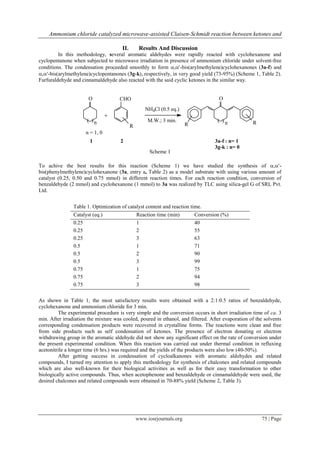
         In this methodology, several aromatic aldehydes were rapidly reacted with cyclohexanone and
cyclopentanone when subjected to microwave irradiation in presence of ammonium chloride under solvent-free
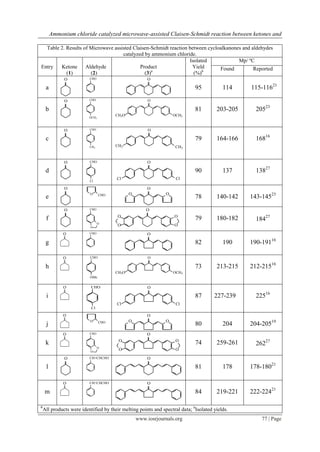
conditions. The condensation proceeded smoothly to form ,-bis(arylmethylene)cyclohexanones (3a-f) and
,-bis(arylmethylene)cyclopentanones (3g-k), respectively, in very good yield (73-95%) (Scheme 1, Table 2).
Furfuraldehyde and cinnamaldehyde also reacted with the said cyclic ketones in the similar way.


                       O             CHO                                             O
                                                    NH4Cl (0.5 eq.)
                                 +
                      ( )n                           M.W.; 3 min.                   ( )n           R
                                            R                          R
                      n = 1, 0
                       1              2                                            3a-f : n= 1
                                                                                   3g-k : n= 0
                                                     Scheme 1

To achive the best results for this reaction (Scheme 1) we have studied the synthesis of ,-
bis(phenylmethylene)cyclohexanone (3a, entry a, Table 2) as a model substrate with using various amount of
catalyst (0.25, 0.50 and 0.75 mmol) in different reaction times. For each reaction condition, conversion of
benzaldehyde (2 mmol) and cyclohexanone (1 mmol) to 3a was realized by TLC using silica-gel G of SRL Pvt.
Ltd.


                Table 1. Optimization of catalyst content and reaction time.
                Catalyst (eq.)                  Reaction time (min)        Conversion (%)
                0.25                            1                          40
                0.25                            2                          55
                0.25                            3                          63
                0.5                             1                          71
                0.5                             2                          90
                0.5                             3                          99
                0.75                            1                          75
                0.75                            2                          94
                0.75                            3                          98

As shown in Table 1, the most satisfactory results were obtained with a 2:1:0.5 ratios of benzaldehyde,
cyclohexanone and ammonium chloride for 3 min.
         The experimental procedure is very simple and the conversion occurs in short irradiation time of ca. 3
min. After irradiation the mixture was cooled, poured in ethanol, and filtered. After evaporation of the solvents
corresponding condensation products were recovered in crystalline forms. The reactions were clean and free
from side products such as self condensation of ketones. The presence of electron donating or electron
withdrawing group in the aromatic aldehyde did not show any significant effect on the rate of conversion under
the present experimental condition. When this reaction was carried out under thermal condition in refluxing
acetonitrile a longer time (6 hrs.) was required and the yields of the products were also low (40-50%).
         After getting success in condensation of cycloalkanones with aromatic aldehydes and related
compounds, I turned my attention to apply this methodology for synthesis of chalcones and related compounds
which are also well-known for their biological activities as well as for their easy transformation to other
biologically active compounds. Thus, when acetophenone and benzaldehyde or cinnamaldehyde were used, the
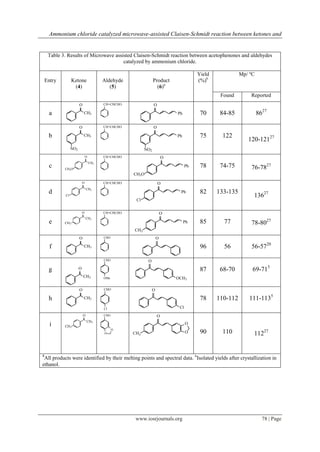
desired chalcones and related compounds were obtained in 70-88% yield (Scheme 2, Table 3).


                                                www.iosrjournals.org                                   75 | Page
Ammonium chloride catalyzed microwave-assisted Claisen-Schmidt reaction between ketones and


                    O                                                                                  O
                                                      [          CHO NH Cl (0.5 eq.)                       [    ]
                          CH3                               ]n         4                                            n
                                +                                        M.W.; 3 min.          R
        R
                                                                                                                                      1
                                            1                                                                                         R
                                        R
             R = H, CH3                         n = 1, 0                                               n = 1, 0
                4                                 5                                                        6
                                                                  Scheme 2

The catalytic role of ammonium chloride in the above process was clearly evident from the observation that in
its absence no reaction took place. Neutral alumina used acted as solid support only, and this view corroborates
the findings of Esmaeili et al.23


                            H O                 Ph                   O        OH                   O
         O
                                                      O                  H
  H             H   NH3                                                                        H                        NH4
                                                 H                              Ph      NH4                Ph                    3a
                                                                                       -H 2O                    )


                                                                                                                    PhCHO
                                                      H     NH3
                                    A                                B                             C

                                                                  Scheme 3

Scheme 3 briefly shows the catalytic behavior of ammonium chloride throughout the predicted mechanistic
pathway for the preparation of 3a. Ammonium chloride could activate the carbonyls of cyclohexanone for
formation of enol A as well as the nucleophilic attack of A to benzaldehyde which formed an intermediate B.
The intermediate B again activated for dehydration by formation of hydrogen bonding of its hydroxyl group
with NH4Cl which formed C. Repetition of these processes formed 3a.
          My findings (Table 2 & 3) reflect the wide applicability and usefulness of the method. Some previously
reported data (Table 4) on reaction conditions and yield of product for preparation of ,-
bis(phenylmethylene)cyclohexanone (entry a, Table 2) were compared with this results. As one can see the
results show a very good comparability with previously reported data particularly Teimouri et al.41 in order to
yields and reaction times.

  Table 4. Comparison own result with reported previously data for synthesis of ,-bis(phenylmethylene)-
  cyclohexanone (3a).

  Catalyst                              Reaction condition                   Time           Catalyst   Yield              Ref.
                                                                                            content    (%)
  Indium trichloride                    Solvent-free, 110ºC                  6 hr       0.1 mmol       95                 7
  Copper triflet                        Solvent-free, 80ºC                   6 hr       0.05 mmol      94                 12
  Iodine                                Solvent-free, 60-65ºC                10 min     0.1 mmol       93                 19
  Ytterbium triflet                     Solvent-free, 90ºC                   6 hr       0.025 mmol     92                 11
  Ruthenium trichloride                 Solvent-free, 120ºC                  6 hr       0.1 mmol       95                 13
  Silica sulfuric acid                  Solvent-free, 80ºC                   2.5 hr     4 mmol         91                 16
  SO42-/ZrO2 or B2O3/ZrO2               Solvent-free, MW                     18 min     unspecified    96                 28
  Amberlyst-15                          Solvent-free, MW                     3 min      100 mg         80                 27
  KF-Al2O3                              Solvent-free, MW                     4 min      37 % (w/w)     90                 21
  Acidic alumina                        Solvent-free, MW                     3.5 min    4 gm           97                 23
  Ammonium chloride                     Ethanol, Reflux                      5 hr       0.5 mmol       91                 41
  Ammonium chloride                     Solvent-free, MW                     3 min      0.5 mmol       95                 Present
                                                                                                                          work


                                                           www.iosrjournals.org                                               76 | Page
Ammonium chloride catalyzed microwave-assisted Claisen-Schmidt reaction between ketones and

  Table 2. Results of Microwave assisted Claisen-Schmidt reaction between cycloalkanones and aldehydes
                                    catalyzed by ammonium chloride.
                                                                  Isolated             Mp/ ºC
Entry   Ketone      Aldehyde                Product                Yield       Found          Reported
           (1)        (2)                     (3)a                  (%)b
              O           CHO                          O

     a                                                                       95           114    115-11621
              O           CHO                          O

     b                                                                       81        203-205     20523
                                       CH3O                        OCH3
                          OCH3


              O           CHO                          O

     c                                                                       79        164-166     16816
                          CH3          CH3                          CH3


              O           CHO                          O

     d                                                                       90           137      13827
                                       Cl                           Cl
                          Cl

              O                                       O
                                              O                O
                                                                                                 143-14523
                          O      CHO
     e                                                                       78        140-142
              O           CHO                         O
                                        O                          O
     f                                                                       79        180-182     18427
                                O
                           O
                                        O                          O

              O           CHO                          O

     g                                                                       82           190    190-19116

              O           CHO                          O

     h                                                                       73        213-215   212-21516
                                       CH3O                        OCH3
                          OMe

              O            CHO                         O

     i                                                                       87       227-239      22516
                                       Cl                           Cl
                           Cl

              O                                       O
                                              O                O
                                                                                                 204-20519
                          O      CHO
     j                                                                       80           204
              O           CHO                         O
                                        O                           O
     k                                                                       74        259-261     26227
                                O
                           O
                                        O                           O

              O           CH=CHCHO                    O

     l                                                                       81           178    178-18021

              O           CH=CHCHO                    O

     m                                                                       84        219-221   222-22421

a
    All products were identified by their melting points and spectral data; bIsolated yields.
                                                  www.iosrjournals.org                               77 | Page
Ammonium chloride catalyzed microwave-assisted Claisen-Schmidt reaction between ketones and


     Table 3. Results of Microwave assisted Claisen-Schmidt reaction between acetophenones and aldehydes
                                       catalyzed by ammonium chloride.

                                                                                       Yield             Mp/ ºC
    Entry         Ketone                 Aldehyde               Product                (%)b
                   (4)                      (5)                   (6)a
                                                                                                Found        Reported
                       O                 CH=CHCHO               O

     a                     CH3                                              Ph          70      84-85             8627

                       O                 CH=CHCHO               O

     b                     CH3                                              Ph          75      122
                                                                                                            120-12127
                 NO2                                      NO2
                               O         CH=CHCHO                       O
                                   CH3
     c      CH3O
                                                                                  Ph    78      74-75        76-7827
                                                    CH3O
                           O             CH=CHCHO                   O
                               CH3
     d                                                                       Ph         82     133-135
            Cl                                                                                                13627
                                                     Cl

                           O             CH=CHCHO                      O
                               CH3
     e      CH3                                                                  Ph     85       77          78-8027
                                                    CH3
                       O                 CHO                       O

      f                    CH3                                                          96       56          56-5720
                                         CHO               O

     g                 O                                                                87      68-70         69-715
                           CH3           OMe                                OCH3

                       O                 CHO                   O

     h                     CH3                                                          78     110-112       111-1135
                                         Cl                                  Cl
                           O             CHO                        O
                               CH3
      i     CH3
                                                                                  O
                                               O
                                         O          CH3                           O     90      110           11227


a
 All products were identified by their melting points and spectral data. bIsolated yields after crystallization in
ethanol.


                                                     www.iosrjournals.org                                           78 | Page
Ammonium chloride catalyzed microwave-assisted Claisen-Schmidt reaction between ketones and

                                            III.    Experimental
1.1. Chemicals and Apparatus
          All the chemicals used in the present study are of analytical grade and were obtained from local
suppliers. Melting points were determined on a Kofler block and uncorrected. IR spectra were recorded on
Perkin Elmer FT-IR Spectrophotometer (Spectrum RX 1) and Jasco FT-IR-4200 Spectrophotometer as KBr
pellets. 1H and 13C NMR spectra were obtained in CDCl3 on a Bruker AV-300 (300 MHz) spectrometers using
TMS as an internal standard. Analytical samples were dried in vacuo at room temperature. Microanalytical data
were recorded on two Perkin-Elmer 2400 Series II C, H, N analyzers. Column chromatograpy were performed
on silica gel (100-200 mesh) using petroleum ether (60-80ºC)-ethyl acetate mixture as eluents. TLC was carried
out on silica gel G.

1.2. General procedure
        Ketone (1 mmol), aldehyde (2 mmol for 3a-m or 1 mmol for 6a-i) neutral alumina (2 g), and
ammonium chloride (0.03 g, 0.5 mmol) were mixed thoroughly with the help of mortar pastle and the mixture
was taken in a Pyrex beaker (10 mL). The solid mixture was irradiated under a microwave (LG, MH-4048GW,
480 W, 3 min). After completion of reaction indicated by TLC, the reaction mixture was cooled to room
temperature, poured in ethanol, and filtered. After evaporation of the solvents corresponding condensation
products were recovered in crystalline forms. The products were characterized from their IR, 1H NMR and 13C
NMR spectroscopy. The characteristics data of some representative compound are given below.

1.3. Analytical and Spectral data of some selected compounds
         2,6-Bis(piperanyl)cyclohexanone (3f): Yellow crystalline solid. m.p. 180-182ºC. FT-IR (KBr): 3050,
2930, 1682 (C=O), 1595 (C=C), 1210, 756 cm-1; 1H NMR (CDCl3, 300 MHz): δ 7.70 (br. s., 2H), 7.00 (br. d.,
2H, J = 7.5 Hz), 6.98 (s, 2H, =CH), 6.85 (d, 2H, J = 8.4 Hz), 6.01 (s, 4H, -OCH2O-), 2.87-2.92 (dt, 4H), 1.76-
1.84 (quintet, 2H); 13C NMR (CDCl3, 75 MHz); δ 190.1 (C=O), 148.1, 147.7, 136.6, 134.6, 130.2, 125.8, 110.1,
108.4, 101.3, 28.5, 22.9. Anal. Calcd for C22H18O5 (362): C, 72.92; H, 5.01. Found: C, 72.68; H, 5.12%.
         2,5-Bis(cinnamylidene)cyclopentanone (3m): Yellow crystalline solid. m.p. 219-221ºC. FT-IR (KBr):
3019, 2909, 1674 (C=O), 1615 (C=C), 1203, 755 cm-1; 1H NMR (CDCl3, 300 MHz): δ 7.03-7.52 (m, 12H),
6.95-7.02 (m, 4H), 2.92 (s, 4H).
         α-Cinnamylidene-4-methylacetophenone (6e): Yellow crystalline solid. m.p. 77ºC. FT-IR (KBr)): 3041,
2953, 1652 (C=O), 1600 (C=C), 1199, 743 cm-1; 1H NMR (CDCl3, 300 MHz): δ 7.89 (d, 2H, J = 8.1 Hz), 7.60
(ddd, 1H, J = 15.3, 7.2 & 3.0 Hz), 7.50 (dd, 2H, J = 6.9 & 1.3 Hz), 7.27-7.40 (m, 5H), 7.10 (d, 1H, J = 17.2 Hz),
6.97-7.05 (m, 2H), 2.43 (s, 3H, CH3).
         4'-Methyl-α-piperanylacetophenone (6i): Yellow crystalline solid. m.p. 110ºC. FT-IR (KBr)): 3060,
2933, 1675 (C=O), 1590 (C=C), 1220, 770 cm-1; 1H NMR (CDCl3, 300 MHz): δ 7.92 (d, 2H, J = 8.1 Hz), 7.73
(d, 1H, J = 15.6 Hz), 7.37 (d, 1H, J = 15.6 Hz), 7.29 (d, 2H, J = 8.1 Hz), 7.17 (d, 1H, J = 1.5 Hz), 7.11 (dd, 1H,
J = 8.0 Hz & 1.5 Hz), 6.83 (d, 1H, J = 7.8 Hz), 6.00 (s, 2H, -OCH2O-), 2.43 (s, 3H, CH3); 13C NMR (CDCl3, 75
MHz): δ 189.9 (C=O), 149.8, 148.3, 144.2, 143.4, 135.8, 129.7, 129.2, 128.5, 125.1, 120.2, 108.6, 106.6, 101.6,
21.65 (CH3). Anal. Calcd for C17H14O3 (266): C, 76.68; H, 5.30. Found: C, 80.55; H, 5.21%.

                                             IV.     Conclusions
          In Conclusion, I have developed an economically and environmentally friendly catalyser for simple and
efficient synthesis of α,α'-bis(arylmethylene)cycloalkanones, α,α'-bis(cinnamylidene)cycloalkanones, α-
cinnamylideneacetophenones and chalcones in relatively short reaction times using microwave irradiation under
solvent-free reaction conditions. This involves the use of NH4Cl as a very inexpensive and easily available
catalyst under neutral and solvent free conditions. Present methodology offers very attractive features such as
reduced reaction times, higher yields and economic viability of the catalyst, when compared with other
catalysts, which will have wide scope in organic synthesis.

                                             Acknowledgements
        Financial support from the University Grants Commission, New Delhi, Government of India (UGC
MRP Grant no. PSW-130/11-12-ERO) is gratefully acknowledged. Author also thanks the authorities of A. J. C.
Bose College for providing infrastructural facilities.

                                                   References
[1]     Li J-T, Lin Z-P & Liu C-T, Indian J Chem, 47B, (2008), 283.
[2]     Rashinkar G S, Pore S B, Mote K B & Salunkhe R S, Indian J Chem, 48B, (2009), 606.
[3]     Das B C, Marippan G, Saha S, Bhowmik D & Chiranjib, J Chem Pharm Res, 2, (2010), 113.

                                             www.iosrjournals.org                                       79 | Page
Ammonium chloride catalyzed microwave-assisted Claisen-Schmidt reaction between ketones and

[4]      Wang S-Y, Ji S-J & Loh T-P, Synlett, (2003), 2377.
[5]      Palleros D R, J Chem Educ, 81, (2004), 1345.
[6]      Huang D F, Wang J X Y & Hu L, Chin Chem Lett, 14, (2003), 333.
[7]      Deng G & Ren T, Synth Commun, 33, (2003), 2995.
[8]      Hu X, Fan X, Zhang X & Wang J, J Chem Res (S), (2004), 684.
[9]      Iranpoor N, Zeyizadeh B & Aghapour A, J Chem Res (S), (1999), 554.
[10]     Sabitha G, Reddy G S K K, Reddy K B & Jadav J S, Synthesis, (2004), 26.
[11]     Wang L, Sheng J, Tian H, Han J, Fan Z & Quin C, Synthesis, (2004), 3060.
[12]     Li J, Su W & Li N, Synth Commun, 35, (2005), 3037.
[13]     Iranpoor N & Kazemi F, Tetrahedron, 54, (1998), 9475.
[14]     Zhang X Y, Fan X S, Nig H Y & Wang J J, Green Chem, 5, (2003), 267.
[15]     Bao W L & Zhang Y M, You Ji Hua Xue, 18, (1998), 272.
[16]     Salehi P, Dabiri M, Zolfigol M A & Fard M A B, J Braz Chem Soc, 15, (2004), 773.
[17]     Ying L H, Zhi Y W, Bin Y J, Shang H S & Tai L J, J Chem Res (S), (2004), 744.
[18]     Irie K & Watanabe, K Bull Chem Soc Jpn, 33, (1980), 1366.
[19]     Pasha M A & Jayashankara V P, Indian J Chem, 46B, (2007), 1025.
[20]     Patil C B, Mahajan S K & Katti S A, J Pharm Sci Res, 3, (2009), 11.
[21]     Jadav J S, Reddy B V S, Nagaraju A & Sarma J A R P, Synth Commun, 33, (2002), 893.
[22]     Gupta R, Gupta A.K, Paul S & Kachroo P L, Indian J Chem, 34B, (1995), 61.
[23]     Esmaeili A A Tabas M S, Nasseri M A & Kazemi F, Monatsh Chem, 136, (2005), 571.
[24]     Bogdal D & Loupy A, Org Process Res Dev, 12, (2008), 710.
[25]     Zheng M, Wang L, Shao J & Zhong Q, Synth Commun, 27, (1997), 351.
[26]     Nakano T, Irifune S, Umano S, Inada A, Ishii Y & Ogawa M, J Org Chem, 52, (1987), 2239.
[27]     Pal R, Mandal T K, Guha C & Mallik A K, J Indian Chem Soc, 88, (2011), 711.
[28]     Jadhav S V, Suresh E & Bajaj H C, Green Chem Lett Rev, 4, (2011), 249.
[29]     Yadav J S, Reddy B V S, Rao C V, Chand P K & Prasad A R, Synlett, (2002), 137.
[30]     Bonne D, Dekhane M & Zhu J, Org Lett, 6, (2004), 4771.
[31]     Janvier P, Sun X, Bienayme H & Zhu J, J Am Chem Soc, 124, (2002), 2560.
[32]     Shaabani A, Rezazadeh F & Soleimani E, Monatsh Chem, 139, (2008), 931.
[33]     Ralls J W, Lundin R E & Bailley G F, J Org Chem, 28, (1963), 3521.
[34]     Sridhara M B, Srinivasa G R & Gowada D C, J Chem Res (S), 1, (2004), 74.
[35]     Sridharan V, Karpagavalli M, Muthusubramanian S & Sivasubramanian S, Indian J Chem, 43B, (2004),
         2243.
[36]     Basu M K, Becker F F & Banik B K, Tetrahedron Lett, 41, (2000), 5603.
[37]     Sridhara M B, Srinivasa G R & Gowada D C, Synth Commun, 34, (2004), 1441.
[38]     Azizian J, Teimouri F & Mohammadizadeh M R, Catal Commun, 8, (2007), 1117.
[39]     Dabiri M, Bahramnejad M & Baghbanzadeh M, Tetrahedron, 65, (2009), 9443.
[40]     Shaabani A, Bazgir A & Teimouri F, Tetrahedron Lett, 44, (2003), 857.
[41]     Teimouri F, Khezri S H, Miri Z, Eftekhari-Sis B & Azizian J, J Sci I A U, 19, (2009), 103.


                                          www.iosrjournals.org                                  80 | Page

K0347480

  • 1.
    IOSR Journal ofApplied Chemistry (IOSR-JAC) e-ISSN: 2278-5736. Volume 3, Issue 4 (Jan. – Feb. 2013), PP 74-80 www.iosrjournals.org Ammonium chloride catalyzed microwave-assisted Claisen- Schmidt reaction between ketones and aldehydes under solvent- free conditions Rammohan Pal Department of Chemistry, Acharya Jagadish Chandra Bose College, 1/1B, A. J. C. Bose Road, Kolkata 700020, West Bengal, India Abstract: It has been found that ammonium chloride, which is a very inexpensive and readily available reagent, can efficiently catalyzed Claisen-Schmidt reaction between ketones and aldehydes. α,α'- Bis(arylmethylene)cycloalkanones, α,α'-bis(cinnamylidene)cycloalkanones, α-cinnamylideneacetophenones and chalcones were afforded by reaction of ketones and aldehydes under microwave assisted solvent-free conditions in presence of ammonium chloride in good to excellent yields. Keywords: Claisen-Schmidt reaction, Ammonium chloride, Microwave irradiation, Solvent-free conditions, Eco-friendly I. Introduction It is well known that α,α'-bis(arylmethylene)cycloalkanones, chalcones and related compounds are used as starting materials for synthesis of a variety of other interesting compounds 1-3 and exihibit a wide range of biological activities such as antibacterial and antitumor properties4. The principal synthetic routes avenues to these compounds comprise the base, protic and Lewis acid catalyzed reaction of ketomethyl or ketomethylene compounds with aldehydes. In view of that, several synthetic methods for the preparation of such compounds have been reported by using catalysts such as: solid NaOH5, BF3.OEt26, InCl37, InCl3/TMSCl8, TiCl3(SO3CF3) 9, TMSCl/NaI10, Yb(OTf)311, Cu(OTf)212, RuCl313, FeCl314, SmI315, silica surfuric acid16, KF/inorganic solid support17, Co(II)-bipyridyl18, Molecular Iodine19 and SOCl220. Microwave irradiation methods were also reported using KF-Al2O321, NaOH22, acidic alumina23, Na2CO3-TBAB (PTC condition)24 and bis(p- methoxyphenyl)telluroxide25 as catalysts. Most of these methods suffer from various disadvantages such as long reaction periods [e.g. 10 hrs using Cp2ZrH2/NiCl226], use of expensive Lewis acids [e.g. amberlyst-1527 and B2O3/ZrO2 or SO42-/ZrO228], use of hazardous catalyst [e.g. iodine19]. Moreover, none of these methods is environmentally friendly, since always an excess of solvent and often toxic or hazardous chemicals are employed. Due to these problems, development of an efficient and versatile method for the preparation of α,α'- bis(arylmethylene)cycloalkanones, chalcone and related compounds are an important aspect and which is an active going on research area and there is a scope for the further improvement towards mild reaction conditions and improved yields. Ammonium chloride has been reported as catalyst for synthesis of various organic compounds. It is efficiently promoted Ugi four-component reactions30, four-component synthesis of pyrrolo[3,4-b]pyridones31 and one-pot synthesis of imidazole[1,2-a]pyridines32. Moreover ammonium chloride was effectively used as catalyst for aliphatic Claisen rearrangement33, reduction of azo compounds to their corresponding hydrazine34, reduction of nitrophenols in aqueous media35 and under ultrasound36, reductive cleavage of azo compounds37, synthesis of diindolylmethanes38, synthesis of spirochromenes and spiroacridines compounds39 and Biginelli synthesis of 3,4-dihydropyrimidinones under solvent-free conditions40. Recently, Teimouri et al.41 were synthesized α,α'-bis(substituted benzylidene)cycloalkanones using ammonium chloride in ethanol under refluxing conditions within 3.5 to 5 hrs. There is an increasing interest in the use of environmentally feasible regents particularly in solvent-free conditions and also reduction of reaction times. Prevention of organic solvents during reactions in organic synthesis leads to a clean, efficient, and economical technology; not only with the reduction of cost, but also increased amounts of reactants can be achieved in the same equipment without huge modification. A survey of the literature revealed that the reaction between cycloalkanones and aromatic aldehydes using ammonium chloride under microwave irradiation has not been studied so far. In continuation of this research, I herein report the rapid synthesis of α,α'- bis(arylmethylene)cycloalkanones, α,α'-bis(cinnamylidene)cycloalkanones, α-cinnamylideneacetophenones and chalcones using ammonium chloride as a environmentally friendly catalyst using microwave irradiation under solvent-free conditions (Scheme 1 & 2). www.iosrjournals.org 74 | Page
  • 2.
    Ammonium chloride catalyzedmicrowave-assisted Claisen-Schmidt reaction between ketones and II. Results And Discussion In this methodology, several aromatic aldehydes were rapidly reacted with cyclohexanone and cyclopentanone when subjected to microwave irradiation in presence of ammonium chloride under solvent-free conditions. The condensation proceeded smoothly to form ,-bis(arylmethylene)cyclohexanones (3a-f) and ,-bis(arylmethylene)cyclopentanones (3g-k), respectively, in very good yield (73-95%) (Scheme 1, Table 2). Furfuraldehyde and cinnamaldehyde also reacted with the said cyclic ketones in the similar way. O CHO O NH4Cl (0.5 eq.) + ( )n M.W.; 3 min. ( )n R R R n = 1, 0 1 2 3a-f : n= 1 3g-k : n= 0 Scheme 1 To achive the best results for this reaction (Scheme 1) we have studied the synthesis of ,- bis(phenylmethylene)cyclohexanone (3a, entry a, Table 2) as a model substrate with using various amount of catalyst (0.25, 0.50 and 0.75 mmol) in different reaction times. For each reaction condition, conversion of benzaldehyde (2 mmol) and cyclohexanone (1 mmol) to 3a was realized by TLC using silica-gel G of SRL Pvt. Ltd. Table 1. Optimization of catalyst content and reaction time. Catalyst (eq.) Reaction time (min) Conversion (%) 0.25 1 40 0.25 2 55 0.25 3 63 0.5 1 71 0.5 2 90 0.5 3 99 0.75 1 75 0.75 2 94 0.75 3 98 As shown in Table 1, the most satisfactory results were obtained with a 2:1:0.5 ratios of benzaldehyde, cyclohexanone and ammonium chloride for 3 min. The experimental procedure is very simple and the conversion occurs in short irradiation time of ca. 3 min. After irradiation the mixture was cooled, poured in ethanol, and filtered. After evaporation of the solvents corresponding condensation products were recovered in crystalline forms. The reactions were clean and free from side products such as self condensation of ketones. The presence of electron donating or electron withdrawing group in the aromatic aldehyde did not show any significant effect on the rate of conversion under the present experimental condition. When this reaction was carried out under thermal condition in refluxing acetonitrile a longer time (6 hrs.) was required and the yields of the products were also low (40-50%). After getting success in condensation of cycloalkanones with aromatic aldehydes and related compounds, I turned my attention to apply this methodology for synthesis of chalcones and related compounds which are also well-known for their biological activities as well as for their easy transformation to other biologically active compounds. Thus, when acetophenone and benzaldehyde or cinnamaldehyde were used, the desired chalcones and related compounds were obtained in 70-88% yield (Scheme 2, Table 3). www.iosrjournals.org 75 | Page
  • 3.
    Ammonium chloride catalyzedmicrowave-assisted Claisen-Schmidt reaction between ketones and O O [ CHO NH Cl (0.5 eq.) [ ] CH3 ]n 4 n + M.W.; 3 min. R R 1 1 R R R = H, CH3 n = 1, 0 n = 1, 0 4 5 6 Scheme 2 The catalytic role of ammonium chloride in the above process was clearly evident from the observation that in its absence no reaction took place. Neutral alumina used acted as solid support only, and this view corroborates the findings of Esmaeili et al.23 H O Ph O OH O O O H H H NH3 H NH4 H Ph NH4 Ph 3a -H 2O ) PhCHO H NH3 A B C Scheme 3 Scheme 3 briefly shows the catalytic behavior of ammonium chloride throughout the predicted mechanistic pathway for the preparation of 3a. Ammonium chloride could activate the carbonyls of cyclohexanone for formation of enol A as well as the nucleophilic attack of A to benzaldehyde which formed an intermediate B. The intermediate B again activated for dehydration by formation of hydrogen bonding of its hydroxyl group with NH4Cl which formed C. Repetition of these processes formed 3a. My findings (Table 2 & 3) reflect the wide applicability and usefulness of the method. Some previously reported data (Table 4) on reaction conditions and yield of product for preparation of ,- bis(phenylmethylene)cyclohexanone (entry a, Table 2) were compared with this results. As one can see the results show a very good comparability with previously reported data particularly Teimouri et al.41 in order to yields and reaction times. Table 4. Comparison own result with reported previously data for synthesis of ,-bis(phenylmethylene)- cyclohexanone (3a). Catalyst Reaction condition Time Catalyst Yield Ref. content (%) Indium trichloride Solvent-free, 110ºC 6 hr 0.1 mmol 95 7 Copper triflet Solvent-free, 80ºC 6 hr 0.05 mmol 94 12 Iodine Solvent-free, 60-65ºC 10 min 0.1 mmol 93 19 Ytterbium triflet Solvent-free, 90ºC 6 hr 0.025 mmol 92 11 Ruthenium trichloride Solvent-free, 120ºC 6 hr 0.1 mmol 95 13 Silica sulfuric acid Solvent-free, 80ºC 2.5 hr 4 mmol 91 16 SO42-/ZrO2 or B2O3/ZrO2 Solvent-free, MW 18 min unspecified 96 28 Amberlyst-15 Solvent-free, MW 3 min 100 mg 80 27 KF-Al2O3 Solvent-free, MW 4 min 37 % (w/w) 90 21 Acidic alumina Solvent-free, MW 3.5 min 4 gm 97 23 Ammonium chloride Ethanol, Reflux 5 hr 0.5 mmol 91 41 Ammonium chloride Solvent-free, MW 3 min 0.5 mmol 95 Present work www.iosrjournals.org 76 | Page
  • 4.
    Ammonium chloride catalyzedmicrowave-assisted Claisen-Schmidt reaction between ketones and Table 2. Results of Microwave assisted Claisen-Schmidt reaction between cycloalkanones and aldehydes catalyzed by ammonium chloride. Isolated Mp/ ºC Entry Ketone Aldehyde Product Yield Found Reported (1) (2) (3)a (%)b O CHO O a 95 114 115-11621 O CHO O b 81 203-205 20523 CH3O OCH3 OCH3 O CHO O c 79 164-166 16816 CH3 CH3 CH3 O CHO O d 90 137 13827 Cl Cl Cl O O O O 143-14523 O CHO e 78 140-142 O CHO O O O f 79 180-182 18427 O O O O O CHO O g 82 190 190-19116 O CHO O h 73 213-215 212-21516 CH3O OCH3 OMe O CHO O i 87 227-239 22516 Cl Cl Cl O O O O 204-20519 O CHO j 80 204 O CHO O O O k 74 259-261 26227 O O O O O CH=CHCHO O l 81 178 178-18021 O CH=CHCHO O m 84 219-221 222-22421 a All products were identified by their melting points and spectral data; bIsolated yields. www.iosrjournals.org 77 | Page
  • 5.
    Ammonium chloride catalyzedmicrowave-assisted Claisen-Schmidt reaction between ketones and Table 3. Results of Microwave assisted Claisen-Schmidt reaction between acetophenones and aldehydes catalyzed by ammonium chloride. Yield Mp/ ºC Entry Ketone Aldehyde Product (%)b (4) (5) (6)a Found Reported O CH=CHCHO O a CH3 Ph 70 84-85 8627 O CH=CHCHO O b CH3 Ph 75 122 120-12127 NO2 NO2 O CH=CHCHO O CH3 c CH3O Ph 78 74-75 76-7827 CH3O O CH=CHCHO O CH3 d Ph 82 133-135 Cl 13627 Cl O CH=CHCHO O CH3 e CH3 Ph 85 77 78-8027 CH3 O CHO O f CH3 96 56 56-5720 CHO O g O 87 68-70 69-715 CH3 OMe OCH3 O CHO O h CH3 78 110-112 111-1135 Cl Cl O CHO O CH3 i CH3 O O O CH3 O 90 110 11227 a All products were identified by their melting points and spectral data. bIsolated yields after crystallization in ethanol. www.iosrjournals.org 78 | Page
  • 6.
    Ammonium chloride catalyzedmicrowave-assisted Claisen-Schmidt reaction between ketones and III. Experimental 1.1. Chemicals and Apparatus All the chemicals used in the present study are of analytical grade and were obtained from local suppliers. Melting points were determined on a Kofler block and uncorrected. IR spectra were recorded on Perkin Elmer FT-IR Spectrophotometer (Spectrum RX 1) and Jasco FT-IR-4200 Spectrophotometer as KBr pellets. 1H and 13C NMR spectra were obtained in CDCl3 on a Bruker AV-300 (300 MHz) spectrometers using TMS as an internal standard. Analytical samples were dried in vacuo at room temperature. Microanalytical data were recorded on two Perkin-Elmer 2400 Series II C, H, N analyzers. Column chromatograpy were performed on silica gel (100-200 mesh) using petroleum ether (60-80ºC)-ethyl acetate mixture as eluents. TLC was carried out on silica gel G. 1.2. General procedure Ketone (1 mmol), aldehyde (2 mmol for 3a-m or 1 mmol for 6a-i) neutral alumina (2 g), and ammonium chloride (0.03 g, 0.5 mmol) were mixed thoroughly with the help of mortar pastle and the mixture was taken in a Pyrex beaker (10 mL). The solid mixture was irradiated under a microwave (LG, MH-4048GW, 480 W, 3 min). After completion of reaction indicated by TLC, the reaction mixture was cooled to room temperature, poured in ethanol, and filtered. After evaporation of the solvents corresponding condensation products were recovered in crystalline forms. The products were characterized from their IR, 1H NMR and 13C NMR spectroscopy. The characteristics data of some representative compound are given below. 1.3. Analytical and Spectral data of some selected compounds 2,6-Bis(piperanyl)cyclohexanone (3f): Yellow crystalline solid. m.p. 180-182ºC. FT-IR (KBr): 3050, 2930, 1682 (C=O), 1595 (C=C), 1210, 756 cm-1; 1H NMR (CDCl3, 300 MHz): δ 7.70 (br. s., 2H), 7.00 (br. d., 2H, J = 7.5 Hz), 6.98 (s, 2H, =CH), 6.85 (d, 2H, J = 8.4 Hz), 6.01 (s, 4H, -OCH2O-), 2.87-2.92 (dt, 4H), 1.76- 1.84 (quintet, 2H); 13C NMR (CDCl3, 75 MHz); δ 190.1 (C=O), 148.1, 147.7, 136.6, 134.6, 130.2, 125.8, 110.1, 108.4, 101.3, 28.5, 22.9. Anal. Calcd for C22H18O5 (362): C, 72.92; H, 5.01. Found: C, 72.68; H, 5.12%. 2,5-Bis(cinnamylidene)cyclopentanone (3m): Yellow crystalline solid. m.p. 219-221ºC. FT-IR (KBr): 3019, 2909, 1674 (C=O), 1615 (C=C), 1203, 755 cm-1; 1H NMR (CDCl3, 300 MHz): δ 7.03-7.52 (m, 12H), 6.95-7.02 (m, 4H), 2.92 (s, 4H). α-Cinnamylidene-4-methylacetophenone (6e): Yellow crystalline solid. m.p. 77ºC. FT-IR (KBr)): 3041, 2953, 1652 (C=O), 1600 (C=C), 1199, 743 cm-1; 1H NMR (CDCl3, 300 MHz): δ 7.89 (d, 2H, J = 8.1 Hz), 7.60 (ddd, 1H, J = 15.3, 7.2 & 3.0 Hz), 7.50 (dd, 2H, J = 6.9 & 1.3 Hz), 7.27-7.40 (m, 5H), 7.10 (d, 1H, J = 17.2 Hz), 6.97-7.05 (m, 2H), 2.43 (s, 3H, CH3). 4'-Methyl-α-piperanylacetophenone (6i): Yellow crystalline solid. m.p. 110ºC. FT-IR (KBr)): 3060, 2933, 1675 (C=O), 1590 (C=C), 1220, 770 cm-1; 1H NMR (CDCl3, 300 MHz): δ 7.92 (d, 2H, J = 8.1 Hz), 7.73 (d, 1H, J = 15.6 Hz), 7.37 (d, 1H, J = 15.6 Hz), 7.29 (d, 2H, J = 8.1 Hz), 7.17 (d, 1H, J = 1.5 Hz), 7.11 (dd, 1H, J = 8.0 Hz & 1.5 Hz), 6.83 (d, 1H, J = 7.8 Hz), 6.00 (s, 2H, -OCH2O-), 2.43 (s, 3H, CH3); 13C NMR (CDCl3, 75 MHz): δ 189.9 (C=O), 149.8, 148.3, 144.2, 143.4, 135.8, 129.7, 129.2, 128.5, 125.1, 120.2, 108.6, 106.6, 101.6, 21.65 (CH3). Anal. Calcd for C17H14O3 (266): C, 76.68; H, 5.30. Found: C, 80.55; H, 5.21%. IV. Conclusions In Conclusion, I have developed an economically and environmentally friendly catalyser for simple and efficient synthesis of α,α'-bis(arylmethylene)cycloalkanones, α,α'-bis(cinnamylidene)cycloalkanones, α- cinnamylideneacetophenones and chalcones in relatively short reaction times using microwave irradiation under solvent-free reaction conditions. This involves the use of NH4Cl as a very inexpensive and easily available catalyst under neutral and solvent free conditions. Present methodology offers very attractive features such as reduced reaction times, higher yields and economic viability of the catalyst, when compared with other catalysts, which will have wide scope in organic synthesis. Acknowledgements Financial support from the University Grants Commission, New Delhi, Government of India (UGC MRP Grant no. PSW-130/11-12-ERO) is gratefully acknowledged. Author also thanks the authorities of A. J. C. Bose College for providing infrastructural facilities. References [1] Li J-T, Lin Z-P & Liu C-T, Indian J Chem, 47B, (2008), 283. [2] Rashinkar G S, Pore S B, Mote K B & Salunkhe R S, Indian J Chem, 48B, (2009), 606. [3] Das B C, Marippan G, Saha S, Bhowmik D & Chiranjib, J Chem Pharm Res, 2, (2010), 113. www.iosrjournals.org 79 | Page
  • 7.
    Ammonium chloride catalyzedmicrowave-assisted Claisen-Schmidt reaction between ketones and [4] Wang S-Y, Ji S-J & Loh T-P, Synlett, (2003), 2377. [5] Palleros D R, J Chem Educ, 81, (2004), 1345. [6] Huang D F, Wang J X Y & Hu L, Chin Chem Lett, 14, (2003), 333. [7] Deng G & Ren T, Synth Commun, 33, (2003), 2995. [8] Hu X, Fan X, Zhang X & Wang J, J Chem Res (S), (2004), 684. [9] Iranpoor N, Zeyizadeh B & Aghapour A, J Chem Res (S), (1999), 554. [10] Sabitha G, Reddy G S K K, Reddy K B & Jadav J S, Synthesis, (2004), 26. [11] Wang L, Sheng J, Tian H, Han J, Fan Z & Quin C, Synthesis, (2004), 3060. [12] Li J, Su W & Li N, Synth Commun, 35, (2005), 3037. [13] Iranpoor N & Kazemi F, Tetrahedron, 54, (1998), 9475. [14] Zhang X Y, Fan X S, Nig H Y & Wang J J, Green Chem, 5, (2003), 267. [15] Bao W L & Zhang Y M, You Ji Hua Xue, 18, (1998), 272. [16] Salehi P, Dabiri M, Zolfigol M A & Fard M A B, J Braz Chem Soc, 15, (2004), 773. [17] Ying L H, Zhi Y W, Bin Y J, Shang H S & Tai L J, J Chem Res (S), (2004), 744. [18] Irie K & Watanabe, K Bull Chem Soc Jpn, 33, (1980), 1366. [19] Pasha M A & Jayashankara V P, Indian J Chem, 46B, (2007), 1025. [20] Patil C B, Mahajan S K & Katti S A, J Pharm Sci Res, 3, (2009), 11. [21] Jadav J S, Reddy B V S, Nagaraju A & Sarma J A R P, Synth Commun, 33, (2002), 893. [22] Gupta R, Gupta A.K, Paul S & Kachroo P L, Indian J Chem, 34B, (1995), 61. [23] Esmaeili A A Tabas M S, Nasseri M A & Kazemi F, Monatsh Chem, 136, (2005), 571. [24] Bogdal D & Loupy A, Org Process Res Dev, 12, (2008), 710. [25] Zheng M, Wang L, Shao J & Zhong Q, Synth Commun, 27, (1997), 351. [26] Nakano T, Irifune S, Umano S, Inada A, Ishii Y & Ogawa M, J Org Chem, 52, (1987), 2239. [27] Pal R, Mandal T K, Guha C & Mallik A K, J Indian Chem Soc, 88, (2011), 711. [28] Jadhav S V, Suresh E & Bajaj H C, Green Chem Lett Rev, 4, (2011), 249. [29] Yadav J S, Reddy B V S, Rao C V, Chand P K & Prasad A R, Synlett, (2002), 137. [30] Bonne D, Dekhane M & Zhu J, Org Lett, 6, (2004), 4771. [31] Janvier P, Sun X, Bienayme H & Zhu J, J Am Chem Soc, 124, (2002), 2560. [32] Shaabani A, Rezazadeh F & Soleimani E, Monatsh Chem, 139, (2008), 931. [33] Ralls J W, Lundin R E & Bailley G F, J Org Chem, 28, (1963), 3521. [34] Sridhara M B, Srinivasa G R & Gowada D C, J Chem Res (S), 1, (2004), 74. [35] Sridharan V, Karpagavalli M, Muthusubramanian S & Sivasubramanian S, Indian J Chem, 43B, (2004), 2243. [36] Basu M K, Becker F F & Banik B K, Tetrahedron Lett, 41, (2000), 5603. [37] Sridhara M B, Srinivasa G R & Gowada D C, Synth Commun, 34, (2004), 1441. [38] Azizian J, Teimouri F & Mohammadizadeh M R, Catal Commun, 8, (2007), 1117. [39] Dabiri M, Bahramnejad M & Baghbanzadeh M, Tetrahedron, 65, (2009), 9443. [40] Shaabani A, Bazgir A & Teimouri F, Tetrahedron Lett, 44, (2003), 857. [41] Teimouri F, Khezri S H, Miri Z, Eftekhari-Sis B & Azizian J, J Sci I A U, 19, (2009), 103. www.iosrjournals.org 80 | Page