Downloaded 935 times
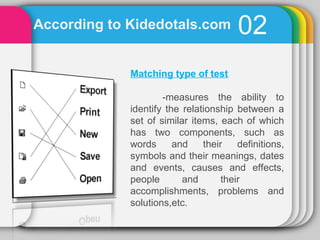
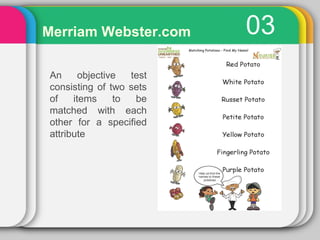
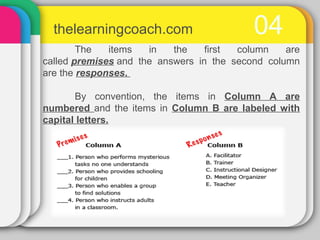
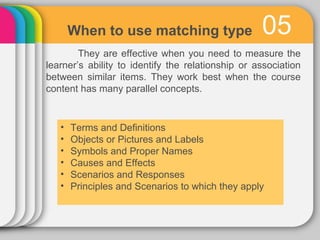
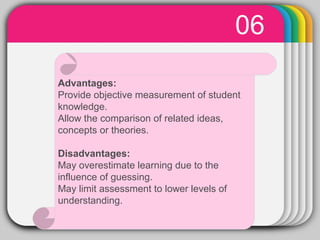
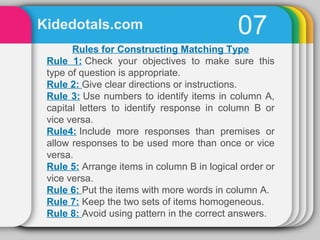
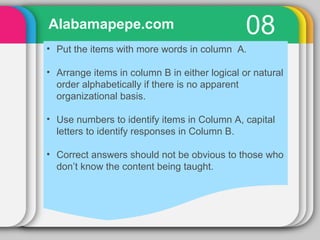
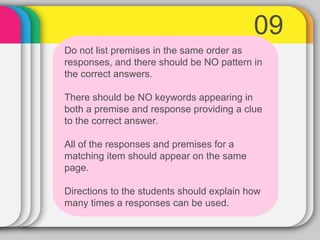
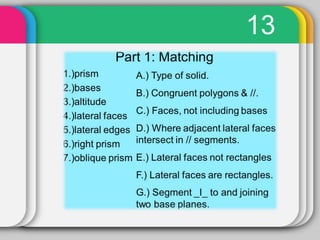

The document discusses matching type tests, which measure a learner's ability to identify relationships between sets of items. A matching type test presents two columns, with the first column (premises) numbered and the second column (responses) labeled with capital letters. It is effective for content with parallel concepts and can measure knowledge of terms and definitions, objects and labels, causes and effects, and other relationships. Advantages are objective measurement and comparing ideas, but it may overestimate learning due to guessing and be limited to lower understanding levels. The document provides rules for constructing matching type tests, such as putting more words in column A, arranging column B logically, using numbers for column A and letters for column B, and avoiding patterns in correct


