Communication disorders
in young children
What is communication ?
Exchange of information
with others
produce understand
messages
Forms of communication
• Nonlinguistic (gestures, body
posture, facial expression, eye
contact, head and body
movement)
• Verbal = words (speaking,
writing, sign language)
• Paralinguistic (tone of voice,
emphasis of words)
Communication development
• Signals: joint attention, gestural
communication, turn-taking
• Language comprehension
• Language production
The ability to understand
develops before the ability to
speak
!! !!
!!
Communication
• Communication varies
with the child’s age
and developmental status
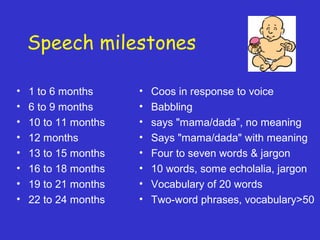
Speech milestones
• 1 to 6 months
• 6 to 9 months
• 10 to 11 months
• 12 months
• 13 to 15 months
• 16 to 18 months
• 19 to 21 months
• 22 to 24 months
• Coos in response to voice
• Babbling
• says "mama/dada”, no meaning
• Says "mama/dada" with meaning
• Four to seven words & jargon
• 10 words, some echolalia, jargon
• Vocabulary of 20 words
• Two-word phrases, vocabulary>50
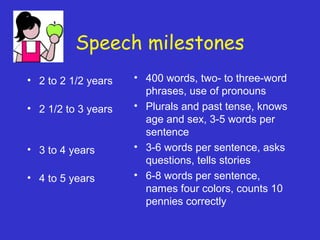
Speech milestones
• 2 to 2 1/2 years
• 2 1/2 to 3 years
• 3 to 4 years
• 4 to 5 years
• 400 words, two- to three-word
phrases, use of pronouns
• Plurals and past tense, knows
age and sex, 3-5 words per
sentence
• 3-6 words per sentence, asks
questions, tells stories
• 6-8 words per sentence,
names four colors, counts 10
pennies correctly
Signs of concern
• Not babbling by 12 to 15 months
• Not comprehending simple commands
by the age of 18 months
• Not talking by 2 years
• Not making sentences by 3 years
• Difficulty telling a simple story by
4-5 years
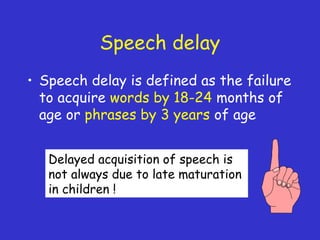
Speech delay
• Speech delay is defined as the failure
to acquire words by 18-24 months of
age or phrases by 3 years of age
Delayed acquisition of speech is
not always due to late maturation
in children !
The impact of
communication disorder
• The communication
has a long-term impact on:
– learning (reading)
– social interaction
Communication
• Language - rule-based system of
symbolic communication involving a
set of small units
• Speech - oral production &
articulation of words
• Form: phonology
morphology
syntax
• Content: semantics
• Function: pragmatic
• Articulation
• Fluency
• Voice
Language Speech
• Improper use of
words and their
meanings
• Inability to
express ideas
• Inappropriate
grammatical
patterns
• Reduced vocabulary
• Inability to follow
directions
• Dysfluency
• Articulation or
phonological
disorders
• Difficulties with
the pitch, volume
or quality of the
voice
Language disorders Speech disorders
Major types of
communication disorders
• Language disorders (60%)
– general language delay (MR, autism, DD)
– specific language impairment
(expressive, receptive + expressive)
• Speech disorders (40%)
• Hearing disorders
Epidemiology of
communication disorders
• The most common developmental
problem in young children (25-50%)
• The disorder is 3-4 times more
common in boys than in girls
Early identification and early
intervention are important
Language variations
Familiar setting during examination !
• Cultural background
• Bilingualism
• Maturation delay - Late talkers
Bilingualism
• A temporary delay in the onset of
both languages
• Comprehension of the two languages
is normal
• The child usually becomes proficient
in both languages before 5 years
Children cannot have a communication
disorder in one language alone
Causes of language disorders
• Hearing loss
• Mental retardation
• Autism /PDD
• Acquired brain damage
(left hemisphere)
• Expressive language disorder
• Receptive aphasia
Specific language impairment
• Seizures
• CP
• Elective mutism
• Psychosocial
deprivation
Hearing Loss
• The most frequently overlooked
disorder affecting speech
development
• Common causes: recurring middle ear
infections, congenital malformations,
meningitis, trauma, genetic disorders
• Diagnosis - behavioral or physiologic
audiometry
Hearing Loss
• Suspect hearing loss when a child
does not seem to understand; is
inattentive; looks intently at others
who are speaking; or better
recognizes sounds with more lip
movement, such as the letter W.
Developmental Delay
• Speech delay caused by late
maturation can be mild, moderate,
severe, or very severe, depending on
the level of impairment of word
sounds, spoken language, and language
comprehension.
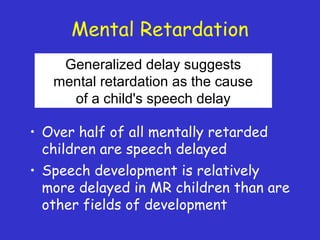
Mental Retardation
• Over half of all mentally retarded
children are speech delayed
• Speech development is relatively
more delayed in MR children than are
other fields of development
Generalized delay suggests
mental retardation as the cause
of a child's speech delay
Mental retardation
• Don't overlook common coexisting
contributors such as: deafness,
dysarthria, or sensory deprivation
• Global language delay, delayed
auditory comprehension and delayed
use of gestures
Pervasive Developmental Disorders
DSM-IV
• Autistic disorder
• PDD-NOS (Pervasive developmental
disorder-not otherwise specified)
• Asperger’s disorder
• Rett’s syndrome
• Childhood disintegrative disorder
(Heller’s syndrome)
Autism
• Onset before 36 months (18-30 mo.)
• Prevalence 1-2:1000
• Autism is more common in boys (3-4:1)
• Recurrence risk in families 3-8%
• Biologic cause in 10-30%: genetic
syndromes, congenital infections, HIE,
neurocutaneus, metabolic, epileptic
Autism
• Onset occurs before 36 months
• Autistic children fail to make eye
contact, smile socially, respond to
being hugged or use gestures to
communicate
• Ritualistic and compulsive behaviors,
including stereotyped repetitive
motor activity
• Autism is three to four times more
common in boys than in girls
Autism-clinical
• Impairment in social interaction
• Impairment in language &
communication
• Restricted, repetitive & stereotyped
pattern of behavior, interest &
activities
Autism & language
• About half of autistic children don't
develop useful speech by age 5 and
have a poor prognosis
• Speech abnormalities: echolalia,
perseveration, pronoun confusion,
abnormalities of prosody, semantic
pragmatic disorder
Cerebral Palsy
• Delay in speech is common in CP
• Speech delay occurs most often in
athetoid type of CP
• Factors that may account for the
speech delay: hearing loss, spasticity
or incoordination of the muscles of
the tongue, coexisting MR or a defect
in the cerebral cortex
Left Cerebral Lesion
• If acquired before 6 years, left-brain
lesions shift the language center to the
right hemisphere
• May cause speech delay and "pathologic"
left-handedness (too early or without a
family history of left-handedness)
• Aphasia, the loss of previously acquired
speech, is almost always traced to a left
cerebral lesion
Seizures
• When these begin in the
first decade, they can cause
delayed speech or aphasia and
can result in verbal auditory agnosia
(word deafness)
Elective mutism
• These children are negativistic, shy,
timid and withdrawn
• Symptoms of poor adjustment, such as
poor peer relationships or
overdependence on their parents
• Anxiety, attention seeking, or
embarrassment about a speech deficit
• Usually family psychopathology
• Can persist for months or years
Psychosocial Factors
• Speech development can be slower in:
– twins
– younger siblings
– children in lower socioeconomic classes
– children of deaf-mute parents
– children exposed to more than one
language.
Language regression
• Autistic regression
• Landau Kleffner - Aquired epileptic
aphasia
• ESES - Electrical status epilepticus in
sleep
• Disintegrative disorder
Specific language impairment =
Developmental language disorders (DLD)
• 5-10% of preschooler
• Difficulties in language acquisition
(without hearing impairment, low
intelligence and neurological damage)
• Diagnosis by exclusion
• Risk for reading/academic difficulty
& social failure
Developmental language disorders
(DLD) - major types
• Phonology-syntactic:
– Mixed receptive-expressive (verbal
auditory agnosia)
– Expressive only (verbal dyspraxia)
• Higher order processing (semantic-
pragmatic):
– Autistic spectrum
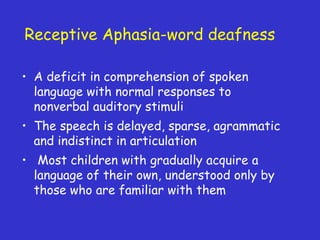
Receptive Aphasia-word deafness
• A deficit in comprehension of spoken
language with normal responses to
nonverbal auditory stimuli
• The speech is delayed, sparse, agrammatic
and indistinct in articulation
• Most children with gradually acquire a
language of their own, understood only by
those who are familiar with them
Prognosis
• Expressive delay alone resolve
spontaneously in the pre-school period
• A poorer prognosis for children with
expressive/receptive delays
• It is not possible to predict at the
time of identification, which of the
children with expressive delay are
likely to have persistent problems
Diagnostic evaluation
• Audiometry with special earphones
• Tympanometry
• An auditory brain-stem response
• Imaging modalities are not indicated
• Prolonged sleep EEG is indicated in
language regression (subclinical
epileptiform EEG)
All children with speech delay
should be referred for audiometry
Diagnostic evaluation
• Additional tests should be ordered only when
they are indicated
• A karyotype for chromosomal abnormalities
and a DNA test in children who have the
phenotypic appearance of fragile X synd.
• An EEG should be considered in children with
seizures or with significant receptive
language disabilities or language regression
(subclinical seizure activities)
Developmental language disorders
-etiology
• Genetic !
• Twin studies (96% concordance in
MZ, 69% in DZ)
• Linkage to chromosome 7q31
• FOXP2 gene (Nature 413:4 oct,2001)
communication
communication

communication

  • 1.
  • 2.
    What is communication? Exchange of information with others produce understand messages
  • 3.
    Forms of communication •Nonlinguistic (gestures, body posture, facial expression, eye contact, head and body movement) • Verbal = words (speaking, writing, sign language) • Paralinguistic (tone of voice, emphasis of words)
  • 4.
    Communication development • Signals:joint attention, gestural communication, turn-taking • Language comprehension • Language production The ability to understand develops before the ability to speak !! !! !!
  • 5.
    Communication • Communication varies withthe child’s age and developmental status
  • 6.
    Speech milestones • 1to 6 months • 6 to 9 months • 10 to 11 months • 12 months • 13 to 15 months • 16 to 18 months • 19 to 21 months • 22 to 24 months • Coos in response to voice • Babbling • says "mama/dada”, no meaning • Says "mama/dada" with meaning • Four to seven words & jargon • 10 words, some echolalia, jargon • Vocabulary of 20 words • Two-word phrases, vocabulary>50
  • 7.
    Speech milestones • 2to 2 1/2 years • 2 1/2 to 3 years • 3 to 4 years • 4 to 5 years • 400 words, two- to three-word phrases, use of pronouns • Plurals and past tense, knows age and sex, 3-5 words per sentence • 3-6 words per sentence, asks questions, tells stories • 6-8 words per sentence, names four colors, counts 10 pennies correctly
  • 8.
    Signs of concern •Not babbling by 12 to 15 months • Not comprehending simple commands by the age of 18 months • Not talking by 2 years • Not making sentences by 3 years • Difficulty telling a simple story by 4-5 years
  • 9.
    Speech delay • Speechdelay is defined as the failure to acquire words by 18-24 months of age or phrases by 3 years of age Delayed acquisition of speech is not always due to late maturation in children !
  • 10.
    The impact of communicationdisorder • The communication has a long-term impact on: – learning (reading) – social interaction
  • 11.
    Communication • Language -rule-based system of symbolic communication involving a set of small units • Speech - oral production & articulation of words
  • 12.
    • Form: phonology morphology syntax •Content: semantics • Function: pragmatic • Articulation • Fluency • Voice Language Speech
  • 13.
    • Improper useof words and their meanings • Inability to express ideas • Inappropriate grammatical patterns • Reduced vocabulary • Inability to follow directions • Dysfluency • Articulation or phonological disorders • Difficulties with the pitch, volume or quality of the voice Language disorders Speech disorders
  • 14.
    Major types of communicationdisorders • Language disorders (60%) – general language delay (MR, autism, DD) – specific language impairment (expressive, receptive + expressive) • Speech disorders (40%) • Hearing disorders
  • 15.
    Epidemiology of communication disorders •The most common developmental problem in young children (25-50%) • The disorder is 3-4 times more common in boys than in girls Early identification and early intervention are important
  • 16.
    Language variations Familiar settingduring examination ! • Cultural background • Bilingualism • Maturation delay - Late talkers
  • 17.
    Bilingualism • A temporarydelay in the onset of both languages • Comprehension of the two languages is normal • The child usually becomes proficient in both languages before 5 years Children cannot have a communication disorder in one language alone
  • 18.
    Causes of languagedisorders • Hearing loss • Mental retardation • Autism /PDD • Acquired brain damage (left hemisphere) • Expressive language disorder • Receptive aphasia Specific language impairment • Seizures • CP • Elective mutism • Psychosocial deprivation
  • 19.
    Hearing Loss • Themost frequently overlooked disorder affecting speech development • Common causes: recurring middle ear infections, congenital malformations, meningitis, trauma, genetic disorders • Diagnosis - behavioral or physiologic audiometry
  • 20.
    Hearing Loss • Suspecthearing loss when a child does not seem to understand; is inattentive; looks intently at others who are speaking; or better recognizes sounds with more lip movement, such as the letter W.
  • 21.
    Developmental Delay • Speechdelay caused by late maturation can be mild, moderate, severe, or very severe, depending on the level of impairment of word sounds, spoken language, and language comprehension.
  • 22.
    Mental Retardation • Overhalf of all mentally retarded children are speech delayed • Speech development is relatively more delayed in MR children than are other fields of development Generalized delay suggests mental retardation as the cause of a child's speech delay
  • 23.
    Mental retardation • Don'toverlook common coexisting contributors such as: deafness, dysarthria, or sensory deprivation • Global language delay, delayed auditory comprehension and delayed use of gestures
  • 24.
    Pervasive Developmental Disorders DSM-IV •Autistic disorder • PDD-NOS (Pervasive developmental disorder-not otherwise specified) • Asperger’s disorder • Rett’s syndrome • Childhood disintegrative disorder (Heller’s syndrome)
  • 25.
    Autism • Onset before36 months (18-30 mo.) • Prevalence 1-2:1000 • Autism is more common in boys (3-4:1) • Recurrence risk in families 3-8% • Biologic cause in 10-30%: genetic syndromes, congenital infections, HIE, neurocutaneus, metabolic, epileptic
  • 26.
    Autism • Onset occursbefore 36 months • Autistic children fail to make eye contact, smile socially, respond to being hugged or use gestures to communicate • Ritualistic and compulsive behaviors, including stereotyped repetitive motor activity • Autism is three to four times more common in boys than in girls
  • 27.
    Autism-clinical • Impairment insocial interaction • Impairment in language & communication • Restricted, repetitive & stereotyped pattern of behavior, interest & activities
  • 28.
    Autism & language •About half of autistic children don't develop useful speech by age 5 and have a poor prognosis • Speech abnormalities: echolalia, perseveration, pronoun confusion, abnormalities of prosody, semantic pragmatic disorder
  • 29.
    Cerebral Palsy • Delayin speech is common in CP • Speech delay occurs most often in athetoid type of CP • Factors that may account for the speech delay: hearing loss, spasticity or incoordination of the muscles of the tongue, coexisting MR or a defect in the cerebral cortex
  • 30.
    Left Cerebral Lesion •If acquired before 6 years, left-brain lesions shift the language center to the right hemisphere • May cause speech delay and "pathologic" left-handedness (too early or without a family history of left-handedness) • Aphasia, the loss of previously acquired speech, is almost always traced to a left cerebral lesion
  • 31.
    Seizures • When thesebegin in the first decade, they can cause delayed speech or aphasia and can result in verbal auditory agnosia (word deafness)
  • 32.
    Elective mutism • Thesechildren are negativistic, shy, timid and withdrawn • Symptoms of poor adjustment, such as poor peer relationships or overdependence on their parents • Anxiety, attention seeking, or embarrassment about a speech deficit • Usually family psychopathology • Can persist for months or years
  • 33.
    Psychosocial Factors • Speechdevelopment can be slower in: – twins – younger siblings – children in lower socioeconomic classes – children of deaf-mute parents – children exposed to more than one language.
  • 34.
    Language regression • Autisticregression • Landau Kleffner - Aquired epileptic aphasia • ESES - Electrical status epilepticus in sleep • Disintegrative disorder
  • 35.
    Specific language impairment= Developmental language disorders (DLD) • 5-10% of preschooler • Difficulties in language acquisition (without hearing impairment, low intelligence and neurological damage) • Diagnosis by exclusion • Risk for reading/academic difficulty & social failure
  • 36.
    Developmental language disorders (DLD)- major types • Phonology-syntactic: – Mixed receptive-expressive (verbal auditory agnosia) – Expressive only (verbal dyspraxia) • Higher order processing (semantic- pragmatic): – Autistic spectrum
  • 37.
    Receptive Aphasia-word deafness •A deficit in comprehension of spoken language with normal responses to nonverbal auditory stimuli • The speech is delayed, sparse, agrammatic and indistinct in articulation • Most children with gradually acquire a language of their own, understood only by those who are familiar with them
  • 38.
    Prognosis • Expressive delayalone resolve spontaneously in the pre-school period • A poorer prognosis for children with expressive/receptive delays • It is not possible to predict at the time of identification, which of the children with expressive delay are likely to have persistent problems
  • 39.
    Diagnostic evaluation • Audiometrywith special earphones • Tympanometry • An auditory brain-stem response • Imaging modalities are not indicated • Prolonged sleep EEG is indicated in language regression (subclinical epileptiform EEG) All children with speech delay should be referred for audiometry
  • 40.
    Diagnostic evaluation • Additionaltests should be ordered only when they are indicated • A karyotype for chromosomal abnormalities and a DNA test in children who have the phenotypic appearance of fragile X synd. • An EEG should be considered in children with seizures or with significant receptive language disabilities or language regression (subclinical seizure activities)
  • 41.
    Developmental language disorders -etiology •Genetic ! • Twin studies (96% concordance in MZ, 69% in DZ) • Linkage to chromosome 7q31 • FOXP2 gene (Nature 413:4 oct,2001)