 

what is ventilation? 
•The process of removing or supplying air by natural or mechanical means to and from a space. 
Necessity 
•To create air movement, so as to remove the vitiated air or its replacement by the fresh air. 
•To prevent an undue concentration of body odour, fumes, dust and other industrial products. 
•To remove products of combustion, and in some cases, to remove body heat and heat liberated by the operation of electrical and mechanical equipment. 
•To create healthy living conditions by preventing the undue accumulation of CO2 and moisture and depletion of the oxygen content of the air. 
•To prevent flammable concentrations of gas vapour or dust in case of industrial buildings.
Functional requirements of a Ventilation system 
Rate of supply of fresh air : 
•Number of air changes depend up on type of buildings and its occupancy. 
•Air changes per hour is the volume of outside air allowed in to a room in one hour compared with the volume of the room. 
For ex: In residential buildings 
• Living rooms and bed rooms: 3 air changes per hour 
• kitchen: 6 air changes/h 
• Bath rooms and W.C: 6 air changes/h 
• Halls and passages: 1 air change/h
Temperature of Air : 
•It is desirable that the incoming air for ventilation should be cool in summer and be warm in winter before it enters the room. Comfortable temperature is 22 °C for summer and 20 °C for winter. 
Humidity: 
•The relative humidity within the range of 30 to 70% at the working temperature of 21 °C is considered as desirable and, therefore should be maintained. 
•When work is required to be done at a higher temperature, low humidity and greater air movements are necessary for removing a greater portion of heat from the body. 
Purity of air: 
• Ventilating air should be free from impurities such as odours, organic matter, inorganic dust and unhealthy fumes of gases like CO, CO2, SO2 etc. 
•To get pure ventilated air, the entry of ventilation system should not be situated in the neighbourhood of chimneys, latrines, urinals or such other sources.
Types of ventilation 
There are two types of ventilations: 
•Natural ventilation 
•Mechanical ventilation 
Natural ventilation 
•Facilitate outside air to inside of a building through windows, doors, ventilation or other openings. 
•Openings should not be less than 1/20th of floor area. 
•The rate of ventilation by natural means depends on : 
Wind effect 
Stack effect
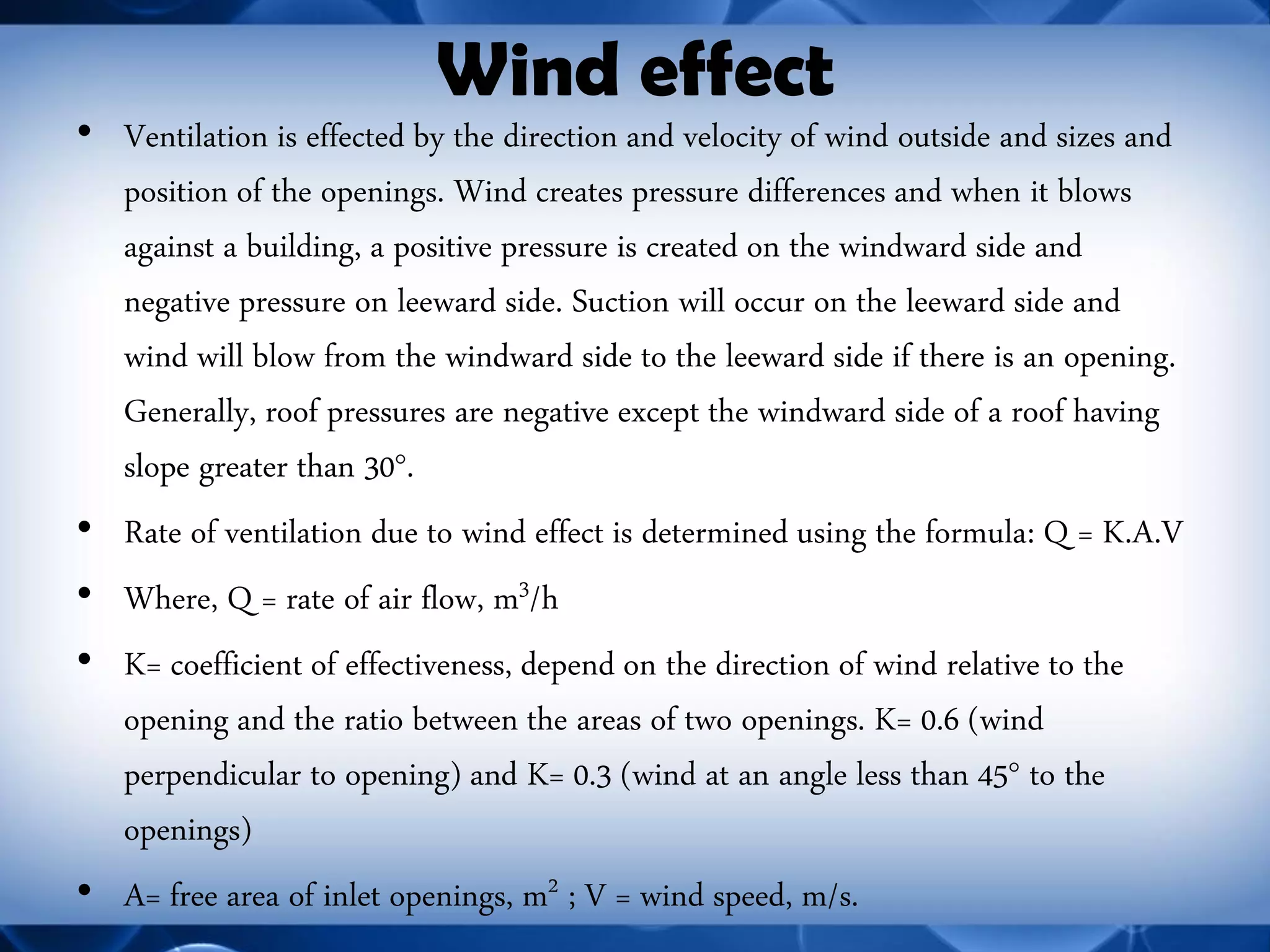
Wind effect 
•Ventilation is effected by the direction and velocity of wind outside and sizes and position of the openings. Wind creates pressure differences and when it blows against a building, a positive pressure is created on the windward side and negative pressure on leeward side. Suction will occur on the leeward side and wind will blow from the windward side to the leeward side if there is an opening. Generally, roof pressures are negative except the windward side of a roof having slope greater than 30°. 
•Rate of ventilation due to wind effect is determined using the formula: Q = K.A.V 
•Where, Q = rate of air flow, m3/h 
•K= coefficient of effectiveness, depend on the direction of wind relative to the opening and the ratio between the areas of two openings. K= 0.6 (wind perpendicular to opening) and K= 0.3 (wind at an angle less than 45° to the openings) 
•A= free area of inlet openings, m2 ; V = wind speed, m/s.
Single sided ventilation 
•Rooms with windows on one side only. Cold air will stream in, and warm air will stream out again through the same window. This kind of ventilation is normal and generally practised, but it is only useful up to a certain room depth. 
Single sided double ventilation 
An advancement of the single sided principle provides a double opening, which is considerably more efficient.
Cross ventilation 
•In the case of cross-ventilation, (windows open on both sides of the room/building) the pressure difference is used between the side of the building facing the wind and the side away from the wind. The positive pressure on the windward and/or a vacuum effect on the leeward side of the building, causes air movement through the building from the windward to the leeward side. In order to obtain the optimal airflow with minimal draught, the windows on the windward side are opened less than on the lee side.
Stack effect 
•Ventilation rate is affected by the convection effects arising from temperature or vapour pressure difference or both, between inside and outside of the room and the difference of height between the outlet and inlet openings. 
•If the air temperature inside is higher than that of outside, the warmer air tries to rise and pass through the opening in the upper part of the building. At the same time, the incoming cooler air from outside through the opening at lower elevation replaces it. 
•The rate of ventilation due to stack effect is determined by using the formula; Q = 640.Ce.A {h(t1-to)}1/2 
•Where, Q = rate of air flow, m3/s 
•Ce= coefficient of effectiveness, the value ranges between 0.65 to 0.5 
•A = free area of inlet openings, m2 
•h = vertical height difference between inlets and outlets, m 
•t1 = average temperature of indoor air at height ‘h’ in °C 
•to = temperature of outdoor air in °C
General considerations and rules for natural ventilation 
•Inlet openings in the building should be well distributed and should be located in the windward side at low level. The outlet openings should be located on the leeward side near the ceiling in the side walls and in roofs 
•Inlet and outlet openings should preferably be of equal size for greatest air flow, but when outlet is in the form of a roof opening the inlet should be larger in size. Where the wind direction is variable, provide openings in all walls
•Inlet openings should not be obstructed by obstructions in the path of flow (adjoining buildings, trees, signboards, partitions, etc) 
•Increased height of the room gives better ventilation due to stack effect 
•The long narrow room should be ventilated by providing suitable openings in short sides 
•Provide ventilators as close to the ceilings as possible 
•For cross ventilation, the position of outlets should be just opposite to inlets 
•If the room is to be used for burning gas or fuel, enough quantity of air should be supplied by natural ventilation for meeting the demands of burning as well as ventilation of the room.
Artificial ventilation 
Outside air is supplied into a building either by positive ventilation, or by infiltration by reduction of pressure inside due to exhaust of air. 
•Mechanical ventilation is recommended in all the cases where a satisfactory standard of ventilation in respect of air quantity, quality or controllability cannot be obtained by natural means. 
•A mechanical system is capable of meeting the requirements of air quantity and qualities regarding humidity, temperature, etc. 
•e.g., Big offices, banks, assembly halls, auditoriums, theatres, large factories, workshops, hotels, etc where space available per occupant is less than 3 m3
Types of Artificial ventilation 
•Extract/exhaust systems: By propeller type exhaust fans. For ex: In kitchen, lavatories, industrial plants, chemical stores 
•Supply or Plenum system: By means of fan; but no provision is made to remove it. 
•Combination of exhaust and supply system or balanced system. 
•Air conditioning: Humidifying/dehumidifying, heating/cooling and filtration 
Essentials of an AC system 
•Filters- to clean air 
•Heating- to heat air in winter system 
•Cooling- to cool air in summer season 
•Humidification- to add moisture to the heated air 
•Dehumidification – to extract moisture from cooled air 
•Air distribution – to circulate or distribute the air inside the room.
What is roof? 
•Roof is the uppermost part of a building which is supported on structural members and covered with a roofing material. 
•The main function of a roof is to enclose the space or building and to protect the same from the damaging effects of weather elements such as rain, wind, heat, snow , etc. 
• A roof must be designed and constructed to meet the requirements of different climates and the covering materials available. Also, other considerations like strength and stability of structure under anticipated loads, heat insulation, lighting, ventilation, sound insulation, aesthetics, etc. 
•The durability of a roof should be equal to or in excess of those materials used in the remainder of the building. 
•A roof should be constructed in such a way as to retain structural stability when dead and imposed loads are applied to it ( dead loads is the weight of materials used to make the roof, imposed loads are loads created by wind, snow, etc.
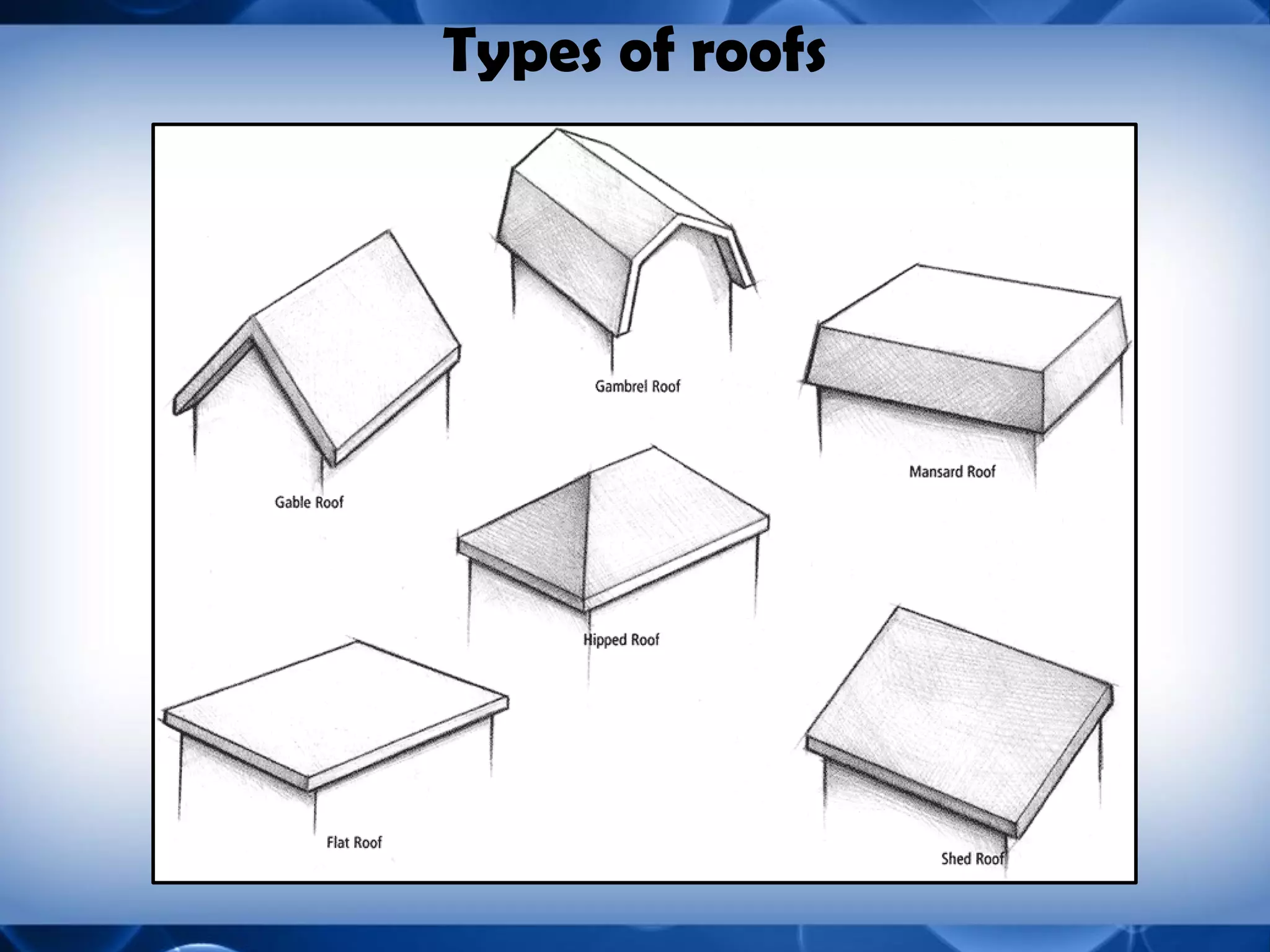
Types of roofs
Gable roof
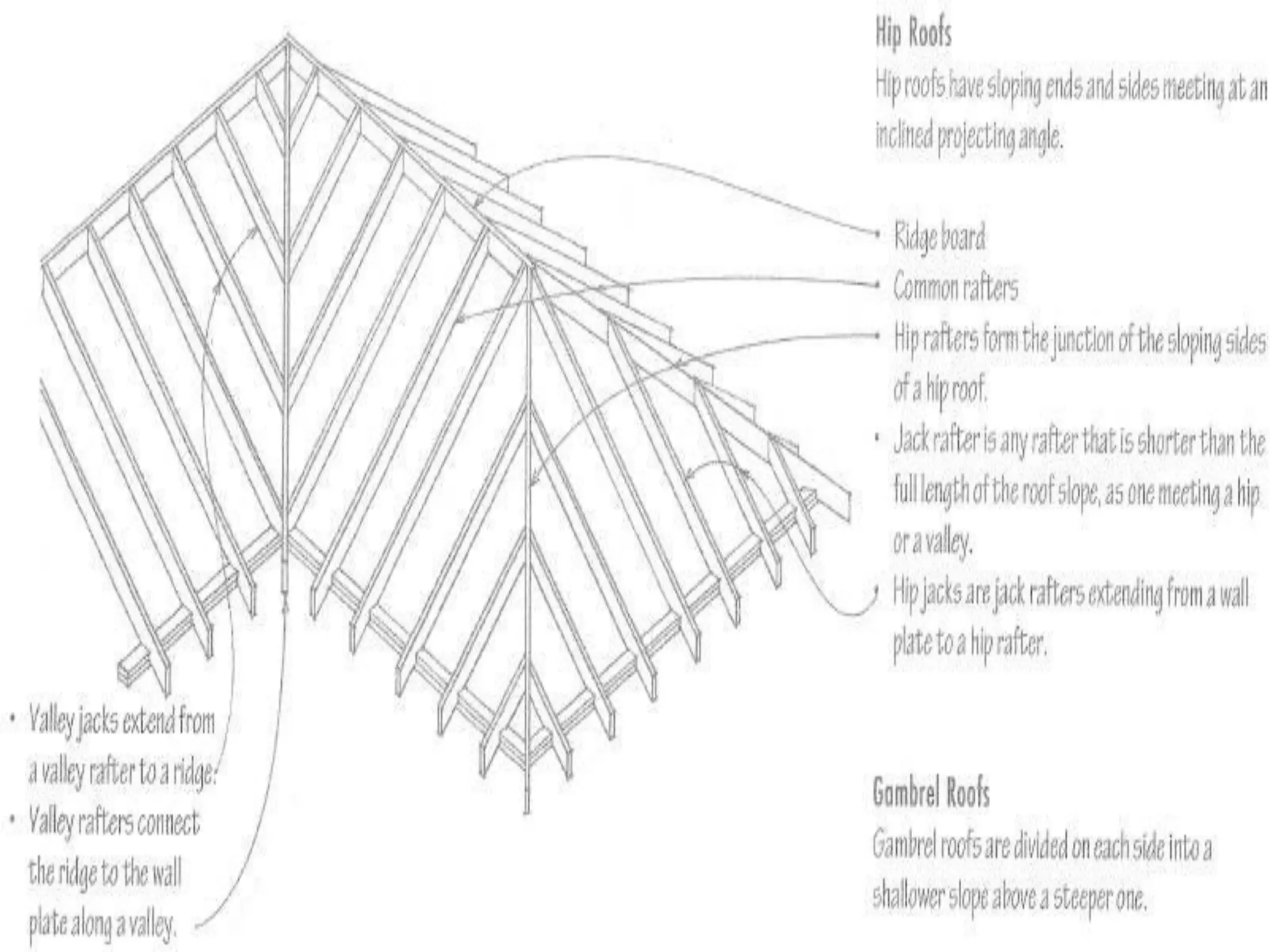
Hip roof
Dutch hip roof 
The Dutch Gable is a combination of the gable and hip roof shapes. Imagine it as a hip roof but with shortened hip lines, an extended ridge line, and a a gable line linking the ridge and hips together.
Valley shapes
For more presentations 
Please visit 
www.slideshare.net/RAHULSINHA1993

Ventilation/Roofing

  • 1.
  • 3.
    what is ventilation? •The process of removing or supplying air by natural or mechanical means to and from a space. Necessity •To create air movement, so as to remove the vitiated air or its replacement by the fresh air. •To prevent an undue concentration of body odour, fumes, dust and other industrial products. •To remove products of combustion, and in some cases, to remove body heat and heat liberated by the operation of electrical and mechanical equipment. •To create healthy living conditions by preventing the undue accumulation of CO2 and moisture and depletion of the oxygen content of the air. •To prevent flammable concentrations of gas vapour or dust in case of industrial buildings.
  • 4.
    Functional requirements ofa Ventilation system Rate of supply of fresh air : •Number of air changes depend up on type of buildings and its occupancy. •Air changes per hour is the volume of outside air allowed in to a room in one hour compared with the volume of the room. For ex: In residential buildings • Living rooms and bed rooms: 3 air changes per hour • kitchen: 6 air changes/h • Bath rooms and W.C: 6 air changes/h • Halls and passages: 1 air change/h
  • 5.
    Temperature of Air: •It is desirable that the incoming air for ventilation should be cool in summer and be warm in winter before it enters the room. Comfortable temperature is 22 °C for summer and 20 °C for winter. Humidity: •The relative humidity within the range of 30 to 70% at the working temperature of 21 °C is considered as desirable and, therefore should be maintained. •When work is required to be done at a higher temperature, low humidity and greater air movements are necessary for removing a greater portion of heat from the body. Purity of air: • Ventilating air should be free from impurities such as odours, organic matter, inorganic dust and unhealthy fumes of gases like CO, CO2, SO2 etc. •To get pure ventilated air, the entry of ventilation system should not be situated in the neighbourhood of chimneys, latrines, urinals or such other sources.
  • 6.
    Types of ventilation There are two types of ventilations: •Natural ventilation •Mechanical ventilation Natural ventilation •Facilitate outside air to inside of a building through windows, doors, ventilation or other openings. •Openings should not be less than 1/20th of floor area. •The rate of ventilation by natural means depends on : Wind effect Stack effect
  • 7.
    Wind effect •Ventilationis effected by the direction and velocity of wind outside and sizes and position of the openings. Wind creates pressure differences and when it blows against a building, a positive pressure is created on the windward side and negative pressure on leeward side. Suction will occur on the leeward side and wind will blow from the windward side to the leeward side if there is an opening. Generally, roof pressures are negative except the windward side of a roof having slope greater than 30°. •Rate of ventilation due to wind effect is determined using the formula: Q = K.A.V •Where, Q = rate of air flow, m3/h •K= coefficient of effectiveness, depend on the direction of wind relative to the opening and the ratio between the areas of two openings. K= 0.6 (wind perpendicular to opening) and K= 0.3 (wind at an angle less than 45° to the openings) •A= free area of inlet openings, m2 ; V = wind speed, m/s.
  • 8.
    Single sided ventilation •Rooms with windows on one side only. Cold air will stream in, and warm air will stream out again through the same window. This kind of ventilation is normal and generally practised, but it is only useful up to a certain room depth. Single sided double ventilation An advancement of the single sided principle provides a double opening, which is considerably more efficient.
  • 9.
    Cross ventilation •Inthe case of cross-ventilation, (windows open on both sides of the room/building) the pressure difference is used between the side of the building facing the wind and the side away from the wind. The positive pressure on the windward and/or a vacuum effect on the leeward side of the building, causes air movement through the building from the windward to the leeward side. In order to obtain the optimal airflow with minimal draught, the windows on the windward side are opened less than on the lee side.
  • 10.
    Stack effect •Ventilationrate is affected by the convection effects arising from temperature or vapour pressure difference or both, between inside and outside of the room and the difference of height between the outlet and inlet openings. •If the air temperature inside is higher than that of outside, the warmer air tries to rise and pass through the opening in the upper part of the building. At the same time, the incoming cooler air from outside through the opening at lower elevation replaces it. •The rate of ventilation due to stack effect is determined by using the formula; Q = 640.Ce.A {h(t1-to)}1/2 •Where, Q = rate of air flow, m3/s •Ce= coefficient of effectiveness, the value ranges between 0.65 to 0.5 •A = free area of inlet openings, m2 •h = vertical height difference between inlets and outlets, m •t1 = average temperature of indoor air at height ‘h’ in °C •to = temperature of outdoor air in °C
  • 11.
    General considerations andrules for natural ventilation •Inlet openings in the building should be well distributed and should be located in the windward side at low level. The outlet openings should be located on the leeward side near the ceiling in the side walls and in roofs •Inlet and outlet openings should preferably be of equal size for greatest air flow, but when outlet is in the form of a roof opening the inlet should be larger in size. Where the wind direction is variable, provide openings in all walls
  • 12.
    •Inlet openings shouldnot be obstructed by obstructions in the path of flow (adjoining buildings, trees, signboards, partitions, etc) •Increased height of the room gives better ventilation due to stack effect •The long narrow room should be ventilated by providing suitable openings in short sides •Provide ventilators as close to the ceilings as possible •For cross ventilation, the position of outlets should be just opposite to inlets •If the room is to be used for burning gas or fuel, enough quantity of air should be supplied by natural ventilation for meeting the demands of burning as well as ventilation of the room.
  • 13.
    Artificial ventilation Outsideair is supplied into a building either by positive ventilation, or by infiltration by reduction of pressure inside due to exhaust of air. •Mechanical ventilation is recommended in all the cases where a satisfactory standard of ventilation in respect of air quantity, quality or controllability cannot be obtained by natural means. •A mechanical system is capable of meeting the requirements of air quantity and qualities regarding humidity, temperature, etc. •e.g., Big offices, banks, assembly halls, auditoriums, theatres, large factories, workshops, hotels, etc where space available per occupant is less than 3 m3
  • 14.
    Types of Artificialventilation •Extract/exhaust systems: By propeller type exhaust fans. For ex: In kitchen, lavatories, industrial plants, chemical stores •Supply or Plenum system: By means of fan; but no provision is made to remove it. •Combination of exhaust and supply system or balanced system. •Air conditioning: Humidifying/dehumidifying, heating/cooling and filtration Essentials of an AC system •Filters- to clean air •Heating- to heat air in winter system •Cooling- to cool air in summer season •Humidification- to add moisture to the heated air •Dehumidification – to extract moisture from cooled air •Air distribution – to circulate or distribute the air inside the room.
  • 16.
    What is roof? •Roof is the uppermost part of a building which is supported on structural members and covered with a roofing material. •The main function of a roof is to enclose the space or building and to protect the same from the damaging effects of weather elements such as rain, wind, heat, snow , etc. • A roof must be designed and constructed to meet the requirements of different climates and the covering materials available. Also, other considerations like strength and stability of structure under anticipated loads, heat insulation, lighting, ventilation, sound insulation, aesthetics, etc. •The durability of a roof should be equal to or in excess of those materials used in the remainder of the building. •A roof should be constructed in such a way as to retain structural stability when dead and imposed loads are applied to it ( dead loads is the weight of materials used to make the roof, imposed loads are loads created by wind, snow, etc.
  • 17.
  • 22.
  • 23.
  • 24.
    Dutch hip roof The Dutch Gable is a combination of the gable and hip roof shapes. Imagine it as a hip roof but with shortened hip lines, an extended ridge line, and a a gable line linking the ridge and hips together.
  • 25.
  • 30.
    For more presentations Please visit www.slideshare.net/RAHULSINHA1993