SOLUTIONS MANUAL for Fundamentals of Aerodynamics 6th Edition by
Anderson
Download:
https://downloadlink.org/p/solutions-manual-for-fundamentals-of-aerodynamics-
6th-edition-by-anderson/
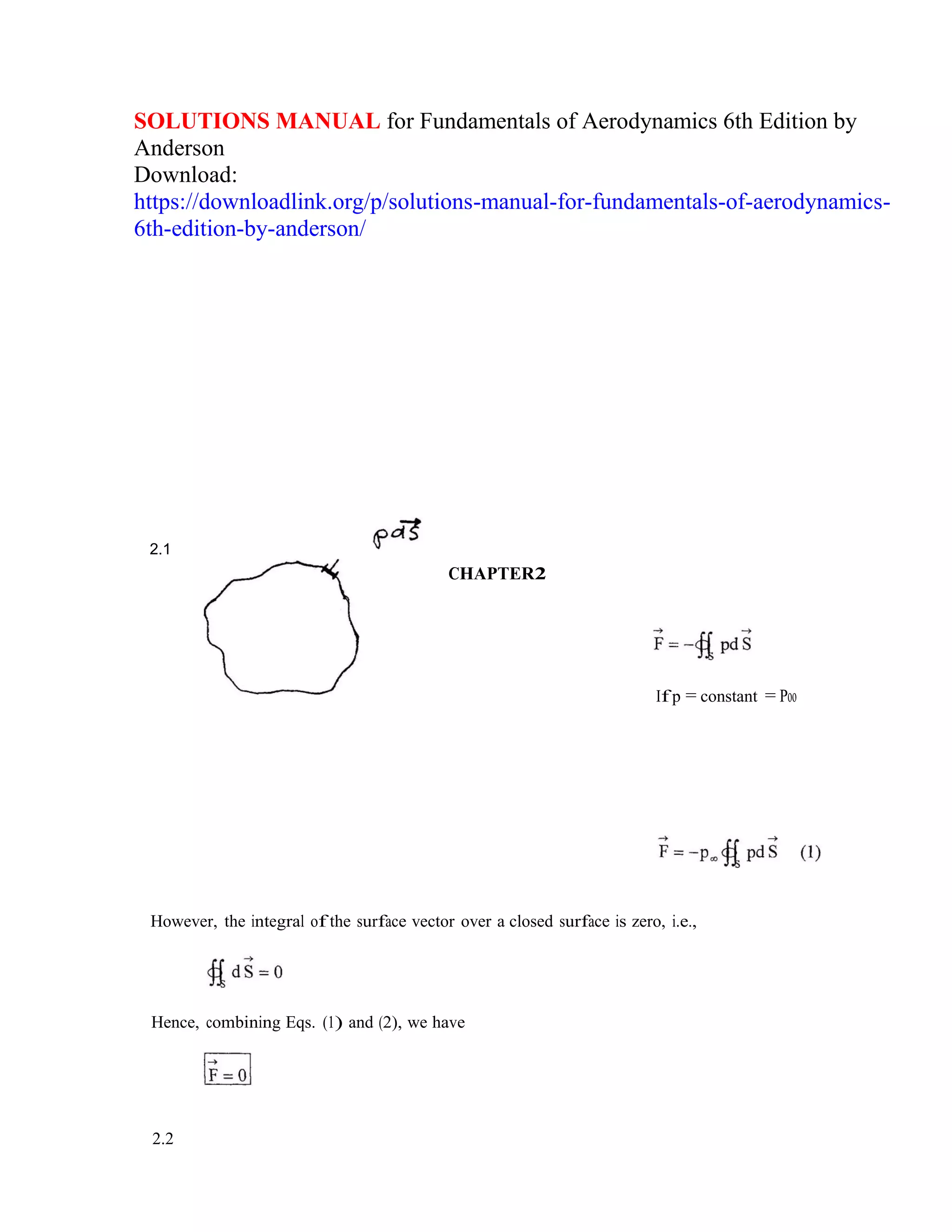
2.1
CHAPTER2
If p = constant = Poo
However, the integral of the surface vector over a closed surface is zero, i.e.,
Hence, combining Eqs. (1) and (2), we have
2.2
t/f',Per W11 I/
/ LL.L/ t L
�
I
/ 7 7 7 7 7 7 7-t! 7 7 7 /
L.ou,e,- Wa II f.t {'X )
19
Copyright © 2017 McGraw-Hill Education. All rights reserved. No reproduction or distribution
without the prior written consent of McGraw-Hill Education
Copyright © 2017 McGraw-Hill Education. All rights reserved. No reproduction or distribution
without the prior written consent of McGraw-Hill Education
h b
2
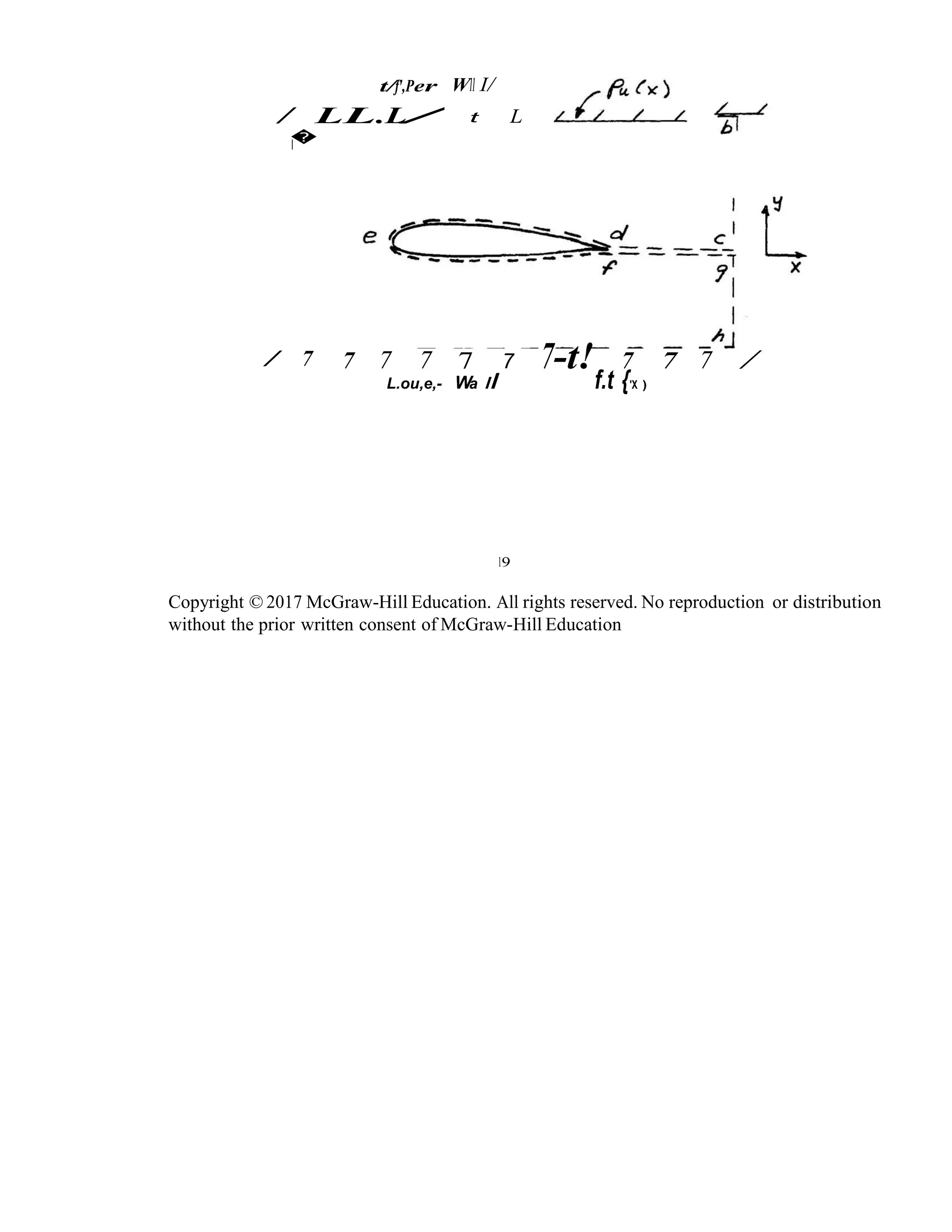
Denote the pressure distributions on the upper and lower walls by pu(x) and p e (x) respectively.
The walls are close enough to the model such that Pu and p I are not necessarily equal to Poo·
Assume that faces ai and bh are far enough upstream and downstream of the model such that
p=poo and v = 0 and ai and bh.
Take they-component ofEq. (2.66)
L = - # (p v. dS) v - H (p dS)y
S abhi
The first integral= 0 over all surfaces, either because V · ds = 0 or because v = 0. Hence
l ;L' = - fJ (pdS)y = - [ J u dx - J p e dx]
-> b h
P
abhi a
Minus sign because y-component is in downward
Direction.
Note: In the above, the integrals over ia and bh cancel because p = Poo on both faces. Hence
L' = f pf dx - f Pu dx
2.3
dy v cy/(x2+y2) y
==-= =
dx u ex I (x + y2 ) x
dy dx
-=-
y x
The streamlines are straight lines emanating from the origin. (This is the velocity field and
streamline pattern for a source, to be discussed in Chapter 3.)
2.4
dy v x
-=-==
dx u y
y dy = - x dx
20
Copyright © 2017 McGraw-Hill Education. All rights reserved. No reproduction or distribution
without the prior written consent of McGraw-Hill Education
� /?
y2 = -x2
+ const
x2 + y2 = const.
The streamlines are concentric with their centers at the origin. (This is the velocity field and
streamline pattern for a vortex, to be discussed in Chapter 3.)
2.5 From inspection, since there is no radial component of velocity, the streamlines must be
circular, with centers at the origin. To show this more precisely,
u = - ve sin = - er r = - cy
r
x
v = Ve cos 8 = er - = ex
r
dy v x
= =
dx u y
&2
+ x
2
= const.J
This is the equation of a circle with the center at the origin. (This velocity field corresponds to
solid body rotation.)
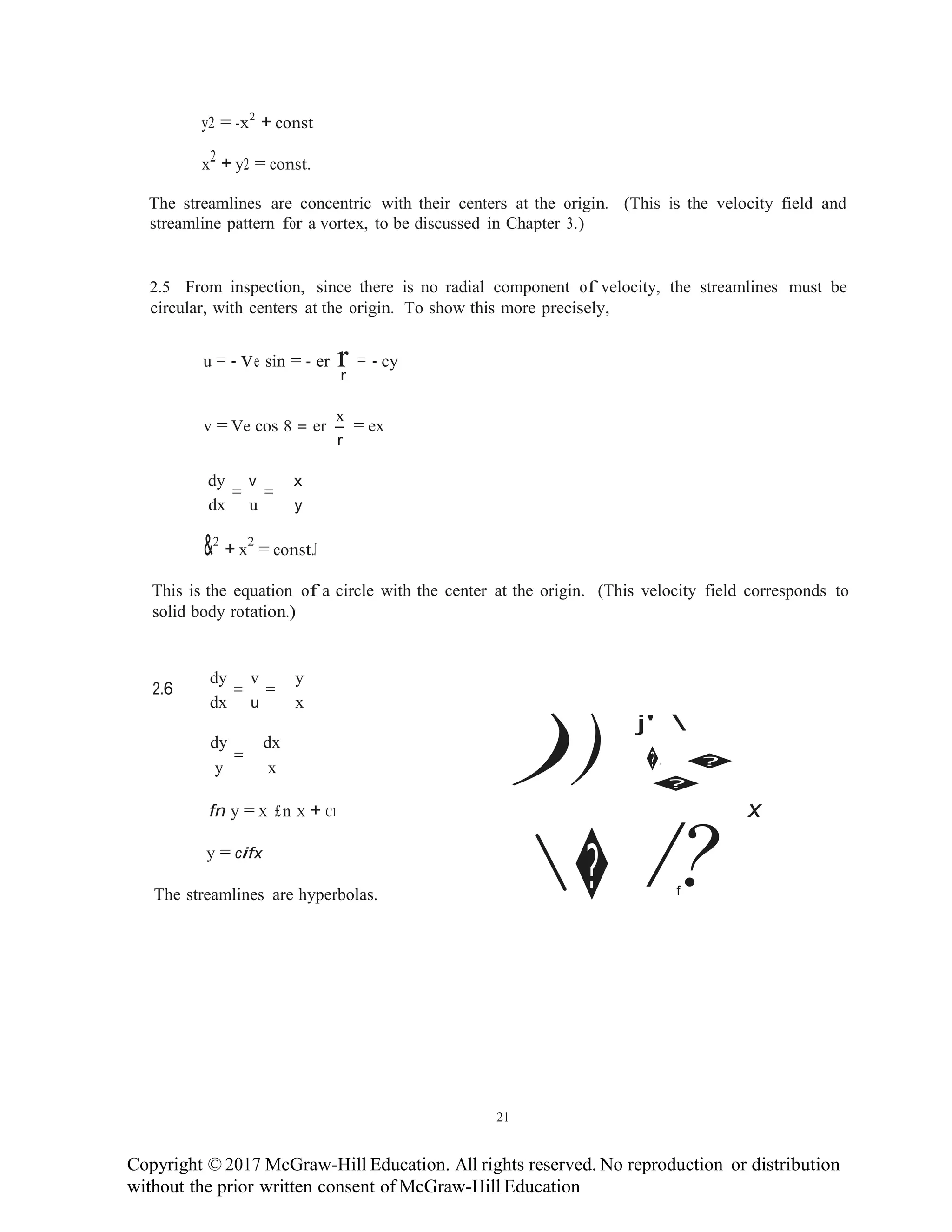
dy v y
2.6
dx
=
u
=
x
dy dx
)) j' 
y
=
x �. �
�
fn y = X £n X + C1 x
y = cifx
The streamlines are hyperbolas. f
21
Copyright © 2017 McGraw-Hill Education. All rights reserved. No reproduction or distribution without the prior written
consent of McGraw-Hill Education
roe
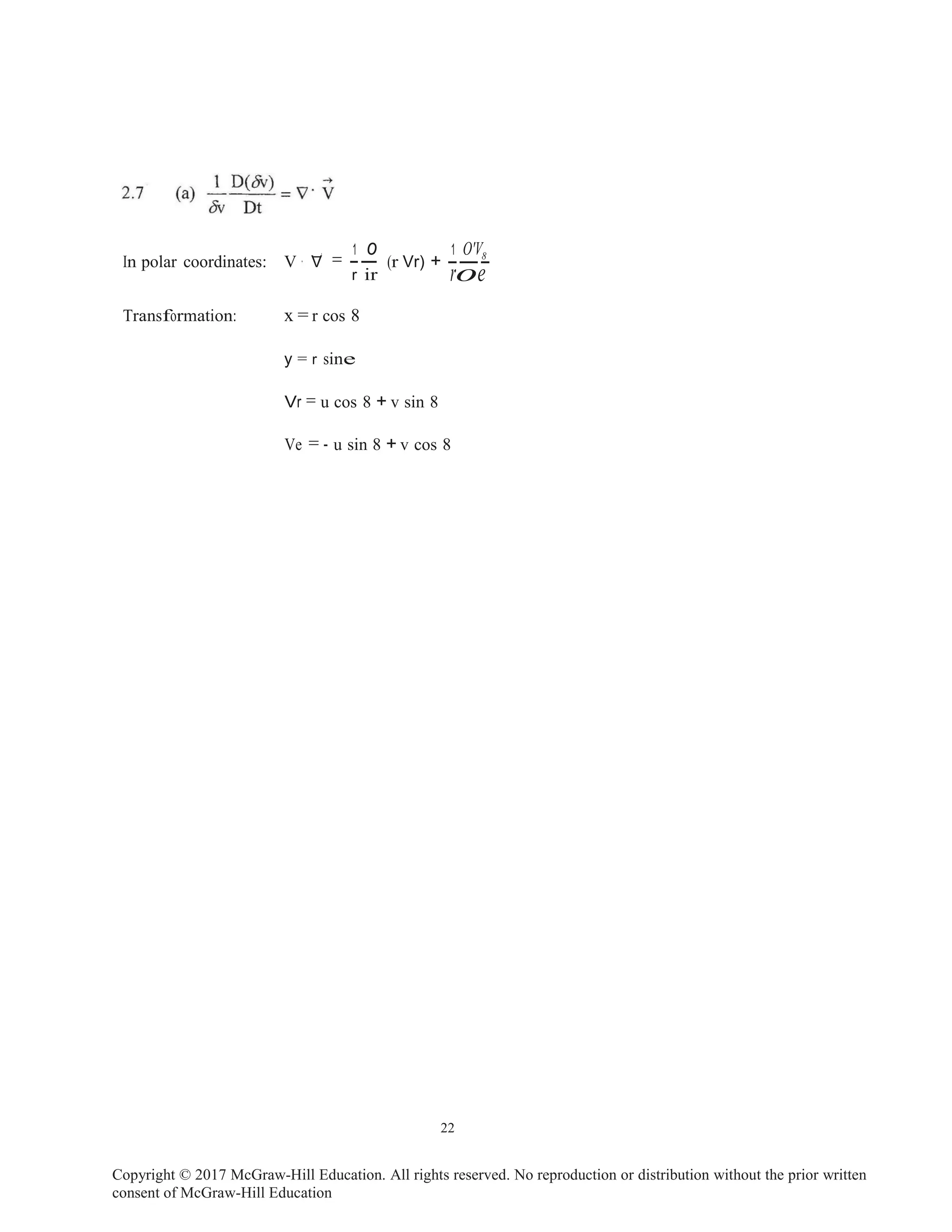
, 1 o 1 O'V
In polar coordinates: V · V = -- (r Vr) + ---8
r ir
Transformation: x = r cos 8
y = r sine
Vr = u cos 8 + v sin 8
Ve = - u sin 8 + v cos 8
22
Copyright © 2017 McGraw-Hill Education. All rights reserved. No reproduction or distribution without the prior written
consent of McGraw-Hill Education
V V = -- (c) + -- = 0
u=
ex er cosB c cosB
(x' + y2) r
?
r
v=
cy er sine
=
c sine
(x2+y2) r2 r
vr = -
C
cos
2
e + -
C
sm
. 2
e = -
C
r r r
Ve= - � cosf) sine+ � cosf sine= 0
r r
. _, 1 8 1 8(0)
r a: r !JB
(b) From Eq. (2.23)
V x V = e2 [O + 0 - O] = �
The flowfield is irrotational.
2.8
cy er sine c sine
u= == ==
(x ' +y2) r ?
' r
-ex
v=
er cose
== - -
c cose
(x2+y2) r ?
' r
Yr= � cosf) sine - � cosu sine= 0
r r
ve = - -C
sm
·2
e - -
C
cos
2
e = - -C
r r r
(a) v· V == L� (O)+ 18(-c/r) =O+O=�
r a: r !}{}
23
Copyright © 2017 McGraw-Hill Education. All rights reserved. No reproduction or distribution without the prior written
consent of McGraw-Hill Education
(b) v'x V = / [o'(-c/r) _�_!b'(O)]
lX r2
r oe2
v' x V=�except at the origin, where r = 0. The flowfield is singular at the origin.
2.9 Ve=cr
v , V= / [o(c/r) +er_..!_ o(O)J
z a- r roe
--> -->
ez (c + c - 0) = 2c ez
The vorticity is finite. The flow is not irrotational; it is rotational.
2.10
c
b
a..
Copyright © 2017 McGraw-Hill Education. All rights reserved. No reproduction or distribution without the prior written
consent of McGraw-Hill Education
24
oe
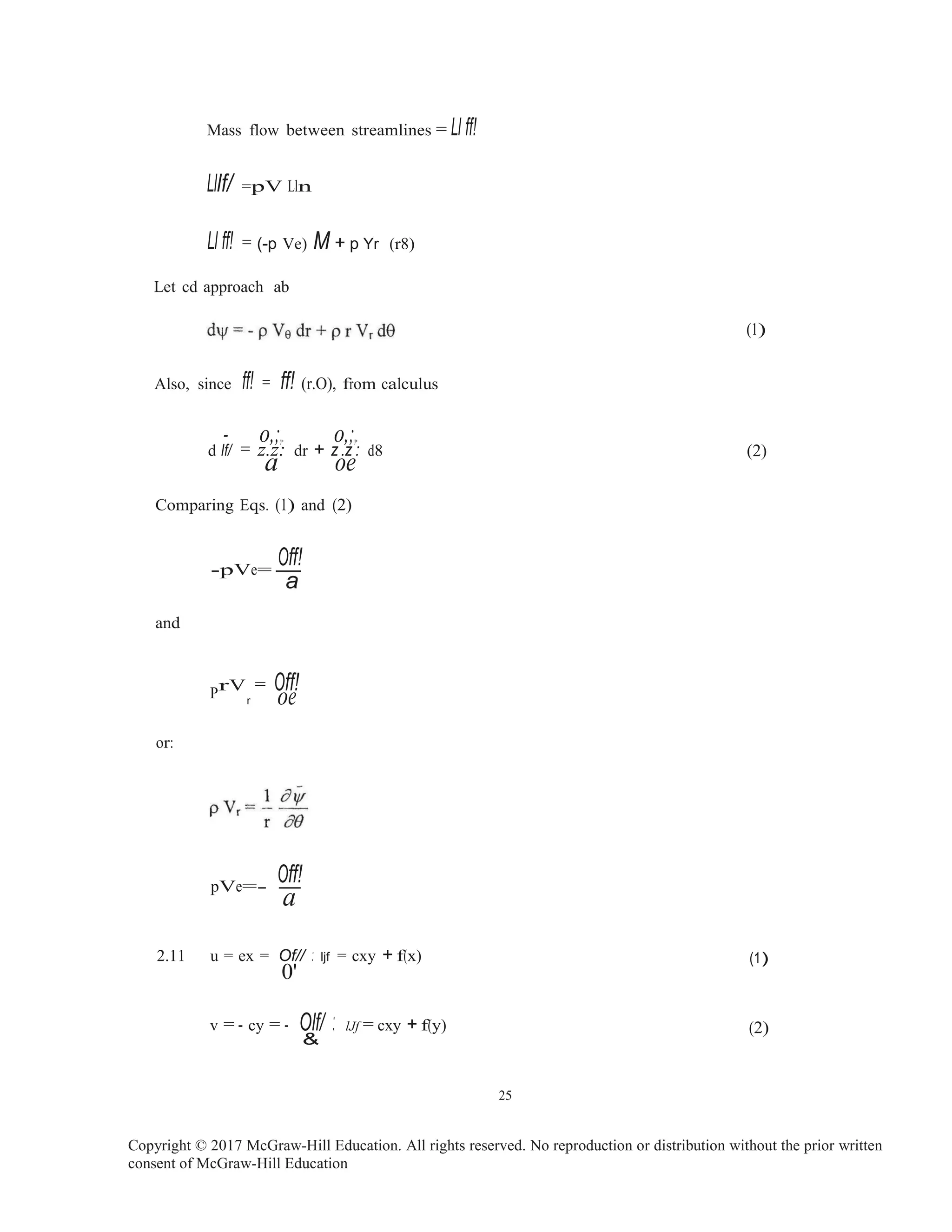
Mass flow between streamlines = Ll ff!
Lllf/ =pV Lln
Ll ff! = (-p Ve) M + p Yr (r8)
Let cd approach ab
Also, since ff! = ff! (r.O), from calculus
- o,;,. o,;,.
d If/ = z
a
.z: dr + z
o
.z
e
: d8
(1)
(2)
Comparing Eqs. (1) and (2)
-pVe=-
Off!
a
and
PrV = Off!
r
or:
Off!pVe=- -
a
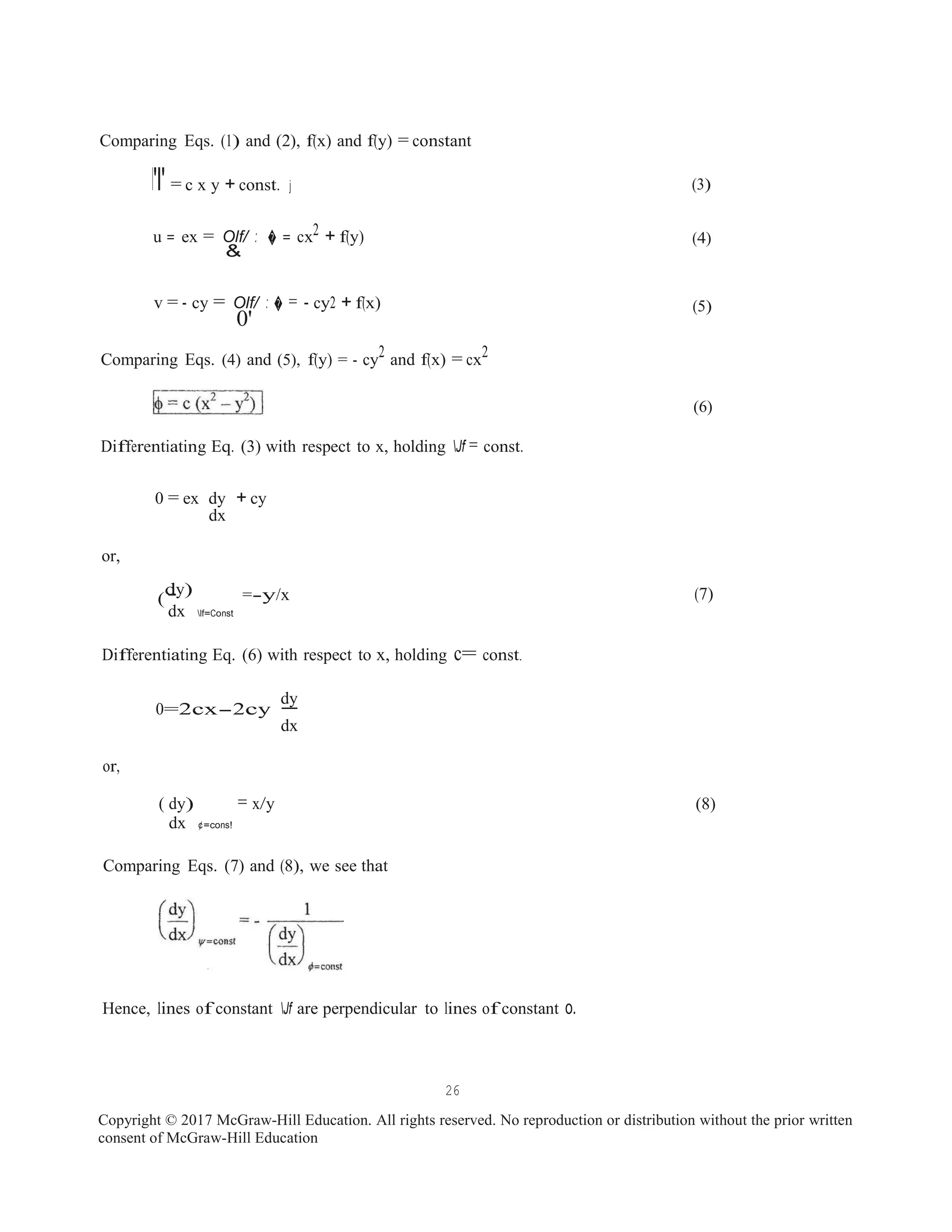
2.11 u = ex = Of// : ljf = cxy + f(x)
0'
v = - cy = - Olf/ : lJf = cxy + f(y)
&
(1)
(2)
25
Copyright © 2017 McGraw-Hill Education. All rights reserved. No reproduction or distribution without the prior written
consent of McGraw-Hill Education
-
-
Comparing Eqs. (1) and (2), f(x) and f(y) = constant
l'l' = c x y + const. j
u = ex = Olf/ : � = cx2 + f(y)
&
v = - cy = Olf/ : � = - cy2 + f(x)
0'
Comparing Eqs. (4) and (5), f(y) = - cy2 and f(x) = cx2
Differentiating Eq. (3) with respect to x, holding Jf = const.
0 = ex dy + cy
dx
or,
(3)
(4)
(5)
(6)
dy)
( =-y/x (7)
dx lf=Const
Differentiating Eq. (6) with respect to x, holding c= const.
0=2cx-2cy
dy
dx
or,
( dy) = x/y
dx ¢=cons!
Comparing Eqs. (7) and (8), we see that
Hence, lines of constant Jf are perpendicular to lines of constant o.
(8)
26
Copyright © 2017 McGraw-Hill Education. All rights reserved. No reproduction or distribution without the prior written
consent of McGraw-Hill Education
Copyright © 2017 McGraw-Hill Education. All rights reserved. No reproduction or distribution without the prior written
consent of McGraw-Hill Education
.
•
m
.
m m
2.12. The geometry ofthe pipe is shown below.
t{=/CJC> ,,w /:s-ec
.,..(I
� .:: /o0 '''' /sr c
As the flow goes through the U-shape bend and is turned, it exerts a net force Ron the internal
surface of the pipe. From the symmetric geometry, R is in the horizontal direction, as shown,
acting to the right. The equal and opposite force, -R, exerted by the pipe on the flow is the
mechanism that reverses the flow velocity. The cross-sectional area of the pipe inlet is nd2
/4
where dis the inside pipe diameter. Hence, A= nd2
/4 = n(0.5)214 = 0.196m2
The mass flow
entering the pipe is
m = P1 A V1 = (1.23)(0.196)(100) = 24.11 kg/sec.
Applying the momentum equation, Eq. (2.64) to this geometry, we obtain a result similar to Eq.
(2.75), namely
R = - # (p V · dS) V (1)
Where the pressure term in Eq. (2.75) is zero because the pressure at the inlet and exit are the
same values. In Eq. (1), the product (p V · dS) is negative at the inlet (V and dS are in opposite
directions), and is positive at the exit (V and dS) are in the same direction). The magnitude of p
V · dS is simply the mass flow,
•
. Finally, at the inlet V1 is to the right, hence it is in the
positive x-direction. At the exit, V2 is to the left, hence it is in the negative x-direction. Thus,
V2 = - V1. With this, Eq. (1) is written as
� .R = - [- m V1 + m V2] = m (V 1 - V2)
=
•
[V1 -(-V1)] =
•
(2V1)
R = (24.11)(2)(100) = &822 Nj
27
Copyright © 2017 McGraw-Hill Education. All rights reserved. No reproduction or distribution without the prior written
consent of McGraw-Hill Education
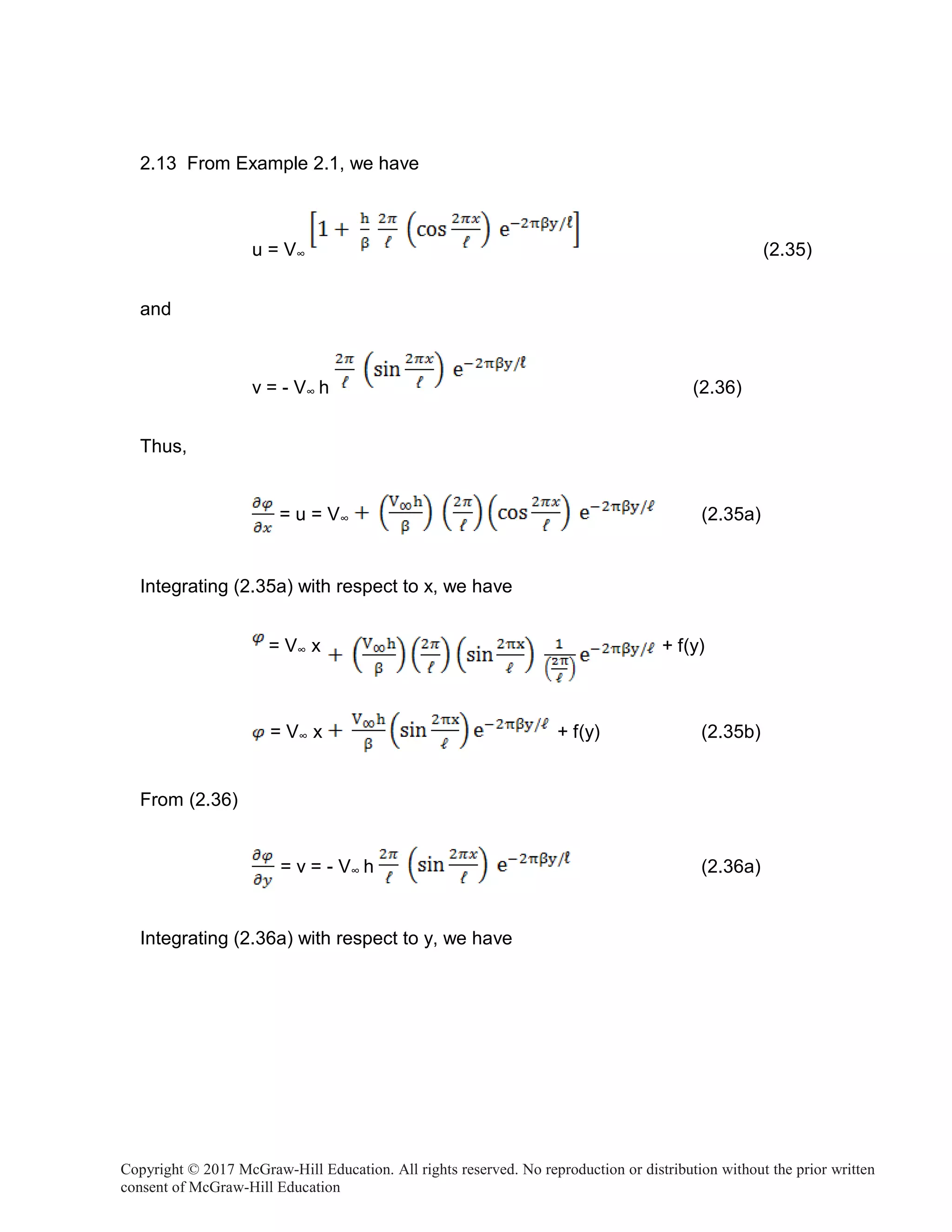
2.13 From Example 2.1, we have
u = V∞ (2.35)
and
v = - V∞ h (2.36)
Thus,
= u = V∞ (2.35a)
Integrating (2.35a) with respect to x, we have
From (2.36)
= V∞ x + f(y)
= V∞ x + f(y) (2.35b)
= v = - V∞ h (2.36a)
Integrating (2.36a) with respect to y, we have
Copyright © 2017 McGraw-Hill Education. All rights reserved. No reproduction or distribution without the prior written
consent of McGraw-Hill Education
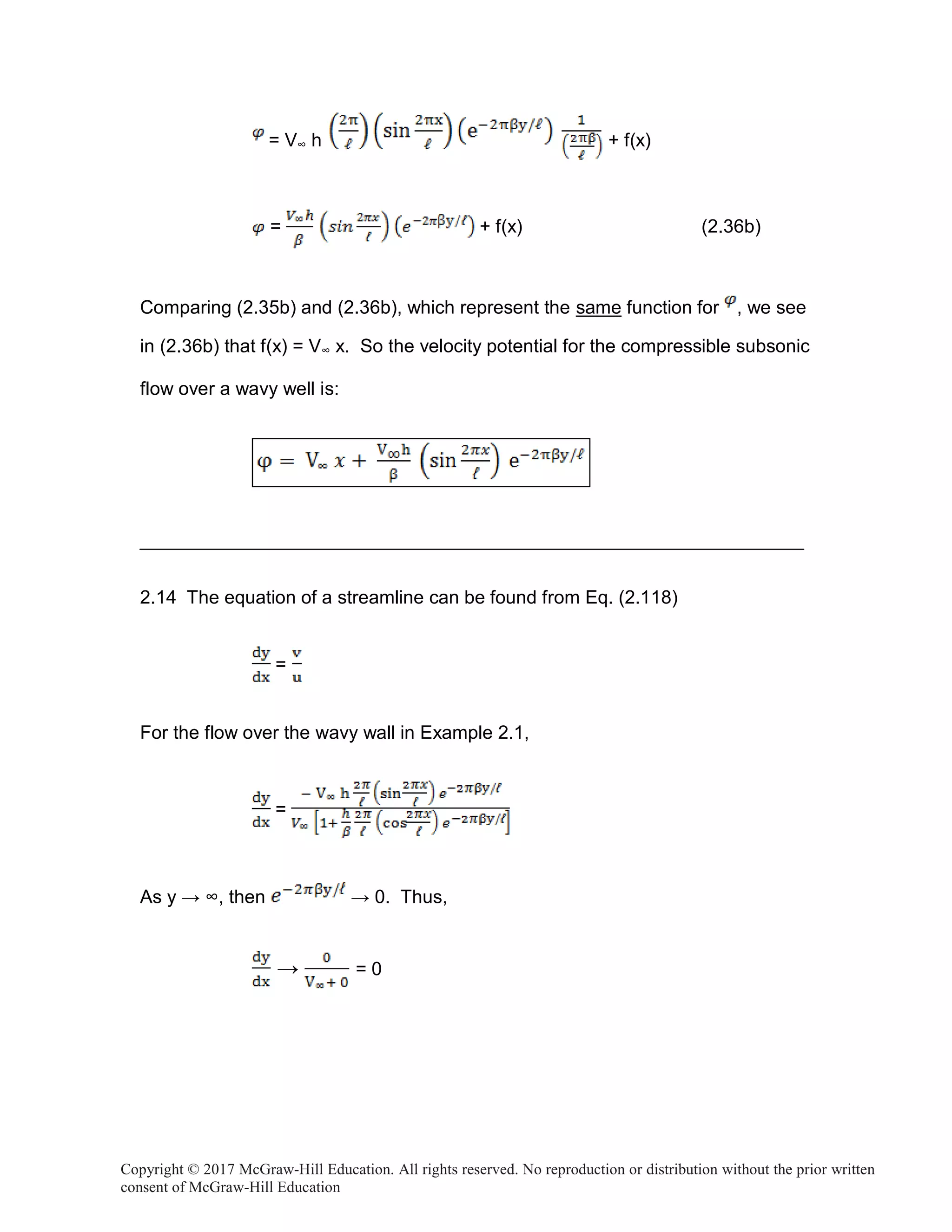
= V∞ h + f(x)
= + f(x) (2.36b)
Comparing (2.35b) and (2.36b), which represent the same function for , we see
in (2.36b) that f(x) = V∞ x. So the velocity potential for the compressible subsonic
flow over a wavy well is:
2.14 The equation of a streamline can be found from Eq. (2.118)
=
For the flow over the wavy wall in Example 2.1,
=
As y → ∞, then → 0. Thus,
→ = 0
The slope is zero. Hence, the streamline at y → ∞ is straight.
SOLUTIONS MANUAL for Fundamentals of Aerodynamics 6th Edition by
Anderson
Download:
https://downloadlink.org/p/solutions-manual-for-fundamentals-of-aerodynamics-
6th-edition-by-anderson/
people also search:
fundamentals of aerodynamics anderson 6th edition pdf
fundamentals of aerodynamics 6th edition pdf free download
fundamentals of aerodynamics 6th edition solutions
fundamentals of aerodynamics 6th edition solutions pdf
fundamentals of aerodynamics anderson 5th edition
fundamentals of aerodynamics 6th edition pdf download
fundamentals of aerodynamics 3rd ed
fundamentals of flight anderson
Solutions manual for fundamentals of aerodynamics 6th edition by anderson

Solutions manual for fundamentals of aerodynamics 6th edition by anderson

  • 1.
    SOLUTIONS MANUAL forFundamentals of Aerodynamics 6th Edition by Anderson Download: https://downloadlink.org/p/solutions-manual-for-fundamentals-of-aerodynamics- 6th-edition-by-anderson/ 2.1 CHAPTER2 If p = constant = Poo However, the integral of the surface vector over a closed surface is zero, i.e., Hence, combining Eqs. (1) and (2), we have 2.2
  • 2.
    t/f',Per W11 I/ /LL.L/ t L � I / 7 7 7 7 7 7 7-t! 7 7 7 / L.ou,e,- Wa II f.t {'X ) 19 Copyright © 2017 McGraw-Hill Education. All rights reserved. No reproduction or distribution without the prior written consent of McGraw-Hill Education
  • 3.
    Copyright © 2017McGraw-Hill Education. All rights reserved. No reproduction or distribution without the prior written consent of McGraw-Hill Education h b 2 Denote the pressure distributions on the upper and lower walls by pu(x) and p e (x) respectively. The walls are close enough to the model such that Pu and p I are not necessarily equal to Poo· Assume that faces ai and bh are far enough upstream and downstream of the model such that p=poo and v = 0 and ai and bh. Take they-component ofEq. (2.66) L = - # (p v. dS) v - H (p dS)y S abhi The first integral= 0 over all surfaces, either because V · ds = 0 or because v = 0. Hence l ;L' = - fJ (pdS)y = - [ J u dx - J p e dx] -> b h P abhi a Minus sign because y-component is in downward Direction. Note: In the above, the integrals over ia and bh cancel because p = Poo on both faces. Hence L' = f pf dx - f Pu dx 2.3 dy v cy/(x2+y2) y ==-= = dx u ex I (x + y2 ) x dy dx -=- y x The streamlines are straight lines emanating from the origin. (This is the velocity field and streamline pattern for a source, to be discussed in Chapter 3.) 2.4 dy v x -=-== dx u y y dy = - x dx 20
  • 4.
    Copyright © 2017McGraw-Hill Education. All rights reserved. No reproduction or distribution without the prior written consent of McGraw-Hill Education � /? y2 = -x2 + const x2 + y2 = const. The streamlines are concentric with their centers at the origin. (This is the velocity field and streamline pattern for a vortex, to be discussed in Chapter 3.) 2.5 From inspection, since there is no radial component of velocity, the streamlines must be circular, with centers at the origin. To show this more precisely, u = - ve sin = - er r = - cy r x v = Ve cos 8 = er - = ex r dy v x = = dx u y &2 + x 2 = const.J This is the equation of a circle with the center at the origin. (This velocity field corresponds to solid body rotation.) dy v y 2.6 dx = u = x dy dx )) j' y = x �. � � fn y = X £n X + C1 x y = cifx The streamlines are hyperbolas. f 21
  • 5.
    Copyright © 2017McGraw-Hill Education. All rights reserved. No reproduction or distribution without the prior written consent of McGraw-Hill Education roe , 1 o 1 O'V In polar coordinates: V · V = -- (r Vr) + ---8 r ir Transformation: x = r cos 8 y = r sine Vr = u cos 8 + v sin 8 Ve = - u sin 8 + v cos 8 22
  • 6.
    Copyright © 2017McGraw-Hill Education. All rights reserved. No reproduction or distribution without the prior written consent of McGraw-Hill Education V V = -- (c) + -- = 0 u= ex er cosB c cosB (x' + y2) r ? r v= cy er sine = c sine (x2+y2) r2 r vr = - C cos 2 e + - C sm . 2 e = - C r r r Ve= - � cosf) sine+ � cosf sine= 0 r r . _, 1 8 1 8(0) r a: r !JB (b) From Eq. (2.23) V x V = e2 [O + 0 - O] = � The flowfield is irrotational. 2.8 cy er sine c sine u= == == (x ' +y2) r ? ' r -ex v= er cose == - - c cose (x2+y2) r ? ' r Yr= � cosf) sine - � cosu sine= 0 r r ve = - -C sm ·2 e - - C cos 2 e = - -C r r r (a) v· V == L� (O)+ 18(-c/r) =O+O=� r a: r !}{} 23
  • 7.
    Copyright © 2017McGraw-Hill Education. All rights reserved. No reproduction or distribution without the prior written consent of McGraw-Hill Education (b) v'x V = / [o'(-c/r) _�_!b'(O)] lX r2 r oe2 v' x V=�except at the origin, where r = 0. The flowfield is singular at the origin. 2.9 Ve=cr v , V= / [o(c/r) +er_..!_ o(O)J z a- r roe --> --> ez (c + c - 0) = 2c ez The vorticity is finite. The flow is not irrotational; it is rotational. 2.10 c b a..
  • 8.
    Copyright © 2017McGraw-Hill Education. All rights reserved. No reproduction or distribution without the prior written consent of McGraw-Hill Education 24
  • 9.
    oe Mass flow betweenstreamlines = Ll ff! Lllf/ =pV Lln Ll ff! = (-p Ve) M + p Yr (r8) Let cd approach ab Also, since ff! = ff! (r.O), from calculus - o,;,. o,;,. d If/ = z a .z: dr + z o .z e : d8 (1) (2) Comparing Eqs. (1) and (2) -pVe=- Off! a and PrV = Off! r or: Off!pVe=- - a 2.11 u = ex = Of// : ljf = cxy + f(x) 0' v = - cy = - Olf/ : lJf = cxy + f(y) & (1) (2) 25 Copyright © 2017 McGraw-Hill Education. All rights reserved. No reproduction or distribution without the prior written consent of McGraw-Hill Education
  • 10.
    - - Comparing Eqs. (1)and (2), f(x) and f(y) = constant l'l' = c x y + const. j u = ex = Olf/ : � = cx2 + f(y) & v = - cy = Olf/ : � = - cy2 + f(x) 0' Comparing Eqs. (4) and (5), f(y) = - cy2 and f(x) = cx2 Differentiating Eq. (3) with respect to x, holding Jf = const. 0 = ex dy + cy dx or, (3) (4) (5) (6) dy) ( =-y/x (7) dx lf=Const Differentiating Eq. (6) with respect to x, holding c= const. 0=2cx-2cy dy dx or, ( dy) = x/y dx ¢=cons! Comparing Eqs. (7) and (8), we see that Hence, lines of constant Jf are perpendicular to lines of constant o. (8) 26 Copyright © 2017 McGraw-Hill Education. All rights reserved. No reproduction or distribution without the prior written consent of McGraw-Hill Education
  • 11.
    Copyright © 2017McGraw-Hill Education. All rights reserved. No reproduction or distribution without the prior written consent of McGraw-Hill Education . • m . m m 2.12. The geometry ofthe pipe is shown below. t{=/CJC> ,,w /:s-ec .,..(I � .:: /o0 '''' /sr c As the flow goes through the U-shape bend and is turned, it exerts a net force Ron the internal surface of the pipe. From the symmetric geometry, R is in the horizontal direction, as shown, acting to the right. The equal and opposite force, -R, exerted by the pipe on the flow is the mechanism that reverses the flow velocity. The cross-sectional area of the pipe inlet is nd2 /4 where dis the inside pipe diameter. Hence, A= nd2 /4 = n(0.5)214 = 0.196m2 The mass flow entering the pipe is m = P1 A V1 = (1.23)(0.196)(100) = 24.11 kg/sec. Applying the momentum equation, Eq. (2.64) to this geometry, we obtain a result similar to Eq. (2.75), namely R = - # (p V · dS) V (1) Where the pressure term in Eq. (2.75) is zero because the pressure at the inlet and exit are the same values. In Eq. (1), the product (p V · dS) is negative at the inlet (V and dS are in opposite directions), and is positive at the exit (V and dS) are in the same direction). The magnitude of p V · dS is simply the mass flow, • . Finally, at the inlet V1 is to the right, hence it is in the positive x-direction. At the exit, V2 is to the left, hence it is in the negative x-direction. Thus, V2 = - V1. With this, Eq. (1) is written as � .R = - [- m V1 + m V2] = m (V 1 - V2) = • [V1 -(-V1)] = • (2V1) R = (24.11)(2)(100) = &822 Nj 27
  • 12.
    Copyright © 2017McGraw-Hill Education. All rights reserved. No reproduction or distribution without the prior written consent of McGraw-Hill Education 2.13 From Example 2.1, we have u = V∞ (2.35) and v = - V∞ h (2.36) Thus, = u = V∞ (2.35a) Integrating (2.35a) with respect to x, we have From (2.36) = V∞ x + f(y) = V∞ x + f(y) (2.35b) = v = - V∞ h (2.36a) Integrating (2.36a) with respect to y, we have
  • 13.
    Copyright © 2017McGraw-Hill Education. All rights reserved. No reproduction or distribution without the prior written consent of McGraw-Hill Education = V∞ h + f(x) = + f(x) (2.36b) Comparing (2.35b) and (2.36b), which represent the same function for , we see in (2.36b) that f(x) = V∞ x. So the velocity potential for the compressible subsonic flow over a wavy well is: 2.14 The equation of a streamline can be found from Eq. (2.118) = For the flow over the wavy wall in Example 2.1, = As y → ∞, then → 0. Thus, → = 0
  • 14.
    The slope iszero. Hence, the streamline at y → ∞ is straight. SOLUTIONS MANUAL for Fundamentals of Aerodynamics 6th Edition by Anderson Download: https://downloadlink.org/p/solutions-manual-for-fundamentals-of-aerodynamics- 6th-edition-by-anderson/ people also search: fundamentals of aerodynamics anderson 6th edition pdf fundamentals of aerodynamics 6th edition pdf free download fundamentals of aerodynamics 6th edition solutions fundamentals of aerodynamics 6th edition solutions pdf fundamentals of aerodynamics anderson 5th edition fundamentals of aerodynamics 6th edition pdf download fundamentals of aerodynamics 3rd ed fundamentals of flight anderson