Activity Hazard Analysis (AHA)
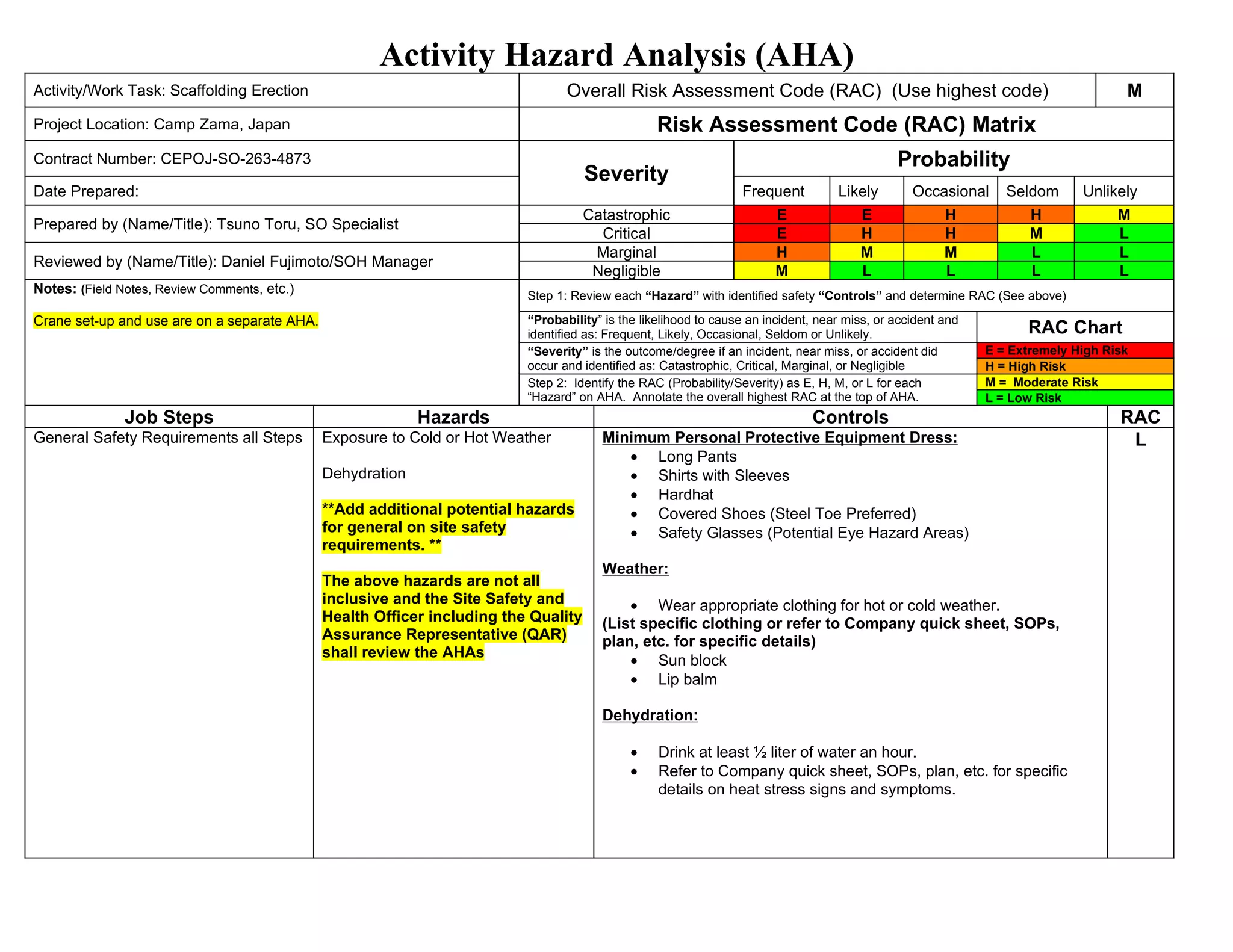
Activity/Work Task: Scaffolding Erection                                         Overall Risk Assessment Code (RAC) (Use highest code)                                             M
Project Location: Camp Zama, Japan                                                                Risk Assessment Code (RAC) Matrix
Contract Number: CEPOJ-SO-263-4873                                                                                                            Probability
                                                                                     Severity
Date Prepared:                                                                                                   Frequent          Likely        Occasional     Seldom      Unlikely
                                                                                     Catastrophic                       E              E               H            H             M
Prepared by (Name/Title): Tsuno Toru, SO Specialist
                                                                                       Critical                         E              H               H            M             L
                                                                                      Marginal                          H              M               M            L             L
Reviewed by (Name/Title): Daniel Fujimoto/SOH Manager
                                                                                      Negligible                        M              L               L            L             L
Notes: (Field Notes, Review Comments, etc.)                               Step 1: Review each “Hazard” with identified safety “Controls” and determine RAC (See above)

Crane set-up and use are on a separate AHA.                               “Probability” is the likelihood to cause an incident, near miss, or accident and
                                                                          identified as: Frequent, Likely, Occasional, Seldom or Unlikely.                         RAC Chart
                                                                          “Severity” is the outcome/degree if an incident, near miss, or accident did        E = Extremely High Risk
                                                                          occur and identified as: Catastrophic, Critical, Marginal, or Negligible           H = High Risk
                                                                          Step 2: Identify the RAC (Probability/Severity) as E, H, M, or L for each          M = Moderate Risk
                                                                          “Hazard” on AHA. Annotate the overall highest RAC at the top of AHA.               L = Low Risk
               Job Steps                                    Hazards                                                           Controls                                            RAC
General Safety Requirements all Steps         Exposure to Cold or Hot Weather          Minimum Personal Protective Equipment Dress:                                                L
                                                                                          • Long Pants
                                              Dehydration                                 • Shirts with Sleeves
                                                                                          • Hardhat
                                              **Add additional potential hazards          • Covered Shoes (Steel Toe Preferred)
                                              for general on site safety                  • Safety Glasses (Potential Eye Hazard Areas)
                                              requirements. **
                                                                                       Weather:
                                              The above hazards are not all
                                              inclusive and the Site Safety and            • Wear appropriate clothing for hot or cold weather.
                                              Health Officer including the Quality     (List specific clothing or refer to Company quick sheet, SOPs,
                                              Assurance Representative (QAR)           plan, etc. for specific details)
                                              shall review the AHAs
                                                                                           • Sun block
                                                                                           • Lip balm

                                                                                       Dehydration:

                                                                                             •    Drink at least ½ liter of water an hour.
                                                                                             •    Refer to Company quick sheet, SOPs, plan, etc. for specific
                                                                                                  details on heat stress signs and symptoms.
Job Steps                 Hazards                                                Controls                                    RAC
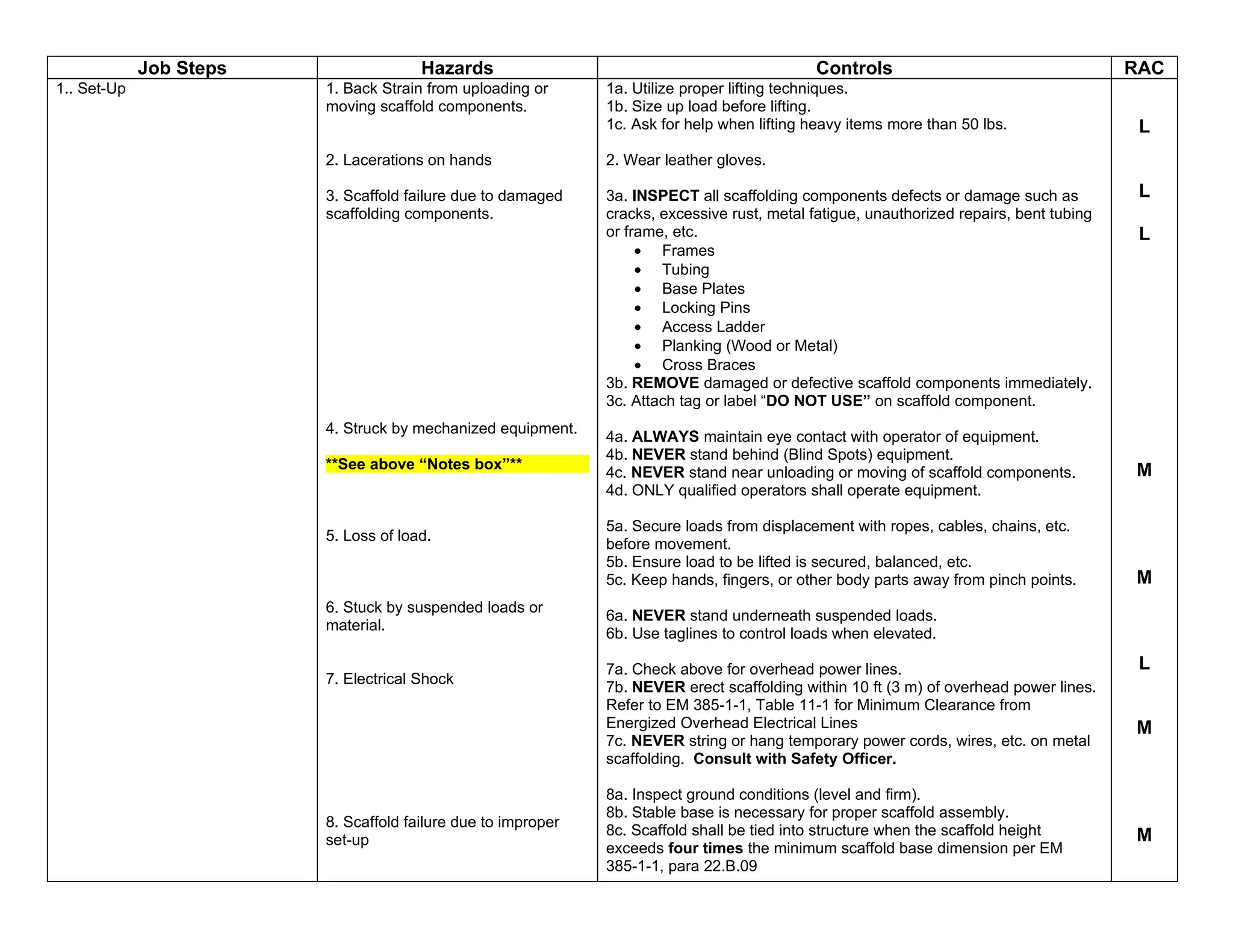
1.. Set-Up               1. Back Strain from uploading or      1a. Utilize proper lifting techniques.
                         moving scaffold components.           1b. Size up load before lifting.
                                                               1c. Ask for help when lifting heavy items more than 50 lbs.                 L
                         2. Lacerations on hands               2. Wear leather gloves.

                         3. Scaffold failure due to damaged    3a. INSPECT all scaffolding components defects or damage such as            L
                         scaffolding components.               cracks, excessive rust, metal fatigue, unauthorized repairs, bent tubing
                                                               or frame, etc.                                                              L
                                                                    • Frames
                                                                    • Tubing
                                                                    • Base Plates
                                                                    • Locking Pins
                                                                    • Access Ladder
                                                                    • Planking (Wood or Metal)
                                                                    • Cross Braces
                                                               3b. REMOVE damaged or defective scaffold components immediately.
                                                               3c. Attach tag or label “DO NOT USE” on scaffold component.
                         4. Struck by mechanized equipment.
                                                               4a. ALWAYS maintain eye contact with operator of equipment.
                                                               4b. NEVER stand behind (Blind Spots) equipment.
                         **See above “Notes box”**                                                                                        M
                                                               4c. NEVER stand near unloading or moving of scaffold components.
                                                               4d. ONLY qualified operators shall operate equipment.

                                                               5a. Secure loads from displacement with ropes, cables, chains, etc.
                         5. Loss of load.
                                                               before movement.
                                                               5b. Ensure load to be lifted is secured, balanced, etc.
                                                               5c. Keep hands, fingers, or other body parts away from pinch points.       M
                         6. Stuck by suspended loads or
                                                               6a. NEVER stand underneath suspended loads.
                         material.
                                                               6b. Use taglines to control loads when elevated.

                                                               7a. Check above for overhead power lines.                                   L
                         7. Electrical Shock
                                                               7b. NEVER erect scaffolding within 10 ft (3 m) of overhead power lines.
                                                               Refer to EM 385-1-1, Table 11-1 for Minimum Clearance from
                                                               Energized Overhead Electrical Lines                                        M
                                                               7c. NEVER string or hang temporary power cords, wires, etc. on metal
                                                               scaffolding. Consult with Safety Officer.

                                                               8a. Inspect ground conditions (level and firm).
                                                               8b. Stable base is necessary for proper scaffold assembly.
                         8. Scaffold failure due to improper
                                                               8c. Scaffold shall be tied into structure when the scaffold height         M
                         set-up
                                                               exceeds four times the minimum scaffold base dimension per EM
                                                               385-1-1, para 22.B.09
Job Steps                       Hazards                                          Controls                                      RAC
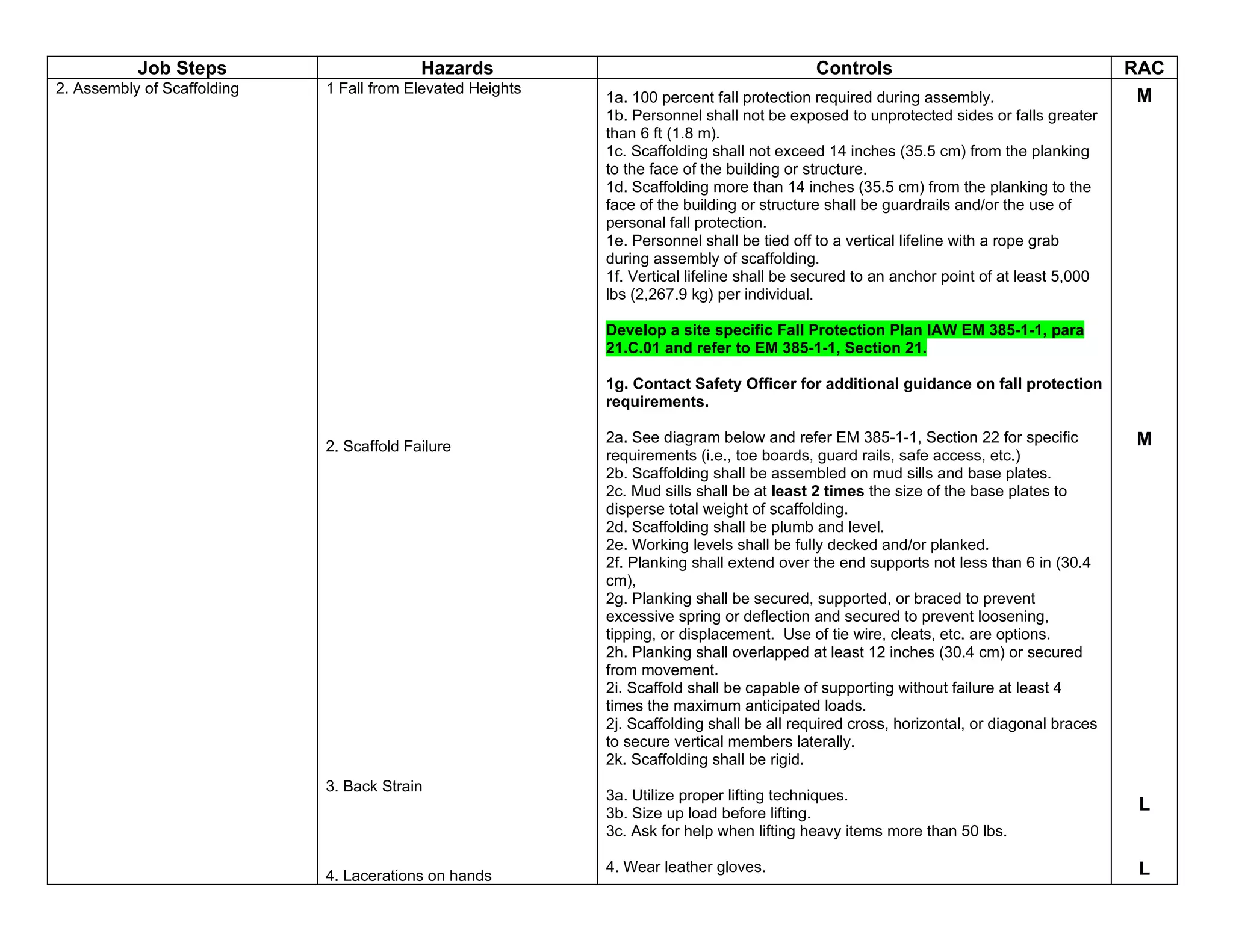
2. Assembly of Scaffolding   1 Fall from Elevated Heights
                                                            1a. 100 percent fall protection required during assembly.                      M
                                                            1b. Personnel shall not be exposed to unprotected sides or falls greater
                                                            than 6 ft (1.8 m).
                                                            1c. Scaffolding shall not exceed 14 inches (35.5 cm) from the planking
                                                            to the face of the building or structure.
                                                            1d. Scaffolding more than 14 inches (35.5 cm) from the planking to the
                                                            face of the building or structure shall be guardrails and/or the use of
                                                            personal fall protection.
                                                            1e. Personnel shall be tied off to a vertical lifeline with a rope grab
                                                            during assembly of scaffolding.
                                                            1f. Vertical lifeline shall be secured to an anchor point of at least 5,000
                                                            lbs (2,267.9 kg) per individual.

                                                            Develop a site specific Fall Protection Plan IAW EM 385-1-1, para
                                                            21.C.01 and refer to EM 385-1-1, Section 21.

                                                            1g. Contact Safety Officer for additional guidance on fall protection
                                                            requirements.

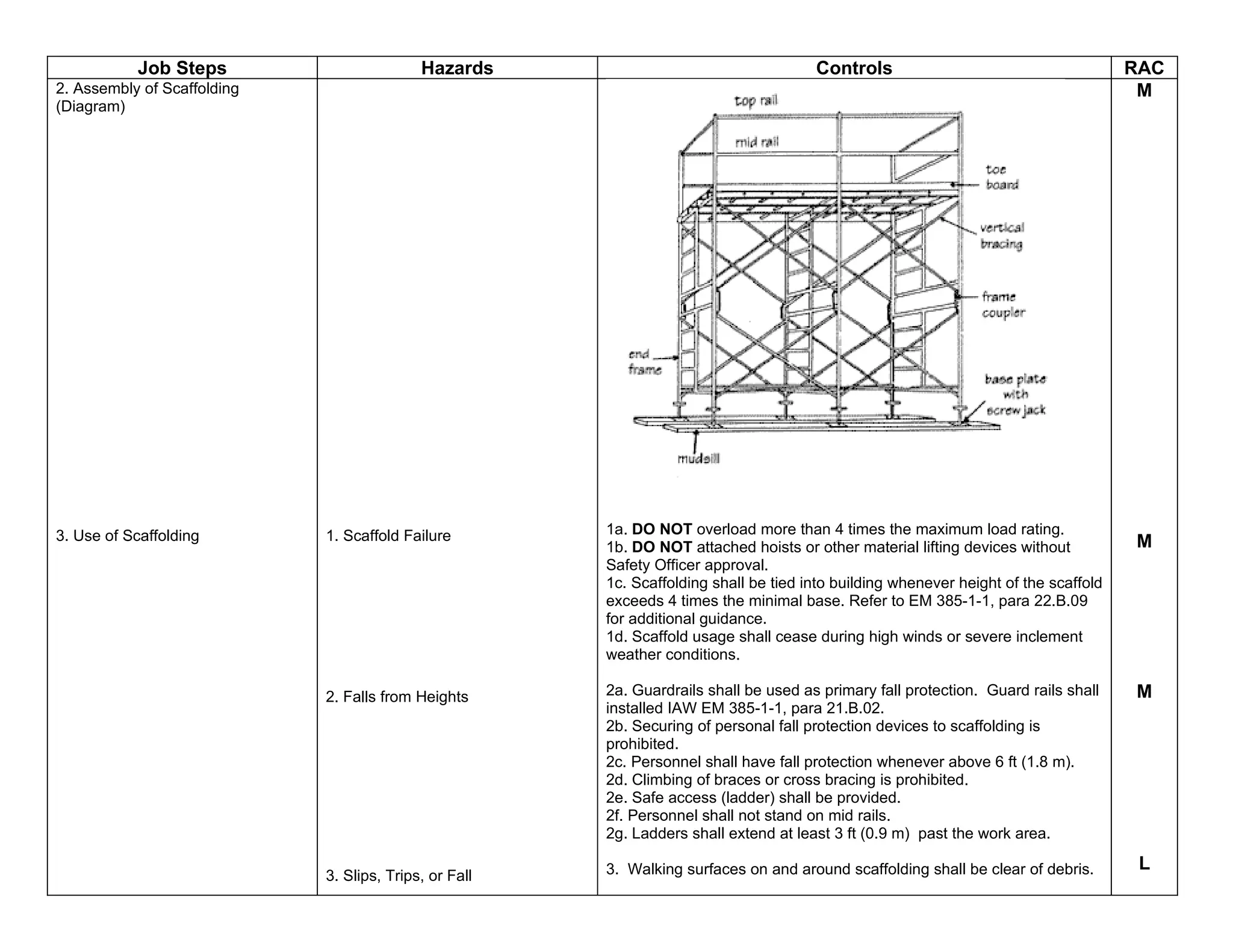
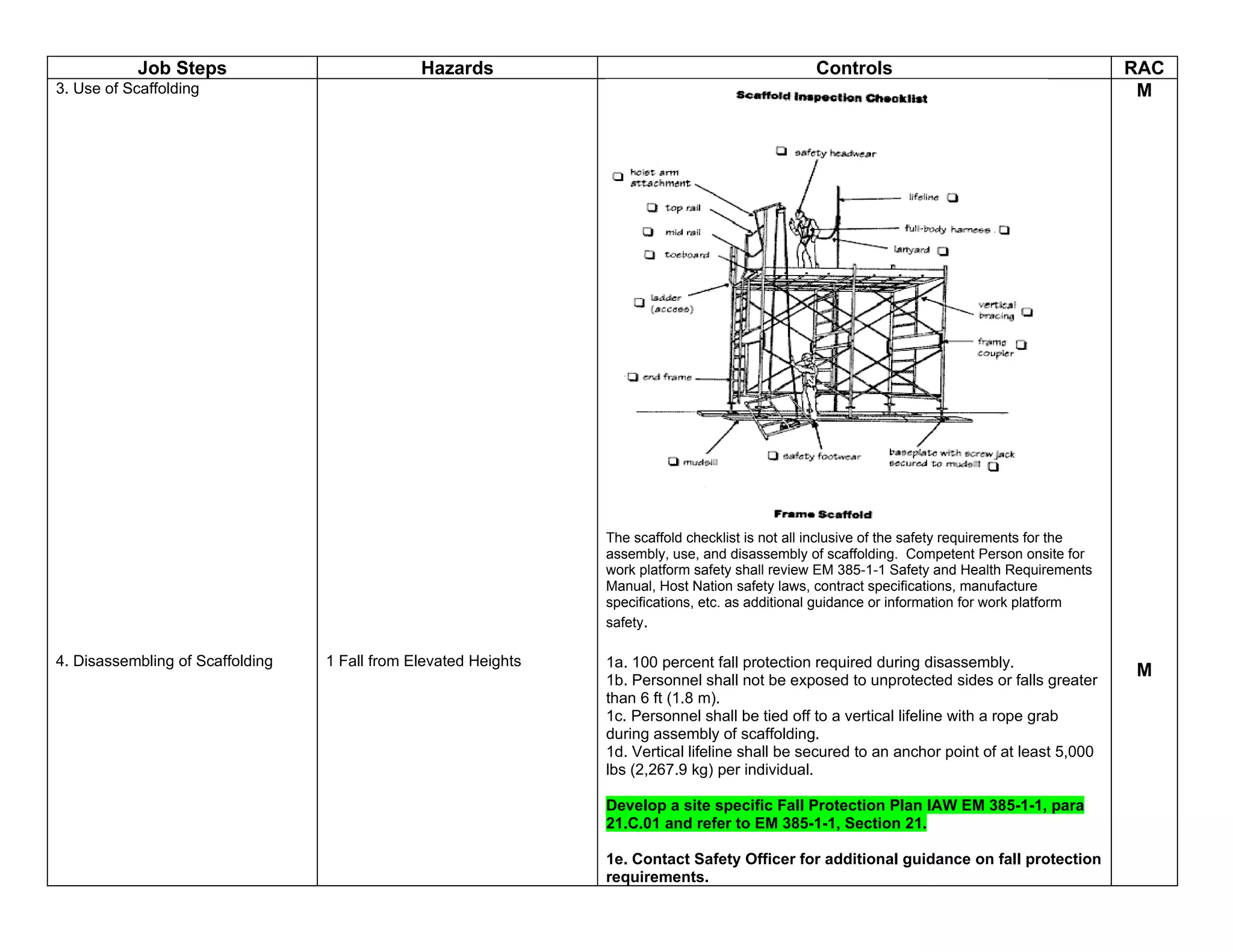
                                                            2a. See diagram below and refer EM 385-1-1, Section 22 for specific           M
                             2. Scaffold Failure
                                                            requirements (i.e., toe boards, guard rails, safe access, etc.)
                                                            2b. Scaffolding shall be assembled on mud sills and base plates.
                                                            2c. Mud sills shall be at least 2 times the size of the base plates to
                                                            disperse total weight of scaffolding.
                                                            2d. Scaffolding shall be plumb and level.
                                                            2e. Working levels shall be fully decked and/or planked.
                                                            2f. Planking shall extend over the end supports not less than 6 in (30.4
                                                            cm),
                                                            2g. Planking shall be secured, supported, or braced to prevent
                                                            excessive spring or deflection and secured to prevent loosening,
                                                            tipping, or displacement. Use of tie wire, cleats, etc. are options.
                                                            2h. Planking shall overlapped at least 12 inches (30.4 cm) or secured
                                                            from movement.
                                                            2i. Scaffold shall be capable of supporting without failure at least 4
                                                            times the maximum anticipated loads.
                                                            2j. Scaffolding shall be all required cross, horizontal, or diagonal braces
                                                            to secure vertical members laterally.
                                                            2k. Scaffolding shall be rigid.
                             3. Back Strain
                                                            3a. Utilize proper lifting techniques.
                                                            3b. Size up load before lifting.
                                                                                                                                           L
                                                            3c. Ask for help when lifting heavy items more than 50 lbs.

                             4. Lacerations on hands
                                                            4. Wear leather gloves.                                                        L
Job Steps                        Hazards                                    Controls                                       RAC
2. Assembly of Scaffolding                                                                                                             M
(Diagram)


3. Use of Scaffolding        1. Scaffold Failure        1a. DO NOT overload more than 4 times the maximum load rating.
                                                        1b. DO NOT attached hoists or other material lifting devices without          M
                                                        Safety Officer approval.
                                                        1c. Scaffolding shall be tied into building whenever height of the scaffold
                                                        exceeds 4 times the minimal base. Refer to EM 385-1-1, para 22.B.09
                                                        for additional guidance.
                                                        1d. Scaffold usage shall cease during high winds or severe inclement
                                                        weather conditions.

                             2. Falls from Heights      2a. Guardrails shall be used as primary fall protection. Guard rails shall    M
                                                        installed IAW EM 385-1-1, para 21.B.02.
                                                        2b. Securing of personal fall protection devices to scaffolding is
                                                        prohibited.
                                                        2c. Personnel shall have fall protection whenever above 6 ft (1.8 m).
                                                        2d. Climbing of braces or cross bracing is prohibited.
                                                        2e. Safe access (ladder) shall be provided.
                                                        2f. Personnel shall not stand on mid rails.
                                                        2g. Ladders shall extend at least 3 ft (0.9 m) past the work area.

                                                        3. Walking surfaces on and around scaffolding shall be clear of debris.        L
                             3. Slips, Trips, or Fall
Job Steps                           Hazards                                            Controls                                        RAC
3. Use of Scaffolding                                                                                                                              M


                                                                 The scaffold checklist is not all inclusive of the safety requirements for the
                                                                 assembly, use, and disassembly of scaffolding. Competent Person onsite for
                                                                 work platform safety shall review EM 385-1-1 Safety and Health Requirements
                                                                 Manual, Host Nation safety laws, contract specifications, manufacture
                                                                 specifications, etc. as additional guidance or information for work platform
                                                                 safety.

4. Disassembling of Scaffolding   1 Fall from Elevated Heights   1a. 100 percent fall protection required during disassembly.
                                                                 1b. Personnel shall not be exposed to unprotected sides or falls greater
                                                                                                                                                  M
                                                                 than 6 ft (1.8 m).
                                                                 1c. Personnel shall be tied off to a vertical lifeline with a rope grab
                                                                 during assembly of scaffolding.
                                                                 1d. Vertical lifeline shall be secured to an anchor point of at least 5,000
                                                                 lbs (2,267.9 kg) per individual.

                                                                 Develop a site specific Fall Protection Plan IAW EM 385-1-1, para
                                                                 21.C.01 and refer to EM 385-1-1, Section 21.

                                                                 1e. Contact Safety Officer for additional guidance on fall protection
                                                                 requirements.
Job Steps                              Hazards                                                  Controls                                    RAC
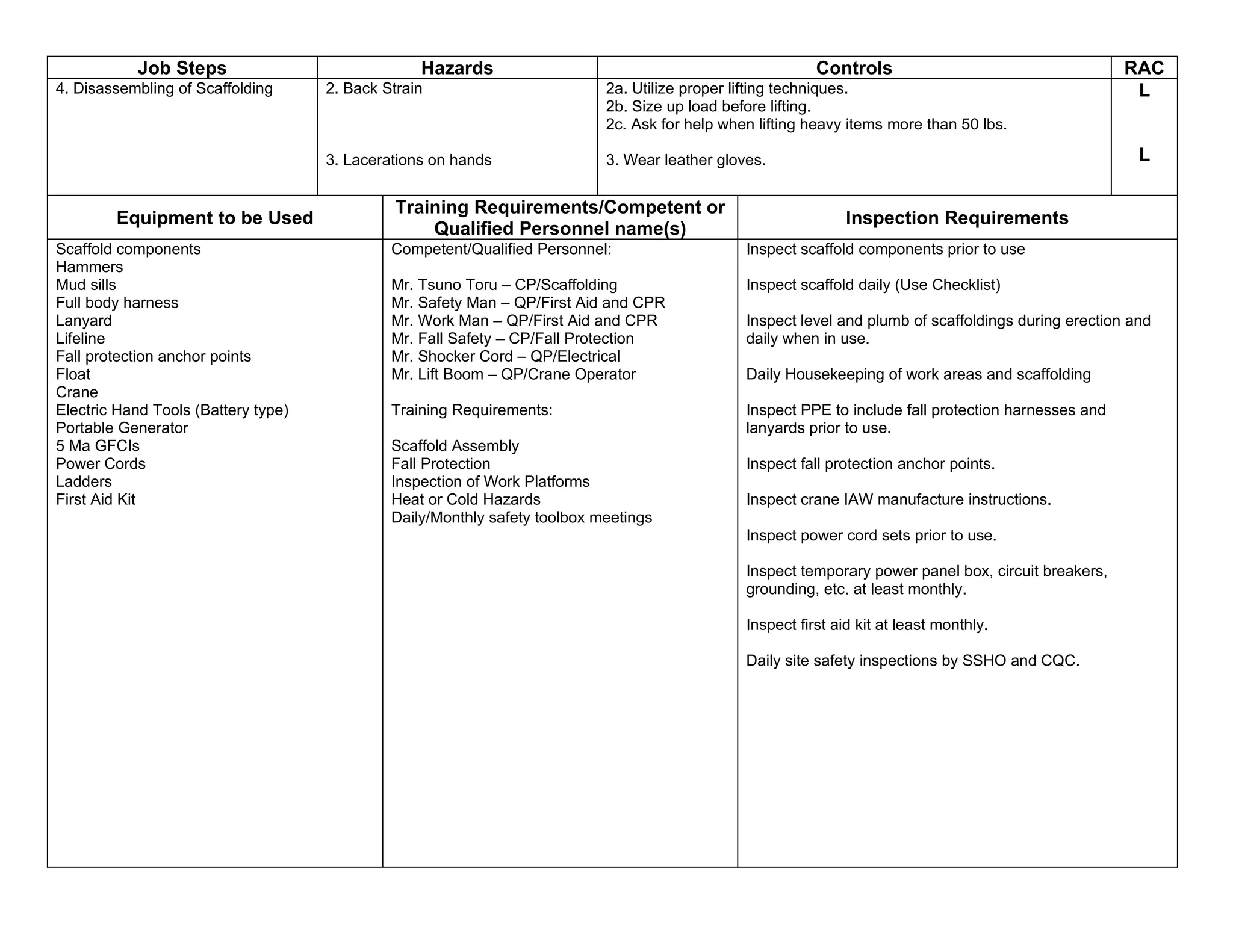
4. Disassembling of Scaffolding      2. Back Strain                         2a. Utilize proper lifting techniques.                                      L
                                                                            2b. Size up load before lifting.
                                                                            2c. Ask for help when lifting heavy items more than 50 lbs.

                                     3. Lacerations on hands                3. Wear leather gloves.                                                      L

                                               Training Requirements/Competent or
        Equipment to be Used                                                                                    Inspection Requirements
                                                   Qualified Personnel name(s)
Scaffold components                           Competent/Qualified Personnel:                    Inspect scaffold components prior to use
Hammers
Mud sills                                     Mr. Tsuno Toru – CP/Scaffolding                   Inspect scaffold daily (Use Checklist)
Full body harness                             Mr. Safety Man – QP/First Aid and CPR
Lanyard                                       Mr. Work Man – QP/First Aid and CPR               Inspect level and plumb of scaffoldings during erection and
Lifeline                                      Mr. Fall Safety – CP/Fall Protection              daily when in use.
Fall protection anchor points                 Mr. Shocker Cord – QP/Electrical
Float                                         Mr. Lift Boom – QP/Crane Operator                 Daily Housekeeping of work areas and scaffolding
Crane
Electric Hand Tools (Battery type)            Training Requirements:                            Inspect PPE to include fall protection harnesses and
Portable Generator                                                                              lanyards prior to use.
5 Ma GFCIs                                    Scaffold Assembly
Power Cords                                   Fall Protection                                   Inspect fall protection anchor points.
Ladders                                       Inspection of Work Platforms
First Aid Kit                                 Heat or Cold Hazards                              Inspect crane IAW manufacture instructions.
                                              Daily/Monthly safety toolbox meetings
                                                                                                Inspect power cord sets prior to use.

                                                                                                Inspect temporary power panel box, circuit breakers,
                                                                                                grounding, etc. at least monthly.

                                                                                                Inspect first aid kit at least monthly.

                                                                                                Daily site safety inspections by SSHO and CQC.

Aha sample-scaffolding

  • 1.
    Activity Hazard Analysis(AHA) Activity/Work Task: Scaffolding Erection Overall Risk Assessment Code (RAC) (Use highest code) M Project Location: Camp Zama, Japan Risk Assessment Code (RAC) Matrix Contract Number: CEPOJ-SO-263-4873 Probability Severity Date Prepared: Frequent Likely Occasional Seldom Unlikely Catastrophic E E H H M Prepared by (Name/Title): Tsuno Toru, SO Specialist Critical E H H M L Marginal H M M L L Reviewed by (Name/Title): Daniel Fujimoto/SOH Manager Negligible M L L L L Notes: (Field Notes, Review Comments, etc.) Step 1: Review each “Hazard” with identified safety “Controls” and determine RAC (See above) Crane set-up and use are on a separate AHA. “Probability” is the likelihood to cause an incident, near miss, or accident and identified as: Frequent, Likely, Occasional, Seldom or Unlikely. RAC Chart “Severity” is the outcome/degree if an incident, near miss, or accident did E = Extremely High Risk occur and identified as: Catastrophic, Critical, Marginal, or Negligible H = High Risk Step 2: Identify the RAC (Probability/Severity) as E, H, M, or L for each M = Moderate Risk “Hazard” on AHA. Annotate the overall highest RAC at the top of AHA. L = Low Risk Job Steps Hazards Controls RAC General Safety Requirements all Steps Exposure to Cold or Hot Weather Minimum Personal Protective Equipment Dress: L • Long Pants Dehydration • Shirts with Sleeves • Hardhat **Add additional potential hazards • Covered Shoes (Steel Toe Preferred) for general on site safety • Safety Glasses (Potential Eye Hazard Areas) requirements. ** Weather: The above hazards are not all inclusive and the Site Safety and • Wear appropriate clothing for hot or cold weather. Health Officer including the Quality (List specific clothing or refer to Company quick sheet, SOPs, Assurance Representative (QAR) plan, etc. for specific details) shall review the AHAs • Sun block • Lip balm Dehydration: • Drink at least ½ liter of water an hour. • Refer to Company quick sheet, SOPs, plan, etc. for specific details on heat stress signs and symptoms.
  • 2.
    Job Steps Hazards Controls RAC 1.. Set-Up 1. Back Strain from uploading or 1a. Utilize proper lifting techniques. moving scaffold components. 1b. Size up load before lifting. 1c. Ask for help when lifting heavy items more than 50 lbs. L 2. Lacerations on hands 2. Wear leather gloves. 3. Scaffold failure due to damaged 3a. INSPECT all scaffolding components defects or damage such as L scaffolding components. cracks, excessive rust, metal fatigue, unauthorized repairs, bent tubing or frame, etc. L • Frames • Tubing • Base Plates • Locking Pins • Access Ladder • Planking (Wood or Metal) • Cross Braces 3b. REMOVE damaged or defective scaffold components immediately. 3c. Attach tag or label “DO NOT USE” on scaffold component. 4. Struck by mechanized equipment. 4a. ALWAYS maintain eye contact with operator of equipment. 4b. NEVER stand behind (Blind Spots) equipment. **See above “Notes box”** M 4c. NEVER stand near unloading or moving of scaffold components. 4d. ONLY qualified operators shall operate equipment. 5a. Secure loads from displacement with ropes, cables, chains, etc. 5. Loss of load. before movement. 5b. Ensure load to be lifted is secured, balanced, etc. 5c. Keep hands, fingers, or other body parts away from pinch points. M 6. Stuck by suspended loads or 6a. NEVER stand underneath suspended loads. material. 6b. Use taglines to control loads when elevated. 7a. Check above for overhead power lines. L 7. Electrical Shock 7b. NEVER erect scaffolding within 10 ft (3 m) of overhead power lines. Refer to EM 385-1-1, Table 11-1 for Minimum Clearance from Energized Overhead Electrical Lines M 7c. NEVER string or hang temporary power cords, wires, etc. on metal scaffolding. Consult with Safety Officer. 8a. Inspect ground conditions (level and firm). 8b. Stable base is necessary for proper scaffold assembly. 8. Scaffold failure due to improper 8c. Scaffold shall be tied into structure when the scaffold height M set-up exceeds four times the minimum scaffold base dimension per EM 385-1-1, para 22.B.09
  • 3.
    Job Steps Hazards Controls RAC 2. Assembly of Scaffolding 1 Fall from Elevated Heights 1a. 100 percent fall protection required during assembly. M 1b. Personnel shall not be exposed to unprotected sides or falls greater than 6 ft (1.8 m). 1c. Scaffolding shall not exceed 14 inches (35.5 cm) from the planking to the face of the building or structure. 1d. Scaffolding more than 14 inches (35.5 cm) from the planking to the face of the building or structure shall be guardrails and/or the use of personal fall protection. 1e. Personnel shall be tied off to a vertical lifeline with a rope grab during assembly of scaffolding. 1f. Vertical lifeline shall be secured to an anchor point of at least 5,000 lbs (2,267.9 kg) per individual. Develop a site specific Fall Protection Plan IAW EM 385-1-1, para 21.C.01 and refer to EM 385-1-1, Section 21. 1g. Contact Safety Officer for additional guidance on fall protection requirements. 2a. See diagram below and refer EM 385-1-1, Section 22 for specific M 2. Scaffold Failure requirements (i.e., toe boards, guard rails, safe access, etc.) 2b. Scaffolding shall be assembled on mud sills and base plates. 2c. Mud sills shall be at least 2 times the size of the base plates to disperse total weight of scaffolding. 2d. Scaffolding shall be plumb and level. 2e. Working levels shall be fully decked and/or planked. 2f. Planking shall extend over the end supports not less than 6 in (30.4 cm), 2g. Planking shall be secured, supported, or braced to prevent excessive spring or deflection and secured to prevent loosening, tipping, or displacement. Use of tie wire, cleats, etc. are options. 2h. Planking shall overlapped at least 12 inches (30.4 cm) or secured from movement. 2i. Scaffold shall be capable of supporting without failure at least 4 times the maximum anticipated loads. 2j. Scaffolding shall be all required cross, horizontal, or diagonal braces to secure vertical members laterally. 2k. Scaffolding shall be rigid. 3. Back Strain 3a. Utilize proper lifting techniques. 3b. Size up load before lifting. L 3c. Ask for help when lifting heavy items more than 50 lbs. 4. Lacerations on hands 4. Wear leather gloves. L
  • 4.
    Job Steps Hazards Controls RAC 2. Assembly of Scaffolding M (Diagram) 3. Use of Scaffolding 1. Scaffold Failure 1a. DO NOT overload more than 4 times the maximum load rating. 1b. DO NOT attached hoists or other material lifting devices without M Safety Officer approval. 1c. Scaffolding shall be tied into building whenever height of the scaffold exceeds 4 times the minimal base. Refer to EM 385-1-1, para 22.B.09 for additional guidance. 1d. Scaffold usage shall cease during high winds or severe inclement weather conditions. 2. Falls from Heights 2a. Guardrails shall be used as primary fall protection. Guard rails shall M installed IAW EM 385-1-1, para 21.B.02. 2b. Securing of personal fall protection devices to scaffolding is prohibited. 2c. Personnel shall have fall protection whenever above 6 ft (1.8 m). 2d. Climbing of braces or cross bracing is prohibited. 2e. Safe access (ladder) shall be provided. 2f. Personnel shall not stand on mid rails. 2g. Ladders shall extend at least 3 ft (0.9 m) past the work area. 3. Walking surfaces on and around scaffolding shall be clear of debris. L 3. Slips, Trips, or Fall
  • 5.
    Job Steps Hazards Controls RAC 3. Use of Scaffolding M The scaffold checklist is not all inclusive of the safety requirements for the assembly, use, and disassembly of scaffolding. Competent Person onsite for work platform safety shall review EM 385-1-1 Safety and Health Requirements Manual, Host Nation safety laws, contract specifications, manufacture specifications, etc. as additional guidance or information for work platform safety. 4. Disassembling of Scaffolding 1 Fall from Elevated Heights 1a. 100 percent fall protection required during disassembly. 1b. Personnel shall not be exposed to unprotected sides or falls greater M than 6 ft (1.8 m). 1c. Personnel shall be tied off to a vertical lifeline with a rope grab during assembly of scaffolding. 1d. Vertical lifeline shall be secured to an anchor point of at least 5,000 lbs (2,267.9 kg) per individual. Develop a site specific Fall Protection Plan IAW EM 385-1-1, para 21.C.01 and refer to EM 385-1-1, Section 21. 1e. Contact Safety Officer for additional guidance on fall protection requirements.
  • 6.
    Job Steps Hazards Controls RAC 4. Disassembling of Scaffolding 2. Back Strain 2a. Utilize proper lifting techniques. L 2b. Size up load before lifting. 2c. Ask for help when lifting heavy items more than 50 lbs. 3. Lacerations on hands 3. Wear leather gloves. L Training Requirements/Competent or Equipment to be Used Inspection Requirements Qualified Personnel name(s) Scaffold components Competent/Qualified Personnel: Inspect scaffold components prior to use Hammers Mud sills Mr. Tsuno Toru – CP/Scaffolding Inspect scaffold daily (Use Checklist) Full body harness Mr. Safety Man – QP/First Aid and CPR Lanyard Mr. Work Man – QP/First Aid and CPR Inspect level and plumb of scaffoldings during erection and Lifeline Mr. Fall Safety – CP/Fall Protection daily when in use. Fall protection anchor points Mr. Shocker Cord – QP/Electrical Float Mr. Lift Boom – QP/Crane Operator Daily Housekeeping of work areas and scaffolding Crane Electric Hand Tools (Battery type) Training Requirements: Inspect PPE to include fall protection harnesses and Portable Generator lanyards prior to use. 5 Ma GFCIs Scaffold Assembly Power Cords Fall Protection Inspect fall protection anchor points. Ladders Inspection of Work Platforms First Aid Kit Heat or Cold Hazards Inspect crane IAW manufacture instructions. Daily/Monthly safety toolbox meetings Inspect power cord sets prior to use. Inspect temporary power panel box, circuit breakers, grounding, etc. at least monthly. Inspect first aid kit at least monthly. Daily site safety inspections by SSHO and CQC.