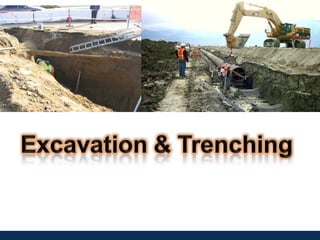
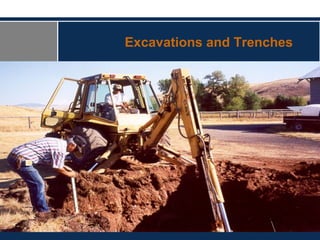
Excavations and Trenches
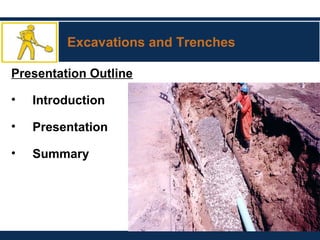
Presentation Outline
• Introduction
• Presentation
• Summary
Excavations and Trenches
Introduction
• Presentation Objectives
• Acts and Regulations overseen by
WorkSafeNB
Excavations and Trenches
Presentation Content
• OHS Act and Regulation Requirements
• Trenching Inspection and Protection
• Underground Utilities
Excavations and Trenches
Summary
• OHS Regulation Overview
• Questions and Discussions
• Points to ponder
Introduction
Objectives
Participants should be able to identity:
• Employer and employee obligations under
the OHS Act and regulations
• Regulation minimum requirements for
working in excavations and trenches
• Safe methods for working in and around
trenches
Introduction
Acts and Regulations
• Ch W-13 Workers’ Compensation Act
(6 Regulations)
• Ch O-0.2 Occupational Health &
Safety Act (7 Regulations)
• Ch W-14 WHSCC Act
Introduction
Acts and Regulations
Ch W-13 Workers’ Compensation Act
- Duties to report accidents (Form 67)
- Assessment rates and experience
rating
Introduction
Acts and Regulations
Ch O-0.2 Occupational Health & Safety Act
- Duties of employers and employees
- Employees 3 basic rights
› Right to know
› Right to participate
› Right to refuse
Introduction
Acts and Regulations
Ch W-14 Workplace Health, Safety and
Compensation Commission Act allows
WorkSafeNB to oversee the implementation
and application of all three acts and their
regulations
Occupational Health & Safety Act
Ch O-0.2
“Employee" means
- a person employed at or in a place of
employment, or
- a person at or in a place of employment for
any purpose in connection therewith,
Occupational Health& Safety Act
Ch O-0.2
“Employer" means
- A person who employs one or more employees,
- A manager, superintendent, supervisor, overseer
or any person having authority over an employee
at a place of employment,
- An agent of the above two
Occupational Health & Safety Act
Ch O-0.2
Every employer shall (Section 9)
• take every reasonable precaution to ensure
the health and safety of his employees;
• comply with this Act, the regulations…
• ensure that his employees comply with this
Act, the regulations…
Occupational Health & Safety Act
Ch O-0.2
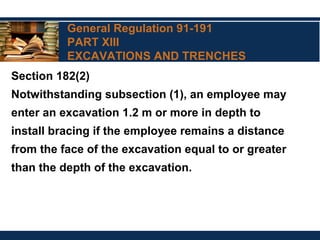
Every employer shall (Section 9)
• Ensure that…equipment, machines, devices and
materials are maintained in good condition and are
of minimum risk to health and safety…
• acquaint an employee with any hazard to be found…
• provide such information, instruction, training and
supervision as are necessary to ensure an
employee's health and safety
Occupational Health & Safety Act
Ch O-0.2
Every employer shall…
• provide and maintain in good condition such
protective equipment as is required by
regulation and ensure that such equipment is
used by an employee
Occupational Health & Safety Act
Ch O-0.2
Every employer shall…
• co-operate with a committee…, a health and
safety representative,…and with any person
responsible for the enforcement of this Act
and the regulations
Occupational Health & Safety Act
Ch O-0.2
Every employee shall…
• comply with this Act, the regulations…
• conduct himself to ensure his own health
and safety and that of other persons… 
• report to the employer the existence of any
hazard of which he is aware;
Occupational Health & Safety Act
Ch O-0.2
Every employee shall…
• wear or use such protective equipment
as is required by regulation; 
• consult and co-operate with the
committee where one has been
established or with the health and safety
representative… 
• co-operate with any person responsible
for the enforcement of this Act and the
regulations.
Occupational Health & Safety Act
Ch O-0.2
General Regulation 91-191
under the
Occupational Health and Safety Act
General Regulation 91-191 under the
Occupational Health and Safety Act
PART I - INTERPRETATION
2 In this Regulation "competent"
means
(a) qualified, because of such factors
as knowledge, training and
experience, to do assigned work in
a manner that will ensure the
health and safety of persons,
General Regulation 91-191 under the
Occupational Health and Safety Act
PART I - INTERPRETATION
2 In this Regulation "competent"
means
(b) knowledgeable about the
provisions of the Act and the
regulations that apply to the
assigned work, and
General Regulation 91-191 under the
Occupational Health and Safety Act
PART I - INTERPRETATION
2 In this Regulation "competent"
means
(c) knowledgeable about potential or
actual danger to health or safety
connected with the assigned
work;
General Regulation 91-191 under the
Occupational Health and Safety Act
PART XIII
EXCAVATIONS AND TRENCHES
Sections 180 to 188
General Regulation 91-191
PART XIII
EXCAVATIONS AND TRENCHES
Section 180(1)
Before beginning an excavation or trench,
an employer shall ensure that the location
of any underground utility line or piping is
determined.
General Regulation 91-191
PART XIII
EXCAVATIONS AND TRENCHES
Section 180(2)
Where employees are working within 600 mm of
underground utility line or piping, an employer
shall ensure that
(a) the authority operating the utility line or
piping has been notified of the operation,
(b) the utility line has been de-energized, and
(c) an adequate operating procedure is used by
the employees.
General Regulation 91-191
PART XIII
EXCAVATIONS AND TRENCHES
Section 180(3)
An employer shall ensure that utility poles,
posts and similar structures are supported or
removed if they are within 3 m of an
excavation or trench that is more than 1.2 m
deep.
General Regulation 91-191
PART XIII
EXCAVATIONS AND TRENCHES
Section 181(1)
An employer shall ensure that the walls of an
excavation or trench are supported by shoring,
bracing or caging except when the excavation
or trench
(a) is less than 1.2 m deep,
(b) subject to subsection (2), is cut in solid rock,
General Regulation 91-191
PART XIII
EXCAVATIONS AND TRENCHES
Section 181(1) continued
…walls…are supported…except when the excavation
or trench
(c) is sloped or benched to within 1.2 m of the
bottom of the excavation or trench with the
slope or bench not exceeding 1 m of vertical
rise to each 1 m of horizontal run, or
(d) is one that an employee is not required to enter.
General Regulation 91-191
PART XIII
EXCAVATIONS AND TRENCHES
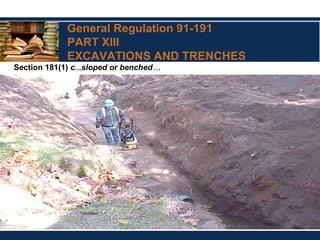
Section 181(1) c…sloped or benched…
General Regulation 91-191
PART XIII
EXCAVATIONS AND TRENCHES
Section 181(2)
Where the walls or crests of an excavation or
trench are cut in solid rock and are not stable, an
employer shall ensure that the walls and crests
are adequately supported by rock bolts, wire
mesh,shoring or a method that provides
equivalent support.
General Regulation 91-191
PART XIII
EXCAVATIONS AND TRENCHES
Section 181(3)
Where powered mobile equipment or a mobile
crane is used near the edge of an excavation or
trench, an employer shall ensure that any
shoring, bracing or caging for the excavation or
trench is adequate to support the increased
pressure.
General Regulation 91-191
PART XIII
EXCAVATIONS AND TRENCHES
Section 181(4)
An employer shall ensure that shoring,
bracing or caging for an excavation or
trench is certified as adequate by an
engineer and shall make the proof of the
certification available to an officer on
request.
General Regulation 91-191
PART XIII
EXCAVATIONS AND TRENCHES
Section 182(1)
An employer shall ensure that an employee does not,
and no employee shall, enter an excavation or trench
1.2 m or more in depth unless
(a) the walls of the excavation or trench are supported by
shoring, bracing or caging, the excavation or trench is
cut in solid rock or the excavation or trench is sloped
or benched to within 1.2 m of the bottom of the
excavation or trench with the slope not exceeding 1 m
of vertical rise to each 1 m of horizontal run,
General Regulation 91-191
PART XIII
EXCAVATIONS AND TRENCHES
Section 182(1) continued
…and no employee shall, enter an excavation or
trench 1.2 m or more in depth unless
(b) subsections 181(2), (3) and (4) have been
complied with,
(c) loose material that may fall into the
excavation or trench has been removed, and
General Regulation 91-191
PART XIII
EXCAVATIONS AND TRENCHES
Section 182(1) continued
…and no employee shall, enter an excavation or trench
1.2 m or more in depth unless
(d) a ladder that extends at least 1 m above the
excavation or trench is installed no more than 15 m
from where the employee is working or some other
safe means of access and egress is provided.
General Regulation 91-191
PART XIII
EXCAVATIONS AND TRENCHES
Section 182(2)
Notwithstanding subsection (1), an employee may
enter an excavation 1.2 m or more in depth to
install bracing if the employee remains a distance
from the face of the excavation equal to or greater
than the depth of the excavation.
General Regulation 91-191
PART XIII
EXCAVATIONS AND TRENCHES
Section 182(3)
Notwithstanding subsection (1), an employer shall
ensure that an employee does not, and no
employee shall, enter an excavation or trench
1.2m or more in depth to install or remove shoring
or caging from a position inside an excavation or a
trench.
General Regulation 91-191
PART XIII
EXCAVATIONS AND TRENCHES
Section 183(1)
Subject to subsection (2), an employer shall ensure
that excavated material is kept at least 1.2 m away
from the edge of an excavation or trench.
General Regulation 91-191
PART XIII
EXCAVATIONS AND TRENCHES
Section 183(2)
Where an excavation or trench is more than 1.8 m
deep in rock, an employer shall ensure that
(a) excavated material is located back from the face
of the excavation or trench a distance equal to at
least the height of the excavated material, or
(b) a fence that is adequate to support the excavated
material is erected at a minimum distance of 1 m
from the face of the excavation or trench.
General Regulation 91-191
PART XIII
EXCAVATIONS AND TRENCHES
Section 184(1)
An employer shall ensure that an excavation or
trench in which an employee works is kept
reasonably free of water.
General Regulation 91-191
PART XIII
EXCAVATIONS AND TRENCHES
Section 184(2)
Where an employee may be exposed to a
hazardous gas or to an oxygen deficient or oxygen
rich atmosphere in an excavation or trench, an
employer shall ensure that testing is carried out in
accordance with section 263 before the employee
enters the excavation or trench.
General Regulation 91-191
PART XIII
EXCAVATIONS AND TRENCHES
General Regulation 91-191
Part XVII, Confined Space
Sections 262 to 272
General Regulation 91-191
PART XIII
EXCAVATIONS AND TRENCHES
Section 184(3)
An employer shall ensure that no hazardous
substance is stored in an excavation or
trench.
General Regulation 91-191
PART XIII
EXCAVATIONS AND TRENCHES
Section 184(4)
An employer shall ensure that precautions
are taken to prevent the accumulation of
hazardous gases in an excavation or
trench and that adequate ventilation is
provided in the excavation or trench.
General Regulation 91-191
PART XIII
EXCAVATIONS AND TRENCHES
Section 184(4)
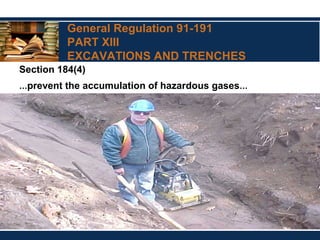
…prevent the accumulation of hazardous gases…
General Regulation 91-191
PART XIII
EXCAVATIONS AND TRENCHES
Section 185
Where an employee is working in an excavation or
trench, an employer shall ensure that there is an
employee working on the surface who is able to
observe the employee working in the excavation
or trench.
General Regulation 91-191
PART XIII
EXCAVATIONS AND TRENCHES
Section 186
An employer shall ensure that an operator of
powered mobile equipment or a mobile crane does
not lower material into an excavation or trench, and
no such operator shall lower material into an
excavation or trench, unless
(a) the operator has unrestricted visibility, or
(b) a signaller is used to direct the movement of the
material.
General Regulation 91-191
PART XIII
EXCAVATIONS AND TRENCHES
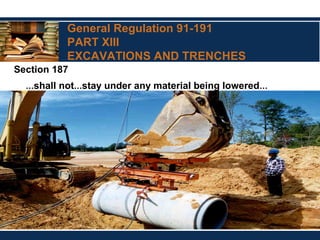
Section 187
An employee shall not move under or stay under
any material being lowered into an excavation or
trench.
General Regulation 91-191
PART XIII
EXCAVATIONS AND TRENCHES
Section 187
…shall not…stay under any material being lowered…
General Regulation 91-191
PART XIII
EXCAVATIONS AND TRENCHES
Section 188(1)
An employer shall ensure that an excavation or
trench is adequately illuminated
(a) when work is being carried out in or near
the excavation or trench, and
(b) by warning lights or reflective materials
to prevent inadvertent entry.
General Regulation 91-191
PART XIII
EXCAVATIONS AND TRENCHES
Section 188(2)
An employer shall ensure that an adequate barrier
is set up around the excavation or trench so as to
protect employees working in the excavation or
trench from vehicular traffic.
General Regulation 91-191
PART X
CONSTRUCTION, TRAFFIC AND BUILDING SAFETY
Traffic Safety
Sections 91 to 93
Section 91(1)
Where construction is being carried out in an
area where an employee's safety may be
endangered by vehicular traffic, an employer
shall provide competent signallers to control the
flow of traffic.
Safety Talk 19
Trenching - Protection
Never enter a trench more than 4 feet
deep unless it’s:
• Sloped
• Shored
• Protected by a trench box
Safety Talk 19
Trenching - Protection
Sloping
- Sloped or benched to within 1.2 metres
from bottom
- and not exceeding 1 metre vertical rise for
each metre of horizontal run
- In solid rock that’s not stable, rock bolts,
wire mesh or shoring must be used
Safety Talk 19
Trenching - Protection
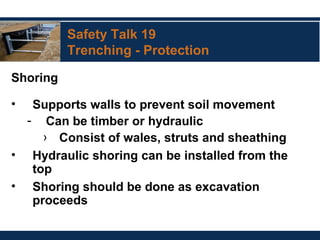
Shoring
• Supports walls to prevent soil movement
- Can be timber or hydraulic
› Consist of wales, struts and sheathing
• Hydraulic shoring can be installed from the
top
• Shoring should be done as excavation
proceeds
Safety Talk 19
Trenching - Protection
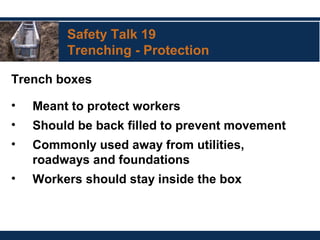
Trench boxes
• Meant to protect workers
• Should be back filled to prevent movement
• Commonly used away from utilities,
roadways and foundations
• Workers should stay inside the box
Safety Talk 19
Trenching - Protection
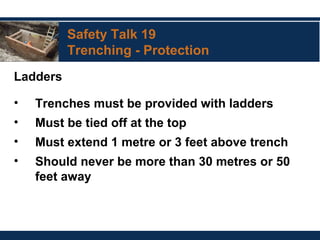
Ladders
• Trenches must be provided with ladders
• Must be tied off at the top
• Must extend 1 metre or 3 feet above trench
• Should never be more than 30 metres or 50
feet away
Safety Talk 20
Trenching - Inspection
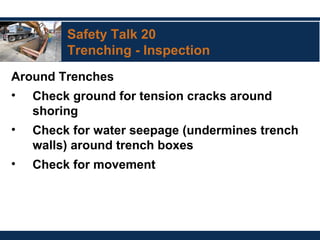
Around Trenches
• Check ground for tension cracks around
shoring
• Check for water seepage (undermines trench
walls) around trench boxes
• Check for movement
Safety Talk 20
Trenching - Inspection
With hydraulic shoring look for:
• Leaks in hoses and cylinders
• Bent bases
• Broken or cracked nipples
• Cracked, split or broken sheathing
Safety Talk 20
Trenching - Inspection
With timber shoring check for:
• Cracked or bowed sheathing
• Wales crushed where they join struts
• Loose or missing cleats
• Split or bowed wales
• Struts off-level
Safety Talk 20
Trenching - Inspection
In trench boxes look for:
• Deformed plates
• Bent or distorted welds in sleeves and struts
• Missing struts
• Bent struts
• Holes, bends or other damage to plates
Safety Talk 25
Underground Utility Locates
• Call the utility owner before digging
• Contractor must ask utility to locate and
mark underground services
• Uncovering underground services must be
done by hand
• Once actual location is determined
excavating equipment can be used
Safety Talk 25
Underground Utility Locates
• Utility provider must be present if
fibre optics is being uncovered
• Pipes, conduits and cable must be
supported
• Breaks can also threaten public
• CALL BEFORE YOU DIG
Safety Talk 25
Underground Utility Locates
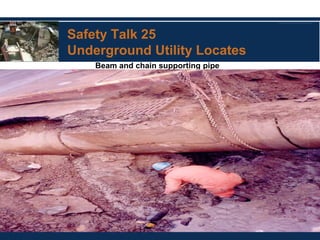
Beam and chain supporting pipe
Hazard Alert
New Brunswick Worker Buried Alive
• Trench was 1.8 metres deep by 2 metres
wide
• Made up of topsoil, gray silt and imported
soil
• 3 cave-ins; work continued
• 4th
cave-in buried worker to his shoulders
• 5th
cave-in completely reburied victim and
buried owner to his shoulders
Hazard Alert
New Brunswick Worker Buried Alive
• Never enter a trench unless it is sloped,
braced or caged
• If there’s a cave-in,
GET OUT AND STAY OUT until the trench
has been made safe
Trenching – Zero Tolerance
Lives are at risk and the law is clear
Safe trenching procedures will save lives
There are no shortcuts to safety
Trenching – Zero Tolerance
No shortcuts - No exceptions - No second
chance
• Zero tolerance means:
- Stop work orders
- Restricting use of equipment
- Fines
- Imprisonment
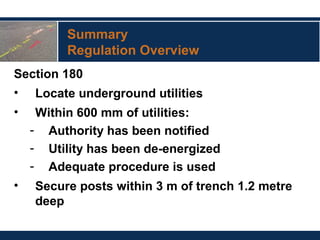
Summary
Regulation Overview
Section 180
• Locate underground utilities
• Within 600 mm of utilities:
- Authority has been notified
- Utility has been de-energized
- Adequate procedure is used
• Secure posts within 3 m of trench 1.2 metre
deep
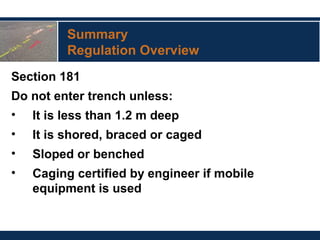
Summary
Regulation Overview
Section 181
Do not enter trench unless:
• It is less than 1.2 m deep
• It is shored, braced or caged
• Sloped or benched
• Caging certified by engineer if mobile
equipment is used
Summary
Regulation Overview
Section 182
Do not enter trench unless:
• Loose materials that may fall have been
removed
• Ladder extends 1 m and is no further than 15
metres
• Install shoring from distance greater than
trench
Summary
Regulation Overview
Section 183
Employer shall ensure:
• Excavated material is kept at least 1.2 m
away
In solid rock more than 1.8 m:
• Excavated material is kept back at least
distance of its height
• Or adequate fencing is used
Summary
Regulation Overview
Section 184
Employer shall ensure:
• Excavation is kept reasonably free of water
• If hazardous gases or oxygen deficient
atmosphere may exist, testing is carried out
• Precautions to prevent accumulation of
gases and adequate ventilation is provided
Summary
Regulation overview
Section 185
Employer shall ensure:
• Employee on the surface is able to observe
employee working in trench
Summary
Regulation Overview
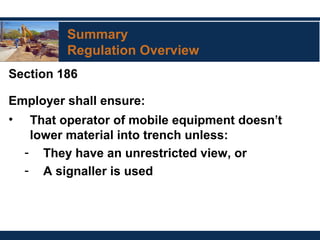
Section 186
Employer shall ensure:
• That operator of mobile equipment doesn’t
lower material into trench unless:
- They have an unrestricted view, or
- A signaller is used
Summary
Regulation Overview
Section 187
An employee shall not move or stay under any
material being lowered into trench
Summary
Regulation Overview
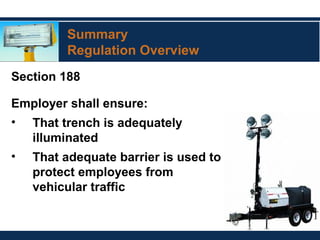
Section 188
Employer shall ensure:
• That trench is adequately
illuminated
• That adequate barrier is used to
protect employees from
vehicular traffic
Summary
Questions and Discussion
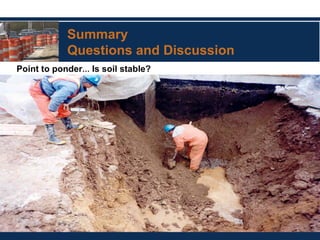
Point to ponder… Is soil stable?
Summary
Questions and Discussion
Points to ponder…
• Shoring, bracing or caging
• Sloping or benching
• Keeping clear of water
• Access and egress
• Traffic safety
Summary
Questions and Discussion
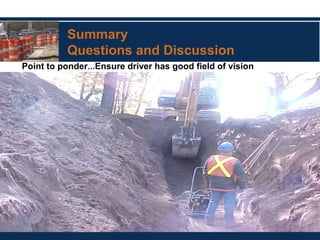
Point to ponder…Ensure driver has good field of vision
Summary
Questions and Discussion
Points to ponder…
• Loose material that may fall in has
been removed
• Shoring adequate to support mobile
equipment
• Employee may be exposed to
engine fumes
• Access and egress
Summary
Questions and Discussion
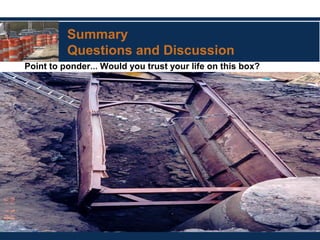
Point to ponder… Would you trust your life on this box?
Summary
Questions and Discussion
Points to ponder…
• Ladder outside of trench box
• Trench box not back-filled
- Permits easier access and egress
and prevents shifting
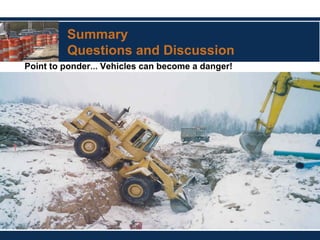
Summary
Questions and Discussion
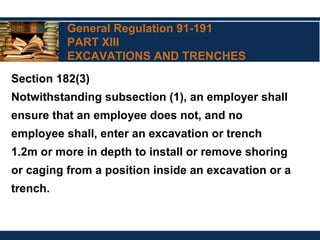
Point to ponder… Vehicles can become a danger!
Summary
Questions and Discussion
Points to ponder…
• Employer shall
- provide…instruction, training and
supervision
• Barrier to protect from vehicular traffic
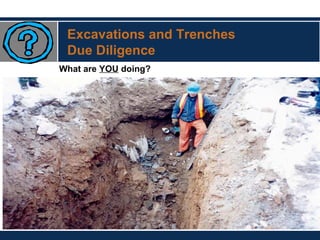
Excavations and Trenches
Due Diligence
What are YOU doing?
Excavations and Trenches
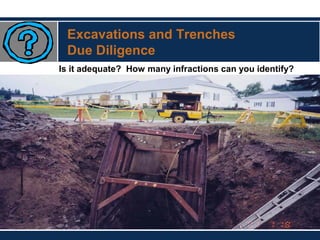
Due Diligence
Is it adequate? How many infractions can you identify?
Your
Excavations
and
Trenches -
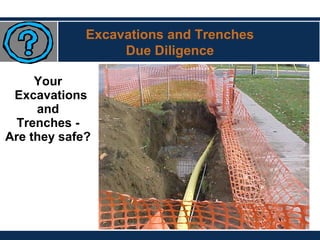
Are they safe?
Excavations and Trenches
Due Diligence

Excavation & Trenching Safety

  • 2.
  • 3.
    Excavations and Trenches PresentationOutline • Introduction • Presentation • Summary
  • 4.
    Excavations and Trenches Introduction •Presentation Objectives • Acts and Regulations overseen by WorkSafeNB
  • 5.
    Excavations and Trenches PresentationContent • OHS Act and Regulation Requirements • Trenching Inspection and Protection • Underground Utilities
  • 6.
    Excavations and Trenches Summary •OHS Regulation Overview • Questions and Discussions • Points to ponder
  • 7.
    Introduction Objectives Participants should beable to identity: • Employer and employee obligations under the OHS Act and regulations • Regulation minimum requirements for working in excavations and trenches • Safe methods for working in and around trenches
  • 8.
    Introduction Acts and Regulations •Ch W-13 Workers’ Compensation Act (6 Regulations) • Ch O-0.2 Occupational Health & Safety Act (7 Regulations) • Ch W-14 WHSCC Act
  • 9.
    Introduction Acts and Regulations ChW-13 Workers’ Compensation Act - Duties to report accidents (Form 67) - Assessment rates and experience rating
  • 10.
    Introduction Acts and Regulations ChO-0.2 Occupational Health & Safety Act - Duties of employers and employees - Employees 3 basic rights › Right to know › Right to participate › Right to refuse
  • 11.
    Introduction Acts and Regulations ChW-14 Workplace Health, Safety and Compensation Commission Act allows WorkSafeNB to oversee the implementation and application of all three acts and their regulations
  • 12.
    Occupational Health &Safety Act Ch O-0.2 “Employee" means - a person employed at or in a place of employment, or - a person at or in a place of employment for any purpose in connection therewith,
  • 13.
    Occupational Health& SafetyAct Ch O-0.2 “Employer" means - A person who employs one or more employees, - A manager, superintendent, supervisor, overseer or any person having authority over an employee at a place of employment, - An agent of the above two
  • 14.
    Occupational Health &Safety Act Ch O-0.2 Every employer shall (Section 9) • take every reasonable precaution to ensure the health and safety of his employees; • comply with this Act, the regulations… • ensure that his employees comply with this Act, the regulations…
  • 15.
    Occupational Health &Safety Act Ch O-0.2 Every employer shall (Section 9) • Ensure that…equipment, machines, devices and materials are maintained in good condition and are of minimum risk to health and safety… • acquaint an employee with any hazard to be found… • provide such information, instruction, training and supervision as are necessary to ensure an employee's health and safety
  • 16.
    Occupational Health &Safety Act Ch O-0.2 Every employer shall… • provide and maintain in good condition such protective equipment as is required by regulation and ensure that such equipment is used by an employee
  • 17.
    Occupational Health &Safety Act Ch O-0.2 Every employer shall… • co-operate with a committee…, a health and safety representative,…and with any person responsible for the enforcement of this Act and the regulations
  • 18.
    Occupational Health &Safety Act Ch O-0.2 Every employee shall… • comply with this Act, the regulations… • conduct himself to ensure his own health and safety and that of other persons…  • report to the employer the existence of any hazard of which he is aware;
  • 19.
    Occupational Health &Safety Act Ch O-0.2 Every employee shall… • wear or use such protective equipment as is required by regulation;  • consult and co-operate with the committee where one has been established or with the health and safety representative…  • co-operate with any person responsible for the enforcement of this Act and the regulations.
  • 20.
    Occupational Health &Safety Act Ch O-0.2 General Regulation 91-191 under the Occupational Health and Safety Act
  • 21.
    General Regulation 91-191under the Occupational Health and Safety Act PART I - INTERPRETATION 2 In this Regulation "competent" means (a) qualified, because of such factors as knowledge, training and experience, to do assigned work in a manner that will ensure the health and safety of persons,
  • 22.
    General Regulation 91-191under the Occupational Health and Safety Act PART I - INTERPRETATION 2 In this Regulation "competent" means (b) knowledgeable about the provisions of the Act and the regulations that apply to the assigned work, and
  • 23.
    General Regulation 91-191under the Occupational Health and Safety Act PART I - INTERPRETATION 2 In this Regulation "competent" means (c) knowledgeable about potential or actual danger to health or safety connected with the assigned work;
  • 24.
    General Regulation 91-191under the Occupational Health and Safety Act PART XIII EXCAVATIONS AND TRENCHES Sections 180 to 188
  • 25.
    General Regulation 91-191 PARTXIII EXCAVATIONS AND TRENCHES Section 180(1) Before beginning an excavation or trench, an employer shall ensure that the location of any underground utility line or piping is determined.
  • 26.
    General Regulation 91-191 PARTXIII EXCAVATIONS AND TRENCHES Section 180(2) Where employees are working within 600 mm of underground utility line or piping, an employer shall ensure that (a) the authority operating the utility line or piping has been notified of the operation, (b) the utility line has been de-energized, and (c) an adequate operating procedure is used by the employees.
  • 27.
    General Regulation 91-191 PARTXIII EXCAVATIONS AND TRENCHES Section 180(3) An employer shall ensure that utility poles, posts and similar structures are supported or removed if they are within 3 m of an excavation or trench that is more than 1.2 m deep.
  • 28.
    General Regulation 91-191 PARTXIII EXCAVATIONS AND TRENCHES Section 181(1) An employer shall ensure that the walls of an excavation or trench are supported by shoring, bracing or caging except when the excavation or trench (a) is less than 1.2 m deep, (b) subject to subsection (2), is cut in solid rock,
  • 29.
    General Regulation 91-191 PARTXIII EXCAVATIONS AND TRENCHES Section 181(1) continued …walls…are supported…except when the excavation or trench (c) is sloped or benched to within 1.2 m of the bottom of the excavation or trench with the slope or bench not exceeding 1 m of vertical rise to each 1 m of horizontal run, or (d) is one that an employee is not required to enter.
  • 30.
    General Regulation 91-191 PARTXIII EXCAVATIONS AND TRENCHES Section 181(1) c…sloped or benched…
  • 31.
    General Regulation 91-191 PARTXIII EXCAVATIONS AND TRENCHES Section 181(2) Where the walls or crests of an excavation or trench are cut in solid rock and are not stable, an employer shall ensure that the walls and crests are adequately supported by rock bolts, wire mesh,shoring or a method that provides equivalent support.
  • 32.
    General Regulation 91-191 PARTXIII EXCAVATIONS AND TRENCHES Section 181(3) Where powered mobile equipment or a mobile crane is used near the edge of an excavation or trench, an employer shall ensure that any shoring, bracing or caging for the excavation or trench is adequate to support the increased pressure.
  • 33.
    General Regulation 91-191 PARTXIII EXCAVATIONS AND TRENCHES Section 181(4) An employer shall ensure that shoring, bracing or caging for an excavation or trench is certified as adequate by an engineer and shall make the proof of the certification available to an officer on request.
  • 34.
    General Regulation 91-191 PARTXIII EXCAVATIONS AND TRENCHES Section 182(1) An employer shall ensure that an employee does not, and no employee shall, enter an excavation or trench 1.2 m or more in depth unless (a) the walls of the excavation or trench are supported by shoring, bracing or caging, the excavation or trench is cut in solid rock or the excavation or trench is sloped or benched to within 1.2 m of the bottom of the excavation or trench with the slope not exceeding 1 m of vertical rise to each 1 m of horizontal run,
  • 35.
    General Regulation 91-191 PARTXIII EXCAVATIONS AND TRENCHES Section 182(1) continued …and no employee shall, enter an excavation or trench 1.2 m or more in depth unless (b) subsections 181(2), (3) and (4) have been complied with, (c) loose material that may fall into the excavation or trench has been removed, and
  • 36.
    General Regulation 91-191 PARTXIII EXCAVATIONS AND TRENCHES Section 182(1) continued …and no employee shall, enter an excavation or trench 1.2 m or more in depth unless (d) a ladder that extends at least 1 m above the excavation or trench is installed no more than 15 m from where the employee is working or some other safe means of access and egress is provided.
  • 37.
    General Regulation 91-191 PARTXIII EXCAVATIONS AND TRENCHES Section 182(2) Notwithstanding subsection (1), an employee may enter an excavation 1.2 m or more in depth to install bracing if the employee remains a distance from the face of the excavation equal to or greater than the depth of the excavation.
  • 38.
    General Regulation 91-191 PARTXIII EXCAVATIONS AND TRENCHES Section 182(3) Notwithstanding subsection (1), an employer shall ensure that an employee does not, and no employee shall, enter an excavation or trench 1.2m or more in depth to install or remove shoring or caging from a position inside an excavation or a trench.
  • 39.
    General Regulation 91-191 PARTXIII EXCAVATIONS AND TRENCHES Section 183(1) Subject to subsection (2), an employer shall ensure that excavated material is kept at least 1.2 m away from the edge of an excavation or trench.
  • 40.
    General Regulation 91-191 PARTXIII EXCAVATIONS AND TRENCHES Section 183(2) Where an excavation or trench is more than 1.8 m deep in rock, an employer shall ensure that (a) excavated material is located back from the face of the excavation or trench a distance equal to at least the height of the excavated material, or (b) a fence that is adequate to support the excavated material is erected at a minimum distance of 1 m from the face of the excavation or trench.
  • 41.
    General Regulation 91-191 PARTXIII EXCAVATIONS AND TRENCHES Section 184(1) An employer shall ensure that an excavation or trench in which an employee works is kept reasonably free of water.
  • 42.
    General Regulation 91-191 PARTXIII EXCAVATIONS AND TRENCHES Section 184(2) Where an employee may be exposed to a hazardous gas or to an oxygen deficient or oxygen rich atmosphere in an excavation or trench, an employer shall ensure that testing is carried out in accordance with section 263 before the employee enters the excavation or trench.
  • 43.
    General Regulation 91-191 PARTXIII EXCAVATIONS AND TRENCHES General Regulation 91-191 Part XVII, Confined Space Sections 262 to 272
  • 44.
    General Regulation 91-191 PARTXIII EXCAVATIONS AND TRENCHES Section 184(3) An employer shall ensure that no hazardous substance is stored in an excavation or trench.
  • 45.
    General Regulation 91-191 PARTXIII EXCAVATIONS AND TRENCHES Section 184(4) An employer shall ensure that precautions are taken to prevent the accumulation of hazardous gases in an excavation or trench and that adequate ventilation is provided in the excavation or trench.
  • 46.
    General Regulation 91-191 PARTXIII EXCAVATIONS AND TRENCHES Section 184(4) …prevent the accumulation of hazardous gases…
  • 47.
    General Regulation 91-191 PARTXIII EXCAVATIONS AND TRENCHES Section 185 Where an employee is working in an excavation or trench, an employer shall ensure that there is an employee working on the surface who is able to observe the employee working in the excavation or trench.
  • 48.
    General Regulation 91-191 PARTXIII EXCAVATIONS AND TRENCHES Section 186 An employer shall ensure that an operator of powered mobile equipment or a mobile crane does not lower material into an excavation or trench, and no such operator shall lower material into an excavation or trench, unless (a) the operator has unrestricted visibility, or (b) a signaller is used to direct the movement of the material.
  • 49.
    General Regulation 91-191 PARTXIII EXCAVATIONS AND TRENCHES Section 187 An employee shall not move under or stay under any material being lowered into an excavation or trench.
  • 50.
    General Regulation 91-191 PARTXIII EXCAVATIONS AND TRENCHES Section 187 …shall not…stay under any material being lowered…
  • 51.
    General Regulation 91-191 PARTXIII EXCAVATIONS AND TRENCHES Section 188(1) An employer shall ensure that an excavation or trench is adequately illuminated (a) when work is being carried out in or near the excavation or trench, and (b) by warning lights or reflective materials to prevent inadvertent entry.
  • 52.
    General Regulation 91-191 PARTXIII EXCAVATIONS AND TRENCHES Section 188(2) An employer shall ensure that an adequate barrier is set up around the excavation or trench so as to protect employees working in the excavation or trench from vehicular traffic.
  • 53.
    General Regulation 91-191 PARTX CONSTRUCTION, TRAFFIC AND BUILDING SAFETY Traffic Safety Sections 91 to 93 Section 91(1) Where construction is being carried out in an area where an employee's safety may be endangered by vehicular traffic, an employer shall provide competent signallers to control the flow of traffic.
  • 54.
    Safety Talk 19 Trenching- Protection Never enter a trench more than 4 feet deep unless it’s: • Sloped • Shored • Protected by a trench box
  • 55.
    Safety Talk 19 Trenching- Protection Sloping - Sloped or benched to within 1.2 metres from bottom - and not exceeding 1 metre vertical rise for each metre of horizontal run - In solid rock that’s not stable, rock bolts, wire mesh or shoring must be used
  • 56.
    Safety Talk 19 Trenching- Protection Shoring • Supports walls to prevent soil movement - Can be timber or hydraulic › Consist of wales, struts and sheathing • Hydraulic shoring can be installed from the top • Shoring should be done as excavation proceeds
  • 57.
    Safety Talk 19 Trenching- Protection Trench boxes • Meant to protect workers • Should be back filled to prevent movement • Commonly used away from utilities, roadways and foundations • Workers should stay inside the box
  • 58.
    Safety Talk 19 Trenching- Protection Ladders • Trenches must be provided with ladders • Must be tied off at the top • Must extend 1 metre or 3 feet above trench • Should never be more than 30 metres or 50 feet away
  • 59.
    Safety Talk 20 Trenching- Inspection Around Trenches • Check ground for tension cracks around shoring • Check for water seepage (undermines trench walls) around trench boxes • Check for movement
  • 60.
    Safety Talk 20 Trenching- Inspection With hydraulic shoring look for: • Leaks in hoses and cylinders • Bent bases • Broken or cracked nipples • Cracked, split or broken sheathing
  • 61.
    Safety Talk 20 Trenching- Inspection With timber shoring check for: • Cracked or bowed sheathing • Wales crushed where they join struts • Loose or missing cleats • Split or bowed wales • Struts off-level
  • 62.
    Safety Talk 20 Trenching- Inspection In trench boxes look for: • Deformed plates • Bent or distorted welds in sleeves and struts • Missing struts • Bent struts • Holes, bends or other damage to plates
  • 63.
    Safety Talk 25 UndergroundUtility Locates • Call the utility owner before digging • Contractor must ask utility to locate and mark underground services • Uncovering underground services must be done by hand • Once actual location is determined excavating equipment can be used
  • 64.
    Safety Talk 25 UndergroundUtility Locates • Utility provider must be present if fibre optics is being uncovered • Pipes, conduits and cable must be supported • Breaks can also threaten public • CALL BEFORE YOU DIG
  • 65.
    Safety Talk 25 UndergroundUtility Locates Beam and chain supporting pipe
  • 66.
    Hazard Alert New BrunswickWorker Buried Alive • Trench was 1.8 metres deep by 2 metres wide • Made up of topsoil, gray silt and imported soil • 3 cave-ins; work continued • 4th cave-in buried worker to his shoulders • 5th cave-in completely reburied victim and buried owner to his shoulders
  • 67.
    Hazard Alert New BrunswickWorker Buried Alive • Never enter a trench unless it is sloped, braced or caged • If there’s a cave-in, GET OUT AND STAY OUT until the trench has been made safe
  • 68.
    Trenching – ZeroTolerance Lives are at risk and the law is clear Safe trenching procedures will save lives There are no shortcuts to safety
  • 69.
    Trenching – ZeroTolerance No shortcuts - No exceptions - No second chance • Zero tolerance means: - Stop work orders - Restricting use of equipment - Fines - Imprisonment
  • 70.
    Summary Regulation Overview Section 180 •Locate underground utilities • Within 600 mm of utilities: - Authority has been notified - Utility has been de-energized - Adequate procedure is used • Secure posts within 3 m of trench 1.2 metre deep
  • 71.
    Summary Regulation Overview Section 181 Donot enter trench unless: • It is less than 1.2 m deep • It is shored, braced or caged • Sloped or benched • Caging certified by engineer if mobile equipment is used
  • 72.
    Summary Regulation Overview Section 182 Donot enter trench unless: • Loose materials that may fall have been removed • Ladder extends 1 m and is no further than 15 metres • Install shoring from distance greater than trench
  • 73.
    Summary Regulation Overview Section 183 Employershall ensure: • Excavated material is kept at least 1.2 m away In solid rock more than 1.8 m: • Excavated material is kept back at least distance of its height • Or adequate fencing is used
  • 74.
    Summary Regulation Overview Section 184 Employershall ensure: • Excavation is kept reasonably free of water • If hazardous gases or oxygen deficient atmosphere may exist, testing is carried out • Precautions to prevent accumulation of gases and adequate ventilation is provided
  • 75.
    Summary Regulation overview Section 185 Employershall ensure: • Employee on the surface is able to observe employee working in trench
  • 76.
    Summary Regulation Overview Section 186 Employershall ensure: • That operator of mobile equipment doesn’t lower material into trench unless: - They have an unrestricted view, or - A signaller is used
  • 77.
    Summary Regulation Overview Section 187 Anemployee shall not move or stay under any material being lowered into trench
  • 78.
    Summary Regulation Overview Section 188 Employershall ensure: • That trench is adequately illuminated • That adequate barrier is used to protect employees from vehicular traffic
  • 79.
    Summary Questions and Discussion Pointto ponder… Is soil stable?
  • 80.
    Summary Questions and Discussion Pointsto ponder… • Shoring, bracing or caging • Sloping or benching • Keeping clear of water • Access and egress • Traffic safety
  • 81.
    Summary Questions and Discussion Pointto ponder…Ensure driver has good field of vision
  • 82.
    Summary Questions and Discussion Pointsto ponder… • Loose material that may fall in has been removed • Shoring adequate to support mobile equipment • Employee may be exposed to engine fumes • Access and egress
  • 83.
    Summary Questions and Discussion Pointto ponder… Would you trust your life on this box?
  • 84.
    Summary Questions and Discussion Pointsto ponder… • Ladder outside of trench box • Trench box not back-filled - Permits easier access and egress and prevents shifting
  • 85.
    Summary Questions and Discussion Pointto ponder… Vehicles can become a danger!
  • 86.
    Summary Questions and Discussion Pointsto ponder… • Employer shall - provide…instruction, training and supervision • Barrier to protect from vehicular traffic
  • 87.
    Excavations and Trenches DueDiligence What are YOU doing?
  • 88.
    Excavations and Trenches DueDiligence Is it adequate? How many infractions can you identify?
  • 89.
    Your Excavations and Trenches - Are theysafe? Excavations and Trenches Due Diligence