Page 1 of 10
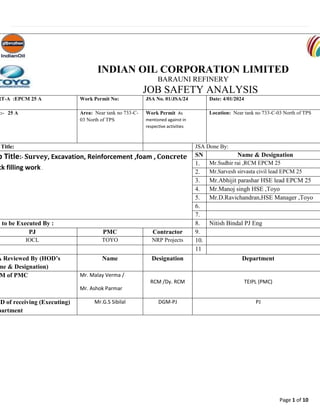
INDIAN OIL CORPORATION LIMITED
BARAUNI REFINERY
JOB SAFETY ANALYSIS
RT-A :EPCM 25 A Work Permit No: JSA No. 01/JSA/24 Date: 4/01/2024
t:- 25 A Area: Near tank no 733-C-
03 North of TPS
Work Permit As
mentioned against in
respective activities
Location: Near tank no 733-C-03 North of TPS
Title: JSA Done By:
b Title:- Survey, Excavation, Reinforcement ,foam , Concrete
ck filling work.
SN Name & Designation
1. Mr.Sudhir rai ,RCM EPCM 25
2. Mr.Sarvesh sirvasta civil lead EPCM 25
3. Mr.Abhijit parashar HSE lead EPCM 25
4. Mr.Manoj singh HSE ,Toyo
5. Mr.D.Ravichandran,HSE Manager ,Toyo
6.
7.
b to be Executed By : 8. Nitish Bindal PJ Eng
PJ PMC Contractor 9.
IOCL TOYO NRP Projects 10.
11
A Reviewed By (HOD’s
me & Designation)
Name Designation Department
M of PMC Mr. Malay Verma /
Mr. Ashok Parmar
RCM /Dy. RCM TEIPL (PMC)
OD of receiving (Executing)
partment
Mr.G.S Sibilal DGM-PJ PJ
Page 2 of 10
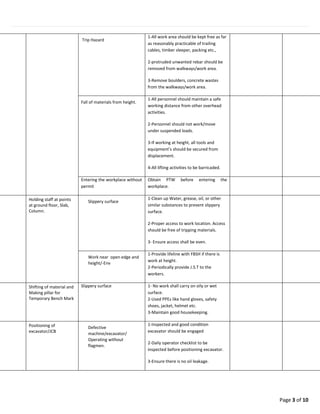
Sl. No. Activities Hazards Recommended Actions
/Procedures & Control Measures
Compliance Status
(Complied/ Not
complied)
Checked By-Na
Officer/PMC En
date & time
Mobilization of
Manpower
Lack of awareness 1-Plan the work involving Permit
Applicant, Permit Issuer& Site supervisor.
2- Provide work specific training
3- Conduct TBT before start of work.
Un Fit Worker 1- Conduct physical fitness test of worker
before his employment from authorized
Practitioner.
2-Visually check the physical fitness of
worker before start of work.
3- Provide close and continues
supervision
Preparatory Works &
Manual handling of
material
 Slip/Trip &Fall.
1-Clean up Water, grease, oil, or other
similar substances to prevent slippery
surface.
2-Proper access to work location. Access
should be free of tripping materials.
3- Ensure access shall be even.
Contact with Sharp edges /
surfaces may cause injury or
bruises and Fall of object may
cause Injury
1-Use Mandatory PPE- Safety
Shoes/Gum boot with steel toe, Safety
Helmet & hand gloves.
2-Hold the material firmly while
handling.
3-Material should not be thrown from
top on ground / other level.
4-Secure the material while shifting on
vehicle or trolley.
5-Keep hands away from sharp edges /
surfaces.
Access to workplace Collision with plant vehicles 1-A high level of personal awareness is
required from all employees while
transiting around site.
2-Where possible personnel should
adhere to designated walkways
3-All personnel should wear Hi-Viz
jackets as a part of mandatory site PPE
requirement.
Page 3 of 10
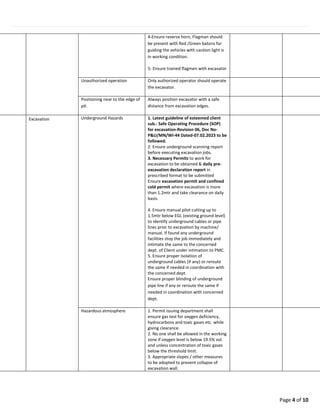
Trip Hazard
1-All work area should be kept free as far
as reasonably practicable of trailing
cables, timber sleeper, packing etc.,
2-protruded unwanted rebar should be
removed from walkways/work area.
3-Remove boulders, concrete wastes
from the walkways/work area.
Fall of materials from height.
1-All personnel should maintain a safe
working distance from other overhead
activities.
2-Personnel should not work/move
under suspended loads.
3-If working at height, all tools and
equipment’s should be secured from
displacement.
4-All lifting activities to be barricaded.
Entering the workplace without
permit
Obtain PTW before entering the
workplace.
Holding staff at points
at ground floor, Slab,
Column.
Slippery surface
1-Clean up Water, grease, oil, or other
similar substances to prevent slippery
surface.
2-Proper access to work location. Access
should be free of tripping materials.
3- Ensure access shall be even.
Work near open edge and
height/-Env
1-Provide lifeline with FBSH if there is
work at height.
2-Periodically provide J.S.T to the
workers.
Shifting of material and
Making pillar for
Temporary Bench Mark
Slippery surface 1- No work shall carry on oily or wet
surface.
2-Used PPEs like hand gloves, safety
shoes, jacket, helmet etc.
3-Maintain good housekeeping.
Positioning of
excavator/JCB
Defective
machine/excavator/
Operating without
flagmen.
1-Inspected and good condition
excavator should be engaged
2-Daily operator checklist to be
inspected before positioning excavator.
3-Ensure there is no oil leakage.
Page 4 of 10
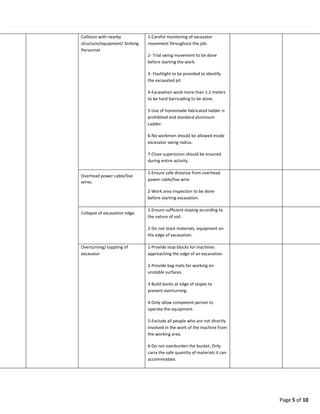
4-Ensure reverse horn, Flagman should
be present with Red /Green batons for
guiding the vehicles with caution light is
in working condition.
5- Ensure trained flagmen with excavator
Unauthorized operation Only authorized operator should operate
the excavator.
Positioning near to the edge of
pit.
Always position excavator with a safe
distance from excavation edges.
Excavation Underground Hazards 1. Latest guideline of esteemed client
sub.: Safe Operating Procedure (SOP)
for excavation-Revision 06, Doc No-
P&U/MN/WI-44 Dated-07.02.2023 to be
followed.
2. Ensure underground scanning report
before executing excavation jobs.
3. Necessary Permits to work for
excavation to be obtained & daily pre-
excavation declaration report in
prescribed format to be submitted
Ensure excavation permit and confined
cold permit where excavation is more
than 1.2mtr and take clearance on daily
basis.
4. Ensure manual pilot cutting up to
1.5mtr below EGL (existing ground level)
to identify underground cables or pipe
lines prior to excavation by machine/
manual. If found any underground
facilities stop the job immediately and
intimate the same to the concerned
dept. of Client under intimation to PMC.
5. Ensure proper isolation of
underground cables (if any) or reroute
the same if needed in coordination with
the concerned dept.
Ensure proper blinding of underground
pipe line if any or reroute the same if
needed in coordination with concerned
dept.
Hazardous atmosphere 1. Permit issuing department shall
ensure gas test for oxygen deficiency,
hydrocarbons and toxic gases etc. while
giving clearance.
2. No one shall be allowed in the working
zone if oxygen level is below 19.5% vol.
and unless concentration of toxic gases
below the threshold limit.
3. Appropriate slopes / other measures
to be adopted to prevent collapse of
excavation wall.
Page 5 of 10
Collision with nearby
structure/equipment/ Striking
Personnel
1-Careful monitoring of excavator
movement throughout the job.
2- Trial swing movement to be done
before starting the work.
3- Flashlight to be provided to identify
the excavated pit
4-Excavation work more than 1.2 meters
to be hard barricading to be done.
5-Use of homemade fabricated ladder is
prohibited and standard aluminum
Ladder.
6-No workmen should be allowed inside
excavator swing radius.
7-Close supervision should be ensured
during entire activity.
Overhead power cable/live
wires.
1-Ensure safe distance from overhead
power cable/live wire.
2-Work area inspection to be done
before starting excavation.
Collapse of excavation edge.
1-Ensure sufficient sloping according to
the nature of soil.
2-Do not stack materials, equipment on
the edge of excavation.
Overturning/ toppling of
excavator
1-Provide stop blocks for machines
approaching the edge of an excavation.
2-Provide bag mats for working on
unstable surfaces.
3-Build banks at edge of slopes to
prevent overturning.
4-Only allow competent person to
operate the equipment.
5-Exclude all people who are not directly
involved in the work of the machine from
the working area.
6-Do not overburden the bucket. Only
carry the safe quantity of materials it can
accommodate.
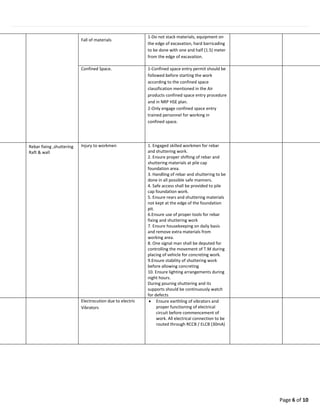
Page 6 of 10
Fall of materials
1-Do not stack materials, equipment on
the edge of excavation, hard barricading
to be done with one and half (1.5) meter
from the edge of excavation.
Confined Space. 1-Confined space entry permit should be
followed before starting the work
according to the confined space
classification mentioned in the Air
products confined space entry procedure
and in NRP HSE plan.
2-Only engage confined space entry
trained personnel for working in
confined space.
Rebar fixing ,shuttering
Raft & wall
Injury to workmen 1. Engaged skilled workmen for rebar
and shuttering work.
2. Ensure proper shifting of rebar and
shuttering materials at pile cap
foundation area.
3. Handling of rebar and shuttering to be
done in all possible safe manners.
4. Safe access shall be provided to pile
cap foundation work.
5. Ensure rears and shuttering materials
not kept at the edge of the foundation
pit.
6.Ensure use of proper tools for rebar
fixing and shuttering work
7. Ensure housekeeping on daily basis
and remove extra materials from
working area.
8. One signal man shall be deputed for
controlling the movement of T.M during
placing of vehicle for concreting work.
9.Ensure stability of shuttering work
before allowing concreting
10. Ensure lighting arrangements during
night hours.
During pouring shuttering and its
supports should be continuously watch
for defects
Electrocution due to electric
Vibrators
 Ensure earthling of vibrators and
proper functioning of electrical
circuit before commencement of
work. All electrical connection to be
routed through RCCB / ELCB (30mA)
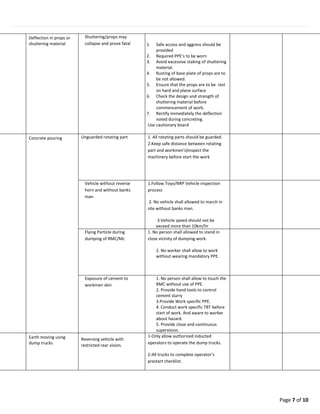
Page 7 of 10
Deflection in props or
shuttering material
Shuttering/props may
collapse and prove fatal 1. Safe access and aggress should be
provided
2. Required PPE’s to be worn
3. Avoid excessive staking of shuttering
material.
4. Rusting of base plate of props are to
be not allowed.
5. Ensure that the props are to be rest
on hard and plane surface
6. Check the design and strength of
shuttering material before
commencement of work.
7. Rectify immediately the deflection
noted during concreting.
Use cautionary board
Concrete pouring Unguarded rotating part 1. All rotating parts should be guarded.
2.Keep safe distance between rotating
part and workmen's)Inspect the
machinery before start the work
Vehicle without reverse
horn and without banks
man
1.Follow Toyo/NRP Vehicle inspection
process
2. No vehicle shall allowed to march in
site without banks man.
3.Vehicle speed should not be
exceed more than 10km/hr
Flying Particle during
dumping of RMC/Mc
1. No person shall allowed to stand in
close vicinity of dumping work.
2. No worker shall allow to work
without wearing mandatory PPE.
Exposure of cement to
workmen skin
1. No person shall allow to touch the
RMC without use of PPE.
2. Provide hand tools to control
cement slurry
3.Provide Work specific PPE.
4. Conduct work specific TBT before
start of work. And aware to worker
about hazard.
5. Provide close and continuous
supervision.
Earth moving using
dump trucks
Reversing vehicle with
restricted rear vision.
1-Only allow authorized inducted
operators to operate the dump trucks.
2-All trucks to complete operator’s
prestart checklist.
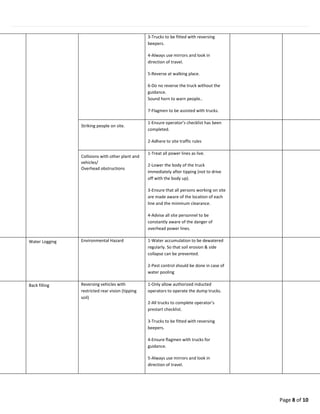
Page 8 of 10
3-Trucks to be fitted with reversing
beepers.
4-Always use mirrors and look in
direction of travel.
5-Reverse at walking place.
6-Do no reverse the truck without the
guidance.
Sound horn to warn people..
7-Flagmen to be assisted with trucks.
Striking people on site.
1-Ensure operator’s checklist has been
completed.
2-Adhere to site traffic rules
Collisions with other plant and
vehicles/
Overhead obstructions
1-Treat all power lines as live.
2-Lower the body of the truck
immediately after tipping (not to drive
off with the body up).
3-Ensure that all persons working on site
are made aware of the location of each
line and the minimum clearance.
4-Advise all site personnel to be
constantly aware of the danger of
overhead power lines.
Water Logging Environmental Hazard 1-Water accumulation to be dewatered
regularly. So that soil erosion & side
collapse can be prevented.
2-Pest control should be done in case of
water pooling
Back filling Reversing vehicles with
restricted rear vision (tipping
soil)
1-Only allow authorized inducted
operators to operate the dump trucks.
2-All trucks to complete operator’s
prestart checklist.
3-Trucks to be fitted with reversing
beepers.
4-Ensure flagmen with trucks for
guidance.
5-Always use mirrors and look in
direction of travel.
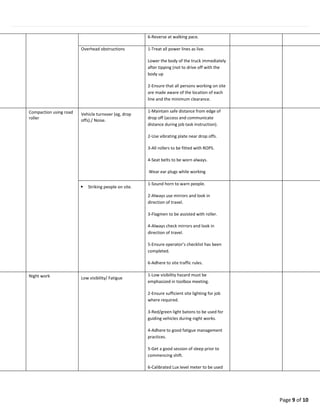
Page 9 of 10
6-Reverse at walking pace.
Overhead obstructions 1-Treat all power lines as live.
Lower the body of the truck immediately
after tipping (not to drive off with the
body up
2-Ensure that all persons working on site
are made aware of the location of each
line and the minimum clearance.
Compaction using road
roller
Vehicle turnover (eg, drop
offs)./ Noise.
1-Maintain safe distance from edge of
drop off (access and communicate
distance during job task instruction).
2-Use vibrating plate near drop offs.
3-All rollers to be fitted with ROPS.
4-Seat belts to be worn always.
Wear ear plugs while working
 Striking people on site.
1-Sound horn to warn people.
2-Always use mirrors and look in
direction of travel.
3-Flagmen to be assisted with roller.
4-Always check mirrors and look in
direction of travel.
5-Ensure operator’s checklist has been
completed.
6-Adhere to site traffic rules.
Night work Low visibility/ Fatigue
1-Low visibility hazard must be
emphasized in toolbox meeting.
2-Ensure sufficient site lighting for job
where required.
3-Red/green light batons to be used for
guiding vehicles during night works.
4-Adhere to good fatigue management
practices.
5-Get a good session of sleep prior to
commencing shift.
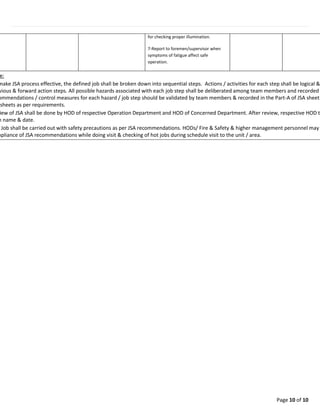
6-Calibrated Lux level meter to be used
Page 10 of 10
for checking proper illumination.
7-Report to foremen/supervisor when
symptoms of fatigue affect safe
operation.
e:
make JSA process effective, the defined job shall be broken down into sequential steps. Actions / activities for each step shall be logical &
vious & forward action steps. All possible hazards associated with each job step shall be deliberated among team members and recorded
ommendations / control measures for each hazard / job step should be validated by team members & recorded in the Part-A of JSA sheet.
sheets as per requirements.
iew of JSA shall be done by HOD of respective Operation Department and HOD of Concerned Department. After review, respective HOD to
h name & date.
Job shall be carried out with safety precautions as per JSA recommendations. HODs/ Fire & Safety & higher management personnel may
mpliance of JSA recommendations while doing visit & checking of hot jobs during schedule visit to the unit / area.

Excavation & Back filling work 02.docx

  • 1.
    Page 1 of10 INDIAN OIL CORPORATION LIMITED BARAUNI REFINERY JOB SAFETY ANALYSIS RT-A :EPCM 25 A Work Permit No: JSA No. 01/JSA/24 Date: 4/01/2024 t:- 25 A Area: Near tank no 733-C- 03 North of TPS Work Permit As mentioned against in respective activities Location: Near tank no 733-C-03 North of TPS Title: JSA Done By: b Title:- Survey, Excavation, Reinforcement ,foam , Concrete ck filling work. SN Name & Designation 1. Mr.Sudhir rai ,RCM EPCM 25 2. Mr.Sarvesh sirvasta civil lead EPCM 25 3. Mr.Abhijit parashar HSE lead EPCM 25 4. Mr.Manoj singh HSE ,Toyo 5. Mr.D.Ravichandran,HSE Manager ,Toyo 6. 7. b to be Executed By : 8. Nitish Bindal PJ Eng PJ PMC Contractor 9. IOCL TOYO NRP Projects 10. 11 A Reviewed By (HOD’s me & Designation) Name Designation Department M of PMC Mr. Malay Verma / Mr. Ashok Parmar RCM /Dy. RCM TEIPL (PMC) OD of receiving (Executing) partment Mr.G.S Sibilal DGM-PJ PJ
  • 2.
    Page 2 of10 Sl. No. Activities Hazards Recommended Actions /Procedures & Control Measures Compliance Status (Complied/ Not complied) Checked By-Na Officer/PMC En date & time Mobilization of Manpower Lack of awareness 1-Plan the work involving Permit Applicant, Permit Issuer& Site supervisor. 2- Provide work specific training 3- Conduct TBT before start of work. Un Fit Worker 1- Conduct physical fitness test of worker before his employment from authorized Practitioner. 2-Visually check the physical fitness of worker before start of work. 3- Provide close and continues supervision Preparatory Works & Manual handling of material  Slip/Trip &Fall. 1-Clean up Water, grease, oil, or other similar substances to prevent slippery surface. 2-Proper access to work location. Access should be free of tripping materials. 3- Ensure access shall be even. Contact with Sharp edges / surfaces may cause injury or bruises and Fall of object may cause Injury 1-Use Mandatory PPE- Safety Shoes/Gum boot with steel toe, Safety Helmet & hand gloves. 2-Hold the material firmly while handling. 3-Material should not be thrown from top on ground / other level. 4-Secure the material while shifting on vehicle or trolley. 5-Keep hands away from sharp edges / surfaces. Access to workplace Collision with plant vehicles 1-A high level of personal awareness is required from all employees while transiting around site. 2-Where possible personnel should adhere to designated walkways 3-All personnel should wear Hi-Viz jackets as a part of mandatory site PPE requirement.
  • 3.
    Page 3 of10 Trip Hazard 1-All work area should be kept free as far as reasonably practicable of trailing cables, timber sleeper, packing etc., 2-protruded unwanted rebar should be removed from walkways/work area. 3-Remove boulders, concrete wastes from the walkways/work area. Fall of materials from height. 1-All personnel should maintain a safe working distance from other overhead activities. 2-Personnel should not work/move under suspended loads. 3-If working at height, all tools and equipment’s should be secured from displacement. 4-All lifting activities to be barricaded. Entering the workplace without permit Obtain PTW before entering the workplace. Holding staff at points at ground floor, Slab, Column. Slippery surface 1-Clean up Water, grease, oil, or other similar substances to prevent slippery surface. 2-Proper access to work location. Access should be free of tripping materials. 3- Ensure access shall be even. Work near open edge and height/-Env 1-Provide lifeline with FBSH if there is work at height. 2-Periodically provide J.S.T to the workers. Shifting of material and Making pillar for Temporary Bench Mark Slippery surface 1- No work shall carry on oily or wet surface. 2-Used PPEs like hand gloves, safety shoes, jacket, helmet etc. 3-Maintain good housekeeping. Positioning of excavator/JCB Defective machine/excavator/ Operating without flagmen. 1-Inspected and good condition excavator should be engaged 2-Daily operator checklist to be inspected before positioning excavator. 3-Ensure there is no oil leakage.
  • 4.
    Page 4 of10 4-Ensure reverse horn, Flagman should be present with Red /Green batons for guiding the vehicles with caution light is in working condition. 5- Ensure trained flagmen with excavator Unauthorized operation Only authorized operator should operate the excavator. Positioning near to the edge of pit. Always position excavator with a safe distance from excavation edges. Excavation Underground Hazards 1. Latest guideline of esteemed client sub.: Safe Operating Procedure (SOP) for excavation-Revision 06, Doc No- P&U/MN/WI-44 Dated-07.02.2023 to be followed. 2. Ensure underground scanning report before executing excavation jobs. 3. Necessary Permits to work for excavation to be obtained & daily pre- excavation declaration report in prescribed format to be submitted Ensure excavation permit and confined cold permit where excavation is more than 1.2mtr and take clearance on daily basis. 4. Ensure manual pilot cutting up to 1.5mtr below EGL (existing ground level) to identify underground cables or pipe lines prior to excavation by machine/ manual. If found any underground facilities stop the job immediately and intimate the same to the concerned dept. of Client under intimation to PMC. 5. Ensure proper isolation of underground cables (if any) or reroute the same if needed in coordination with the concerned dept. Ensure proper blinding of underground pipe line if any or reroute the same if needed in coordination with concerned dept. Hazardous atmosphere 1. Permit issuing department shall ensure gas test for oxygen deficiency, hydrocarbons and toxic gases etc. while giving clearance. 2. No one shall be allowed in the working zone if oxygen level is below 19.5% vol. and unless concentration of toxic gases below the threshold limit. 3. Appropriate slopes / other measures to be adopted to prevent collapse of excavation wall.
  • 5.
    Page 5 of10 Collision with nearby structure/equipment/ Striking Personnel 1-Careful monitoring of excavator movement throughout the job. 2- Trial swing movement to be done before starting the work. 3- Flashlight to be provided to identify the excavated pit 4-Excavation work more than 1.2 meters to be hard barricading to be done. 5-Use of homemade fabricated ladder is prohibited and standard aluminum Ladder. 6-No workmen should be allowed inside excavator swing radius. 7-Close supervision should be ensured during entire activity. Overhead power cable/live wires. 1-Ensure safe distance from overhead power cable/live wire. 2-Work area inspection to be done before starting excavation. Collapse of excavation edge. 1-Ensure sufficient sloping according to the nature of soil. 2-Do not stack materials, equipment on the edge of excavation. Overturning/ toppling of excavator 1-Provide stop blocks for machines approaching the edge of an excavation. 2-Provide bag mats for working on unstable surfaces. 3-Build banks at edge of slopes to prevent overturning. 4-Only allow competent person to operate the equipment. 5-Exclude all people who are not directly involved in the work of the machine from the working area. 6-Do not overburden the bucket. Only carry the safe quantity of materials it can accommodate.
  • 6.
    Page 6 of10 Fall of materials 1-Do not stack materials, equipment on the edge of excavation, hard barricading to be done with one and half (1.5) meter from the edge of excavation. Confined Space. 1-Confined space entry permit should be followed before starting the work according to the confined space classification mentioned in the Air products confined space entry procedure and in NRP HSE plan. 2-Only engage confined space entry trained personnel for working in confined space. Rebar fixing ,shuttering Raft & wall Injury to workmen 1. Engaged skilled workmen for rebar and shuttering work. 2. Ensure proper shifting of rebar and shuttering materials at pile cap foundation area. 3. Handling of rebar and shuttering to be done in all possible safe manners. 4. Safe access shall be provided to pile cap foundation work. 5. Ensure rears and shuttering materials not kept at the edge of the foundation pit. 6.Ensure use of proper tools for rebar fixing and shuttering work 7. Ensure housekeeping on daily basis and remove extra materials from working area. 8. One signal man shall be deputed for controlling the movement of T.M during placing of vehicle for concreting work. 9.Ensure stability of shuttering work before allowing concreting 10. Ensure lighting arrangements during night hours. During pouring shuttering and its supports should be continuously watch for defects Electrocution due to electric Vibrators  Ensure earthling of vibrators and proper functioning of electrical circuit before commencement of work. All electrical connection to be routed through RCCB / ELCB (30mA)
  • 7.
    Page 7 of10 Deflection in props or shuttering material Shuttering/props may collapse and prove fatal 1. Safe access and aggress should be provided 2. Required PPE’s to be worn 3. Avoid excessive staking of shuttering material. 4. Rusting of base plate of props are to be not allowed. 5. Ensure that the props are to be rest on hard and plane surface 6. Check the design and strength of shuttering material before commencement of work. 7. Rectify immediately the deflection noted during concreting. Use cautionary board Concrete pouring Unguarded rotating part 1. All rotating parts should be guarded. 2.Keep safe distance between rotating part and workmen's)Inspect the machinery before start the work Vehicle without reverse horn and without banks man 1.Follow Toyo/NRP Vehicle inspection process 2. No vehicle shall allowed to march in site without banks man. 3.Vehicle speed should not be exceed more than 10km/hr Flying Particle during dumping of RMC/Mc 1. No person shall allowed to stand in close vicinity of dumping work. 2. No worker shall allow to work without wearing mandatory PPE. Exposure of cement to workmen skin 1. No person shall allow to touch the RMC without use of PPE. 2. Provide hand tools to control cement slurry 3.Provide Work specific PPE. 4. Conduct work specific TBT before start of work. And aware to worker about hazard. 5. Provide close and continuous supervision. Earth moving using dump trucks Reversing vehicle with restricted rear vision. 1-Only allow authorized inducted operators to operate the dump trucks. 2-All trucks to complete operator’s prestart checklist.
  • 8.
    Page 8 of10 3-Trucks to be fitted with reversing beepers. 4-Always use mirrors and look in direction of travel. 5-Reverse at walking place. 6-Do no reverse the truck without the guidance. Sound horn to warn people.. 7-Flagmen to be assisted with trucks. Striking people on site. 1-Ensure operator’s checklist has been completed. 2-Adhere to site traffic rules Collisions with other plant and vehicles/ Overhead obstructions 1-Treat all power lines as live. 2-Lower the body of the truck immediately after tipping (not to drive off with the body up). 3-Ensure that all persons working on site are made aware of the location of each line and the minimum clearance. 4-Advise all site personnel to be constantly aware of the danger of overhead power lines. Water Logging Environmental Hazard 1-Water accumulation to be dewatered regularly. So that soil erosion & side collapse can be prevented. 2-Pest control should be done in case of water pooling Back filling Reversing vehicles with restricted rear vision (tipping soil) 1-Only allow authorized inducted operators to operate the dump trucks. 2-All trucks to complete operator’s prestart checklist. 3-Trucks to be fitted with reversing beepers. 4-Ensure flagmen with trucks for guidance. 5-Always use mirrors and look in direction of travel.
  • 9.
    Page 9 of10 6-Reverse at walking pace. Overhead obstructions 1-Treat all power lines as live. Lower the body of the truck immediately after tipping (not to drive off with the body up 2-Ensure that all persons working on site are made aware of the location of each line and the minimum clearance. Compaction using road roller Vehicle turnover (eg, drop offs)./ Noise. 1-Maintain safe distance from edge of drop off (access and communicate distance during job task instruction). 2-Use vibrating plate near drop offs. 3-All rollers to be fitted with ROPS. 4-Seat belts to be worn always. Wear ear plugs while working  Striking people on site. 1-Sound horn to warn people. 2-Always use mirrors and look in direction of travel. 3-Flagmen to be assisted with roller. 4-Always check mirrors and look in direction of travel. 5-Ensure operator’s checklist has been completed. 6-Adhere to site traffic rules. Night work Low visibility/ Fatigue 1-Low visibility hazard must be emphasized in toolbox meeting. 2-Ensure sufficient site lighting for job where required. 3-Red/green light batons to be used for guiding vehicles during night works. 4-Adhere to good fatigue management practices. 5-Get a good session of sleep prior to commencing shift. 6-Calibrated Lux level meter to be used
  • 10.
    Page 10 of10 for checking proper illumination. 7-Report to foremen/supervisor when symptoms of fatigue affect safe operation. e: make JSA process effective, the defined job shall be broken down into sequential steps. Actions / activities for each step shall be logical & vious & forward action steps. All possible hazards associated with each job step shall be deliberated among team members and recorded ommendations / control measures for each hazard / job step should be validated by team members & recorded in the Part-A of JSA sheet. sheets as per requirements. iew of JSA shall be done by HOD of respective Operation Department and HOD of Concerned Department. After review, respective HOD to h name & date. Job shall be carried out with safety precautions as per JSA recommendations. HODs/ Fire & Safety & higher management personnel may mpliance of JSA recommendations while doing visit & checking of hot jobs during schedule visit to the unit / area.