Motivating Performance Through Job Design & Goal Setting Presented by: For-Ian V. Sandoval  with Team LSPU
LEARNING OBJECTIVES Discuss  the background of job design as an applied  area of work motivation Define  the various techniques and approaches to job  design Explain  goal-setting theory and guidelines from  research Describe  the application of goal setting to overall  systems performance
JOB DESIGN
JOB DESIGN Work arrangement (or rearrangement) aimed at  reducing or overcoming job dissatisfaction and  employee alienation arising from repetitive and  mechanistic tasks.  Through job design, organizations try to raise  productivity levels by offering non-monetary  rewards such as greater satisfaction from a sense  of personal achievement in meeting the  increased challenge and responsibility of one's  work.
JOB DESIGN Essential to reduced job stress, motivation can  be enhanced, and  satisfaction of employees and  their performance can be improved that  organizations can effectively compete in the  global market.
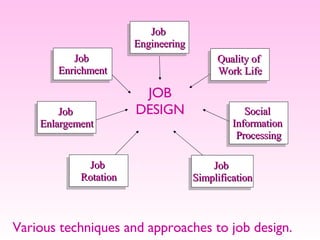
Various techniques and approaches to job design. JOB DESIGN Job  Engineering Job  Enrichment Job  Enlargement Job  Rotation Job  Simplification Social  Information  Processing Quality of  Work Life
JOB ENGINEERING Scientific management / industrial approach  concerned with product, process, and design  tool design; plant layout; standard operating  procedures; wok measurement and standards;  worker methods; and human-machine  interactions.
JOB ENLARGEMENT Job design technique in which the number of  tasks associated with a job is increased (and  appropriate training provided) to add greater  variety to activities, thus reducing monotony.  It is a horizontal restructuring method in that  the job is enlarged by adding related tasks. Job  enlargement may also result in greater  workforce flexibility.
JOB ROTATION Job design technique in which employees are  moved between two or more jobs in a planned manner.  The objective is to expose the employees to  different experiences and wider variety of skills  to enhance job satisfaction and to cross-train  them.
JOB SIMPLIFICATION Job design technique in which jobs are broken  into relatively simple tasks.  It aims at greater productivity through reduced  application of mental and/or physical effort.
JOB ENRICHMENT Job design technique that is a variation on job  enlargement, job rotation and job simplification  concept.  Job enrichment adds new sources of job  satisfaction by increasing the level of  responsibility of the employee.  It is a vertical restructuring method in that it  gives the employee additional authority,  autonomy, and control over the way the job is  accomplished.  Also called job enhancement or vertical job  expansion.
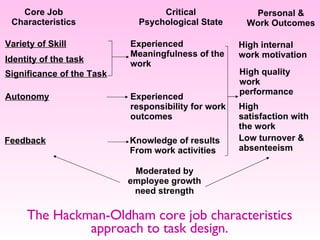
The Hackman-Oldham core job characteristics approach to task design. Significance of the Task Core Job Characteristics Variety of Skill Identity of the task Autonomy Feedback Critical Psychological State Experienced Meaningfulness of the work Experienced  responsibility for work outcomes Knowledge of results From work activities Personal & Work Outcomes High internal work motivation High quality work performance  High satisfaction with the work  Low turnover & absenteeism  Moderated by employee growth need strength
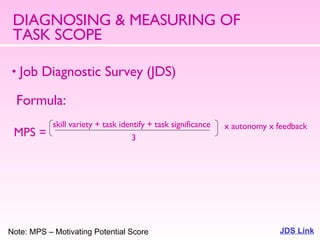
DIAGNOSING & MEASURING OF TASK SCOPE Job Diagnostic Survey (JDS)  Formula:  Note: MPS – Motivating Potential Score JDS Link MPS = skill variety + task identify + task significance 3 x autonomy x feedback
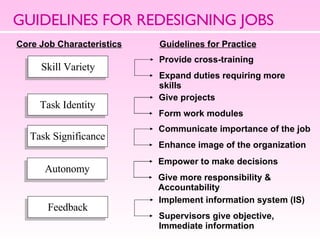
GUIDELINES FOR REDESIGNING JOBS Core Job Characteristics Guidelines for Practice Skill Variety Provide cross-training Expand duties requiring more  skills Task Identity Give projects Form work modules Task Significance Communicate importance of the job Enhance image of the organization Autonomy Empower to make decisions Give more responsibility &  Accountability Feedback Implement information system (IS) Supervisors give objective, Immediate information
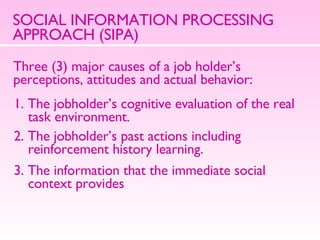
SOCIAL INFORMATION PROCESSING APPROACH (SIPA) Three (3) major causes of a job holder’s perceptions, attitudes and actual behavior: 1. The jobholder’s cognitive evaluation of the real task environment. 2. The jobholder’s past actions including reinforcement history learning. 3. The information that the immediate social context provides
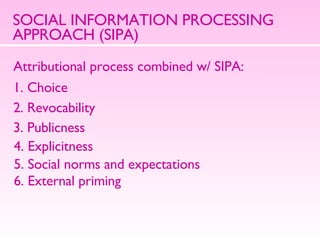
SOCIAL INFORMATION PROCESSING APPROACH (SIPA) Attributional process combined w/ SIPA:  1. Choice 2. Revocability 3. Publicness 4. Explicitness 5. Social norms and expectations 6. External priming
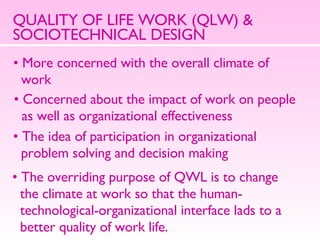
QUALITY OF LIFE WORK (QLW) & SOCIOTECHNICAL DESIGN More concerned with the overall climate of  work Concerned about the impact of work on people  as well as organizational effectiveness  The idea of participation in organizational  problem solving and decision making The overriding purpose of QWL is to change  the climate at work so that the human- technological-organizational interface lads to a  better quality of work life.
QUALITY OF LIFE WORK (QLW) & SOCIOTECHNICAL DESIGN Sociotechnical approach is concerned with the  interface and harmony between  personal, social  and technological functioning. It translates into the redesign of technological  process and the formation of autonomous, self- regulating work groups or teams.
GOAL SETTING
GOAL SETTING Involves establishing specific, measurable and  time targeted objectives It is an effective tool for making progress by  ensuring that participants are clearly aware of  what is expected from them, if an objective is to  be achieved.  On a personal level, setting goals is a process  that allows people to specify then work towards  their own objectives - most commonly with  financial or career-based goals.
GOAL SETTING It should be tangible, specific, realistic and have a  time targeted for completion.  Goal setting also requires motivation &  commitments Goals provide a sense of direction and purpose  Goals provide a sense of direction and purpose
GOAL SETTING Four mechanisms through which goal setting is able to affect individual performance:  1. Goals focus attention towards goal-relevant  activities and away from goal-irrelevant activities.  2. Goals serve as an energizer; higher goals will induce greater effort while low goals induce lesser effort.
GOAL SETTING 3. Goals affect persistence; constraints with regard to resources will affect work pace.  4. Goals activate cognitive knowledge and strategies which allows employees to cope with the situation at hand.
GOAL SETTING Moderators which indicate the success of goal setting: 1. Goal Commitment People will perform better when they are committed to achieve certain goals. Goal commitment is dependent of :  The importance of the expected outcomes of goal attainment and;  b. Self-efficacy; ones belief that (s) he is able to achieve the goals.
GOAL SETTING 2. Feedback  Keep track of performance to allow employees to see how effective they have been in attaining the goals. Without proper feedback channels it is impossible to adapt or adjust to the required behavior.  3. Task complexity More difficult goals require more cognitive strategies and well developed skills. The more difficult the tasks ahead, a smaller group of people will possess the necessary skills and strategies. From an organizational perspective it is thereby more difficult to successfully attain more difficult goals since resources become more scarce.
GOAL SETTING 4.  Employee Motivation  The more employees are motivated, the more they are stimulated and interested in accepting goals.  5.  Macro-economical characteristics The position of the economy in the conjucture puts pressure or simply relieves the organization. This means that some goals are easier set in specific macro-economical surroundings. Depression is for instance the least successful conjucturial phase for goal setting.
GOAL SETTING Guidelines to improve performance through goal setting:  1. Specific goals 2. Difficult, challenging goals 3. “Owned” and accepted goals 4. Objective, timely feedback about progress toward goals
GOAL SETTING Practical limitations in goal setting: 1. Difficult goals increases the level of risk managers and employees are willing to take 2. Inhibited subjects from helping others who were requesting assistance, which has implications for teamwork 3. Difficult goals may lead to stress, put perpetual ceiling on performance, cause the employees to ignore non-goal areas 4. Encourage short-range thinking, dishonesty or cheating.
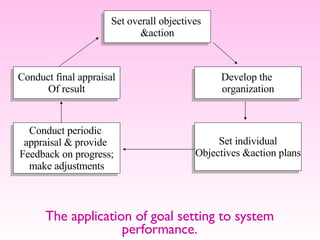
The application of goal setting to system performance. Set overall objectives  &action Develop the  organization Set individual Objectives &action plans Conduct final appraisal Of result Conduct periodic  appraisal & provide  Feedback on progress; make adjustments
Thank You!

HBO - Job Design & Goal Setting

  • 1.
    Motivating Performance ThroughJob Design & Goal Setting Presented by: For-Ian V. Sandoval with Team LSPU
  • 2.
    LEARNING OBJECTIVES Discuss the background of job design as an applied area of work motivation Define the various techniques and approaches to job design Explain goal-setting theory and guidelines from research Describe the application of goal setting to overall systems performance
  • 3.
  • 4.
    JOB DESIGN Workarrangement (or rearrangement) aimed at reducing or overcoming job dissatisfaction and employee alienation arising from repetitive and mechanistic tasks. Through job design, organizations try to raise productivity levels by offering non-monetary rewards such as greater satisfaction from a sense of personal achievement in meeting the increased challenge and responsibility of one's work.
  • 5.
    JOB DESIGN Essentialto reduced job stress, motivation can be enhanced, and satisfaction of employees and their performance can be improved that organizations can effectively compete in the global market.
  • 6.
    Various techniques andapproaches to job design. JOB DESIGN Job Engineering Job Enrichment Job Enlargement Job Rotation Job Simplification Social Information Processing Quality of Work Life
  • 7.
    JOB ENGINEERING Scientificmanagement / industrial approach concerned with product, process, and design tool design; plant layout; standard operating procedures; wok measurement and standards; worker methods; and human-machine interactions.
  • 8.
    JOB ENLARGEMENT Jobdesign technique in which the number of tasks associated with a job is increased (and appropriate training provided) to add greater variety to activities, thus reducing monotony. It is a horizontal restructuring method in that the job is enlarged by adding related tasks. Job enlargement may also result in greater workforce flexibility.
  • 9.
    JOB ROTATION Jobdesign technique in which employees are moved between two or more jobs in a planned manner. The objective is to expose the employees to different experiences and wider variety of skills to enhance job satisfaction and to cross-train them.
  • 10.
    JOB SIMPLIFICATION Jobdesign technique in which jobs are broken into relatively simple tasks. It aims at greater productivity through reduced application of mental and/or physical effort.
  • 11.
    JOB ENRICHMENT Jobdesign technique that is a variation on job enlargement, job rotation and job simplification concept. Job enrichment adds new sources of job satisfaction by increasing the level of responsibility of the employee. It is a vertical restructuring method in that it gives the employee additional authority, autonomy, and control over the way the job is accomplished. Also called job enhancement or vertical job expansion.
  • 12.
    The Hackman-Oldham corejob characteristics approach to task design. Significance of the Task Core Job Characteristics Variety of Skill Identity of the task Autonomy Feedback Critical Psychological State Experienced Meaningfulness of the work Experienced responsibility for work outcomes Knowledge of results From work activities Personal & Work Outcomes High internal work motivation High quality work performance High satisfaction with the work Low turnover & absenteeism Moderated by employee growth need strength
  • 13.
    DIAGNOSING & MEASURINGOF TASK SCOPE Job Diagnostic Survey (JDS) Formula: Note: MPS – Motivating Potential Score JDS Link MPS = skill variety + task identify + task significance 3 x autonomy x feedback
  • 14.
    GUIDELINES FOR REDESIGNINGJOBS Core Job Characteristics Guidelines for Practice Skill Variety Provide cross-training Expand duties requiring more skills Task Identity Give projects Form work modules Task Significance Communicate importance of the job Enhance image of the organization Autonomy Empower to make decisions Give more responsibility & Accountability Feedback Implement information system (IS) Supervisors give objective, Immediate information
  • 15.
    SOCIAL INFORMATION PROCESSINGAPPROACH (SIPA) Three (3) major causes of a job holder’s perceptions, attitudes and actual behavior: 1. The jobholder’s cognitive evaluation of the real task environment. 2. The jobholder’s past actions including reinforcement history learning. 3. The information that the immediate social context provides
  • 16.
    SOCIAL INFORMATION PROCESSINGAPPROACH (SIPA) Attributional process combined w/ SIPA: 1. Choice 2. Revocability 3. Publicness 4. Explicitness 5. Social norms and expectations 6. External priming
  • 17.
    QUALITY OF LIFEWORK (QLW) & SOCIOTECHNICAL DESIGN More concerned with the overall climate of work Concerned about the impact of work on people as well as organizational effectiveness The idea of participation in organizational problem solving and decision making The overriding purpose of QWL is to change the climate at work so that the human- technological-organizational interface lads to a better quality of work life.
  • 18.
    QUALITY OF LIFEWORK (QLW) & SOCIOTECHNICAL DESIGN Sociotechnical approach is concerned with the interface and harmony between personal, social and technological functioning. It translates into the redesign of technological process and the formation of autonomous, self- regulating work groups or teams.
  • 19.
  • 20.
    GOAL SETTING Involvesestablishing specific, measurable and time targeted objectives It is an effective tool for making progress by ensuring that participants are clearly aware of what is expected from them, if an objective is to be achieved. On a personal level, setting goals is a process that allows people to specify then work towards their own objectives - most commonly with financial or career-based goals.
  • 21.
    GOAL SETTING Itshould be tangible, specific, realistic and have a time targeted for completion. Goal setting also requires motivation & commitments Goals provide a sense of direction and purpose Goals provide a sense of direction and purpose
  • 22.
    GOAL SETTING Fourmechanisms through which goal setting is able to affect individual performance: 1. Goals focus attention towards goal-relevant activities and away from goal-irrelevant activities. 2. Goals serve as an energizer; higher goals will induce greater effort while low goals induce lesser effort.
  • 23.
    GOAL SETTING 3.Goals affect persistence; constraints with regard to resources will affect work pace. 4. Goals activate cognitive knowledge and strategies which allows employees to cope with the situation at hand.
  • 24.
    GOAL SETTING Moderatorswhich indicate the success of goal setting: 1. Goal Commitment People will perform better when they are committed to achieve certain goals. Goal commitment is dependent of : The importance of the expected outcomes of goal attainment and; b. Self-efficacy; ones belief that (s) he is able to achieve the goals.
  • 25.
    GOAL SETTING 2.Feedback Keep track of performance to allow employees to see how effective they have been in attaining the goals. Without proper feedback channels it is impossible to adapt or adjust to the required behavior. 3. Task complexity More difficult goals require more cognitive strategies and well developed skills. The more difficult the tasks ahead, a smaller group of people will possess the necessary skills and strategies. From an organizational perspective it is thereby more difficult to successfully attain more difficult goals since resources become more scarce.
  • 26.
    GOAL SETTING 4. Employee Motivation The more employees are motivated, the more they are stimulated and interested in accepting goals. 5. Macro-economical characteristics The position of the economy in the conjucture puts pressure or simply relieves the organization. This means that some goals are easier set in specific macro-economical surroundings. Depression is for instance the least successful conjucturial phase for goal setting.
  • 27.
    GOAL SETTING Guidelinesto improve performance through goal setting: 1. Specific goals 2. Difficult, challenging goals 3. “Owned” and accepted goals 4. Objective, timely feedback about progress toward goals
  • 28.
    GOAL SETTING Practicallimitations in goal setting: 1. Difficult goals increases the level of risk managers and employees are willing to take 2. Inhibited subjects from helping others who were requesting assistance, which has implications for teamwork 3. Difficult goals may lead to stress, put perpetual ceiling on performance, cause the employees to ignore non-goal areas 4. Encourage short-range thinking, dishonesty or cheating.
  • 29.
    The application ofgoal setting to system performance. Set overall objectives &action Develop the organization Set individual Objectives &action plans Conduct final appraisal Of result Conduct periodic appraisal & provide Feedback on progress; make adjustments
  • 30.