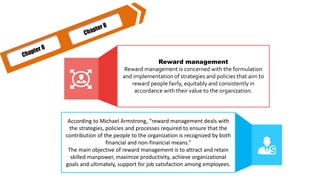
Reward management
Reward management is concerned with the formulation
and implementation of strategies and policies that aim to
reward people fairly, equitably and consistently in
accordance with their value to the organization.
According to Michael Armstrong, “reward management deals with
the strategies, policies and processes required to ensure that the
contribution of the people to the organization is recognized by both
financial and non-financial means.”
The main objective of reward management is to attract and retain
skilled manpower, maximize productivity, achieve organizational
goals and ultimately, support for job satisfaction among employees.
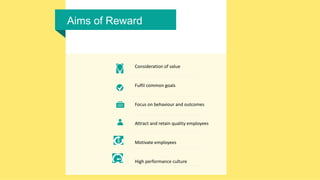
Aims of Reward
Management
Consideration of value
Fulfil common goals
Focus on behaviour and outcomes
Attract and retain quality employees
Motivate employees
High performance culture
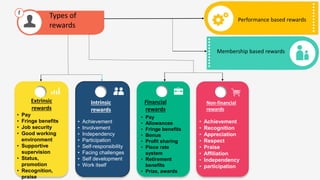
Types of
rewards
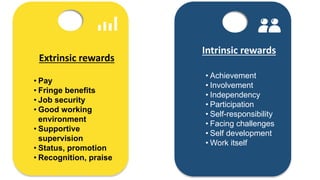
• Pay
• Fringe benefits
• Job security
• Good working
environment
• Supportive
supervision
• Status,
promotion
• Recognition,
praise
Extrinsic
rewards
• Achievement
• Involvement
• Independency
• Participation
• Self-responsibility
• Facing challenges
• Self development
• Work itself
Intrinsic
rewards
• Pay
• Allowances
• Fringe benefits
• Bonus
• Profit sharing
• Piece rate
system
• Retirement
benefits
• Prize, awards
Financial
rewards
• Achievement
• Recognition
• Appreciation
• Respect
• Praise
• Affiliation
• Independency
• participation
Non-financial
rewards
Performance based rewards
Membership based rewards
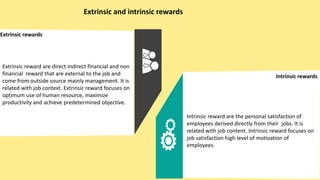
Extrinsic and intrinsic rewards
Extrinsic rewards
Intrinsic rewards
Extrinsic reward are direct indirect financial and non
financial reward that are external to the job and
come from outside source mainly management. It is
related with job context. Extrinsic reward focuses on
optimum use of human resource, maximize
productivity and achieve predetermined objective.
Intrinsic reward are the personal satisfaction of
employees derived directly from their jobs. It is
related with job content. Intrinsic reward focuses on
job satisfaction high level of motivation of
employees.
Extrinsic rewards
• Achievement
• Involvement
• Independency
• Participation
• Self-responsibility
• Facing challenges
• Self development
• Work itself
Intrinsic rewards
• Pay
• Fringe benefits
• Job security
• Good working
environment
• Supportive
supervision
• Status, promotion
• Recognition, praise
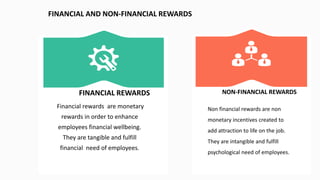
FINANCIAL AND NON-FINANCIAL REWARDS
FINANCIAL REWARDS
Financial rewards are monetary
rewards in order to enhance
employees financial wellbeing.
They are tangible and fulfill
financial need of employees.
NON-FINANCIAL REWARDS
Non financial rewards are non
monetary incentives created to
add attraction to life on the job.
They are intangible and fulfill
psychological need of employees.
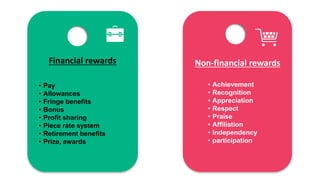
• Pay
• Allowances
• Fringe benefits
• Bonus
• Profit sharing
• Piece rate system
• Retirement benefits
• Prize, awards
Financial rewards
• Achievement
• Recognition
• Appreciation
• Respect
• Praise
• Affiliation
• Independency
• participation
Non-financial rewards
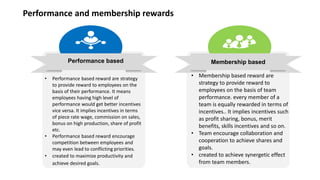
Performance based
Performance and membership rewards
Membership based
• Performance based reward are strategy
to provide reward to employees on the
basis of their performance. It means
employees having high level of
performance would get better incentives
vice versa. It implies incentives in terms
of piece rate wage, commission on sales,
bonus on high production, share of profit
etc.
• Performance based reward encourage
competition between employees and
may even lead to conflicting priorities.
• created to maximize productivity and
achieve desired goals.
• Membership based reward are
strategy to provide reward to
employees on the basis of team
performance. every member of a
team is equally rewarded in terms of
incentives.. It implies incentives such
as profit sharing, bonus, merit
benefits, skills incentives and so on.
• Team encourage collaboration and
cooperation to achieve shares and
goals.
• created to achieve synergetic effect
from team members.
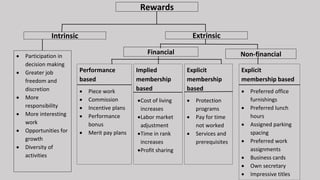
Performance
based
 Piece work
 Commission
 Incentive plans
 Performance
bonus
 Merit pay plans
Implied
membership
based
Cost of living
increases
Labor market
adjustment
Time in rank
increases
Profit sharing
Explicit
membership
based
 Protection
programs
 Pay for time
not worked
 Services and
prerequisites
Explicit
membership based
 Preferred office
furnishings
 Preferred lunch
hours
 Assigned parking
spacing
 Preferred work
assignments
 Business cards
 Own secretary
 Impressive titles
Financial Non-financial Participation in
decision making
 Greater job
freedom and
discretion
 More
responsibility
 More interesting
work
 Opportunities for
growth
 Diversity of
activities
Rewards
Intrinsic Extrinsic
• Service Benefits
oPersonal Service, Family service
• Other job related Benefits
oFlexible work schedule, Cafeteria Benefits

Reward management

  • 1.
    Reward management Reward managementis concerned with the formulation and implementation of strategies and policies that aim to reward people fairly, equitably and consistently in accordance with their value to the organization. According to Michael Armstrong, “reward management deals with the strategies, policies and processes required to ensure that the contribution of the people to the organization is recognized by both financial and non-financial means.” The main objective of reward management is to attract and retain skilled manpower, maximize productivity, achieve organizational goals and ultimately, support for job satisfaction among employees.
  • 2.
    Aims of Reward Management Considerationof value Fulfil common goals Focus on behaviour and outcomes Attract and retain quality employees Motivate employees High performance culture
  • 3.
    Types of rewards • Pay •Fringe benefits • Job security • Good working environment • Supportive supervision • Status, promotion • Recognition, praise Extrinsic rewards • Achievement • Involvement • Independency • Participation • Self-responsibility • Facing challenges • Self development • Work itself Intrinsic rewards • Pay • Allowances • Fringe benefits • Bonus • Profit sharing • Piece rate system • Retirement benefits • Prize, awards Financial rewards • Achievement • Recognition • Appreciation • Respect • Praise • Affiliation • Independency • participation Non-financial rewards Performance based rewards Membership based rewards
  • 4.
    Extrinsic and intrinsicrewards Extrinsic rewards Intrinsic rewards Extrinsic reward are direct indirect financial and non financial reward that are external to the job and come from outside source mainly management. It is related with job context. Extrinsic reward focuses on optimum use of human resource, maximize productivity and achieve predetermined objective. Intrinsic reward are the personal satisfaction of employees derived directly from their jobs. It is related with job content. Intrinsic reward focuses on job satisfaction high level of motivation of employees.
  • 5.
    Extrinsic rewards • Achievement •Involvement • Independency • Participation • Self-responsibility • Facing challenges • Self development • Work itself Intrinsic rewards • Pay • Fringe benefits • Job security • Good working environment • Supportive supervision • Status, promotion • Recognition, praise
  • 6.
    FINANCIAL AND NON-FINANCIALREWARDS FINANCIAL REWARDS Financial rewards are monetary rewards in order to enhance employees financial wellbeing. They are tangible and fulfill financial need of employees. NON-FINANCIAL REWARDS Non financial rewards are non monetary incentives created to add attraction to life on the job. They are intangible and fulfill psychological need of employees.
  • 7.
    • Pay • Allowances •Fringe benefits • Bonus • Profit sharing • Piece rate system • Retirement benefits • Prize, awards Financial rewards • Achievement • Recognition • Appreciation • Respect • Praise • Affiliation • Independency • participation Non-financial rewards
  • 8.
    Performance based Performance andmembership rewards Membership based • Performance based reward are strategy to provide reward to employees on the basis of their performance. It means employees having high level of performance would get better incentives vice versa. It implies incentives in terms of piece rate wage, commission on sales, bonus on high production, share of profit etc. • Performance based reward encourage competition between employees and may even lead to conflicting priorities. • created to maximize productivity and achieve desired goals. • Membership based reward are strategy to provide reward to employees on the basis of team performance. every member of a team is equally rewarded in terms of incentives.. It implies incentives such as profit sharing, bonus, merit benefits, skills incentives and so on. • Team encourage collaboration and cooperation to achieve shares and goals. • created to achieve synergetic effect from team members.
  • 9.
    Performance based  Piece work Commission  Incentive plans  Performance bonus  Merit pay plans Implied membership based Cost of living increases Labor market adjustment Time in rank increases Profit sharing Explicit membership based  Protection programs  Pay for time not worked  Services and prerequisites Explicit membership based  Preferred office furnishings  Preferred lunch hours  Assigned parking spacing  Preferred work assignments  Business cards  Own secretary  Impressive titles Financial Non-financial Participation in decision making  Greater job freedom and discretion  More responsibility  More interesting work  Opportunities for growth  Diversity of activities Rewards Intrinsic Extrinsic
  • 10.
    • Service Benefits oPersonalService, Family service • Other job related Benefits oFlexible work schedule, Cafeteria Benefits