Job analysis
Course: MBA SEM 2
Subject: Human Resource
Management
Unit 2
WHAT IS JOB ANALYSIS?
 The procedure for determining the
duties and skill requirements of a job
and the kind of person who should be
hired for it.
 Job analysis produces information used
for writing job descriptions and job
specifications.
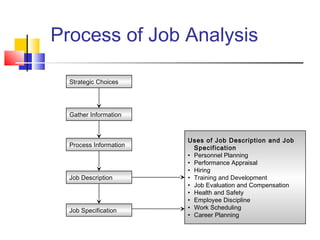
Process of Job Analysis
Gather Information
Process Information
Job Description
Job Specification
Strategic Choices
Uses of Job Description and Job
Specification
• Personnel Planning
• Performance Appraisal
• Hiring
• Training and Development
• Job Evaluation and Compensation
• Health and Safety
• Employee Discipline
• Work Scheduling
• Career Planning
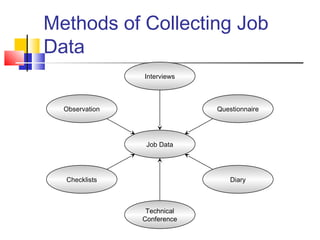
Methods of Collecting Job
Data
Observation Questionnaire
Checklists Diary
Interviews
Job Data
Technical
Conference
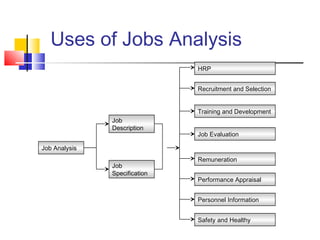
Uses of Jobs Analysis
Job Analysis
Job
Description
Job
Specification
Job Evaluation
Remuneration
Training and Development
Recruitment and Selection
HRP
Performance Appraisal
Personnel Information
Safety and Healthy
JOB DESCRIPTION
 It is a written record of the duties,
responsibilities and requirements of a
particular job.
 It is a statement describing the job in
such terms as its title, location, duties,
working conditions and hazards.
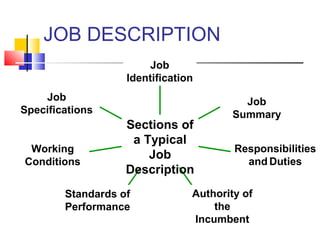
JOB DESCRIPTION
Job
Identification
Job
Summary
Responsibilities
and Duties
Authority of
the
Incumbent
Standards of
Performance
Working
Conditions
Job
Specifications
Sections of
a Typical
Job
Description
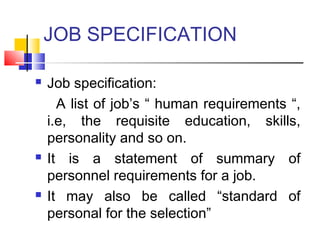
JOB SPECIFICATION
 Job specification:
A list of job’s “ human requirements “,
i.e, the requisite education, skills,
personality and so on.
 It is a statement of summary of
personnel requirements for a job.
 It may also be called “standard of
personal for the selection”
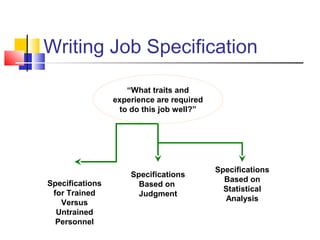
Writing Job Specification
Specifications
for Trained
Versus
Untrained
Personnel
Specifications
Based on
Statistical
Analysis
“What traits and
experience are required
to do this job well?”
Specifications
Based on
Judgment
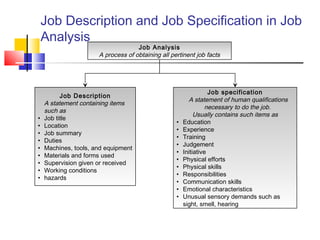
Job Description and Job Specification in Job
Analysis
Job Description
A statement containing items
such as
• Job title
• Location
• Job summary
• Duties
• Machines, tools, and equipment
• Materials and forms used
• Supervision given or received
• Working conditions
• hazards
Job specification
A statement of human qualifications
necessary to do the job.
Usually contains such items as
• Education
• Experience
• Training
• Judgement
• Initiative
• Physical efforts
• Physical skills
• Responsibilities
• Communication skills
• Emotional characteristics
• Unusual sensory demands such as
sight, smell, hearing
Job Analysis
A process of obtaining all pertinent job facts
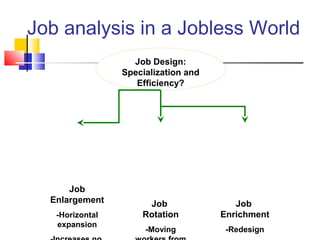
Job analysis in a Jobless World
Job
Enlargement
-Horizontal
expansion
Job
Enrichment
-Redesign
Job Design:
Specialization and
Efficiency?
Job
Rotation
-Moving
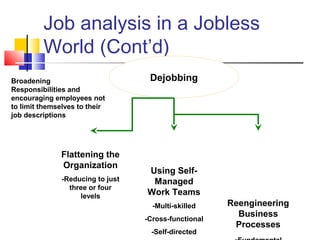
Job analysis in a Jobless
World (Cont’d)
Flattening the
Organization
-Reducing to just
three or four
levels
Reengineering
Business
Processes
Dejobbing
Using Self-
Managed
Work Teams
-Multi-skilled
-Cross-functional
-Self-directed
Broadening
Responsibilities and
encouraging employees not
to limit themselves to their
job descriptions
JOB DESIGN
 Job design is an attempt to create a match
between job requirements and human
attributes.
 Milkovich and Boudreau defined job design
as, “Job design integrates work content
(tasks, functions, and relationships), the
rewards (extrinsic and intrinsic) and the
qualifications required (skills, knowledge,
abilities) for each job in a way that meets the
needs of employees and the organization”.
Methods of Job Design
A) Job Simplification:
In it, the complete job is broken down into
small subparts; this is done so that
employee can do these jobs without
much specialized training
B) Job Rotation:
Another technique designed to enhance
employee motivation is job rotation, or
periodically assigning employees to
alternating jobs or tasks.
C) Job Enlargement:
Increasing employee’s satisfaction with routine jobs
is job enlargement, or increasing the number of
tasks performed (i.e. increasing the scope of the
job).
D) Job Enrichment:
If the job is designed in such a manner that it
becomes more interesting and challenging to the
job performer and provides him opportunities for
achievement, recognition, responsibility,
advancement and growth, the job itself becomes a
source of motivation to the individual
Bibliography
 http://www.whatishumanresource.com
 Human Resource and Personnel
Management- K. Aswathappa, Tata
McGraw Hill

Mba ii hrm u-2.2 job analysis

  • 1.
    Job analysis Course: MBASEM 2 Subject: Human Resource Management Unit 2
  • 2.
    WHAT IS JOBANALYSIS?  The procedure for determining the duties and skill requirements of a job and the kind of person who should be hired for it.  Job analysis produces information used for writing job descriptions and job specifications.
  • 3.
    Process of JobAnalysis Gather Information Process Information Job Description Job Specification Strategic Choices Uses of Job Description and Job Specification • Personnel Planning • Performance Appraisal • Hiring • Training and Development • Job Evaluation and Compensation • Health and Safety • Employee Discipline • Work Scheduling • Career Planning
  • 4.
    Methods of CollectingJob Data Observation Questionnaire Checklists Diary Interviews Job Data Technical Conference
  • 5.
    Uses of JobsAnalysis Job Analysis Job Description Job Specification Job Evaluation Remuneration Training and Development Recruitment and Selection HRP Performance Appraisal Personnel Information Safety and Healthy
  • 6.
    JOB DESCRIPTION  Itis a written record of the duties, responsibilities and requirements of a particular job.  It is a statement describing the job in such terms as its title, location, duties, working conditions and hazards.
  • 7.
    JOB DESCRIPTION Job Identification Job Summary Responsibilities and Duties Authorityof the Incumbent Standards of Performance Working Conditions Job Specifications Sections of a Typical Job Description
  • 8.
    JOB SPECIFICATION  Jobspecification: A list of job’s “ human requirements “, i.e, the requisite education, skills, personality and so on.  It is a statement of summary of personnel requirements for a job.  It may also be called “standard of personal for the selection”
  • 9.
    Writing Job Specification Specifications forTrained Versus Untrained Personnel Specifications Based on Statistical Analysis “What traits and experience are required to do this job well?” Specifications Based on Judgment
  • 10.
    Job Description andJob Specification in Job Analysis Job Description A statement containing items such as • Job title • Location • Job summary • Duties • Machines, tools, and equipment • Materials and forms used • Supervision given or received • Working conditions • hazards Job specification A statement of human qualifications necessary to do the job. Usually contains such items as • Education • Experience • Training • Judgement • Initiative • Physical efforts • Physical skills • Responsibilities • Communication skills • Emotional characteristics • Unusual sensory demands such as sight, smell, hearing Job Analysis A process of obtaining all pertinent job facts
  • 11.
    Job analysis ina Jobless World Job Enlargement -Horizontal expansion Job Enrichment -Redesign Job Design: Specialization and Efficiency? Job Rotation -Moving
  • 12.
    Job analysis ina Jobless World (Cont’d) Flattening the Organization -Reducing to just three or four levels Reengineering Business Processes Dejobbing Using Self- Managed Work Teams -Multi-skilled -Cross-functional -Self-directed Broadening Responsibilities and encouraging employees not to limit themselves to their job descriptions
  • 13.
    JOB DESIGN  Jobdesign is an attempt to create a match between job requirements and human attributes.  Milkovich and Boudreau defined job design as, “Job design integrates work content (tasks, functions, and relationships), the rewards (extrinsic and intrinsic) and the qualifications required (skills, knowledge, abilities) for each job in a way that meets the needs of employees and the organization”.
  • 14.
    Methods of JobDesign A) Job Simplification: In it, the complete job is broken down into small subparts; this is done so that employee can do these jobs without much specialized training B) Job Rotation: Another technique designed to enhance employee motivation is job rotation, or periodically assigning employees to alternating jobs or tasks.
  • 15.
    C) Job Enlargement: Increasingemployee’s satisfaction with routine jobs is job enlargement, or increasing the number of tasks performed (i.e. increasing the scope of the job). D) Job Enrichment: If the job is designed in such a manner that it becomes more interesting and challenging to the job performer and provides him opportunities for achievement, recognition, responsibility, advancement and growth, the job itself becomes a source of motivation to the individual
  • 16.
    Bibliography  http://www.whatishumanresource.com  HumanResource and Personnel Management- K. Aswathappa, Tata McGraw Hill