

Human Resources Planning
The process of forecasting an organisation’s
future demand for, and supply of the right type of
people in the right number, in right place at right
time.
It is a sub-system in the total org. Planning.
It tries to assess human resources requirements in
Advance and keeping in view the production,
Market fluctuations, demand/supply forecast etc.
In the background
Need for HRP
Replacement of persons
Labour Turnover
Expansion Plans
Tech. Changes
Assessing Needs
OBJECTIVES / IMPORTANCE
OF HRP
Forecast personnel requirements
Cope with the changes
Use existing manpower productivity
Promote employees in a systematic manner
Creating high talented personnel
Protection of weaker sections
International strategies
Resistance to change.
Factors influencing the HRP
•Type and Strategy of Organization.
•Organisation Growth Cycles and Planning.
•Environmental Uncertainties.
•Time Horizon.
•Type and Quality of Forecasting
information.
•Nature of job being filled.
•Off loading the work.
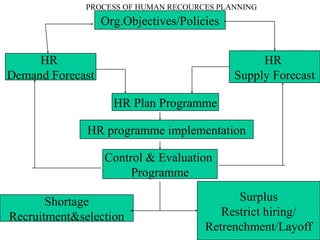
PROCESS OF HUMAN RECOURCES PLANNING
Org.Objectives/Policies
HR
Demand Forecast
HR Plan Programme
HR programme implementation
HR
Supply Forecast
Control & Evaluation
Programme
Shortage
Recruitment&selection
Surplus
Restrict hiring/
Retrenchment/Layoff
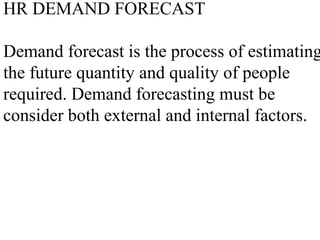
HR DEMAND FORECAST
Demand forecast is the process of estimating
the future quantity and quality of people
required. Demand forecasting must be
consider both external and internal factors.
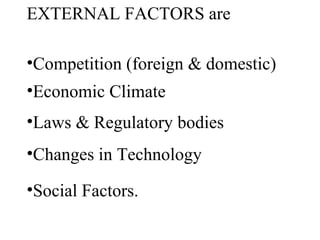
EXTERNAL FACTORS are
•Competition (foreign & domestic)
•Economic Climate
•Laws & Regulatory bodies
•Changes in Technology
•Social Factors.
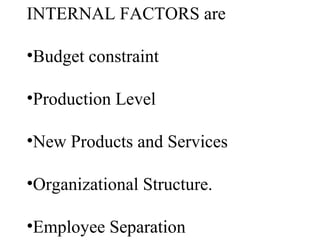
INTERNAL FACTORS are
•Budget constraint
•Production Level
•New Products and Services
•Organizational Structure.
•Employee Separation
Demand Forecast may be
Long-range or Short range.
Long-Range includes
•Strategic Plans
•Demography
•The economy
•Technological trends
•Social Trends
Strategic plans: If the mgt. Wants to split its Org
or wants to expand or taking new assignments i.e.
entering into another type of production should
plan for new professionals.
Demography: This related to fluctuations in
births & death rates of a particular country, it may
effect the long term policies.
The Economy: Economic conditions in the count
Technological Trends: Advances in tech. Have
effects the demand forecasting.
Social Trends: The impact of the social customs
Political Systems have had major effects.
Forecasting Techniques
•Managerial Judgement
•Ratio-Trend Analysis
•Work-study techniques
•Delphi technique
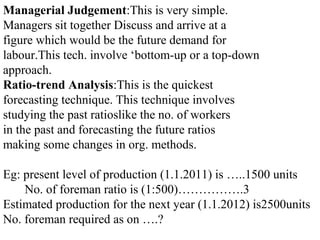
Managerial Judgement:This is very simple.
Managers sit together Discuss and arrive at a
figure which would be the future demand for
labour.This tech. involve ‘bottom-up or a top-down
approach.
Ratio-trend Analysis:This is the quickest
forecasting technique. This technique involves
studying the past ratioslike the no. of workers
in the past and forecasting the future ratios
making some changes in org. methods.
Eg: present level of production (1.1.2011) is …..1500 units
No. of foreman ratio is (1:500)…………….3
Estimated production for the next year (1.1.2012) is2500units
No. foreman required as on ….?
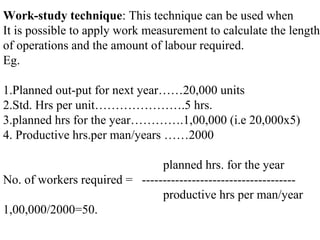
Work-study technique: This technique can be used when
It is possible to apply work measurement to calculate the length
of operations and the amount of labour required.
Eg.
1.Planned out-put for next year……20,000 units
2.Std. Hrs per unit………………….5 hrs.
3.planned hrs for the year………….1,00,000 (i.e 20,000x5)
4. Productive hrs.per man/years ……2000
planned hrs. for the year
No. of workers required = -------------------------------------
productive hrs per man/year
1,00,000/2000=50.
Delphi Technique: Named after the ancient
Greek prophet at the city of Delphi. In this
method group of experts, usually managers
estimates the personnel needs. The HRP experts
acts as a intermediaries, summarise the various
responses and report the findings back to the
experts. The experts are surveyed again after
they receive feedback. Summaries and surveys
repeated again until they reach a common
opinion.
HR SUPPLY FORCASTING
After demand forecasting, next logical step for
the manager is to determine whether it will be abl
to procure the required no. of personnel and the
sources of such procurement. This Information
provided by the supply forecasting.
Supply forecasting measures the no. of people like
to available from within and out side of the org.
after considering absenteeism, internal movement
promotions, wastage and change in working hrs.
Supply analysis covers:
•Existing Human Resources
•Internal Sources of Supply,External Sources of S
Supply analysis covers:
•Existing Human Resources
•Internal Sources of Supply,
•External Sources of Supply
Existing HR or Inventory:
Inventory can be prepared basing on the employee skill &
abilities. They are like
Personal Data : Ages, Sex, Marital status.
Skills : Education, Job, Experience.
Spl.qualifications : any spl. achievements of
membership in any
professional bodies.
Salary & Job History : Present and past salary and
increments in pay.
Company data : Benefits, seniority, retirement info.
Capacity of Individual : like dept. tests interviews.
Spl. Preferance of Individual: like geographic location,
Internal sources of Supply:
For internal sources of supply we have to Consider like:
Voluntary retirements
Retrenchments
Dismissals
Lay-offs
Disablements due to accidents
So to calculate about turnover rate
No.of employees entered in the org./Actual employees x
100.
The internal source includes trg. Facilities, salary levels,
Benefits and individual development.
External sources:
Local and National Factors.
Local: Local populations,
Local un-employment Level,
availability of employees in part-time, out-put from
local educational institutions,
Availability of manpower with required skills &
Qualifications,
local housing,
reservations.
National Level: Trends in growth of working
Population, out-come from technical, professional and
educational institutions in the country, Social security
measures(un-employment benefits Retirement
benefits) impact of government rules and regulations
JOB ANALYSIS
Jobs are very important to individual – jobs are
Help for standard of living – place of residence-
Status and org. point of view its important to
reach or achieve their objectives or targets.
Jobs are not fixed they are subject to change
Due to tech. change.
JOB ANALYSIS
JOB TERMINOLOGY
•TASK
•DUTY
•POSITION
•TASK
It is an identifiable work activity carried out for a
specific purpose.Eg: counseling sessions.
•DUTY
Consisting of several tasks that are performed by an
individual.
•POSITION
Is nothing but collection of Tasks and Duties
performed by the employee.
Job Analysis means:
•The process of gathering information about
the job.
•It is a detailed examination of a specific job
•It is a systematic investigation of the tasks,
duties and responsibilities necessary to do a job.
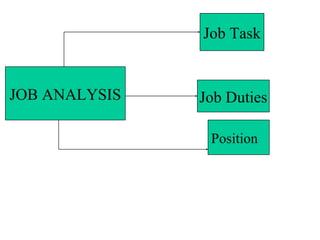
JOB ANALYSIS
Job Task
Job Duties
Position
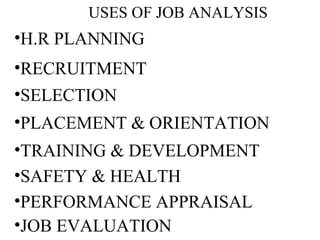
USES OF JOB ANALYSIS
•H.R PLANNING
•RECRUITMENT
•SELECTION
•PLACEMENT & ORIENTATION
•TRAINING & DEVELOPMENT
•SAFETY & HEALTH
•PERFORMANCE APPRAISAL
•JOB EVALUATION
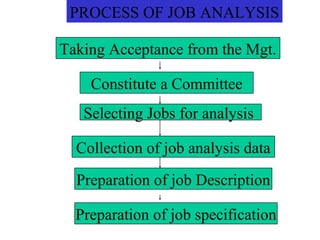
PROCESS OF JOB ANALYSIS
Taking Acceptance from the Mgt.
Constitute a Committee
Selecting Jobs for analysis
Collection of job analysis data
Preparation of job Description
Preparation of job specification
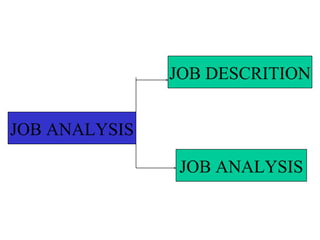
JOB ANALYSIS
JOB DESCRITION
JOB ANALYSIS
Job description is nothing but a written
Statement of the tasks & duties performed,
material & tools used, working conditions and
relations with other jobs.
Contents of Job Description are:
Job title – Location of the Job – Equipment
Worked with – Designation of immediate
Supervisor & subordinate – Salary level –
Conditions of work – T&D facilities, Promotion
Chances.
Job description is an organised, factual statement
Of the duties and responsibilities of a specific job
It should tell what the job holder does – how it is
Done – under what conditions it is done.
Uses of J.D: It can me used to orient new emp.
Towards basic duties & responsibilities.
It can be used for job evaluation.
Job specification: It is nothing but a written
Statement of the minimum qualification
required for the successful performance of a
Job. It specifies the qualifications, experience,
Skills, knowledge and abilities to perform a
Particular job
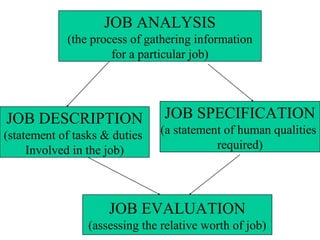
JOB ANALYSIS
(the process of gathering information
for a particular job)
JOB DESCRIPTION
(statement of tasks & duties
Involved in the job)
JOB SPECIFICATION
(a statement of human qualities
required)
JOB EVALUATION
(assessing the relative worth of job)
METHODS OF JOB ANALYSIS
•INTERVIEW
•OBSERVATION
•QUESTIONNAIRE METHOD
•PANEL OF EXPERTS
•DIARY METHOD

Hrp

  • 1.
  • 2.
    The process offorecasting an organisation’s future demand for, and supply of the right type of people in the right number, in right place at right time. It is a sub-system in the total org. Planning. It tries to assess human resources requirements in Advance and keeping in view the production, Market fluctuations, demand/supply forecast etc. In the background
  • 3.
    Need for HRP Replacementof persons Labour Turnover Expansion Plans Tech. Changes Assessing Needs
  • 4.
  • 5.
    Forecast personnel requirements Copewith the changes Use existing manpower productivity Promote employees in a systematic manner Creating high talented personnel Protection of weaker sections International strategies Resistance to change.
  • 6.
    Factors influencing theHRP •Type and Strategy of Organization. •Organisation Growth Cycles and Planning. •Environmental Uncertainties. •Time Horizon. •Type and Quality of Forecasting information. •Nature of job being filled. •Off loading the work.
  • 7.
    PROCESS OF HUMANRECOURCES PLANNING Org.Objectives/Policies HR Demand Forecast HR Plan Programme HR programme implementation HR Supply Forecast Control & Evaluation Programme Shortage Recruitment&selection Surplus Restrict hiring/ Retrenchment/Layoff
  • 8.
    HR DEMAND FORECAST Demandforecast is the process of estimating the future quantity and quality of people required. Demand forecasting must be consider both external and internal factors.
  • 9.
    EXTERNAL FACTORS are •Competition(foreign & domestic) •Economic Climate •Laws & Regulatory bodies •Changes in Technology •Social Factors.
  • 10.
    INTERNAL FACTORS are •Budgetconstraint •Production Level •New Products and Services •Organizational Structure. •Employee Separation
  • 11.
    Demand Forecast maybe Long-range or Short range.
  • 12.
    Long-Range includes •Strategic Plans •Demography •Theeconomy •Technological trends •Social Trends
  • 13.
    Strategic plans: Ifthe mgt. Wants to split its Org or wants to expand or taking new assignments i.e. entering into another type of production should plan for new professionals. Demography: This related to fluctuations in births & death rates of a particular country, it may effect the long term policies. The Economy: Economic conditions in the count Technological Trends: Advances in tech. Have effects the demand forecasting. Social Trends: The impact of the social customs Political Systems have had major effects.
  • 14.
    Forecasting Techniques •Managerial Judgement •Ratio-TrendAnalysis •Work-study techniques •Delphi technique
  • 15.
    Managerial Judgement:This isvery simple. Managers sit together Discuss and arrive at a figure which would be the future demand for labour.This tech. involve ‘bottom-up or a top-down approach. Ratio-trend Analysis:This is the quickest forecasting technique. This technique involves studying the past ratioslike the no. of workers in the past and forecasting the future ratios making some changes in org. methods. Eg: present level of production (1.1.2011) is …..1500 units No. of foreman ratio is (1:500)…………….3 Estimated production for the next year (1.1.2012) is2500units No. foreman required as on ….?
  • 16.
    Work-study technique: Thistechnique can be used when It is possible to apply work measurement to calculate the length of operations and the amount of labour required. Eg. 1.Planned out-put for next year……20,000 units 2.Std. Hrs per unit………………….5 hrs. 3.planned hrs for the year………….1,00,000 (i.e 20,000x5) 4. Productive hrs.per man/years ……2000 planned hrs. for the year No. of workers required = ------------------------------------- productive hrs per man/year 1,00,000/2000=50.
  • 17.
    Delphi Technique: Namedafter the ancient Greek prophet at the city of Delphi. In this method group of experts, usually managers estimates the personnel needs. The HRP experts acts as a intermediaries, summarise the various responses and report the findings back to the experts. The experts are surveyed again after they receive feedback. Summaries and surveys repeated again until they reach a common opinion.
  • 18.
  • 19.
    After demand forecasting,next logical step for the manager is to determine whether it will be abl to procure the required no. of personnel and the sources of such procurement. This Information provided by the supply forecasting. Supply forecasting measures the no. of people like to available from within and out side of the org. after considering absenteeism, internal movement promotions, wastage and change in working hrs. Supply analysis covers: •Existing Human Resources •Internal Sources of Supply,External Sources of S
  • 20.
    Supply analysis covers: •ExistingHuman Resources •Internal Sources of Supply, •External Sources of Supply
  • 21.
    Existing HR orInventory: Inventory can be prepared basing on the employee skill & abilities. They are like Personal Data : Ages, Sex, Marital status. Skills : Education, Job, Experience. Spl.qualifications : any spl. achievements of membership in any professional bodies. Salary & Job History : Present and past salary and increments in pay. Company data : Benefits, seniority, retirement info. Capacity of Individual : like dept. tests interviews. Spl. Preferance of Individual: like geographic location,
  • 22.
    Internal sources ofSupply: For internal sources of supply we have to Consider like: Voluntary retirements Retrenchments Dismissals Lay-offs Disablements due to accidents So to calculate about turnover rate No.of employees entered in the org./Actual employees x 100. The internal source includes trg. Facilities, salary levels, Benefits and individual development.
  • 23.
    External sources: Local andNational Factors.
  • 24.
    Local: Local populations, Localun-employment Level, availability of employees in part-time, out-put from local educational institutions, Availability of manpower with required skills & Qualifications, local housing, reservations. National Level: Trends in growth of working Population, out-come from technical, professional and educational institutions in the country, Social security measures(un-employment benefits Retirement benefits) impact of government rules and regulations
  • 25.
  • 26.
    Jobs are veryimportant to individual – jobs are Help for standard of living – place of residence- Status and org. point of view its important to reach or achieve their objectives or targets. Jobs are not fixed they are subject to change Due to tech. change.
  • 27.
  • 28.
    •TASK It is anidentifiable work activity carried out for a specific purpose.Eg: counseling sessions. •DUTY Consisting of several tasks that are performed by an individual. •POSITION Is nothing but collection of Tasks and Duties performed by the employee.
  • 29.
    Job Analysis means: •Theprocess of gathering information about the job. •It is a detailed examination of a specific job •It is a systematic investigation of the tasks, duties and responsibilities necessary to do a job.
  • 30.
  • 31.
    USES OF JOBANALYSIS •H.R PLANNING •RECRUITMENT •SELECTION •PLACEMENT & ORIENTATION •TRAINING & DEVELOPMENT •SAFETY & HEALTH •PERFORMANCE APPRAISAL •JOB EVALUATION
  • 32.
    PROCESS OF JOBANALYSIS Taking Acceptance from the Mgt. Constitute a Committee Selecting Jobs for analysis Collection of job analysis data Preparation of job Description Preparation of job specification
  • 33.
  • 34.
    Job description isnothing but a written Statement of the tasks & duties performed, material & tools used, working conditions and relations with other jobs. Contents of Job Description are: Job title – Location of the Job – Equipment Worked with – Designation of immediate Supervisor & subordinate – Salary level – Conditions of work – T&D facilities, Promotion Chances.
  • 35.
    Job description isan organised, factual statement Of the duties and responsibilities of a specific job It should tell what the job holder does – how it is Done – under what conditions it is done. Uses of J.D: It can me used to orient new emp. Towards basic duties & responsibilities. It can be used for job evaluation.
  • 36.
    Job specification: Itis nothing but a written Statement of the minimum qualification required for the successful performance of a Job. It specifies the qualifications, experience, Skills, knowledge and abilities to perform a Particular job
  • 37.
    JOB ANALYSIS (the processof gathering information for a particular job) JOB DESCRIPTION (statement of tasks & duties Involved in the job) JOB SPECIFICATION (a statement of human qualities required) JOB EVALUATION (assessing the relative worth of job)
  • 38.
    METHODS OF JOBANALYSIS •INTERVIEW •OBSERVATION •QUESTIONNAIRE METHOD •PANEL OF EXPERTS •DIARY METHOD