




Job analysis
Job descriptions, Job specifications,
strategic planning
By – Tushar Bangani
• A job may be defined as a “collection or
aggregation of tasks, duties and responsibilities
which as a whole, are regarded as a regular
assignment to individual employees”.
Job Analysis
• This is a process to identify and determine in
detail the particular job duties and
requirements and the relative importance of
these duties for a given job.
• Process where judgments are made about
data collected.
• It involves job specification and job
description
Importance of Job Analysis
• The purpose of Job Analysis is to establish and
document the job relatedness' of employment
procedures such as:
– Selection, compensation
– Training
– Performance appraisal
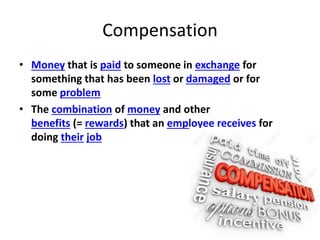
Compensation
• Money that is paid to someone in exchange for
something that has been lost or damaged or for
some problem
• The combination of money and other
benefits (= rewards) that an employee receives for
doing their job
Training
• Job analysis can be used for training and
needs assessment to identify the following
– Training condition
– Assessment test used to identify effectiveness‘
– Equipment's used in delivering the training
Performance appraisal
• Job analysis can be used in performance review to identify and develop
• Goals and objectives
• Performance and evaluation
• Evaluation criteria
• Duties of probationary/trying periods
Conclusion
• Job Analysis is very important in every
organization because it helps to know the KSA of
the employees and to hire the right employees
on the right job.
– It involves jobs specification and job description.
– Process where judgments are made about data
collected.
– The purpose of conducting job analysis is for training,
compensation and selection process.
– Aspects to be analyzed include environment,
equipment, and relationships
Meaning
• A job description is a document that describes
the general tasks, or other related,
and responsibilities of a position
• It may specify the functionary to whom the
position reports, specifications such as
the qualifications or skills needed by the
person in the job, and a salary range.
Importance
• All employees like to know what is expected of them
and how they will be evaluated. Job descriptions can
also be a great value to employers.
• It helps determine how critical the job is, how this
particular job relates to others and identify the
characteristics needed by a new employee filling the
role
• A job description typically outlines the necessary skills,
training and education needed by a potential
employee. It will spell out duties and responsibilities of
the job.
Contents
• Job Identification.
• Job Summary.
• Job Duties and Responsibilities.
• Working Conditions.
• Social Environment.
• Machines, Tools and Equipment.
• Supervision.
• Relation to other Jobs.
Conclusion
• A job description is a list of the general tasks,
or functions, and responsibilities of position.
Typically, it also includes to whom the position
reports, specifications needed by the person
in the job. A job description is usually
developed by conducting a job analysis, which
includes examining the tasks and sequences of
tasks necessary to perform the job.
JOB SPECIFICATION Example
• MARKETING MANAGER
– Description
• The marketing manager is responsible for the overall
management of the marketing department.
– Experience
• 10 years
• Supervising a staff
– Education
• Bachelors Degree in Marketing or a related field
required
• Masters in Business or Marketing preferred
CONCLUSION
• While job description describes activities to be
done , The job Specification list the Knowledge
Skill and abilities (KSA) of individual to
perform job Satisfactorily
• Without proper job analysis by the human
resources department, it is difficult for any
organization to remain competitive and be
able to attract and retain talent.
What is Strategic Planning?
• Strategic planning is an organization's process
of defining its strategy, or direction, and
making decisions on allocating its resources to
pursue this strategy.
– What do want to do?
– How do we best excel?
– Where do we want the company to be?
Importance
• Requirement for sustained competitive
advantage
• Views things from broader perspective
• Facilitates collaboration
Benefits
• Defines Company's vision, mission & future goals.
• Improves awareness of the external & internal
environments and clearly identifies the
competitive advantage.
• Increases managers commitment to achieving
company objectives.
• Improves coordination of activities & more
efficient allocation of company's resources.
• Strengthens the firms performance.
Job analysis
Job analysis

Job analysis

  • 1.
    Job analysis Job descriptions,Job specifications, strategic planning By – Tushar Bangani
  • 2.
    • A jobmay be defined as a “collection or aggregation of tasks, duties and responsibilities which as a whole, are regarded as a regular assignment to individual employees”.
  • 3.
    Job Analysis • Thisis a process to identify and determine in detail the particular job duties and requirements and the relative importance of these duties for a given job. • Process where judgments are made about data collected. • It involves job specification and job description
  • 4.
    Importance of JobAnalysis • The purpose of Job Analysis is to establish and document the job relatedness' of employment procedures such as: – Selection, compensation – Training – Performance appraisal
  • 5.
    Compensation • Money thatis paid to someone in exchange for something that has been lost or damaged or for some problem • The combination of money and other benefits (= rewards) that an employee receives for doing their job
  • 6.
    Training • Job analysiscan be used for training and needs assessment to identify the following – Training condition – Assessment test used to identify effectiveness‘ – Equipment's used in delivering the training
  • 7.
    Performance appraisal • Jobanalysis can be used in performance review to identify and develop • Goals and objectives • Performance and evaluation • Evaluation criteria • Duties of probationary/trying periods
  • 8.
    Conclusion • Job Analysisis very important in every organization because it helps to know the KSA of the employees and to hire the right employees on the right job. – It involves jobs specification and job description. – Process where judgments are made about data collected. – The purpose of conducting job analysis is for training, compensation and selection process. – Aspects to be analyzed include environment, equipment, and relationships
  • 10.
    Meaning • A jobdescription is a document that describes the general tasks, or other related, and responsibilities of a position • It may specify the functionary to whom the position reports, specifications such as the qualifications or skills needed by the person in the job, and a salary range.
  • 11.
    Importance • All employeeslike to know what is expected of them and how they will be evaluated. Job descriptions can also be a great value to employers. • It helps determine how critical the job is, how this particular job relates to others and identify the characteristics needed by a new employee filling the role • A job description typically outlines the necessary skills, training and education needed by a potential employee. It will spell out duties and responsibilities of the job.
  • 12.
    Contents • Job Identification. •Job Summary. • Job Duties and Responsibilities. • Working Conditions. • Social Environment. • Machines, Tools and Equipment. • Supervision. • Relation to other Jobs.
  • 13.
    Conclusion • A jobdescription is a list of the general tasks, or functions, and responsibilities of position. Typically, it also includes to whom the position reports, specifications needed by the person in the job. A job description is usually developed by conducting a job analysis, which includes examining the tasks and sequences of tasks necessary to perform the job.
  • 16.
    JOB SPECIFICATION Example •MARKETING MANAGER – Description • The marketing manager is responsible for the overall management of the marketing department. – Experience • 10 years • Supervising a staff – Education • Bachelors Degree in Marketing or a related field required • Masters in Business or Marketing preferred
  • 17.
    CONCLUSION • While jobdescription describes activities to be done , The job Specification list the Knowledge Skill and abilities (KSA) of individual to perform job Satisfactorily • Without proper job analysis by the human resources department, it is difficult for any organization to remain competitive and be able to attract and retain talent.
  • 19.
    What is StrategicPlanning? • Strategic planning is an organization's process of defining its strategy, or direction, and making decisions on allocating its resources to pursue this strategy. – What do want to do? – How do we best excel? – Where do we want the company to be?
  • 20.
    Importance • Requirement forsustained competitive advantage • Views things from broader perspective • Facilitates collaboration
  • 21.
    Benefits • Defines Company'svision, mission & future goals. • Improves awareness of the external & internal environments and clearly identifies the competitive advantage. • Increases managers commitment to achieving company objectives. • Improves coordination of activities & more efficient allocation of company's resources. • Strengthens the firms performance.