Job Analysis
Job
A job may be defined as a “collection
or aggregation of tasks, duties and
responsibilities which as a whole, are
regarded as a regular assignment to
individual employees”
In other words, when the total work to
be done is divided and grouped into
packages, we call it a “Job”.
Job
Definitions - Job and Job Position
Job Consists of group of tasks that must be
performed for organization to achieve its
goals
Position Collection of tasks and responsibilities
performed by one person; there is a
position for every individual in organization
Jobs vs Positions
Q. A workgroup consisting of a supervisor,
two senior clerks, four word processing
operators and one office boy has:-
• How many jobs .. .. ?
• How many positions …… ..?
Job Analysis
Job analysis is the process of studying and
collecting information relating to the
operations and responsibility of a specific job
Edwin Flippo
It is a systematic analysis of each job for the
purpose of collecting information as to (1)
what the job holder does, (2) under what
circumstances it is performed and (3) what
qualifications are required for doing the job
Job Analysis
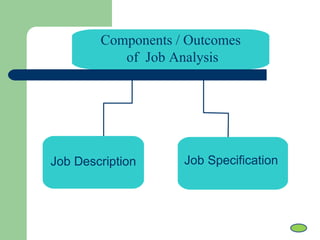
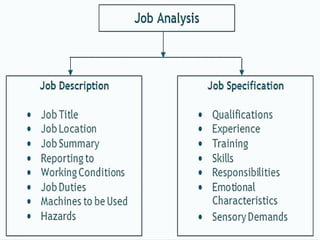
Components / Outcomes
of Job Analysis
Job Description Job Specification
Definition of Job Description
Job Description is an organized factual
statement of the duties and
responsibilities of a specific job. It
should tell what is to be done, how it is
done and why
The details given in Job
Description
• Job title
• Organizational location of the job
• Supervision given and received
• Materials, tools, machinery and equipment
worked with
• Designation of the immediate superiors and
subordinates
• Salary and other allowances, bonus, incentive
wage, method of payment, hours of work, shift,
break etc.
• Complete list of duties to be performed separated
according to daily, weekly monthly and casual,
estimated time to be spent on each duty
• Conditions of work: Location, time, speed of work,
accuracy, health hazards, accident hazards
• Training and development facilities
Promotional chances and channels
The details given in Job
Description
Job Specification
Job Specification is a statement of minimum
acceptable human qualities necessary to
perform a job properly
Job Specification
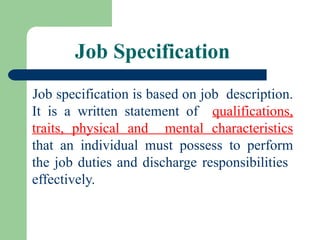
Job specification is based on job description.
It is a written statement of qualifications,
traits, physical and mental characteristics
that an individual must possess to perform
the job duties and discharge responsibilities
effectively.
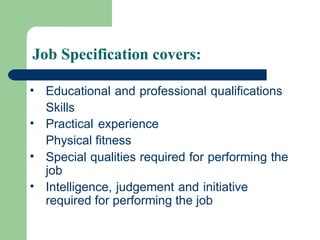
Job Specification covers:
• Educational and professional qualifications
Skills
• Practical experience
Physical fitness
• Special qualities required for performing the
job
• Intelligence, judgement and initiative
required for performing the job
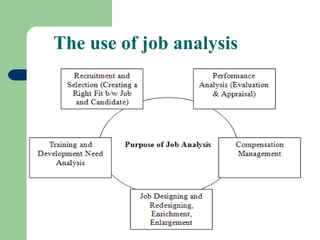
The use of job analysis
1. Recruitment & selection
• Helps in determining what kind of person is
required to perform a particular job
• It points out the educational qualifications,
level of experience and technical, physical,
emotional and personal skills required to
carry out a job in desired fashion.
• The objective is to fit a right person at a
right place.
2. Performance analysis
• To check if goals and objectives of a
particular job are met or not
• It helps in deciding the performance
standards, evaluation criteria and
individual’s output
• On this basis, the overall performance of
an employee is measured and he or she is
appraised accordingly
3. Training & development
• The difference between the expected and
actual output determines the level of
training that need to be imparted to
employees. It is used to assess the
training and development needs of
employees
• It also helps in deciding the training
content, tools and equipments to be used
to conduct training and methods of
training
4. Compensation management
• Plays a vital role in deciding the pay
packages and extra perks and benefits,
fixed and variable incentives of
employees
• The pay package depends on the
position, job title, duties and
responsibilities involved in a job
5. Job designing & redesigning
• The main purpose of job analysis is to
streamline the human efforts and get the best
possible output
• It helps in designing, redesigning, enriching,
evaluating and also cutting back and adding the
extra responsibilities in a particular job
• This is done to enhance the employee
satisfaction while increasing the human
output
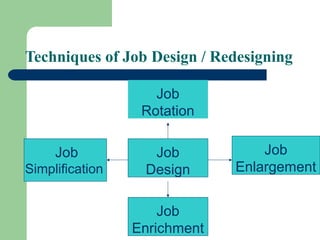
Techniques of Job Design / Redesigning
Job
Design
Job
Enrichment
Job
Simplification
Job
Enlargement
Job
Rotation
1. Job Simplification
• This requires that jobs be broken down into
their smallest units and then analyzed
• These subunits are then assigned to
workers as their total job
• Time and motion studies are often used for
work simplification
2. Job Enlargement: (Horizontal)
• It involves the addition to or expansion of tasks
in the job and job becomes a meaningful
operation
• Its focus is on enlarging the contents of jobs by
adding tasks and responsibilities
• It involves the vertical expansion of jobs by
increasing the amount of worker
responsibilities associated with the positions
• E.g. a worker who previously only loaded
boxes for delivery into a trailer may be
given the responsibility of verifying that the
customer order is correct.
3. Job Enrichment: (Vertical)
• This refers to the movement of an
employee from one job to the another over
a designated period of time
• Jobs themselves are not actually
changed, only the employees are rotated
among various jobs
• An employee who works on another job for
some days or months and returns back to
the first job
4. Job Rotation
4. Job Rotation
• This would relieve the employee from
boredom and monotony, improves the
employee’s skills regarding various jobs
and prepares the employee to meet the
contingencies
• This is also intended to improve
worker’s self-image and provides
personal growth
Job Analysis Methods
• Questionnaires
• Observation
• Interviews
• Employee recording
• Combination of methods
1. Questionnaires
• Typically quick and economical to use
• Structured questionnaire to employees
Problem
• Employees may lack verbal skills
• Some employees tend to exaggerate
significance of their tasks
2. Observation
• Job analyst watches worker perform job
tasks and records observations
• Used primarily to gather information on
jobs emphasizing manual skills
Problem
• Used alone is often insufficient
• What if when mental skills are dominant in
a job
3. Interviews
• Interview both employee and
supervisor
• Interview employee first,
helping him or her describe
duties performed
• Then, analyst normally contacts
supervisor for additional
information
Problem
• Self-serving bias
4.Employee Recording
• Employee describe / write
daily work activities in diary
or log
Problem
• Employees exaggerating
job importance
• Not appropriate for general
nature jobs
5. Combination of Methods
Usually use more than one method
• Administrative and desk jobs
Questionnaires supported by
interviews and limited observation
• Production jobs
Interviews supplemented by
extensive work observations may
provide necessary data
34

Lecture 3 - Job Analysis.pptx PhD - Model.pptx

  • 1.
  • 2.
    Job A job maybe defined as a “collection or aggregation of tasks, duties and responsibilities which as a whole, are regarded as a regular assignment to individual employees”
  • 3.
    In other words,when the total work to be done is divided and grouped into packages, we call it a “Job”. Job
  • 4.
    Definitions - Joband Job Position Job Consists of group of tasks that must be performed for organization to achieve its goals Position Collection of tasks and responsibilities performed by one person; there is a position for every individual in organization
  • 5.
    Jobs vs Positions Q.A workgroup consisting of a supervisor, two senior clerks, four word processing operators and one office boy has:- • How many jobs .. .. ? • How many positions …… ..?
  • 6.
    Job Analysis Job analysisis the process of studying and collecting information relating to the operations and responsibility of a specific job Edwin Flippo
  • 7.
    It is asystematic analysis of each job for the purpose of collecting information as to (1) what the job holder does, (2) under what circumstances it is performed and (3) what qualifications are required for doing the job Job Analysis
  • 8.
    Components / Outcomes ofJob Analysis Job Description Job Specification
  • 9.
    Definition of JobDescription Job Description is an organized factual statement of the duties and responsibilities of a specific job. It should tell what is to be done, how it is done and why
  • 10.
    The details givenin Job Description • Job title • Organizational location of the job • Supervision given and received • Materials, tools, machinery and equipment worked with • Designation of the immediate superiors and subordinates • Salary and other allowances, bonus, incentive wage, method of payment, hours of work, shift, break etc.
  • 11.
    • Complete listof duties to be performed separated according to daily, weekly monthly and casual, estimated time to be spent on each duty • Conditions of work: Location, time, speed of work, accuracy, health hazards, accident hazards • Training and development facilities Promotional chances and channels The details given in Job Description
  • 12.
    Job Specification Job Specificationis a statement of minimum acceptable human qualities necessary to perform a job properly
  • 13.
    Job Specification Job specificationis based on job description. It is a written statement of qualifications, traits, physical and mental characteristics that an individual must possess to perform the job duties and discharge responsibilities effectively.
  • 14.
    Job Specification covers: •Educational and professional qualifications Skills • Practical experience Physical fitness • Special qualities required for performing the job • Intelligence, judgement and initiative required for performing the job
  • 16.
    The use ofjob analysis
  • 17.
    1. Recruitment &selection • Helps in determining what kind of person is required to perform a particular job • It points out the educational qualifications, level of experience and technical, physical, emotional and personal skills required to carry out a job in desired fashion. • The objective is to fit a right person at a right place.
  • 18.
    2. Performance analysis •To check if goals and objectives of a particular job are met or not • It helps in deciding the performance standards, evaluation criteria and individual’s output • On this basis, the overall performance of an employee is measured and he or she is appraised accordingly
  • 19.
    3. Training &development • The difference between the expected and actual output determines the level of training that need to be imparted to employees. It is used to assess the training and development needs of employees • It also helps in deciding the training content, tools and equipments to be used to conduct training and methods of training
  • 20.
    4. Compensation management •Plays a vital role in deciding the pay packages and extra perks and benefits, fixed and variable incentives of employees • The pay package depends on the position, job title, duties and responsibilities involved in a job
  • 21.
    5. Job designing& redesigning • The main purpose of job analysis is to streamline the human efforts and get the best possible output • It helps in designing, redesigning, enriching, evaluating and also cutting back and adding the extra responsibilities in a particular job • This is done to enhance the employee satisfaction while increasing the human output
  • 22.
    Techniques of JobDesign / Redesigning Job Design Job Enrichment Job Simplification Job Enlargement Job Rotation
  • 23.
    1. Job Simplification •This requires that jobs be broken down into their smallest units and then analyzed • These subunits are then assigned to workers as their total job • Time and motion studies are often used for work simplification
  • 24.
    2. Job Enlargement:(Horizontal) • It involves the addition to or expansion of tasks in the job and job becomes a meaningful operation • Its focus is on enlarging the contents of jobs by adding tasks and responsibilities
  • 25.
    • It involvesthe vertical expansion of jobs by increasing the amount of worker responsibilities associated with the positions • E.g. a worker who previously only loaded boxes for delivery into a trailer may be given the responsibility of verifying that the customer order is correct. 3. Job Enrichment: (Vertical)
  • 26.
    • This refersto the movement of an employee from one job to the another over a designated period of time • Jobs themselves are not actually changed, only the employees are rotated among various jobs • An employee who works on another job for some days or months and returns back to the first job 4. Job Rotation
  • 27.
    4. Job Rotation •This would relieve the employee from boredom and monotony, improves the employee’s skills regarding various jobs and prepares the employee to meet the contingencies • This is also intended to improve worker’s self-image and provides personal growth
  • 28.
    Job Analysis Methods •Questionnaires • Observation • Interviews • Employee recording • Combination of methods
  • 29.
    1. Questionnaires • Typicallyquick and economical to use • Structured questionnaire to employees Problem • Employees may lack verbal skills • Some employees tend to exaggerate significance of their tasks
  • 30.
    2. Observation • Jobanalyst watches worker perform job tasks and records observations • Used primarily to gather information on jobs emphasizing manual skills Problem • Used alone is often insufficient • What if when mental skills are dominant in a job
  • 31.
    3. Interviews • Interviewboth employee and supervisor • Interview employee first, helping him or her describe duties performed • Then, analyst normally contacts supervisor for additional information Problem • Self-serving bias
  • 32.
    4.Employee Recording • Employeedescribe / write daily work activities in diary or log Problem • Employees exaggerating job importance • Not appropriate for general nature jobs
  • 33.
    5. Combination ofMethods Usually use more than one method • Administrative and desk jobs Questionnaires supported by interviews and limited observation • Production jobs Interviews supplemented by extensive work observations may provide necessary data
  • 34.

Editor's Notes

  • #4 Job is generic (Manager), Position is specified / explained (Manager, HR)
  • #5 4 jobs and 8 positions