A seminar   on    Factor affecting IVIVC Guided by:   Presented by: Dr.Manish.P.Patel  Patel Jignesh.P  Head of Department  M.pharm-1sem Department of pharmaceutics  M.pharm, Nootan Pharmacy college Visnagar. 1/37
Area under discussion… INTRODUCTION WHAT IS IVIVC? WHY TO GO FOR IVIVC? FACTORS IN DEVELOPMENT OF A PREDICTABLE IVIVC FEW DEFINITIONS LEVELS OF CORRELATION  TYPES OF CORRELATION METHODS OF CORRELATION STAGES OF IVIVC MODEL DEVELOPMENT  APPLICATIONS OF IVIVC IN DRUG DELIVERY WHATS IN STORE FOR THE FUTURE? STUDY QUESTIONS REFERENCES 2/37
The therapeutic efficacy of a pharmaceutical formulation is governed by factors related to: in vitro dissolution characteristics of the drug & its in vivo bioavailability.  This inherent interdependency within the drug-patient biosystem is the major concern that underlines the importance of in vitro/in vivo correlation studies.  3/37
Bioavailability implications  of dissolution should never be accepted on faith, rather it has to be  proved  through carefully designed in vitro-in vivo correlation studies.  The need for such comparisons has been recognized since  early  1960’s  & the regulations on bioavailability and bioequivalence were issued by the  FDA in  1977 . Long back,  Wagner  had stated that, “ Future research in dissolution rate should be directed mainly towards establishing correlation of in-vitro data with in-vivo data.” 4/37
WHAT IS IVIVC??? In IVIVC, "C" denotes  "Correlation" , which means "the degree of relationship between two variables". This term does not limit a relationship to only the linear type, but allows for non-linear relationships as well.  Conceptually , IVIVC describes a relationship between the in vitro dissolution / release versus the in vivo absorption.  FDA  had defined IVIVC as  “A predictive mathematical model describing relationship between in-vitro property of a dosage form and in-vivo response.” In-vitro properties  are  rate or extent of drug released  under a given set of conditions.  In-vivo properties  are  plasma drug conc.  expressed in terms of Cmax, AUC. 5/37
WHY TO GO FOR IVIVC??? Theoretically worthwhile, but Clinical approach is a  poor tool  for accurate measurement of bioavailability.  Determination of  drug level at the site  of administration.  Urinary excretion analysis of drug is meaningful for establishing IVIVC but  complicated pharmacokinetic considerations.  Thus it is generally assumed that blood (serum/plasma) level measurements give a better assessment of bioavailability and bioequivalence. 6/37
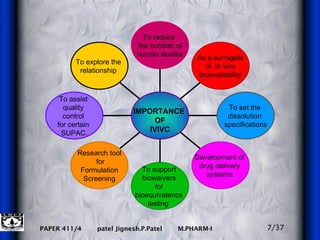
7/37 To explore the  relationship  To assist  quality  control  for certain  SUPAC. Research tool for Formulation  Screening To support  biowaivers  for  bioequivalence  testing  Development of  drug delivery  systems. To set the  dissolution  specifications As a surrogate of  in vivo bioavailability  To reduce  the number of human studies   IMPORTANCE  OF IVIVC
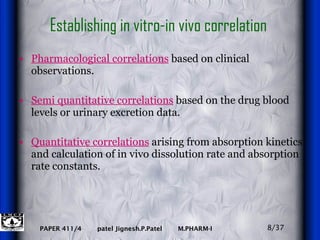
Establishing in vitro-in vivo correlation  Pharmacological correlations  based on clinical observations. Semi quantitative correlations  based on the drug blood levels or urinary excretion data. Quantitative correlations  arising from absorption kinetics and calculation of in vivo dissolution rate and absorption rate constants. 8/37
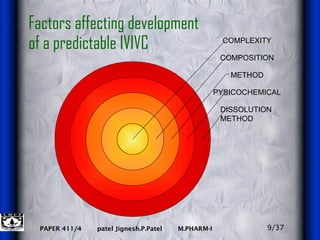
Factors affecting development  of a predictable IVIVC 9/37 DISSOLUTION  METHOD PYSICOCHEMICAL METHOD COMPOSITION COMPLEXITY
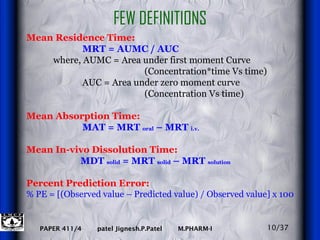
Mean Residence Time: MRT = AUMC / AUC where, AUMC = Area under first moment Curve  (Concentration*time Vs time) AUC = Area under zero moment curve  (Concentration Vs time) Mean Absorption Time: MAT = MRT  oral  – MRT  i.v. Mean In-vivo Dissolution Time:   MDT  solid  = MRT  solid  – MRT  solution Percent Prediction Error:   % PE = [(Observed value – Predicted value) / Observed value] x 100 FEW DEFINITIONS 10/37
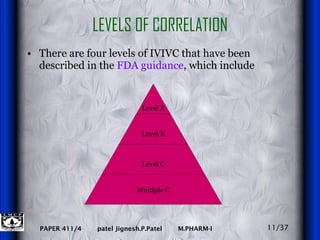
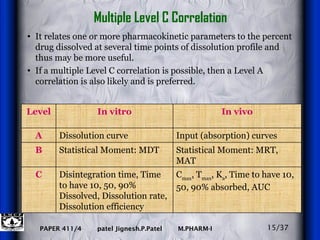
LEVELS OF CORRELATION There are four levels of IVIVC that have been described in the  FDA guidance , which include  11/37 Level A Level B Level C Multiple C
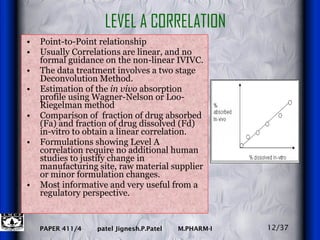
Point-to-Point relationship Usually Correlations are linear, and no formal guidance on the non-linear IVIVC. The data treatment involves a two stage Deconvolution Method.  Estimation of the  in vivo  absorption profile using Wagner-Nelson or Loo-Riegelman method  Comparison of  fraction of drug absorbed (Fa) and fraction of drug dissolved (Fd) in-vitro to obtain a linear correlation. Formulations showing Level A correlation require no additional human studies to justify change in manufacturing site, raw material supplier or minor formulation changes. Most informative and very useful from a regulatory perspective. LEVEL A CORRELATION 12/37
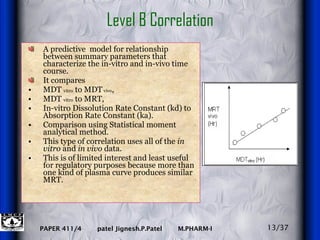
A predictive  model for relationship between summary parameters that characterize the in-vitro and in-vivo time course. It compares  MDT  vitro  to MDT  vivo ,  MDT  vitro  to MRT,  In-vitro Dissolution Rate Constant (kd) to Absorption Rate Constant (ka). Comparison using Statistical moment analytical method. This type of correlation uses all of the  in vitro  and  in vivo  data. This is of limited interest and least useful for regulatory purposes because more than one kind of plasma curve produces similar MRT. Level B Correlation 13/37
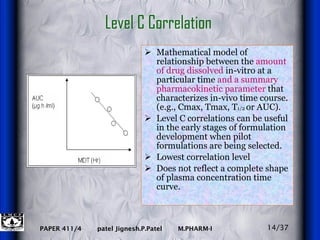
Mathematical model of relationship between the  amount of drug dissolved  in-vitro at a particular time  and a summary pharmacokinetic parameter  that characterizes in-vivo time course. (e.g., Cmax, Tmax, T 1/2  or AUC). Level C correlations can be useful in the early stages of formulation development when pilot formulations are being selected.  Lowest correlation level  Does not reflect a complete shape of plasma concentration time curve. Level C Correlation  14/37
Multiple Level C Correlation It relates one or more pharmacokinetic parameters to the percent drug dissolved at several time points of dissolution profile and thus may be more useful. If a multiple Level C correlation is possible, then a Level A correlation is also likely and is preferred.  15/37 C max , T max , K a , Time to have 10, 50, 90% absorbed, AUC Disintegration time, Time to have 10, 50, 90% Dissolved, Dissolution rate, Dissolution efficiency C Statistical Moment: MRT,  MAT Statistical Moment: MDT B Input (absorption) curves Dissolution curve  A In vivo In vitro Level
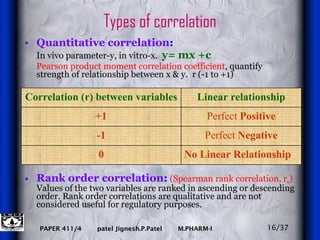
Types of correlation Quantitative correlation :  In vivo parameter-y, in vitro-x.  y= mx +c Pearson product moment correlation coefficient , quantify strength of relationship between x & y.  r (-1 to +1)  Rank order correlation :   (Spearman rank correlation, r s )   Values of the two variables are ranked in ascending or descending order. Rank order correlations are qualitative and are not considered useful for regulatory purposes.  16/37 No Linear Relationship 0 Perfect  Negative -1 Perfect  Positive +1 Linear relationship Correlation (r) between variables
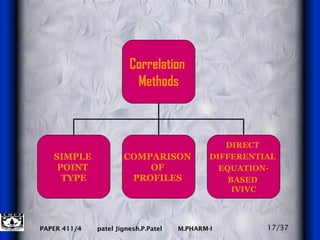
17/37 Correlation  Methods SIMPLE  POINT  TYPE COMPARISON  OF  PROFILES   DIRECT  DIFFERENTIAL  EQUATION- BASED  IVIVC
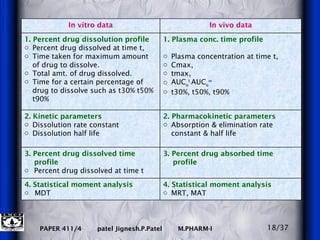
18/37 4. Statistical moment analysis MRT, MAT 3. Percent drug absorbed time profile 2. Pharmacokinetic parameters Absorption & elimination rate constant & half life  1. Plasma conc. time profile   Plasma concentration at time t, Cmax, tmax, AUC o t  AUC o ∞ t30%, t50%, t90% In vivo data 4. Statistical moment analysis MDT 3.   Percent drug dissolved time  profile Percent drug dissolved at time t 2. Kinetic parameters Dissolution rate constant Dissolution half life 1. Percent drug dissolution profile Percent drug dissolved at time t, Time taken for maximum amount of drug to dissolve.  Total amt. of drug dissolved. Time for a certain percentage of drug to dissolve such as t30% t50% t90% In vitro data
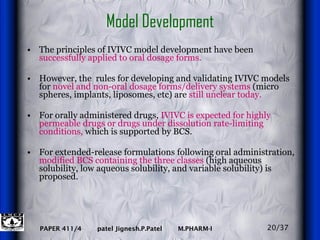
STAGES OF IVIVC MODEL  MODEL DEVELOPMENT 19/37 MODEL VALIDATION
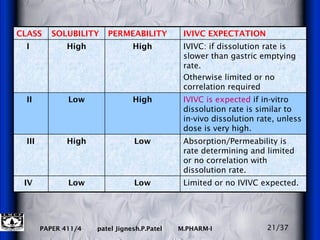
Model Development The principles of IVIVC model development have been  successfully applied to oral dosage forms.   However, the  rules for developing and validating IVIVC models for  novel and non-oral dosage forms/delivery systems  (micro spheres, implants, liposomes, etc) are  still unclear today.   For orally administered drugs,  IVIVC is expected for highly permeable drugs or drugs under dissolution rate-limiting conditions,  which is supported by BCS.  For extended-release formulations following oral administration,  modified BCS   containing the three classes  (high aqueous solubility, low aqueous solubility, and variable solubility) is proposed. 20/37
21/37 Limited or no IVIVC expected.  Low Low IV Absorption/Permeability is rate determining and limited or no correlation with dissolution rate. Low High III IVIVC is expected  if in-vitro dissolution rate is similar to in-vivo dissolution rate, unless dose is very high.  High Low II IVIVC: if dissolution rate is slower than gastric emptying rate. Otherwise limited or no correlation required  High High I IVIVC EXPECTATION  PERMEABILITY  SOLUBILITY  CLASS
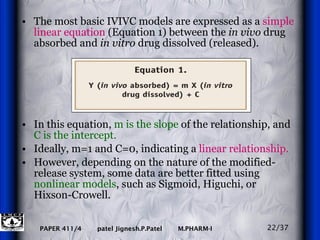
The most basic IVIVC models are expressed as a  simple linear equation  (Equation 1) between the  in vivo  drug absorbed and  in vitro  drug dissolved (released).  In this equation,  m is the slope  of the relationship, and  C is the intercept.  Ideally, m=1 and C=0, indicating a  linear relationship. However, depending on the nature of the modified-release system, some data are better fitted using  nonlinear models , such as Sigmoid, Higuchi, or Hixson-Crowell. 22/37
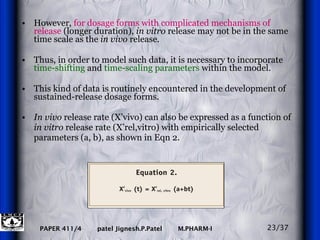
However,  for dosage forms with complicated mechanisms of release  (longer duration),  in vitro  release may not be in the same time scale as the  in vivo  release.  Thus, in order to model such data, it is necessary to incorporate  time-shifting  and  time-scaling parameters  within the model. This kind of data is routinely encountered in the development of sustained-release dosage forms. In vivo  release rate (X’vivo) can also be expressed as a function of  in vitro  release rate (X’rel,vitro) with empirically selected parameters (a, b), as shown in Eqn 2.  23/37
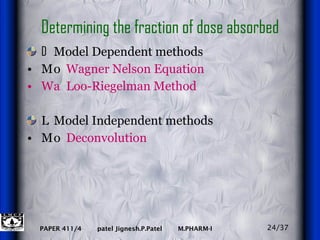
Determining the fraction of dose absorbed  Model Dependent methods  Wagner Nelson Equation  Loo-Riegelman Method  Model Independent methods  Deconvolution 24/37
Model Validation  [1] Internal Validation (using data from the formulations used to build the model)  Internal validation serves the purpose of providing basis for the acceptability of the model. [2] External Validation (using data obtained from a different (new) formulation)  External validation is superior and affords greater “confidence” in the model.  25/37
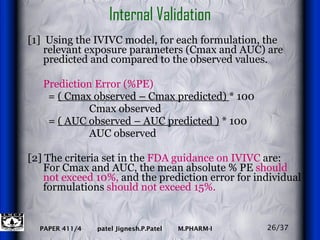
Internal Validation [1]  Using the IVIVC model, for each formulation, the relevant exposure parameters (Cmax and AUC) are predicted and compared to the observed values.  Prediction Error (%PE)   =  ( Cmax observed – Cmax predicted)  * 100 Cmax observed    =  ( AUC observed – AUC predicted )  * 100 AUC observed [2] The criteria set in the  FDA guidance on IVIVC  are:  For Cmax and AUC, the mean absolute % PE  should not exceed 10%,  and the prediction error for individual formulations  should not exceed 15%. 26/37
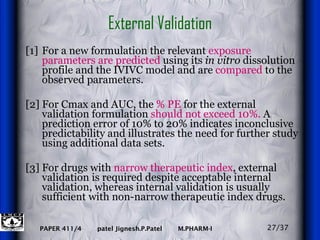
External Validation [1]   For a new formulation the relevant  exposure parameters are predicted  using its  in vitro  dissolution profile and the IVIVC model and are  compared  to the observed parameters. [2] For Cmax and AUC, the  % PE  for the external validation formulation  should not exceed 10%.  A prediction error of 10% to 20% indicates inconclusive predictability and illustrates the need for further study using additional data sets.  [3]   For drugs with  narrow therapeutic index , external validation is required despite acceptable internal validation, whereas internal validation is usually sufficient with non-narrow therapeutic index drugs. 27/37
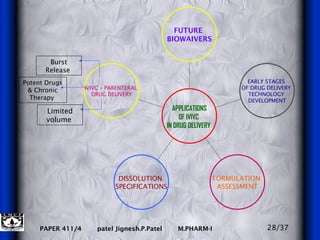
28/37 IVIVC – PARENTERAL  DRUG DELIVERY DISSOLUTION  SPECIFICATIONS FORMULATION  ASSESSMENT EARLY STAGES  OF DRUG DELIVERY  TECHNOLOGY  DEVELOPMENT FUTURE  BIOWAIVERS APPLICATIONS  OF IVIVC  IN DRUG DELIVERY  Potent Drugs & Chronic Therapy  Limited volume  Burst Release
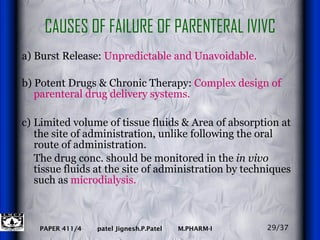
CAUSES OF FAILURE OF PARENTERAL IVIVC a) Burst Release:  Unpredictable and Unavoidable.   b) Potent Drugs & Chronic Therapy:  Complex design of parenteral drug delivery systems. c)   Limited volume of tissue fluids & Area of absorption at the site of administration, unlike following the oral route of administration. The drug conc. should be monitored in the  in vivo  tissue fluids at the site of administration by techniques such as  microdialysis.   29/37
WHATS IN STORE FOR THE FUTURE>>> IVIVR (In vitro-in vivo relationship)  One possible substitution for IVIVC is IVIVR, with  "R" denoting "relationship."   Hence, IVIVR need not be limited to straight-line relationships, which generally fails for IR products.  This IVIVR analysis has been applied to several formulations of metoprolol, piroxicam, and ranitidine.  This indicated that one intent of IVIVR should be to learn about the relative contribution of dissolution to a product's overall absorption kinetics.  30/37
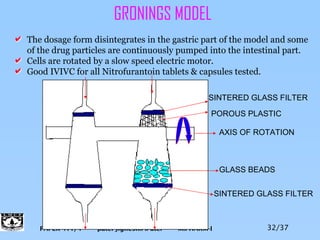
DISSOLUTION SIMULATORS Introduced to  enhance the capability  of in vitro dissolution as a predictor of the in vivo behavior of dosage forms.  But, highly complex and expensive apparatus.   a) Groning’s Model   b) Sartorius Dissolution simulator  c) Sartorius Membrane Filter Solubility Simulator d) Sartorius Membrane Filter Absorption  Simulator 31/37
GRONINGS MODEL GLASS BEADS SINTERED GLASS FILTER AXIS OF ROTATION SINTERED GLASS FILTER POROUS PLASTIC The dosage form disintegrates in the gastric part of the model and some of the drug particles are continuously pumped into the intestinal part.  Cells are rotated by a slow speed electric motor.  Good IVIVC for all Nitrofurantoin tablets & capsules tested. 32/37
CONCLUSION Dissolution promotes good bioavailability but does not assure it.  Meaningful IVIVC is possible only when dissolution rate dominates membrane transport and transit rate, thus limiting the rate and/or extent of absorption.  In the era of tight budgets and increasing costs of drug development, the most critical application of IVIVC with respect to cost savings is the biowaiver, the avoidance of expensive clinical trials. While the principles of IVIVC have been mostly applied to oral products, there exists a need to develop methodologies and standards for non-oral delivery systems. 33/37
STUDY QUESTIONS What do you mean by IVIVC? Add a brief note on its importance. Discuss different levels of correlation given by FDA? Add a note on stages of IVIVC Model development? Describe in brief application of IVIVC? Add a note on future directions of IVIVC? Write short note on IVIVR Dissolution simulators Parenteral IVIVC Causes of failure of Parenteral IVIVC 34/37
REFERENCES IVIVC: An Important Tool in the Development of Drug Delivery Systems; Gangadhar Sunkara, PhD, and Dakshina M. Chilukuri, PhD.  http://www.drugdeliverytech.com/cgi-bin/articles.cgi?idArticle=144   Dissolution, Bioavailability and Bioequivalence by Hamed M. Abdou, Mack Publishing House. Guidance for Industry; Extended Release Oral Dosage Forms: Development, Evaluation, and Application of In Vitro/In Vivo Correlations.  www.fda.gov/cder/guidance/index.htm 35/37
IVIVC Vs IVIVR; James E. Polli, Ph.D.  http://www.dissolutiontech.com/DTresour/800Articles/800_art1.html IVIVC: Methods and Applications in Modified-Release Product Development; Harald Rettig and Jana Mysicka. Dissolution Technologies | FEBRUARY 2008. Journal Metadata Search: Pharmaceutical Press - Journal of Pharmacy and Pharmacology   55(4); 495 (2003) In Vitro–In Vivo Correlation: Importance of Dissolution in IVIVC; J-M. Cardot, E. Beyssac, and M.Alric. Dissolution Technologies | FEBRUARY  2007 36/37
“ THERE IS ALWAYS SOMETHING MORE THAN YOU CAN DO” 37/37