Presented by,
Pallab Kumar Pal
M.Pharm, 1st year(Pharmaceutics)
Roll no. 10
Under the guidance of,
Dr. Somasree Ray
Astt. Professor (Department of Pharmaceutics)
Gupta College of Technological Sciences
Introduction
In-vitro study means study in an artificial environment
outside the living organism
In-vivo study means study in living system or living organism
Invitro-invivo correlation is a predictive mathematical model
describing relation between invtro dissolution parameters and
corresponding invivo data and response (FDA definition)
Basic requirements for developing IVIVC
Data obtained from human studies are required for regulatory consideration
of the correlation
Two or more drug product formulations with different release rates are
developed and their in vitro dissolution profiles generated using an
appropriate dissolution method
Usage of same dissolution method for all the formulations
Plasma concentration data from a bioavailability study for each of the
formulations
Levels of IVIVC
Level A
Level B
Level C
Multiple Level C
Level D
Level A
Point to point correlation exists between invitro and invivo data
It is highest level of correlation
%drug absorbed calculated by Method of Residual, Wagner-Nelson Method
, Loo-Reigelman method
0
10
20
30
40
50
60
70
80
90
100
0 20 40 60 80 100 120
%drugabsorbed
%drug dissolved
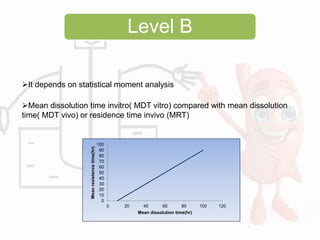
It depends on statistical moment analysis
Mean dissolution time invitro( MDT vitro) compared with mean dissolution
time( MDT vivo) or residence time invivo (MRT)
0
10
20
30
40
50
60
70
80
90
100
0 20 40 60 80 100 120
Meanresistancetime(hr)
Mean dissolution time(hr)
Level B
Level C
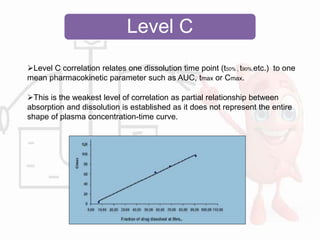
Level C correlation relates one dissolution time point (t50% , t90%,etc.) to one
mean pharmacokinetic parameter such as AUC, tmax or Cmax.
This is the weakest level of correlation as partial relationship between
absorption and dissolution is established as it does not represent the entire
shape of plasma concentration-time curve.
Multiple Level C
Relationship between one or more pharmacokinetic parameters of interest
(Cmax, AUC, or any other suitable parameters) and amount of drug dissolved at
several time point of dissolution profile
Multiple Level C correlation should be based on at least three dissolution
time points covering the early, middle, and late stages of the dissolution
profile
Level D
It is a semi quantitative (qualitative analysis) and rank order correlation
It is not considered useful for regulatory purpose but can be serves as an
aid in the development of a formulation or processing procedure
Class Solubility Permeability Absorption Expected IVIVC
I High High Gastric
emptying
controlled
IVIVC is expected if
dissolution rate is slower
than gastric emptying rate,
otherwise limited or no
correlation
II Low High Dissolution
controlled
IVIVC is expected if in vitro
dissolution rate is similar to
in vivo dissolution rate,
unless dose is very high
III High Low Dissolution
independent
Absorption (permeability) is
rate determining; limited or
no IVIVC with dissolution
rate
IV Low Low Case-by-
case
evaluation
Limited or no IVIVC is
expected
BCS and expected IVIVC for immediate release drug products
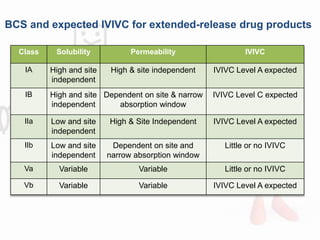
Class Solubility Permeability IVIVC
IA High and site
independent
High & site independent IVIVC Level A expected
IB High and site
independent
Dependent on site & narrow
absorption window
IVIVC Level C expected
IIa Low and site
independent
High & Site Independent IVIVC Level A expected
IIb Low and site
independent
Dependent on site and
narrow absorption window
Little or no IVIVC
Va Variable Variable Little or no IVIVC
Vb Variable Variable IVIVC Level A expected
BCS and expected IVIVC for extended-release drug products
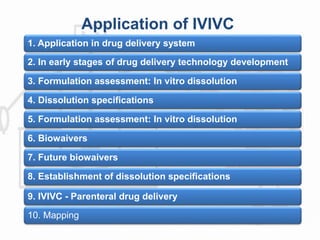
Application of IVIVC
3. Formulation assessment: In vitro dissolution
2. In early stages of drug delivery technology development
4. Dissolution specifications
7. Future biowaivers
9. IVIVC - Parenteral drug delivery
1. Application in drug delivery system
5. Formulation assessment: In vitro dissolution
6. Biowaivers
8. Establishment of dissolution specifications
10. Mapping
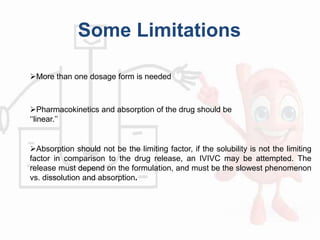
Some Limitations
More than one dosage form is needed
Pharmacokinetics and absorption of the drug should be
‘‘linear.’’
Absorption should not be the limiting factor, if the solubility is not the limiting
factor in comparison to the drug release, an IVIVC may be attempted. The
release must depend on the formulation, and must be the slowest phenomenon
vs. dissolution and absorption.
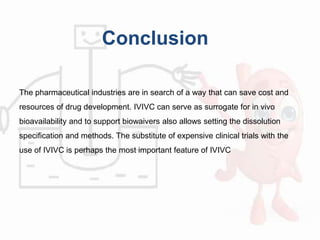
Conclusion
The pharmaceutical industries are in search of a way that can save cost and
resources of drug development. IVIVC can serve as surrogate for in vivo
bioavailability and to support biowaivers also allows setting the dissolution
specification and methods. The substitute of expensive clinical trials with the
use of IVIVC is perhaps the most important feature of IVIVC
Invitro invivo correlation