
KH. HUSSAN REZA (M.PHARMA)
Asst. Professor
Bengal School of Technology
INTRODUCTION
United State Pharmacopoeia (USP) definition:
The establishment of a rational relationship between a
biological property, or a parameter derived from a
biological property produced by a dosage form, and a
physicochemical property or characteristic of the
same dosage form
Food and Drug Administration (FDA) definition
IVIVC is a predictive mathematical model describing
the relationship between an in vitro property of a
dosage form and a relevant in vivo response.
Generally, the in vitro property is the rate or extent of
drug dissolution or release while the in vivo response
is the plasma drug concentration or amount of drug
absorbed
CORRELATION LEVELS
Five correlation levels have been defined in the IVIVC
FDA guidance
IVIVC can be used in the development of new
pharmaceuticals to reduce the number of human
studies during the formulation development
a tool to reliably correlate in vitro and in vivo drug
release data
IVIVC can be used in the development of new
pharmaceuticals to reduce the number of human
studies
Level A Correlation
Level B Correlation
Multiple-level C correlation
Level D correlation
Level A correlation
represents a point-to-point relationship between in
vitro dissolution rate and in vivo input rate of the
drug from the dosage form
an in vitro dissolution curve can serve as a surrogate
for in vivo performance.
percent of drug absorbed calculated by
 model dependent techniques : Wagner-Nelson ,Loo-
Riegelman method
model-independent numerical deconvolution
Level B Correlation
utilizes the principles of statistical moment analysis
correlation, the mean in vitro dissolution time
(MDTvitro) of the product is compared to either
mean in vivo residence time (MRT) or the mean in
vivo dissolution time (MDTvivo).
it is not considered to be a point-to point correlation
does not uniquely reflect the actual in vivo plasma
level curves
Level C Correlation
one dissolution time point (t50%, t90%, etc.) is
compared to one mean pharmacokinetic parameter
such as AUC, tmax or Cmax.
predicting in vivo drug performance., useful in the
early stages of formulation development
single point correlation and doses not reflect the
entire shape of the plasma drug concentration curve
Multiple-level C correlation
A multiple level C correlation relates one or several
pharmacokinetic parameters of interest (Cmax, AUC,
or any other suitable parameters) to the amount of
drug dissolved at several time points of the
dissolution profile.
A multiple Level C correlation should be based on at
least three dissolution time points, early, middle, and
late stages of the dissolution profile.
Level D correlation
correlation is a rank order and qualitative analysis
and is not considered useful for regulatory purposes.
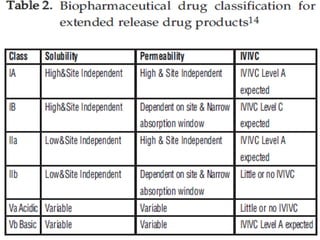
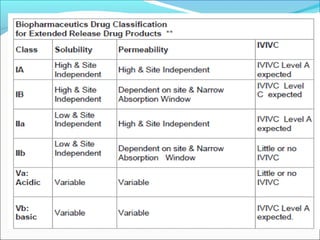
BIOPHARMACEUTICS CLASSIFICATION
SYSTEM (BCS)
dissolution, solubility and intestinal permeability
The classification is dealing with drug dissolution and
absorption model
Absorption Number (An):
The Absorption Number (An) is the ratio of the Mean
Residence Time (Tres) to the Mean Absorption Time
(Tabs)
Dissolution Number (Dn)
The Dissolution Number (Dn) is the ratio of Tres to
Mean Dissolution Time (Tdiss)
Ivivc
Ivivc
Ivivc

Ivivc

  • 1.
    KH. HUSSAN REZA(M.PHARMA) Asst. Professor Bengal School of Technology
  • 2.
    INTRODUCTION United State Pharmacopoeia(USP) definition: The establishment of a rational relationship between a biological property, or a parameter derived from a biological property produced by a dosage form, and a physicochemical property or characteristic of the same dosage form
  • 3.
    Food and DrugAdministration (FDA) definition IVIVC is a predictive mathematical model describing the relationship between an in vitro property of a dosage form and a relevant in vivo response. Generally, the in vitro property is the rate or extent of drug dissolution or release while the in vivo response is the plasma drug concentration or amount of drug absorbed
  • 4.
    CORRELATION LEVELS Five correlationlevels have been defined in the IVIVC FDA guidance IVIVC can be used in the development of new pharmaceuticals to reduce the number of human studies during the formulation development a tool to reliably correlate in vitro and in vivo drug release data IVIVC can be used in the development of new pharmaceuticals to reduce the number of human studies
  • 5.
    Level A Correlation LevelB Correlation Multiple-level C correlation Level D correlation
  • 6.
    Level A correlation representsa point-to-point relationship between in vitro dissolution rate and in vivo input rate of the drug from the dosage form an in vitro dissolution curve can serve as a surrogate for in vivo performance. percent of drug absorbed calculated by  model dependent techniques : Wagner-Nelson ,Loo- Riegelman method model-independent numerical deconvolution
  • 7.
    Level B Correlation utilizesthe principles of statistical moment analysis correlation, the mean in vitro dissolution time (MDTvitro) of the product is compared to either mean in vivo residence time (MRT) or the mean in vivo dissolution time (MDTvivo). it is not considered to be a point-to point correlation does not uniquely reflect the actual in vivo plasma level curves
  • 8.
    Level C Correlation onedissolution time point (t50%, t90%, etc.) is compared to one mean pharmacokinetic parameter such as AUC, tmax or Cmax. predicting in vivo drug performance., useful in the early stages of formulation development single point correlation and doses not reflect the entire shape of the plasma drug concentration curve
  • 9.
    Multiple-level C correlation Amultiple level C correlation relates one or several pharmacokinetic parameters of interest (Cmax, AUC, or any other suitable parameters) to the amount of drug dissolved at several time points of the dissolution profile. A multiple Level C correlation should be based on at least three dissolution time points, early, middle, and late stages of the dissolution profile.
  • 10.
    Level D correlation correlationis a rank order and qualitative analysis and is not considered useful for regulatory purposes.
  • 12.
    BIOPHARMACEUTICS CLASSIFICATION SYSTEM (BCS) dissolution,solubility and intestinal permeability The classification is dealing with drug dissolution and absorption model Absorption Number (An): The Absorption Number (An) is the ratio of the Mean Residence Time (Tres) to the Mean Absorption Time (Tabs) Dissolution Number (Dn) The Dissolution Number (Dn) is the ratio of Tres to Mean Dissolution Time (Tdiss)