


Prepared by: Guided By:
Yatindra Bhadankar Dr. Ravish J.Patel
18MPHTCH001 Assistant Professor
M.Pharm(P.T) 1
2
• Rapidity in Drug development can be achieved by
researchers on finding a mathematical link between
bioavailability and dissolution testing which leads to the
concept of in vitro - in vivo correlation (IVIVC).
• IVIVC is a mathematical model that can be used to
estimate in vivo behavior from its in vitro performance.
• Level A correlation is widely accepted by the regulatory
agencies.
3
• Biopharmaceutical Classification System (BCS)
explains the suitability of IVIVC.
• Dissolution method design plays a pivotal role in the
estimation of correlations.
• Apparatus qualification and guidelines,Several
factors is other essential parameters in the study of
IVIVC.
4
• The United States Pharmacopoeia (USP) defines IVIVC as
"the establishment of a relationship between a biological
property, or a parameter derived from a biological
property produced from a dosage form, and a
physicochemical property of the same dosage form".
• Food and Drug Administration (FDA) as "a predictive
mathematical model describing the relationship
between an in-vitro property of a dosage form and an in-
vivo response".
5
• Setting up of an in vitro release test that would serve as a
surrogate for in vivo plasma profiles ( bioequivalence
testing).
• To minimize unnecessary human testing;
• To set up biopharmaceutically meaningful in vitro release
specifications.
• Decreased regulatory burdens.
• Minimization of cost and time required in additional
• bioavailability studies
6
• USP defined five levels of correlation each of which
denotes the ability to predict in vivo response of a dosage
form from its in vitro property.
• “Higher the level==== better is the correlation”
7
8
• It is defined as a hypothetical model describing the
relationship between a fraction of drug absorbed and
fraction of drug dissolved.
• When in vitro curve and in vivo curve are super
imposable, it is said to be 1:1 relationship, the
relationship is called point-to-point relationship.
• Level A correlation is the highest level of correlation and
most preferred to achieve; since it allows bio waiver .
9
• A Level A correlation is usally estimated by a Two-stage
procedure:
1)Deconvolution.
2) Evaluating the predictability.
10
• Deconvolution:
• Its process where output (plasma conc. profile)is converted
into input(in vivo dissolution of dosage form).
• The plasma or urinary excretion data obtained in the
definitive bioavailability study of MR dosage form are
treated by deconvolution.
• The resulting data represent the in vivo input rate of the
dosage form.
• It can also be called in vivo dissolution when the rate
controlling step is dissolution rate.
• Any deconvolution procedure will produce the acceptable
results. 11
Model Dependent Model Independent
Wagner Nelson Method Numeric Deconvolution
LOO- Riegelman Method
12
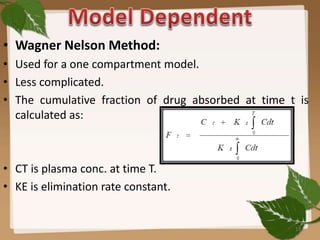
• Wagner Nelson Method:
• Used for a one compartment model.
• Less complicated.
• The cumulative fraction of drug absorbed at time t is
calculated as:
• CT is plasma conc. at time T.
• KE is elimination rate constant.
13
• LOO-Riegelman Method:
• Used for multi compartment system.
• More complicated.
• Fraction absorbed at any time t is given by:
• Xp T is amount of drug in peripheral
• compartment as a function of time
• Vc is apparent volume of distribution
• K10 is apparent first order elimination rate constant
14
• Numerical Approach:
• Alternative approach requiring in vivo plasma data from an
oral solution or iv dose
• Based on convolution integral equation
• The absorption rate R(abs )that results is in plasma
concentration
• c(t) may be estimated by solving following eq.
15
16
• Convolution Approach
• Input is converted into output.
• Single step approach
• Here in vitro dissolution profile is converted into plasma
concentration time profile.
• It can be done by model independent or model
dependent approaches, physiology based software's and
simulation can be applied.
• Then predicted plasma profile is compared with the real
plasma profile.
17
18
• They reflect the whole curve because all dissolution and
plasma level data points are used.
• They are excellent quality control procedures.
• More informative
• Very useful from regulatory point of view.
19
• An IVIVC should be evaluated to demonstrate that
predictability of the in vivo performance of a drug
product, from the in vitro dissolution characteristics of
the drug product formulations, is maintained over a
range of in vitro release rates
• Evaluation approaches focus on estimation of predictive
performance or prediction error.
• %PE= ( Observed-predicted/Observed)*100
20
Internal Predictability External Predictability
•Evaluates how well model
describes the data used to
define IVIVC
• based on the initial data sets
used to define the IVIVC
• Used for wide therapeutic
range drugs
•Used if formulations with 3
or more release rates were
Used
•Relates how well the model
predicts when one or more
additional data sets are used
• based on additional data
sets obtained from a
different (new) formulation
• Used for narrow therapeutic
range drugs
• Used if formulations with
only 2 release rates were
Used
21
Internal Predictability External Predictability
Acceptance Criteria
• Average %PE of 10% or
less for Cmax and AUC
• %PE for each formulation
should not exceed 15%
• If these criteria are not
met external predictability
should be performed.
Acceptance Criteria
• Average % PE of 10% or
less for Cmax and AUC
• %PE between 10-20%
demands for additional
data sets.
• %PE greater than 20%
indicates inadequate
predictability
22
• Uses the principles of statistical moment analysis
• The mean in vitro dissolution time is compared either to
the mean residence time (MRT) or to the mean in vivo
dissolution time.
• Is not a point-to-point correlation
• Reason - because a number of different in vivo curves
will produce similar mean residence time values.
• Level B correlations are rarely seen in NDAs
23
24
• One dissolution time point (t50% t90% etc.) is compared to
one mean pharmacokinetic parameter such as AUC, Tmax ,
Cmax
• A single point estimation and does not reflect the entire
shape of plasma drug concentration curve.
• Weakest level of correlation .
• Can be useful in early stages of formulation development
when pilot formulations are being selected
• Biowaiver not possible
25
26
• Relates one or several pharmacokinetic parameters of
interest (Cmax, AUC etc.) to the amount of drug dissolved
at several time points of the dissolution profile
• It should be based on at least 3 dissolution time points
covering early, middle and late stages of dissolution
profile.
27
• Level D correlation is a rank order and qualitative
analysis and is not considered useful for regulatory
purposes.
• It is not a formal correlation but serves as an aid in the
development of a formulation or processing procedure.
28
29
• IVIVC plays an important role in product development:-
• serves as a surrogate of in vivo and assists in supporting
biowaivers;
• supports and / or validates the use of dissolution
methods and specifications;
• assists in quality control during manufacturing and
selecting appropriate formulations.
30
31
• Leon Shargel,Susanna wu-pong,Andrew Yu.Applied
Biopharmaceutics and pharmacokinetics.6th edition,pg no
380-383.
• The Open Drug Delivery Journal, 2010, 4, 38-47Open
Access.
• Amitava Ghosh et al. / Journal of Pharmacy Research
2009, 2(8),1255-1260 .
• www.jpronline.info
32
33

IVIVC-

  • 1.
    Prepared by: GuidedBy: Yatindra Bhadankar Dr. Ravish J.Patel 18MPHTCH001 Assistant Professor M.Pharm(P.T) 1
  • 2.
  • 3.
    • Rapidity inDrug development can be achieved by researchers on finding a mathematical link between bioavailability and dissolution testing which leads to the concept of in vitro - in vivo correlation (IVIVC). • IVIVC is a mathematical model that can be used to estimate in vivo behavior from its in vitro performance. • Level A correlation is widely accepted by the regulatory agencies. 3
  • 4.
    • Biopharmaceutical ClassificationSystem (BCS) explains the suitability of IVIVC. • Dissolution method design plays a pivotal role in the estimation of correlations. • Apparatus qualification and guidelines,Several factors is other essential parameters in the study of IVIVC. 4
  • 5.
    • The UnitedStates Pharmacopoeia (USP) defines IVIVC as "the establishment of a relationship between a biological property, or a parameter derived from a biological property produced from a dosage form, and a physicochemical property of the same dosage form". • Food and Drug Administration (FDA) as "a predictive mathematical model describing the relationship between an in-vitro property of a dosage form and an in- vivo response". 5
  • 6.
    • Setting upof an in vitro release test that would serve as a surrogate for in vivo plasma profiles ( bioequivalence testing). • To minimize unnecessary human testing; • To set up biopharmaceutically meaningful in vitro release specifications. • Decreased regulatory burdens. • Minimization of cost and time required in additional • bioavailability studies 6
  • 7.
    • USP definedfive levels of correlation each of which denotes the ability to predict in vivo response of a dosage form from its in vitro property. • “Higher the level==== better is the correlation” 7
  • 8.
  • 9.
    • It isdefined as a hypothetical model describing the relationship between a fraction of drug absorbed and fraction of drug dissolved. • When in vitro curve and in vivo curve are super imposable, it is said to be 1:1 relationship, the relationship is called point-to-point relationship. • Level A correlation is the highest level of correlation and most preferred to achieve; since it allows bio waiver . 9
  • 10.
    • A LevelA correlation is usally estimated by a Two-stage procedure: 1)Deconvolution. 2) Evaluating the predictability. 10
  • 11.
    • Deconvolution: • Itsprocess where output (plasma conc. profile)is converted into input(in vivo dissolution of dosage form). • The plasma or urinary excretion data obtained in the definitive bioavailability study of MR dosage form are treated by deconvolution. • The resulting data represent the in vivo input rate of the dosage form. • It can also be called in vivo dissolution when the rate controlling step is dissolution rate. • Any deconvolution procedure will produce the acceptable results. 11
  • 12.
    Model Dependent ModelIndependent Wagner Nelson Method Numeric Deconvolution LOO- Riegelman Method 12
  • 13.
    • Wagner NelsonMethod: • Used for a one compartment model. • Less complicated. • The cumulative fraction of drug absorbed at time t is calculated as: • CT is plasma conc. at time T. • KE is elimination rate constant. 13
  • 14.
    • LOO-Riegelman Method: •Used for multi compartment system. • More complicated. • Fraction absorbed at any time t is given by: • Xp T is amount of drug in peripheral • compartment as a function of time • Vc is apparent volume of distribution • K10 is apparent first order elimination rate constant 14
  • 15.
    • Numerical Approach: •Alternative approach requiring in vivo plasma data from an oral solution or iv dose • Based on convolution integral equation • The absorption rate R(abs )that results is in plasma concentration • c(t) may be estimated by solving following eq. 15
  • 16.
  • 17.
    • Convolution Approach •Input is converted into output. • Single step approach • Here in vitro dissolution profile is converted into plasma concentration time profile. • It can be done by model independent or model dependent approaches, physiology based software's and simulation can be applied. • Then predicted plasma profile is compared with the real plasma profile. 17
  • 18.
  • 19.
    • They reflectthe whole curve because all dissolution and plasma level data points are used. • They are excellent quality control procedures. • More informative • Very useful from regulatory point of view. 19
  • 20.
    • An IVIVCshould be evaluated to demonstrate that predictability of the in vivo performance of a drug product, from the in vitro dissolution characteristics of the drug product formulations, is maintained over a range of in vitro release rates • Evaluation approaches focus on estimation of predictive performance or prediction error. • %PE= ( Observed-predicted/Observed)*100 20
  • 21.
    Internal Predictability ExternalPredictability •Evaluates how well model describes the data used to define IVIVC • based on the initial data sets used to define the IVIVC • Used for wide therapeutic range drugs •Used if formulations with 3 or more release rates were Used •Relates how well the model predicts when one or more additional data sets are used • based on additional data sets obtained from a different (new) formulation • Used for narrow therapeutic range drugs • Used if formulations with only 2 release rates were Used 21
  • 22.
    Internal Predictability ExternalPredictability Acceptance Criteria • Average %PE of 10% or less for Cmax and AUC • %PE for each formulation should not exceed 15% • If these criteria are not met external predictability should be performed. Acceptance Criteria • Average % PE of 10% or less for Cmax and AUC • %PE between 10-20% demands for additional data sets. • %PE greater than 20% indicates inadequate predictability 22
  • 23.
    • Uses theprinciples of statistical moment analysis • The mean in vitro dissolution time is compared either to the mean residence time (MRT) or to the mean in vivo dissolution time. • Is not a point-to-point correlation • Reason - because a number of different in vivo curves will produce similar mean residence time values. • Level B correlations are rarely seen in NDAs 23
  • 24.
  • 25.
    • One dissolutiontime point (t50% t90% etc.) is compared to one mean pharmacokinetic parameter such as AUC, Tmax , Cmax • A single point estimation and does not reflect the entire shape of plasma drug concentration curve. • Weakest level of correlation . • Can be useful in early stages of formulation development when pilot formulations are being selected • Biowaiver not possible 25
  • 26.
  • 27.
    • Relates oneor several pharmacokinetic parameters of interest (Cmax, AUC etc.) to the amount of drug dissolved at several time points of the dissolution profile • It should be based on at least 3 dissolution time points covering early, middle and late stages of dissolution profile. 27
  • 28.
    • Level Dcorrelation is a rank order and qualitative analysis and is not considered useful for regulatory purposes. • It is not a formal correlation but serves as an aid in the development of a formulation or processing procedure. 28
  • 29.
  • 30.
    • IVIVC playsan important role in product development:- • serves as a surrogate of in vivo and assists in supporting biowaivers; • supports and / or validates the use of dissolution methods and specifications; • assists in quality control during manufacturing and selecting appropriate formulations. 30
  • 31.
  • 32.
    • Leon Shargel,Susannawu-pong,Andrew Yu.Applied Biopharmaceutics and pharmacokinetics.6th edition,pg no 380-383. • The Open Drug Delivery Journal, 2010, 4, 38-47Open Access. • Amitava Ghosh et al. / Journal of Pharmacy Research 2009, 2(8),1255-1260 . • www.jpronline.info 32
  • 33.