P R E S E N T E D B Y
ZA H I D H U S A I N
M . P H A R M ( P H A R M A C E U T I C S )
FA C U LT Y O F P H A R M A C Y, I N T E G R A L
U N I V E R S I T Y, L U C K N O W
IV DISSOLUTION IV-IV
CORRELATIONS
DISSOLUTION
 A process in which a solid substance is solubilised in a given solvent i.e., mass
transfer from solid surface to liquid phase. (i.e., from solid to liquid)
(or)
 It is a process by which drug released from solid dosage form and immediately
goes into molecular solution.
 It is a Rate Determining Step
 If the drug is hydrophilic with high aqueous solubility then dissolution is rapid
and rate determining step in the absorption of such drugs is rate of permeation
through the bio membrane.
Absorption of such drugs is said to be
permeation rate limited or Tran’s membrane rate limited.
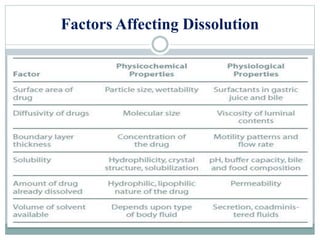
Factors Affecting Dissolution
In-Vitro Dissolution Testing
 Dissolution and drug release tests are in-vitro tests that measure the rate
and extent of dissolution or release of the drug substance from a drug
product, usually aqueous medium under specified conditions.
 It is an important QC procedure for the drug product and linked to
product performance in-vivo.
 NEED FOR DISSOLUTION TESTING:
 Evaluation of bioavailability.
 Batch to batch drug release uniformity.
 Development of more efficacious and therapeutically optical dosage
forms.
 Ensures quality and stability of the product.
 Product development, quality control, research and application.
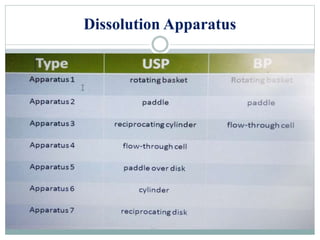
Dissolution Apparatus
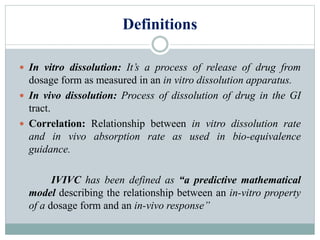
Definitions
 In vitro dissolution: It’s a process of release of drug from
dosage form as measured in an in vitro dissolution apparatus.
 In vivo dissolution: Process of dissolution of drug in the GI
tract.
 Correlation: Relationship between in vitro dissolution rate
and in vivo absorption rate as used in bio-equivalence
guidance.
IVIVC has been defined as “a predictive mathematical
model describing the relationship between an in-vitro property
of a dosage form and an in-vivo response”
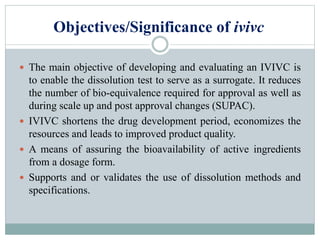
Objectives/Significance of ivivc
 The main objective of developing and evaluating an IVIVC is
to enable the dissolution test to serve as a surrogate. It reduces
the number of bio-equivalence required for approval as well as
during scale up and post approval changes (SUPAC).
 IVIVC shortens the drug development period, economizes the
resources and leads to improved product quality.
 A means of assuring the bioavailability of active ingredients
from a dosage form.
 Supports and or validates the use of dissolution methods and
specifications.
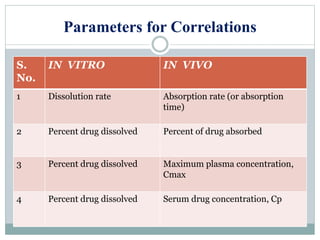
Parameters for Correlations
S.
No.
IN VITRO IN VIVO
1 Dissolution rate Absorption rate (or absorption
time)
2 Percent drug dissolved Percent of drug absorbed
3 Percent drug dissolved Maximum plasma concentration,
Cmax
4 Percent drug dissolved Serum drug concentration, Cp
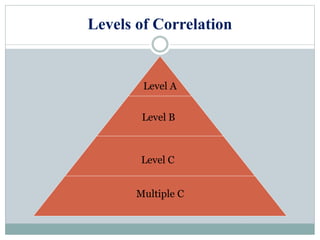
Levels of Correlation
Level A
Level B
Level C
Multiple C
Level A Correlation
• Highest category of correlation.
• Linear correlation.
• Superimposable in vitro and in vivo input curve
Or can be made superimposable by use of a
constant offset value.
• Most informative and useful from a regulatory
perspective.
Level B Correlation
• Uses the principles of statistical moment analysis
• The mean in vitro dissolution time is compared
either to the mean residence time (MRT) or to the
mean in vivo dissolution time.
• Is not a point-to-point correlation.
• Level B correlations are rarely seen in NDAs
Level C Correlation
 Level C correlation represents a single point
correlation.
 One dissolution time point (t50%, t90%, etc.) is
compared to one mean pharmacokinetic parameter
such as AUC, tmax or Cmax.
 Weakest level of correlation as partial relationship
between absorption and dissolution is established.
Multiple Level C Correlations
 Multiple Level C correlation relates one or several
pharmacokinetic parameters of interest (Cmax,
AUC, or any other suitable parameters) to the
amount of drug dissolved at several time points of
the dissolution profile.
 Its correlation is more meaningful than that of Level
C as several time points are considered.
IVIVC in Computer- Aided
Biopharmaceuticals
1. There are 2 approaches enabling the Gatroplus TM generated drug specific
absorption model to be used to assess the relationship between the in-vitro
and in-vivo data:-
 Convolution to predict the plasma concentration profile.
 Deconvolution to estimate the in-vitro dissolution profile.
2. Once IVIVC develops, an in-vitro dissolution test can identify the changes that
may affect the efficacy and safety of the drug products.
3. In the convolution approach, a set of in-vitro data representing different
dissolution scenario is used as the input function in Gatstroplus TM software
to estimate the expected drug plasma concentration time profile.
4. In the next step, the obtained profiles are compared
with mean drug plasma concentration profile observed
in-vivo in order to establish an IVIVC.
5. In the second approach i.e., deconvolution approach,
the GastroplusTM generated in-vivo dissolution profile
is plotted against the in-vitro obtained dissolution
profile, so that bio performance dissolution conditions
can be identified.
CONCLUSIONS
 The current IVIVC studies have focused more on the
development and validation of level A IVIVC which gives
more useful information on the relationship between in vitro
release and in vivo absorption from dosage form.
 Levels B and C IVIVCs have been evaluated for several
purposes in formulation development, for example, to select
the appropriate excipients and optimize the manufacturing
processes.
 Present regulatory guidelines for IVIVC is only applicable to
oral conventional and modified release dosage forms;
however, further research is necessary to develop IVIVCs for
non-oral products, inhaled medicines and dermatological
medicaments also.
References
 Leon Shargel, Susanna wu-pong, Andrew Yu. Applied
biopharmaceutics and pharmacokinetics. 6th edition, pg no-
380-383.
 Sundaramoorthi Nainar, Kingston Rajiah, Santhosam
Angamuthu, D Prabakaran and Ravisekhar Kasibhatta.
Biopharmaceutical Classification System in In-vitro/In-vivo
Correlation: Concept and Development Strategies in Drug
Delivery. Tropical Journal of Pharmaceutical Research April
2012; 11 (2): 319-329
 Rabindranath pal, Manas Chakraborty, Rabindra Debnath and
Bijan K Gupta. In vitro-In vivo Correlation (IVIVC) study of
Leflunomide loaded microspheres. International Journal of
Pharmacy and Pharmaceutical Sciences, Vol. 1, Suppl 1, Nov.-
Dec. 2009
Cont…
 Hitesh Jain , Kruti Joshi1, Shweta Gediya, Vishal
Sutariya, Hirak Shah, T. Y. Pasha. IN VITRO IN VIVO
CORRELATION (IVIVC): A REVIEW. Imperial Journal of
Pharmaceutics & Cosmetology.
THANK
YOU

Iv dissolution iviv corelation

  • 1.
    P R ES E N T E D B Y ZA H I D H U S A I N M . P H A R M ( P H A R M A C E U T I C S ) FA C U LT Y O F P H A R M A C Y, I N T E G R A L U N I V E R S I T Y, L U C K N O W IV DISSOLUTION IV-IV CORRELATIONS
  • 2.
    DISSOLUTION  A processin which a solid substance is solubilised in a given solvent i.e., mass transfer from solid surface to liquid phase. (i.e., from solid to liquid) (or)  It is a process by which drug released from solid dosage form and immediately goes into molecular solution.  It is a Rate Determining Step  If the drug is hydrophilic with high aqueous solubility then dissolution is rapid and rate determining step in the absorption of such drugs is rate of permeation through the bio membrane. Absorption of such drugs is said to be permeation rate limited or Tran’s membrane rate limited.
  • 3.
  • 4.
    In-Vitro Dissolution Testing Dissolution and drug release tests are in-vitro tests that measure the rate and extent of dissolution or release of the drug substance from a drug product, usually aqueous medium under specified conditions.  It is an important QC procedure for the drug product and linked to product performance in-vivo.  NEED FOR DISSOLUTION TESTING:  Evaluation of bioavailability.  Batch to batch drug release uniformity.  Development of more efficacious and therapeutically optical dosage forms.  Ensures quality and stability of the product.  Product development, quality control, research and application.
  • 5.
  • 6.
    Definitions  In vitrodissolution: It’s a process of release of drug from dosage form as measured in an in vitro dissolution apparatus.  In vivo dissolution: Process of dissolution of drug in the GI tract.  Correlation: Relationship between in vitro dissolution rate and in vivo absorption rate as used in bio-equivalence guidance. IVIVC has been defined as “a predictive mathematical model describing the relationship between an in-vitro property of a dosage form and an in-vivo response”
  • 7.
    Objectives/Significance of ivivc The main objective of developing and evaluating an IVIVC is to enable the dissolution test to serve as a surrogate. It reduces the number of bio-equivalence required for approval as well as during scale up and post approval changes (SUPAC).  IVIVC shortens the drug development period, economizes the resources and leads to improved product quality.  A means of assuring the bioavailability of active ingredients from a dosage form.  Supports and or validates the use of dissolution methods and specifications.
  • 8.
    Parameters for Correlations S. No. INVITRO IN VIVO 1 Dissolution rate Absorption rate (or absorption time) 2 Percent drug dissolved Percent of drug absorbed 3 Percent drug dissolved Maximum plasma concentration, Cmax 4 Percent drug dissolved Serum drug concentration, Cp
  • 9.
    Levels of Correlation LevelA Level B Level C Multiple C
  • 10.
    Level A Correlation •Highest category of correlation. • Linear correlation. • Superimposable in vitro and in vivo input curve Or can be made superimposable by use of a constant offset value. • Most informative and useful from a regulatory perspective.
  • 11.
    Level B Correlation •Uses the principles of statistical moment analysis • The mean in vitro dissolution time is compared either to the mean residence time (MRT) or to the mean in vivo dissolution time. • Is not a point-to-point correlation. • Level B correlations are rarely seen in NDAs
  • 12.
    Level C Correlation Level C correlation represents a single point correlation.  One dissolution time point (t50%, t90%, etc.) is compared to one mean pharmacokinetic parameter such as AUC, tmax or Cmax.  Weakest level of correlation as partial relationship between absorption and dissolution is established.
  • 13.
    Multiple Level CCorrelations  Multiple Level C correlation relates one or several pharmacokinetic parameters of interest (Cmax, AUC, or any other suitable parameters) to the amount of drug dissolved at several time points of the dissolution profile.  Its correlation is more meaningful than that of Level C as several time points are considered.
  • 14.
    IVIVC in Computer-Aided Biopharmaceuticals 1. There are 2 approaches enabling the Gatroplus TM generated drug specific absorption model to be used to assess the relationship between the in-vitro and in-vivo data:-  Convolution to predict the plasma concentration profile.  Deconvolution to estimate the in-vitro dissolution profile. 2. Once IVIVC develops, an in-vitro dissolution test can identify the changes that may affect the efficacy and safety of the drug products. 3. In the convolution approach, a set of in-vitro data representing different dissolution scenario is used as the input function in Gatstroplus TM software to estimate the expected drug plasma concentration time profile.
  • 15.
    4. In thenext step, the obtained profiles are compared with mean drug plasma concentration profile observed in-vivo in order to establish an IVIVC. 5. In the second approach i.e., deconvolution approach, the GastroplusTM generated in-vivo dissolution profile is plotted against the in-vitro obtained dissolution profile, so that bio performance dissolution conditions can be identified.
  • 16.
    CONCLUSIONS  The currentIVIVC studies have focused more on the development and validation of level A IVIVC which gives more useful information on the relationship between in vitro release and in vivo absorption from dosage form.  Levels B and C IVIVCs have been evaluated for several purposes in formulation development, for example, to select the appropriate excipients and optimize the manufacturing processes.  Present regulatory guidelines for IVIVC is only applicable to oral conventional and modified release dosage forms; however, further research is necessary to develop IVIVCs for non-oral products, inhaled medicines and dermatological medicaments also.
  • 17.
    References  Leon Shargel,Susanna wu-pong, Andrew Yu. Applied biopharmaceutics and pharmacokinetics. 6th edition, pg no- 380-383.  Sundaramoorthi Nainar, Kingston Rajiah, Santhosam Angamuthu, D Prabakaran and Ravisekhar Kasibhatta. Biopharmaceutical Classification System in In-vitro/In-vivo Correlation: Concept and Development Strategies in Drug Delivery. Tropical Journal of Pharmaceutical Research April 2012; 11 (2): 319-329  Rabindranath pal, Manas Chakraborty, Rabindra Debnath and Bijan K Gupta. In vitro-In vivo Correlation (IVIVC) study of Leflunomide loaded microspheres. International Journal of Pharmacy and Pharmaceutical Sciences, Vol. 1, Suppl 1, Nov.- Dec. 2009
  • 18.
    Cont…  Hitesh Jain, Kruti Joshi1, Shweta Gediya, Vishal Sutariya, Hirak Shah, T. Y. Pasha. IN VITRO IN VIVO CORRELATION (IVIVC): A REVIEW. Imperial Journal of Pharmaceutics & Cosmetology.
  • 19.