www.oeclib.in
Submitted By:
Odisha Electronics Control Library
Seminar
On
JAVA RING
 What is a java ring?
 History
 Components
 Working
 Security
 Applications
 Advantages
 Disadvantages
 Conclusion
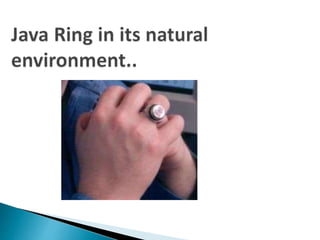
 Is a finger ring that contains a small microprocessor
with built in capabilities for the user.
 Is a sort of a smartcard that is wearable on a finger.
 Is in fact a java smart card based on Java Virtual
Machine that was proposed as the Java card 2.0.
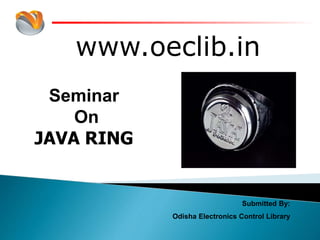
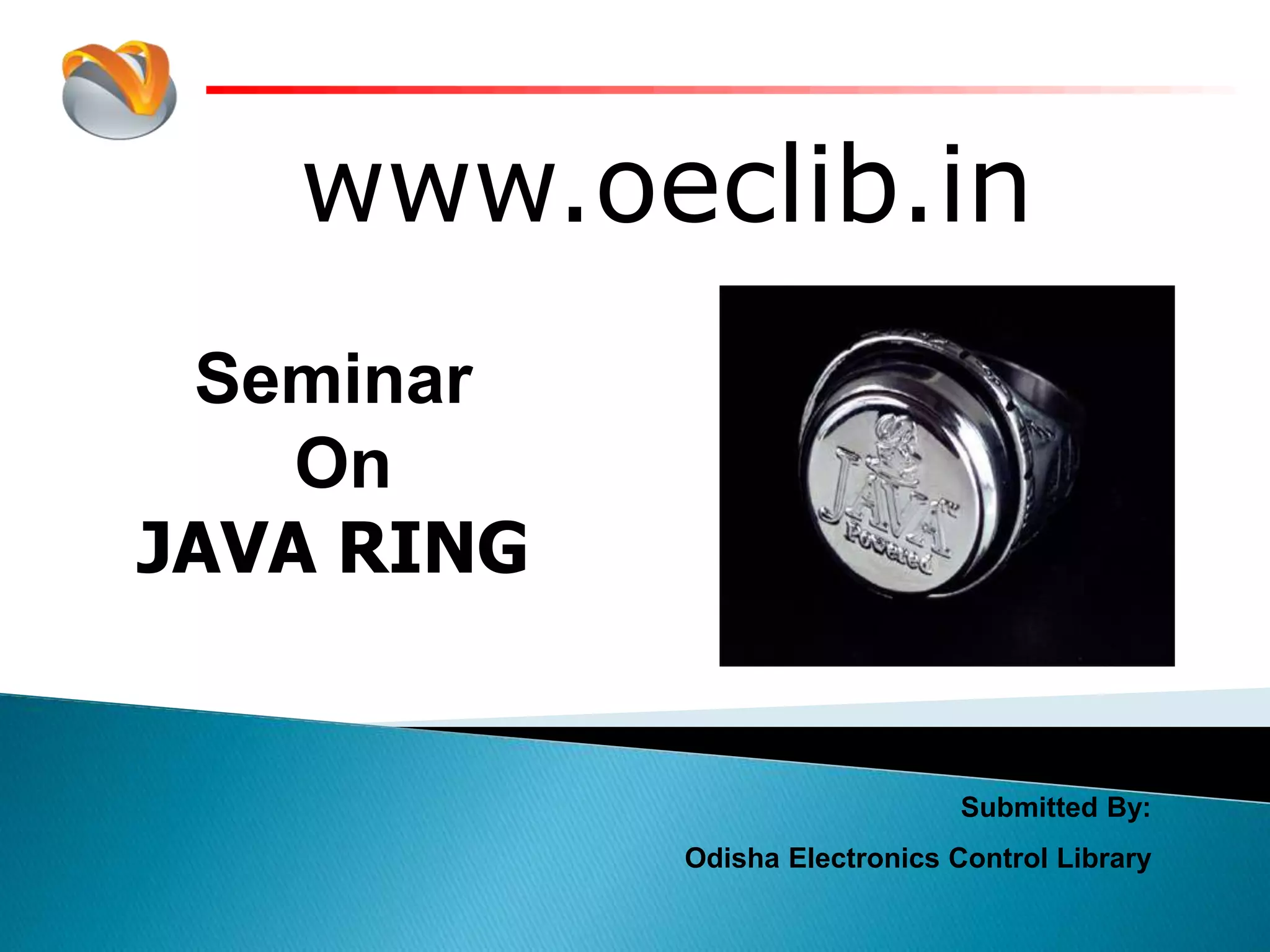
 The Java Ring is a stainless-steel ring, 16-millimeters
(0.6 inches) in diameter, that houses a 1-million-
transistor processor, called an iButton.
 The ring has 134 KB of RAM, 32 KB of ROM, a
real-time clock and a Java virtual machine, which is a
piece of software that recognizes the Java language
and translates it for the user's computer system
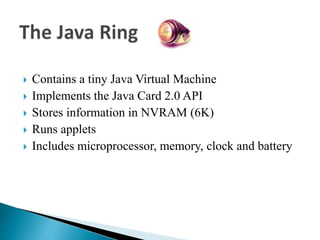
 Contains a tiny Java Virtual Machine
 Implements the Java Card 2.0 API
 Stores information in NVRAM (6K)
 Runs applets
 Includes microprocessor, memory, clock and battery
 The java ring, which is powered by Java card was
introduced at Sun Microsystems's JavaOne
Conference, in March 1998.
 It was developed by Dallas Semiconductor.
 Workstations at the conference had "ring readers"
installed on them that downloaded information about
the user from the conference registration system.
 This information was then used to enable a number of
personalized services.
 Java ring has been tested at Celebration School,
an innovative K-12 school, just outside
Orlando, FL. The rings are given to students
and have been programmed to;
 store electronic cash to pay for lunches
 automatically unlock doors
 take attendance
 store medical information
 allow students to check out books.
Students simply press the signet of their
Java Ring, and it performs the desired function.
 The rings given to students are programmed with Java
applets that communicate with host applications on
networked systems. Applets are small applications that
are designed to be run within another application.
 The Java Ring is snapped into a reader, called a Blue
Dot receptor, to allow communication between a host
system and the Java Ring.
 Java Virtual Machine (JVM)
 RAM
 ROM
 real-time clock
 iButton
 Blue dot reciptor
 The java virtual machine is the piece of software that
recognizes the java language and translates the byte
Code.
 Java ring contains 134kb of non-volatile random
access memory .
 This non-volatile random access memory offers high
read/write speed.
 It also provides rapid zeroization.
 The java ring contains 32kb of ROM .
 Special kind of operating system called e-commerce
operating system is stored in the ROM
 Real time clock gives the exact time of the day and it
can run up to 10 years continuously .
 It is driven by a constant 32KHz crystal oscillator.
 In addition ,the frequency of the processor clock is
not constant ,ranges from 10-20MHz.
 This aspect prohibits hackers in obtaining the
information from the iButton.
 The iButton is a mechanical packaging standard that
places a 1-Wire component inside a small stainless steel
"button" similar to a disk-shaped battery.
 Each iButton has a unique and unalterable address laser
etched onto its chip inside the can.
 The address can be used as a key or identifier for each
iButton.
 iButtons are connected to 1-Wire bus systems by
means of a socket with contacts which touch the "lid"
and "base" of the canister.
 The connection can be fleeting, similar to swiping a
credit card through a reader. Semi-permanent
connections are possible with a different socket type.
(The iButton clips into it, but is easily removed).
 Unlike electrically erasable programmable read-only
memory (EEPROM), the NVRAM iButton memory
can be erased and rewritten as often as necessary
without wearing out.
 It can also be erased or rewritten at the high speeds
typical of complementary metal oxide semiconductor
(CMOS) memory, without requiring the time-
consuming programming of EEPROM
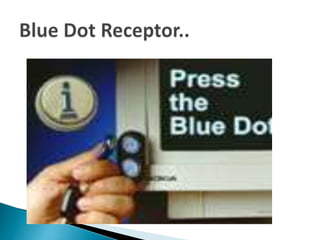
 The Blue Dot Receptors are iButton reader/probes
that provide a convenient pipeline into the PC for
iButton-to-PC communication.
 The receptor's cable connects to a USB, serial, or
parallel-port 1-Wire adapter, whichever type of port
you wish to use.
 The receptor itself easily affixes to any accessible
spot on the front of the PC.
 The user can elect a quick information transfer with
a momentary touch of the iButton to the Blue Dot.
 For hands-free operation the iButton can be snapped
into the Blue Dot and remain there.
 Each receptor contains two Blue Dots to
accommodate instances where multiple iButtons are
required for a transaction.
 Whenever the user pushes his ring on a ring
reader(Blue Dot Receptor), the corresponding
application will take place.
 The jewel of the java ring is the iButton.
 iButton is a computer chip enclosed in a thick
stainless steel can.
 It uses 1-wire protocol for communication with the
host and the iButton.
 Information is transferred between your iButton and a
PC with a momentary contact at up to 142kbps.
 You simply touch your iButton to a Blue Dot receptor
or other iButton probe, which is connected to a PC.
 The Blue Dot receptor is cabled to a 1-Wire adapter
that is attached to a spare PC port. 1-Wire adapters
exist for USB, serial, and parallel ports. The Blue Dot
receptor and 1-Wire Adapter are inexpensive
 The Java Card 2.0 architecture has taken client/server
architectures to a new place -- one where the "server"
is a small piece of software on an extremely small
system, and the client is a potentially huge piece of
software on a potentially much larger system.
 The network protocol is encapsulated in packets that
are called application program data units, or APDUs
for short.
 The smart card runtime code gets the first crack at
decoding the APDUs as they arrive on the serial
interface.
 Further, there are predefined APDUs that tell the
runtime to select an applet, delete applets, load
applets, and so on.
 Thus, errant applets are simply deleted by the
developer once it's ascertained that they aren't
responding correctly to the APDUs they receive
 The barrier substrate and the triple-layer metal
construction techniques employed in the silicon
fabrication effectively deny unauthorized access to
the data stored in the NVRAM. If any attempt is
made to penetrate these barriers, the NVRAM data is
immediately erased.
 Java rings are authorized through Personal
Identification Numbers (PINs) so that no one can
steal a person's ring and use that ring.
 Access Control
 Time and attendance
 eCash
 Thermochron Applications
 Gaming Systems
 A very easy and convenient way for users.
 More secure than using passwords.
 Portable.
 Ruggedness.
 Wearable.
 Provides authentication to users which is crucial for
many applications.
 Easier for administrator to maintain the security
infrastructure.
 Provides real memory, more power, and a capacity
for dynamic programming.
 Parents and teachers will have less control over
children and students
 Loss of privacy
 The java powered cryptographic iButton named java
ring can readily support the commerce models that have
traditionally been the province of credit cards.
 Its greatest promise appears to lie in its capacity to
interact with Internet applications to support strong
remote authentication and remotely authorized financial
transactions.
 The use of Java promotes compatibility with these
applications by providing a common language for all
application programming.
 www.google.com
 www.wikipedia.com
 www.oeclib.in
Java Ring

Java Ring

  • 1.
    www.oeclib.in Submitted By: Odisha ElectronicsControl Library Seminar On JAVA RING
  • 2.
     What isa java ring?  History  Components  Working  Security  Applications  Advantages  Disadvantages  Conclusion
  • 3.
     Is afinger ring that contains a small microprocessor with built in capabilities for the user.  Is a sort of a smartcard that is wearable on a finger.  Is in fact a java smart card based on Java Virtual Machine that was proposed as the Java card 2.0.
  • 4.
     The JavaRing is a stainless-steel ring, 16-millimeters (0.6 inches) in diameter, that houses a 1-million- transistor processor, called an iButton.  The ring has 134 KB of RAM, 32 KB of ROM, a real-time clock and a Java virtual machine, which is a piece of software that recognizes the Java language and translates it for the user's computer system
  • 5.
     Contains atiny Java Virtual Machine  Implements the Java Card 2.0 API  Stores information in NVRAM (6K)  Runs applets  Includes microprocessor, memory, clock and battery
  • 7.
     The javaring, which is powered by Java card was introduced at Sun Microsystems's JavaOne Conference, in March 1998.  It was developed by Dallas Semiconductor.  Workstations at the conference had "ring readers" installed on them that downloaded information about the user from the conference registration system.  This information was then used to enable a number of personalized services.
  • 8.
     Java ringhas been tested at Celebration School, an innovative K-12 school, just outside Orlando, FL. The rings are given to students and have been programmed to;  store electronic cash to pay for lunches  automatically unlock doors  take attendance  store medical information  allow students to check out books. Students simply press the signet of their Java Ring, and it performs the desired function.
  • 9.
     The ringsgiven to students are programmed with Java applets that communicate with host applications on networked systems. Applets are small applications that are designed to be run within another application.  The Java Ring is snapped into a reader, called a Blue Dot receptor, to allow communication between a host system and the Java Ring.
  • 10.
     Java VirtualMachine (JVM)  RAM  ROM  real-time clock  iButton  Blue dot reciptor
  • 11.
     The javavirtual machine is the piece of software that recognizes the java language and translates the byte Code.
  • 12.
     Java ringcontains 134kb of non-volatile random access memory .  This non-volatile random access memory offers high read/write speed.  It also provides rapid zeroization.
  • 13.
     The javaring contains 32kb of ROM .  Special kind of operating system called e-commerce operating system is stored in the ROM
  • 14.
     Real timeclock gives the exact time of the day and it can run up to 10 years continuously .  It is driven by a constant 32KHz crystal oscillator.  In addition ,the frequency of the processor clock is not constant ,ranges from 10-20MHz.  This aspect prohibits hackers in obtaining the information from the iButton.
  • 15.
     The iButtonis a mechanical packaging standard that places a 1-Wire component inside a small stainless steel "button" similar to a disk-shaped battery.  Each iButton has a unique and unalterable address laser etched onto its chip inside the can.  The address can be used as a key or identifier for each iButton.
  • 17.
     iButtons areconnected to 1-Wire bus systems by means of a socket with contacts which touch the "lid" and "base" of the canister.  The connection can be fleeting, similar to swiping a credit card through a reader. Semi-permanent connections are possible with a different socket type. (The iButton clips into it, but is easily removed).
  • 18.
     Unlike electricallyerasable programmable read-only memory (EEPROM), the NVRAM iButton memory can be erased and rewritten as often as necessary without wearing out.  It can also be erased or rewritten at the high speeds typical of complementary metal oxide semiconductor (CMOS) memory, without requiring the time- consuming programming of EEPROM
  • 20.
     The BlueDot Receptors are iButton reader/probes that provide a convenient pipeline into the PC for iButton-to-PC communication.  The receptor's cable connects to a USB, serial, or parallel-port 1-Wire adapter, whichever type of port you wish to use.  The receptor itself easily affixes to any accessible spot on the front of the PC.
  • 22.
     The usercan elect a quick information transfer with a momentary touch of the iButton to the Blue Dot.  For hands-free operation the iButton can be snapped into the Blue Dot and remain there.  Each receptor contains two Blue Dots to accommodate instances where multiple iButtons are required for a transaction.
  • 23.
     Whenever theuser pushes his ring on a ring reader(Blue Dot Receptor), the corresponding application will take place.  The jewel of the java ring is the iButton.  iButton is a computer chip enclosed in a thick stainless steel can.  It uses 1-wire protocol for communication with the host and the iButton.
  • 24.
     Information istransferred between your iButton and a PC with a momentary contact at up to 142kbps.  You simply touch your iButton to a Blue Dot receptor or other iButton probe, which is connected to a PC.  The Blue Dot receptor is cabled to a 1-Wire adapter that is attached to a spare PC port. 1-Wire adapters exist for USB, serial, and parallel ports. The Blue Dot receptor and 1-Wire Adapter are inexpensive
  • 25.
     The JavaCard 2.0 architecture has taken client/server architectures to a new place -- one where the "server" is a small piece of software on an extremely small system, and the client is a potentially huge piece of software on a potentially much larger system.  The network protocol is encapsulated in packets that are called application program data units, or APDUs for short.
  • 26.
     The smartcard runtime code gets the first crack at decoding the APDUs as they arrive on the serial interface.  Further, there are predefined APDUs that tell the runtime to select an applet, delete applets, load applets, and so on.  Thus, errant applets are simply deleted by the developer once it's ascertained that they aren't responding correctly to the APDUs they receive
  • 27.
     The barriersubstrate and the triple-layer metal construction techniques employed in the silicon fabrication effectively deny unauthorized access to the data stored in the NVRAM. If any attempt is made to penetrate these barriers, the NVRAM data is immediately erased.  Java rings are authorized through Personal Identification Numbers (PINs) so that no one can steal a person's ring and use that ring.
  • 28.
     Access Control Time and attendance  eCash  Thermochron Applications  Gaming Systems
  • 29.
     A veryeasy and convenient way for users.  More secure than using passwords.  Portable.  Ruggedness.  Wearable.
  • 30.
     Provides authenticationto users which is crucial for many applications.  Easier for administrator to maintain the security infrastructure.  Provides real memory, more power, and a capacity for dynamic programming.
  • 31.
     Parents andteachers will have less control over children and students  Loss of privacy
  • 32.
     The javapowered cryptographic iButton named java ring can readily support the commerce models that have traditionally been the province of credit cards.  Its greatest promise appears to lie in its capacity to interact with Internet applications to support strong remote authentication and remotely authorized financial transactions.  The use of Java promotes compatibility with these applications by providing a common language for all application programming.
  • 33.