DEFINITION OF JAUNDICE
It is a yellow discoloration of the skin and
sclerae that results from elevated levels of
bilirubin, which comes from the break
down products of haemoglobin (haem
part) that results from RBCs destruction.
03/18/25
5
CT..
Combined overproduction andunder
secretion ( e.g. in sepsis)
Some disease states (hypothyroidism
as there is impaired metabolism)
Prematurity
03/18/25
7
8.
NORMAL PHYSIOLOGY
Bilirubin source-breakdownof
haemoglobin from old red blood
cells.
Soon after production of bilirubin, it
is insoluble in water hence called
unconjugated bilirubin (indirect).03/18/25
8
9.
CT..
The unconjugated bilirubinis
transported in the blood by binding
on to albumin.
In the liver, it is conjugated with
glucuronic acid in the presence of
Glucuronyl transferase, 03/18/25
9
10.
Ct..
To produce ahighly soluble
substance, conjugated bilirubin,
which is then excreted in the bile
into the intestines.
03/18/25
10
11.
Cont…
In the intestinebacterial action
reduces the conjugated bilirubin
Then most of it is excreted in
stools as stercobilin, and small
amount in urine. 03/18/25
11
12.
CLASSIFICATION OF JAUNDICE
Jaundicecan be caused by several
factors. These are classified into three:
– Pre-hepatic jaundice(haemolytic)
– Hepatic jaundice
– Post-hepatic jaundice (obstructive)
03/18/25
12
Ct…
This overloads theliver’s
conjugating ability and excess
unconjugated bilirubin accumulates
in the blood
however, it cannot be excreted by
the kidneys. 03/18/25
15
16.
CT..
But the livercontinues to
excrete normal amounts of
conjugated bilirubin in the
bile, as a result stools are
normal in colour.
03/18/25
16
17.
HAEMOLYTIC JAUNDICE CT’D
Thebilirubin is water-insoluble but fat
soluble therefore able to cross the blood-
brain- barrier when high enough.
This causes Kernicterus in babies occurs
even soon after birth.
03/18/25
17
18.
CAUSES
ABO bloodgroup incompatibility
(commonest) e.g. in blood transfusion
Rhesus blood group incompatibility
Glucose-6-phosphate dehydrogenase
(G6PD) deficiency (is a non-immune
haemolytic disorder) 03/18/25
18
HEPATIC (HEPATOCELLULAR
JAUNDICE)
Damageto the liver- loss of conjugating ability
Blockage to outflow of conjugated bilirubin
(swelling of damaged cells which obstruct
small bile ducts).
This lead to dark urine, and pale stools
(conjugated bilirubin leaks back into the blood
and is excreted by the urine instead.)
03/18/25
20
21.
``````````
Attributed toalteration in the liver`s ability to
take up bilirubin from the blood circulation or
excrete it into the bile.
Mostly caused by diseased liver cells
(hepatocellular diseases)
This compromises conjugating ability and there
is also blockage to outflow of conjugated
bilirubin 03/18/25
21
22.
.
The conjugatedbilirubin leaks back to
the circulation and is secreted in urine
leading to passage of darkish urine and
pale stools
Common causes include hepatitis A & B,
liver cirrhosis, hepatocellular cancer
03/18/25
22
23.
Common Causes Cont…
Infections(malaria, typhoid)
Drugs e.g. Nevirapine
Toxins
Metabolic defects like Galactosaemia
(hereditary carbohydrate disorder where
enzymes for galactose metabolism is absent)
03/18/25
23
24.
POST-HEPATIC OBSTRUCTIVE
JAUNDICE
Failureof bile to reach the duodenum due
to obstruction of the bile flow
Obstruction to excretion of bilirubin through
the biliary system resulting in pale stools
and dark urine.
Thus also called obstructive or cholestatic
jaundice 03/18/25
24
Management
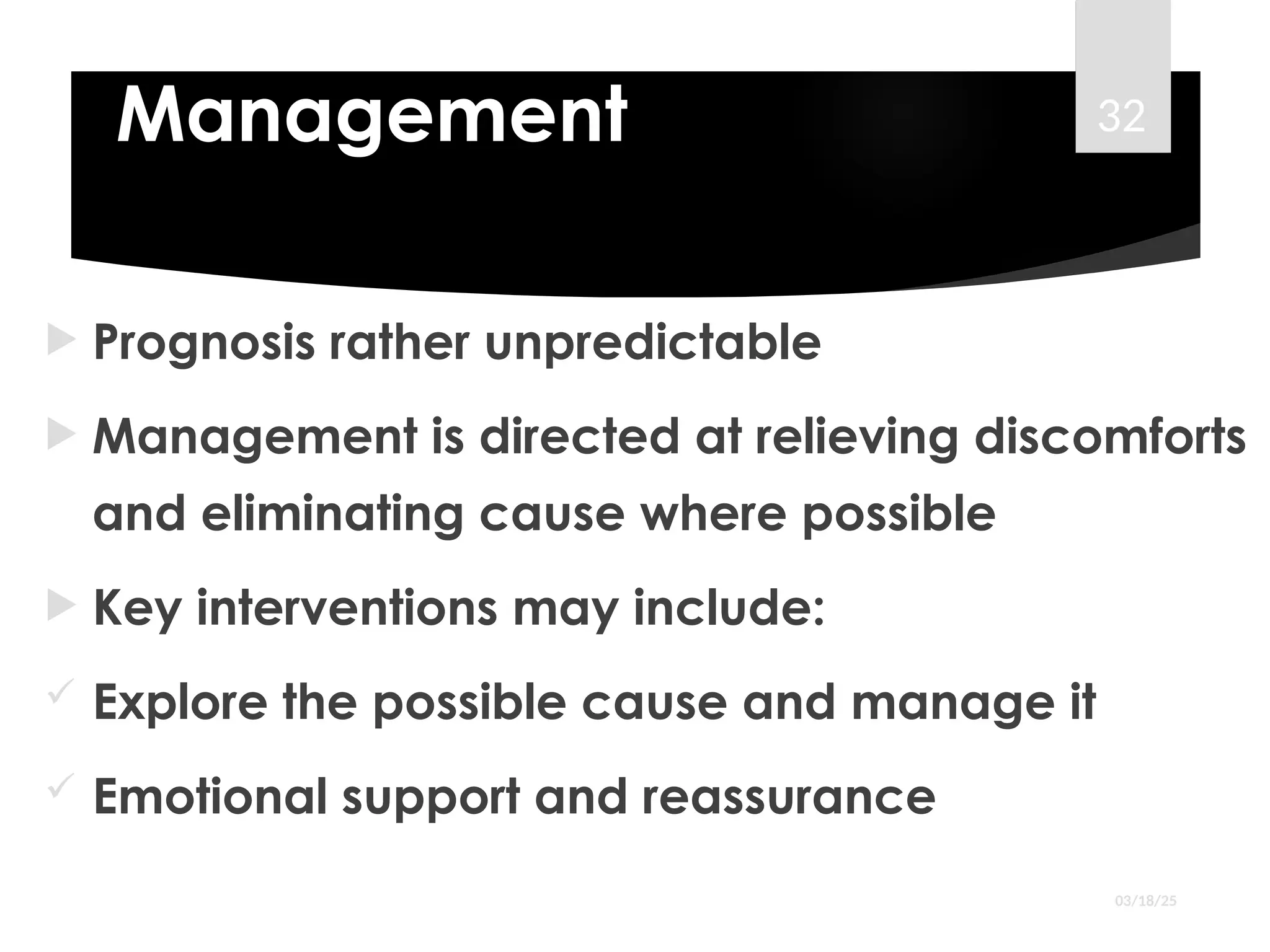
Prognosis ratherunpredictable
Management is directed at relieving discomforts
and eliminating cause where possible
Key interventions may include:
Explore the possible cause and manage it
Emotional support and reassurance
03/18/25
32
Nursing Management
The therapyis directed at preventing blood
unconjugated bilirubin from reaching neurotoxic
levels. Underlying causes such as sepsis must be
treated with prescribed antibiotics.
Assess and document degree of jaundice of skin
and sclera.
Provide psychological support to reduce anxiety.
03/18/25
35
36.
Reinforce thedoctor’s explanation about
the cause and expected outcome of
jaundice, and encourage the client to
express feelings and concerns about body-
image changes.
Promote adequate nutrition. 03/18/25
36
37.
Ct.
Advice topt for restrict fat intake
Provide high protein diet
High carbohydrate diet take roughage
for digestion
Provide plenty of fluids, juices
Give glucose water
Maintain hydration status
Maintain intake and output chart 03/18/25
37
38.
Ct..
For itchingskin give antihistamines such as
promethazine 25mg orally tds
Antihistamine creams to reduce itching
Diazepam 10mg Po/Im to promote relaxation
and sleep and reduce restlessness
Vitamin supplements Vit B12 and vit K
03/18/25
38
39.
Ct..
Watch patientfor signs of haemorrhage
Avoid pricking patient unnecessarily to
prevent bleeding
Avoid IM injections whenever possible
Cut fingernails
03/18/25
39
40.
Ct..
Give healthinformation to patient and family on
Condition, cause and care and protection
Educate on diet
Taking fluids
Skin protection
Complications
Prognosis
Watch for signs of haemorrhage
03/18/25
40
41.
NURSING DIAGNOSIS
Impairedskin integrity related to pururitis.
Risk of haemorrhage related to disturbed
prothrombin factor
Constipation related to disease process
Abdominal pain related to disease
Anxiety related to disease condition
Altered nutrition less than body requirement
related to constipation & abdominal pain &
discomfort. 03/18/25
41






![Simulation based learning _Rev[1].ppt JOAB.ppt](https://cdn.slidesharecdn.com/ss_thumbnails/emamatiyafinalrev1-250309104337-a8877e76-thumbnail.jpg?width=640&height=640&fit=bounds)
![INTER-PERSONAL COMMUNICATION IN NURSING [1].pptx](https://cdn.slidesharecdn.com/ss_thumbnails/inter-communication1-250309103945-e946794c-thumbnail.jpg?width=640&height=640&fit=bounds)
![Upper_resp_tract_edited_for_2024_cohort[1].pptx](https://cdn.slidesharecdn.com/ss_thumbnails/upperresptracteditedfor2024cohort1-250225134620-84a86c8f-thumbnail.jpg?width=640&height=640&fit=bounds)
![20971INTRODUCTION_TO_HIV&AIDS for nursing students[1].ppt](https://cdn.slidesharecdn.com/ss_thumbnails/20971introductiontohivaids1-250225134220-578a1188-thumbnail.jpg?width=640&height=640&fit=bounds)

![4. EDUCATIONAL PSYCHOLOGY EDITED[1].pptx](https://cdn.slidesharecdn.com/ss_thumbnails/4-250224085157-3c676047-thumbnail.jpg?width=640&height=640&fit=bounds)
![The Immune system edited for 2024 cohort[1].pptx](https://cdn.slidesharecdn.com/ss_thumbnails/theimmunesystemeditedfor2024cohort1-250224085036-4b3e6a28-thumbnail.jpg?width=640&height=640&fit=bounds)


![Pneumocystis_jirovecii_pneumonia[1].pptx](https://cdn.slidesharecdn.com/ss_thumbnails/malamulo-pneumocystisjiroveciipneumonia1-241127111242-957cc6eb-thumbnail.jpg?width=640&height=640&fit=bounds)
![management of Chest_trauma for nursing [1].ppt](https://cdn.slidesharecdn.com/ss_thumbnails/malamulochesttrauma1-241127110255-71befbaa-thumbnail.jpg?width=640&height=640&fit=bounds)
![Chest_trauma types and management[1].ppt](https://cdn.slidesharecdn.com/ss_thumbnails/malamulochesttrauma1-241126062258-4b388e87-thumbnail.jpg?width=640&height=640&fit=bounds)
![ASTHMA_IN_CHILDREN for NURSING STUDENT[1].pptx](https://cdn.slidesharecdn.com/ss_thumbnails/malamuloasthmainchildren1-241125202930-914bc525-thumbnail.jpg?width=640&height=640&fit=bounds)
![Acute Respiratory Infection Guidelines(ARI)__PRESENTATION[1].pptx](https://cdn.slidesharecdn.com/ss_thumbnails/aripresentation1-241114171345-63d1411f-thumbnail.jpg?width=640&height=640&fit=bounds)
![Acute Respiratory Infections(ARI)__PRESENTATION[1].pptx](https://cdn.slidesharecdn.com/ss_thumbnails/aripresentation1-241020112302-e350d353-thumbnail.jpg?width=640&height=640&fit=bounds)
![ECTOPIC_PREGNANCY_disorders of reproductive organs_1_(3)[1].ppt](https://cdn.slidesharecdn.com/ss_thumbnails/ectopicpregnancyupg131-241020092422-a0e8252f-thumbnail.jpg?width=640&height=640&fit=bounds)
![BURNS assessment and management_GRP_1_PPT[1].pptx](https://cdn.slidesharecdn.com/ss_thumbnails/burnsgrp1ppt1-241020072724-5845af38-thumbnail.jpg?width=640&height=640&fit=bounds)
![Integrated Management -IMNCI_case_management_process[1].pptx](https://cdn.slidesharecdn.com/ss_thumbnails/imncicasemanagementprocess1-241018200546-4cf422ad-thumbnail.jpg?width=640&height=640&fit=bounds)


