THE ORIGIN OF FOLDING SCREENS
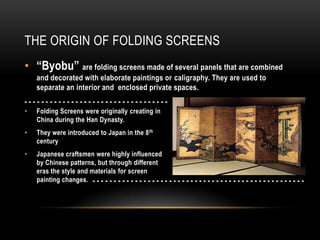
• “Byobu” are folding screens made of several panels that are combined
    and decorated with elaborate paintings or caligraphy. They are used to
    separate an interior and enclosed private spaces.
----------------------------------
•   Folding Screens were originally creating in
    China during the Han Dynasty.
•   They were introduced to Japan in the 8 th
    century
•   Japanese craftsmen were highly influenced
    by Chinese patterns, but through different
    eras the style and materials for screen
    painting changes. - - - - - - - - - - - - - - - - - - - - - - - - - - - - - - - - - - - - - - - - - - - - - - - - - -
HISTORY OF JAPANESE SCREEN PAINTING
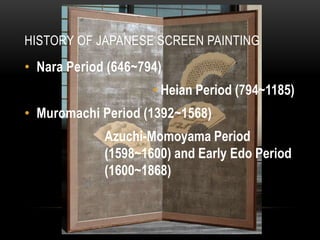
• Nara Period (646~794)
                     • Heian Period (794~1185)
• Muromachi Period (1392~1568)
             Azuchi-Momoyama Period
             (1598~1600) and Early Edo Period
             (1600~1868)
NARA PERIOD
•   Byobu’s are used as furnishing is the
    imperial court and in important
    ceremonies
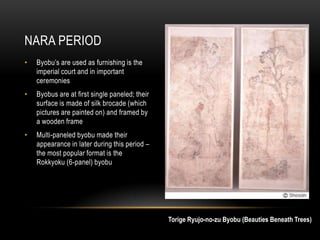
•   Byobus are at first single paneled; their
    surface is made of silk brocade (which
    pictures are painted on) and framed by
    a wooden frame
•   Multi-paneled byobu made their
    appearance in later during this period –
    the most popular format is the
    Rokkyoku (6-panel) byobu


                                                Torige Ryujo-no-zu Byobu (Beauties Beneath Trees)
HEIAN PERIOD
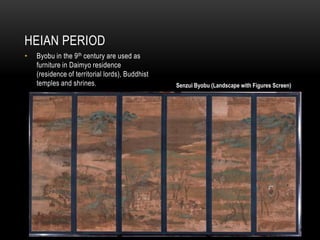
•   Byobu in the 9 th century are used as
    furniture in Daimyo residence
    (residence of territorial lords), Buddhist
    temples and shrines.                         Senzui Byobu (Landscape with Figures Screen)
MUROMACHI PERIOD
•   Byobus are more popular and public around this era – they can to found in dojos and
    shops.
•   They are usually Nikyoku (2 panel) byobu because that way it is more convenient to fold
    and carry.
•   The themes are often monochromatic, Nature-themed, or famous landscapes in Japan.
AZUCHI-MOMOYAMA PERIOD AND EDO PERIOD
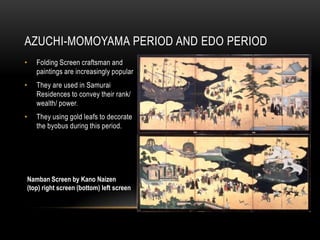
•   Folding Screen craftsman and
    paintings are increasingly popular
•   They are used in Samurai
    Residences to convey their rank/
    wealth/ power.
•   They using gold leafs to decorate
    the byobus during this period.


Namban Screen by Kano Naizen
(top) right screen (bottom) left screen
TYPES OF BYOBU –
CLASSIFIED BY NUMBERS OF PANELS
  1.   Tsuitate (衝立)
  2.   Nikyoku byobu (二曲屏風) or Nimaiori byobu (二枚折屏風)
       • Also known as furosaki byobu (風炉先屏風) for tea
         ceremonies
  3.   Yonkyoku byobu (四曲屏風)
  4.   Rokkyoku byobu (六曲屏風) or Rokumaiori byobu (六枚折屏風)
  5.   Jukyoku byobu (十曲屏風)
TYPES OF BYOBU –
 CLASSIFIED BY NUMBERS OF PANELS


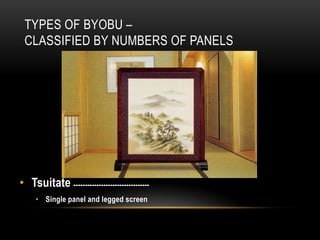
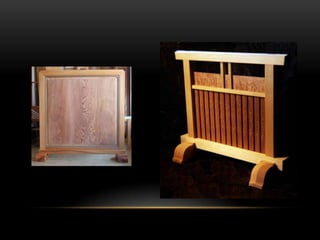
• Tsuitate ---------------------------------
     • Single panel and legged screen
TYPES OF BYOBU –
 CLASSIFIED BY NUMBERS OF PANELS


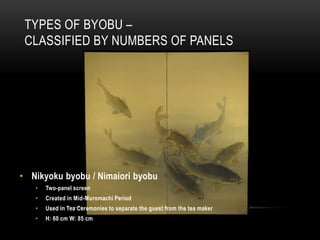
• Nikyoku byobu / Nimaiori byobu
   •   Two-panel screen
   •   Created in Mid-Muromachi Period
   •   Used in Tea Ceremonies to separate the guest from the tea maker
   •   H: 60 cm W: 85 cm
TYPES OF BYOBU –
CLASSIFIED BY NUMBERS OF PANELS


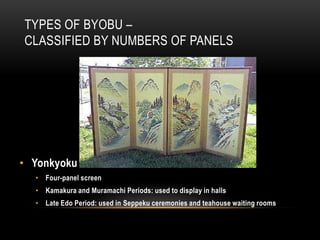
• Yonkyoku
  • Four-panel screen
  • Kamakura and Muramachi Periods: used to display in halls
  • Late Edo Period: used in Seppeku ceremonies and teahouse waiting rooms
TYPES OF BYOBU –
CLASSIFIED BY NUMBERS OF PANELS


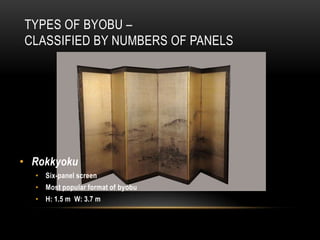
• Rokkyoku
  • Six-panel screen
  • Most popular format of byobu
  • H: 1.5 m W: 3.7 m
TYPES OF BYOBU –
CLASSIFIED BY NUMBERS OF PANELS


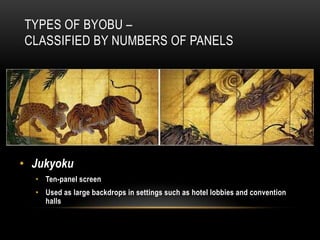
• Jukyoku
  • Ten-panel screen
  • Used as large backdrops in settings such as hotel lobbies and convention
    halls
TYPES OF BYOBU –
CLASSIFIED BY PURPOSE AND THEMES
  1.   Furosaki byobu (風炉先屏風)
  2.   Ga no byobu (賀の屏風)
  3.   Shiro-e byobu (白絵屏風)
       • Also known as Ubuya byobu (産所屏風) – in birth giving rooms
  4.   Makura byobu (枕屏風)
  5.   Koshi byobu (腰屏風)
TYPES OF BYOBU –
CLASSIFIED BY PURPOSE AND THEMES


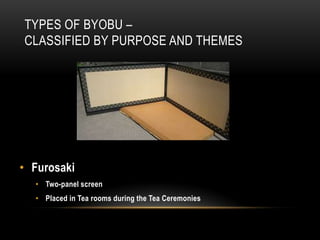
• Furosaki
  • Two-panel screen
  • Placed in Tea rooms during the Tea Ceremonies
TYPES OF BYOBU –
 CLASSIFIED BY PURPOSE AND THEMES


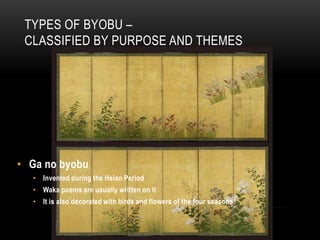
• Ga no byobu
  • Invented during the Heian Period
  • Waka poems are usually written on it
  • It is also decorated with birds and flowers of the four seasons
TYPES OF BYOBU –
CLASSIFIED BY PURPOSE AND THEMES


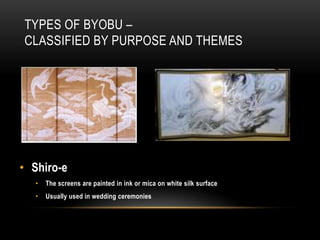
• Shiro-e
   •   The screens are painted in ink or mica on white silk surface
   •   Usually used in wedding ceremonies
TYPES OF BYOBU –
CLASSIFIED BY PURPOSE AND THEMES


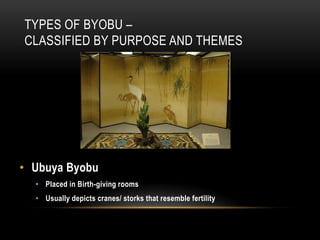
• Ubuya Byobu
  • Placed in Birth-giving rooms
  • Usually depicts cranes/ storks that resemble fertility
TYPES OF BYOBU –
CLASSIFIED BY PURPOSE AND THEMES


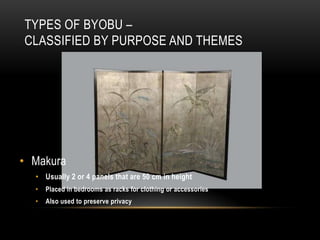
• Makura
  • Usually 2 or 4 panels that are 50 cm in height
  •   Placed in bedrooms as racks for clothing or accessories
  •   Also used to preserve privacy
TYPES OF BYOBU –
CLASSIFIED BY PURPOSE AND THEMES


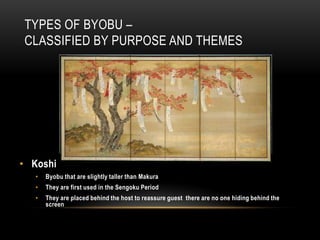
• Koshi
   •   Byobu that are slightly taller than Makura
   •   They are first used in the Sengoku Period
   •   They are placed behind the host to reassure guest there are no one hiding behind the
       screen
SOURCES
•   http://web-japan.org/museum/byobu/byobu.html
•   http://en.wikipedia.org/wiki/By%C5%8Dbu

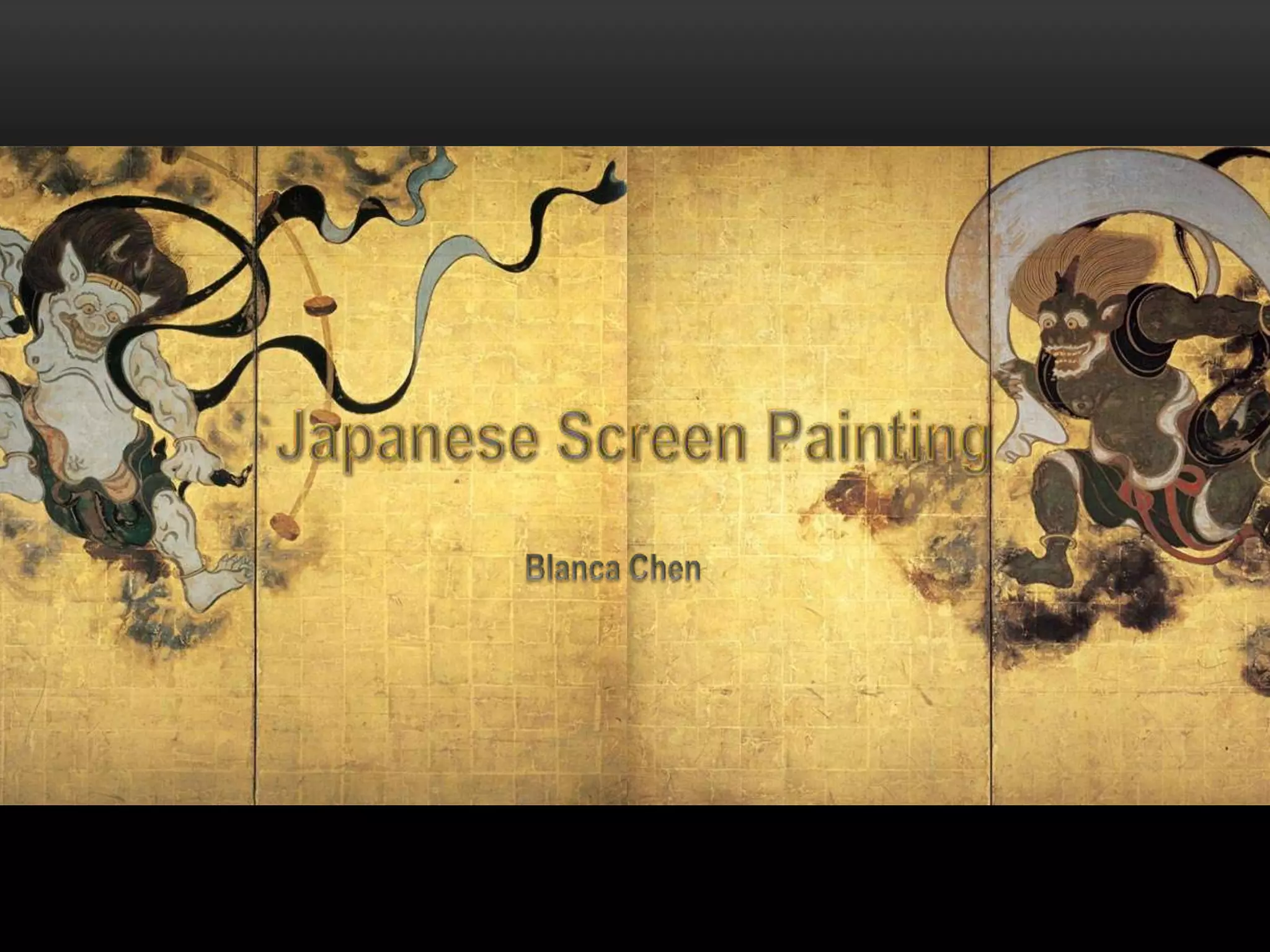
Japanese screen painting

  • 2.
    THE ORIGIN OFFOLDING SCREENS • “Byobu” are folding screens made of several panels that are combined and decorated with elaborate paintings or caligraphy. They are used to separate an interior and enclosed private spaces. ---------------------------------- • Folding Screens were originally creating in China during the Han Dynasty. • They were introduced to Japan in the 8 th century • Japanese craftsmen were highly influenced by Chinese patterns, but through different eras the style and materials for screen painting changes. - - - - - - - - - - - - - - - - - - - - - - - - - - - - - - - - - - - - - - - - - - - - - - - - - -
  • 3.
    HISTORY OF JAPANESESCREEN PAINTING • Nara Period (646~794) • Heian Period (794~1185) • Muromachi Period (1392~1568) Azuchi-Momoyama Period (1598~1600) and Early Edo Period (1600~1868)
  • 4.
    NARA PERIOD • Byobu’s are used as furnishing is the imperial court and in important ceremonies • Byobus are at first single paneled; their surface is made of silk brocade (which pictures are painted on) and framed by a wooden frame • Multi-paneled byobu made their appearance in later during this period – the most popular format is the Rokkyoku (6-panel) byobu Torige Ryujo-no-zu Byobu (Beauties Beneath Trees)
  • 5.
    HEIAN PERIOD • Byobu in the 9 th century are used as furniture in Daimyo residence (residence of territorial lords), Buddhist temples and shrines. Senzui Byobu (Landscape with Figures Screen)
  • 6.
    MUROMACHI PERIOD • Byobus are more popular and public around this era – they can to found in dojos and shops. • They are usually Nikyoku (2 panel) byobu because that way it is more convenient to fold and carry. • The themes are often monochromatic, Nature-themed, or famous landscapes in Japan.
  • 7.
    AZUCHI-MOMOYAMA PERIOD ANDEDO PERIOD • Folding Screen craftsman and paintings are increasingly popular • They are used in Samurai Residences to convey their rank/ wealth/ power. • They using gold leafs to decorate the byobus during this period. Namban Screen by Kano Naizen (top) right screen (bottom) left screen
  • 8.
    TYPES OF BYOBU– CLASSIFIED BY NUMBERS OF PANELS 1. Tsuitate (衝立) 2. Nikyoku byobu (二曲屏風) or Nimaiori byobu (二枚折屏風) • Also known as furosaki byobu (風炉先屏風) for tea ceremonies 3. Yonkyoku byobu (四曲屏風) 4. Rokkyoku byobu (六曲屏風) or Rokumaiori byobu (六枚折屏風) 5. Jukyoku byobu (十曲屏風)
  • 9.
    TYPES OF BYOBU– CLASSIFIED BY NUMBERS OF PANELS • Tsuitate --------------------------------- • Single panel and legged screen
  • 11.
    TYPES OF BYOBU– CLASSIFIED BY NUMBERS OF PANELS • Nikyoku byobu / Nimaiori byobu • Two-panel screen • Created in Mid-Muromachi Period • Used in Tea Ceremonies to separate the guest from the tea maker • H: 60 cm W: 85 cm
  • 12.
    TYPES OF BYOBU– CLASSIFIED BY NUMBERS OF PANELS • Yonkyoku • Four-panel screen • Kamakura and Muramachi Periods: used to display in halls • Late Edo Period: used in Seppeku ceremonies and teahouse waiting rooms
  • 13.
    TYPES OF BYOBU– CLASSIFIED BY NUMBERS OF PANELS • Rokkyoku • Six-panel screen • Most popular format of byobu • H: 1.5 m W: 3.7 m
  • 14.
    TYPES OF BYOBU– CLASSIFIED BY NUMBERS OF PANELS • Jukyoku • Ten-panel screen • Used as large backdrops in settings such as hotel lobbies and convention halls
  • 15.
    TYPES OF BYOBU– CLASSIFIED BY PURPOSE AND THEMES 1. Furosaki byobu (風炉先屏風) 2. Ga no byobu (賀の屏風) 3. Shiro-e byobu (白絵屏風) • Also known as Ubuya byobu (産所屏風) – in birth giving rooms 4. Makura byobu (枕屏風) 5. Koshi byobu (腰屏風)
  • 16.
    TYPES OF BYOBU– CLASSIFIED BY PURPOSE AND THEMES • Furosaki • Two-panel screen • Placed in Tea rooms during the Tea Ceremonies
  • 17.
    TYPES OF BYOBU– CLASSIFIED BY PURPOSE AND THEMES • Ga no byobu • Invented during the Heian Period • Waka poems are usually written on it • It is also decorated with birds and flowers of the four seasons
  • 18.
    TYPES OF BYOBU– CLASSIFIED BY PURPOSE AND THEMES • Shiro-e • The screens are painted in ink or mica on white silk surface • Usually used in wedding ceremonies
  • 19.
    TYPES OF BYOBU– CLASSIFIED BY PURPOSE AND THEMES • Ubuya Byobu • Placed in Birth-giving rooms • Usually depicts cranes/ storks that resemble fertility
  • 20.
    TYPES OF BYOBU– CLASSIFIED BY PURPOSE AND THEMES • Makura • Usually 2 or 4 panels that are 50 cm in height • Placed in bedrooms as racks for clothing or accessories • Also used to preserve privacy
  • 21.
    TYPES OF BYOBU– CLASSIFIED BY PURPOSE AND THEMES • Koshi • Byobu that are slightly taller than Makura • They are first used in the Sengoku Period • They are placed behind the host to reassure guest there are no one hiding behind the screen
  • 22.
    SOURCES • http://web-japan.org/museum/byobu/byobu.html • http://en.wikipedia.org/wiki/By%C5%8Dbu