Art Movements of
the Post WWI Years
      1919-1939


            Raphaella W. Chappaqua, NY
modernism
     1916 - 1940
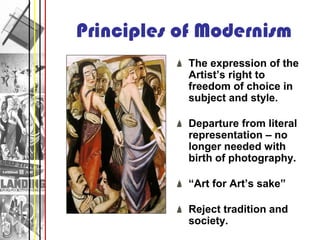
Principles of Modernism
           The expression of the
           Artist’s right to
           freedom of choice in
           subject and style.

           Departure from literal
           representation – no
           longer needed with
           birth of photography.

           “Art for Art’s sake”

           Reject tradition and
           society.
Art movements as part of
            Modernism
   Dadaism (1916 – 1924)
   Bauhaus (1919 – 1933)

   Art Deco (1920 – 1935)

   Surrealism [early] (1920 - 1935)
dadaism
   1916 - 1924
Tristan Tzara – founder of Dadaism

 “ Freedom : Dada Dada Dada, a
 roaring of tense colors, and
 interlacing of opposites and all
 contradictions, grotesques,
 inconsistencies: LIFE”


                      “Dada Manifesto” [1919]
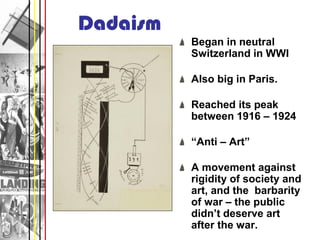
Dadaism
          Began in neutral
          Switzerland in WWI

          Also big in Paris.

          Reached its peak
          between 1916 – 1924

          “Anti – Art”

          A movement against
          rigidity of society and
          art, and the barbarity
          of war – the public
          didn’t deserve art
          after the war.
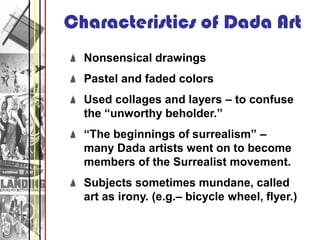
Characteristics of Dada Art
  Nonsensical drawings
  Pastel and faded colors
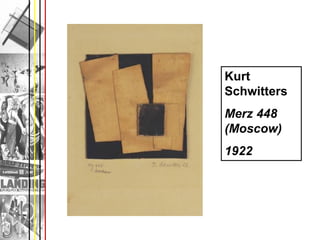
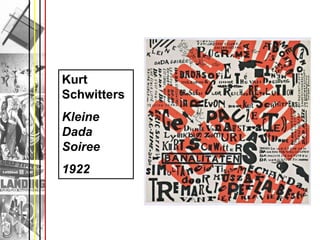
  Used collages and layers – to confuse
  the “unworthy beholder.”
  “The beginnings of surrealism” –
  many Dada artists went on to become
  members of the Surrealist movement.
  Subjects sometimes mundane, called
  art as irony. (e.g.– bicycle wheel, flyer.)
Important Artists
of the Dada Movement
  Tristan Tzara (1896 – 1953)
  Francis Picabia (1879 – 1953)
  Kurt Schwitters (1887 – 1948)
  Max Ernst (1891 – 1976)
  Marcel Duchamp (1887 – 1958)
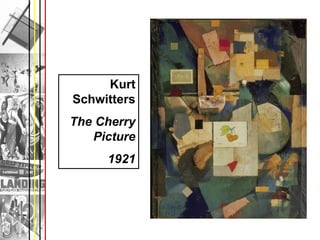
Kurt
Schwitters
The Cherry
   Picture
     1921
Kurt
Schwitters
Merz 448
(Moscow)
1922
Kurt
Schwitters
Kleine
Dada
Soiree
1922
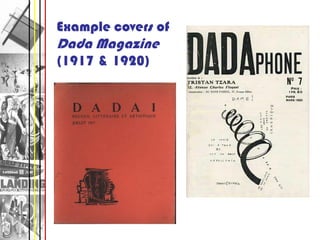
Example covers of
Dada Magazine
(1917 & 1920)
bauhaus
   1919 - 1933
Walter Gropius:
    Founder of Bauhaus

“The School will gradually turn
into a workshop…
    Art and Technology - a
new unity.”
Bauhaus
    Began in 1919 with
    Bauhaus School in
    Weimar, Germany.
    Lead by Walter
    Gropius, Hannes Meyer,
    & Ludwig Mies Van Der
    Rohe.
    Wanted to create new
    art to reflect the new
    times they were living
    in after WWI.
    Artist should be trained
    to work in the industry.
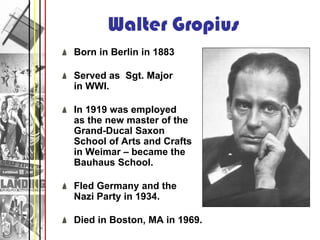
Walter Gropius
Born in Berlin in 1883

Served as Sgt. Major
in WWI.

In 1919 was employed
as the new master of the
Grand-Ducal Saxon
School of Arts and Crafts
in Weimar – became the
Bauhaus School.

Fled Germany and the
Nazi Party in 1934.

Died in Boston, MA in 1969.
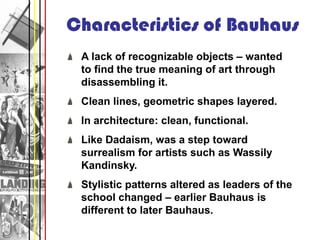
Characteristics of Bauhaus
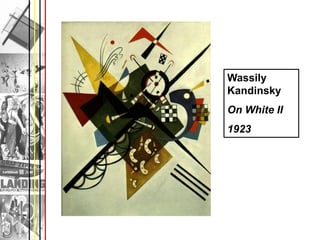
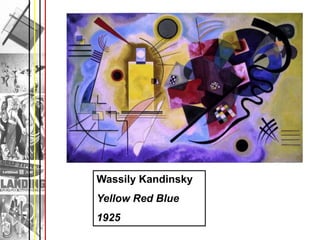
 A lack of recognizable objects – wanted
 to find the true meaning of art through
 disassembling it.
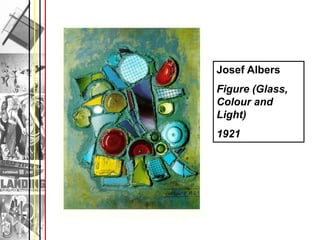
 Clean lines, geometric shapes layered.
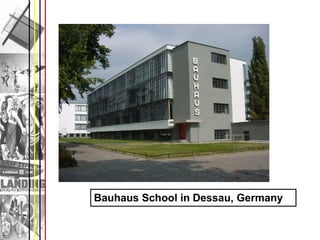
 In architecture: clean, functional.
 Like Dadaism, was a step toward
 surrealism for artists such as Wassily
 Kandinsky.
 Stylistic patterns altered as leaders of the
 school changed – earlier Bauhaus is
 different to later Bauhaus.
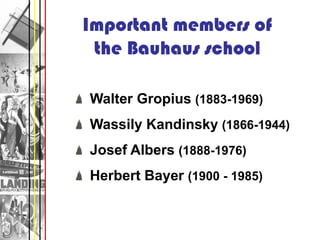
Important members of
 the Bauhaus school

Walter Gropius (1883-1969)
Wassily Kandinsky (1866-1944)
Josef Albers (1888-1976)
Herbert Bayer (1900 - 1985)
Bauhaus School in Dessau, Germany
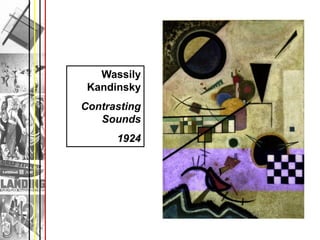
Wassily
 Kandinsky
Contrasting
   Sounds
      1924
Wassily
Kandinsky
On White II
1923
Wassily Kandinsky
Yellow Red Blue
1925
Josef Albers
Figure (Glass,
Colour and
Light)
1921
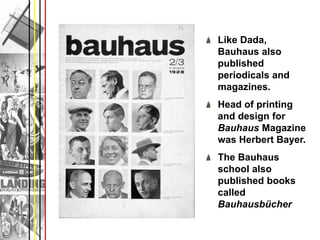
Like Dada,
Bauhaus also
published
periodicals and
magazines.
Head of printing
and design for
Bauhaus Magazine
was Herbert Bayer.
The Bauhaus
school also
published books
called
Bauhausbücher
art deco
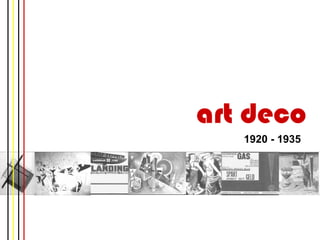
   1920 - 1935
Art Deco
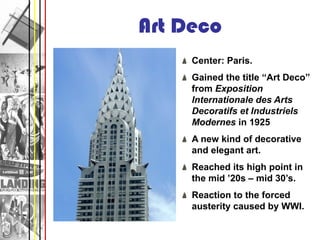
     Center: Paris.
     Gained the title “Art Deco”
     from Exposition
     Internationale des Arts
     Decoratifs et Industriels
     Modernes in 1925
     A new kind of decorative
     and elegant art.
     Reached its high point in
     the mid ’20s – mid 30’s.
     Reaction to the forced
     austerity caused by WWI.
Characteristics of Art Deco
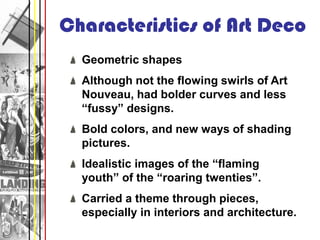
  Geometric shapes
  Although not the flowing swirls of Art
  Nouveau, had bolder curves and less
  “fussy” designs.
  Bold colors, and new ways of shading
  pictures.
  Idealistic images of the “flaming
  youth” of the “roaring twenties”.
  Carried a theme through pieces,
  especially in interiors and architecture.
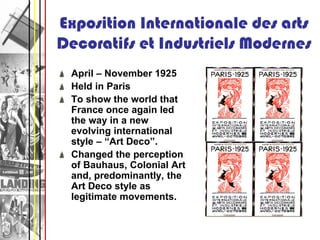
Exposition Internationale des arts
Decoratifs et Industriels Modernes
 April – November 1925
 Held in Paris
 To show the world that
 France once again led
 the way in a new
 evolving international
 style – “Art Deco”.
 Changed the perception
 of Bauhaus, Colonial Art
 and, predominantly, the
 Art Deco style as
 legitimate movements.
Important Art Deco Artists

 Tamara de Lempicka
 (1898 – 1980)

 “Erte” - Romain De Tirtoff
 (1892 – 1990)

 William Van Allen (1883 – 1954)
 “Cassandre” - Adolphe
 Mouron    (1901 – 1968)
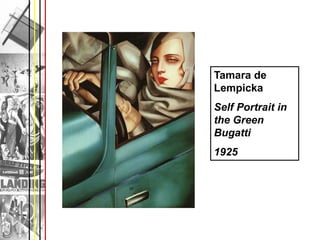
Tamara de
Lempicka
Self Portrait in
the Green
Bugatti
1925
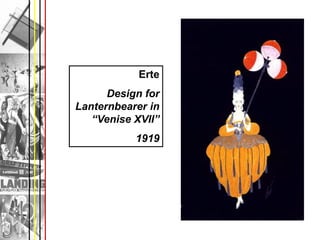
Erte
      Design for
Lanternbearer in
   “Venise XVII”
           1919
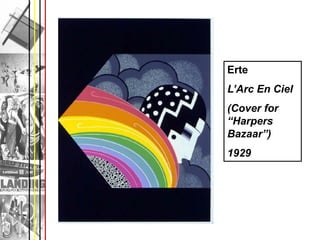
Erte
L’Arc En Ciel
(Cover for
“Harpers
Bazaar”)
1929
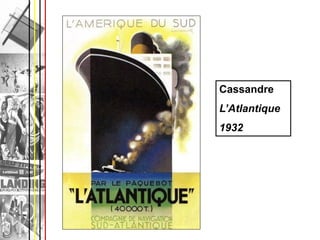
Cassandre
L’Atlantique
1932
early surrealism
           1920 - 1935
Surrealism
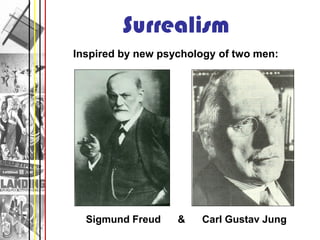
Inspired by new psychology of two men:


  Sigmund Freud    &   Carl Gustav Jung
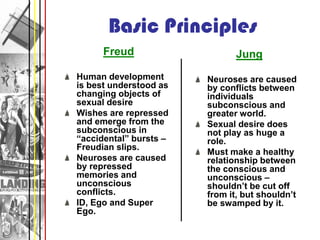
Basic Principles
      Freud                    Jung
Human development       Neuroses are caused
is best understood as   by conflicts between
changing objects of     individuals
sexual desire           subconscious and
Wishes are repressed    greater world.
and emerge from the     Sexual desire does
subconscious in         not play as huge a
“accidental” bursts –   role.
Freudian slips.
                        Must make a healthy
Neuroses are caused     relationship between
by repressed            the conscious and
memories and            unconscious –
unconscious             shouldn’t be cut off
conflicts.              from it, but shouldn’t
ID, Ego and Super       be swamped by it.
Ego.
Surrealism
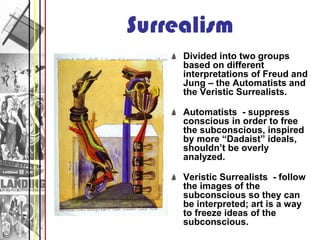
     Divided into two groups
     based on different
     interpretations of Freud and
     Jung – the Automatists and
     the Veristic Surrealists.

     Automatists - suppress
     conscious in order to free
     the subconscious, inspired
     by more “Dadaist” ideals,
     shouldn’t be overly
     analyzed.

     Veristic Surrealists - follow
     the images of the
     subconscious so they can
     be interpreted; art is a way
     to freeze ideas of the
     subconscious.
Surrealism
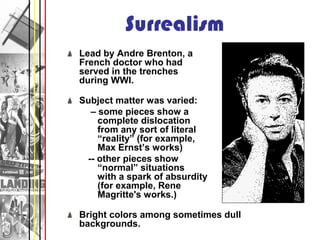
Lead by Andre Brenton, a
French doctor who had
served in the trenches
during WWI.

Subject matter was varied:
  – some pieces show a
    complete dislocation
    from any sort of literal
    “reality” (for example,
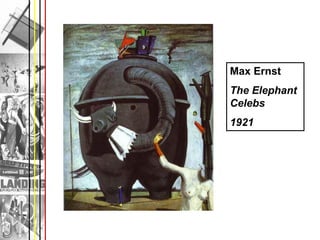
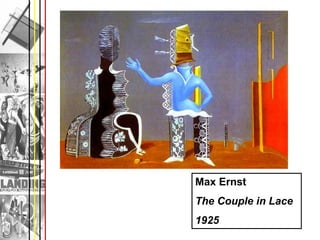
    Max Ernst’s works)
 -- other pieces show
    “normal” situations
    with a spark of absurdity
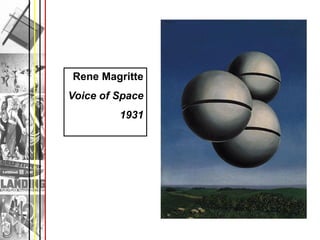
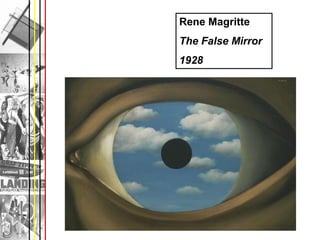
    (for example, Rene
    Magritte's works.)

Bright colors among sometimes dull
backgrounds.
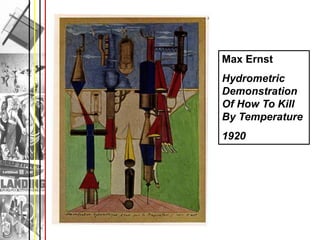
Max Ernst
Hydrometric
Demonstration
Of How To Kill
By Temperature
1920
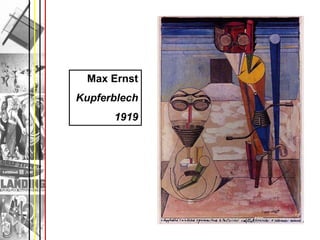
Max Ernst
Kupferblech
      1919
Max Ernst
The Elephant
Celebs
1921
Max Ernst
The Couple in Lace
1925
Rene Magritte
Voice of Space
         1931
Rene Magritte
The False Mirror
1928

Modern Art Powerpoint pdf

  • 1.
    Art Movements of thePost WWI Years 1919-1939 Raphaella W. Chappaqua, NY
  • 2.
    modernism 1916 - 1940
  • 3.
    Principles of Modernism The expression of the Artist’s right to freedom of choice in subject and style. Departure from literal representation – no longer needed with birth of photography. “Art for Art’s sake” Reject tradition and society.
  • 4.
    Art movements aspart of Modernism Dadaism (1916 – 1924) Bauhaus (1919 – 1933) Art Deco (1920 – 1935) Surrealism [early] (1920 - 1935)
  • 5.
    dadaism 1916 - 1924
  • 6.
    Tristan Tzara –founder of Dadaism “ Freedom : Dada Dada Dada, a roaring of tense colors, and interlacing of opposites and all contradictions, grotesques, inconsistencies: LIFE” “Dada Manifesto” [1919]
  • 7.
    Dadaism Began in neutral Switzerland in WWI Also big in Paris. Reached its peak between 1916 – 1924 “Anti – Art” A movement against rigidity of society and art, and the barbarity of war – the public didn’t deserve art after the war.
  • 8.
    Characteristics of DadaArt Nonsensical drawings Pastel and faded colors Used collages and layers – to confuse the “unworthy beholder.” “The beginnings of surrealism” – many Dada artists went on to become members of the Surrealist movement. Subjects sometimes mundane, called art as irony. (e.g.– bicycle wheel, flyer.)
  • 9.
    Important Artists of theDada Movement Tristan Tzara (1896 – 1953) Francis Picabia (1879 – 1953) Kurt Schwitters (1887 – 1948) Max Ernst (1891 – 1976) Marcel Duchamp (1887 – 1958)
  • 10.
  • 11.
  • 12.
  • 13.
    Example covers of DadaMagazine (1917 & 1920)
  • 14.
    bauhaus 1919 - 1933
  • 15.
    Walter Gropius: Founder of Bauhaus “The School will gradually turn into a workshop… Art and Technology - a new unity.”
  • 16.
    Bauhaus Began in 1919 with Bauhaus School in Weimar, Germany. Lead by Walter Gropius, Hannes Meyer, & Ludwig Mies Van Der Rohe. Wanted to create new art to reflect the new times they were living in after WWI. Artist should be trained to work in the industry.
  • 17.
    Walter Gropius Born inBerlin in 1883 Served as Sgt. Major in WWI. In 1919 was employed as the new master of the Grand-Ducal Saxon School of Arts and Crafts in Weimar – became the Bauhaus School. Fled Germany and the Nazi Party in 1934. Died in Boston, MA in 1969.
  • 18.
    Characteristics of Bauhaus A lack of recognizable objects – wanted to find the true meaning of art through disassembling it. Clean lines, geometric shapes layered. In architecture: clean, functional. Like Dadaism, was a step toward surrealism for artists such as Wassily Kandinsky. Stylistic patterns altered as leaders of the school changed – earlier Bauhaus is different to later Bauhaus.
  • 19.
    Important members of the Bauhaus school Walter Gropius (1883-1969) Wassily Kandinsky (1866-1944) Josef Albers (1888-1976) Herbert Bayer (1900 - 1985)
  • 20.
    Bauhaus School inDessau, Germany
  • 21.
  • 22.
  • 23.
  • 24.
  • 25.
    Like Dada, Bauhaus also published periodicalsand magazines. Head of printing and design for Bauhaus Magazine was Herbert Bayer. The Bauhaus school also published books called Bauhausbücher
  • 26.
    art deco 1920 - 1935
  • 27.
    Art Deco Center: Paris. Gained the title “Art Deco” from Exposition Internationale des Arts Decoratifs et Industriels Modernes in 1925 A new kind of decorative and elegant art. Reached its high point in the mid ’20s – mid 30’s. Reaction to the forced austerity caused by WWI.
  • 28.
    Characteristics of ArtDeco Geometric shapes Although not the flowing swirls of Art Nouveau, had bolder curves and less “fussy” designs. Bold colors, and new ways of shading pictures. Idealistic images of the “flaming youth” of the “roaring twenties”. Carried a theme through pieces, especially in interiors and architecture.
  • 29.
    Exposition Internationale desarts Decoratifs et Industriels Modernes April – November 1925 Held in Paris To show the world that France once again led the way in a new evolving international style – “Art Deco”. Changed the perception of Bauhaus, Colonial Art and, predominantly, the Art Deco style as legitimate movements.
  • 30.
    Important Art DecoArtists Tamara de Lempicka (1898 – 1980) “Erte” - Romain De Tirtoff (1892 – 1990) William Van Allen (1883 – 1954) “Cassandre” - Adolphe Mouron (1901 – 1968)
  • 31.
    Tamara de Lempicka Self Portraitin the Green Bugatti 1925
  • 32.
    Erte Design for Lanternbearer in “Venise XVII” 1919
  • 33.
    Erte L’Arc En Ciel (Coverfor “Harpers Bazaar”) 1929
  • 34.
  • 35.
    early surrealism 1920 - 1935
  • 36.
    Surrealism Inspired by newpsychology of two men: Sigmund Freud & Carl Gustav Jung
  • 37.
    Basic Principles Freud Jung Human development Neuroses are caused is best understood as by conflicts between changing objects of individuals sexual desire subconscious and Wishes are repressed greater world. and emerge from the Sexual desire does subconscious in not play as huge a “accidental” bursts – role. Freudian slips. Must make a healthy Neuroses are caused relationship between by repressed the conscious and memories and unconscious – unconscious shouldn’t be cut off conflicts. from it, but shouldn’t ID, Ego and Super be swamped by it. Ego.
  • 38.
    Surrealism Divided into two groups based on different interpretations of Freud and Jung – the Automatists and the Veristic Surrealists. Automatists - suppress conscious in order to free the subconscious, inspired by more “Dadaist” ideals, shouldn’t be overly analyzed. Veristic Surrealists - follow the images of the subconscious so they can be interpreted; art is a way to freeze ideas of the subconscious.
  • 39.
    Surrealism Lead by AndreBrenton, a French doctor who had served in the trenches during WWI. Subject matter was varied: – some pieces show a complete dislocation from any sort of literal “reality” (for example, Max Ernst’s works) -- other pieces show “normal” situations with a spark of absurdity (for example, Rene Magritte's works.) Bright colors among sometimes dull backgrounds.
  • 40.
    Max Ernst Hydrometric Demonstration Of HowTo Kill By Temperature 1920
  • 41.
  • 42.
  • 43.
  • 44.
  • 45.