IVU FINDINGS
IN COMMON
CASES
DR. SABHILASH SUGATHAN
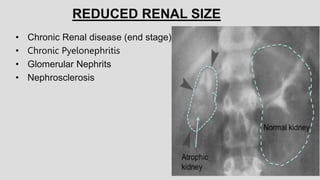
REDUCED RENAL SIZE
• Chronic Renal disease (end stage)
• Chronic Pyelonephritis
• Glomerular Nephrits
• Nephrosclerosis
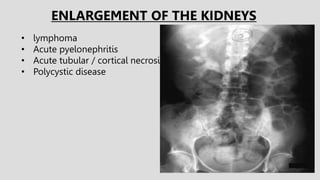
• lymphoma
• Acute pyelonephritis
• Acute tubular / cortical necrosis
• Polycystic disease
ENLARGEMENT OF THE KIDNEYS
CONGENITAL ANOMALIES
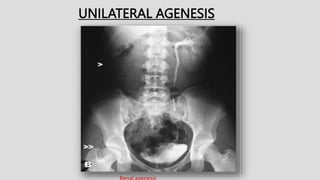
UNILATERAL AGENESIS
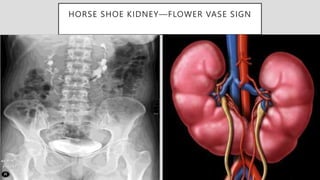
HORSE SHOE KIDNEY—FLOWER VASE SIGN
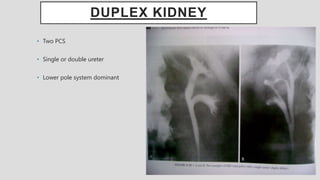
DUPLEX KIDNEY
• Two PCS
• Single or double ureter
• Lower pole system dominant
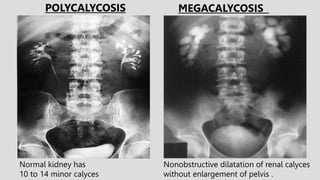
Normal kidney has
10 to 14 minor calyces
POLYCALYCOSIS MEGACALYCOSIS
Nonobstructive dilatation of renal calyces
without enlargement of pelvis .
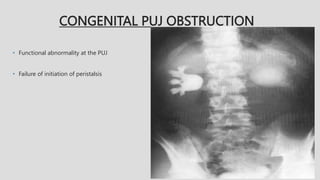
CONGENITAL PUJ OBSTRUCTION
• Functional abnormality at the PUJ
• Failure of initiation of peristalsis
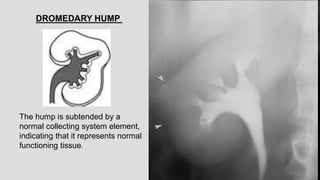
The hump is subtended by a
normal collecting system element,
indicating that it represents normal
functioning tissue.
DROMEDARY HUMP
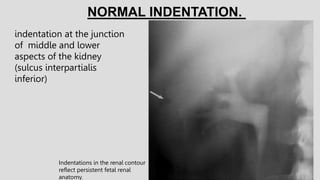
indentation at the junction
of middle and lower
aspects of the kidney
(sulcus interpartialis
inferior)
NORMAL INDENTATION.
Indentations in the renal contour
reflect persistent fetal renal
anatomy.
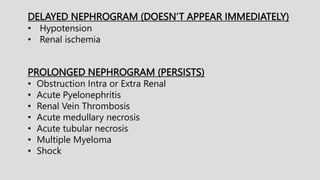
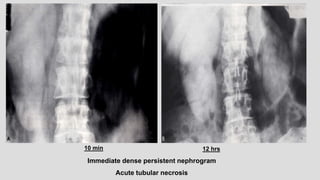
PROLONGED NEPHROGRAM (PERSISTS)
• Obstruction Intra or Extra Renal
• Acute Pyelonephritis
• Renal Vein Thrombosis
• Acute medullary necrosis
• Acute tubular necrosis
• Multiple Myeloma
• Shock
DELAYED NEPHROGRAM (DOESN’T APPEAR IMMEDIATELY)
• Hypotension
• Renal ischemia
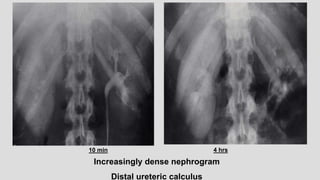
Increasingly dense nephrogram
Distal ureteric calculus
10 min 4 hrs
Immediate dense persistent nephrogram
Acute tubular necrosis
10 min 12 hrs
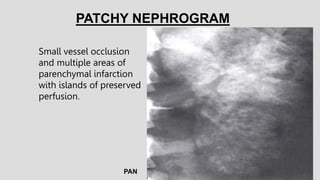
PAN
Small vessel occlusion
and multiple areas of
parenchymal infarction
with islands of preserved
perfusion.
PATCHY NEPHROGRAM
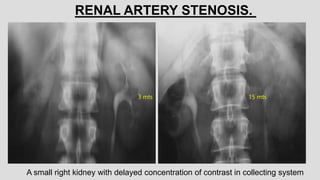
A small right kidney with delayed concentration of contrast in collecting system
RENAL ARTERY STENOSIS.
3 mts 15 mts
OBSTRUCTION
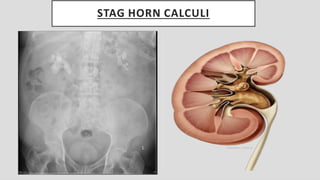
Obstructive Uropathy Rt Kidney
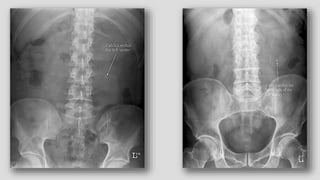
STAG HORN CALCULI
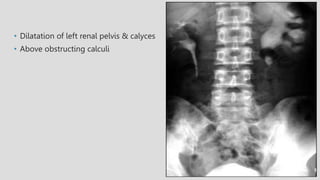
• Dilatation of left renal pelvis & calyces
• Above obstructing calculi
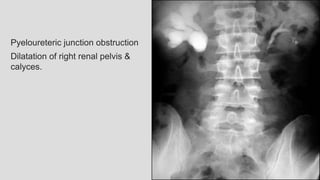
Pyeloureteric junction obstruction
Dilatation of right renal pelvis &
calyces.
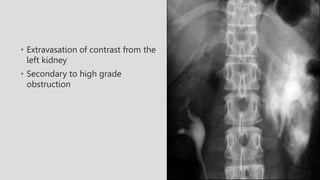
• Extravasation of contrast from the
left kidney
• Secondary to high grade
obstruction
OBSTRUCTION
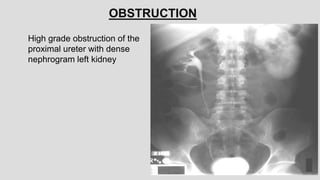
High grade obstruction of the
proximal ureter with dense
nephrogram left kidney
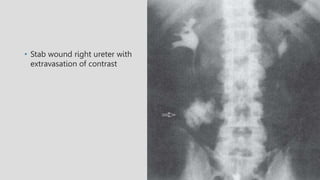
• Stab wound right ureter with
extravasation of contrast
CYSTIC DISEASE
Adult polycystic kidney disease:
-Enlargement of the kidney
-Distortion of the pelvicalyceal system. (by multiple cysts of varying sizes,
which may calcify)
-‘Swiss cheese’ nephrogram may be seen.
-Uretric calculi in 20% of cases.
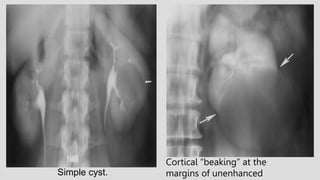
Simple cysts:
-May not be visualized in IVU.
. -Peripheral cysts- bulge in the renal outline.
-USG is the simplest method.
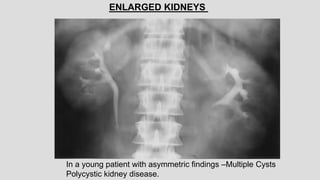
In a young patient with asymmetric findings –Multiple Cysts
Polycystic kidney disease.
ENLARGED KIDNEYS
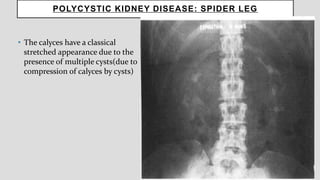
POLYCYSTIC KIDNEY DISEASE: SPIDER LEG
• The calyces have a classical
stretched appearance due to the
presence of multiple cysts(due to
compression of calyces by cysts)
Simple cyst.
Cortical “beaking” at the
margins of unenhanced
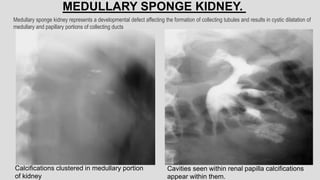
Calcifications clustered in medullary portion
of kidney
Cavities seen within renal papilla calcifications
appear within them.
MEDULLARY SPONGE KIDNEY.
Medullary sponge kidney represents a developmental defect affecting the formation of collecting tubules and results in cystic dilatation of
medullary and papillary portions of collecting ducts
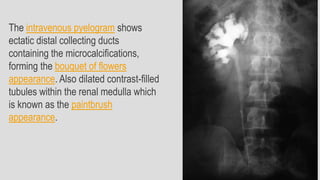
The intravenous pyelogram shows
ectatic distal collecting ducts
containing the microcalcifications,
forming the bouquet of flowers
appearance. Also dilated contrast-filled
tubules within the renal medulla which
is known as the paintbrush
appearance.
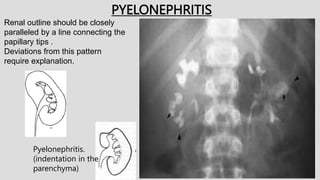
PYELONEPHRITIS
Renal outline should be closely
paralleled by a line connecting the
papillary tips .
Deviations from this pattern
require explanation.
Pyelonephritis.
(indentation in the
parenchyma)
CHRONIC PYELONEPHRITIS
• Small and scarred kidneys,
• Unilateral or bilateral,
• Always asymmetric.
• Cortical loss with distorted and clubbed calyces,
• Commonly affects the upper and lower poles, with disruption of the
normal inter papillary line.
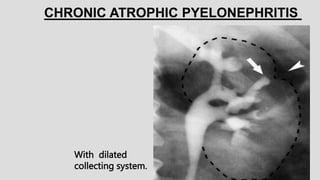
With dilated
collecting system.
CHRONIC ATROPHIC PYELONEPHRITIS
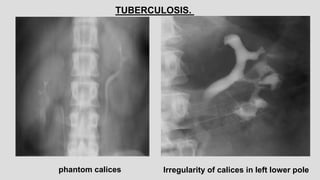
RENAL TUBERCULOSIS
• a)IVU may be normal initially
• b)Calcification (33%)
• -Small punctuate areas to complete
replacement of the kidney.
• -Ureter, bladder, prostate, vas deferens and
• seminal vesicle may calcify.
• c)Caseation and abscess formation
• -The renal outline may be deformed.
• d)Cavitation and stricture formation
• e)Fibrosis and atrophy
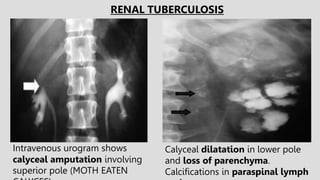
Intravenous urogram shows
calyceal amputation involving
superior pole (MOTH EATEN
RENAL TUBERCULOSIS
Calyceal dilatation in lower pole
and loss of parenchyma.
Calcifications in paraspinal lymph
TUBERCULOSIS.
Irregularity of calices in left lower pole
phantom calices
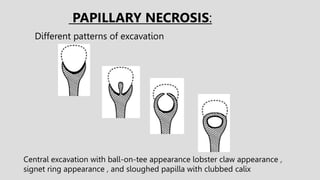
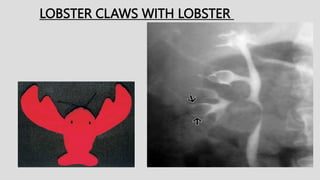
PAPILLARY NECROSIS:
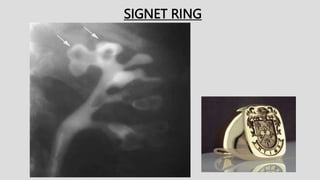
Central excavation with ball-on-tee appearance lobster claw appearance ,
signet ring appearance , and sloughed papilla with clubbed calix
Different patterns of excavation
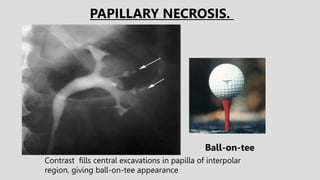
Contrast fills central excavations in papilla of interpolar
region, giving ball-on-tee appearance
Ball-on-tee
PAPILLARY NECROSIS.
LOBSTER CLAWS WITH LOBSTER
SIGNET RING
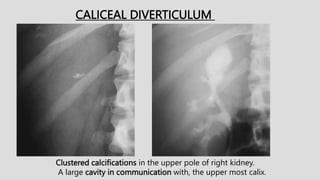
Clustered calcifications in the upper pole of right kidney.
A large cavity in communication with, the upper most calix.
CALICEAL DIVERTICULUM
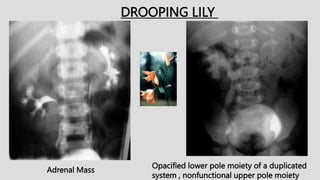
DROOPING LILY
Opacified lower pole moiety of a duplicated
system , nonfunctional upper pole moiety
Adrenal Mass
TUMOURS
Plain
• -Soft tissue mass
• -Curvilinear or amorphous calcification
Contrast
• -Distorted collecting system
• -Irregular filling defect within the collecting
system.
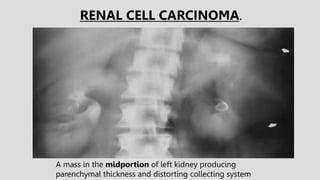
A mass in the midportion of left kidney producing
parenchymal thickness and distorting collecting system
RENAL CELL CARCINOMA.
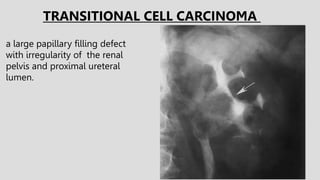
a large papillary filling defect
with irregularity of the renal
pelvis and proximal ureteral
lumen.
TRANSITIONAL CELL CARCINOMA
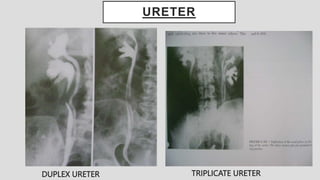
URETER
TRIPLICATE URETER
DUPLEX URETER
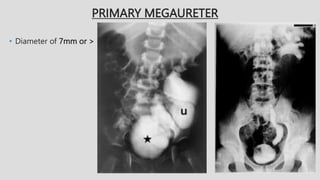
PRIMARY MEGAURETER
• Diameter of 7mm or >
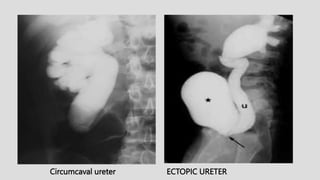
Circumcaval ureter ECTOPIC URETER
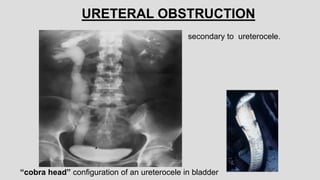
“cobra head” configuration of an ureterocele in bladder
URETERAL OBSTRUCTION
secondary to ureterocele.
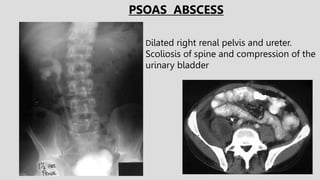
Dilated right renal pelvis and ureter.
Scoliosis of spine and compression of the
urinary bladder
PSOAS ABSCESS
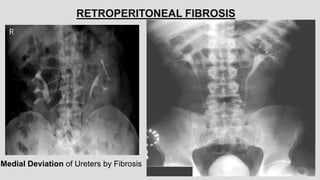
RETROPERITONEAL FIBROSIS
Medial Deviation of Ureters by Fibrosis
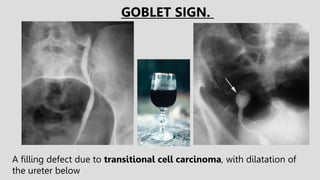
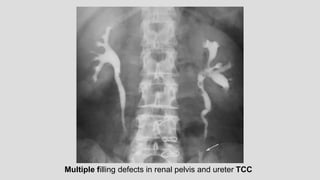
A filling defect due to transitional cell carcinoma, with dilatation of
the ureter below
GOBLET SIGN.
Multiple filling defects in renal pelvis and ureter TCC
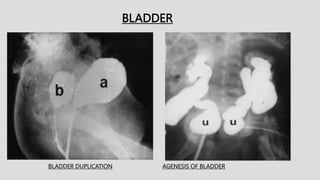
BLADDER DUPLICATION
BLADDER
AGENESIS OF BLADDER
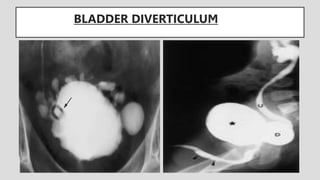
BLADDER DIVERTICULUM
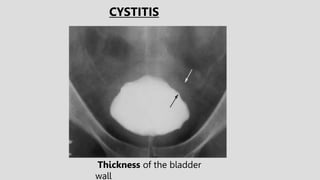
Thickness of the bladder
wall
CYSTITIS
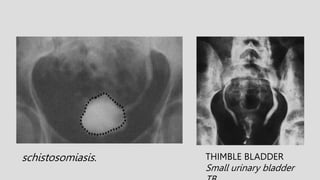
THIMBLE BLADDER
Small urinary bladder
schistosomiasis.
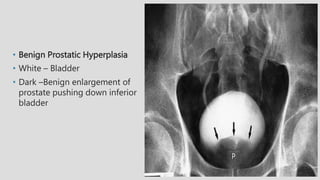
• Benign Prostatic Hyperplasia
• White – Bladder
• Dark –Benign enlargement of
prostate pushing down inferior
bladder
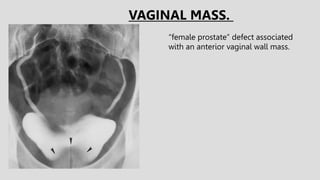
“female prostate” defect associated
with an anterior vaginal wall mass.
VAGINAL MASS.
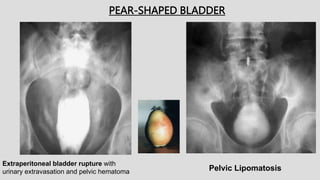
PEAR-SHAPED BLADDER
Extraperitoneal bladder rupture with
urinary extravasation and pelvic hematoma Pelvic Lipomatosis
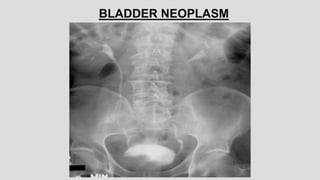
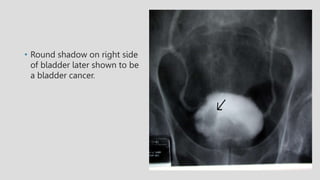
BLADDER NEOPLASM
• Round shadow on right side
of bladder later shown to be
a bladder cancer.
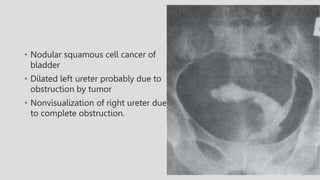
• Nodular squamous cell cancer of
bladder
• Dilated left ureter probably due to
obstruction by tumor
• Nonvisualization of right ureter due
to complete obstruction.
THANK YOU

IVU FINDINGS.pptx