Ultrasonography
Presented by:
Omar Al-selwi
Values of ultrasound
1.show renal
parenchyma
2.detection of UT
calculi
3.renal and bladder
masses
4.congenital anomalies
Advantage of Ultrasound
1.Save
2.do not need patients
preparation
3.not invasive
4.Reliable
5.Affordable
6.no contrast media
7.No radiation
Disadvantages of ultrasound
1.limited tissue penetration
2.limited fields of view
3.difficulty imaging obese or
heavier muscles
4. patients
5.limited functional
informationa
6.inability to image certain
structures as lung and bowel
The Kidney
In kidney ultrasound we notice the
1. Size
2. Thickness
3. perirenal space
4. Contour
5. parenchyma
Normal
• The normal adult renal length, measured by
ultrasound, is 9–12 cm
• the kidneys should be smooth in outline
• The parenchyma surrounds a central echodense
region (the renal sinus) consisting of the
pelvicaliceal system
• There may be a difference between the two
kidneys, normally of less than 1.5 cm.
normal view
the first one is coronal view ,we can see
the left kidney and the renal
parenchyma which consists of cortex
the outer region and the middle on the
inner hyperechoic region but in this
image it isn t very clear the middle loss
and we have the hyperechoic region
which is the renal sinus fat because it
has fat getting more dense and it is
appear hyperechoic and below we can
see the renal pelvis but we can not see
the ureter because normally we don t
really see the ureter
In the longitudinal view we have the
right kidney and the liver above that
and we can appreciate the kidney, it has
the outer cortex and renal sinus
Which are very well visualized in this
picture
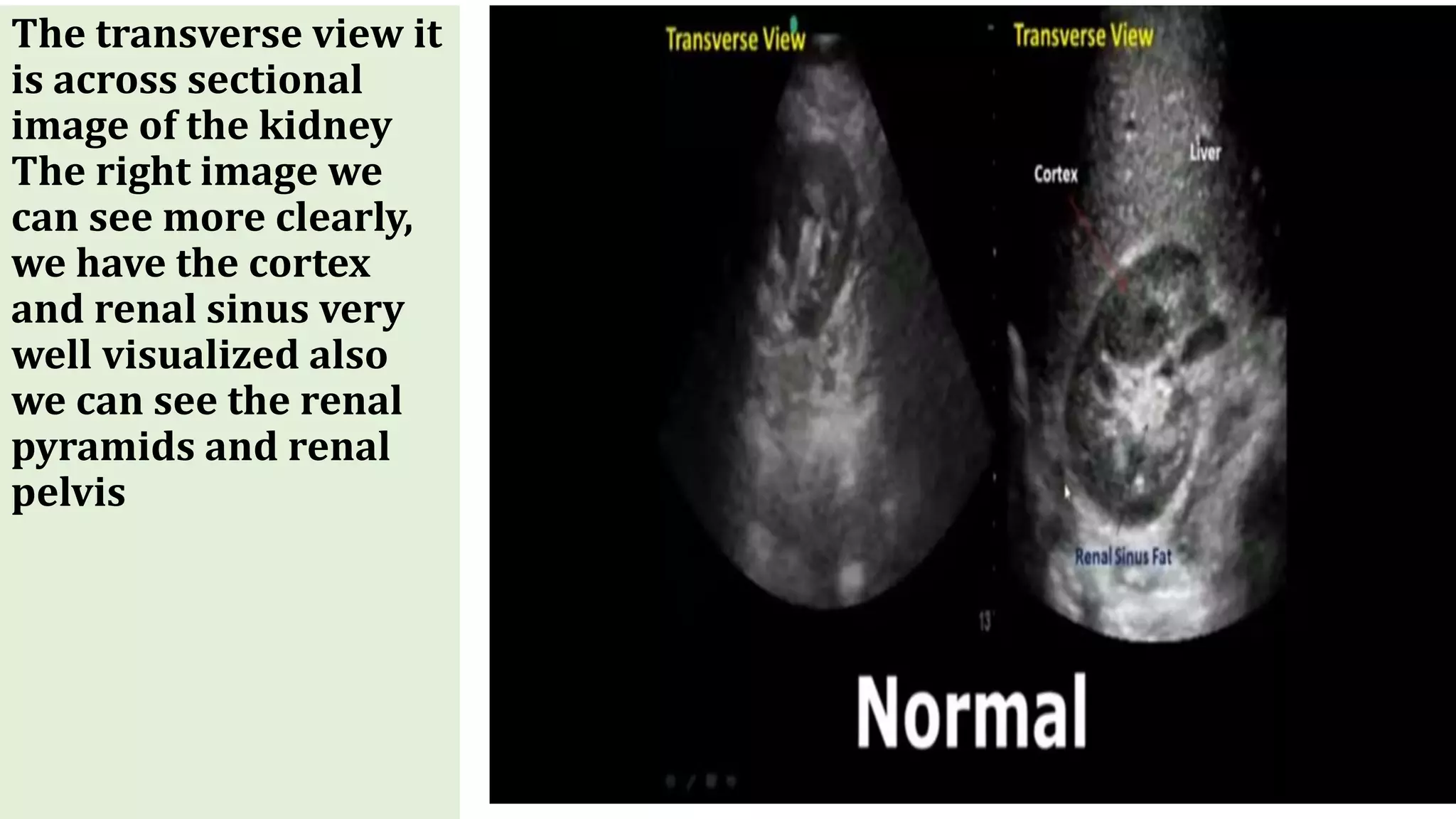
The transverse view it
is across sectional
image of the kidney
The right image we
can see more clearly,
we have the cortex
and renal sinus very
well visualized also
we can see the renal
pyramids and renal
pelvis
Renal
echogenicity
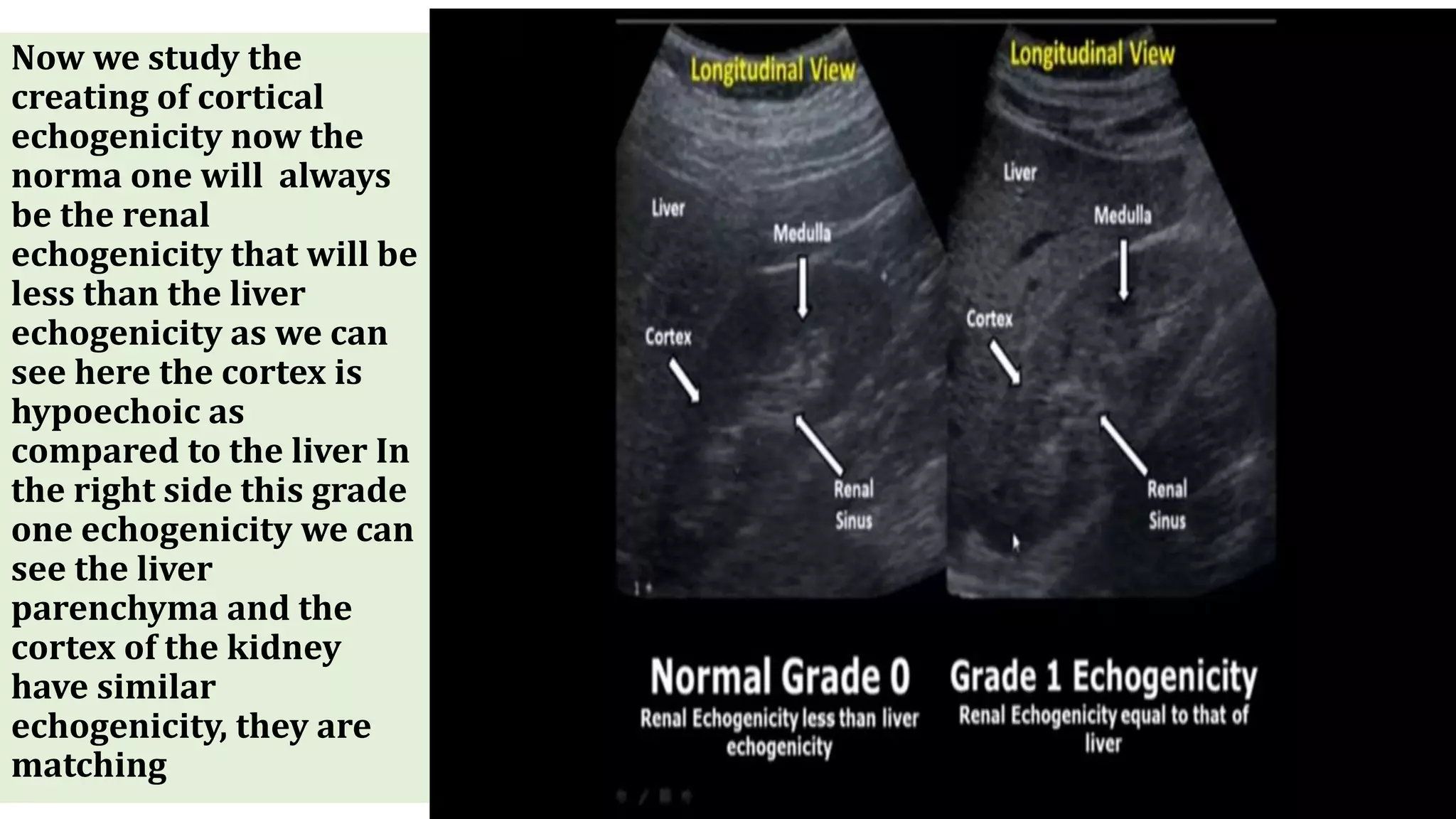
Now we study the
creating of cortical
echogenicity now the
norma one will always
be the renal
echogenicity that will be
less than the liver
echogenicity as we can
see here the cortex is
hypoechoic as
compared to the liver In
the right side this grade
one echogenicity we can
see the liver
parenchyma and the
cortex of the kidney
have similar
echogenicity, they are
matching
In grade 2
echogenicit
y, the renal
echogenicit
y is more
than the
liver
In renal failure the
kidney is very
hyperechoic and it
is also reduced in
size, this one we
can see almost six
centimeters only
whereas the normal
size rang is above
nine centimeters
Kidney stones
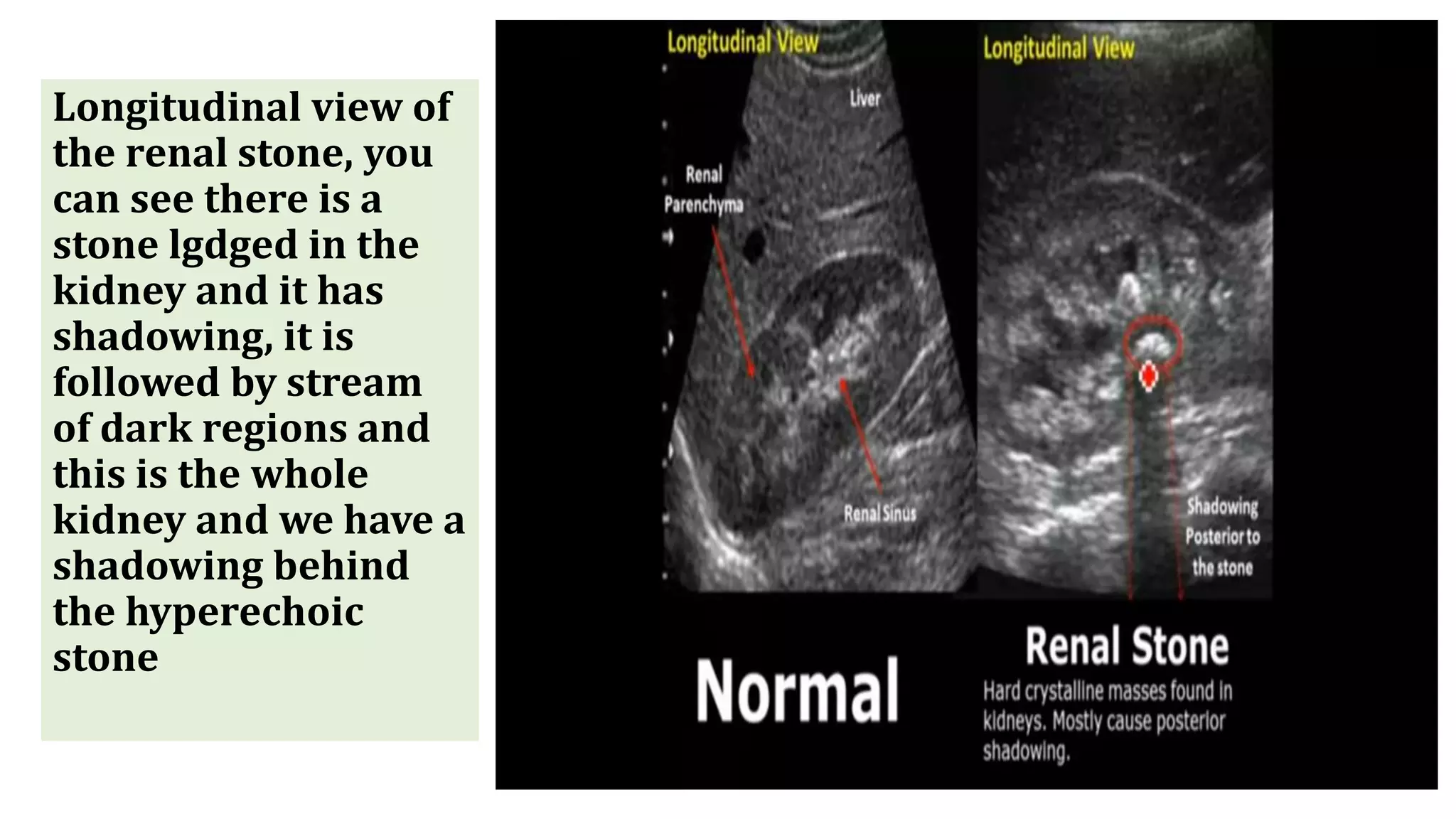
Longitudinal view of
the renal stone, you
can see there is a
stone lgdged in the
kidney and it has
shadowing, it is
followed by stream
of dark regions and
this is the whole
kidney and we have a
shadowing behind
the hyperechoic
stone
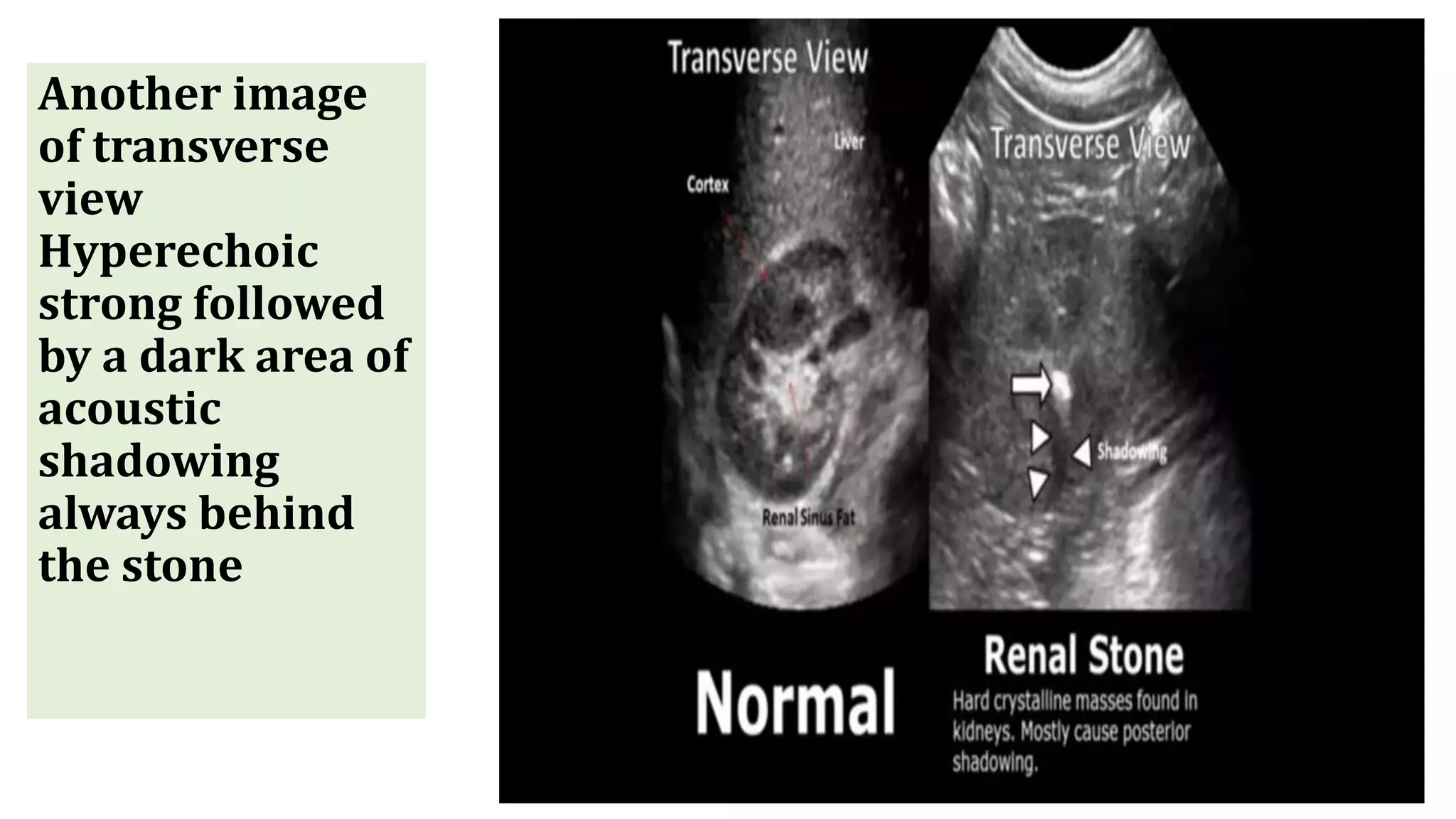
Another image
of transverse
view
Hyperechoic
strong followed
by a dark area of
acoustic
shadowing
always behind
the stone
Transverse view ,
Staghorn caculi
are larg calculi
which involve the
renal pelvis and at
least two calluses
of the kidney, this
has heavier
shadowing
In the longitudinal
view we can not
appreciate as well
as in the
longitudinal view,
we can see multiple
stones which is
involving a much
larger region as a
compared to the
solitary stone we
saw earlier and we
can see one acoustic
shadow
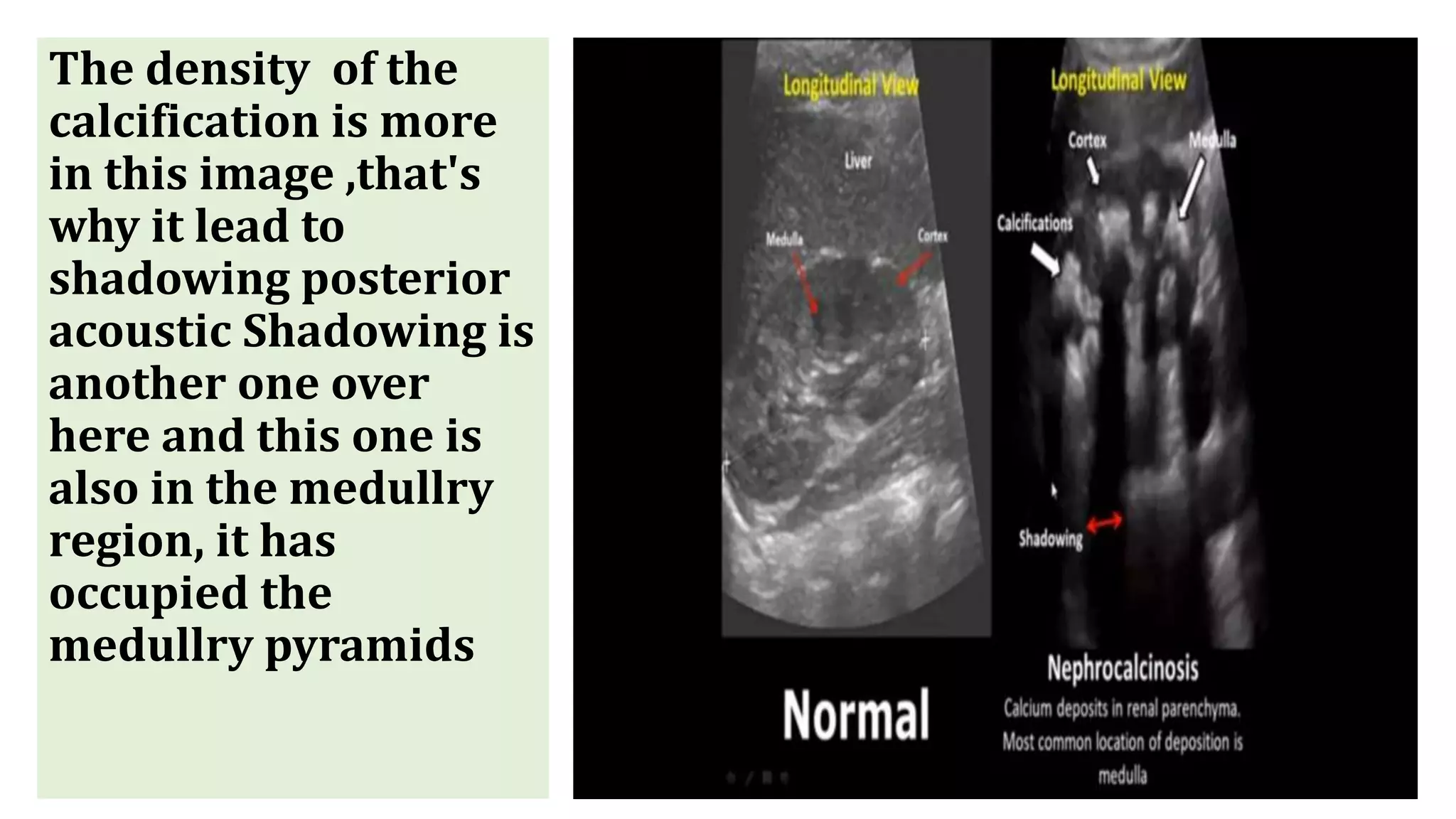
Nephrocalcinosis is
a condition in
which calcium
deposited in the
renal parenchyma,
most common
locations is the
middle and we can
see the hyperechoic
region, these are
the calcium
deposits through
medullry regions
The density of the
calcification is more
in this image ,that's
why it lead to
shadowing posterior
acoustic Shadowing is
another one over
here and this one is
also in the medullry
region, it has
occupied the
medullry pyramids
Infection&inflammation
The pyelonephritis
may cause abnormal
echogenicity in the
kidney, the regions
that are hyperechoic
they are due to
hemorrhage and the
regions that are
hypoechoic they are
due to edema
The transverse
view of
pyelonephritis
show us the
hyperechoic area
and some
hypoechoic area it
is overall
heterogeneous
appearance
Another
longitudinal
view of
pyelonephritis,
which hoses the
medulla as well
very clearly and
we can see the
abnormal
echogenicity the
hyperechoic
region
Chronic kidney
disease also
causes increased
echogenicity of the
kidney along with
some poor
visualization of
structures such as
medullry
pyramids We don't
see them very
clearly in these
images
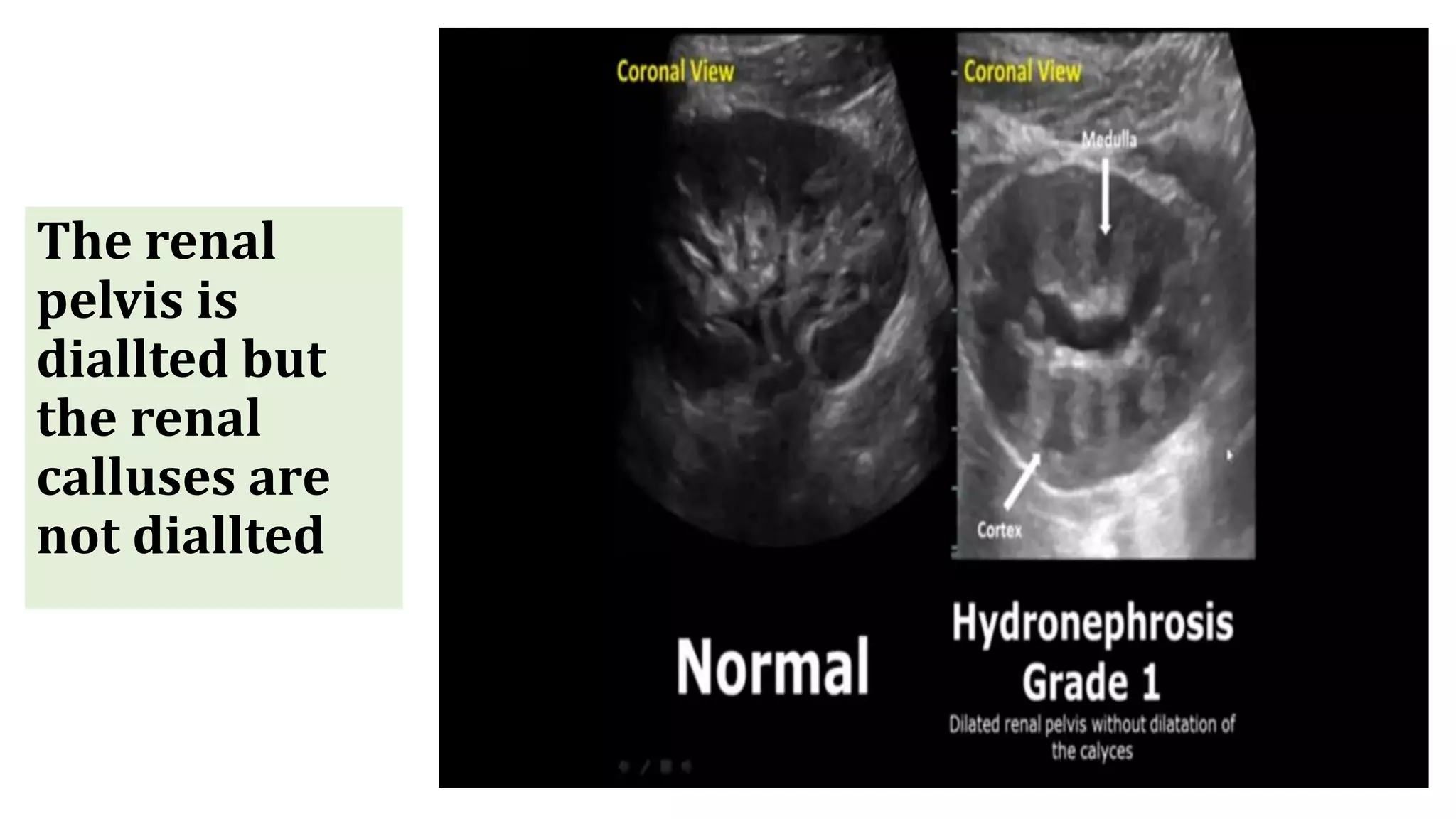
The renal
pelvis is
diallted but
the renal
calluses are
not diallted
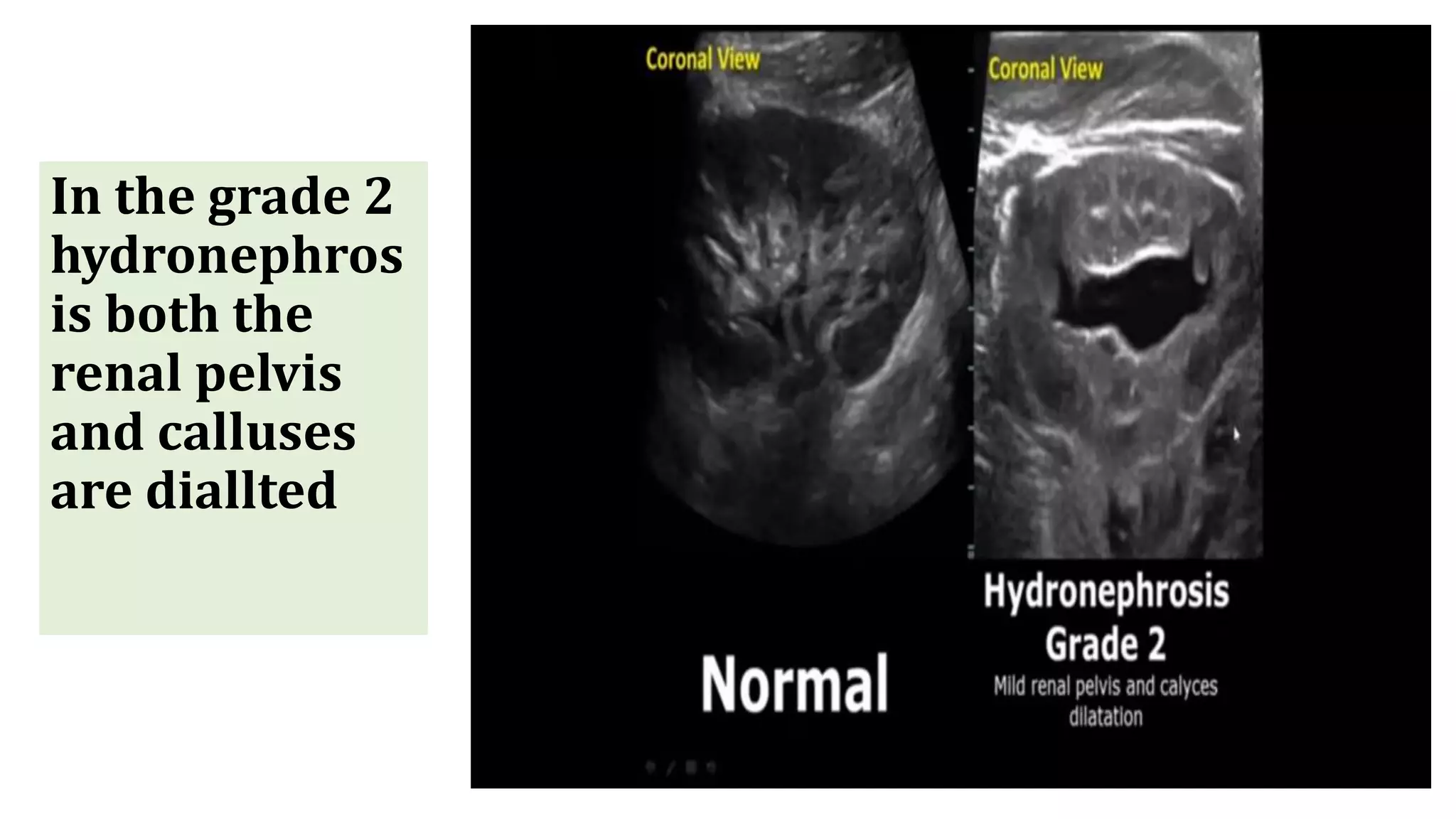
In the grade 2
hydronephros
is both the
renal pelvis
and calluses
are diallted
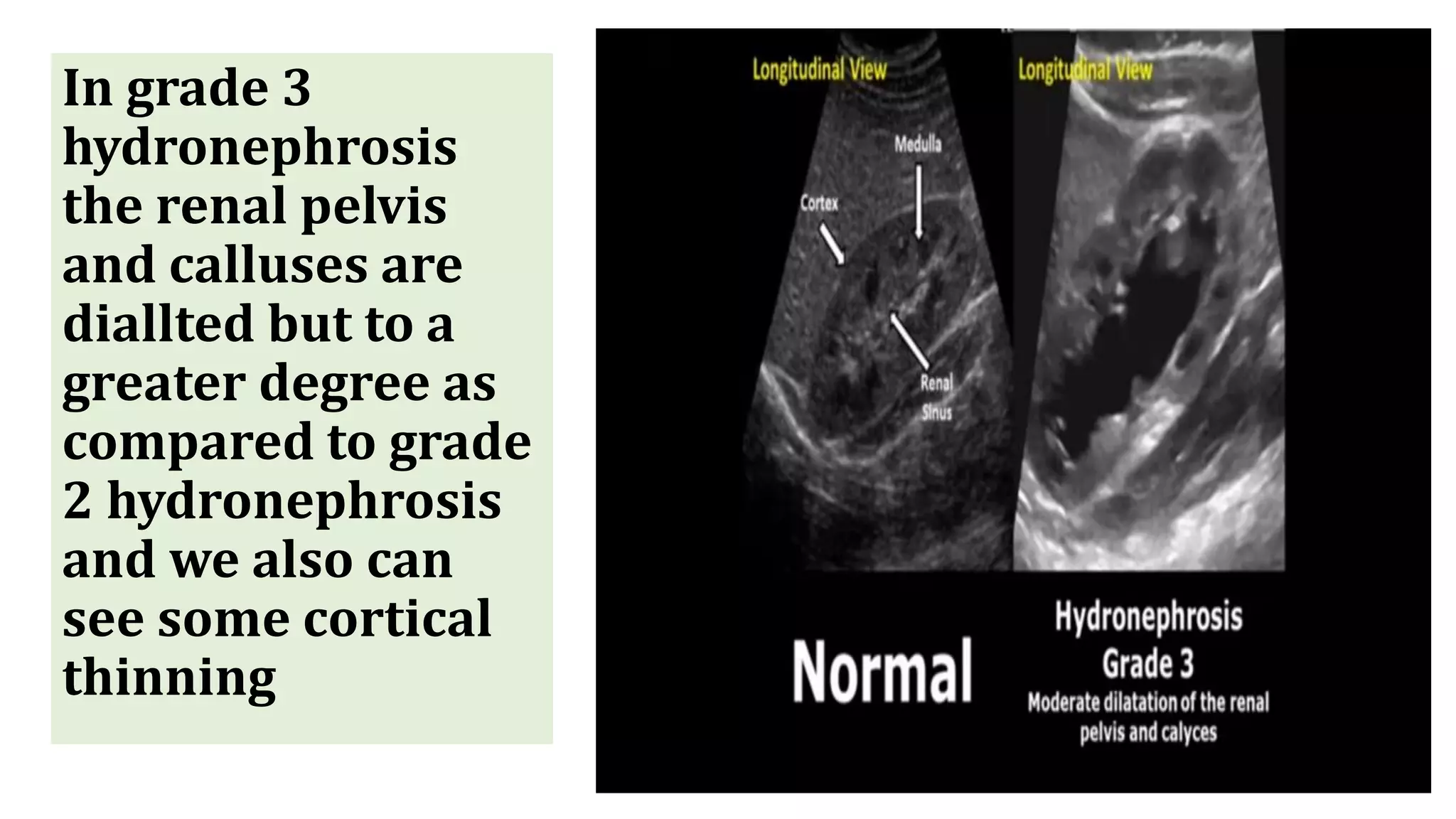
In grade 3
hydronephrosis
the renal pelvis
and calluses are
diallted but to a
greater degree as
compared to grade
2 hydronephrosis
and we also can
see some cortical
thinning
Grade 4
hydronephrosis
show very large
degree of dilation
evolving the entire
kidney and there
is higher amount
higher degree of
cortical thining
and it is lead to
renal atrophy
Tumors
cystic
Simple renal
cyst dislocated
in this region we
can see it very
round and it will
have posterior
acoustic
enhancement,
Another appearance of
the longitudinal view it
is more detailed we can
see this is in the upper
pole of the kidney
Ther is again the
acoustic enhancement
which is behind the cyst
it will be hyperechoic
region because more
ultrasound rays are
passing through the
cysts so it give
enhancement
In polycystic kidney
disease we have multiple
cysts around anechoic
structures with
posterior acoustic
enhancement there will
be multiple of them
,there is one in the
cortex and we can see in
the transverse field the
renal parenchyma, most
of them are in the near
renal sinus or the
medullry region and
there will be more than
one
It is an inherted disorder
A longitudinal
view of the right
kidney
There are
multiple cysts
againe with
posterior
acoustic
enhancement
and anechoic
round
structures
Tumors
Solid
Angiomyolipom
a is a beingne
renal tumer
which consists
of vascular
smooth muscle
and fat tissue it
usually around
mass which is
somewhat
hyperechoic
Another
longitudinal view
of the kidney,
showing
angiomyolipoma
here we can see
the rounded
hyperquak mass
in the lower pole
of kidney
Wilm's tumor
is a rare kidney
tumor that
occurs in the
children, and
we can see a
large
heterogeneous
mass located in
the upper pole
of the kidney
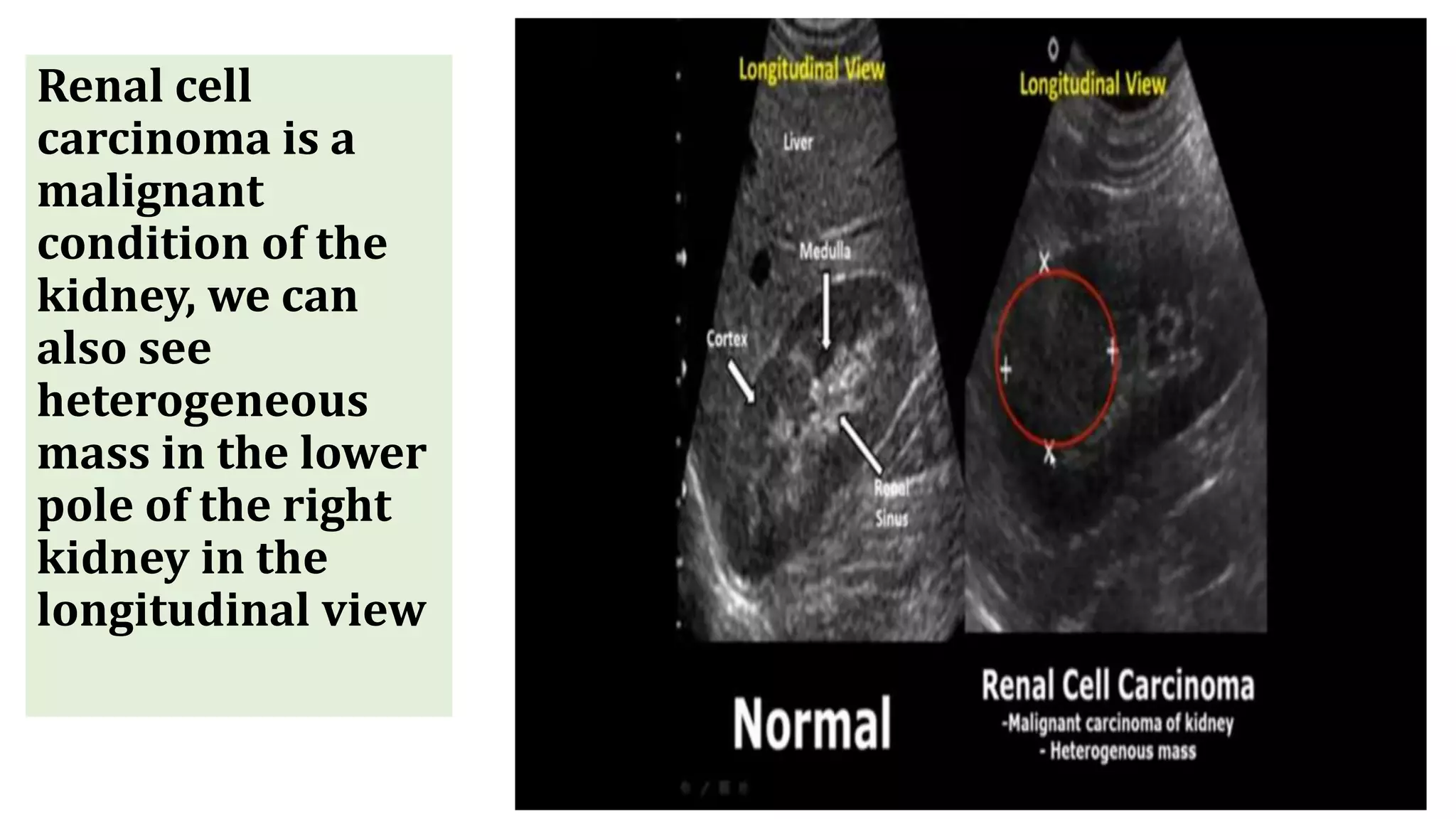
Renal cell
carcinoma is a
malignant
condition of the
kidney, we can
also see
heterogeneous
mass in the lower
pole of the right
kidney in the
longitudinal view
Congenital
anomalies
Crossed fused ectopia
is a condition in
which both kidneys
are found fused
together, here we can
see the tow separate
renal sinuses and
also groove here that
separate both
kidneys and this is on
the left side ,In the
right side in this case
will be empty it will
not have any kidneys
Normal Crossed fused ectopia
horseshoe-kidney
Multicystic
dysplastic
kidney
renal agenesis
Kidney
Trauma
In the renal
trauma, the
hypoechoic and
heterogeneous
areas are due to
the hemorrhage
and hematoma
Hematoma
Hyperechoic
area
The
Ureter
Normally the ureter not
seen in the ultrasound but
it seen if there is dilation
because of stones or
stricture or obstruction
In this image we
see the proximal
ureter that is
somewhat dialted
because of the
presence of a
stone and it
causing dilation of
the renal pelvis as
well in the grade 1
hydronephrosis
urinary
bladder
Normal
• The urinary bladder should be examined in
the distended state
• the walls should be sharply deined and barely
perceptible
• The bladder may also be assessed following
micturition, to measure the post micturition
residual volume of urine.
Longitudinal
view of the
normal
dilated
bladder and
in the right
the
transverse
view
Normal view of the fullness bladder
Bladder
stones
A stone in
the bladder
with
posterior
shadowing,
the stone
appears
hyperechoic
Infection&inflammation
Cystitis is
inflammation
of the bladder
and we can
notice that the
thickness of
the bladder is
more than five
millimeters
Cystits
Acute cystitis chronic cystitis
BLADDER
Tumors
Bladder cancer
usually called
traditional cell
carcinoma
appears as
rounded
metrogenous or
round
hypoechoic mass
orginted from
the wall of the
bladder
Ultrasound sacn
from a patient
showing small
tumor within the
bladder
Bladder
diverticula
Micky mouse sign
Trauma
Normal hematoma
Prostate
• Transrectal ultrasound (TRUS)can show the overall size of
the prostate and can diagnose relatively small masses
within its substance
• ultrasound cannot distinguish benign from benign
malignant disease when conined to the prostate,except
on the basis that masses in the peripheral zone are likely
to be malignant and those in the central zone are more
likely to beign.
• Transrectal ultrasoundguided biopsy is used extensivel for
the diagnosis of prostatic carcinoma
Normal
Infection&inflammation
Benign
prostatic
hyperplasia
PROSTATIC
CALCIFICATION
Prostate calcifications
Tumors
Prostate cancer
Prostaticcyst
renal ultrasound.pptx

renal ultrasound.pptx

  • 1.
  • 2.
    Values of ultrasound 1.showrenal parenchyma 2.detection of UT calculi 3.renal and bladder masses 4.congenital anomalies
  • 3.
    Advantage of Ultrasound 1.Save 2.donot need patients preparation 3.not invasive 4.Reliable 5.Affordable 6.no contrast media 7.No radiation
  • 4.
    Disadvantages of ultrasound 1.limitedtissue penetration 2.limited fields of view 3.difficulty imaging obese or heavier muscles 4. patients 5.limited functional informationa 6.inability to image certain structures as lung and bowel
  • 5.
  • 6.
    In kidney ultrasoundwe notice the 1. Size 2. Thickness 3. perirenal space 4. Contour 5. parenchyma
  • 7.
  • 8.
    • The normaladult renal length, measured by ultrasound, is 9–12 cm • the kidneys should be smooth in outline • The parenchyma surrounds a central echodense region (the renal sinus) consisting of the pelvicaliceal system • There may be a difference between the two kidneys, normally of less than 1.5 cm.
  • 10.
    normal view the firstone is coronal view ,we can see the left kidney and the renal parenchyma which consists of cortex the outer region and the middle on the inner hyperechoic region but in this image it isn t very clear the middle loss and we have the hyperechoic region which is the renal sinus fat because it has fat getting more dense and it is appear hyperechoic and below we can see the renal pelvis but we can not see the ureter because normally we don t really see the ureter In the longitudinal view we have the right kidney and the liver above that and we can appreciate the kidney, it has the outer cortex and renal sinus Which are very well visualized in this picture
  • 11.
    The transverse viewit is across sectional image of the kidney The right image we can see more clearly, we have the cortex and renal sinus very well visualized also we can see the renal pyramids and renal pelvis
  • 12.
  • 13.
    Now we studythe creating of cortical echogenicity now the norma one will always be the renal echogenicity that will be less than the liver echogenicity as we can see here the cortex is hypoechoic as compared to the liver In the right side this grade one echogenicity we can see the liver parenchyma and the cortex of the kidney have similar echogenicity, they are matching
  • 14.
    In grade 2 echogenicit y,the renal echogenicit y is more than the liver
  • 15.
    In renal failurethe kidney is very hyperechoic and it is also reduced in size, this one we can see almost six centimeters only whereas the normal size rang is above nine centimeters
  • 16.
  • 17.
    Longitudinal view of therenal stone, you can see there is a stone lgdged in the kidney and it has shadowing, it is followed by stream of dark regions and this is the whole kidney and we have a shadowing behind the hyperechoic stone
  • 18.
    Another image of transverse view Hyperechoic strongfollowed by a dark area of acoustic shadowing always behind the stone
  • 19.
    Transverse view , Staghorncaculi are larg calculi which involve the renal pelvis and at least two calluses of the kidney, this has heavier shadowing
  • 20.
    In the longitudinal viewwe can not appreciate as well as in the longitudinal view, we can see multiple stones which is involving a much larger region as a compared to the solitary stone we saw earlier and we can see one acoustic shadow
  • 21.
    Nephrocalcinosis is a conditionin which calcium deposited in the renal parenchyma, most common locations is the middle and we can see the hyperechoic region, these are the calcium deposits through medullry regions
  • 22.
    The density ofthe calcification is more in this image ,that's why it lead to shadowing posterior acoustic Shadowing is another one over here and this one is also in the medullry region, it has occupied the medullry pyramids
  • 24.
  • 25.
    The pyelonephritis may causeabnormal echogenicity in the kidney, the regions that are hyperechoic they are due to hemorrhage and the regions that are hypoechoic they are due to edema
  • 26.
    The transverse view of pyelonephritis showus the hyperechoic area and some hypoechoic area it is overall heterogeneous appearance
  • 27.
    Another longitudinal view of pyelonephritis, which hosesthe medulla as well very clearly and we can see the abnormal echogenicity the hyperechoic region
  • 28.
    Chronic kidney disease also causesincreased echogenicity of the kidney along with some poor visualization of structures such as medullry pyramids We don't see them very clearly in these images
  • 32.
    The renal pelvis is dialltedbut the renal calluses are not diallted
  • 33.
    In the grade2 hydronephros is both the renal pelvis and calluses are diallted
  • 34.
    In grade 3 hydronephrosis therenal pelvis and calluses are diallted but to a greater degree as compared to grade 2 hydronephrosis and we also can see some cortical thinning
  • 35.
    Grade 4 hydronephrosis show verylarge degree of dilation evolving the entire kidney and there is higher amount higher degree of cortical thining and it is lead to renal atrophy
  • 37.
  • 39.
    Simple renal cyst dislocated inthis region we can see it very round and it will have posterior acoustic enhancement,
  • 40.
    Another appearance of thelongitudinal view it is more detailed we can see this is in the upper pole of the kidney Ther is again the acoustic enhancement which is behind the cyst it will be hyperechoic region because more ultrasound rays are passing through the cysts so it give enhancement
  • 41.
    In polycystic kidney diseasewe have multiple cysts around anechoic structures with posterior acoustic enhancement there will be multiple of them ,there is one in the cortex and we can see in the transverse field the renal parenchyma, most of them are in the near renal sinus or the medullry region and there will be more than one It is an inherted disorder
  • 42.
    A longitudinal view ofthe right kidney There are multiple cysts againe with posterior acoustic enhancement and anechoic round structures
  • 43.
  • 44.
    Angiomyolipom a is abeingne renal tumer which consists of vascular smooth muscle and fat tissue it usually around mass which is somewhat hyperechoic
  • 45.
    Another longitudinal view of thekidney, showing angiomyolipoma here we can see the rounded hyperquak mass in the lower pole of kidney
  • 46.
    Wilm's tumor is arare kidney tumor that occurs in the children, and we can see a large heterogeneous mass located in the upper pole of the kidney
  • 47.
    Renal cell carcinoma isa malignant condition of the kidney, we can also see heterogeneous mass in the lower pole of the right kidney in the longitudinal view
  • 50.
  • 51.
  • 53.
    Crossed fused ectopia isa condition in which both kidneys are found fused together, here we can see the tow separate renal sinuses and also groove here that separate both kidneys and this is on the left side ,In the right side in this case will be empty it will not have any kidneys
  • 54.
  • 56.
  • 59.
  • 63.
  • 65.
  • 66.
    In the renal trauma,the hypoechoic and heterogeneous areas are due to the hemorrhage and hematoma
  • 67.
  • 68.
  • 69.
    Normally the ureternot seen in the ultrasound but it seen if there is dilation because of stones or stricture or obstruction
  • 70.
    In this imagewe see the proximal ureter that is somewhat dialted because of the presence of a stone and it causing dilation of the renal pelvis as well in the grade 1 hydronephrosis
  • 71.
  • 72.
  • 73.
    • The urinarybladder should be examined in the distended state • the walls should be sharply deined and barely perceptible • The bladder may also be assessed following micturition, to measure the post micturition residual volume of urine.
  • 74.
    Longitudinal view of the normal dilated bladderand in the right the transverse view
  • 75.
    Normal view ofthe fullness bladder
  • 77.
  • 78.
    A stone in thebladder with posterior shadowing, the stone appears hyperechoic
  • 80.
  • 81.
    Cystitis is inflammation of thebladder and we can notice that the thickness of the bladder is more than five millimeters Cystits
  • 82.
  • 83.
  • 84.
    Bladder cancer usually called traditionalcell carcinoma appears as rounded metrogenous or round hypoechoic mass orginted from the wall of the bladder
  • 86.
    Ultrasound sacn from apatient showing small tumor within the bladder
  • 88.
  • 91.
  • 92.
  • 93.
  • 96.
  • 97.
    • Transrectal ultrasound(TRUS)can show the overall size of the prostate and can diagnose relatively small masses within its substance • ultrasound cannot distinguish benign from benign malignant disease when conined to the prostate,except on the basis that masses in the peripheral zone are likely to be malignant and those in the central zone are more likely to beign. • Transrectal ultrasoundguided biopsy is used extensivel for the diagnosis of prostatic carcinoma
  • 98.
  • 101.
  • 105.
  • 111.
  • 113.
  • 114.
  • 117.
  • 119.