GLA University
i-vtec engine technology
Submitted By :- Submitted To :-
Rahul Soni Mr. R P Singh
Sec:- F Mr. Shashank Srivastava
Roll No:- 121200229 (07)
Contents
 Introduction
 Basic Mechanism
 Principals
 I-VTEC Controller
 Series of VTEC engine
 I-VTEC
 I-VTEC in Motorcycles
 Advantages
 Limitations
 Future of I-VTEC
INTRODUCTION
 I-VTEC (Variable Valve Timing and Lift Electronic
Control) is a valve train system developed by Honda
 improve the volumetric efficiency of a four stroke internal
combustion engine .
 The I-VTEC system uses two camshaft profiles and
electronically selects between the profiles.
 It was invented by Honda engineer Ikuo Kajitani.
 This was the first system of its kind.
BASIC MECHANISMS
 The basic mechanism used by the i-vtec
technology is hydraulically actuated pin.
 Pin reached to rocker arms.
 A spring mechanism used to
return the pin back.
 Comprises of two camshaft
lobes.
WORKING:-
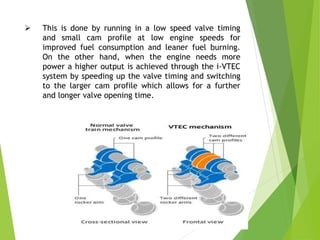
 This is done by running in a low speed valve timing
and small cam profile at low engine speeds for
improved fuel consumption and leaner fuel burning.
On the other hand, when the engine needs more
power a higher output is achieved through the i-VTEC
system by speeding up the valve timing and switching
to the larger cam profile which allows for a further
and longer valve opening time.
PRINCIPALS
 One of the cam lobes on the left hand have a
wider profile , opens its valve earlier.
 For more time and close it later in compare
to the other.
 The fuel is allowed to enter through one
valve completely , while other valve opens
partly.
i-VTEC CONTROLLER
 Basically a RPM activated.
 ECU used to switch cams to early/late.
SERIES OF VTEC ENGINES
 SOHC VTEC
 VTEC –E
 3 STAGE VTEC
 I- VTEC
 K-series
 R-series
I-VTEC
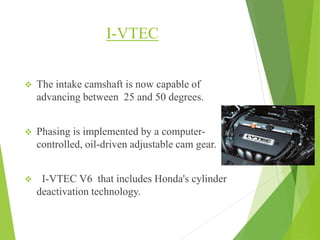
 The intake camshaft is now capable of
advancing between 25 and 50 degrees.
 Phasing is implemented by a computer-
controlled, oil-driven adjustable cam gear.
 I-VTEC V6 that includes Honda's cylinder
deactivation technology.
i-VTEC IN MOTORCYCLES
 Firstly used in 2003 in sports bikes.
 One intake valve remains closed until a threshold of
7000 rpm is reached.
 Second valve is opened by an oil-pressure actuated
pin.
 Uses a single camshaft to provide two timing
routines for the intake .
ADVANTAGES
 Better fuel efficiency.
 High initial torque with relevant high power.
 Lower emission.
 Strong performance.
LIMITATIONS
 Higher cost of engine.
 More complex mechanism.
 Wear and Tear problems.
 Failed to overcome turbo charging.
 Decreased engine life.
FUTURE OF i-VTEC
 Implementation on performance engines.
 Better opportunities of higher petroleum
prices.
 Consideration on its disadvantages gives
improvement in it.
 Economy and satisfaction to be estimated.
REFRENCES
 WIKIPEDIA.ORG
 SEMINARTOPICS.COM
 PAPERPRESENTATION.COM
C
HTF

i-vtec engine technology

  • 1.
    GLA University i-vtec enginetechnology Submitted By :- Submitted To :- Rahul Soni Mr. R P Singh Sec:- F Mr. Shashank Srivastava Roll No:- 121200229 (07)
  • 2.
    Contents  Introduction  BasicMechanism  Principals  I-VTEC Controller  Series of VTEC engine  I-VTEC  I-VTEC in Motorcycles  Advantages  Limitations  Future of I-VTEC
  • 3.
    INTRODUCTION  I-VTEC (VariableValve Timing and Lift Electronic Control) is a valve train system developed by Honda  improve the volumetric efficiency of a four stroke internal combustion engine .  The I-VTEC system uses two camshaft profiles and electronically selects between the profiles.  It was invented by Honda engineer Ikuo Kajitani.  This was the first system of its kind.
  • 4.
    BASIC MECHANISMS  Thebasic mechanism used by the i-vtec technology is hydraulically actuated pin.  Pin reached to rocker arms.  A spring mechanism used to return the pin back.  Comprises of two camshaft lobes.
  • 5.
  • 6.
     This isdone by running in a low speed valve timing and small cam profile at low engine speeds for improved fuel consumption and leaner fuel burning. On the other hand, when the engine needs more power a higher output is achieved through the i-VTEC system by speeding up the valve timing and switching to the larger cam profile which allows for a further and longer valve opening time.
  • 7.
    PRINCIPALS  One ofthe cam lobes on the left hand have a wider profile , opens its valve earlier.  For more time and close it later in compare to the other.  The fuel is allowed to enter through one valve completely , while other valve opens partly.
  • 8.
    i-VTEC CONTROLLER  Basicallya RPM activated.  ECU used to switch cams to early/late.
  • 9.
    SERIES OF VTECENGINES  SOHC VTEC  VTEC –E  3 STAGE VTEC  I- VTEC  K-series  R-series
  • 10.
    I-VTEC  The intakecamshaft is now capable of advancing between 25 and 50 degrees.  Phasing is implemented by a computer- controlled, oil-driven adjustable cam gear.  I-VTEC V6 that includes Honda's cylinder deactivation technology.
  • 11.
    i-VTEC IN MOTORCYCLES Firstly used in 2003 in sports bikes.  One intake valve remains closed until a threshold of 7000 rpm is reached.  Second valve is opened by an oil-pressure actuated pin.  Uses a single camshaft to provide two timing routines for the intake .
  • 12.
    ADVANTAGES  Better fuelefficiency.  High initial torque with relevant high power.  Lower emission.  Strong performance.
  • 13.
    LIMITATIONS  Higher costof engine.  More complex mechanism.  Wear and Tear problems.  Failed to overcome turbo charging.  Decreased engine life.
  • 14.
    FUTURE OF i-VTEC Implementation on performance engines.  Better opportunities of higher petroleum prices.  Consideration on its disadvantages gives improvement in it.  Economy and satisfaction to be estimated.
  • 15.
  • 16.