ADVANCES IN IC
ENGINES
SANKAR RAM T. , MIDHUN ANTONY JOSEPH
Jyothi engineering college, Cheruthuruthy, Thrissur.
Introduction to IC engines
 Invented in early 1680
 First attempt by Christian Huygens
 Converts heat energy produced by burning of
fuel to mechanical output.
 Basically consists of a piston-cylinder
arrangement.
 The expansion of air due to the heat produced
moves the piston inside the cylinder.
Classification of IC engines
 Two main classifications:
 Based on combustion
 Spark Ignition [SI engines] (Eg: Petrol Engine)
 Compression Ignition [CI engines] (Eg: Diesel
Engine)
 Based on Number of strokes
 Two stroke
 Four Stroke
 Six Stroke
Major areas of advancement
 The vision behind evolving of IC engine was to
extract maximum power from the fuel while
reducing emissions and pollution from the
engine.
 The main areas of advancement are:
 Engine Design
 Material Selection
 Timing Controls
 Fuel Injection And Combustion
 The advances moves almost parallel and most
companies have their own versions of the
advances discussed here.
Engine Design
 The early designs involved a single cylinder.
This caused a large amount of fluctuations in
power output.
 So more number of cylinders were added to
reduce output fluctuations and size of engine
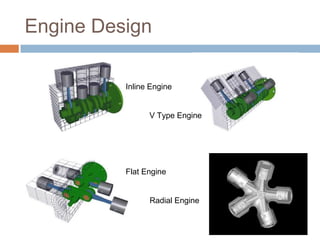
 There are four types of engine designs used.
 Inline
 V Type
 Flat Type
 Radial Engines
Engine Design
Inline Engine
V Type Engine
Flat Engine
Radial Engine
Material selection
 When selecting materials for engine, following
factors are considered
 Weight of material
 Melting point
 Coefficient of expansion
 Heat transmission power
 Vibration and sound damping
 The main metals used in engine manufacture
are
 Grey Cast Iron
 Aluminium
 Magnesium
Use of Sodium in engines
 A part of engine is hollowed and is filled with
sodium
 When temperature of the part becomes 1600C
sodium melts
 This molten state has better heat transfer that
solid metal
 Sodium is mainly used in:
 Sodium Valves (Exhaust Valves)
 Piston Skirts
Timing controls
 The Efficiency of engine is decided by the
timing of its sequential operation.
 Timing of inlet and exhaust valves
 Timing of the spark in SI engines
 Timing of fuel injection in CI engines
 Sequential operation of each cylinders in multi cylinder engine
 In normal cases these timings are a design
parameter set at time of manufacture.
 The goal of timing control is to change the
timings of engine while its working.
Variable Valve Timing (VVT)
 At low rpm, the timing is adjusted for maximum
efficiency.
 At high rpm, time the valve remains opened is
reduced while increasing the opening size.
 This helps to pump more charge to cylinder
without creating backpressure or scavenching.
 An electronic system uses a microcontroller to
adjust the solenoid valve.
Variable Valve Timing (VVT)
 In a mechanical system, the input from crank
is given to a gear which is locked to the cam
using a pin.
 When adjustment is needed, the pin is
removed magnetically and a stepper motor
adjusts the cam.
 Used in many cars in various names
BMW Valvetronic, VANOS
Fiat Twin Cam VIS
General Motors VVT, DCVCP
Honda VTEC, i-VTEC
Variable Valve Timing (VVT)
Active Valve Train
 In active valve train, there will be two cams
designed for specific road conditions.
 When the microprocessor detects a rough
terrain, the cam used will be the one for more
power.
 But during cruising, the cam is switched to a
low power, high efficient cam using a cam
tapper.
 Introduced first by Lotus Motors and later
developed by Nissan Motors.
Cylinder Deactivation
 Cylinder deactivation is a derived form of
active cam switching.
 In this method, while cruising a part of
cylinders are switched off by switching to a
cam without lobes.
 This method is successful because of
following
 Lesser fuel consumption
 Less heat generation
 Less power lost in managing other cylinders
 This is mostly employed in V Type Engines.
Cylinder Deactivation
 The cylinder is deactivated by
 Keeping the inlet valve closed so that there is no
fuel flow
 Keeping the exhaust valve open so there is no
work done in compression.
 Some Companies using cylinder deactivation
are
 General Motors V8-6-4 (Cadillac)
 General Motors Active Fuel Management
 DaimlerChrysler Active Cylinder Control (ACC) (for Mercedes-
Benz)
 Honda Variable Cylinder Management (VCM)
Fuels and Fuel Injection
 The fuels and its input to the engine highly
influences the emissions from the engines.
 In SI engines a air-fuel mixture called charge
is introduced to the cylinder before
compression
 In CI engines the fuel is injected after the
compression stroke to the cylinder. This helps
in attaining higher compression ratios.
 In SI engines it is not possible because there
is a chance that the fuel may burn before
hand.
Direct Injection
 With direct injection, the advantages of CI
engines can be obtained in SI engines also.
 In direct injection, first the air is filled in the
cylinder. Then half way through the
compression stroke, a small amount of fuel is
injected to the cylinder to create a lean
mixture.
 At the end of compression, just before the
spark the rest of fuel is injected to the head of
spark plug.
 The burning of fuel occurs in a stratified
Direct Injection
 Direct injection has many advantages such as
 No need of carburetor
 Easy design of manifold
 Better compression is achievable
 No case of knocking in engines
 Lower NOx emissions
 Due to stratified combustion leaner mixture can
be used which reduces the fuel consumption.
Direct Injection
Superchargers
 Consists of a compressor coupled to the
engine using a belt.
 The output is directly connected to the engine.
 As the engine rotates, the air is sucked in and
compressed which is then fed to the cylinders.
 Increases the amount of oxygen given to
engine thus helps in better burning.
 Is a must in aircrafts flying at high altitudes
were air is less dense.
Turbochargers
 Is a derived form of supercharger
 Consists of a turbine and a compressor
coupled in a shaft.
 Instead of using the power from engine to turn
the compressor, the exhaust is used to turn the
turbine which rotates the compressor.
 Turbochargers can only act at high velocity
exhaust so they need some time to start up in
cold start. This time is called as turbo lag.
Six Stroke Engines
 The invention of six stroke engines was for the
following reasons:
 Less weight to power ratio
 Less scavenching
 Less moving parts
 More power and fuel economy
 Obtain freedom in designing
 Better cooling
 Six stroke engines are developed in two
different ways
Air/Water injection to Cylinder
 In this method air or water is injected to the
cylinder at the end of exhaust stroke.
 The fluid absorbs the heat and expands
providing another power stroke. An exhaust
stroke is provided to removed the fluid from
cylinder.
 Three recognized names in this section are:
 Bajulaz six stroke engine (Preheating of air)
 Velozeta six stroke engine (Injection of air)
 Crower six stroke engine (Injection of water)
Opposed Piston Engines
 This model uses two pistons working in and
cylinder.
 The pistons are used to open and close ports
just like a two stroke engine.
 The working of opposed pistons provide better
compression.
 The pistons have either a change in speed or
have a phase shift between them.
 Some engines in this section are:
 Beare Head Engine
 M4+2 engine
References
 en.wikipedia.org
 www.greencar.com
 www.mitsubishi-motors.com
 www.bmw.com/com/en/insights
 Elements of IC Engines, Rogowsky, Tata
McGraw hill
 Internal Combustion Engines, Mathur &
Metha, Vol I&II Pergamon Press
Advancesinicengines 120325133435-phpapp02

Advancesinicengines 120325133435-phpapp02

  • 1.
    ADVANCES IN IC ENGINES SANKARRAM T. , MIDHUN ANTONY JOSEPH Jyothi engineering college, Cheruthuruthy, Thrissur.
  • 2.
    Introduction to ICengines  Invented in early 1680  First attempt by Christian Huygens  Converts heat energy produced by burning of fuel to mechanical output.  Basically consists of a piston-cylinder arrangement.  The expansion of air due to the heat produced moves the piston inside the cylinder.
  • 3.
    Classification of ICengines  Two main classifications:  Based on combustion  Spark Ignition [SI engines] (Eg: Petrol Engine)  Compression Ignition [CI engines] (Eg: Diesel Engine)  Based on Number of strokes  Two stroke  Four Stroke  Six Stroke
  • 4.
    Major areas ofadvancement  The vision behind evolving of IC engine was to extract maximum power from the fuel while reducing emissions and pollution from the engine.  The main areas of advancement are:  Engine Design  Material Selection  Timing Controls  Fuel Injection And Combustion  The advances moves almost parallel and most companies have their own versions of the advances discussed here.
  • 5.
    Engine Design  Theearly designs involved a single cylinder. This caused a large amount of fluctuations in power output.  So more number of cylinders were added to reduce output fluctuations and size of engine  There are four types of engine designs used.  Inline  V Type  Flat Type  Radial Engines
  • 6.
    Engine Design Inline Engine VType Engine Flat Engine Radial Engine
  • 7.
    Material selection  Whenselecting materials for engine, following factors are considered  Weight of material  Melting point  Coefficient of expansion  Heat transmission power  Vibration and sound damping  The main metals used in engine manufacture are  Grey Cast Iron  Aluminium  Magnesium
  • 8.
    Use of Sodiumin engines  A part of engine is hollowed and is filled with sodium  When temperature of the part becomes 1600C sodium melts  This molten state has better heat transfer that solid metal  Sodium is mainly used in:  Sodium Valves (Exhaust Valves)  Piston Skirts
  • 9.
    Timing controls  TheEfficiency of engine is decided by the timing of its sequential operation.  Timing of inlet and exhaust valves  Timing of the spark in SI engines  Timing of fuel injection in CI engines  Sequential operation of each cylinders in multi cylinder engine  In normal cases these timings are a design parameter set at time of manufacture.  The goal of timing control is to change the timings of engine while its working.
  • 10.
    Variable Valve Timing(VVT)  At low rpm, the timing is adjusted for maximum efficiency.  At high rpm, time the valve remains opened is reduced while increasing the opening size.  This helps to pump more charge to cylinder without creating backpressure or scavenching.  An electronic system uses a microcontroller to adjust the solenoid valve.
  • 11.
    Variable Valve Timing(VVT)  In a mechanical system, the input from crank is given to a gear which is locked to the cam using a pin.  When adjustment is needed, the pin is removed magnetically and a stepper motor adjusts the cam.  Used in many cars in various names BMW Valvetronic, VANOS Fiat Twin Cam VIS General Motors VVT, DCVCP Honda VTEC, i-VTEC
  • 12.
  • 13.
    Active Valve Train In active valve train, there will be two cams designed for specific road conditions.  When the microprocessor detects a rough terrain, the cam used will be the one for more power.  But during cruising, the cam is switched to a low power, high efficient cam using a cam tapper.  Introduced first by Lotus Motors and later developed by Nissan Motors.
  • 14.
    Cylinder Deactivation  Cylinderdeactivation is a derived form of active cam switching.  In this method, while cruising a part of cylinders are switched off by switching to a cam without lobes.  This method is successful because of following  Lesser fuel consumption  Less heat generation  Less power lost in managing other cylinders  This is mostly employed in V Type Engines.
  • 15.
    Cylinder Deactivation  Thecylinder is deactivated by  Keeping the inlet valve closed so that there is no fuel flow  Keeping the exhaust valve open so there is no work done in compression.  Some Companies using cylinder deactivation are  General Motors V8-6-4 (Cadillac)  General Motors Active Fuel Management  DaimlerChrysler Active Cylinder Control (ACC) (for Mercedes- Benz)  Honda Variable Cylinder Management (VCM)
  • 16.
    Fuels and FuelInjection  The fuels and its input to the engine highly influences the emissions from the engines.  In SI engines a air-fuel mixture called charge is introduced to the cylinder before compression  In CI engines the fuel is injected after the compression stroke to the cylinder. This helps in attaining higher compression ratios.  In SI engines it is not possible because there is a chance that the fuel may burn before hand.
  • 17.
    Direct Injection  Withdirect injection, the advantages of CI engines can be obtained in SI engines also.  In direct injection, first the air is filled in the cylinder. Then half way through the compression stroke, a small amount of fuel is injected to the cylinder to create a lean mixture.  At the end of compression, just before the spark the rest of fuel is injected to the head of spark plug.  The burning of fuel occurs in a stratified
  • 18.
    Direct Injection  Directinjection has many advantages such as  No need of carburetor  Easy design of manifold  Better compression is achievable  No case of knocking in engines  Lower NOx emissions  Due to stratified combustion leaner mixture can be used which reduces the fuel consumption.
  • 19.
  • 20.
    Superchargers  Consists ofa compressor coupled to the engine using a belt.  The output is directly connected to the engine.  As the engine rotates, the air is sucked in and compressed which is then fed to the cylinders.  Increases the amount of oxygen given to engine thus helps in better burning.  Is a must in aircrafts flying at high altitudes were air is less dense.
  • 21.
    Turbochargers  Is aderived form of supercharger  Consists of a turbine and a compressor coupled in a shaft.  Instead of using the power from engine to turn the compressor, the exhaust is used to turn the turbine which rotates the compressor.  Turbochargers can only act at high velocity exhaust so they need some time to start up in cold start. This time is called as turbo lag.
  • 22.
    Six Stroke Engines The invention of six stroke engines was for the following reasons:  Less weight to power ratio  Less scavenching  Less moving parts  More power and fuel economy  Obtain freedom in designing  Better cooling  Six stroke engines are developed in two different ways
  • 23.
    Air/Water injection toCylinder  In this method air or water is injected to the cylinder at the end of exhaust stroke.  The fluid absorbs the heat and expands providing another power stroke. An exhaust stroke is provided to removed the fluid from cylinder.  Three recognized names in this section are:  Bajulaz six stroke engine (Preheating of air)  Velozeta six stroke engine (Injection of air)  Crower six stroke engine (Injection of water)
  • 24.
    Opposed Piston Engines This model uses two pistons working in and cylinder.  The pistons are used to open and close ports just like a two stroke engine.  The working of opposed pistons provide better compression.  The pistons have either a change in speed or have a phase shift between them.  Some engines in this section are:  Beare Head Engine  M4+2 engine
  • 25.
    References  en.wikipedia.org  www.greencar.com www.mitsubishi-motors.com  www.bmw.com/com/en/insights  Elements of IC Engines, Rogowsky, Tata McGraw hill  Internal Combustion Engines, Mathur & Metha, Vol I&II Pergamon Press