Advancement of IC Engine
SEMINAR REPORT
Guidance under
Mr. D. Sanyal
(Specialized Area:-Theory of Machine,
Mechanical Science, Engineering Drawing)
Presented by:- Prakash Giri
Kalyani Govt. Engineering College
Date :- 20/11/15 Mechanical Engineering
3rd Yr, Roll No- 31
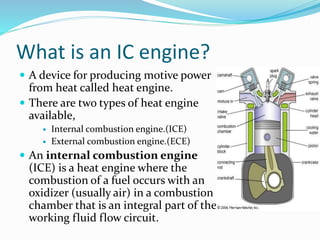
What is an IC engine?
 A device for producing motive power
from heat called heat engine.
 There are two types of heat engine
available,
 Internal combustion engine.(ICE)
 External combustion engine.(ECE)
 An internal combustion engine
(ICE) is a heat engine where the
combustion of a fuel occurs with an
oxidizer (usually air) in a combustion
chamber that is an integral part of the
working fluid flow circuit.
Introduction to IC engines
 Invented in early 1680.
 First attempt by Christian Huygens.
 First commercial success by Étienne Lenoir in 1859.
 First modern IC engine proposed by Siegfried Marcus
in 1864.
 Converts heat energy produced by burning of fuel to
mechanical output.
 Basically consists of a piston-cylinder arrangement.
 The expansion of combustion fuel due to the heat
produced moves the piston inside the cylinder.
Classification of IC engines
 Two main classifications:
 Based on combustion
 Spark Ignition [SI engines] (Eg: Petrol Engine)
 Compression Ignition [CI engines] (Eg: Diesel
Engine)
 Based on Number of strokes
 Two stroke
 Four Stroke
 Six Stroke
Major areas of advancement
 The vision behind evolving of IC engine was to extract
maximum power from the fuel while reducing emissions
and pollution from the engine.
 The main areas of advancement are:
 Engine Design
 Material Selection
 Timing Controls
 Fuel Injection And Combustion
 Pollution control
 Use of non-conventional or advanced fuels
 The advances moves almost parallel and most companies
have their own versions of the advances discussed here.
Our Goals for advancement
 To get more power from engine
 Less weight to power ratio
 Lower weight to torque ratio
 Less complexity in engine deign
 Better fuel economy
 Less pollution
 Lower cost of production
 Higher safety
Engine Design
 The early designs involved a single cylinder. This
caused a large amount of fluctuations in power
output.
 So more number of cylinders were added to reduce
output fluctuations and size of engine
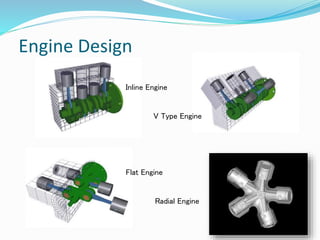
 There are four types of engine designs used.
 Inline
 V Type
 Flat Type
 Radial Engines
Engine Design
Inline Engine
V Type Engine
Flat Engine
Radial Engine
Material selection
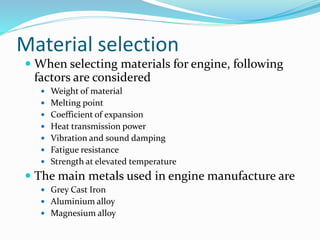
 When selecting materials for engine, following
factors are considered
 Weight of material
 Melting point
 Coefficient of expansion
 Heat transmission power
 Vibration and sound damping
 Fatigue resistance
 Strength at elevated temperature
 The main metals used in engine manufacture are
 Grey Cast Iron
 Aluminium alloy
 Magnesium alloy
Use of Sodium in engines
 A part of engine is hollowed and is filled with sodium
 When temperature of the part becomes 1600C sodium
melts
 This molten state has better heat transfer that solid
metal
 Sodium is mainly used in:
 Sodium Valves (Exhaust Valves)
 Piston Skirts
Timing controls
 The Efficiency of engine is decided by the timing of its
sequential operation.
 Timing of inlet and exhaust valves
 Timing of the spark in SI engines
 Timing of fuel injection in CI engines
 Sequential operation of each cylinders in multi cylinder engine
 In normal cases these timings are a design parameter
set at time of manufacture.
 The goal of timing control is to change the timings of
engine while its working.
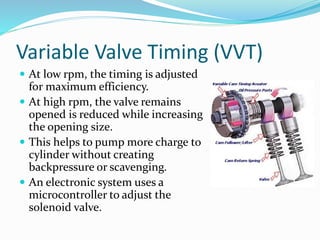
Variable Valve Timing (VVT)
 At low rpm, the timing is adjusted
for maximum efficiency.
 At high rpm, the valve remains
opened is reduced while increasing
the opening size.
 This helps to pump more charge to
cylinder without creating
backpressure or scavenging.
 An electronic system uses a
microcontroller to adjust the
solenoid valve.
Continued.
 In a mechanical system, the input from crank is given
to a gear which is locked to the cam using a pin.
 When adjustment is needed, the pin is removed
magnetically and a stepper motor adjusts the cam.
 Used in many cars in various names
BMW Valvetronic, VANOS
Fiat Twin Cam VIS
General Motors VVT, DCVCP
Honda VTEC, i-VTEC
Porsche VarioCam
Active Valve Train
 In active valve train, there will be two cams designed
for specific road conditions.
 When the microprocessor detects a rough terrain, the
cam used will be the one for more power.
 But during cruising, the cam is switched to a low
power, high efficient cam using a cam tapper.
 Introduced first by Lotus Motors and later developed
by Nissan Motors.
Cylinder Deactivation
 Cylinder deactivation is a derived form of active cam
switching.
 In this method, while cruising a part of cylinders are
switched off by switching to a cam without lobes.
 This method leads to
 Lesser fuel consumption
 Less heat generation
 Less power lost in managing other cylinders
 This is mostly employed in V Type Engines.
Continued.
 The cylinder is deactivated by
 Keeping the inlet valve closed so that there is no fuel
flow
 Keeping the exhaust valve open so there is no work done
in compression.
 Some Companies using cylinder deactivation are
 General Motors V8-6-4 (Cadillac)
 General Motors Active Fuel Management
 DaimlerChrysler Active Cylinder Control (ACC) (for Mercedes-
Benz)
 Honda Variable Cylinder Management (VCM)
Fuels and Fuel Injection
 The fuels and its input to the engine highly influences
the emissions from the engines.
 In SI engines a air-fuel mixture called charge is
introduced to the cylinder before compression
 In CI engines the fuel is injected after the compression
stroke to the cylinder. This helps in attaining higher
compression ratios.
 In SI engines it is not possible because there is a
chance that the fuel may burn before hand.
Direct Injection
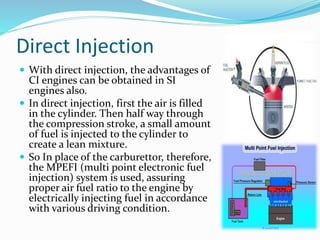
 With direct injection, the advantages of
CI engines can be obtained in SI
engines also.
 In direct injection, first the air is filled
in the cylinder. Then half way through
the compression stroke, a small amount
of fuel is injected to the cylinder to
create a lean mixture.
 So In place of the carburettor, therefore,
the MPEFI (multi point electronic fuel
injection) system is used, assuring
proper air fuel ratio to the engine by
electrically injecting fuel in accordance
with various driving condition.
Continued.
 At the end of compression, just before the spark the rest of
fuel is injected to the head of spark plug.
 The burning of fuel occurs in a stratified pattern near the
spark plug.
 Direct injection has many advantages such as
No need of carburetor
Easy design of manifold
Better compression is achievable
No case of knocking in engines
Lower NOx emissions
Due to stratified combustion leaner mixture can be used
which reduces the fuel consumption.
Superchargers
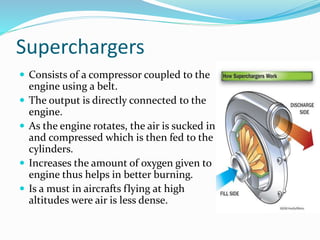
 Consists of a compressor coupled to the
engine using a belt.
 The output is directly connected to the
engine.
 As the engine rotates, the air is sucked in
and compressed which is then fed to the
cylinders.
 Increases the amount of oxygen given to
engine thus helps in better burning.
 Is a must in aircrafts flying at high
altitudes were air is less dense.
Turbochargers
 Is a derived form of supercharger
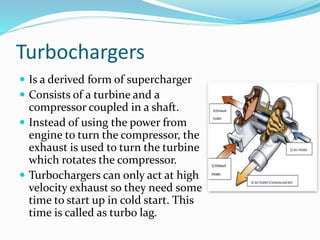
 Consists of a turbine and a
compressor coupled in a shaft.
 Instead of using the power from
engine to turn the compressor, the
exhaust is used to turn the turbine
which rotates the compressor.
 Turbochargers can only act at high
velocity exhaust so they need some
time to start up in cold start. This
time is called as turbo lag.
Six Stroke Engines
The invention of six stroke engines was for the
following reasons:
Less weight to power ratio
Less scavenging
Less moving parts
More power and fuel economy
Obtain freedom in designing
Better cooling
Six stroke engines are developed in two different ways
Air/Water injection to Cylinder
 In this method air or water is injected to the cylinder at
the end of exhaust stroke.
 The fluid absorbs the heat and expands providing
another power stroke. An exhaust stroke is provided to
removed the fluid from cylinder.
 Three recognized names in this section are:
 Bajulaz six stroke engine (Preheating of air)
 Velozeta six stroke engine (Injection of air)
 Crower six stroke engine (Injection of water)
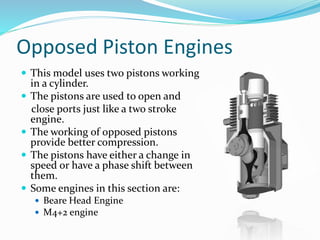
Opposed Piston Engines
 This model uses two pistons working
in a cylinder.
 The pistons are used to open and
close ports just like a two stroke
engine.
 The working of opposed pistons
provide better compression.
 The pistons have either a change in
speed or have a phase shift between
them.
 Some engines in this section are:
 Beare Head Engine
 M4+2 engine
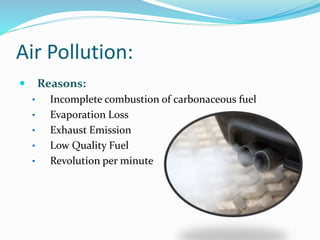
Air Pollution:
 Reasons:
• Incomplete combustion of carbonaceous fuel
• Evaporation Loss
• Exhaust Emission
• Low Quality Fuel
• Revolution per minute
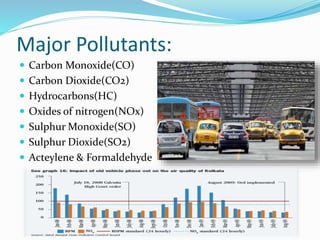
Major Pollutants:
 Carbon Monoxide(CO)
 Carbon Dioxide(CO2)
 Hydrocarbons(HC)
 Oxides of nitrogen(NOx)
 Sulphur Monoxide(SO)
 Sulphur Dioxide(SO2)
 Acteylene & Formaldehyde
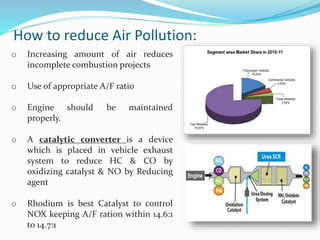
How to reduce Air Pollution:
o Increasing amount of air reduces
incomplete combustion projects
o Use of appropriate A/F ratio
o Engine should be maintained
properly.
o A catalytic converter is a device
which is placed in vehicle exhaust
system to reduce HC & CO by
oxidizing catalyst & NO by Reducing
agent
o Rhodium is best Catalyst to control
NOX keeping A/F ration within 14.6:1
to 14.7:1
Have a look
References
 www.google.co.in
 www.wikipedia.org
 www.youtube.com
 www.reviewcars.com
 www.engihub.com
Advancement of IC engine

Advancement of IC engine

  • 1.
    Advancement of ICEngine SEMINAR REPORT Guidance under Mr. D. Sanyal (Specialized Area:-Theory of Machine, Mechanical Science, Engineering Drawing) Presented by:- Prakash Giri Kalyani Govt. Engineering College Date :- 20/11/15 Mechanical Engineering 3rd Yr, Roll No- 31
  • 2.
    What is anIC engine?  A device for producing motive power from heat called heat engine.  There are two types of heat engine available,  Internal combustion engine.(ICE)  External combustion engine.(ECE)  An internal combustion engine (ICE) is a heat engine where the combustion of a fuel occurs with an oxidizer (usually air) in a combustion chamber that is an integral part of the working fluid flow circuit.
  • 3.
    Introduction to ICengines  Invented in early 1680.  First attempt by Christian Huygens.  First commercial success by Étienne Lenoir in 1859.  First modern IC engine proposed by Siegfried Marcus in 1864.  Converts heat energy produced by burning of fuel to mechanical output.  Basically consists of a piston-cylinder arrangement.  The expansion of combustion fuel due to the heat produced moves the piston inside the cylinder.
  • 4.
    Classification of ICengines  Two main classifications:  Based on combustion  Spark Ignition [SI engines] (Eg: Petrol Engine)  Compression Ignition [CI engines] (Eg: Diesel Engine)  Based on Number of strokes  Two stroke  Four Stroke  Six Stroke
  • 5.
    Major areas ofadvancement  The vision behind evolving of IC engine was to extract maximum power from the fuel while reducing emissions and pollution from the engine.  The main areas of advancement are:  Engine Design  Material Selection  Timing Controls  Fuel Injection And Combustion  Pollution control  Use of non-conventional or advanced fuels  The advances moves almost parallel and most companies have their own versions of the advances discussed here.
  • 6.
    Our Goals foradvancement  To get more power from engine  Less weight to power ratio  Lower weight to torque ratio  Less complexity in engine deign  Better fuel economy  Less pollution  Lower cost of production  Higher safety
  • 7.
    Engine Design  Theearly designs involved a single cylinder. This caused a large amount of fluctuations in power output.  So more number of cylinders were added to reduce output fluctuations and size of engine  There are four types of engine designs used.  Inline  V Type  Flat Type  Radial Engines
  • 8.
    Engine Design Inline Engine VType Engine Flat Engine Radial Engine
  • 9.
    Material selection  Whenselecting materials for engine, following factors are considered  Weight of material  Melting point  Coefficient of expansion  Heat transmission power  Vibration and sound damping  Fatigue resistance  Strength at elevated temperature  The main metals used in engine manufacture are  Grey Cast Iron  Aluminium alloy  Magnesium alloy
  • 10.
    Use of Sodiumin engines  A part of engine is hollowed and is filled with sodium  When temperature of the part becomes 1600C sodium melts  This molten state has better heat transfer that solid metal  Sodium is mainly used in:  Sodium Valves (Exhaust Valves)  Piston Skirts
  • 11.
    Timing controls  TheEfficiency of engine is decided by the timing of its sequential operation.  Timing of inlet and exhaust valves  Timing of the spark in SI engines  Timing of fuel injection in CI engines  Sequential operation of each cylinders in multi cylinder engine  In normal cases these timings are a design parameter set at time of manufacture.  The goal of timing control is to change the timings of engine while its working.
  • 12.
    Variable Valve Timing(VVT)  At low rpm, the timing is adjusted for maximum efficiency.  At high rpm, the valve remains opened is reduced while increasing the opening size.  This helps to pump more charge to cylinder without creating backpressure or scavenging.  An electronic system uses a microcontroller to adjust the solenoid valve.
  • 13.
    Continued.  In amechanical system, the input from crank is given to a gear which is locked to the cam using a pin.  When adjustment is needed, the pin is removed magnetically and a stepper motor adjusts the cam.  Used in many cars in various names BMW Valvetronic, VANOS Fiat Twin Cam VIS General Motors VVT, DCVCP Honda VTEC, i-VTEC Porsche VarioCam
  • 14.
    Active Valve Train In active valve train, there will be two cams designed for specific road conditions.  When the microprocessor detects a rough terrain, the cam used will be the one for more power.  But during cruising, the cam is switched to a low power, high efficient cam using a cam tapper.  Introduced first by Lotus Motors and later developed by Nissan Motors.
  • 15.
    Cylinder Deactivation  Cylinderdeactivation is a derived form of active cam switching.  In this method, while cruising a part of cylinders are switched off by switching to a cam without lobes.  This method leads to  Lesser fuel consumption  Less heat generation  Less power lost in managing other cylinders  This is mostly employed in V Type Engines.
  • 16.
    Continued.  The cylinderis deactivated by  Keeping the inlet valve closed so that there is no fuel flow  Keeping the exhaust valve open so there is no work done in compression.  Some Companies using cylinder deactivation are  General Motors V8-6-4 (Cadillac)  General Motors Active Fuel Management  DaimlerChrysler Active Cylinder Control (ACC) (for Mercedes- Benz)  Honda Variable Cylinder Management (VCM)
  • 17.
    Fuels and FuelInjection  The fuels and its input to the engine highly influences the emissions from the engines.  In SI engines a air-fuel mixture called charge is introduced to the cylinder before compression  In CI engines the fuel is injected after the compression stroke to the cylinder. This helps in attaining higher compression ratios.  In SI engines it is not possible because there is a chance that the fuel may burn before hand.
  • 18.
    Direct Injection  Withdirect injection, the advantages of CI engines can be obtained in SI engines also.  In direct injection, first the air is filled in the cylinder. Then half way through the compression stroke, a small amount of fuel is injected to the cylinder to create a lean mixture.  So In place of the carburettor, therefore, the MPEFI (multi point electronic fuel injection) system is used, assuring proper air fuel ratio to the engine by electrically injecting fuel in accordance with various driving condition.
  • 19.
    Continued.  At theend of compression, just before the spark the rest of fuel is injected to the head of spark plug.  The burning of fuel occurs in a stratified pattern near the spark plug.  Direct injection has many advantages such as No need of carburetor Easy design of manifold Better compression is achievable No case of knocking in engines Lower NOx emissions Due to stratified combustion leaner mixture can be used which reduces the fuel consumption.
  • 20.
    Superchargers  Consists ofa compressor coupled to the engine using a belt.  The output is directly connected to the engine.  As the engine rotates, the air is sucked in and compressed which is then fed to the cylinders.  Increases the amount of oxygen given to engine thus helps in better burning.  Is a must in aircrafts flying at high altitudes were air is less dense.
  • 21.
    Turbochargers  Is aderived form of supercharger  Consists of a turbine and a compressor coupled in a shaft.  Instead of using the power from engine to turn the compressor, the exhaust is used to turn the turbine which rotates the compressor.  Turbochargers can only act at high velocity exhaust so they need some time to start up in cold start. This time is called as turbo lag.
  • 22.
    Six Stroke Engines Theinvention of six stroke engines was for the following reasons: Less weight to power ratio Less scavenging Less moving parts More power and fuel economy Obtain freedom in designing Better cooling Six stroke engines are developed in two different ways
  • 23.
    Air/Water injection toCylinder  In this method air or water is injected to the cylinder at the end of exhaust stroke.  The fluid absorbs the heat and expands providing another power stroke. An exhaust stroke is provided to removed the fluid from cylinder.  Three recognized names in this section are:  Bajulaz six stroke engine (Preheating of air)  Velozeta six stroke engine (Injection of air)  Crower six stroke engine (Injection of water)
  • 24.
    Opposed Piston Engines This model uses two pistons working in a cylinder.  The pistons are used to open and close ports just like a two stroke engine.  The working of opposed pistons provide better compression.  The pistons have either a change in speed or have a phase shift between them.  Some engines in this section are:  Beare Head Engine  M4+2 engine
  • 25.
    Air Pollution:  Reasons: •Incomplete combustion of carbonaceous fuel • Evaporation Loss • Exhaust Emission • Low Quality Fuel • Revolution per minute
  • 26.
    Major Pollutants:  CarbonMonoxide(CO)  Carbon Dioxide(CO2)  Hydrocarbons(HC)  Oxides of nitrogen(NOx)  Sulphur Monoxide(SO)  Sulphur Dioxide(SO2)  Acteylene & Formaldehyde
  • 27.
    How to reduceAir Pollution: o Increasing amount of air reduces incomplete combustion projects o Use of appropriate A/F ratio o Engine should be maintained properly. o A catalytic converter is a device which is placed in vehicle exhaust system to reduce HC & CO by oxidizing catalyst & NO by Reducing agent o Rhodium is best Catalyst to control NOX keeping A/F ration within 14.6:1 to 14.7:1
  • 28.
  • 29.
    References  www.google.co.in  www.wikipedia.org www.youtube.com  www.reviewcars.com  www.engihub.com