Fuel Feed System
In Petrol Engines
Types
• Gravity system
• Pressure system
• Vacuum system
• Pump system
• Fuel Injection system
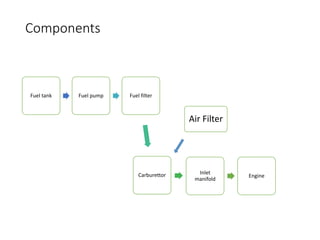
Components
Fuel tank Fuel pump Fuel filter
Carburettor Inlet
manifold
Engine
Air Filter
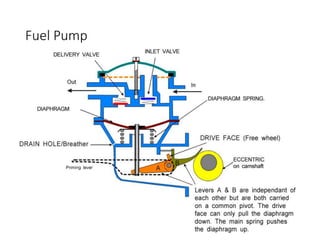
Fuel Pump
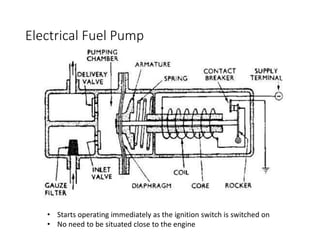
Electrical Fuel Pump
• Starts operating immediately as the ignition switch is switched on
• No need to be situated close to the engine
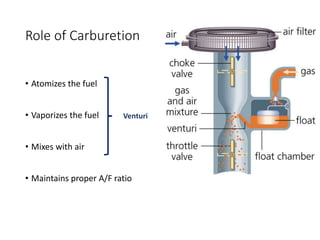
Role of Carburetion
• Atomizes the fuel
• Vaporizes the fuel
• Mixes with air
• Maintains proper A/F ratio
Venturi
Stoichiometric Ratio of Gasoline
• It is the theoretical (Chemically correct) A/F ratio by weight required
for proper combustion (14.5:1)
• Lean Mixture
• Here the proportion of fuel is less than the Stoichiometric Ratio
• Rich Mixture
• Here the proportion of fuel is more than the Stoichiometric Ratio
• Cruising of a vehicle needs an A/F ratio about 15:1
Requirements of the Engine
• Starting
• Needs rich mixture
• Idling
• Needs rich mixture
• Normal Running
• Lean mixture may be supplied
• Power Range (High power)
• Needs rich mixture
Why Idling needs rich mixture
• To compensate the charge dilution, it must be rich
• To overcome the Frictional & Inertial resistances
• Normal Running
• Engine is already designed and tuned to run at the nominal speed
• Power Range
• Requires rich mixture to provide more power
• Prevents overheating
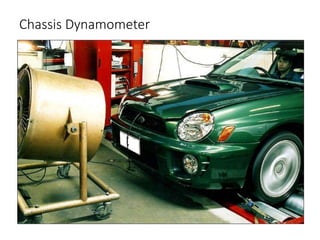
Chassis Dynamometer
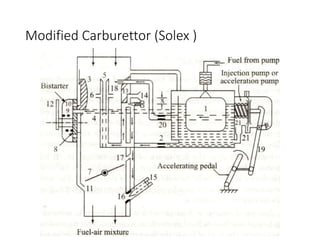
Modified Carburettor (Solex )
Types of Carburettors
• Based on draft
• Updraft
• Downdraft
• Sidedraft
• Based on design
• Constant choke carburettors
• Constant vacuum carburettors
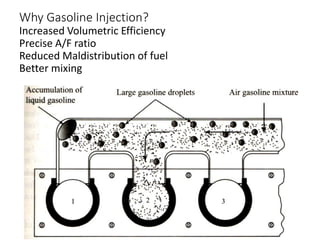
Why Gasoline Injection?
Increased Volumetric Efficiency
Precise A/F ratio
Reduced Maldistribution of fuel
Better mixing
Summary
• Carburetion is the process of atomizing, vaporizing and mixing the
fuel with air
• Mixture which has less than proportion of fuel is less than the
Stoichiometric Ratio is called lean mixture

1.petrol fuel feed system

  • 1.
    Fuel Feed System InPetrol Engines
  • 2.
    Types • Gravity system •Pressure system • Vacuum system • Pump system • Fuel Injection system
  • 3.
    Components Fuel tank Fuelpump Fuel filter Carburettor Inlet manifold Engine Air Filter
  • 4.
  • 5.
    Electrical Fuel Pump •Starts operating immediately as the ignition switch is switched on • No need to be situated close to the engine
  • 6.
    Role of Carburetion •Atomizes the fuel • Vaporizes the fuel • Mixes with air • Maintains proper A/F ratio Venturi
  • 7.
    Stoichiometric Ratio ofGasoline • It is the theoretical (Chemically correct) A/F ratio by weight required for proper combustion (14.5:1) • Lean Mixture • Here the proportion of fuel is less than the Stoichiometric Ratio • Rich Mixture • Here the proportion of fuel is more than the Stoichiometric Ratio • Cruising of a vehicle needs an A/F ratio about 15:1
  • 8.
    Requirements of theEngine • Starting • Needs rich mixture • Idling • Needs rich mixture • Normal Running • Lean mixture may be supplied • Power Range (High power) • Needs rich mixture
  • 9.
    Why Idling needsrich mixture • To compensate the charge dilution, it must be rich • To overcome the Frictional & Inertial resistances • Normal Running • Engine is already designed and tuned to run at the nominal speed • Power Range • Requires rich mixture to provide more power • Prevents overheating
  • 10.
  • 11.
  • 12.
    Types of Carburettors •Based on draft • Updraft • Downdraft • Sidedraft • Based on design • Constant choke carburettors • Constant vacuum carburettors
  • 13.
    Why Gasoline Injection? IncreasedVolumetric Efficiency Precise A/F ratio Reduced Maldistribution of fuel Better mixing
  • 14.
    Summary • Carburetion isthe process of atomizing, vaporizing and mixing the fuel with air • Mixture which has less than proportion of fuel is less than the Stoichiometric Ratio is called lean mixture

Editor's Notes

  • #5 Disadvantage: Vapour lock
  • #10 Throttle almost in closed condition hence inlet manifold pressure is considerable less Whereas Exhaust pressure is relatively high It leads to insufficient scavenging (due to back pressure) and the charge gets diluted by the exhaust gases
  • #14 In 1903, maiden SI engine powered flight with gear pump FI made by Wright brothers