IUCN Criteria
of
Endangerment
Praveen Kumar Singh
M.Sc. Environmental Science
Central University of Rajasthan
IUCN at a glance
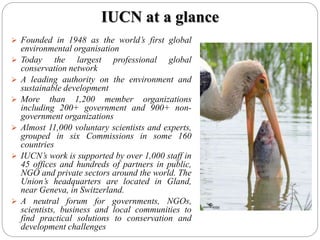
 Founded in 1948 as the world’s first global
environmental organisation
 Today the largest professional global
conservation network
 A leading authority on the environment and
sustainable development
 More than 1,200 member organizations
including 200+ government and 900+ non-
government organizations
 Almost 11,000 voluntary scientists and experts,
grouped in six Commissions in some 160
countries
 IUCN’s work is supported by over 1,000 staff in
45 offices and hundreds of partners in public,
NGO and private sectors around the world. The
Union’s headquarters are located in Gland,
near Geneva, in Switzerland.
 A neutral forum for governments, NGOs,
scientists, business and local communities to
find practical solutions to conservation and
development challenges
Continued……
 Thousands of field projects and activities around the world
 Governance by a Council elected by member organizations every four years at the
IUCN World Conservation Congress
 Funded by governments, bilateral and multilateral agencies, foundations, member
organisations and corporations
 Official Observer Status at the United Nations General Assembly
What does IUCN do?
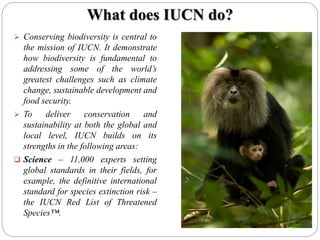
 Conserving biodiversity is central to
the mission of IUCN. It demonstrate
how biodiversity is fundamental to
addressing some of the world’s
greatest challenges such as climate
change, sustainable development and
food security.
 To deliver conservation and
sustainability at both the global and
local level, IUCN builds on its
strengths in the following areas:
 Science – 11,000 experts setting
global standards in their fields, for
example, the definitive international
standard for species extinction risk –
the IUCN Red List of Threatened
Species™.
 Action – hundreds of conservation
projects all over the world from the
local level to those involving several
countries, all aimed at the sustainable
management of biodiversity and
natural resources.
 Influence – through the collective
strength of more than 1,200
government and non-governmental
Member organizations, IUCN
influences international
environmental conventions, policies
and laws.
Continued……
How does IUCN work?
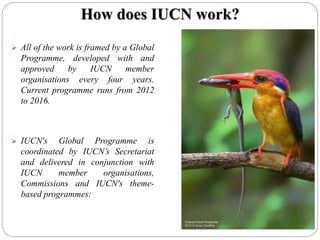
 All of the work is framed by a Global
Programme, developed with and
approved by IUCN member
organisations every four years.
Current programme runs from 2012
to 2016.
 IUCN's Global Programme is
coordinated by IUCN’s Secretariat
and delivered in conjunction with
IUCN member organisations,
Commissions and IUCN's theme-
based programmes:
 Business
 Economics
 Ecosystem management
 Environmental law
 Forest conservation
 Gender
 Global policy
 Marine and polar
 Protected areas
 Science and knowledge
 Social policy
 Species
 Water
 World Heritage
Continued……
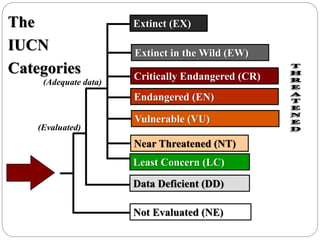
The
IUCN
Categories
Not Evaluated (NE)
Near Threatened (NT)
Data Deficient (DD)
Endangered (EN)
Critically Endangered (CR)
Vulnerable (VU)
Extinct in the Wild (EW)
Extinct (EX)
Least Concern (LC)
(Evaluated)
(Adequate data)
Data Deficient (DD)
A taxon is Data Deficient when there is inadequate information to make a direct, or
indirect, assessment of its risk of extinction based on its distribution and/or
population status.
Tree Tomato
Solanum [Cyphomandra] betacea
Not Evaluated (NE)
A taxon is Not Evaluated when it has not yet been evaluated
against the criteria.
Although DD and NE are not
threatened categories, taxa classed as
DD or NE should NOT be treated as
not threatened.
Data Deficient (DD) tags
Taxa listed as DD may be given the following tags
 Unknown provenance: The taxon is known only from one or more
specimens with no or extremely uncertain locality information, so that it is
not possible to make any further inference about its status.
 Uncertain taxonomic status: The taxon’s validity at the species level has
been questioned or is unconfirmed, e.g., it may represent a subspecies,
hybrid, ecophenotype or aberrant individual.
 Insufficient information: There is inadequate information on the
population size/structure, trend or range to apply the Red List Criteria.
Near Threatened (NT)
A taxon is Near Threatened when it has been evaluated against the criteria and
does not qualify for CR, EN or VU now, but is close to qualifying for or is likely to
qualify for a threatened category in the near future.
Least Concern (LC)
A taxon is Least Concern when it has been evaluated against the criteria and does
not qualify for CR, EN,VU or NT. Widespread and abundant
taxa are included in this category.
Chinkara in Desert National Park
Blackbuck (Antilope cervicapra)
A taxon is threatened when the best available evidence indicates that it meets any of
the criteria for the thresholds stated in one of the three threatened categories:
Vulnerable, Endangered or Critically Endangered.
Critically Endangered (CR)
CR taxa are considered to be facing an extremely high risk of
extinction in the wild.
Endangered (EN)
EN taxa are considered to be facing a very high
risk of extinction in the wild. Tiger
Vulnerable (VU)
VU taxa are considered to be facing a high risk of extinction
in the wild.
Great Indian bustard
Sarus crane
A taxon is Extinct when there is no reasonable doubt that the last individual has
died.
Javan tiger
Extinct (EX)
Extinct in the Wild (EW)
A taxon is Extinct in the Wild when it is known only to survive in cultivation, in
captivity or as a naturalized population (or populations) well
outside the past range.
A species is presumed EX or EW only when exhaustive
surveys have been carried out:
• throughout its historic range;
• in known and/or expected habitat;
• at appropriate times (diurnal, seasonal, annual); and
• over a time frame appropriate to the species' life cycle
and have failed to record an individual.
Extinct (EX) Extinct in the Wild (EW)
PE species are those that are, on the balance of evidence, likely to be extinct, but for
which there is a small chance that they may be extant and thus should not be listed
as Extinct until adequate surveys have failed to find the species and local or
unconfirmed reports have been discounted.
CR (PE)
Possibly Extinct Tag
Evidence for extinction:
For species with recent last records, the declines have been well documented.
Severe threatening processes are known to have occurred (e.g. extensive habitat
loss, spread of alien invasive, intensive hunting).
The species possesses attributes known to predispose taxa to extinction e.g.
natural rarity and/or tiny range, etc.
Recent surveys have been apparently adequate given the species’ ease of
detection, but have failed to detect the species.
Evidence against extinction:
Recent field work has been inadequate (any surveys have been insufficiently
intensive/extensive, or inappropriately timed; or the species’ range is
inaccessible, remote, unsafe or inadequately known).
The species is difficult to detect (it is cryptic, inconspicuous, nocturnal,
nomadic, silent or its vocalisations are unknown, identification is difficult, or the
species occurs at low densities).
There have been reasonably convincing recent local reports or unconfirmed
sightings.
Suitable habitat (free of introduced predators and pathogens if relevant)
remains within the species’ known range, and/or allospecies or congeners may
survive despite similar threatening processes.
Possibly Extinct species
Possibly
Extinct
Nature of the criteria
There are five quantitative criteria which are used to determine whether a taxon is
threatened or not, and if threatened, which category of threat it belongs in
(Critically Endangered, Endangered or Vulnerable).
The five criteria are:
A. Declining population (past, present and/or projected)
B. Geographic range size, and fragmentation, decline or fluctuations
C. Small population size and fragmentation, decline, or fluctuations
D. Very small population or very restricted distribution
E. Quantitative analysis of extinction risk (e.g., Population Viability Analysis)
Thank
You…

IUCN Criteria

  • 1.
    IUCN Criteria of Endangerment Praveen KumarSingh M.Sc. Environmental Science Central University of Rajasthan
  • 2.
    IUCN at aglance  Founded in 1948 as the world’s first global environmental organisation  Today the largest professional global conservation network  A leading authority on the environment and sustainable development  More than 1,200 member organizations including 200+ government and 900+ non- government organizations  Almost 11,000 voluntary scientists and experts, grouped in six Commissions in some 160 countries  IUCN’s work is supported by over 1,000 staff in 45 offices and hundreds of partners in public, NGO and private sectors around the world. The Union’s headquarters are located in Gland, near Geneva, in Switzerland.  A neutral forum for governments, NGOs, scientists, business and local communities to find practical solutions to conservation and development challenges
  • 3.
    Continued……  Thousands offield projects and activities around the world  Governance by a Council elected by member organizations every four years at the IUCN World Conservation Congress  Funded by governments, bilateral and multilateral agencies, foundations, member organisations and corporations  Official Observer Status at the United Nations General Assembly
  • 4.
    What does IUCNdo?  Conserving biodiversity is central to the mission of IUCN. It demonstrate how biodiversity is fundamental to addressing some of the world’s greatest challenges such as climate change, sustainable development and food security.  To deliver conservation and sustainability at both the global and local level, IUCN builds on its strengths in the following areas:  Science – 11,000 experts setting global standards in their fields, for example, the definitive international standard for species extinction risk – the IUCN Red List of Threatened Species™.
  • 5.
     Action –hundreds of conservation projects all over the world from the local level to those involving several countries, all aimed at the sustainable management of biodiversity and natural resources.  Influence – through the collective strength of more than 1,200 government and non-governmental Member organizations, IUCN influences international environmental conventions, policies and laws. Continued……
  • 6.
    How does IUCNwork?  All of the work is framed by a Global Programme, developed with and approved by IUCN member organisations every four years. Current programme runs from 2012 to 2016.  IUCN's Global Programme is coordinated by IUCN’s Secretariat and delivered in conjunction with IUCN member organisations, Commissions and IUCN's theme- based programmes:
  • 7.
     Business  Economics Ecosystem management  Environmental law  Forest conservation  Gender  Global policy  Marine and polar  Protected areas  Science and knowledge  Social policy  Species  Water  World Heritage Continued……
  • 8.
    The IUCN Categories Not Evaluated (NE) NearThreatened (NT) Data Deficient (DD) Endangered (EN) Critically Endangered (CR) Vulnerable (VU) Extinct in the Wild (EW) Extinct (EX) Least Concern (LC) (Evaluated) (Adequate data)
  • 9.
    Data Deficient (DD) Ataxon is Data Deficient when there is inadequate information to make a direct, or indirect, assessment of its risk of extinction based on its distribution and/or population status. Tree Tomato Solanum [Cyphomandra] betacea Not Evaluated (NE) A taxon is Not Evaluated when it has not yet been evaluated against the criteria. Although DD and NE are not threatened categories, taxa classed as DD or NE should NOT be treated as not threatened.
  • 10.
    Data Deficient (DD)tags Taxa listed as DD may be given the following tags  Unknown provenance: The taxon is known only from one or more specimens with no or extremely uncertain locality information, so that it is not possible to make any further inference about its status.  Uncertain taxonomic status: The taxon’s validity at the species level has been questioned or is unconfirmed, e.g., it may represent a subspecies, hybrid, ecophenotype or aberrant individual.  Insufficient information: There is inadequate information on the population size/structure, trend or range to apply the Red List Criteria.
  • 11.
    Near Threatened (NT) Ataxon is Near Threatened when it has been evaluated against the criteria and does not qualify for CR, EN or VU now, but is close to qualifying for or is likely to qualify for a threatened category in the near future. Least Concern (LC) A taxon is Least Concern when it has been evaluated against the criteria and does not qualify for CR, EN,VU or NT. Widespread and abundant taxa are included in this category. Chinkara in Desert National Park Blackbuck (Antilope cervicapra)
  • 12.
    A taxon isthreatened when the best available evidence indicates that it meets any of the criteria for the thresholds stated in one of the three threatened categories: Vulnerable, Endangered or Critically Endangered. Critically Endangered (CR) CR taxa are considered to be facing an extremely high risk of extinction in the wild. Endangered (EN) EN taxa are considered to be facing a very high risk of extinction in the wild. Tiger Vulnerable (VU) VU taxa are considered to be facing a high risk of extinction in the wild. Great Indian bustard Sarus crane
  • 13.
    A taxon isExtinct when there is no reasonable doubt that the last individual has died. Javan tiger Extinct (EX) Extinct in the Wild (EW) A taxon is Extinct in the Wild when it is known only to survive in cultivation, in captivity or as a naturalized population (or populations) well outside the past range.
  • 14.
    A species ispresumed EX or EW only when exhaustive surveys have been carried out: • throughout its historic range; • in known and/or expected habitat; • at appropriate times (diurnal, seasonal, annual); and • over a time frame appropriate to the species' life cycle and have failed to record an individual. Extinct (EX) Extinct in the Wild (EW)
  • 15.
    PE species arethose that are, on the balance of evidence, likely to be extinct, but for which there is a small chance that they may be extant and thus should not be listed as Extinct until adequate surveys have failed to find the species and local or unconfirmed reports have been discounted. CR (PE) Possibly Extinct Tag Evidence for extinction: For species with recent last records, the declines have been well documented. Severe threatening processes are known to have occurred (e.g. extensive habitat loss, spread of alien invasive, intensive hunting). The species possesses attributes known to predispose taxa to extinction e.g. natural rarity and/or tiny range, etc. Recent surveys have been apparently adequate given the species’ ease of detection, but have failed to detect the species.
  • 16.
    Evidence against extinction: Recentfield work has been inadequate (any surveys have been insufficiently intensive/extensive, or inappropriately timed; or the species’ range is inaccessible, remote, unsafe or inadequately known). The species is difficult to detect (it is cryptic, inconspicuous, nocturnal, nomadic, silent or its vocalisations are unknown, identification is difficult, or the species occurs at low densities). There have been reasonably convincing recent local reports or unconfirmed sightings. Suitable habitat (free of introduced predators and pathogens if relevant) remains within the species’ known range, and/or allospecies or congeners may survive despite similar threatening processes. Possibly Extinct species
  • 17.
  • 18.
    Nature of thecriteria There are five quantitative criteria which are used to determine whether a taxon is threatened or not, and if threatened, which category of threat it belongs in (Critically Endangered, Endangered or Vulnerable). The five criteria are: A. Declining population (past, present and/or projected) B. Geographic range size, and fragmentation, decline or fluctuations C. Small population size and fragmentation, decline, or fluctuations D. Very small population or very restricted distribution E. Quantitative analysis of extinction risk (e.g., Population Viability Analysis)
  • 20.