Intelligent Transportation System
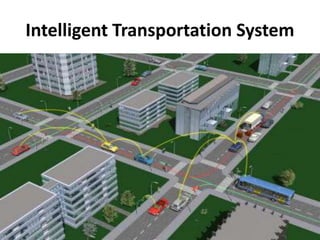
• Intelligent transportation systems (ITS) are
advanced applications which, aim to provide
innovative services relating to different
modes of transport and traffic management
and enable various users to be better
informed and make safer, more coordinated,
and 'smarter' use of transport networks.
Intelligent Transportation System
• IST can help reduce congestion improve
mobility save lives and optimize the
performance of existing infrastructure and
road users.
• Its prime work is to facilitates easier and
efficient data collection, data transfer,
communication between the transport
infrastructure users and assessment of
facilities .
Intelligent Transportation System
• Although ITS may refer to all modes of
transport, ITS as systems in which information
and communication technologies are applied
in the field of road transport, including
infrastructure, vehicles and users, and in
traffic management and mobility
management, as well as for interfaces with
other modes of transport
Intelligent Transportation System
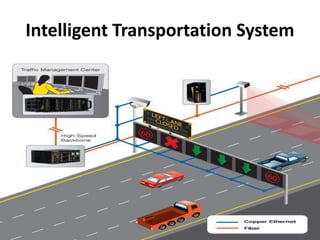
Intelligent transport systems
• Intelligent transport systems vary in technologies
applied, from basic management systems such as car
navigation; traffic signal control systems; container
management systems; variable message signs;
automatic number plate recognition or speed cameras
to monitor applications, such as security CCTV
systems; and to more advanced applications that
integrate live data and feedback from a number of
other sources, such as parking guidance and
information systems; weather information etc.
Additionally, predictive techniques are being
developed to allow advanced modeling and
comparison with historical baseline data.
ITS - History
Preparation (1925 – 1980)
• Electric traffic signals– perceived as first ITS
deployment in the world(Baltimore, USA).
• Computer controlled intersections (1960s)
• Electronic Route Guidance System (1970s) – radio
based and in-vehicle (two-way communication)
• Beginning of microprocessor and GPS technologies
Focus was more on building roads than technologies
ITS - History
• Feasibility Phase (1980-1995) – Led by Europe,
US and Japan In Europe, 19 countries established
the PROMETHEUS (Program for European Traffic
with Efficiency and Unprecedented Safety)
project.
• It received €749,000,000 in funding from
the EUREKA member states,[1] and defined the
state of the art of autonomous vehicles.
Numerous universities and car manufacturers
participated in this Pan-European project.
ITS - History
• Under a steering committee were three projects on
industrial research and four on basic research.[2]
Industrial research
• PRO-CAR : Driver assistance by computer systems
• PRO-NET : Vehicle-to-vehicle communication
• PRO-ROAD : Vehicle-to-environment communication
Basic Research
• PRO-ART : Methods and systems of artificial intelligence
• PRO-CHIP: Custom hardware for intelligent processing in
vehicles
• PRO-COM : Methods and standards for communication
• PRO-GEN : Traffic scenario for new assessment and
introduction of new systems
ITS - History
• The project culminated in a 'Board Members Meeting' (BMM) on
18–20 October 1994 in Paris Projects demonstrated ('Common
European Demonstrators') were:
• CED 1 : Vision Enhancement
• CED 2-1 : Friction Monitoring and Vehicle Dynamics
• CED 2-2 : Lane Keeping Support
• CED 2-3 : Visibility Range Monitoring
• CED 2-4 : Driver Status Monitoring
• CED 3 : Collision Avoidance
• CED 4 : Cooperative Driving
• CED 5 : Autonomous Intelligent Cruise Control
• CED 6 : Automatic Emergency Call
• CED 7 : Fleet Management
• CED 9 : Dual Mode Route Guidance
• CED 10: Travel and Traffic Information Systems
ITS - History
(1980-1995)
• Vehicles with cameras and processors
• Automatic road and lane following,
• Maintaining safe distance from the vehicle in front
Collision avoidance
Lane-changing and overtaking
Communication systems
• Product Development (1995-present)
Large-scale integration and deployment
Data-driven
Sensors
1 Classification of Sensor Technology
• Based on functional principle
• Mobile Sensors
Inbuilt to each individual vehicle (GPS receivers,
acoustic/ultrasonic sensors, Bluetooth)
• Point Sensors
Mounted at fixed locations along the roadway and observes
traffic only at this particular location (Inductive Loop
detectors, pneumatic tubes, RFID technology)
• Space Sensors
Ability to take snapshots of traffic across space
(Drone/Satellite photography)
Sensors
• Based on implementation of sensor Intrusive
Installation of sensing system affects existing
infrastructure – pavement work (loop detectors,
pneumatic tubes)
• Nonintrusive
Installation does not impede traffic flow (RFID and
VIPS technology)
• Off-Roadway
Sensor not fixed on the roadway (GPS receivers,
cell phones, drones, and satellites 8
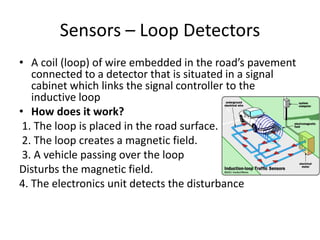
Sensors – Loop Detectors
• A coil (loop) of wire embedded in the road’s pavement
connected to a detector that is situated in a signal
cabinet which links the signal controller to the
inductive loop
• How does it work?
1. The loop is placed in the road surface.
2. The loop creates a magnetic field.
3. A vehicle passing over the loop
Disturbs the magnetic field.
4. The electronics unit detects the disturbance
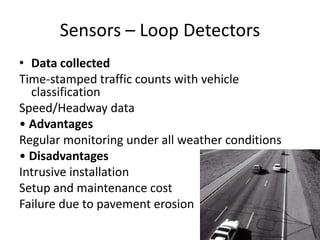
Sensors – Loop Detectors
• Data collected
Time-stamped traffic counts with vehicle
classification
Speed/Headway data
• Advantages
Regular monitoring under all weather conditions
• Disadvantages
Intrusive installation
Setup and maintenance cost
Failure due to pavement erosion
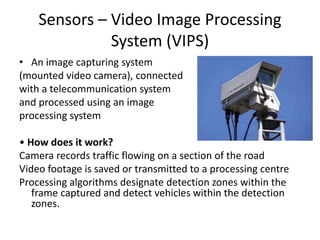
Sensors – Video Image Processing
System (VIPS)
• An image capturing system
(mounted video camera), connected
with a telecommunication system
and processed using an image
processing system
• How does it work?
Camera records traffic flowing on a section of the road
Video footage is saved or transmitted to a processing centre
Processing algorithms designate detection zones within the
frame captured and detect vehicles within the detection
zones.
Sensors – Video Image Processing
System (VIPS)
• Data collected
Time-stamped traffic counts with vehicle classification
Speed/Headway data
• Advantages
Regular monitoring under all weather conditions
Non-intrusive and flexible in setting up detection zones,
limits errors
• Disadvantages
Very expensive
Vulnerable to visual obstruction (inclement weather, sun
glare)
VIPS - Automatic Road Enforcement
• Speed cameras that identify vehicles traveling over the legal speed
limit. Many such devices use radar to detect a vehicle's speed or
electromagnetic loops buried in each lane of the road.
• Red light cameras that detect vehicles that cross a stop line or
designated stopping place while a red traffic light is showing.
• Bus lane cameras that identify vehicles traveling in lanes reserved
for buses. In some jurisdictions, bus lanes can also be used by taxis
or vehicles engaged in car pooling.
• Level crossing cameras that identify vehicles crossing railways at
grade illegally.
• High-occupancy vehicle lane cameras that identify vehicles
violating HOV requirements.
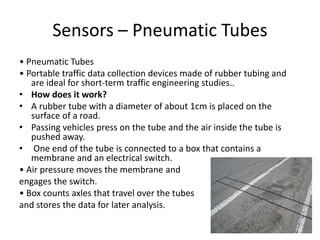
Sensors – Pneumatic Tubes
• Pneumatic Tubes
• Portable traffic data collection devices made of rubber tubing and
are ideal for short-term traffic engineering studies..
• How does it work?
• A rubber tube with a diameter of about 1cm is placed on the
surface of a road.
• Passing vehicles press on the tube and the air inside the tube is
pushed away.
• One end of the tube is connected to a box that contains a
membrane and an electrical switch.
• Air pressure moves the membrane and
engages the switch.
• Box counts axles that travel over the tubes
and stores the data for later analysis.
Sensors – Pneumatic Tubes
• Data collected
Time-stamped axle counts which collects vehicle classification,
direction of flow, traffic counts,Instantaneous Speed and
headway data can be inferred
• Advantages
Low cost
Portable and reusable
• Disadvantages
Limited coverage and can not be used for regular
measurements
Vulnerable to damage, inaccurate data collection and can be
intrusive
Some Benefits of ITS
• Improved safety
• • Reduced congestion
• • Reduced emissions co2
• • Reduced travel times
• • Improved reliability
• • Enhanced access and quality of life
• • Crash prevention
• • Cost savings for commercial vehicle operations
• • Enhanced travel options
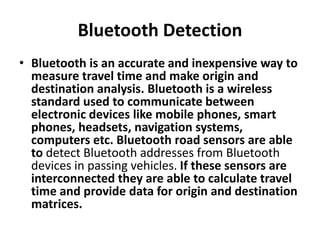
Bluetooth Detection
• Bluetooth is an accurate and inexpensive way to
measure travel time and make origin and
destination analysis. Bluetooth is a wireless
standard used to communicate between
electronic devices like mobile phones, smart
phones, headsets, navigation systems,
computers etc. Bluetooth road sensors are able
to detect Bluetooth addresses from Bluetooth
devices in passing vehicles. If these sensors are
interconnected they are able to calculate travel
time and provide data for origin and destination
matrices.
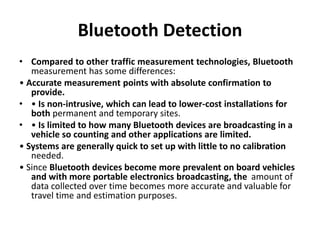
Bluetooth Detection
• Compared to other traffic measurement technologies, Bluetooth
measurement has some differences:
• Accurate measurement points with absolute confirmation to
provide.
• • Is non-intrusive, which can lead to lower-cost installations for
both permanent and temporary sites.
• • Is limited to how many Bluetooth devices are broadcasting in a
vehicle so counting and other applications are limited.
• Systems are generally quick to set up with little to no calibration
needed.
• Since Bluetooth devices become more prevalent on board vehicles
and with more portable electronics broadcasting, the amount of
data collected over time becomes more accurate and valuable for
travel time and estimation purposes.
Audio Detection
• Audio Detection
• • It is also possible to measure traffic density on
a road using the Audio signal that consists of the
cumulative sound from tire noise, engine noise,
engine-idling noise, honks and air turbulence
noise.
• • A roadside-installed microphone picks up the
audio that comprises the various vehicle noise
and Audio signal processing techniques can be
used to estimate the traffic state.

Intelligent Transportation Systems .pptx

  • 1.
  • 2.
    Intelligent Transportation System •Intelligent transportation systems (ITS) are advanced applications which, aim to provide innovative services relating to different modes of transport and traffic management and enable various users to be better informed and make safer, more coordinated, and 'smarter' use of transport networks.
  • 3.
    Intelligent Transportation System •IST can help reduce congestion improve mobility save lives and optimize the performance of existing infrastructure and road users. • Its prime work is to facilitates easier and efficient data collection, data transfer, communication between the transport infrastructure users and assessment of facilities .
  • 4.
  • 5.
    Intelligent Transportation System •Although ITS may refer to all modes of transport, ITS as systems in which information and communication technologies are applied in the field of road transport, including infrastructure, vehicles and users, and in traffic management and mobility management, as well as for interfaces with other modes of transport
  • 6.
  • 7.
    Intelligent transport systems •Intelligent transport systems vary in technologies applied, from basic management systems such as car navigation; traffic signal control systems; container management systems; variable message signs; automatic number plate recognition or speed cameras to monitor applications, such as security CCTV systems; and to more advanced applications that integrate live data and feedback from a number of other sources, such as parking guidance and information systems; weather information etc. Additionally, predictive techniques are being developed to allow advanced modeling and comparison with historical baseline data.
  • 8.
    ITS - History Preparation(1925 – 1980) • Electric traffic signals– perceived as first ITS deployment in the world(Baltimore, USA). • Computer controlled intersections (1960s) • Electronic Route Guidance System (1970s) – radio based and in-vehicle (two-way communication) • Beginning of microprocessor and GPS technologies Focus was more on building roads than technologies
  • 9.
    ITS - History •Feasibility Phase (1980-1995) – Led by Europe, US and Japan In Europe, 19 countries established the PROMETHEUS (Program for European Traffic with Efficiency and Unprecedented Safety) project. • It received €749,000,000 in funding from the EUREKA member states,[1] and defined the state of the art of autonomous vehicles. Numerous universities and car manufacturers participated in this Pan-European project.
  • 10.
    ITS - History •Under a steering committee were three projects on industrial research and four on basic research.[2] Industrial research • PRO-CAR : Driver assistance by computer systems • PRO-NET : Vehicle-to-vehicle communication • PRO-ROAD : Vehicle-to-environment communication Basic Research • PRO-ART : Methods and systems of artificial intelligence • PRO-CHIP: Custom hardware for intelligent processing in vehicles • PRO-COM : Methods and standards for communication • PRO-GEN : Traffic scenario for new assessment and introduction of new systems
  • 11.
    ITS - History •The project culminated in a 'Board Members Meeting' (BMM) on 18–20 October 1994 in Paris Projects demonstrated ('Common European Demonstrators') were: • CED 1 : Vision Enhancement • CED 2-1 : Friction Monitoring and Vehicle Dynamics • CED 2-2 : Lane Keeping Support • CED 2-3 : Visibility Range Monitoring • CED 2-4 : Driver Status Monitoring • CED 3 : Collision Avoidance • CED 4 : Cooperative Driving • CED 5 : Autonomous Intelligent Cruise Control • CED 6 : Automatic Emergency Call • CED 7 : Fleet Management • CED 9 : Dual Mode Route Guidance • CED 10: Travel and Traffic Information Systems
  • 12.
    ITS - History (1980-1995) •Vehicles with cameras and processors • Automatic road and lane following, • Maintaining safe distance from the vehicle in front Collision avoidance Lane-changing and overtaking Communication systems • Product Development (1995-present) Large-scale integration and deployment Data-driven
  • 13.
    Sensors 1 Classification ofSensor Technology • Based on functional principle • Mobile Sensors Inbuilt to each individual vehicle (GPS receivers, acoustic/ultrasonic sensors, Bluetooth) • Point Sensors Mounted at fixed locations along the roadway and observes traffic only at this particular location (Inductive Loop detectors, pneumatic tubes, RFID technology) • Space Sensors Ability to take snapshots of traffic across space (Drone/Satellite photography)
  • 14.
    Sensors • Based onimplementation of sensor Intrusive Installation of sensing system affects existing infrastructure – pavement work (loop detectors, pneumatic tubes) • Nonintrusive Installation does not impede traffic flow (RFID and VIPS technology) • Off-Roadway Sensor not fixed on the roadway (GPS receivers, cell phones, drones, and satellites 8
  • 15.
    Sensors – LoopDetectors • A coil (loop) of wire embedded in the road’s pavement connected to a detector that is situated in a signal cabinet which links the signal controller to the inductive loop • How does it work? 1. The loop is placed in the road surface. 2. The loop creates a magnetic field. 3. A vehicle passing over the loop Disturbs the magnetic field. 4. The electronics unit detects the disturbance
  • 16.
    Sensors – LoopDetectors • Data collected Time-stamped traffic counts with vehicle classification Speed/Headway data • Advantages Regular monitoring under all weather conditions • Disadvantages Intrusive installation Setup and maintenance cost Failure due to pavement erosion
  • 17.
    Sensors – VideoImage Processing System (VIPS) • An image capturing system (mounted video camera), connected with a telecommunication system and processed using an image processing system • How does it work? Camera records traffic flowing on a section of the road Video footage is saved or transmitted to a processing centre Processing algorithms designate detection zones within the frame captured and detect vehicles within the detection zones.
  • 18.
    Sensors – VideoImage Processing System (VIPS) • Data collected Time-stamped traffic counts with vehicle classification Speed/Headway data • Advantages Regular monitoring under all weather conditions Non-intrusive and flexible in setting up detection zones, limits errors • Disadvantages Very expensive Vulnerable to visual obstruction (inclement weather, sun glare)
  • 19.
    VIPS - AutomaticRoad Enforcement • Speed cameras that identify vehicles traveling over the legal speed limit. Many such devices use radar to detect a vehicle's speed or electromagnetic loops buried in each lane of the road. • Red light cameras that detect vehicles that cross a stop line or designated stopping place while a red traffic light is showing. • Bus lane cameras that identify vehicles traveling in lanes reserved for buses. In some jurisdictions, bus lanes can also be used by taxis or vehicles engaged in car pooling. • Level crossing cameras that identify vehicles crossing railways at grade illegally. • High-occupancy vehicle lane cameras that identify vehicles violating HOV requirements.
  • 20.
    Sensors – PneumaticTubes • Pneumatic Tubes • Portable traffic data collection devices made of rubber tubing and are ideal for short-term traffic engineering studies.. • How does it work? • A rubber tube with a diameter of about 1cm is placed on the surface of a road. • Passing vehicles press on the tube and the air inside the tube is pushed away. • One end of the tube is connected to a box that contains a membrane and an electrical switch. • Air pressure moves the membrane and engages the switch. • Box counts axles that travel over the tubes and stores the data for later analysis.
  • 21.
    Sensors – PneumaticTubes • Data collected Time-stamped axle counts which collects vehicle classification, direction of flow, traffic counts,Instantaneous Speed and headway data can be inferred • Advantages Low cost Portable and reusable • Disadvantages Limited coverage and can not be used for regular measurements Vulnerable to damage, inaccurate data collection and can be intrusive
  • 22.
    Some Benefits ofITS • Improved safety • • Reduced congestion • • Reduced emissions co2 • • Reduced travel times • • Improved reliability • • Enhanced access and quality of life • • Crash prevention • • Cost savings for commercial vehicle operations • • Enhanced travel options
  • 25.
    Bluetooth Detection • Bluetoothis an accurate and inexpensive way to measure travel time and make origin and destination analysis. Bluetooth is a wireless standard used to communicate between electronic devices like mobile phones, smart phones, headsets, navigation systems, computers etc. Bluetooth road sensors are able to detect Bluetooth addresses from Bluetooth devices in passing vehicles. If these sensors are interconnected they are able to calculate travel time and provide data for origin and destination matrices.
  • 26.
    Bluetooth Detection • Comparedto other traffic measurement technologies, Bluetooth measurement has some differences: • Accurate measurement points with absolute confirmation to provide. • • Is non-intrusive, which can lead to lower-cost installations for both permanent and temporary sites. • • Is limited to how many Bluetooth devices are broadcasting in a vehicle so counting and other applications are limited. • Systems are generally quick to set up with little to no calibration needed. • Since Bluetooth devices become more prevalent on board vehicles and with more portable electronics broadcasting, the amount of data collected over time becomes more accurate and valuable for travel time and estimation purposes.
  • 27.
    Audio Detection • AudioDetection • • It is also possible to measure traffic density on a road using the Audio signal that consists of the cumulative sound from tire noise, engine noise, engine-idling noise, honks and air turbulence noise. • • A roadside-installed microphone picks up the audio that comprises the various vehicle noise and Audio signal processing techniques can be used to estimate the traffic state.