By
CH. RAJU
O8Q61A0514
Introduction
 Automatic vehicle location (AVL) is a computer –based
  vehicle tracking system

 The actual real –time position of each vehicle is
  determined and relayed to a control center

 AVL systems include: computer -aided dispatch
  software, mobile data terminals, emergency alarms,
  and digital communications
About GPS:
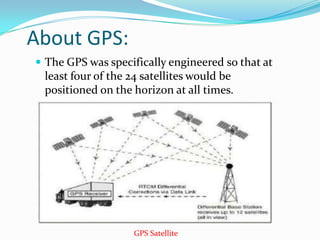
 The GPS was specifically engineered so that at
 least four of the 24 satellites would be
 positioned on the horizon at all times.


                   GPS Satellite
What is AVL technology?
 AVL systems use satellite and land communications to
 display each vehicle's
              location
              status
              heading
              speed on the computer's
                  screen.
Navigation Technologies
 Four Navigation Technologies. They are


          1. Global Positioning System

         2. Dead-Reckoning System

         3. Signpost/Odometer Systems

         4. Radio Navigation/Location
TRACKING SYSTEMS
 There are two types of tracking systems


                    PASSIVE TRACKING

                     REAL TIME TRACKING
PASSIVE TRACKING:
 It refers to stand-alone GPS Receivers, which stores
  data for further process

 Passive Tracking systems are limited to vehicle
  tracking only

 It stores the location, time, velocity and heading data
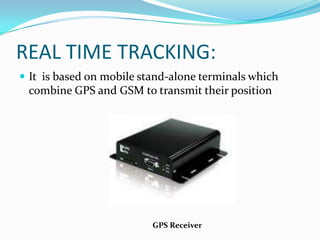
REAL TIME TRACKING:
 It is based on mobile stand-alone terminals which
 combine GPS and GSM to transmit their position


                          GPS Receiver
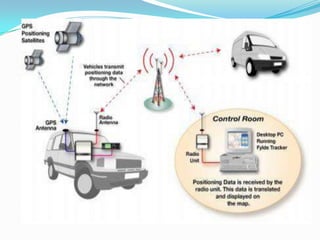
WORKING OF A GPS BASED AVL:
It contains the following
     GPS SATELLITES

     RADIO SYSTEM

     COMMUNICATION CENTER

     DISPATCH SECTION

     CUSTOMER ASSISTANCE UNIT
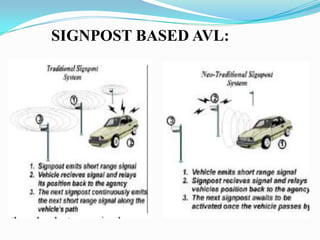
WORKING OF SIGNPOST BASED AVL:

It contains the following

    Optical scanners
     Magnetic strips
     Beam emission

    Short-range radio
SIGNPOST BASED AVL:
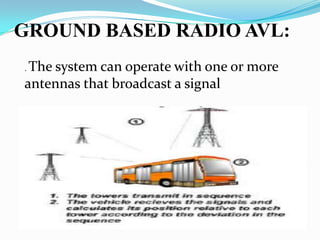
GROUND BASED RADIO AVL:
.The system can operate with one or more
antennas that broadcast a signal
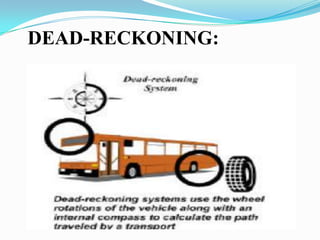
DEAD-RECKONING:
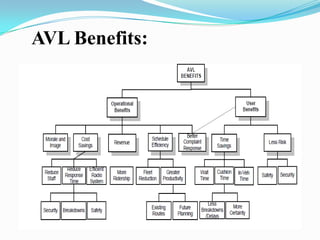
AVL Benefits:
Uses Of AVL
 Vehicle location display in real-time.

 Recording of arrival and departure times (proof of

  delivery etc).

 Monitoring of driving practices (speed).

 Alerts if vehicle leaves or enters a defined area
Applications Of AVL
 In Military
 Geo-Caching
 Track Anything
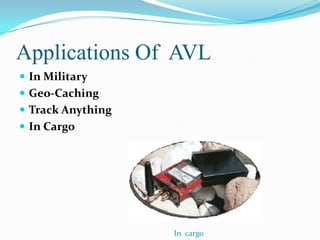
 In Cargo


                   In cargo
Conclusion
 By using GPS we track the location of the vehicle


 It is a cost effective and efficient technique


 It gives protection to the vehicles and also the accident
  alerts
automatic vehicle location

automatic vehicle location

  • 1.
  • 2.
    Introduction  Automatic vehiclelocation (AVL) is a computer –based vehicle tracking system  The actual real –time position of each vehicle is determined and relayed to a control center  AVL systems include: computer -aided dispatch software, mobile data terminals, emergency alarms, and digital communications
  • 3.
    About GPS:  TheGPS was specifically engineered so that at least four of the 24 satellites would be positioned on the horizon at all times. GPS Satellite
  • 4.
    What is AVLtechnology?  AVL systems use satellite and land communications to display each vehicle's  location  status  heading  speed on the computer's screen.
  • 5.
    Navigation Technologies  FourNavigation Technologies. They are 1. Global Positioning System 2. Dead-Reckoning System 3. Signpost/Odometer Systems 4. Radio Navigation/Location
  • 6.
    TRACKING SYSTEMS  Thereare two types of tracking systems  PASSIVE TRACKING  REAL TIME TRACKING
  • 7.
    PASSIVE TRACKING:  Itrefers to stand-alone GPS Receivers, which stores data for further process  Passive Tracking systems are limited to vehicle tracking only  It stores the location, time, velocity and heading data
  • 8.
    REAL TIME TRACKING: It is based on mobile stand-alone terminals which combine GPS and GSM to transmit their position GPS Receiver
  • 9.
    WORKING OF AGPS BASED AVL: It contains the following GPS SATELLITES RADIO SYSTEM COMMUNICATION CENTER DISPATCH SECTION CUSTOMER ASSISTANCE UNIT
  • 11.
    WORKING OF SIGNPOSTBASED AVL: It contains the following Optical scanners Magnetic strips Beam emission Short-range radio
  • 12.
  • 13.
    GROUND BASED RADIOAVL: .The system can operate with one or more antennas that broadcast a signal
  • 14.
  • 15.
  • 16.
    Uses Of AVL Vehicle location display in real-time.  Recording of arrival and departure times (proof of delivery etc).  Monitoring of driving practices (speed).  Alerts if vehicle leaves or enters a defined area
  • 17.
    Applications Of AVL In Military  Geo-Caching  Track Anything  In Cargo In cargo
  • 18.
    Conclusion  By usingGPS we track the location of the vehicle  It is a cost effective and efficient technique  It gives protection to the vehicles and also the accident alerts