© 2008 Cisco Systems, Inc. All rights reserved. Cisco ConfidentialPresentation_ID 1
Chapter 3:
Network Protocols and
Communications
Introduction to Networks
Presentation_ID 2© 2008 Cisco Systems, Inc. All rights reserved. Cisco Confidential
Chapter 3: Objectives
After completing this chapter, you will be able to:
 Explain how rules are used to facilitate communication.
 Explain the role of protocols and standards organizations in
facilitating interoperability in network communications.
 Explain how devices on a LAN access resources in a small to
medium-sized business network.
Presentation_ID 3© 2008 Cisco Systems, Inc. All rights reserved. Cisco Confidential
Chapter 3
3.1 Rules of Communication
3.2 Network Protocols and Standards
3.3 Moving Data in the Network
3.4 Summary
© 2008 Cisco Systems, Inc. All rights reserved. Cisco ConfidentialPresentation_ID 4
3.1 Rules of
Communication
Presentation_ID 5© 2008 Cisco Systems, Inc. All rights reserved. Cisco Confidential
The Rules
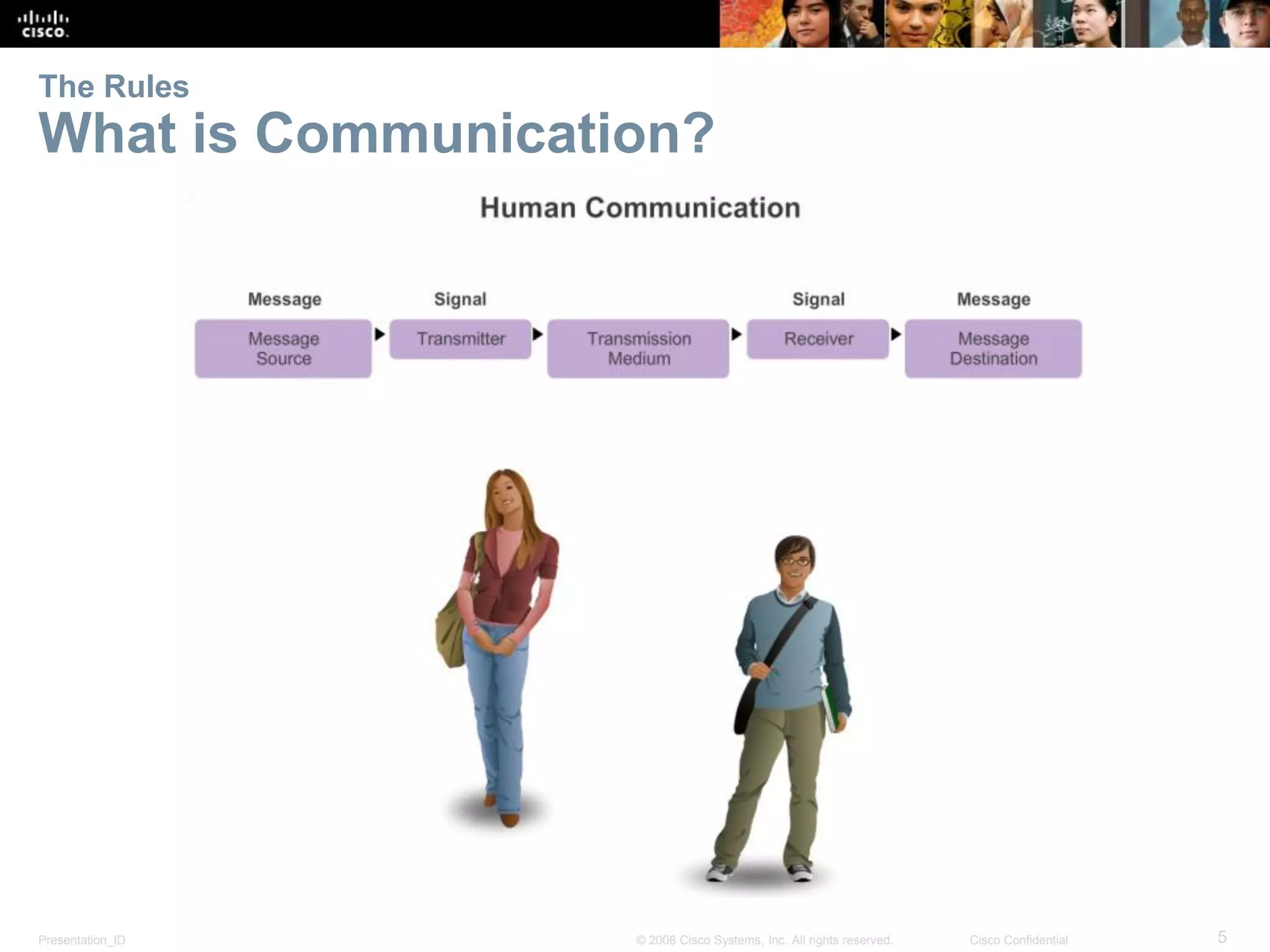
What is Communication?
Presentation_ID 6© 2008 Cisco Systems, Inc. All rights reserved. Cisco Confidential
The Rules
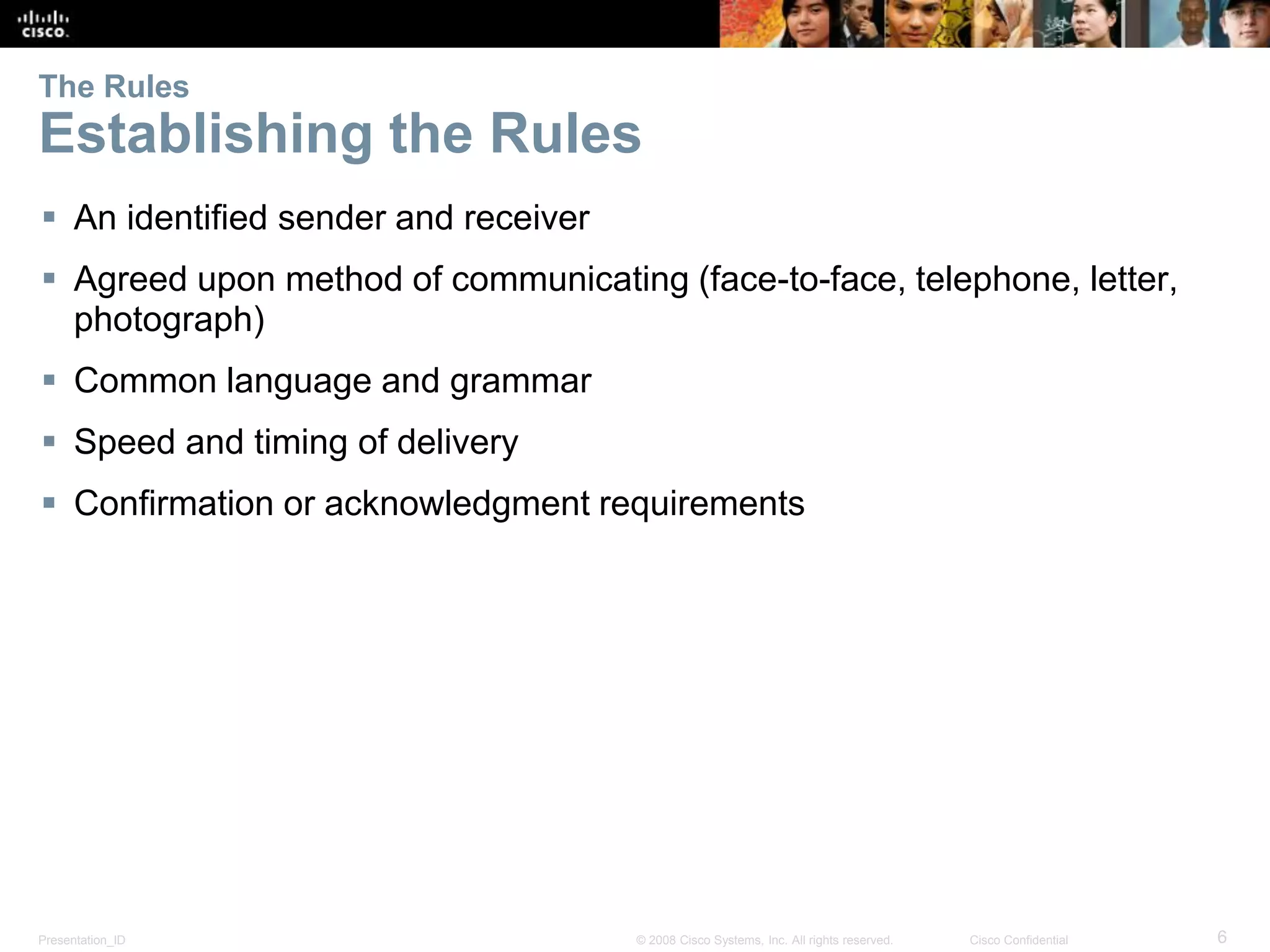
Establishing the Rules
 An identified sender and receiver
 Agreed upon method of communicating (face-to-face, telephone, letter,
photograph)
 Common language and grammar
 Speed and timing of delivery
 Confirmation or acknowledgment requirements
Presentation_ID 7© 2008 Cisco Systems, Inc. All rights reserved. Cisco Confidential
The Rules
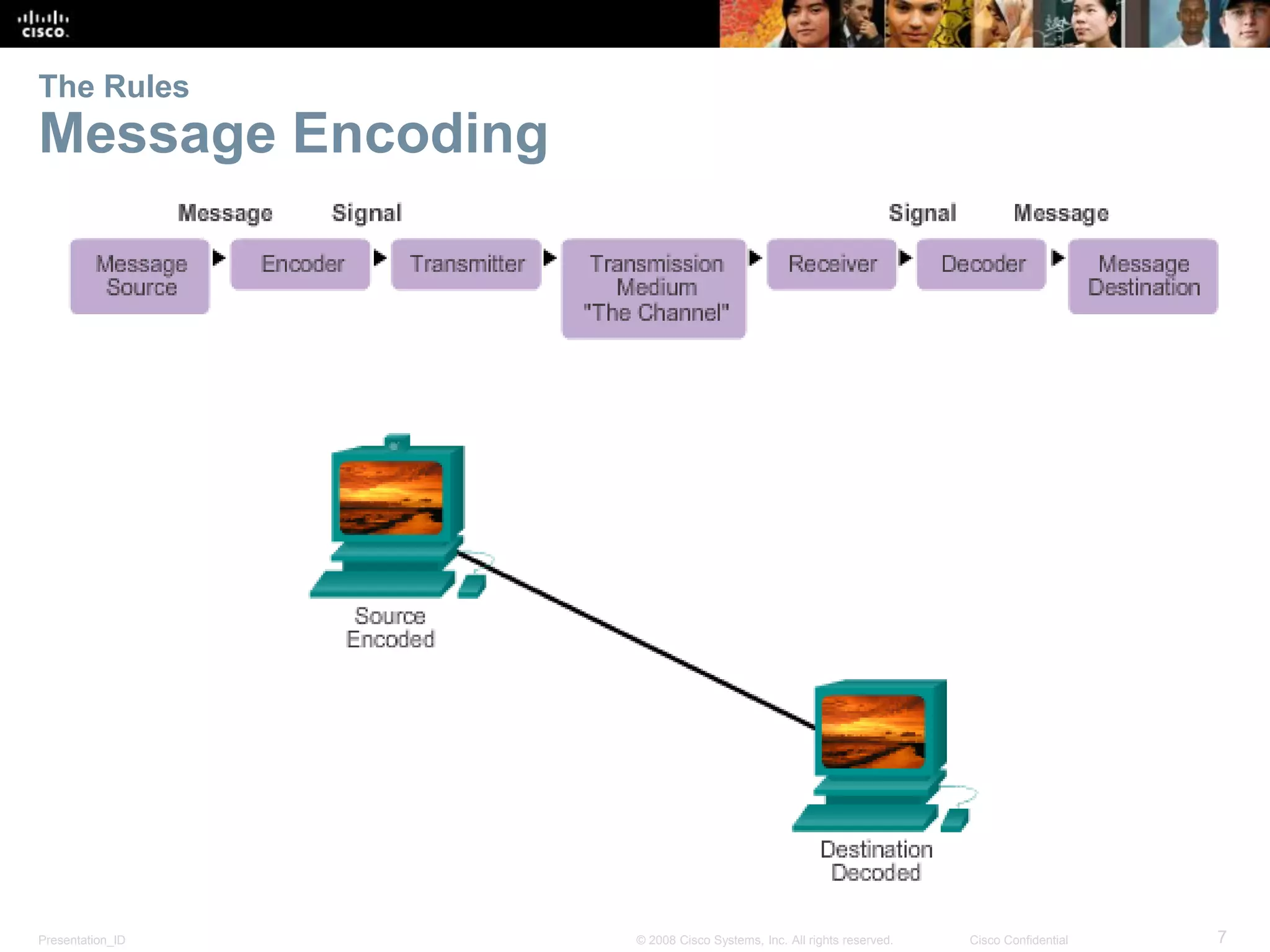
Message Encoding
Presentation_ID 8© 2008 Cisco Systems, Inc. All rights reserved. Cisco Confidential
The Rules
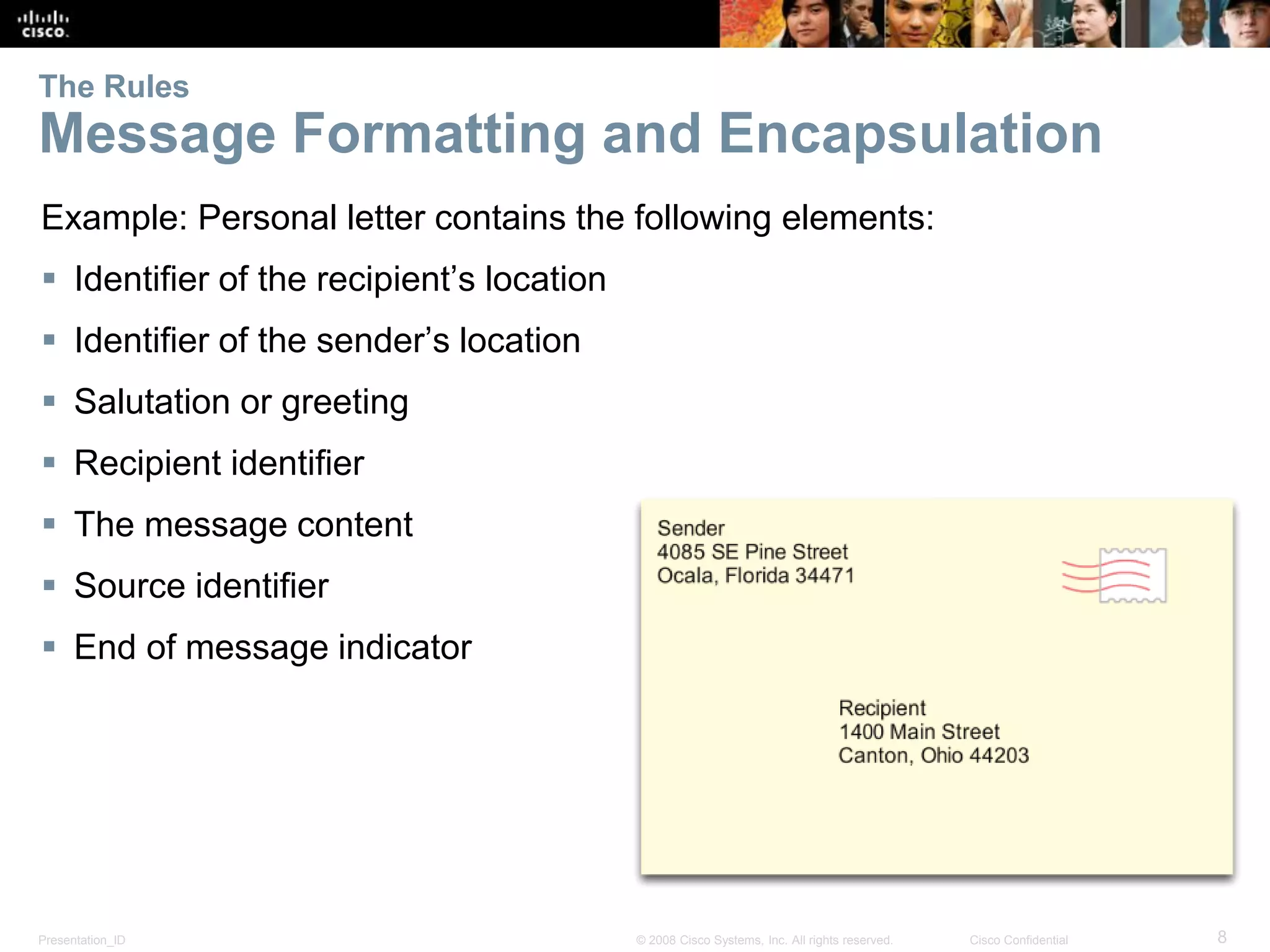
Message Formatting and Encapsulation
Example: Personal letter contains the following elements:
 Identifier of the recipient’s location
 Identifier of the sender’s location
 Salutation or greeting
 Recipient identifier
 The message content
 Source identifier
 End of message indicator
Presentation_ID 9© 2008 Cisco Systems, Inc. All rights reserved. Cisco Confidential
The Rules
Message Size
An overview of the segmenting process:
 The size restrictions of frames require the source host to break a long
message into individual pieces (or segments) that meet both the minimum
and maximum size requirements.
 Each segment is encapsulated in a separate frame with the address
information, and is sent over the network.
 At the receiving host, the messages are de-encapsulated and put back
together to be processed and interpreted.
Presentation_ID 10© 2008 Cisco Systems, Inc. All rights reserved. Cisco Confidential
The Rules
Message Timing
 Access Method
 Flow Control
 Response Timeout
Presentation_ID 11© 2008 Cisco Systems, Inc. All rights reserved. Cisco Confidential
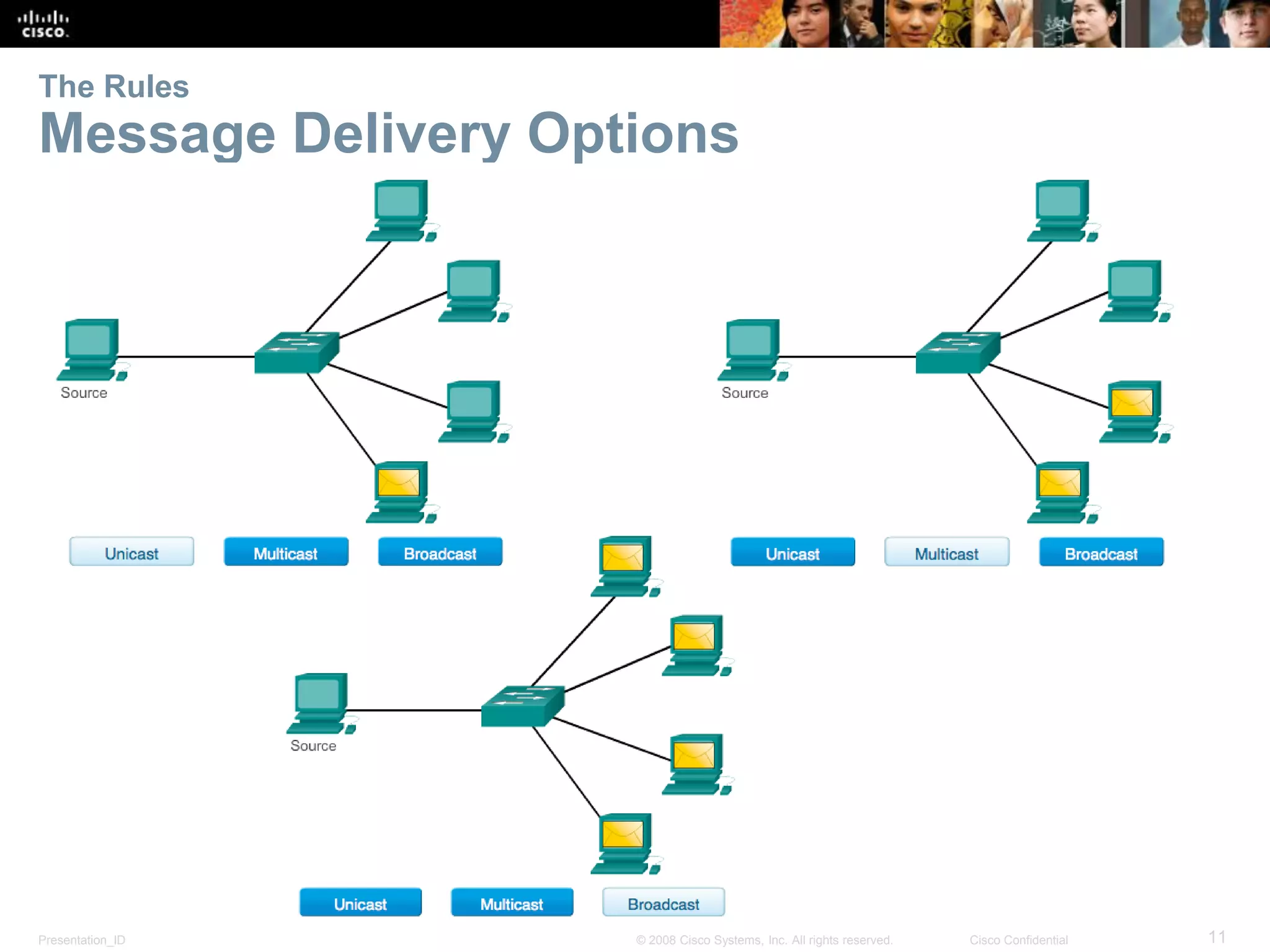
The Rules
Message Delivery Options
© 2008 Cisco Systems, Inc. All rights reserved. Cisco ConfidentialPresentation_ID 12
3.2 Network Protocols and Standards
Presentation_ID 13© 2008 Cisco Systems, Inc. All rights reserved. Cisco Confidential
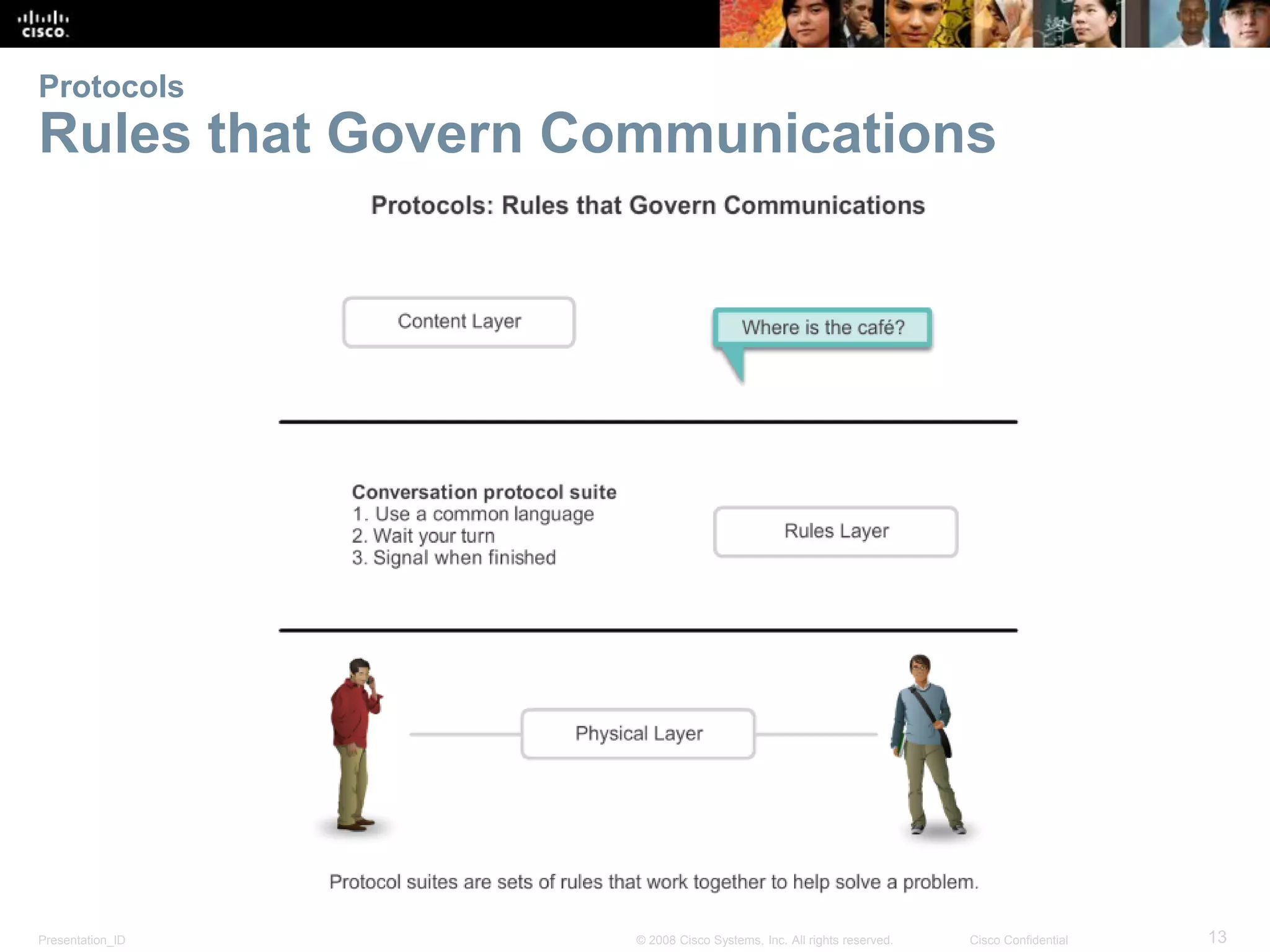
Protocols
Rules that Govern Communications
Presentation_ID 14© 2008 Cisco Systems, Inc. All rights reserved. Cisco Confidential
Protocols
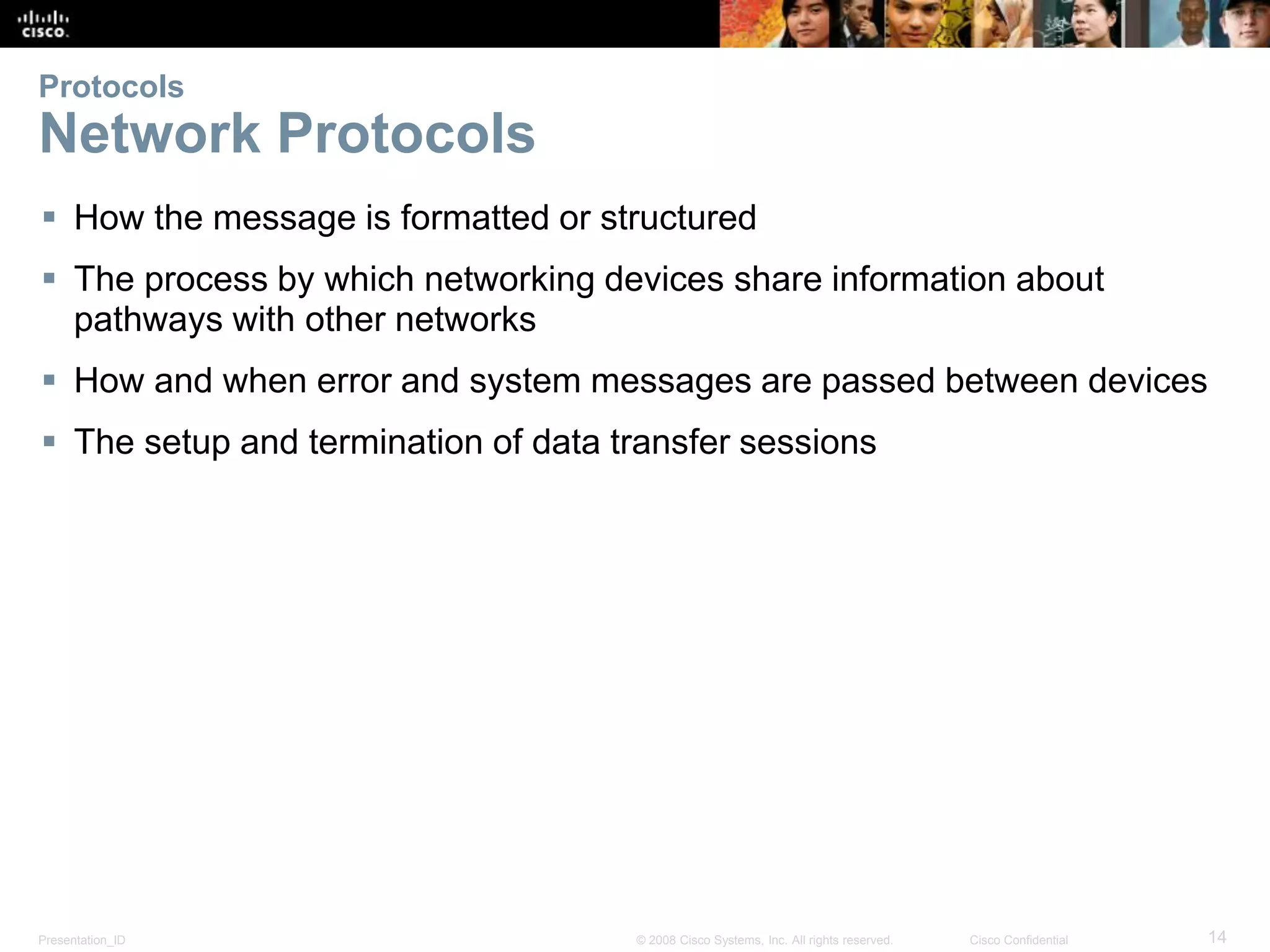
Network Protocols
 How the message is formatted or structured
 The process by which networking devices share information about
pathways with other networks
 How and when error and system messages are passed between devices
 The setup and termination of data transfer sessions
Presentation_ID 15© 2008 Cisco Systems, Inc. All rights reserved. Cisco Confidential
Protocols
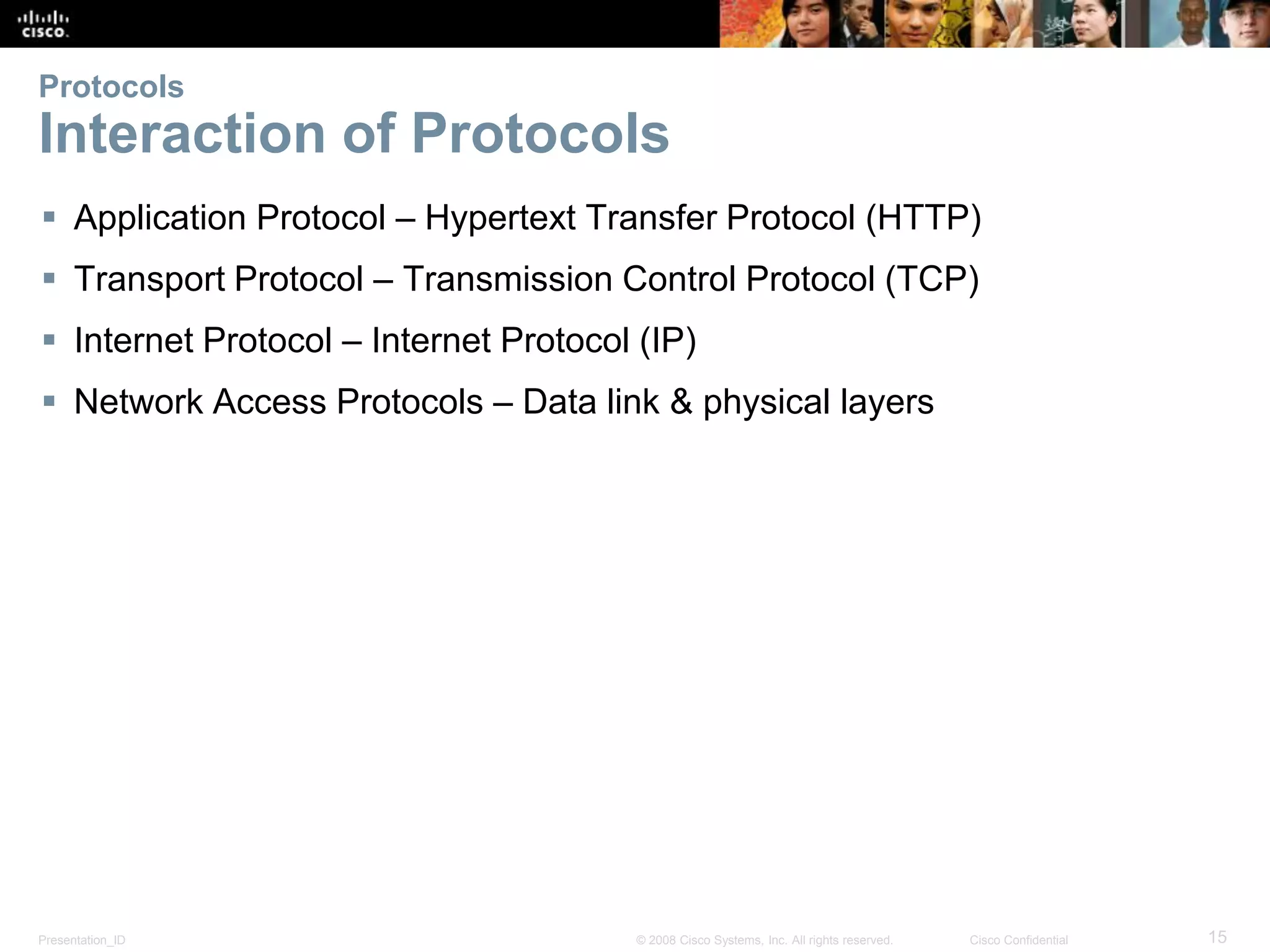
Interaction of Protocols
 Application Protocol – Hypertext Transfer Protocol (HTTP)
 Transport Protocol – Transmission Control Protocol (TCP)
 Internet Protocol – Internet Protocol (IP)
 Network Access Protocols – Data link & physical layers
Presentation_ID 16© 2008 Cisco Systems, Inc. All rights reserved. Cisco Confidential
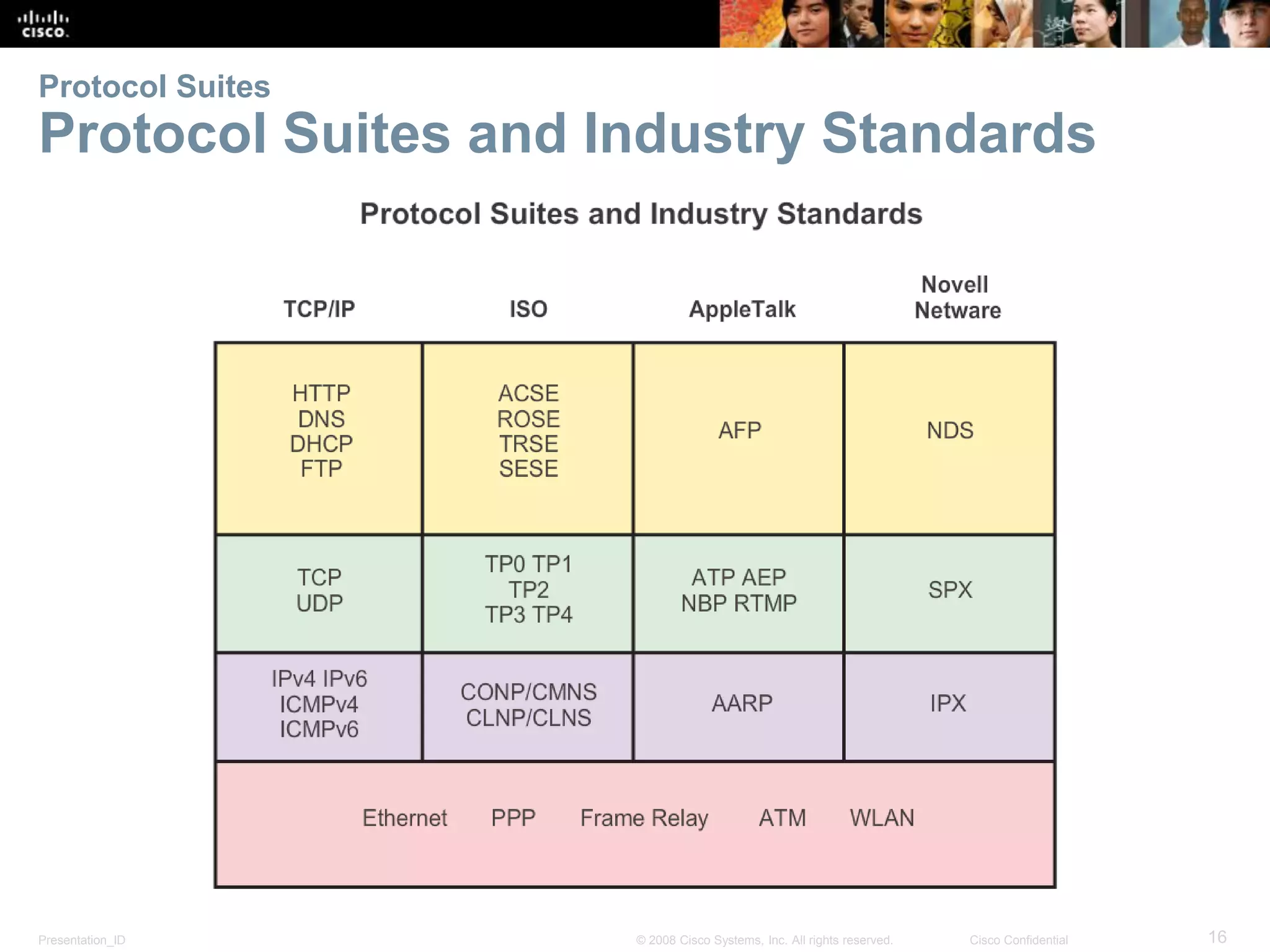
Protocol Suites
Protocol Suites and Industry Standards
Presentation_ID 17© 2008 Cisco Systems, Inc. All rights reserved. Cisco Confidential
Protocol Suites
Creation of Internet, Development of TCP/IP
 The first packet switching network and predecessor to today’s Internet
was the Advanced Research Projects Agency Network (ARPANET),
which came to life in 1969 by connecting mainframe computers at four
locations.
 ARPANET was funded by the U.S. Department of Defense for use by
universities and research laboratories. Bolt, Beranek and Newman (BBN)
was the contractor that did much of the initial development of the
ARPANET, including creating the first router known as an Interface
Message Processor (IMP).
 In 1973, Robert Kahn and Vinton Cerf began work on TCP to develop the
next generation of the ARPANET. TCP was designed to replace
ARPANET’s current Network Control Program (NCP).
 In 1978, TCP was divided into two protocols: TCP and IP. Later, other
protocols were added to the TCP/IP suite of protocols including Telnet,
FTP, DNS, and many others.
Presentation_ID 18© 2008 Cisco Systems, Inc. All rights reserved. Cisco Confidential
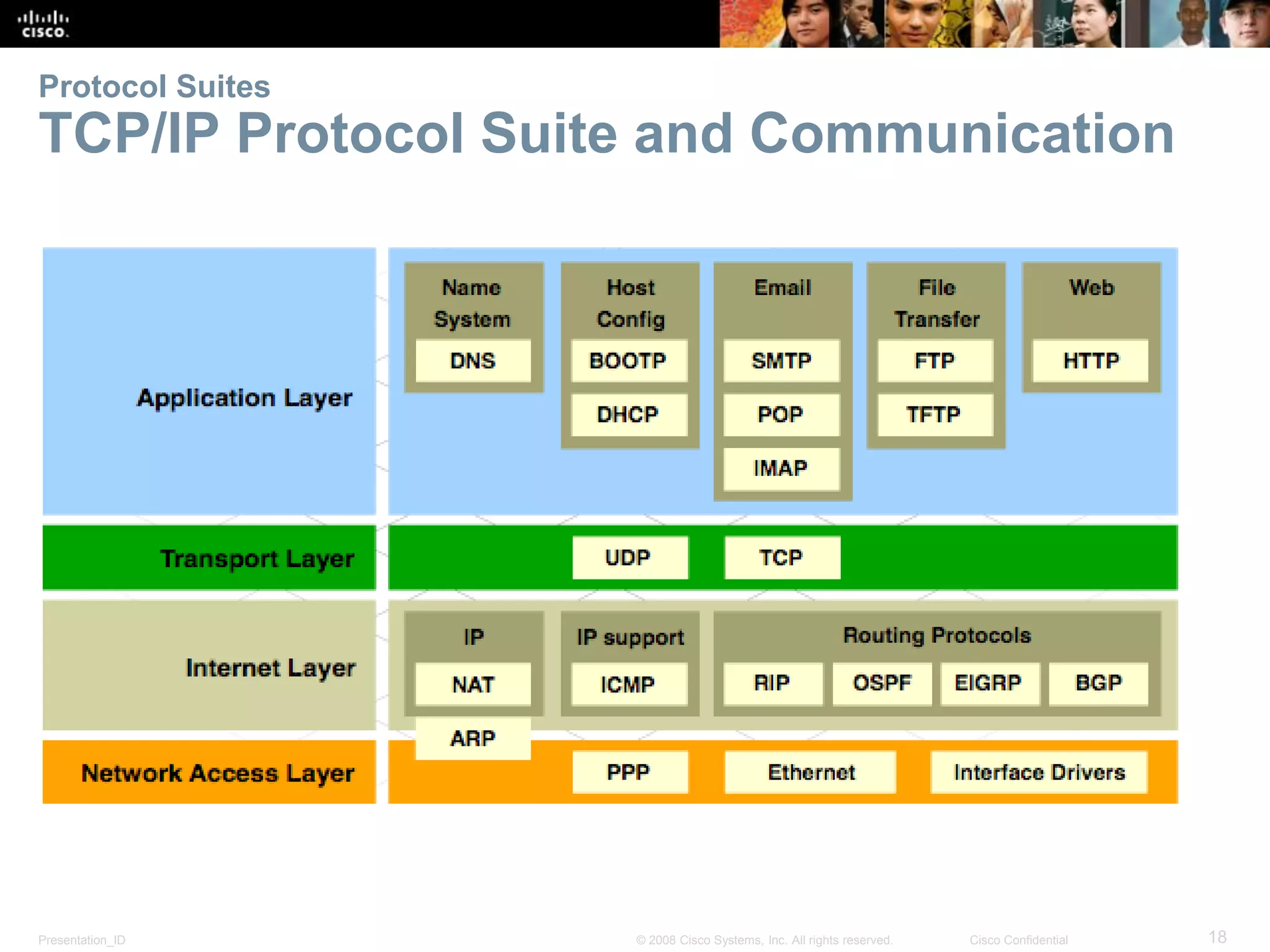
Protocol Suites
TCP/IP Protocol Suite and Communication
Presentation_ID 19© 2008 Cisco Systems, Inc. All rights reserved. Cisco Confidential
Standards Organizations
Open Standards
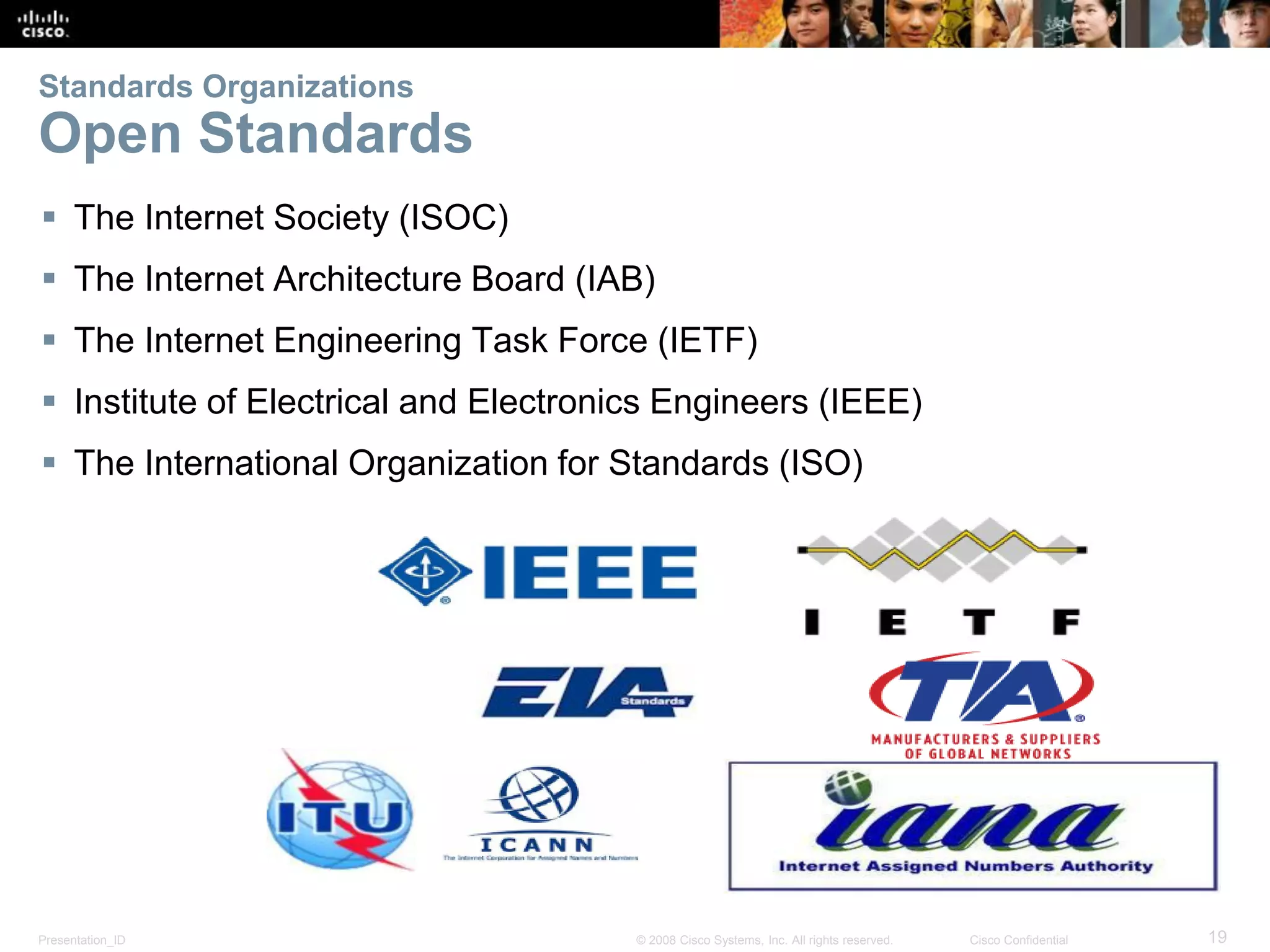
 The Internet Society (ISOC)
 The Internet Architecture Board (IAB)
 The Internet Engineering Task Force (IETF)
 Institute of Electrical and Electronics Engineers (IEEE)
 The International Organization for Standards (ISO)
Presentation_ID 20© 2008 Cisco Systems, Inc. All rights reserved. Cisco Confidential
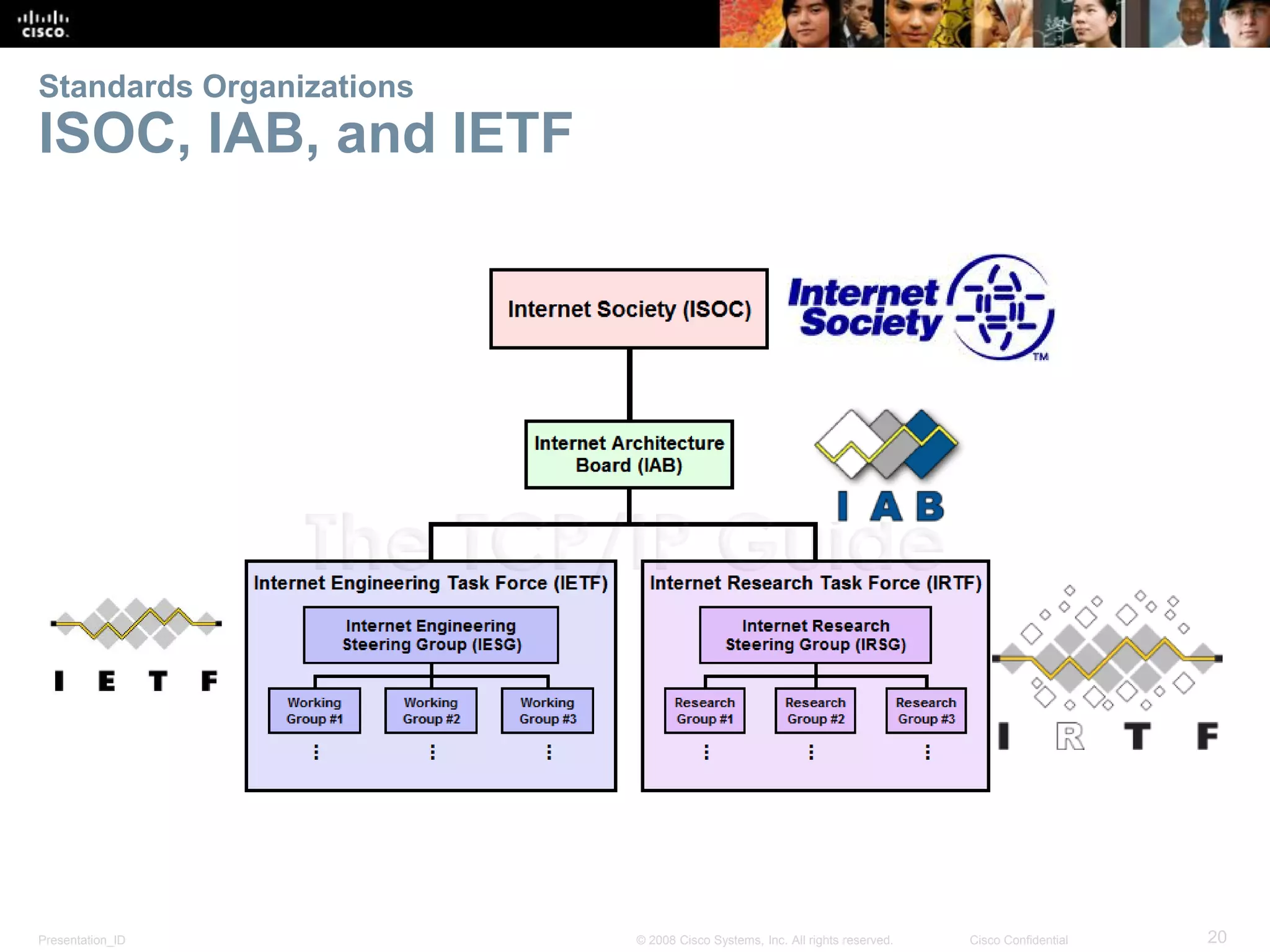
Standards Organizations
ISOC, IAB, and IETF
Presentation_ID 21© 2008 Cisco Systems, Inc. All rights reserved. Cisco Confidential
Standards Organizations
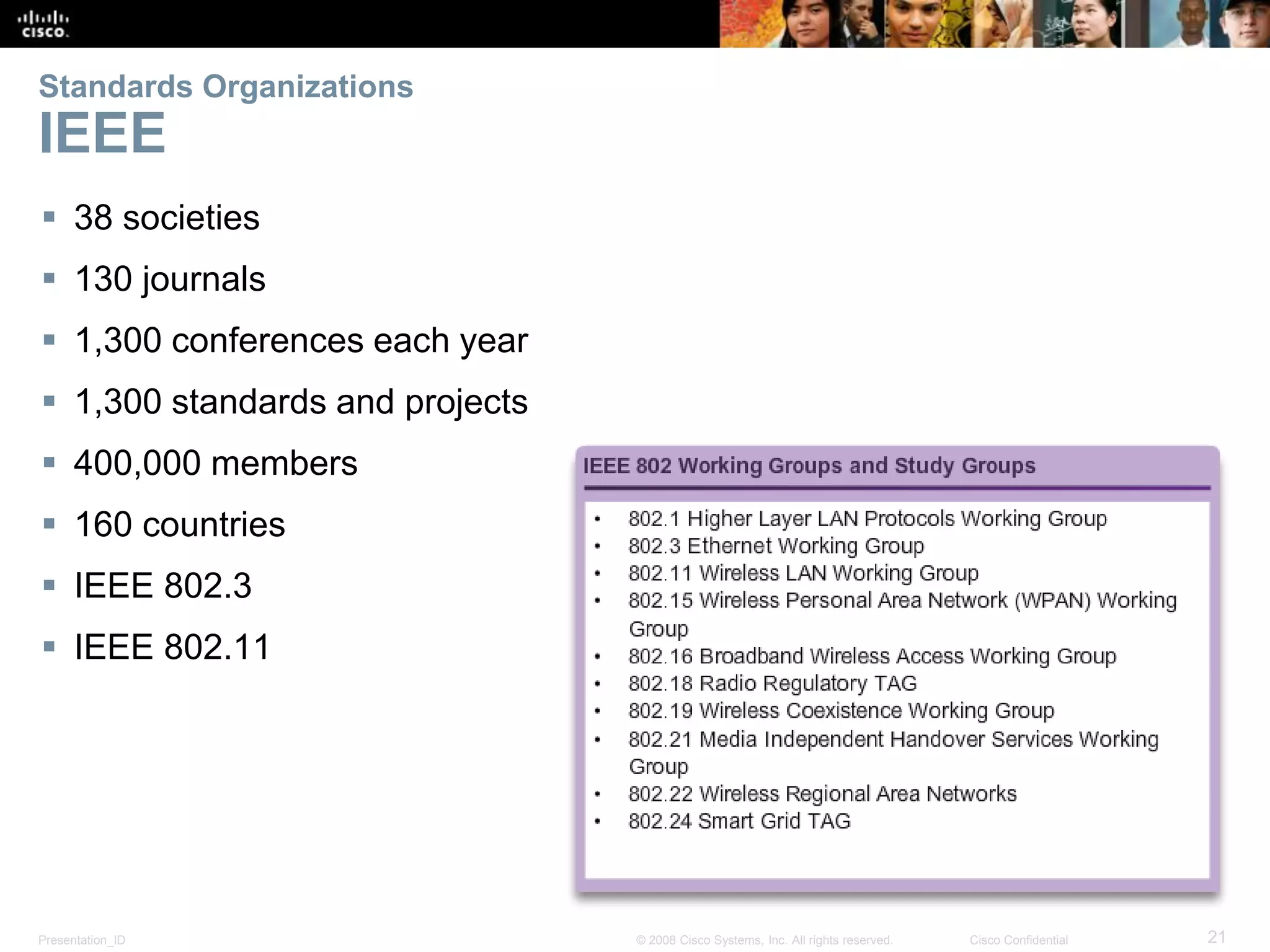
IEEE
 38 societies
 130 journals
 1,300 conferences each year
 1,300 standards and projects
 400,000 members
 160 countries
 IEEE 802.3
 IEEE 802.11
Presentation_ID 22© 2008 Cisco Systems, Inc. All rights reserved. Cisco Confidential
Standards Organizations
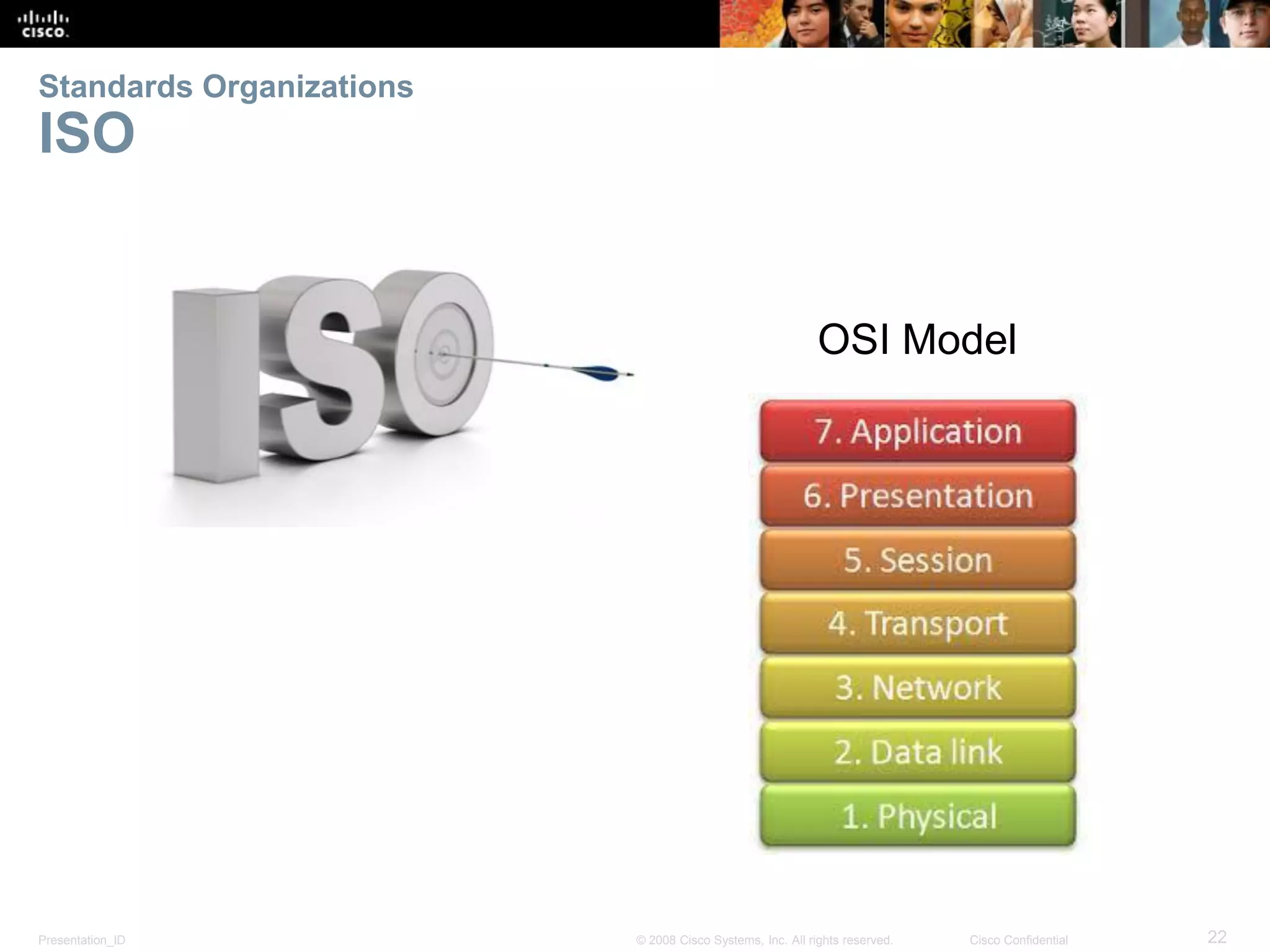
ISO
OSI Model
Presentation_ID 23© 2008 Cisco Systems, Inc. All rights reserved. Cisco Confidential
Standards Organizations
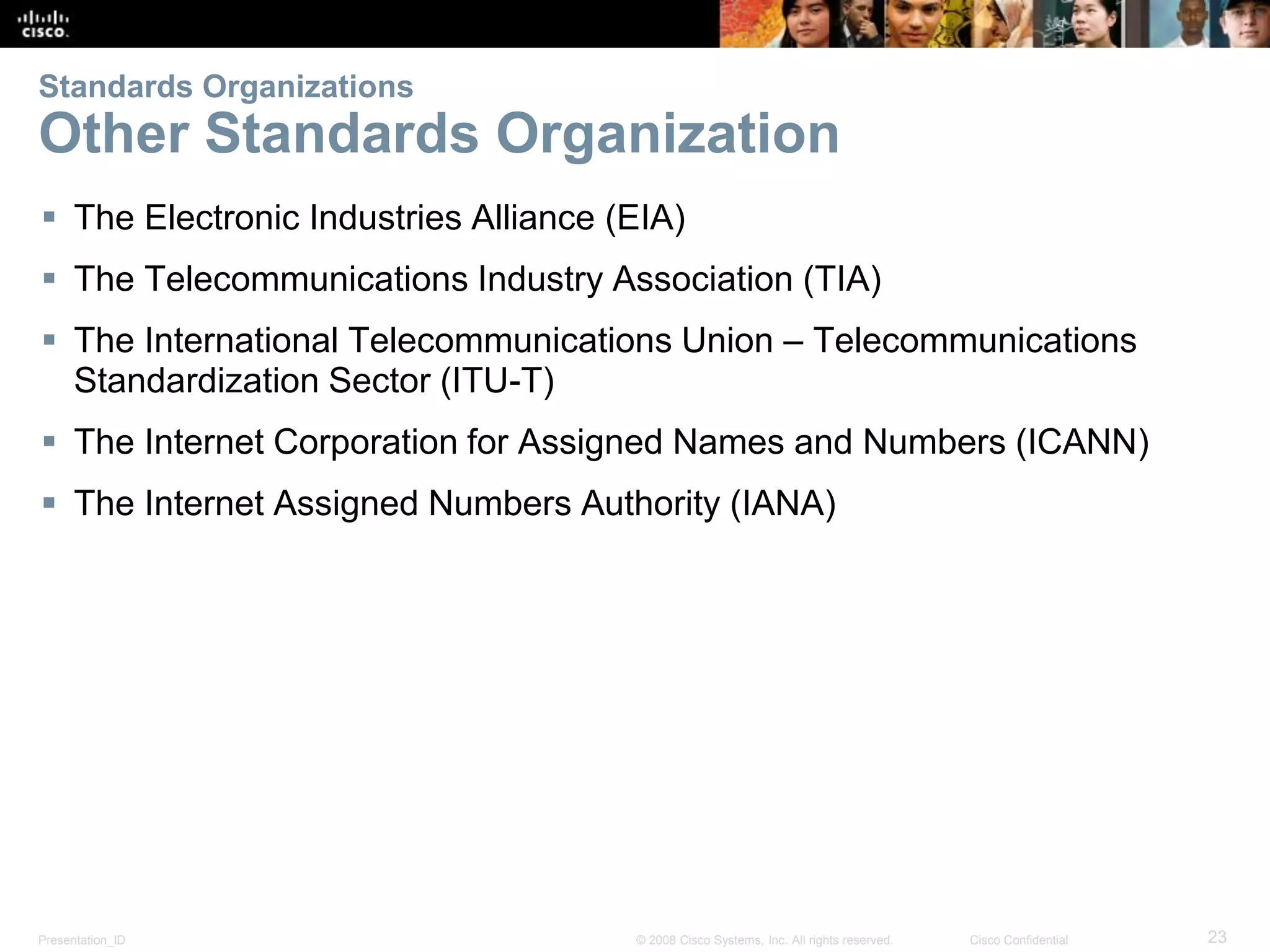
Other Standards Organization
 The Electronic Industries Alliance (EIA)
 The Telecommunications Industry Association (TIA)
 The International Telecommunications Union – Telecommunications
Standardization Sector (ITU-T)
 The Internet Corporation for Assigned Names and Numbers (ICANN)
 The Internet Assigned Numbers Authority (IANA)
Presentation_ID 24© 2008 Cisco Systems, Inc. All rights reserved. Cisco Confidential
Reference Models
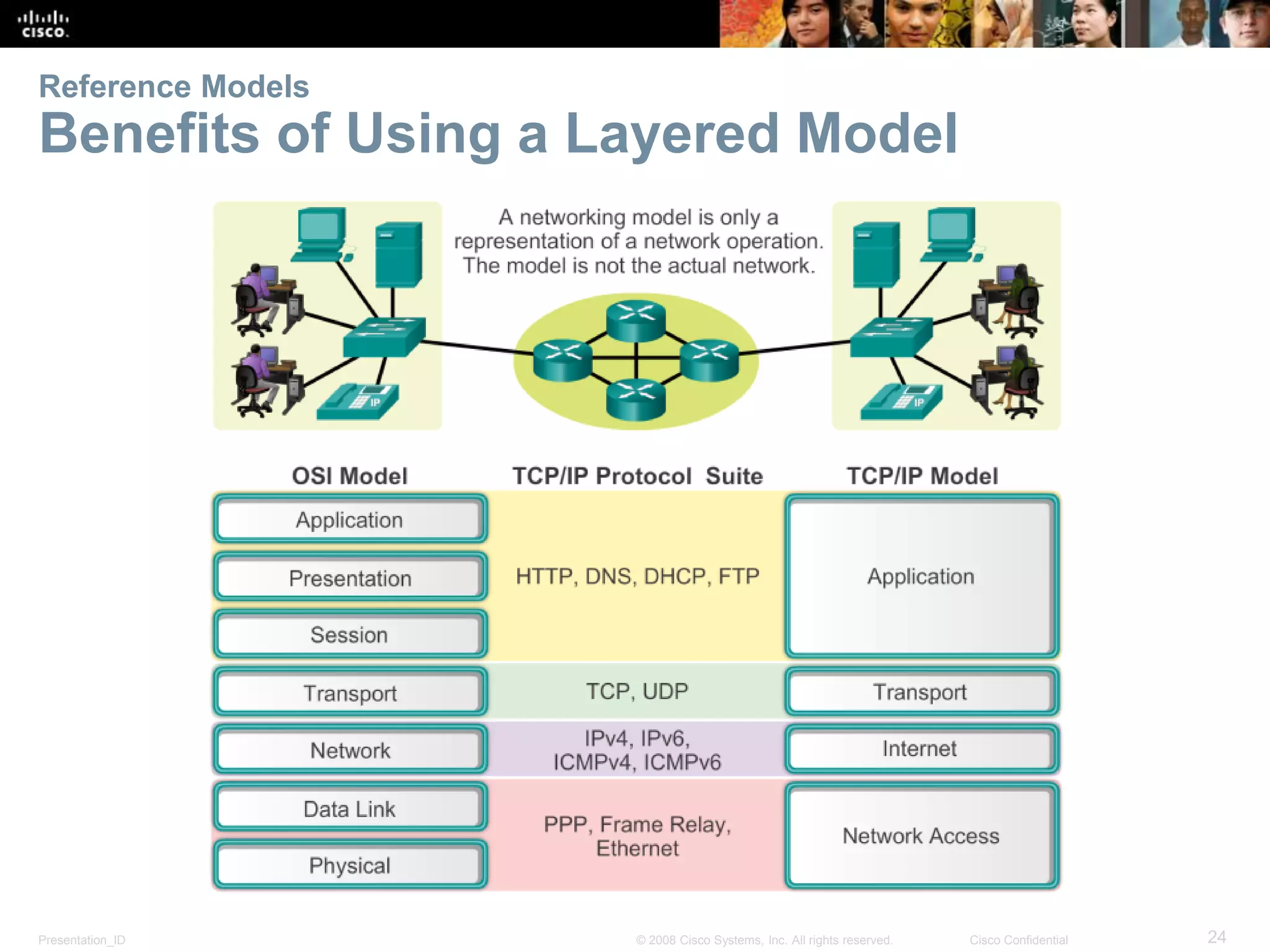
Benefits of Using a Layered Model
Presentation_ID 25© 2008 Cisco Systems, Inc. All rights reserved. Cisco Confidential
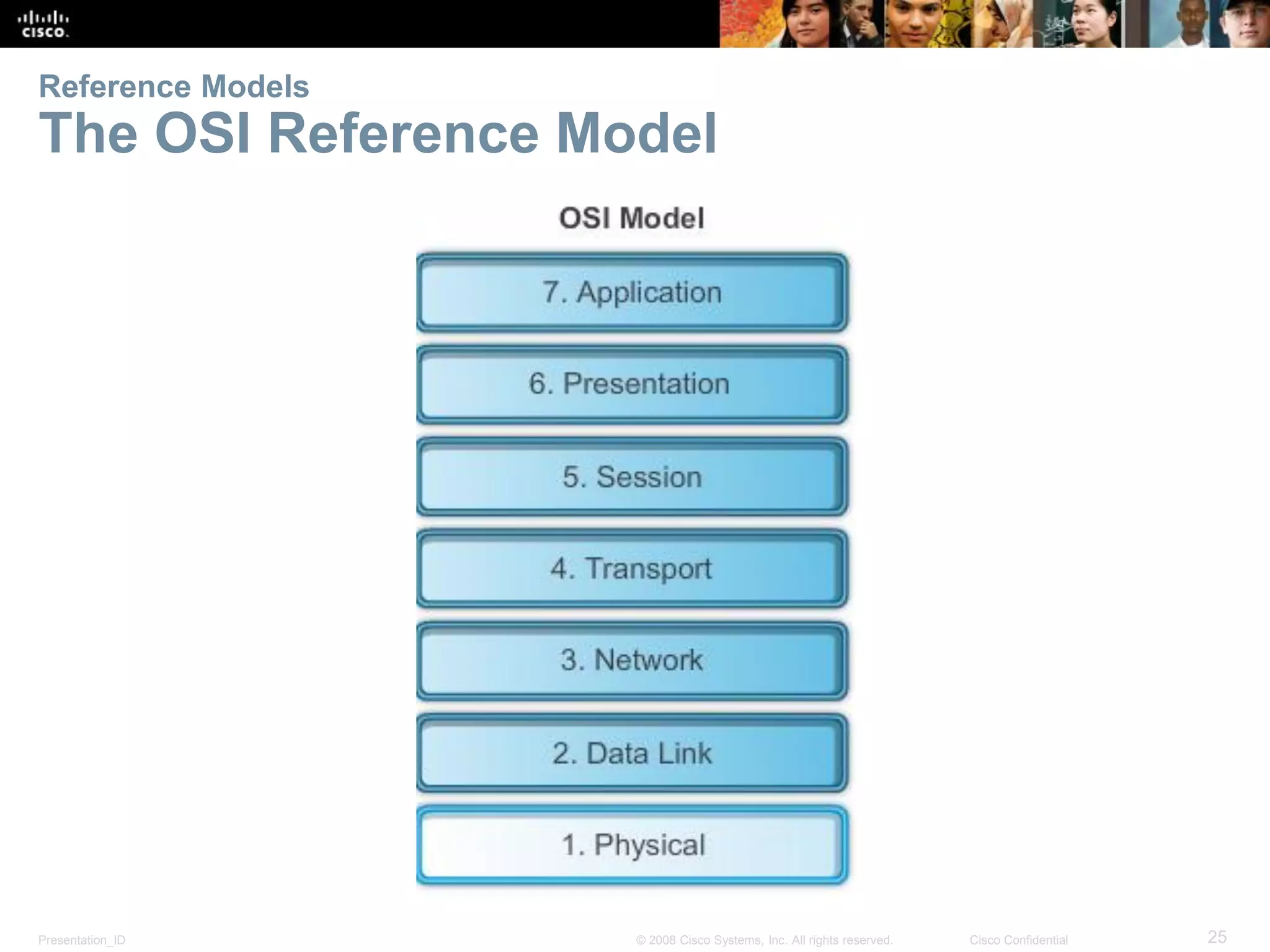
Reference Models
The OSI Reference Model
Presentation_ID 26© 2008 Cisco Systems, Inc. All rights reserved. Cisco Confidential
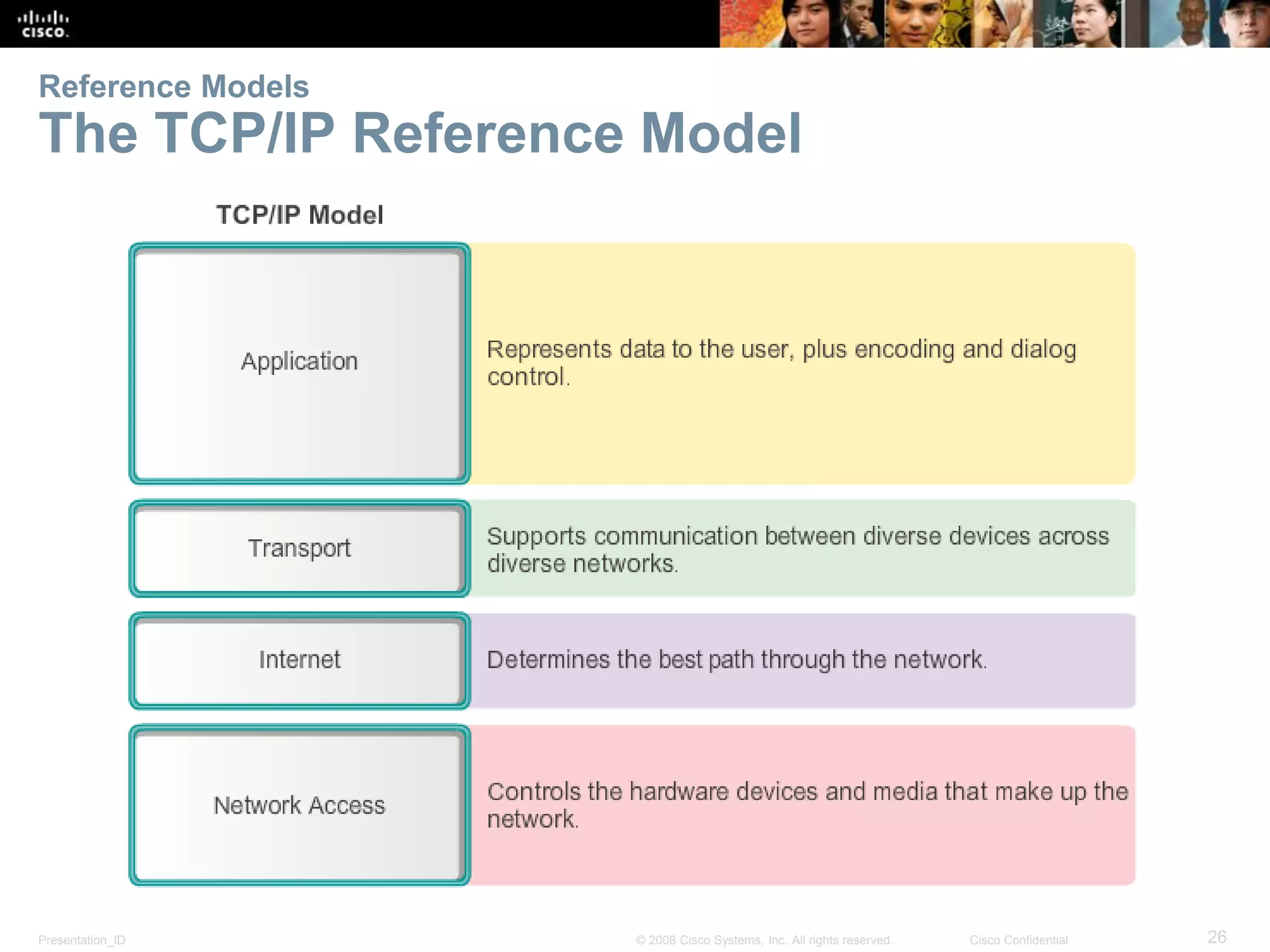
Reference Models
The TCP/IP Reference Model
Presentation_ID 27© 2008 Cisco Systems, Inc. All rights reserved. Cisco Confidential
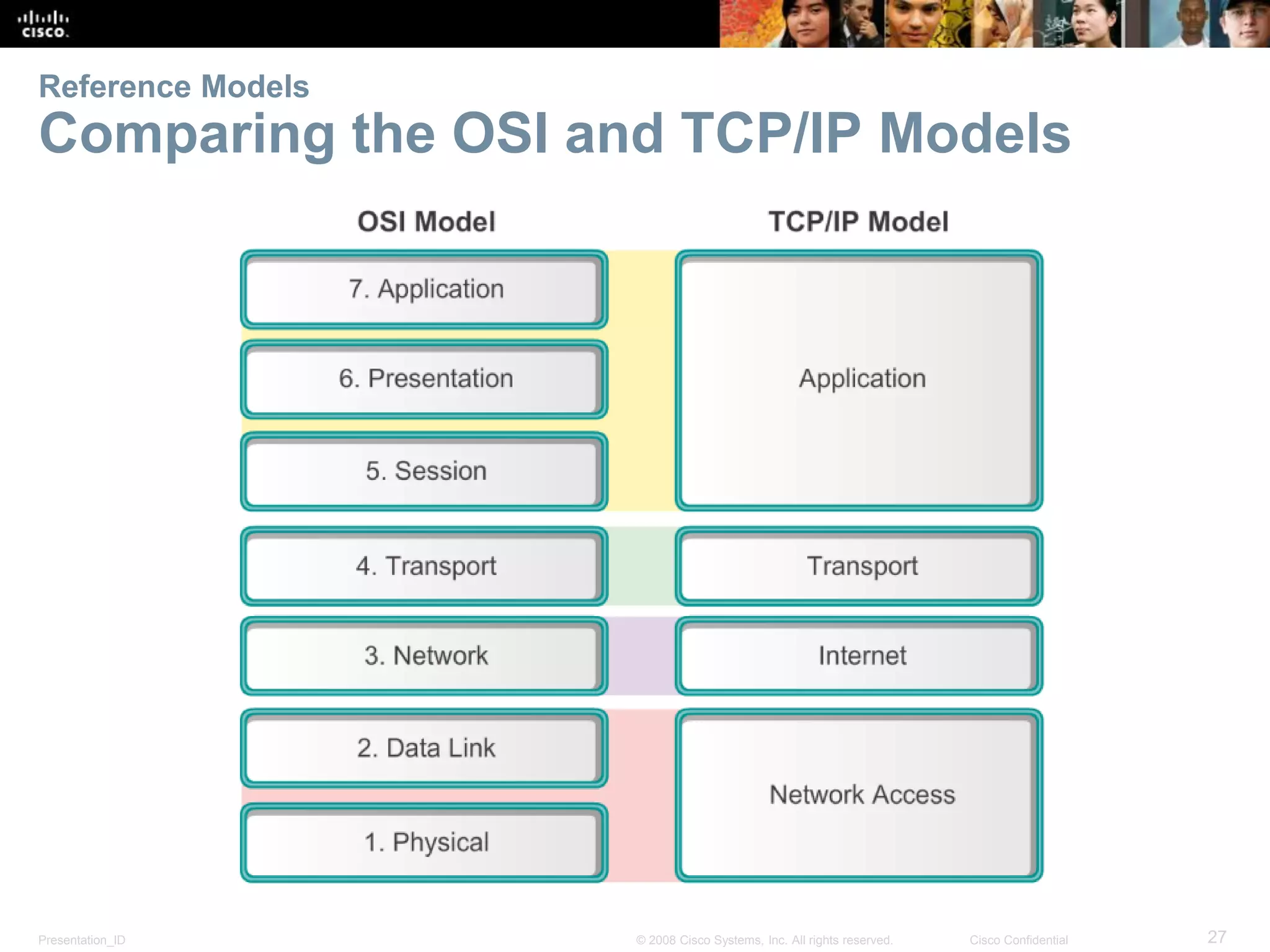
Reference Models
Comparing the OSI and TCP/IP Models
© 2008 Cisco Systems, Inc. All rights reserved. Cisco ConfidentialPresentation_ID 28
3.3 Moving Data in the Network
Presentation_ID 29© 2008 Cisco Systems, Inc. All rights reserved. Cisco Confidential
Data Encapsulation
Communicating the Messages
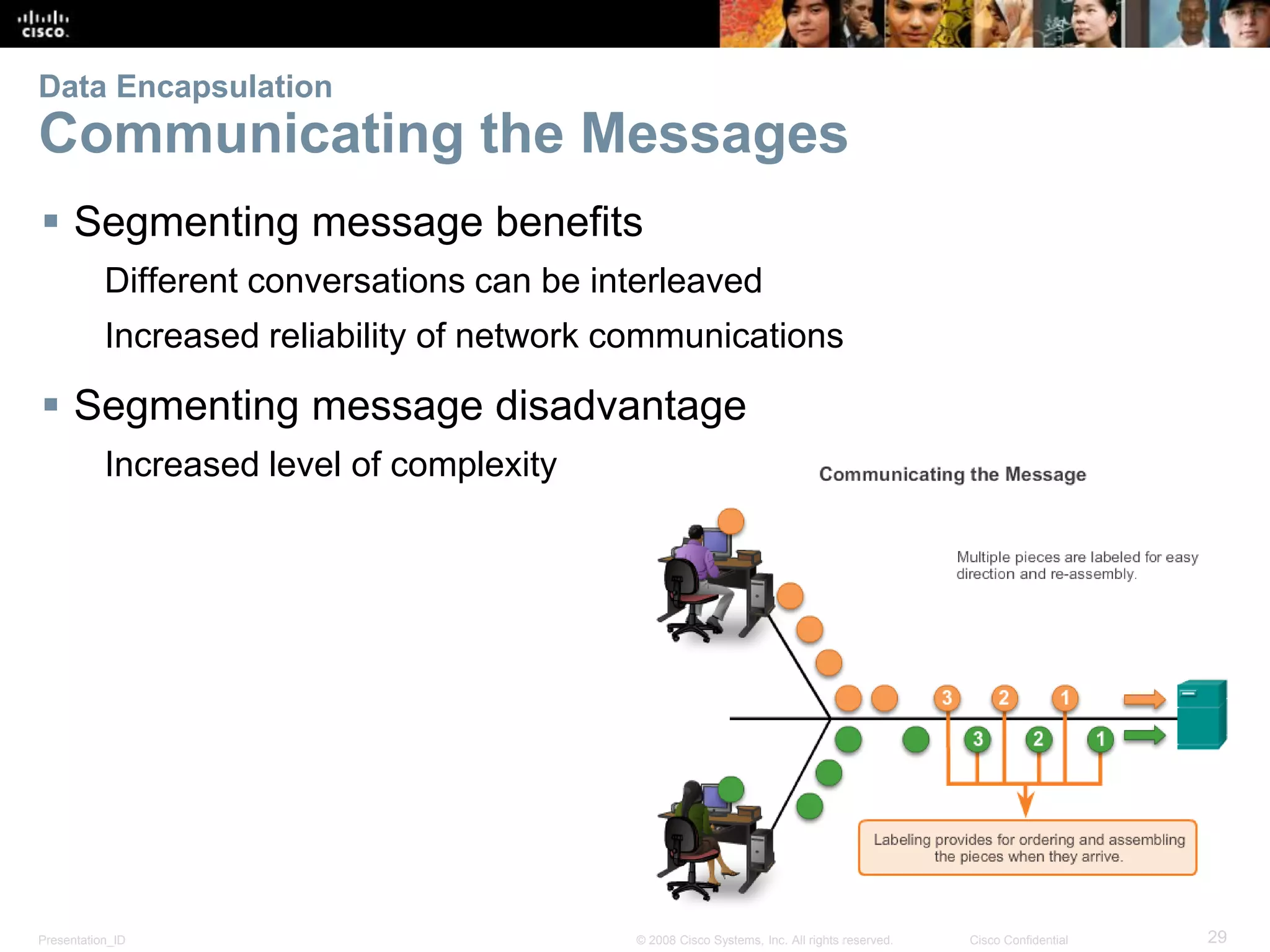
 Segmenting message benefits
Different conversations can be interleaved
Increased reliability of network communications
 Segmenting message disadvantage
Increased level of complexity
Presentation_ID 30© 2008 Cisco Systems, Inc. All rights reserved. Cisco Confidential
Data Encapsulation
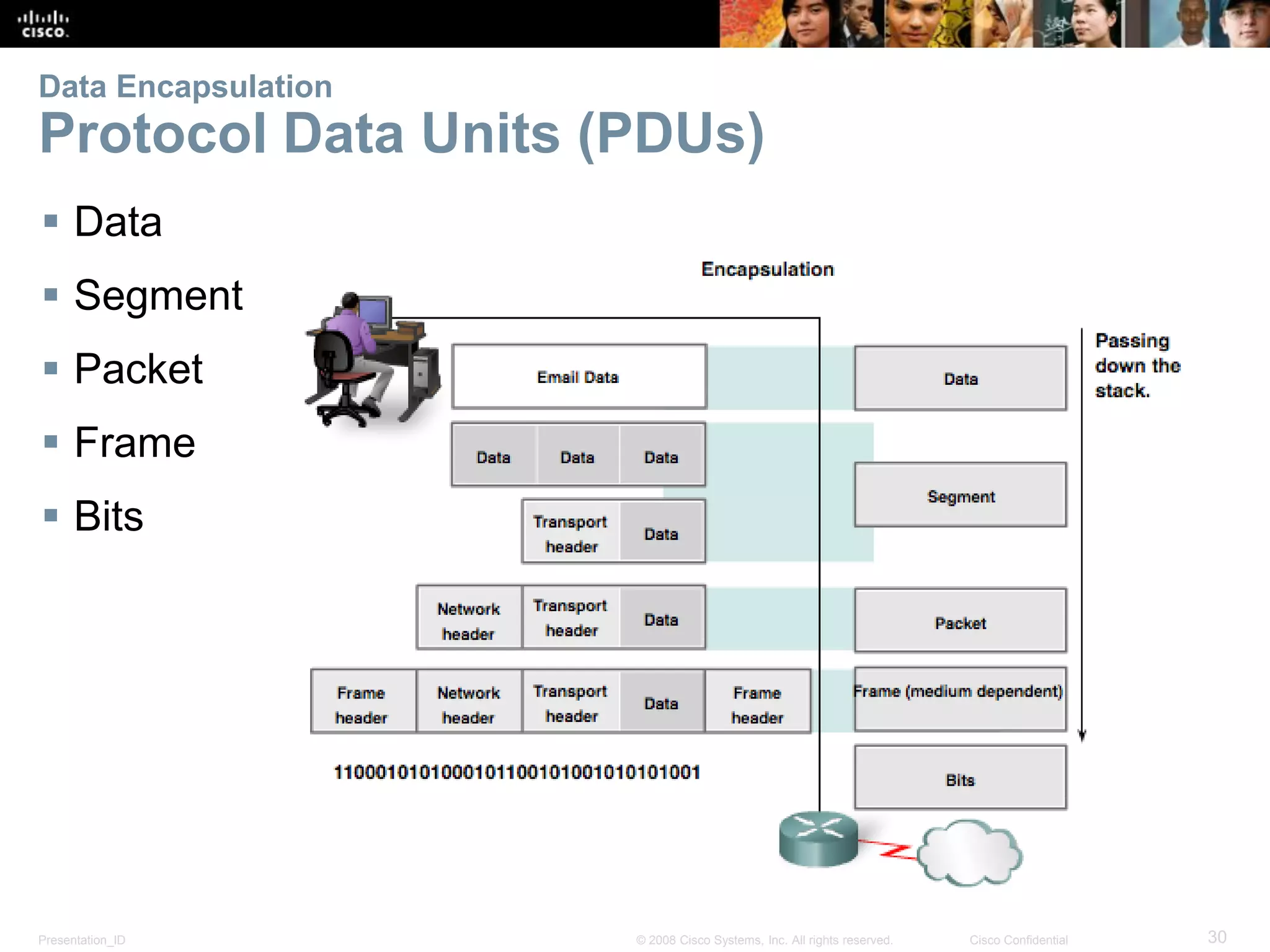
Protocol Data Units (PDUs)
 Data
 Segment
 Packet
 Frame
 Bits
Presentation_ID 31© 2008 Cisco Systems, Inc. All rights reserved. Cisco Confidential
Data Encapsulation
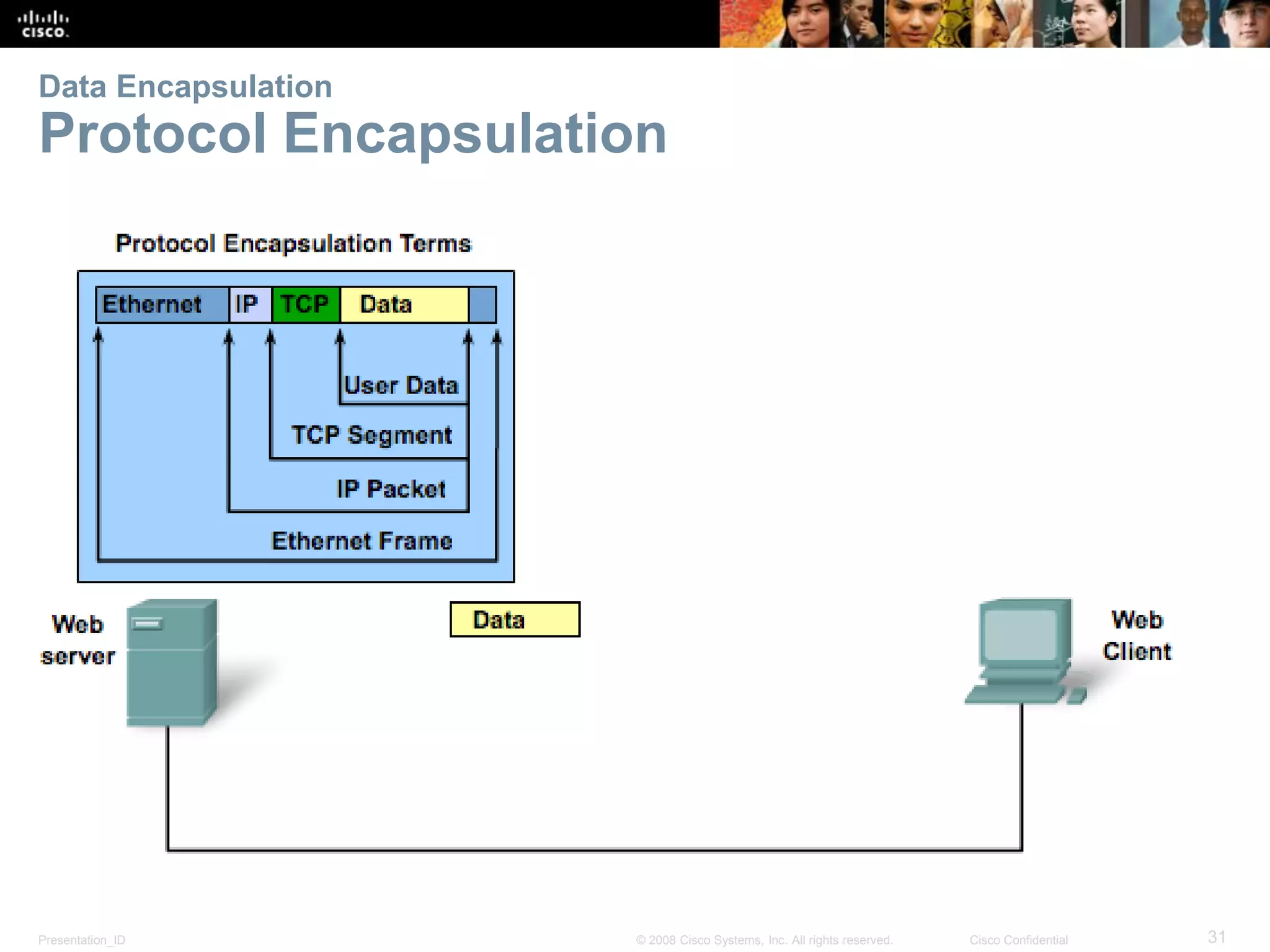
Protocol Encapsulation
Presentation_ID 32© 2008 Cisco Systems, Inc. All rights reserved. Cisco Confidential
Data Encapsulation
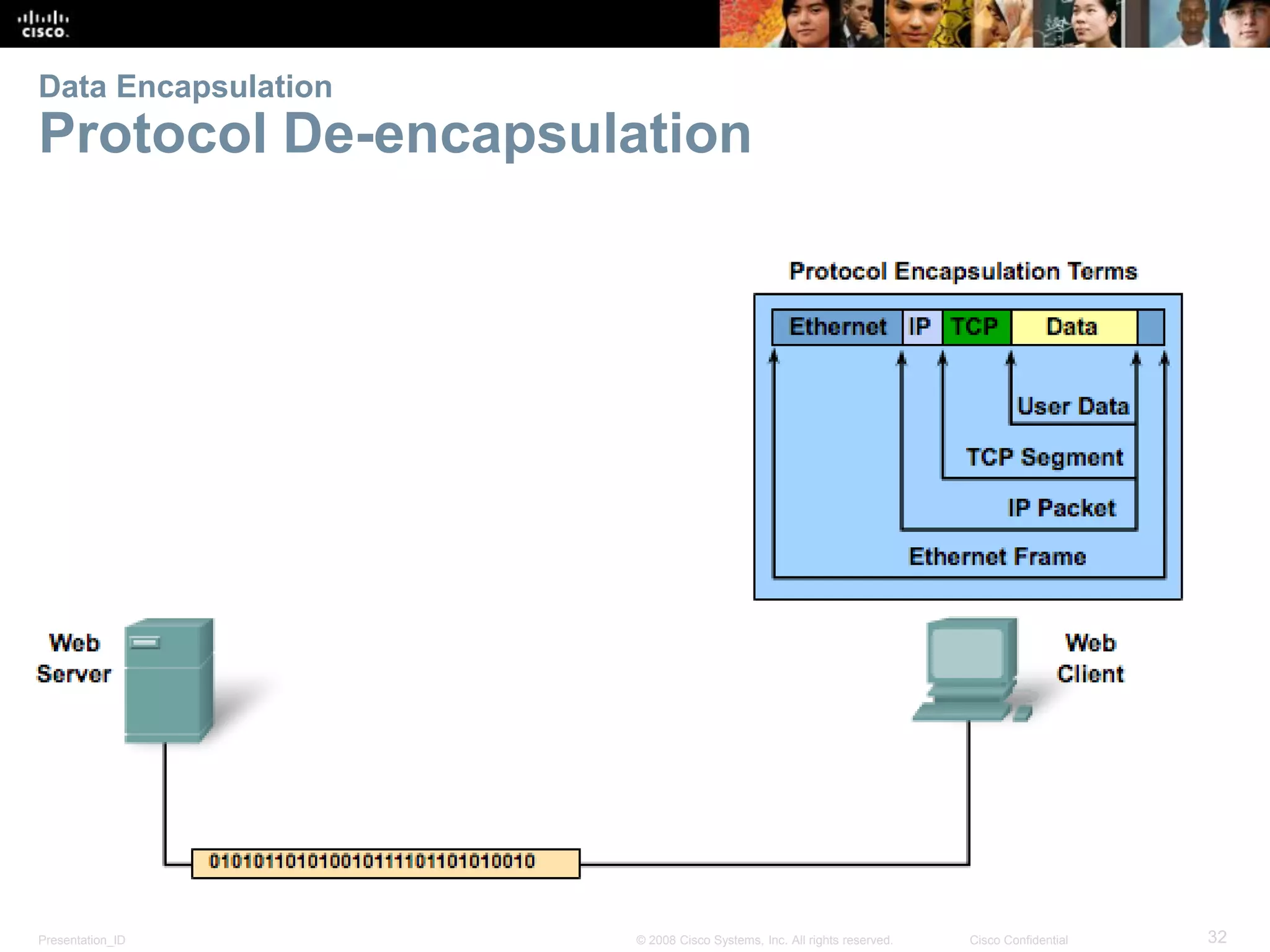
Protocol De-encapsulation
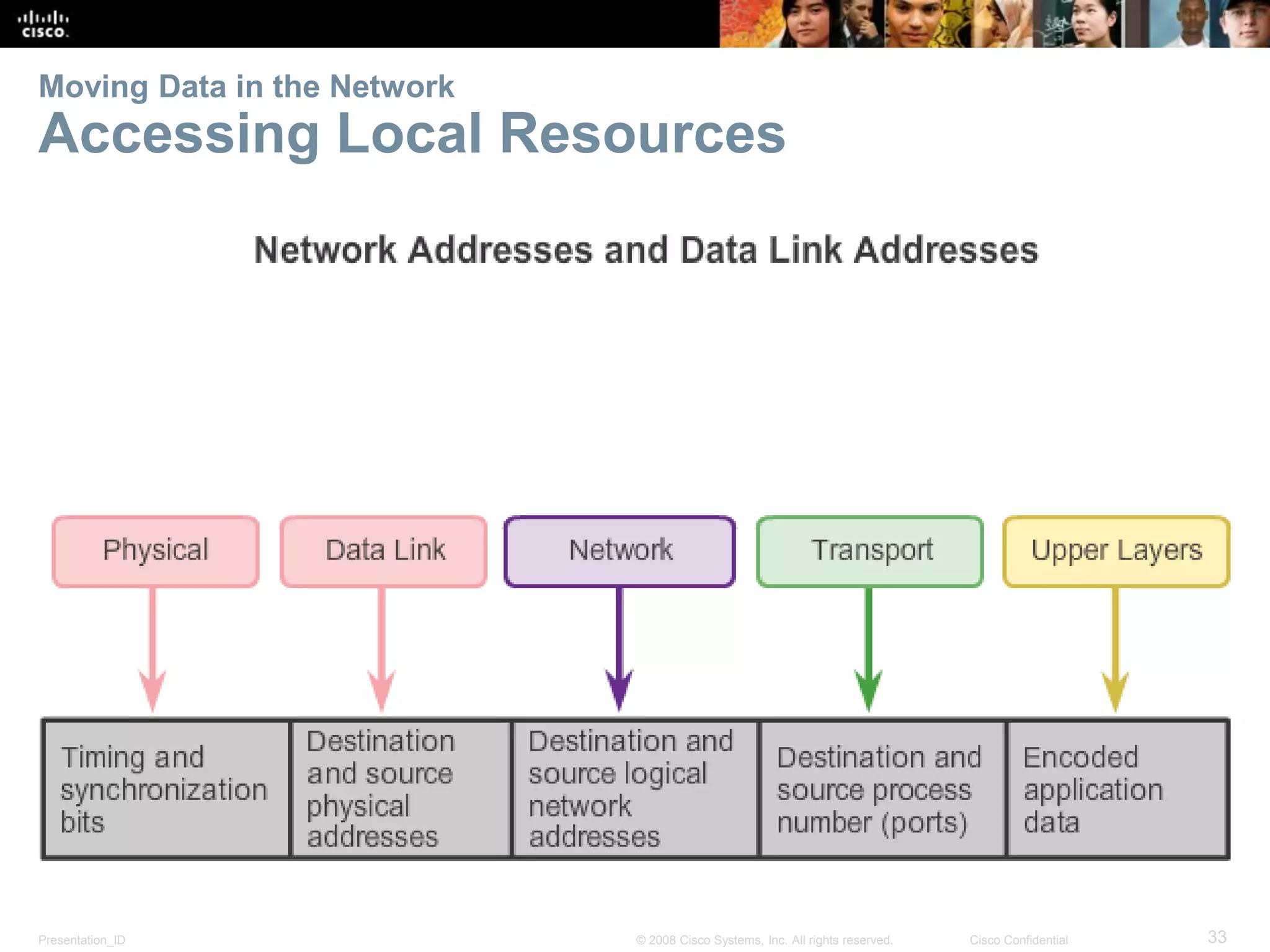
Presentation_ID 33© 2008 Cisco Systems, Inc. All rights reserved. Cisco Confidential
Moving Data in the Network
Accessing Local Resources
Presentation_ID 34© 2008 Cisco Systems, Inc. All rights reserved. Cisco Confidential
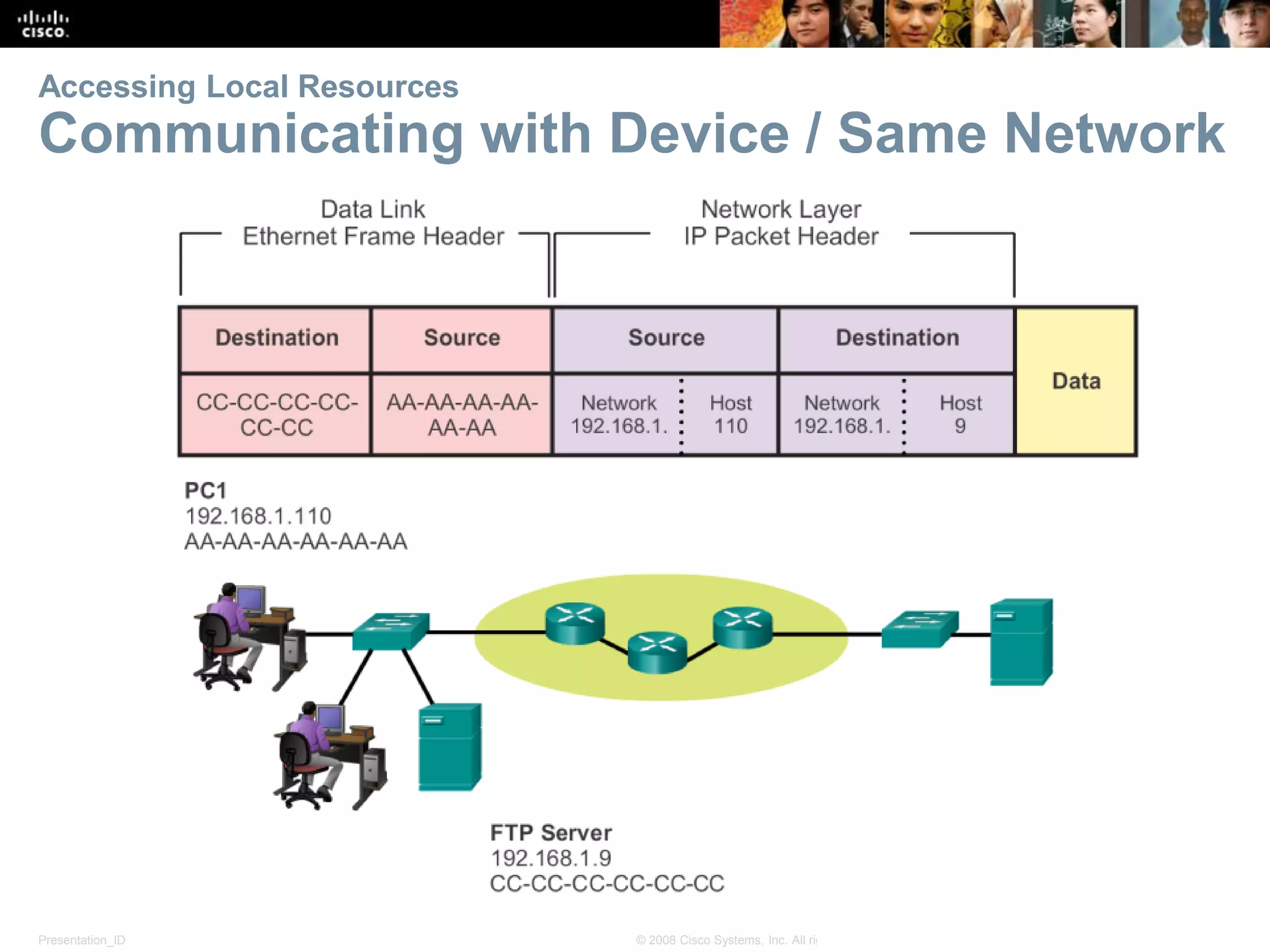
Accessing Local Resources
Communicating with Device / Same Network
Presentation_ID 35© 2008 Cisco Systems, Inc. All rights reserved. Cisco Confidential
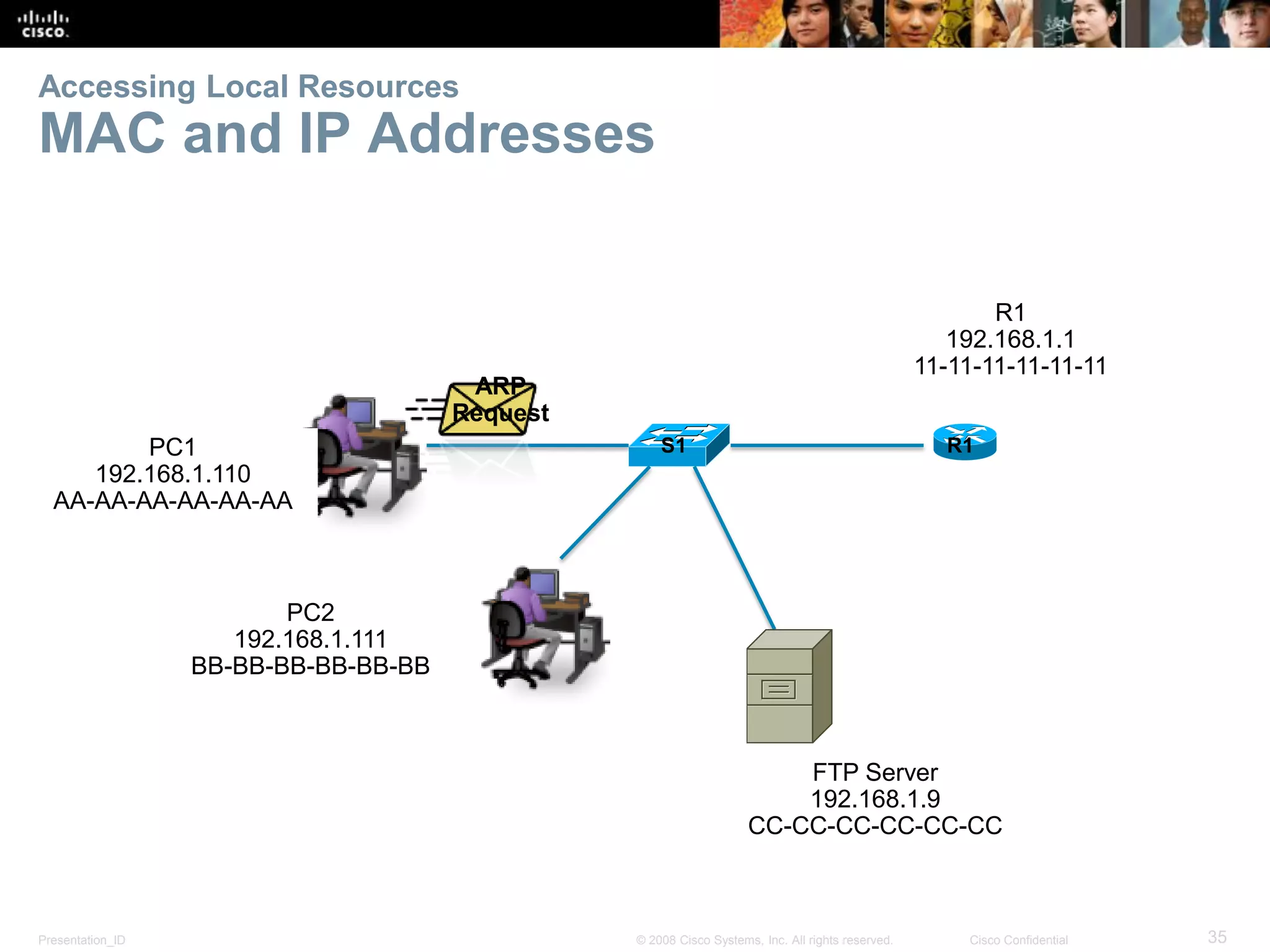
Accessing Local Resources
MAC and IP Addresses
PC1
192.168.1.110
AA-AA-AA-AA-AA-AA
PC2
192.168.1.111
BB-BB-BB-BB-BB-BB
FTP Server
192.168.1.9
CC-CC-CC-CC-CC-CC
R1
192.168.1.1
11-11-11-11-11-11
ARP
Request
S1 R1
Presentation_ID 36© 2008 Cisco Systems, Inc. All rights reserved. Cisco Confidential
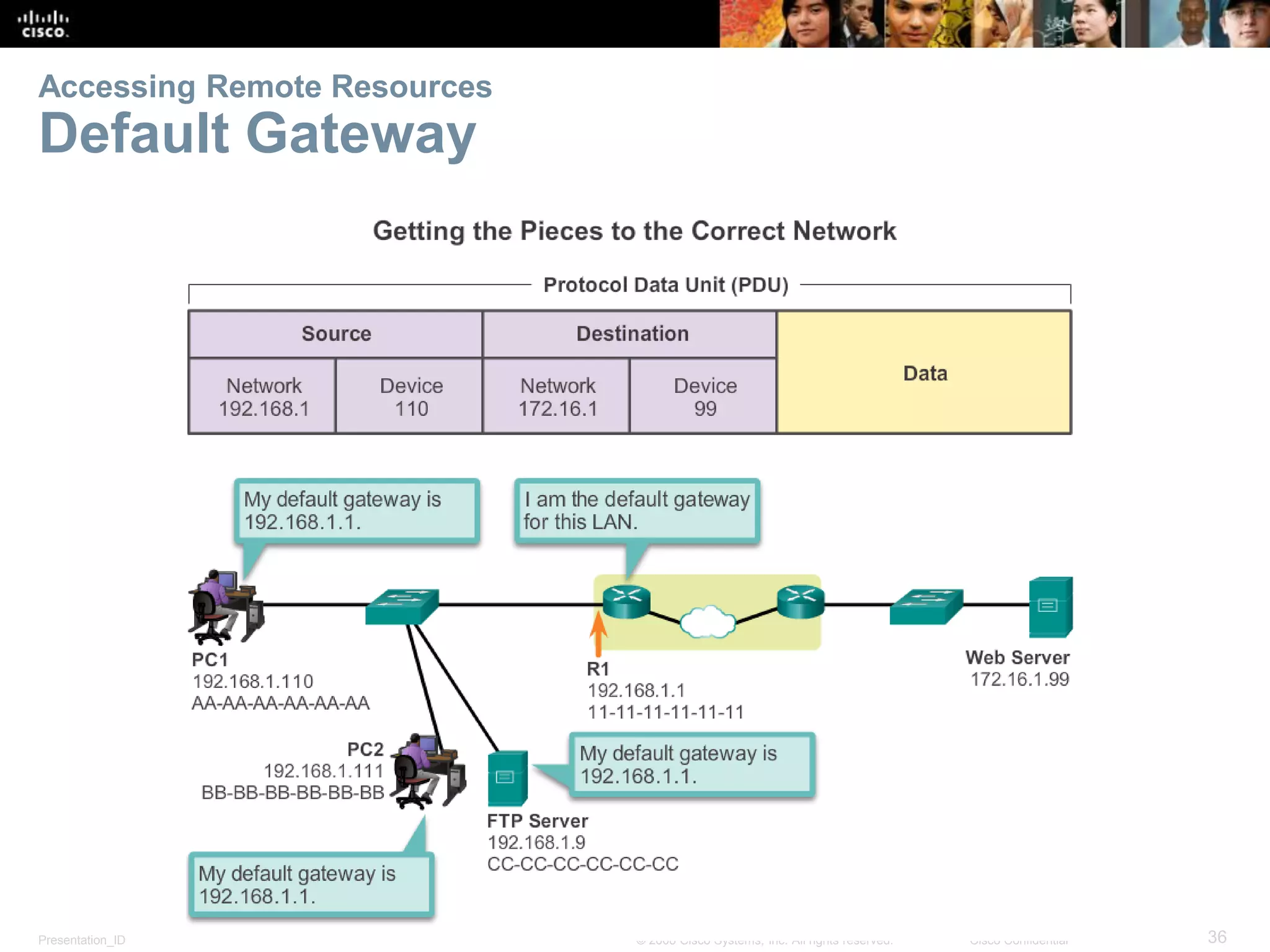
Accessing Remote Resources
Default Gateway
Presentation_ID 37© 2008 Cisco Systems, Inc. All rights reserved. Cisco Confidential
Accessing Remote Resources
Communicating Device / Remote Network
Presentation_ID 38© 2008 Cisco Systems, Inc. All rights reserved. Cisco Confidential
Network Protocols and Communications
Summary
In this chapter, you learned:
 Data networks are systems of end devices, intermediary devices, and the
media connecting the devices. For communication to occur, these devices
must know how to communicate.
 These devices must comply with communication rules and protocols.
TCP/IP is an example of a protocol suite.
 Most protocols are created by a standards organization such as the IETF
or IEEE.
 The most widely-used networking models are the OSI and TCP/IP
models.
 Data that passes down the stack of the OSI model is segmented into
pieces and encapsulated with addresses and other labels. The process is
reversed as the pieces are de-encapsulated and passed up the
destination protocol stack.
Presentation_ID 39© 2008 Cisco Systems, Inc. All rights reserved. Cisco Confidential
Network Protocols and Communications
Summary (cont.)
In this chapter, you learned:
 The OSI model describes the processes of encoding, formatting,
segmenting, and encapsulating data for transmission over the network.
 The TCP/IP protocol suite is an open standard protocol that has been
endorsed by the networking industry and ratified, or approved, by a
standards organization.
 The Internet Protocol Suite is a suite of protocols required for transmitting
and receiving information using the Internet.
 Protocol Data Units (PDUs) are named according to the protocols of the
TCP/IP suite: data, segment, packet, frame, and bits.
 Applying models allows individuals, companies, and trade associations to
analyze current networks and plan the networks of the future.
Presentation_ID 40© 2008 Cisco Systems, Inc. All rights reserved. Cisco Confidential

CCNAv5 - S1: Chapter 3 - Network protocols and communications

  • 1.
    © 2008 CiscoSystems, Inc. All rights reserved. Cisco ConfidentialPresentation_ID 1 Chapter 3: Network Protocols and Communications Introduction to Networks
  • 2.
    Presentation_ID 2© 2008Cisco Systems, Inc. All rights reserved. Cisco Confidential Chapter 3: Objectives After completing this chapter, you will be able to:  Explain how rules are used to facilitate communication.  Explain the role of protocols and standards organizations in facilitating interoperability in network communications.  Explain how devices on a LAN access resources in a small to medium-sized business network.
  • 3.
    Presentation_ID 3© 2008Cisco Systems, Inc. All rights reserved. Cisco Confidential Chapter 3 3.1 Rules of Communication 3.2 Network Protocols and Standards 3.3 Moving Data in the Network 3.4 Summary
  • 4.
    © 2008 CiscoSystems, Inc. All rights reserved. Cisco ConfidentialPresentation_ID 4 3.1 Rules of Communication
  • 5.
    Presentation_ID 5© 2008Cisco Systems, Inc. All rights reserved. Cisco Confidential The Rules What is Communication?
  • 6.
    Presentation_ID 6© 2008Cisco Systems, Inc. All rights reserved. Cisco Confidential The Rules Establishing the Rules  An identified sender and receiver  Agreed upon method of communicating (face-to-face, telephone, letter, photograph)  Common language and grammar  Speed and timing of delivery  Confirmation or acknowledgment requirements
  • 7.
    Presentation_ID 7© 2008Cisco Systems, Inc. All rights reserved. Cisco Confidential The Rules Message Encoding
  • 8.
    Presentation_ID 8© 2008Cisco Systems, Inc. All rights reserved. Cisco Confidential The Rules Message Formatting and Encapsulation Example: Personal letter contains the following elements:  Identifier of the recipient’s location  Identifier of the sender’s location  Salutation or greeting  Recipient identifier  The message content  Source identifier  End of message indicator
  • 9.
    Presentation_ID 9© 2008Cisco Systems, Inc. All rights reserved. Cisco Confidential The Rules Message Size An overview of the segmenting process:  The size restrictions of frames require the source host to break a long message into individual pieces (or segments) that meet both the minimum and maximum size requirements.  Each segment is encapsulated in a separate frame with the address information, and is sent over the network.  At the receiving host, the messages are de-encapsulated and put back together to be processed and interpreted.
  • 10.
    Presentation_ID 10© 2008Cisco Systems, Inc. All rights reserved. Cisco Confidential The Rules Message Timing  Access Method  Flow Control  Response Timeout
  • 11.
    Presentation_ID 11© 2008Cisco Systems, Inc. All rights reserved. Cisco Confidential The Rules Message Delivery Options
  • 12.
    © 2008 CiscoSystems, Inc. All rights reserved. Cisco ConfidentialPresentation_ID 12 3.2 Network Protocols and Standards
  • 13.
    Presentation_ID 13© 2008Cisco Systems, Inc. All rights reserved. Cisco Confidential Protocols Rules that Govern Communications
  • 14.
    Presentation_ID 14© 2008Cisco Systems, Inc. All rights reserved. Cisco Confidential Protocols Network Protocols  How the message is formatted or structured  The process by which networking devices share information about pathways with other networks  How and when error and system messages are passed between devices  The setup and termination of data transfer sessions
  • 15.
    Presentation_ID 15© 2008Cisco Systems, Inc. All rights reserved. Cisco Confidential Protocols Interaction of Protocols  Application Protocol – Hypertext Transfer Protocol (HTTP)  Transport Protocol – Transmission Control Protocol (TCP)  Internet Protocol – Internet Protocol (IP)  Network Access Protocols – Data link & physical layers
  • 16.
    Presentation_ID 16© 2008Cisco Systems, Inc. All rights reserved. Cisco Confidential Protocol Suites Protocol Suites and Industry Standards
  • 17.
    Presentation_ID 17© 2008Cisco Systems, Inc. All rights reserved. Cisco Confidential Protocol Suites Creation of Internet, Development of TCP/IP  The first packet switching network and predecessor to today’s Internet was the Advanced Research Projects Agency Network (ARPANET), which came to life in 1969 by connecting mainframe computers at four locations.  ARPANET was funded by the U.S. Department of Defense for use by universities and research laboratories. Bolt, Beranek and Newman (BBN) was the contractor that did much of the initial development of the ARPANET, including creating the first router known as an Interface Message Processor (IMP).  In 1973, Robert Kahn and Vinton Cerf began work on TCP to develop the next generation of the ARPANET. TCP was designed to replace ARPANET’s current Network Control Program (NCP).  In 1978, TCP was divided into two protocols: TCP and IP. Later, other protocols were added to the TCP/IP suite of protocols including Telnet, FTP, DNS, and many others.
  • 18.
    Presentation_ID 18© 2008Cisco Systems, Inc. All rights reserved. Cisco Confidential Protocol Suites TCP/IP Protocol Suite and Communication
  • 19.
    Presentation_ID 19© 2008Cisco Systems, Inc. All rights reserved. Cisco Confidential Standards Organizations Open Standards  The Internet Society (ISOC)  The Internet Architecture Board (IAB)  The Internet Engineering Task Force (IETF)  Institute of Electrical and Electronics Engineers (IEEE)  The International Organization for Standards (ISO)
  • 20.
    Presentation_ID 20© 2008Cisco Systems, Inc. All rights reserved. Cisco Confidential Standards Organizations ISOC, IAB, and IETF
  • 21.
    Presentation_ID 21© 2008Cisco Systems, Inc. All rights reserved. Cisco Confidential Standards Organizations IEEE  38 societies  130 journals  1,300 conferences each year  1,300 standards and projects  400,000 members  160 countries  IEEE 802.3  IEEE 802.11
  • 22.
    Presentation_ID 22© 2008Cisco Systems, Inc. All rights reserved. Cisco Confidential Standards Organizations ISO OSI Model
  • 23.
    Presentation_ID 23© 2008Cisco Systems, Inc. All rights reserved. Cisco Confidential Standards Organizations Other Standards Organization  The Electronic Industries Alliance (EIA)  The Telecommunications Industry Association (TIA)  The International Telecommunications Union – Telecommunications Standardization Sector (ITU-T)  The Internet Corporation for Assigned Names and Numbers (ICANN)  The Internet Assigned Numbers Authority (IANA)
  • 24.
    Presentation_ID 24© 2008Cisco Systems, Inc. All rights reserved. Cisco Confidential Reference Models Benefits of Using a Layered Model
  • 25.
    Presentation_ID 25© 2008Cisco Systems, Inc. All rights reserved. Cisco Confidential Reference Models The OSI Reference Model
  • 26.
    Presentation_ID 26© 2008Cisco Systems, Inc. All rights reserved. Cisco Confidential Reference Models The TCP/IP Reference Model
  • 27.
    Presentation_ID 27© 2008Cisco Systems, Inc. All rights reserved. Cisco Confidential Reference Models Comparing the OSI and TCP/IP Models
  • 28.
    © 2008 CiscoSystems, Inc. All rights reserved. Cisco ConfidentialPresentation_ID 28 3.3 Moving Data in the Network
  • 29.
    Presentation_ID 29© 2008Cisco Systems, Inc. All rights reserved. Cisco Confidential Data Encapsulation Communicating the Messages  Segmenting message benefits Different conversations can be interleaved Increased reliability of network communications  Segmenting message disadvantage Increased level of complexity
  • 30.
    Presentation_ID 30© 2008Cisco Systems, Inc. All rights reserved. Cisco Confidential Data Encapsulation Protocol Data Units (PDUs)  Data  Segment  Packet  Frame  Bits
  • 31.
    Presentation_ID 31© 2008Cisco Systems, Inc. All rights reserved. Cisco Confidential Data Encapsulation Protocol Encapsulation
  • 32.
    Presentation_ID 32© 2008Cisco Systems, Inc. All rights reserved. Cisco Confidential Data Encapsulation Protocol De-encapsulation
  • 33.
    Presentation_ID 33© 2008Cisco Systems, Inc. All rights reserved. Cisco Confidential Moving Data in the Network Accessing Local Resources
  • 34.
    Presentation_ID 34© 2008Cisco Systems, Inc. All rights reserved. Cisco Confidential Accessing Local Resources Communicating with Device / Same Network
  • 35.
    Presentation_ID 35© 2008Cisco Systems, Inc. All rights reserved. Cisco Confidential Accessing Local Resources MAC and IP Addresses PC1 192.168.1.110 AA-AA-AA-AA-AA-AA PC2 192.168.1.111 BB-BB-BB-BB-BB-BB FTP Server 192.168.1.9 CC-CC-CC-CC-CC-CC R1 192.168.1.1 11-11-11-11-11-11 ARP Request S1 R1
  • 36.
    Presentation_ID 36© 2008Cisco Systems, Inc. All rights reserved. Cisco Confidential Accessing Remote Resources Default Gateway
  • 37.
    Presentation_ID 37© 2008Cisco Systems, Inc. All rights reserved. Cisco Confidential Accessing Remote Resources Communicating Device / Remote Network
  • 38.
    Presentation_ID 38© 2008Cisco Systems, Inc. All rights reserved. Cisco Confidential Network Protocols and Communications Summary In this chapter, you learned:  Data networks are systems of end devices, intermediary devices, and the media connecting the devices. For communication to occur, these devices must know how to communicate.  These devices must comply with communication rules and protocols. TCP/IP is an example of a protocol suite.  Most protocols are created by a standards organization such as the IETF or IEEE.  The most widely-used networking models are the OSI and TCP/IP models.  Data that passes down the stack of the OSI model is segmented into pieces and encapsulated with addresses and other labels. The process is reversed as the pieces are de-encapsulated and passed up the destination protocol stack.
  • 39.
    Presentation_ID 39© 2008Cisco Systems, Inc. All rights reserved. Cisco Confidential Network Protocols and Communications Summary (cont.) In this chapter, you learned:  The OSI model describes the processes of encoding, formatting, segmenting, and encapsulating data for transmission over the network.  The TCP/IP protocol suite is an open standard protocol that has been endorsed by the networking industry and ratified, or approved, by a standards organization.  The Internet Protocol Suite is a suite of protocols required for transmitting and receiving information using the Internet.  Protocol Data Units (PDUs) are named according to the protocols of the TCP/IP suite: data, segment, packet, frame, and bits.  Applying models allows individuals, companies, and trade associations to analyze current networks and plan the networks of the future.
  • 40.
    Presentation_ID 40© 2008Cisco Systems, Inc. All rights reserved. Cisco Confidential