

IT Essentials PC Hardware
  and Software 4.1

  Instructional Resource
  Chapter 8: Fundamental
  Networks


Presentation_ID               © 2008 Cisco Systems, Inc. All rights reserved.   Cisco Confidential   1
Chapter 8: Objectives
            Explain the principles of networking.
            Describe types of networks.
            Describe basic networking concepts and technologies.
            Describe the physical components of a network.
            Describe LAN topologies and architectures.
            Identify standards organizations.
            Identify Ethernet standards.
            Explain OSI and TCP/IP data models.
            Describe how to configure a NIC and a modem.
            Identify names, purposes, and characteristics of other technologies that are used to
             establish connectivity.
            Identify and apply common preventive maintenance techniques that are used for
             networks.
            Troubleshoot a network.
Presentation_ID                                      © 2008 Cisco Systems, Inc. All rights reserved.   Cisco Confidential   2
Chapter 8: Critical Concepts
            What is this chapter about and why is it important?
                  The chapter introduces networking and the basic concepts that are associated
                   with networking. Networks are everywhere; with voice, video, and data
                   converging on the same network, it is important for students to be able to install
                   devices on a network. Even students who are not planning on entering the
                   networking field must be able to add devices to the network, understand basic
                   networking concepts as they relate to such installations, and be able to configure
                   basic network settings.
                  Included in this introduction are the different types of networks, IP addressing
                    including using DHCP and ICMP to check for connectivity, network components
                    and cabling, Ethernet standards, Internet connectivity, and basic network
                    troubleshooting.


Presentation_ID                                         © 2008 Cisco Systems, Inc. All rights reserved.   Cisco Confidential   3
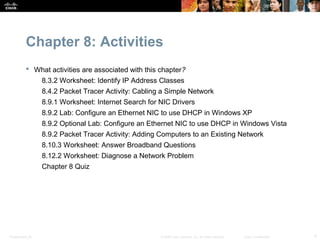
Chapter 8: Activities
            What activities are associated with this chapter?
                  8.3.2 Worksheet: Identify IP Address Classes
                  8.4.2 Packet Tracer Activity: Cabling a Simple Network
                  8.9.1 Worksheet: Internet Search for NIC Drivers
                  8.9.2 Lab: Configure an Ethernet NIC to use DHCP in Windows XP
                  8.9.2 Optional Lab: Configure an Ethernet NIC to use DHCP in Windows Vista
                  8.9.2 Packet Tracer Activity: Adding Computers to an Existing Network
                  8.10.3 Worksheet: Answer Broadband Questions
                  8.12.2 Worksheet: Diagnose a Network Problem
                  Chapter 8 Quiz


Presentation_ID                                        © 2008 Cisco Systems, Inc. All rights reserved.   Cisco Confidential   4
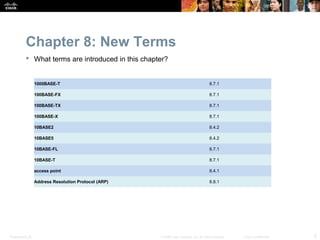
Chapter 8: New Terms
            What terms are introduced in this chapter?


                  1000BASE-T                                                             8.7.1

                  100BASE-FX                                                             8.7.1

                  100BASE-TX                                                             8.7.1

                  100BASE-X                                                              8.7.1

                  10BASE2                                                                8.4.2

                  10BASE5                                                                8.4.2

                  10BASE-FL                                                              8.7.1

                  10BASE-T                                                               8.7.1

                  access point                                                           8.4.1

                  Address Resolution Protocol (ARP)                                      8.8.1


Presentation_ID                                       © 2008 Cisco Systems, Inc. All rights reserved.   Cisco Confidential   5
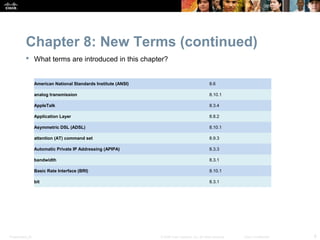
Chapter 8: New Terms (continued)
            What terms are introduced in this chapter?


                  American National Standards Institute (ANSI)                                      8.6

                  analog transmission                                                               8.10.1

                  AppleTalk                                                                         8.3.4

                  Application Layer                                                                 8.8.2

                  Asymmetric DSL (ADSL)                                                             8.10.1

                  attention (AT) command set                                                        8.9.3

                  Automatic Private IP Addressing (APIPA)                                           8.3.3

                  bandwidth                                                                         8.3.1

                  Basic Rate Interface (BRI)                                                        8.10.1

                  bit                                                                               8.3.1


Presentation_ID                                                  © 2008 Cisco Systems, Inc. All rights reserved.   Cisco Confidential   6
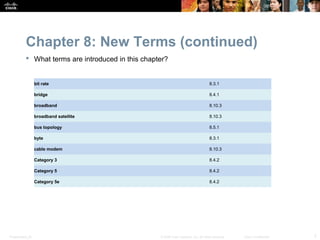
Chapter 8: New Terms (continued)
            What terms are introduced in this chapter?


                  bit rate                                                             8.3.1

                  bridge                                                               8.4.1

                  broadband                                                            8.10.3

                  broadband satellite                                                  8.10.3

                  bus topology                                                         8.5.1

                  byte                                                                 8.3.1

                  cable modem                                                          8.10.3

                  Category 3                                                           8.4.2

                  Category 5                                                           8.4.2

                  Category 5e                                                          8.4.2


Presentation_ID                                     © 2008 Cisco Systems, Inc. All rights reserved.   Cisco Confidential   7
Chapter 8: New Terms (continued)
            What terms are introduced in this chapter?


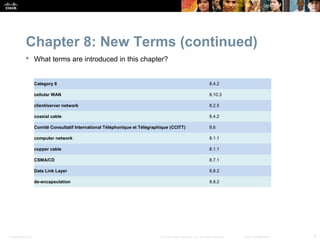
                  Category 6                                                                                   8.4.2

                  cellular WAN                                                                                 8.10.3

                  client/server network                                                                        8.2.5

                  coaxial cable                                                                                8.4.2

                  Comité Consultatif International Téléphonique et Télégraphique (CCITT)                       8.6

                  computer network                                                                             8.1.1

                  copper cable                                                                                 8.1.1

                  CSMA/CD                                                                                      8.7.1

                  Data Link Layer                                                                              8.8.2

                  de-encapsulation                                                                             8.8.2


Presentation_ID                                                             © 2008 Cisco Systems, Inc. All rights reserved.   Cisco Confidential   8
Chapter 8: New Terms (continued)
            What terms are introduced in this chapter?


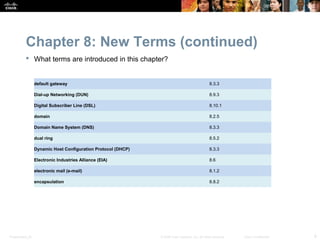
                  default gateway                                                                 8.3.3

                  Dial-up Networking (DUN)                                                        8.9.3

                  Digital Subscriber Line (DSL)                                                   8.10.1

                  domain                                                                          8.2.5

                  Domain Name System (DNS)                                                        8.3.3

                  dual ring                                                                       8.5.2

                  Dynamic Host Configuration Protocol (DHCP)                                      8.3.3

                  Electronic Industries Alliance (EIA)                                            8.6

                  electronic mail (e-mail)                                                        8.1.2

                  encapsulation                                                                   8.8.2


Presentation_ID                                                © 2008 Cisco Systems, Inc. All rights reserved.   Cisco Confidential   9
Chapter 8: New Terms (continued)
            What terms are introduced in this chapter?


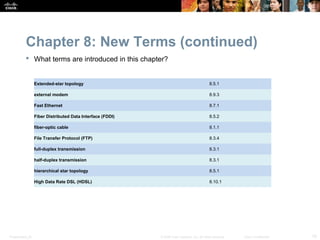
                  Extended-star topology                                                       8.5.1

                  external modem                                                               8.9.3

                  Fast Ethernet                                                                8.7.1

                  Fiber Distributed Data Interface (FDDI)                                      8.5.2

                  fiber-optic cable                                                            8.1.1

                  File Transfer Protocol (FTP)                                                 8.3.4

                  full-duplex transmission                                                     8.3.1

                  half-duplex transmission                                                     8.3.1

                  hierarchical star topology                                                   8.5.1

                  High Data Rate DSL (HDSL)                                                    8.10.1


Presentation_ID                                             © 2008 Cisco Systems, Inc. All rights reserved.   Cisco Confidential   10
Chapter 8: New Terms (continued)
            What terms are introduced in this chapter?


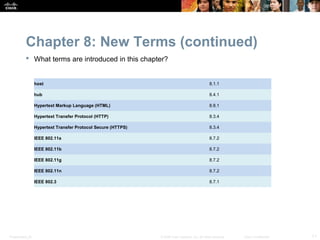
                  host                                                                            8.1.1

                  hub                                                                             8.4.1

                  Hypertext Markup Language (HTML)                                                8.8.1

                  Hypertext Transfer Protocol (HTTP)                                              8.3.4

                  Hypertext Transfer Protocol Secure (HTTPS)                                      8.3.4

                  IEEE 802.11a                                                                    8.7.2

                  IEEE 802.11b                                                                    8.7.2

                  IEEE 802.11g                                                                    8.7.2

                  IEEE 802.11n                                                                    8.7.2

                  IEEE 802.3                                                                      8.7.1


Presentation_ID                                                © 2008 Cisco Systems, Inc. All rights reserved.   Cisco Confidential   11
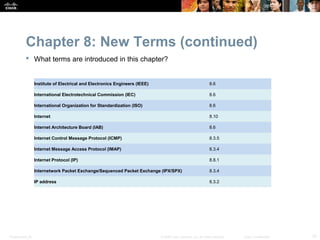
Chapter 8: New Terms (continued)
            What terms are introduced in this chapter?


                  Institute of Electrical and Electronics Engineers (IEEE)                                      8.6

                  International Electrotechnical Commission (IEC)                                               8.6

                  International Organization for Standardization (ISO)                                          8.6

                  Internet                                                                                      8.10

                  Internet Architecture Board (IAB)                                                             8.6

                  Internet Control Message Protocol (ICMP)                                                      8.3.5

                  Internet Message Access Protocol (IMAP)                                                       8.3.4

                  Internet Protocol (IP)                                                                        8.8.1

                  Internetwork Packet Exchange/Sequenced Packet Exchange (IPX/SPX)                              8.3.4

                  IP address                                                                                    8.3.2


Presentation_ID                                                              © 2008 Cisco Systems, Inc. All rights reserved.   Cisco Confidential   12
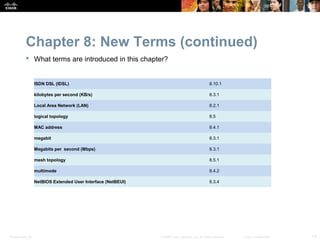
Chapter 8: New Terms (continued)
            What terms are introduced in this chapter?


                  ISDN DSL (IDSL)                                                                8.10.1

                  kilobytes per second (KB/s)                                                    8.3.1

                  Local Area Network (LAN)                                                       8.2.1

                  logical topology                                                               8.5

                  MAC address                                                                    8.4.1

                  megabit                                                                        8.3.1

                  Megabits per second (Mbps)                                                     8.3.1

                  mesh topology                                                                  8.5.1

                  multimode                                                                      8.4.2

                  NetBIOS Extended User Interface (NetBEUI)                                      8.3.4


Presentation_ID                                               © 2008 Cisco Systems, Inc. All rights reserved.   Cisco Confidential   13
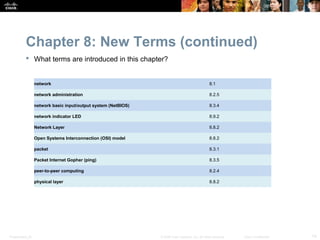
Chapter 8: New Terms (continued)
            What terms are introduced in this chapter?


                  network                                                                          8.1

                  network administration                                                           8.2.5

                  network basic input/output system (NetBIOS)                                      8.3.4

                  network indicator LED                                                            8.9.2

                  Network Layer                                                                    8.8.2

                  Open Systems Interconnection (OSI) model                                         8.8.2

                  packet                                                                           8.3.1

                  Packet Internet Gopher (ping)                                                    8.3.5

                  peer-to-peer computing                                                           8.2.4

                  physical layer                                                                   8.8.2


Presentation_ID                                                 © 2008 Cisco Systems, Inc. All rights reserved.   Cisco Confidential   14
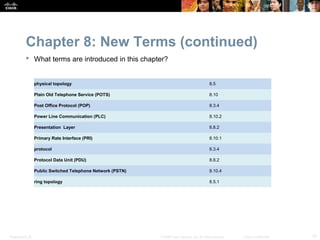
Chapter 8: New Terms (continued)
            What terms are introduced in this chapter?


                  physical topology                                                             8.5

                  Plain Old Telephone Service (POTS)                                            8.10

                  Post Office Protocol (POP)                                                    8.3.4

                  Power Line Communication (PLC)                                                8.10.2

                  Presentation Layer                                                            8.8.2

                  Primary Rate Interface (PRI)                                                  8.10.1

                  protocol                                                                      8.3.4

                  Protocol Data Unit (PDU)                                                      8.8.2

                  Public Switched Telephone Network (PSTN)                                      8.10.4

                  ring topology                                                                 8.5.1


Presentation_ID                                              © 2008 Cisco Systems, Inc. All rights reserved.   Cisco Confidential   15
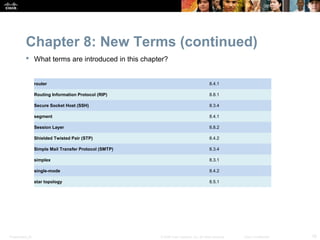
Chapter 8: New Terms (continued)
            What terms are introduced in this chapter?


                  router                                                                    8.4.1

                  Routing Information Protocol (RIP)                                        8.8.1

                  Secure Socket Host (SSH)                                                  8.3.4

                  segment                                                                   8.4.1

                  Session Layer                                                             8.8.2

                  Shielded Twisted Pair (STP)                                               8.4.2

                  Simple Mail Transfer Protocol (SMTP)                                      8.3.4

                  simplex                                                                   8.3.1

                  single-mode                                                               8.4.2

                  star topology                                                             8.5.1


Presentation_ID                                          © 2008 Cisco Systems, Inc. All rights reserved.   Cisco Confidential   16
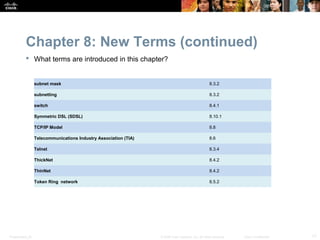
Chapter 8: New Terms (continued)
            What terms are introduced in this chapter?


                  subnet mask                                                                        8.3.2

                  subnetting                                                                         8.3.2

                  switch                                                                             8.4.1

                  Symmetric DSL (SDSL)                                                               8.10.1

                  TCP/IP Model                                                                       8.8

                  Telecommunications Industry Association (TIA)                                      8.6

                  Telnet                                                                             8.3.4

                  ThickNet                                                                           8.4.2

                  ThinNet                                                                            8.4.2

                  Token Ring network                                                                 8.5.2


Presentation_ID                                                   © 2008 Cisco Systems, Inc. All rights reserved.   Cisco Confidential   17
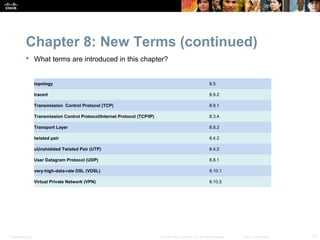
Chapter 8: New Terms (continued)
            What terms are introduced in this chapter?


                  topology                                                                                      8.5

                  tracert                                                                                       8.9.2

                  Transmission Control Protocol (TCP)                                                           8.8.1

                  Transmission Control Protocol/Internet Protocol (TCP/IP)                                      8.3.4

                  Transport Layer                                                                               8.8.2

                  twisted pair                                                                                  8.4.2

                  uUnshielded Twisted Pair (UTP)                                                                8.4.2

                  User Datagram Protocol (UDP)                                                                  8.8.1

                  very-high-data-rate DSL (VDSL)                                                                8.10.1

                  Virtual Private Network (VPN)                                                                 8.10.5


Presentation_ID                                                              © 2008 Cisco Systems, Inc. All rights reserved.   Cisco Confidential   18
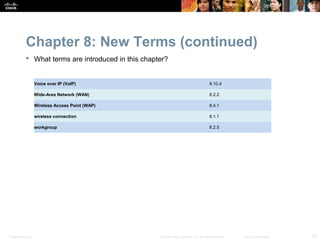
Chapter 8: New Terms (continued)
            What terms are introduced in this chapter?


                  Voice over IP (VoIP)                                                 8.10.4

                  Wide-Area Network (WAN)                                              8.2.2

                  Wireless Access Point (WAP)                                          8.4.1

                  wireless connection                                                  8.1.1

                  workgroup                                                            8.2.5


Presentation_ID                                     © 2008 Cisco Systems, Inc. All rights reserved.   Cisco Confidential   19
Chapter 8: Changes
           What has changed from the previous version (4.0) of ITEPC?
             Page 8.2.5 Explain client/server networks
             • Basics of workgroups and domains

                  Page 8.3.1 Explain bandwidth and data transmission
                  • Latency

                  Page 8.3.2 Describe IP addressing
                  • IP addresses
                  • Classes
                  • Subnet Mask

                  Page 8.3.3 Define DHCP
                  • Automatic configuration
                  • APIPA
                  • NAT


Presentation_ID                                       © 2008 Cisco Systems, Inc. All rights reserved.   Cisco Confidential   20
Chapter 8: Changes (continued)
           What has changed from the previous version (4.0) of ITEPC?
             Page 8.3.4 Describe Internet protocols and applications
             • TCP/IP properties
             • Common protocols and ports
                  • HTTP, FTP, POP, SMTP, Telnet, and HTTPS

                  Page 8.3.5 Define ICMP
                  • Ping

                  Page 8.4.2 Identify names, purposes, and characteristics of common network
                    cables
                  • Connectors
                       • RJ-45
                       •RJ-11

                  Page 8.7.1 Explain cabled Ethernet standards
                  • IEEE 802.3


Presentation_ID                                       © 2008 Cisco Systems, Inc. All rights reserved.   Cisco Confidential   21
Chapter 8: Changes (continued)
           What has changed from the previous version (4.0) of ITEPC?
             Page 8.7.2 Explain wireless Ethernet standards
             • 802.11a
             • 802.11b
             • 802.11g
             • 802.11n

                  Page 8.8.1 Define the TCP/IP model
                  • Application Layer Protocols
                  • Transport Layer Protocols
                  • Internet Layer Protocols
                  • Network Access Layer ProtocolsPage 8.9.2 Attach a computer to existing
                    network
                  • Ipconfig Command
                  • Ping Command
                  • Telent Service


Presentation_ID                                       © 2008 Cisco Systems, Inc. All rights reserved.   Cisco Confidential   22
Chapter 8: Changes (continued)
           What has changed from the previous version (4.0) of ITEPC?
                  Page 8.10.3 Define broadband
                  • Bluetooth
                  • Cellular
                  • Fiber Broadband


                  Page 8.10.5 Define VPN
                  • Virtual Private Networks

                  Page 8.12.1 Review the troubleshooting process
                  • Identify the Problem
                  • Establish a Theory of Probable Causes
                  • Determine an Exact Cause
                  • Implement a Solution
                  • Verify Solution and Full System Functionality
                  • Document Findings

Presentation_ID                                         © 2008 Cisco Systems, Inc. All rights reserved.   Cisco Confidential   23
Chapter 8: Changes (continued)
           What has changed from the previous version (4.0) of ITEPC?
             Page 8.12.2 Identify common network problems and solutions
             • NIC LEDs are not lit
             • A user is unable to use Telnet
             • An older laptop cannot detect a wireless router
             • A computer has an invalid IP address
             • A remote device does not respond to a ping request
             • A user is unable to connect to the Internet
             • A laptop cannot connect to the wireless network


Presentation_ID                                  © 2008 Cisco Systems, Inc. All rights reserved.   Cisco Confidential   24
Chapter 8: Classroom Management
           Use the Cisco Discovery Networking for Home and Small Business curriculum
            activities for extra networking practice:
               • 3.1.3.2 explains network components
               • 3.5.3.2 explains default gateway
               • 5.1.3.2 explains network numbers
               • 5.2.1.2 explains default subnet mask
               • 5.2.2.3 explains public and private IP addressing
               • 6.2.7.2 explains port numbers
               • 6.3.3.3 explains OSI model
           Use the Cisco Exploration Network Fundamentals curriculum activities for extra
            networking practice:
               • 4.2.2.1 explains port numbers
               • 6.4.1.1 explains the network and host portion of an IP address
           As a class project or homework assignment, the students should research the
            technologies that are available in the area to connect to a network, such as cellular,
            VoIP, satellite, etc.


Presentation_ID                                       © 2008 Cisco Systems, Inc. All rights reserved.   Cisco Confidential   25
Chapter 8: Teaching Analogies
         The OSI model is similar to creating a set of guidelines for building any type of
          bicycle. The guidelines specify how to guide and stop the bicycle, how to carry a
          person, and what type of tires to use for the bicycle.
         A traditional analog phone call could be compared to the television signals received
          through an antenna. A VoIP phone call could be compared to the television digital
          signals received through a cable provider.
         Data must be broken up into packets to be sent across the Internet. This is similar to
          sorting a big basket of clothes by color and fabric in the laundry room. The capacity
          of the washer determines the amount of clothes that can be washed, similar to how a
           protocol specifies the amount of data that can go in one packet.
         Protocols are a set of rules that have been developed for a specific type of
          communication. An analogy for the different protocols would be the rules that are set
          before a meeting, such as agenda items and discussion time limits.


Presentation_ID                                     © 2008 Cisco Systems, Inc. All rights reserved.   Cisco Confidential   26
Chapter 8: Suggested Class Discussions
                 What are some examples of different types of networks in our lives?
                  Possible examples may include a phone network, a cell phone network, a
                  network of friends, or a social or professional network.
                 Compare and contrast the OSI versus TCP/IP models. Emphasize how
                  the TCP/IP model has real protocols where the OSI model is a theoretical
                  model.
                 What are protocols?
                 What kind of rules would a network need?
                 How do you test communication?


Presentation_ID                                     © 2008 Cisco Systems, Inc. All rights reserved.   Cisco Confidential   27
Chapter 8: Best Practices
                 Network two computers using a crossover cable or multiple computers using a
                  switch or hub.
                 Share a printer on a network and print to it from another computer on the same
                  network.
                 Configure a wireless access point and have the students connect to it with any
                  type of wireless device.
                 Have the students work in teams to act out the rules of particular protocols, such
                  as TCP versus UDP.


Presentation_ID                                          © 2008 Cisco Systems, Inc. All rights reserved.   Cisco Confidential   28
Chapter 8: Outside Reading
           Ethernet and Routing Basics by Cisco Systems
                  http://www.cisco.com


Presentation_ID                                    © 2008 Cisco Systems, Inc. All rights reserved.   Cisco Confidential   29
Presentation_ID   © 2008 Cisco Systems, Inc. All rights reserved.   Cisco Confidential   30
Presentation_ID   © 2008 Cisco Systems, Inc. All rights reserved.   Cisco Confidential   31

ITE - Chapter 8

  • 1.
    IT Essentials PCHardware and Software 4.1 Instructional Resource Chapter 8: Fundamental Networks Presentation_ID © 2008 Cisco Systems, Inc. All rights reserved. Cisco Confidential 1
  • 2.
    Chapter 8: Objectives  Explain the principles of networking.  Describe types of networks.  Describe basic networking concepts and technologies.  Describe the physical components of a network.  Describe LAN topologies and architectures.  Identify standards organizations.  Identify Ethernet standards.  Explain OSI and TCP/IP data models.  Describe how to configure a NIC and a modem.  Identify names, purposes, and characteristics of other technologies that are used to establish connectivity.  Identify and apply common preventive maintenance techniques that are used for networks.  Troubleshoot a network. Presentation_ID © 2008 Cisco Systems, Inc. All rights reserved. Cisco Confidential 2
  • 3.
    Chapter 8: CriticalConcepts  What is this chapter about and why is it important? The chapter introduces networking and the basic concepts that are associated with networking. Networks are everywhere; with voice, video, and data converging on the same network, it is important for students to be able to install devices on a network. Even students who are not planning on entering the networking field must be able to add devices to the network, understand basic networking concepts as they relate to such installations, and be able to configure basic network settings. Included in this introduction are the different types of networks, IP addressing including using DHCP and ICMP to check for connectivity, network components and cabling, Ethernet standards, Internet connectivity, and basic network troubleshooting. Presentation_ID © 2008 Cisco Systems, Inc. All rights reserved. Cisco Confidential 3
  • 4.
    Chapter 8: Activities  What activities are associated with this chapter? 8.3.2 Worksheet: Identify IP Address Classes 8.4.2 Packet Tracer Activity: Cabling a Simple Network 8.9.1 Worksheet: Internet Search for NIC Drivers 8.9.2 Lab: Configure an Ethernet NIC to use DHCP in Windows XP 8.9.2 Optional Lab: Configure an Ethernet NIC to use DHCP in Windows Vista 8.9.2 Packet Tracer Activity: Adding Computers to an Existing Network 8.10.3 Worksheet: Answer Broadband Questions 8.12.2 Worksheet: Diagnose a Network Problem Chapter 8 Quiz Presentation_ID © 2008 Cisco Systems, Inc. All rights reserved. Cisco Confidential 4
  • 5.
    Chapter 8: NewTerms  What terms are introduced in this chapter? 1000BASE-T 8.7.1 100BASE-FX 8.7.1 100BASE-TX 8.7.1 100BASE-X 8.7.1 10BASE2 8.4.2 10BASE5 8.4.2 10BASE-FL 8.7.1 10BASE-T 8.7.1 access point 8.4.1 Address Resolution Protocol (ARP) 8.8.1 Presentation_ID © 2008 Cisco Systems, Inc. All rights reserved. Cisco Confidential 5
  • 6.
    Chapter 8: NewTerms (continued)  What terms are introduced in this chapter? American National Standards Institute (ANSI) 8.6 analog transmission 8.10.1 AppleTalk 8.3.4 Application Layer 8.8.2 Asymmetric DSL (ADSL) 8.10.1 attention (AT) command set 8.9.3 Automatic Private IP Addressing (APIPA) 8.3.3 bandwidth 8.3.1 Basic Rate Interface (BRI) 8.10.1 bit 8.3.1 Presentation_ID © 2008 Cisco Systems, Inc. All rights reserved. Cisco Confidential 6
  • 7.
    Chapter 8: NewTerms (continued)  What terms are introduced in this chapter? bit rate 8.3.1 bridge 8.4.1 broadband 8.10.3 broadband satellite 8.10.3 bus topology 8.5.1 byte 8.3.1 cable modem 8.10.3 Category 3 8.4.2 Category 5 8.4.2 Category 5e 8.4.2 Presentation_ID © 2008 Cisco Systems, Inc. All rights reserved. Cisco Confidential 7
  • 8.
    Chapter 8: NewTerms (continued)  What terms are introduced in this chapter? Category 6 8.4.2 cellular WAN 8.10.3 client/server network 8.2.5 coaxial cable 8.4.2 Comité Consultatif International Téléphonique et Télégraphique (CCITT) 8.6 computer network 8.1.1 copper cable 8.1.1 CSMA/CD 8.7.1 Data Link Layer 8.8.2 de-encapsulation 8.8.2 Presentation_ID © 2008 Cisco Systems, Inc. All rights reserved. Cisco Confidential 8
  • 9.
    Chapter 8: NewTerms (continued)  What terms are introduced in this chapter? default gateway 8.3.3 Dial-up Networking (DUN) 8.9.3 Digital Subscriber Line (DSL) 8.10.1 domain 8.2.5 Domain Name System (DNS) 8.3.3 dual ring 8.5.2 Dynamic Host Configuration Protocol (DHCP) 8.3.3 Electronic Industries Alliance (EIA) 8.6 electronic mail (e-mail) 8.1.2 encapsulation 8.8.2 Presentation_ID © 2008 Cisco Systems, Inc. All rights reserved. Cisco Confidential 9
  • 10.
    Chapter 8: NewTerms (continued)  What terms are introduced in this chapter? Extended-star topology 8.5.1 external modem 8.9.3 Fast Ethernet 8.7.1 Fiber Distributed Data Interface (FDDI) 8.5.2 fiber-optic cable 8.1.1 File Transfer Protocol (FTP) 8.3.4 full-duplex transmission 8.3.1 half-duplex transmission 8.3.1 hierarchical star topology 8.5.1 High Data Rate DSL (HDSL) 8.10.1 Presentation_ID © 2008 Cisco Systems, Inc. All rights reserved. Cisco Confidential 10
  • 11.
    Chapter 8: NewTerms (continued)  What terms are introduced in this chapter? host 8.1.1 hub 8.4.1 Hypertext Markup Language (HTML) 8.8.1 Hypertext Transfer Protocol (HTTP) 8.3.4 Hypertext Transfer Protocol Secure (HTTPS) 8.3.4 IEEE 802.11a 8.7.2 IEEE 802.11b 8.7.2 IEEE 802.11g 8.7.2 IEEE 802.11n 8.7.2 IEEE 802.3 8.7.1 Presentation_ID © 2008 Cisco Systems, Inc. All rights reserved. Cisco Confidential 11
  • 12.
    Chapter 8: NewTerms (continued)  What terms are introduced in this chapter? Institute of Electrical and Electronics Engineers (IEEE) 8.6 International Electrotechnical Commission (IEC) 8.6 International Organization for Standardization (ISO) 8.6 Internet 8.10 Internet Architecture Board (IAB) 8.6 Internet Control Message Protocol (ICMP) 8.3.5 Internet Message Access Protocol (IMAP) 8.3.4 Internet Protocol (IP) 8.8.1 Internetwork Packet Exchange/Sequenced Packet Exchange (IPX/SPX) 8.3.4 IP address 8.3.2 Presentation_ID © 2008 Cisco Systems, Inc. All rights reserved. Cisco Confidential 12
  • 13.
    Chapter 8: NewTerms (continued)  What terms are introduced in this chapter? ISDN DSL (IDSL) 8.10.1 kilobytes per second (KB/s) 8.3.1 Local Area Network (LAN) 8.2.1 logical topology 8.5 MAC address 8.4.1 megabit 8.3.1 Megabits per second (Mbps) 8.3.1 mesh topology 8.5.1 multimode 8.4.2 NetBIOS Extended User Interface (NetBEUI) 8.3.4 Presentation_ID © 2008 Cisco Systems, Inc. All rights reserved. Cisco Confidential 13
  • 14.
    Chapter 8: NewTerms (continued)  What terms are introduced in this chapter? network 8.1 network administration 8.2.5 network basic input/output system (NetBIOS) 8.3.4 network indicator LED 8.9.2 Network Layer 8.8.2 Open Systems Interconnection (OSI) model 8.8.2 packet 8.3.1 Packet Internet Gopher (ping) 8.3.5 peer-to-peer computing 8.2.4 physical layer 8.8.2 Presentation_ID © 2008 Cisco Systems, Inc. All rights reserved. Cisco Confidential 14
  • 15.
    Chapter 8: NewTerms (continued)  What terms are introduced in this chapter? physical topology 8.5 Plain Old Telephone Service (POTS) 8.10 Post Office Protocol (POP) 8.3.4 Power Line Communication (PLC) 8.10.2 Presentation Layer 8.8.2 Primary Rate Interface (PRI) 8.10.1 protocol 8.3.4 Protocol Data Unit (PDU) 8.8.2 Public Switched Telephone Network (PSTN) 8.10.4 ring topology 8.5.1 Presentation_ID © 2008 Cisco Systems, Inc. All rights reserved. Cisco Confidential 15
  • 16.
    Chapter 8: NewTerms (continued)  What terms are introduced in this chapter? router 8.4.1 Routing Information Protocol (RIP) 8.8.1 Secure Socket Host (SSH) 8.3.4 segment 8.4.1 Session Layer 8.8.2 Shielded Twisted Pair (STP) 8.4.2 Simple Mail Transfer Protocol (SMTP) 8.3.4 simplex 8.3.1 single-mode 8.4.2 star topology 8.5.1 Presentation_ID © 2008 Cisco Systems, Inc. All rights reserved. Cisco Confidential 16
  • 17.
    Chapter 8: NewTerms (continued)  What terms are introduced in this chapter? subnet mask 8.3.2 subnetting 8.3.2 switch 8.4.1 Symmetric DSL (SDSL) 8.10.1 TCP/IP Model 8.8 Telecommunications Industry Association (TIA) 8.6 Telnet 8.3.4 ThickNet 8.4.2 ThinNet 8.4.2 Token Ring network 8.5.2 Presentation_ID © 2008 Cisco Systems, Inc. All rights reserved. Cisco Confidential 17
  • 18.
    Chapter 8: NewTerms (continued)  What terms are introduced in this chapter? topology 8.5 tracert 8.9.2 Transmission Control Protocol (TCP) 8.8.1 Transmission Control Protocol/Internet Protocol (TCP/IP) 8.3.4 Transport Layer 8.8.2 twisted pair 8.4.2 uUnshielded Twisted Pair (UTP) 8.4.2 User Datagram Protocol (UDP) 8.8.1 very-high-data-rate DSL (VDSL) 8.10.1 Virtual Private Network (VPN) 8.10.5 Presentation_ID © 2008 Cisco Systems, Inc. All rights reserved. Cisco Confidential 18
  • 19.
    Chapter 8: NewTerms (continued)  What terms are introduced in this chapter? Voice over IP (VoIP) 8.10.4 Wide-Area Network (WAN) 8.2.2 Wireless Access Point (WAP) 8.4.1 wireless connection 8.1.1 workgroup 8.2.5 Presentation_ID © 2008 Cisco Systems, Inc. All rights reserved. Cisco Confidential 19
  • 20.
    Chapter 8: Changes  What has changed from the previous version (4.0) of ITEPC? Page 8.2.5 Explain client/server networks • Basics of workgroups and domains Page 8.3.1 Explain bandwidth and data transmission • Latency Page 8.3.2 Describe IP addressing • IP addresses • Classes • Subnet Mask Page 8.3.3 Define DHCP • Automatic configuration • APIPA • NAT Presentation_ID © 2008 Cisco Systems, Inc. All rights reserved. Cisco Confidential 20
  • 21.
    Chapter 8: Changes(continued)  What has changed from the previous version (4.0) of ITEPC? Page 8.3.4 Describe Internet protocols and applications • TCP/IP properties • Common protocols and ports • HTTP, FTP, POP, SMTP, Telnet, and HTTPS Page 8.3.5 Define ICMP • Ping Page 8.4.2 Identify names, purposes, and characteristics of common network cables • Connectors • RJ-45 •RJ-11 Page 8.7.1 Explain cabled Ethernet standards • IEEE 802.3 Presentation_ID © 2008 Cisco Systems, Inc. All rights reserved. Cisco Confidential 21
  • 22.
    Chapter 8: Changes(continued)  What has changed from the previous version (4.0) of ITEPC? Page 8.7.2 Explain wireless Ethernet standards • 802.11a • 802.11b • 802.11g • 802.11n Page 8.8.1 Define the TCP/IP model • Application Layer Protocols • Transport Layer Protocols • Internet Layer Protocols • Network Access Layer ProtocolsPage 8.9.2 Attach a computer to existing network • Ipconfig Command • Ping Command • Telent Service Presentation_ID © 2008 Cisco Systems, Inc. All rights reserved. Cisco Confidential 22
  • 23.
    Chapter 8: Changes(continued)  What has changed from the previous version (4.0) of ITEPC? Page 8.10.3 Define broadband • Bluetooth • Cellular • Fiber Broadband Page 8.10.5 Define VPN • Virtual Private Networks Page 8.12.1 Review the troubleshooting process • Identify the Problem • Establish a Theory of Probable Causes • Determine an Exact Cause • Implement a Solution • Verify Solution and Full System Functionality • Document Findings Presentation_ID © 2008 Cisco Systems, Inc. All rights reserved. Cisco Confidential 23
  • 24.
    Chapter 8: Changes(continued)  What has changed from the previous version (4.0) of ITEPC? Page 8.12.2 Identify common network problems and solutions • NIC LEDs are not lit • A user is unable to use Telnet • An older laptop cannot detect a wireless router • A computer has an invalid IP address • A remote device does not respond to a ping request • A user is unable to connect to the Internet • A laptop cannot connect to the wireless network Presentation_ID © 2008 Cisco Systems, Inc. All rights reserved. Cisco Confidential 24
  • 25.
    Chapter 8: ClassroomManagement  Use the Cisco Discovery Networking for Home and Small Business curriculum activities for extra networking practice: • 3.1.3.2 explains network components • 3.5.3.2 explains default gateway • 5.1.3.2 explains network numbers • 5.2.1.2 explains default subnet mask • 5.2.2.3 explains public and private IP addressing • 6.2.7.2 explains port numbers • 6.3.3.3 explains OSI model  Use the Cisco Exploration Network Fundamentals curriculum activities for extra networking practice: • 4.2.2.1 explains port numbers • 6.4.1.1 explains the network and host portion of an IP address  As a class project or homework assignment, the students should research the technologies that are available in the area to connect to a network, such as cellular, VoIP, satellite, etc. Presentation_ID © 2008 Cisco Systems, Inc. All rights reserved. Cisco Confidential 25
  • 26.
    Chapter 8: TeachingAnalogies  The OSI model is similar to creating a set of guidelines for building any type of bicycle. The guidelines specify how to guide and stop the bicycle, how to carry a person, and what type of tires to use for the bicycle.  A traditional analog phone call could be compared to the television signals received through an antenna. A VoIP phone call could be compared to the television digital signals received through a cable provider.  Data must be broken up into packets to be sent across the Internet. This is similar to sorting a big basket of clothes by color and fabric in the laundry room. The capacity of the washer determines the amount of clothes that can be washed, similar to how a protocol specifies the amount of data that can go in one packet.  Protocols are a set of rules that have been developed for a specific type of communication. An analogy for the different protocols would be the rules that are set before a meeting, such as agenda items and discussion time limits. Presentation_ID © 2008 Cisco Systems, Inc. All rights reserved. Cisco Confidential 26
  • 27.
    Chapter 8: SuggestedClass Discussions  What are some examples of different types of networks in our lives? Possible examples may include a phone network, a cell phone network, a network of friends, or a social or professional network.  Compare and contrast the OSI versus TCP/IP models. Emphasize how the TCP/IP model has real protocols where the OSI model is a theoretical model.  What are protocols?  What kind of rules would a network need?  How do you test communication? Presentation_ID © 2008 Cisco Systems, Inc. All rights reserved. Cisco Confidential 27
  • 28.
    Chapter 8: BestPractices  Network two computers using a crossover cable or multiple computers using a switch or hub.  Share a printer on a network and print to it from another computer on the same network.  Configure a wireless access point and have the students connect to it with any type of wireless device.  Have the students work in teams to act out the rules of particular protocols, such as TCP versus UDP. Presentation_ID © 2008 Cisco Systems, Inc. All rights reserved. Cisco Confidential 28
  • 29.
    Chapter 8: OutsideReading Ethernet and Routing Basics by Cisco Systems http://www.cisco.com Presentation_ID © 2008 Cisco Systems, Inc. All rights reserved. Cisco Confidential 29
  • 30.
    Presentation_ID © 2008 Cisco Systems, Inc. All rights reserved. Cisco Confidential 30
  • 31.
    Presentation_ID © 2008 Cisco Systems, Inc. All rights reserved. Cisco Confidential 31