© 2008 Cisco Systems, Inc. All rights reserved. Cisco ConfidentialPresentation_ID 1
Chapter 7: Enhanced
Interior Gateway
Protocol (EIGRP)
Scaling Networks
Presentation_ID 2© 2008 Cisco Systems, Inc. All rights reserved. Cisco Confidential
Chapter 7
7.0 Introduction
7.1 Characteristics of EIGRP
7.2 Configuring EIGRP for IPv4
7.3 Operation of EIGRP
7.4 Configuration of EIGRP for IPv6
7.5 Summary
Presentation_ID 3© 2008 Cisco Systems, Inc. All rights reserved. Cisco Confidential
Chapter 7: Objectives
 Describe the features and operation of EIGRP.
 Examine the different EIGRP packet formats.
 Calculate the composite metric used by the Diffusing Update
Algorithm (DUAL).
 Describe the concepts and operation of DUAL.
 Examine the commands to configure and verify basic EIGRP
operations for IPv4 and IPv6.
© 2008 Cisco Systems, Inc. All rights reserved. Cisco ConfidentialPresentation_ID 4
7.1 Characteristics of EIGRP
Presentation_ID 5© 2008 Cisco Systems, Inc. All rights reserved. Cisco Confidential
Basic Features of EIGRP
Features of EIGRP
 Released in 1992 as a Cisco proprietary protocol.
 2013 basic functionality of EIGRP released as an open standard.
 Advanced Distance Vector routing protocol.
 Uses the Diffusing Update Algorithm (DUAL) to calculate paths and
back-up paths.
 Establishes Neighbor Adjacencies.
 Uses the Reliable Transport Protocol to provide delivery of EIGRP
packets to neighbors.
 Partial and Bounded Updates. Send updates only when there is a
change and only to the routers that need the information.
 Supports Equal and Unequal Cost Load Balancing.
Presentation_ID 6© 2008 Cisco Systems, Inc. All rights reserved. Cisco Confidential
Basic Features of EIGRP
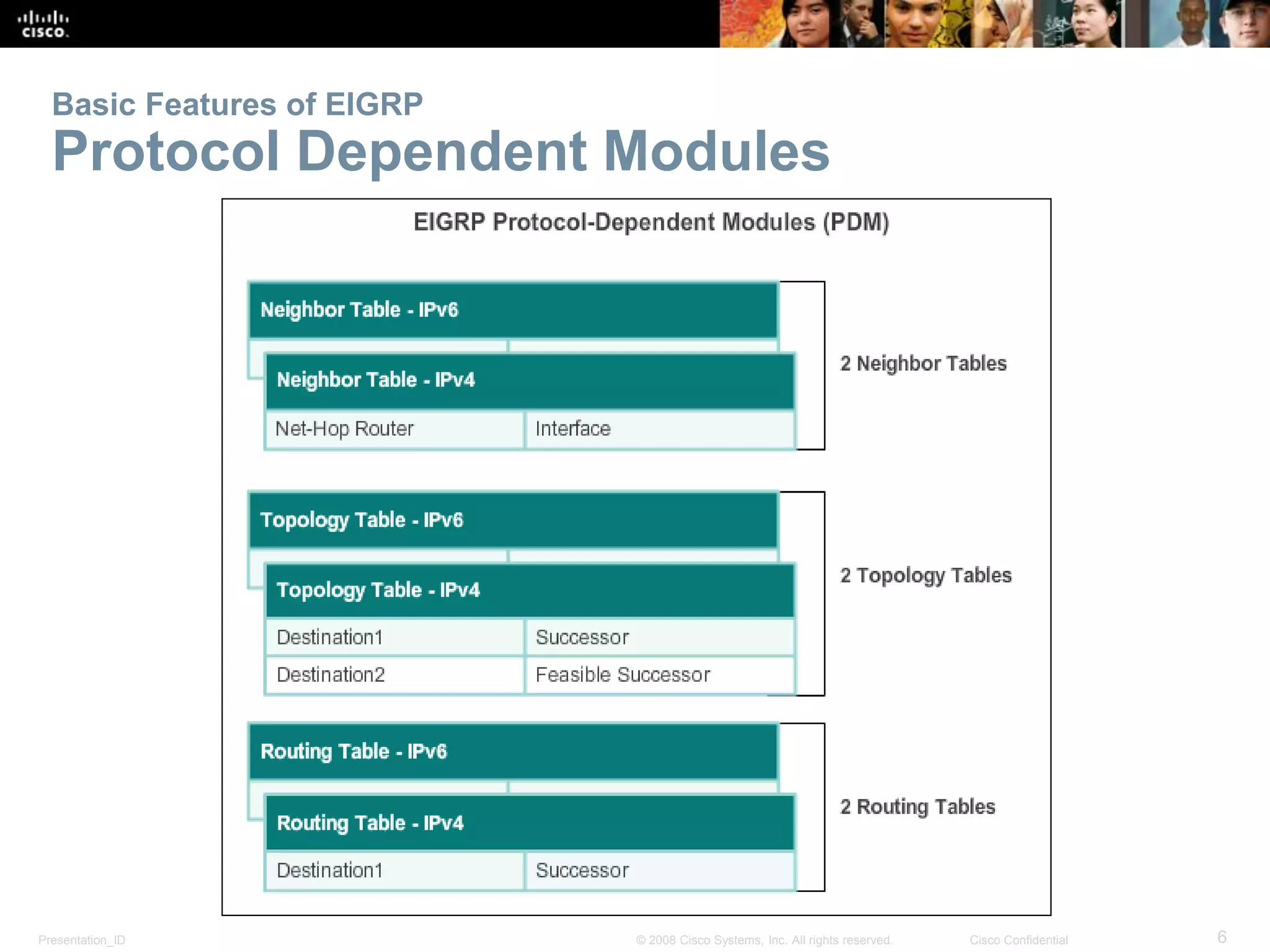
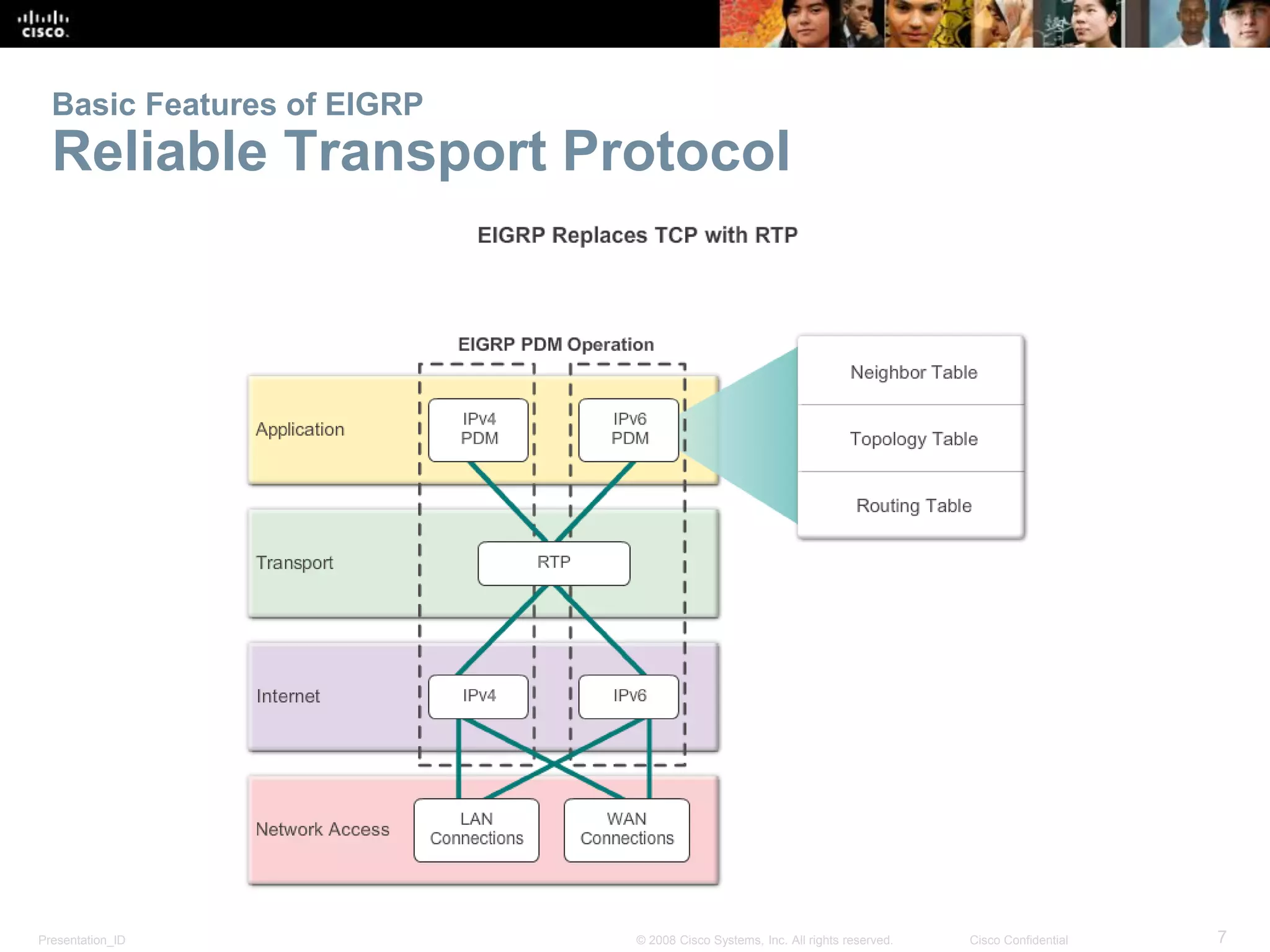
Protocol Dependent Modules
Presentation_ID 7© 2008 Cisco Systems, Inc. All rights reserved. Cisco Confidential
Basic Features of EIGRP
Reliable Transport Protocol
Presentation_ID 8© 2008 Cisco Systems, Inc. All rights reserved. Cisco Confidential
Basic Features of EIGRP
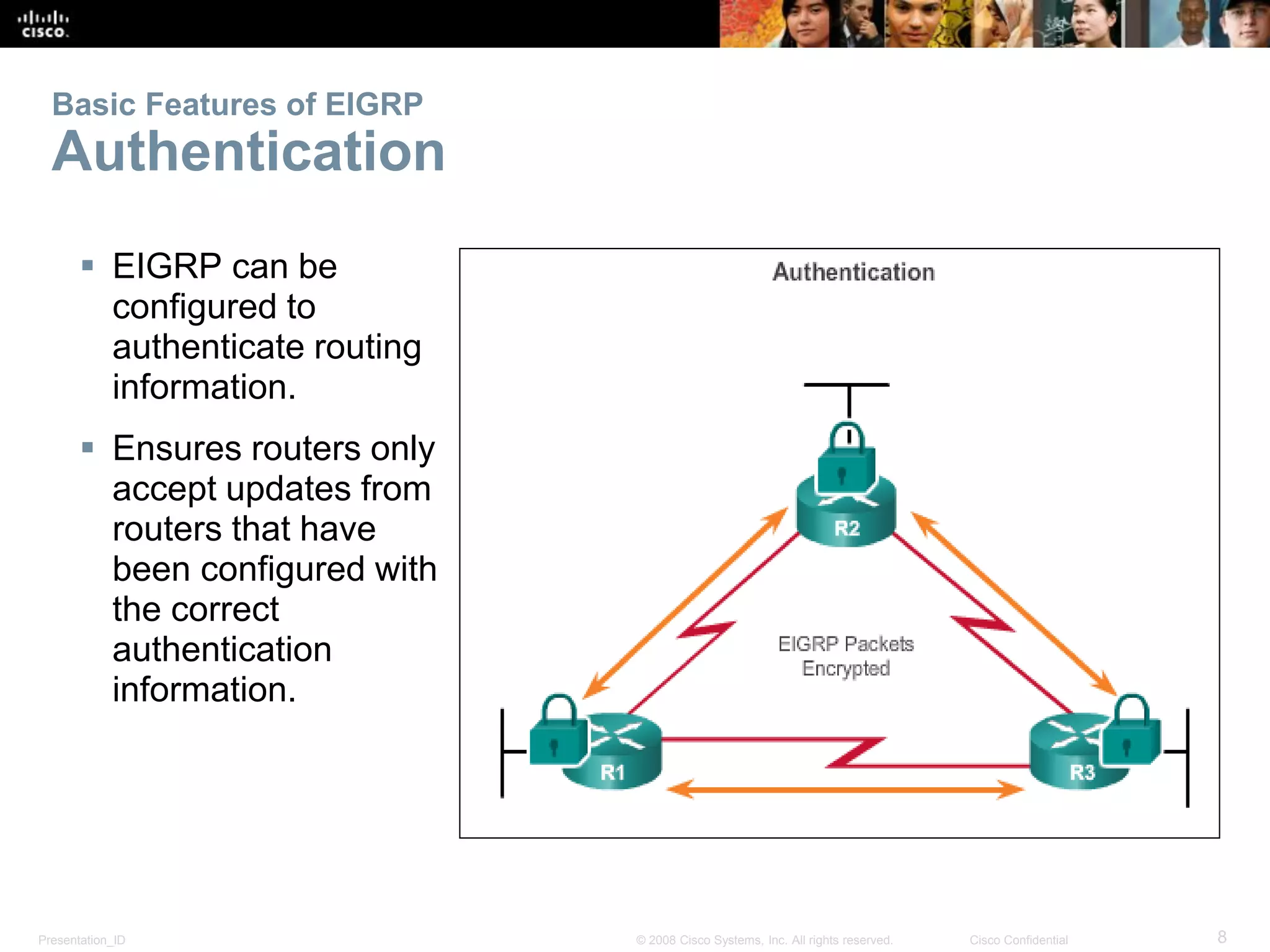
Authentication
 EIGRP can be
configured to
authenticate routing
information.
 Ensures routers only
accept updates from
routers that have
been configured with
the correct
authentication
information.
Presentation_ID 9© 2008 Cisco Systems, Inc. All rights reserved. Cisco Confidential
Types of EIGRP Packets
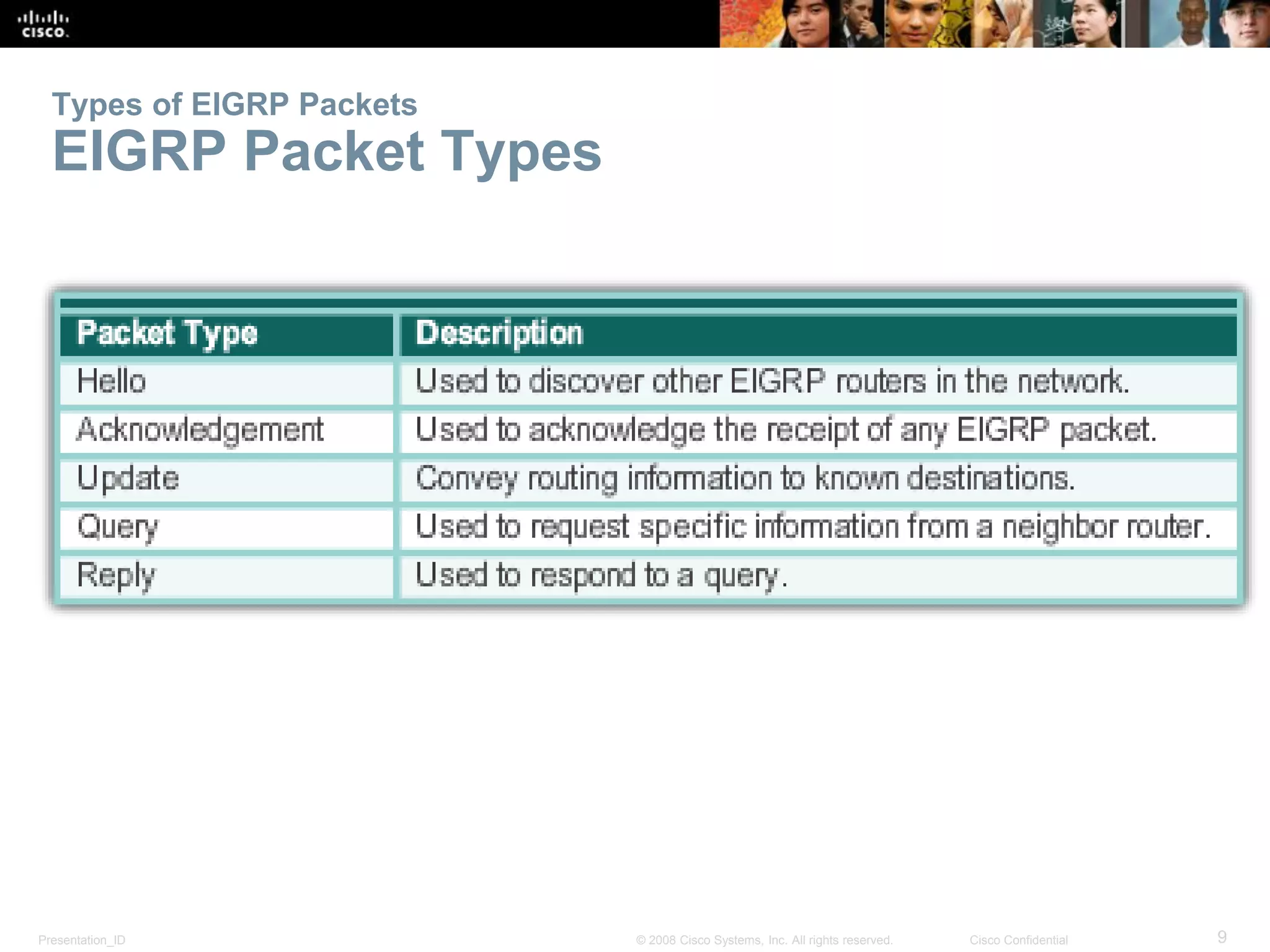
EIGRP Packet Types
Presentation_ID 10© 2008 Cisco Systems, Inc. All rights reserved. Cisco Confidential
Types of EIGRP Packets
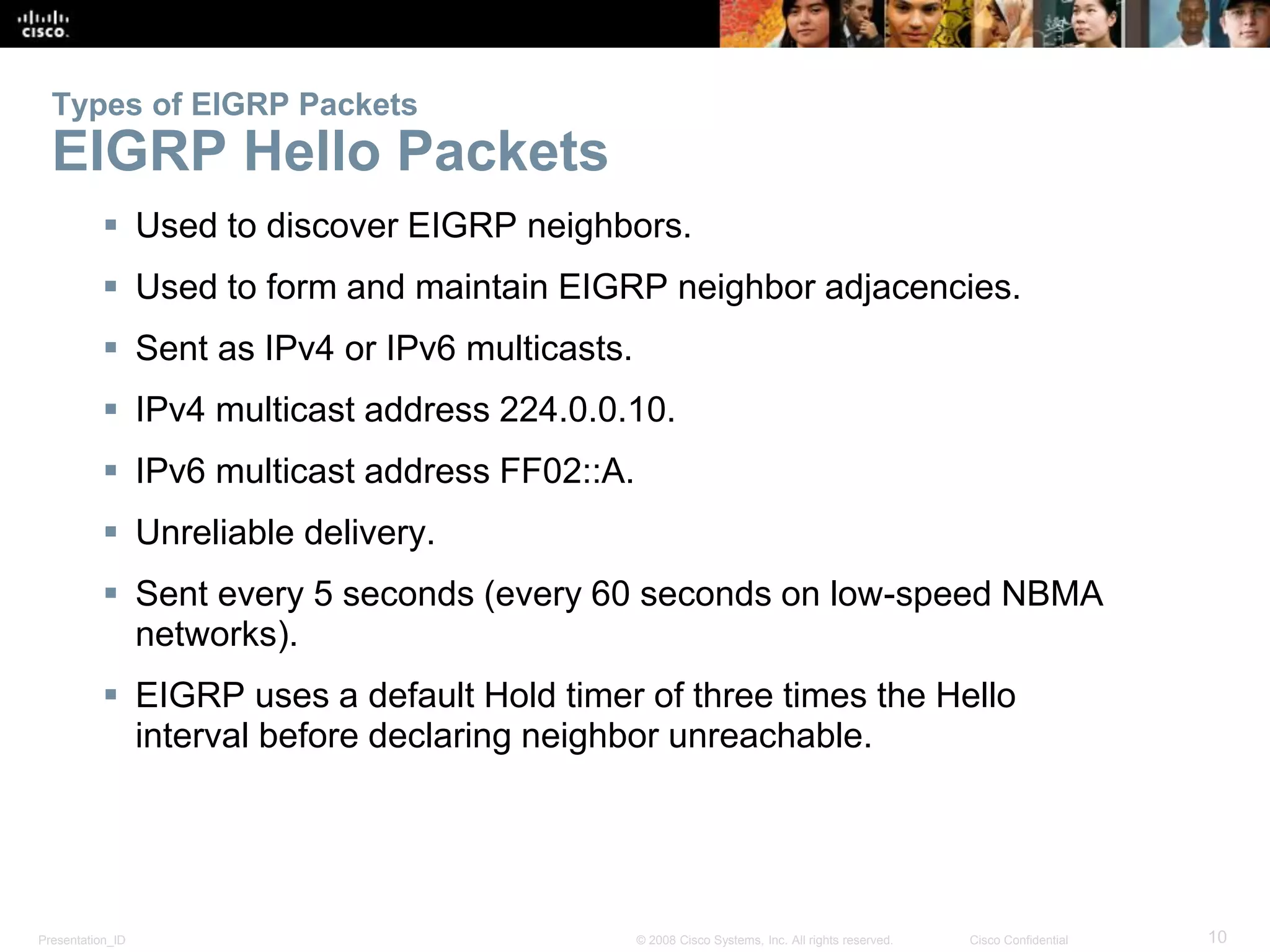
EIGRP Hello Packets
 Used to discover EIGRP neighbors.
 Used to form and maintain EIGRP neighbor adjacencies.
 Sent as IPv4 or IPv6 multicasts.
 IPv4 multicast address 224.0.0.10.
 IPv6 multicast address FF02::A.
 Unreliable delivery.
 Sent every 5 seconds (every 60 seconds on low-speed NBMA
networks).
 EIGRP uses a default Hold timer of three times the Hello
interval before declaring neighbor unreachable.
Presentation_ID 11© 2008 Cisco Systems, Inc. All rights reserved. Cisco Confidential
Types of EIGRP Packets
EIGRP Update & Acknowledgement Packets
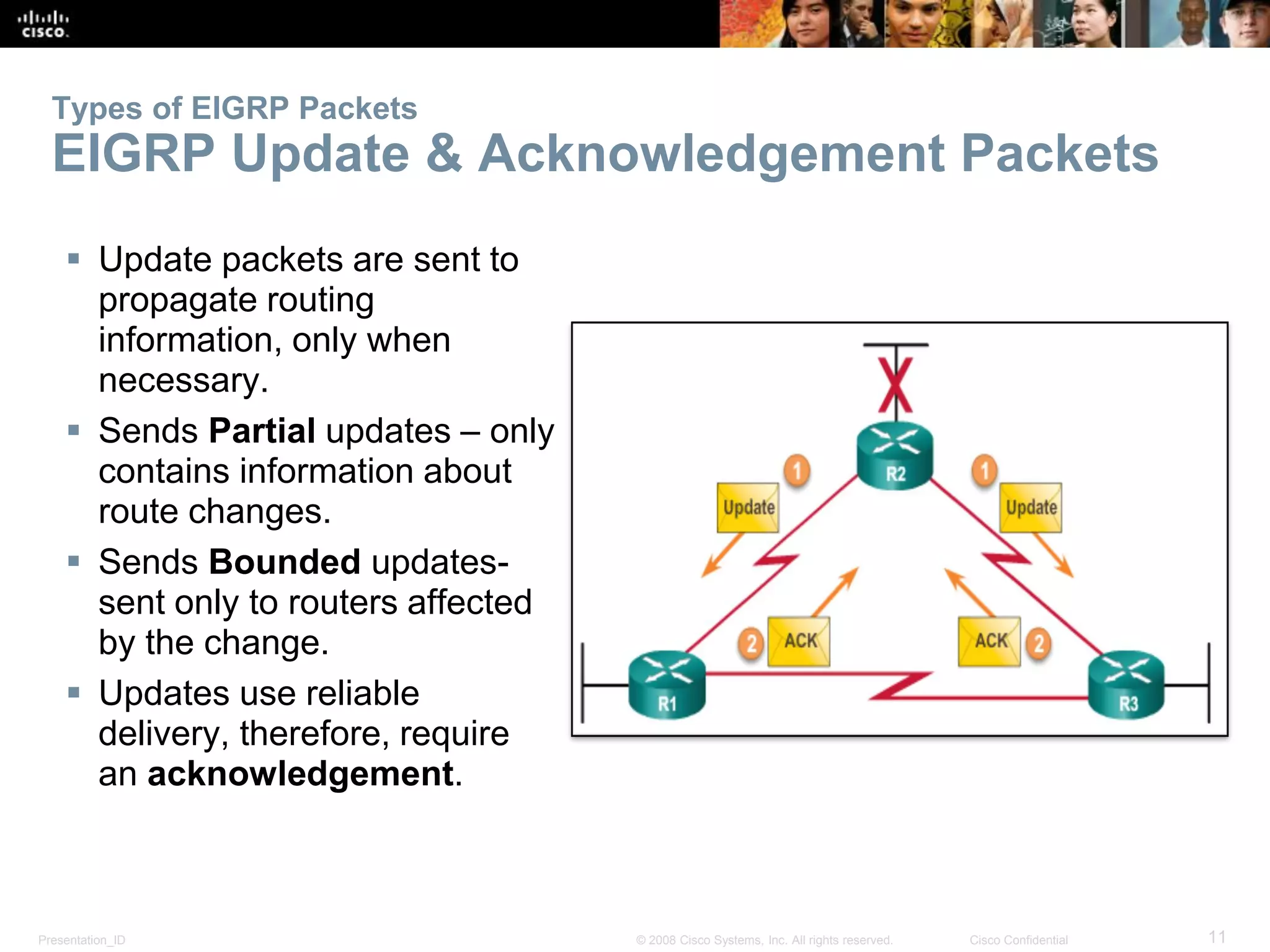
 Update packets are sent to
propagate routing
information, only when
necessary.
 Sends Partial updates – only
contains information about
route changes.
 Sends Bounded updates-
sent only to routers affected
by the change.
 Updates use reliable
delivery, therefore, require
an acknowledgement.
Presentation_ID 12© 2008 Cisco Systems, Inc. All rights reserved. Cisco Confidential
Types of EIGRP Packets
EIGRP Query and Reply Packets
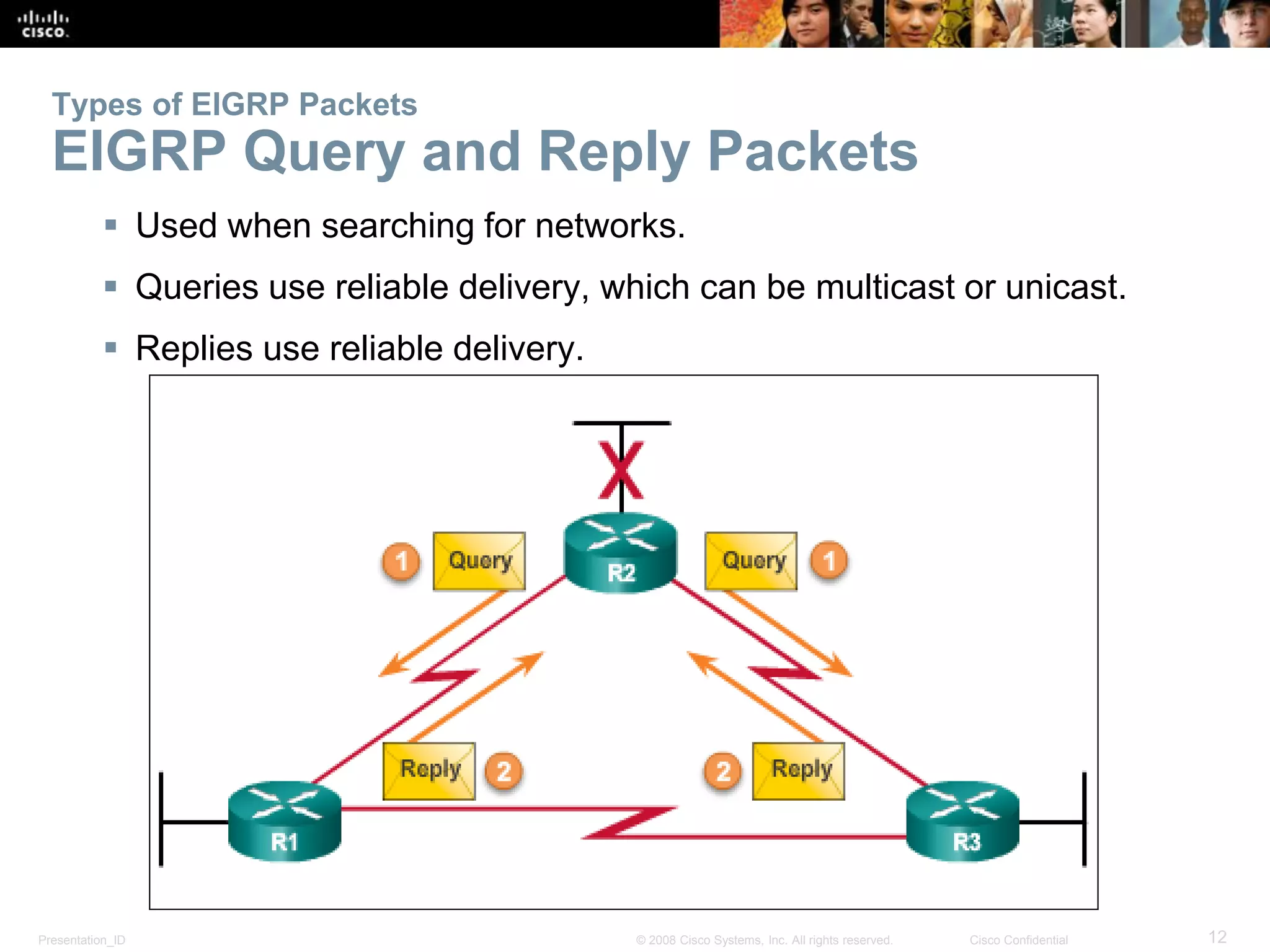
 Used when searching for networks.
 Queries use reliable delivery, which can be multicast or unicast.
 Replies use reliable delivery.
Presentation_ID 13© 2008 Cisco Systems, Inc. All rights reserved. Cisco Confidential
EIGRP Messages
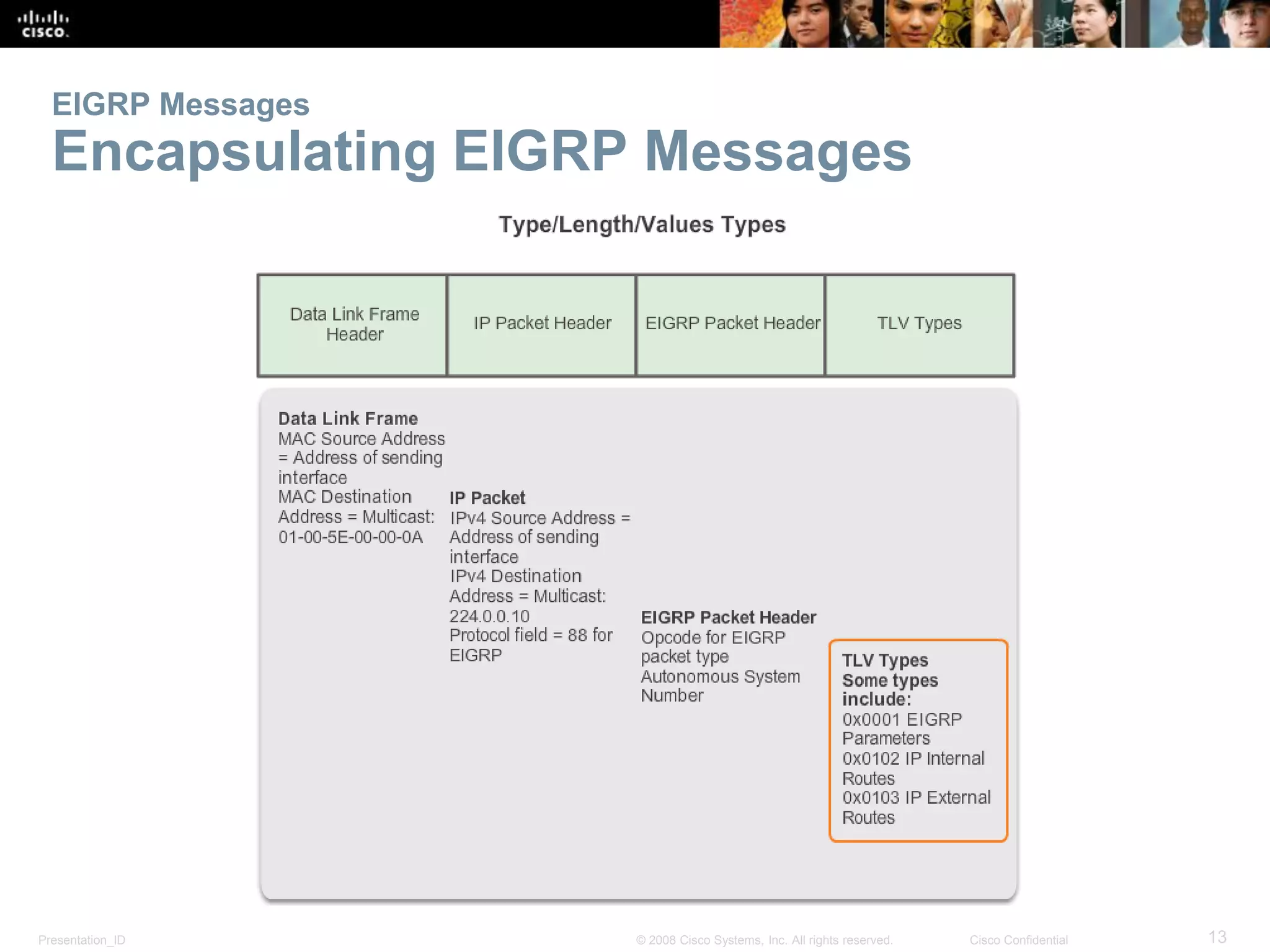
Encapsulating EIGRP Messages
Presentation_ID 14© 2008 Cisco Systems, Inc. All rights reserved. Cisco Confidential
EIGRP Messages
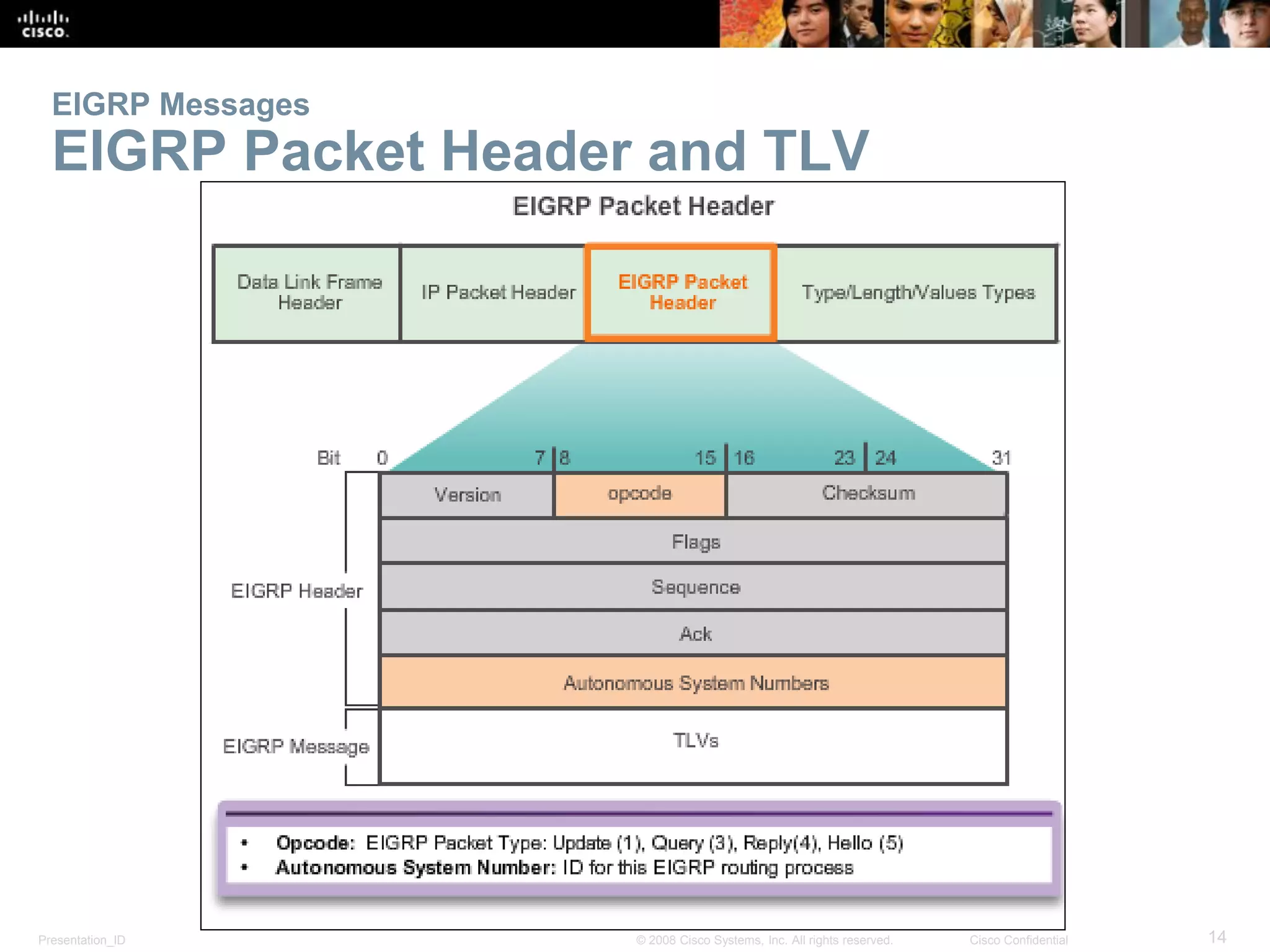
EIGRP Packet Header and TLV
© 2008 Cisco Systems, Inc. All rights reserved. Cisco ConfidentialPresentation_ID 15
7.2 Configuring EIGRP for IPv4
Presentation_ID 16© 2008 Cisco Systems, Inc. All rights reserved. Cisco Confidential
Configuring EIGRP with IPv4
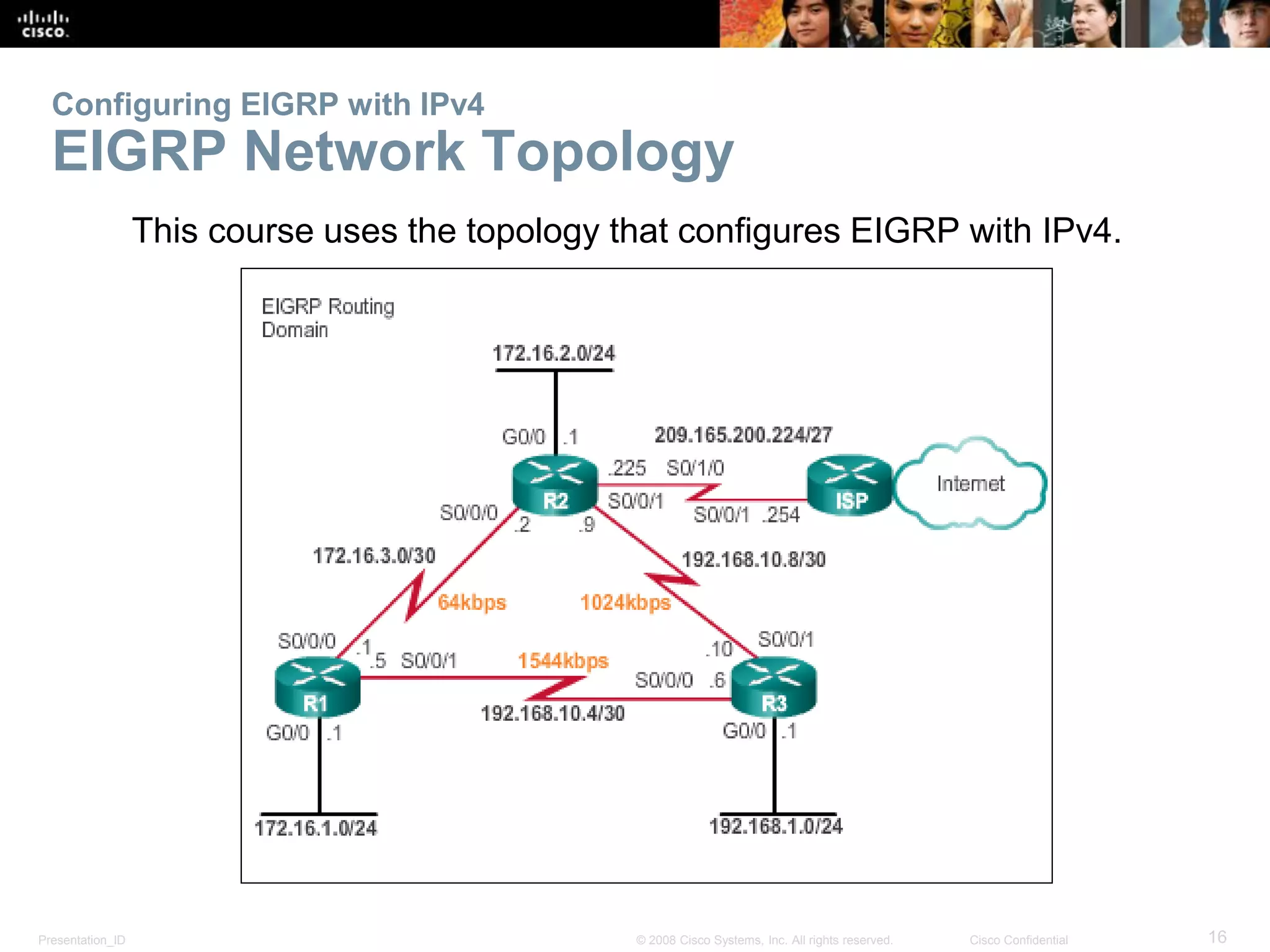
EIGRP Network Topology
This course uses the topology that configures EIGRP with IPv4.
Presentation_ID 17© 2008 Cisco Systems, Inc. All rights reserved. Cisco Confidential
Configuring EIGRP with IPv4
Autonomous System Numbers
 The router eigrp autonomous-system command enables
the EIGRP process.
 The autonomous system number is only significant to the EIGRP
routing domain.
 The EIGRP autonomous system number is not associated with the
Internet Assigned Numbers Authority (IANA) globally assigned
autonomous system numbers used by external routing protocols.
 Internet Service Providers (ISPs) require an autonomous system
number from IANA.
 ISPs often use the Border Gateway Protocol (BGP), which does
use the IANA autonomous system number in its configuration.
Presentation_ID 18© 2008 Cisco Systems, Inc. All rights reserved. Cisco Confidential
Configuring EIGRP with IPv4
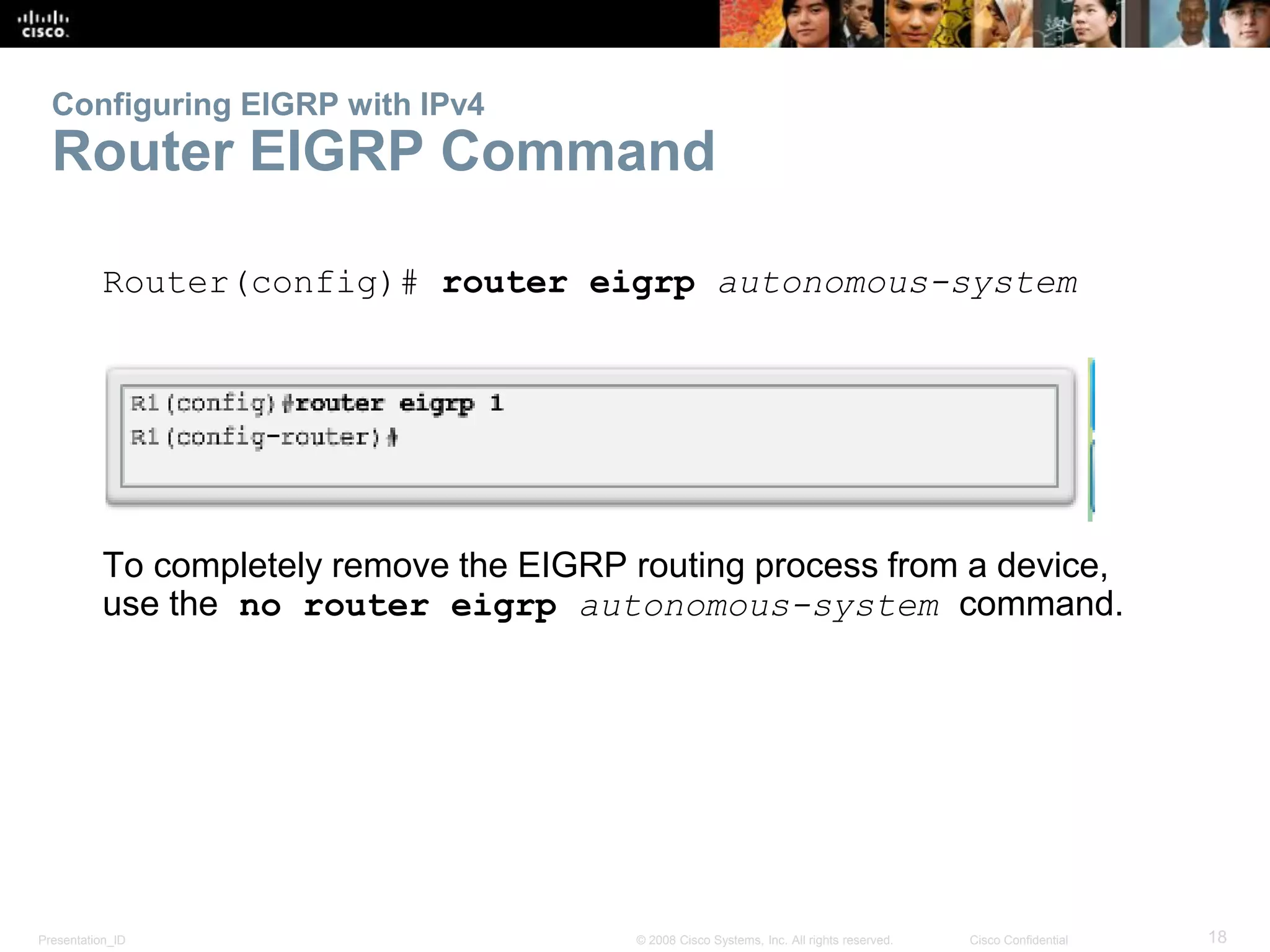
Router EIGRP Command
Router(config)# router eigrp autonomous-system
To completely remove the EIGRP routing process from a device,
use the no router eigrp autonomous-system command.
Presentation_ID 19© 2008 Cisco Systems, Inc. All rights reserved. Cisco Confidential
Configuring EIGRP with IPv4
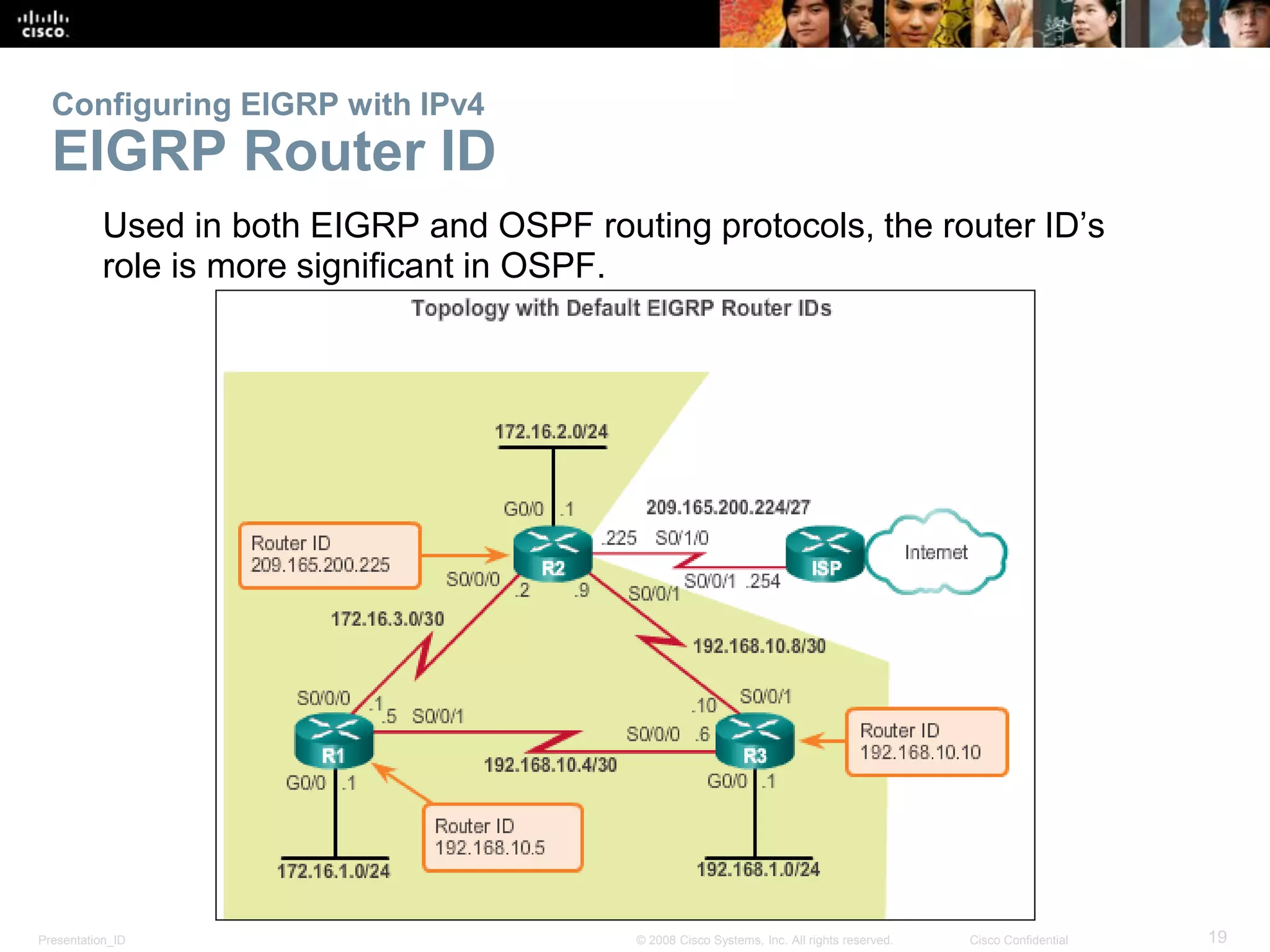
EIGRP Router ID
Used in both EIGRP and OSPF routing protocols, the router ID’s
role is more significant in OSPF.
Presentation_ID 20© 2008 Cisco Systems, Inc. All rights reserved. Cisco Confidential
Configuring EIGRP with IPv4
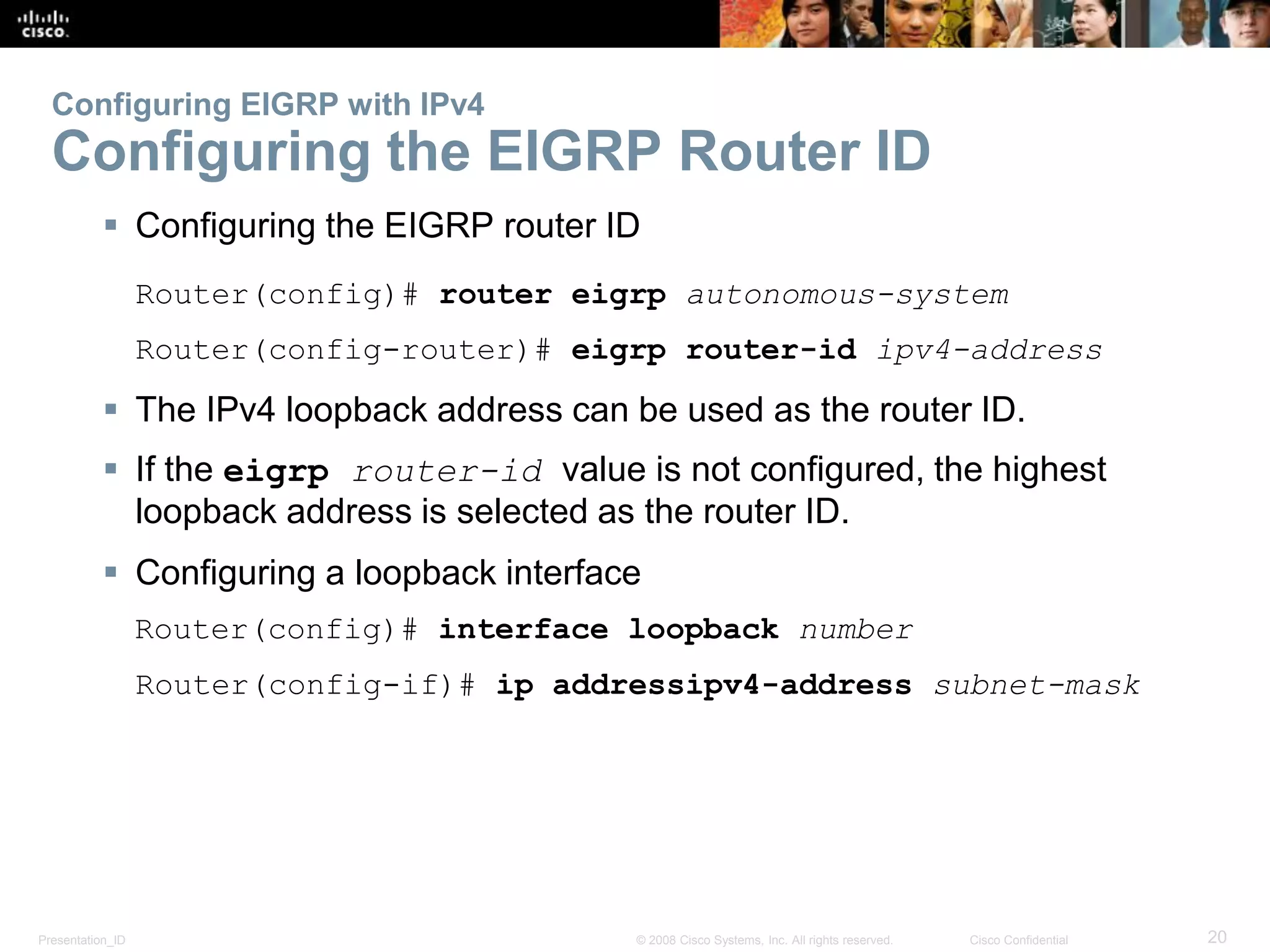
Configuring the EIGRP Router ID
 Configuring the EIGRP router ID
Router(config)# router eigrp autonomous-system
Router(config-router)# eigrp router-id ipv4-address
 The IPv4 loopback address can be used as the router ID.
 If the eigrp router-id value is not configured, the highest
loopback address is selected as the router ID.
 Configuring a loopback interface
Router(config)# interface loopback number
Router(config-if)# ip addressipv4-address subnet-mask
Presentation_ID 21© 2008 Cisco Systems, Inc. All rights reserved. Cisco Confidential
Configuring EIGRP with IPv4
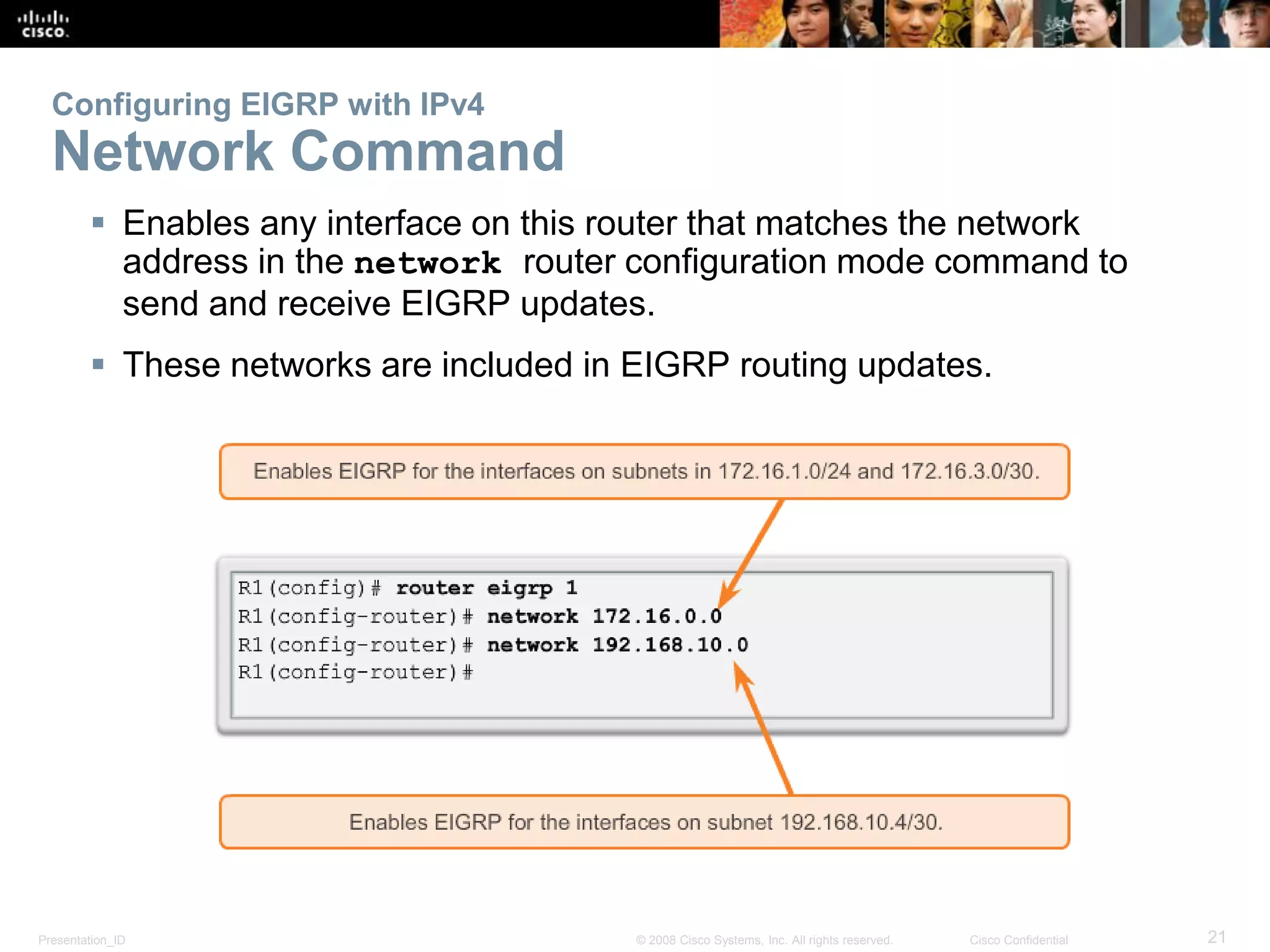
Network Command
 Enables any interface on this router that matches the network
address in the network router configuration mode command to
send and receive EIGRP updates.
 These networks are included in EIGRP routing updates.
Presentation_ID 22© 2008 Cisco Systems, Inc. All rights reserved. Cisco Confidential
Configuring EIGRP with IPv4
Network Command
The eigrp log-neighbor-changes router configuration mode
• On by default
• Displays changes in neighbor adjacencies
• Verifies neighbor adjacencies during configuration
• Indicates when any adjacencies have been removed
Presentation_ID 23© 2008 Cisco Systems, Inc. All rights reserved. Cisco Confidential
Configuring EIGRP with IPv4
The Network Command and Wildcard Mask
 To configure EIGRP to advertise specific subnets only, use the
wildcard-mask option with the network command.
Router(config-router)# network network
address [wildcard-mask]
 The wildcard mask is the inverse of the subnet mask.
 To calculate the wildcard mask, subtract the subnet mask from
255.255.255.255:
255.255.255.255
-- 255.255.255.252
0. 0. 0. 3 wildcard mask
 Note: Some IOS versions also let you enter the subnet mask
instead of a wildcard mask.
Presentation_ID 24© 2008 Cisco Systems, Inc. All rights reserved. Cisco Confidential
Configuring EIGRP with IPv4
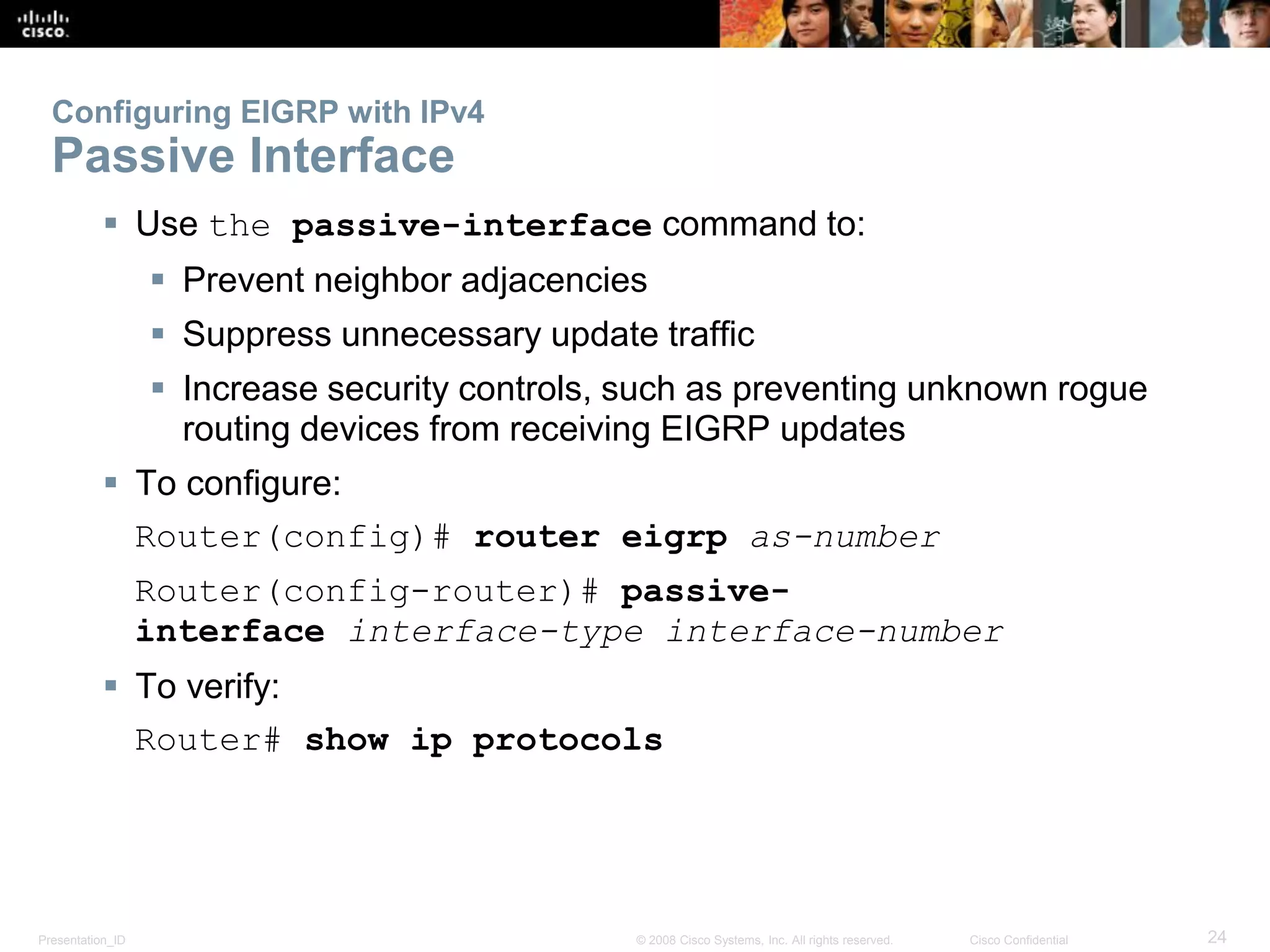
Passive Interface
 Use the passive-interface command to:
 Prevent neighbor adjacencies
 Suppress unnecessary update traffic
 Increase security controls, such as preventing unknown rogue
routing devices from receiving EIGRP updates
 To configure:
Router(config)# router eigrp as-number
Router(config-router)# passive-
interface interface-type interface-number
 To verify:
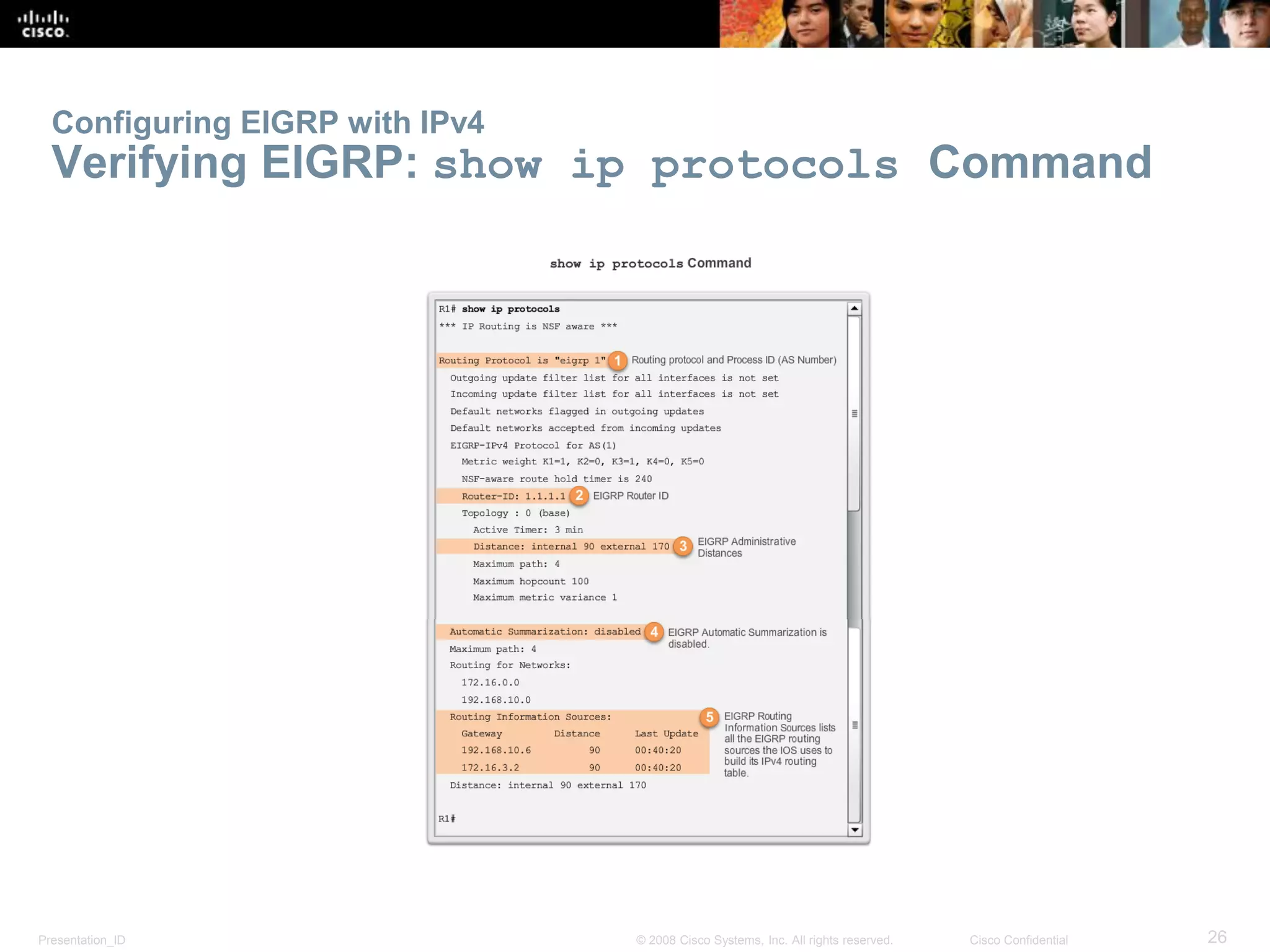
Router# show ip protocols
Presentation_ID 25© 2008 Cisco Systems, Inc. All rights reserved. Cisco Confidential
Configuring EIGRP with IPv4
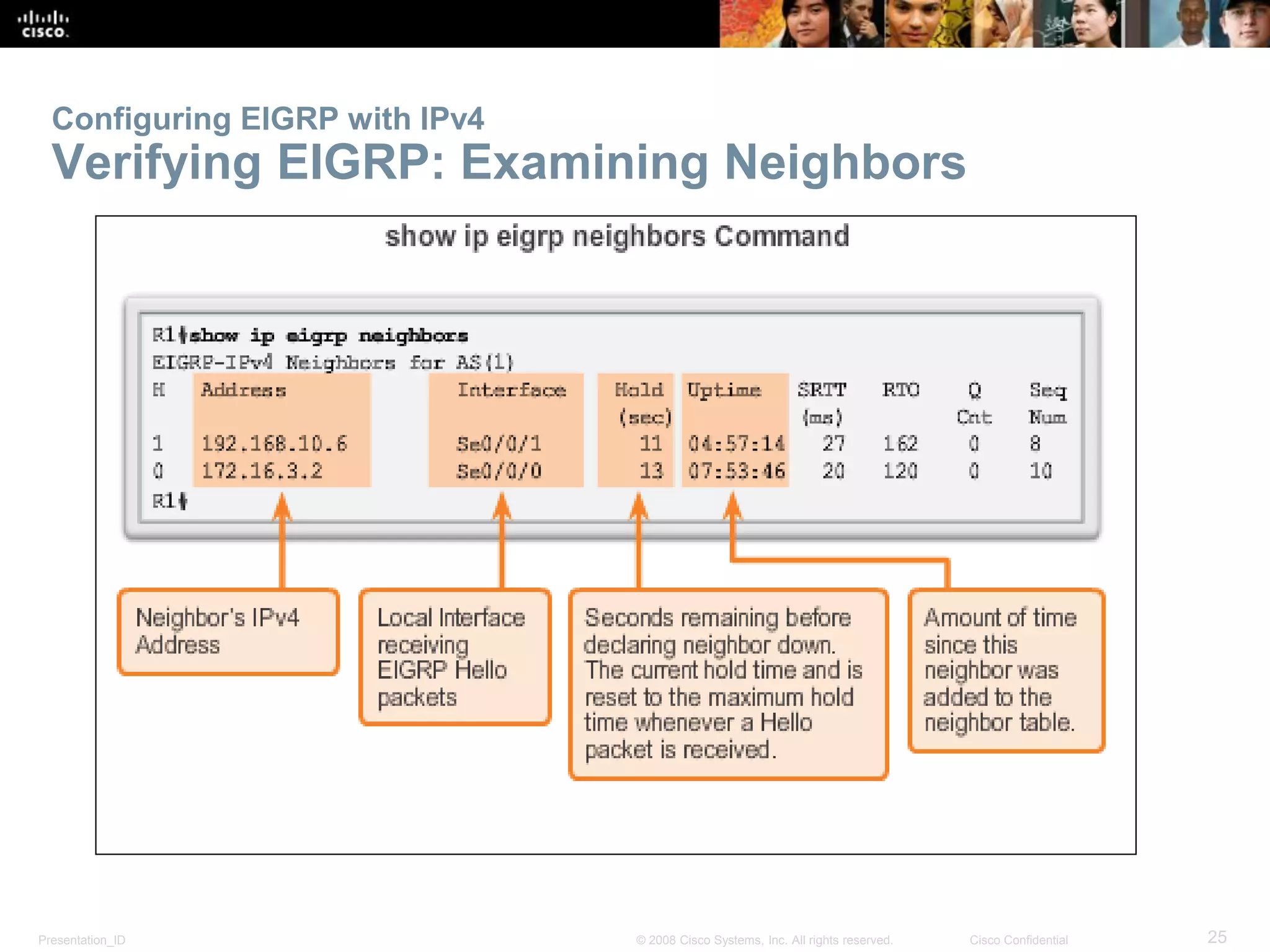
Verifying EIGRP: Examining Neighbors

Presentation_ID 26© 2008 Cisco Systems, Inc. All rights reserved. Cisco Confidential
Configuring EIGRP with IPv4
Verifying EIGRP: show ip protocols Command
Presentation_ID 27© 2008 Cisco Systems, Inc. All rights reserved. Cisco Confidential
Configuring EIGRP with IPv4
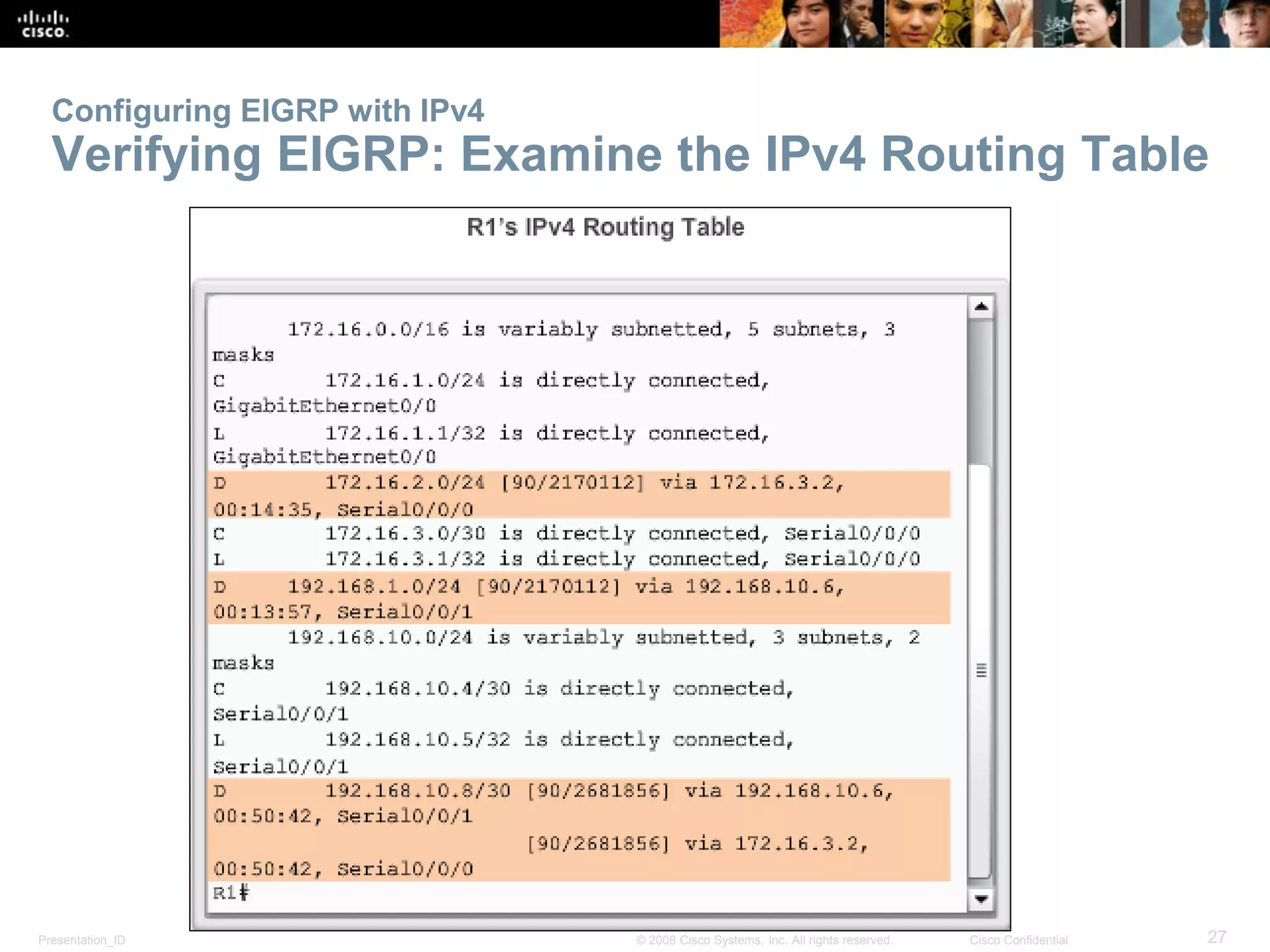
Verifying EIGRP: Examine the IPv4 Routing Table
© 2008 Cisco Systems, Inc. All rights reserved. Cisco ConfidentialPresentation_ID 28
7.3 Operation of EIGRP
Presentation_ID 29© 2008 Cisco Systems, Inc. All rights reserved. Cisco Confidential
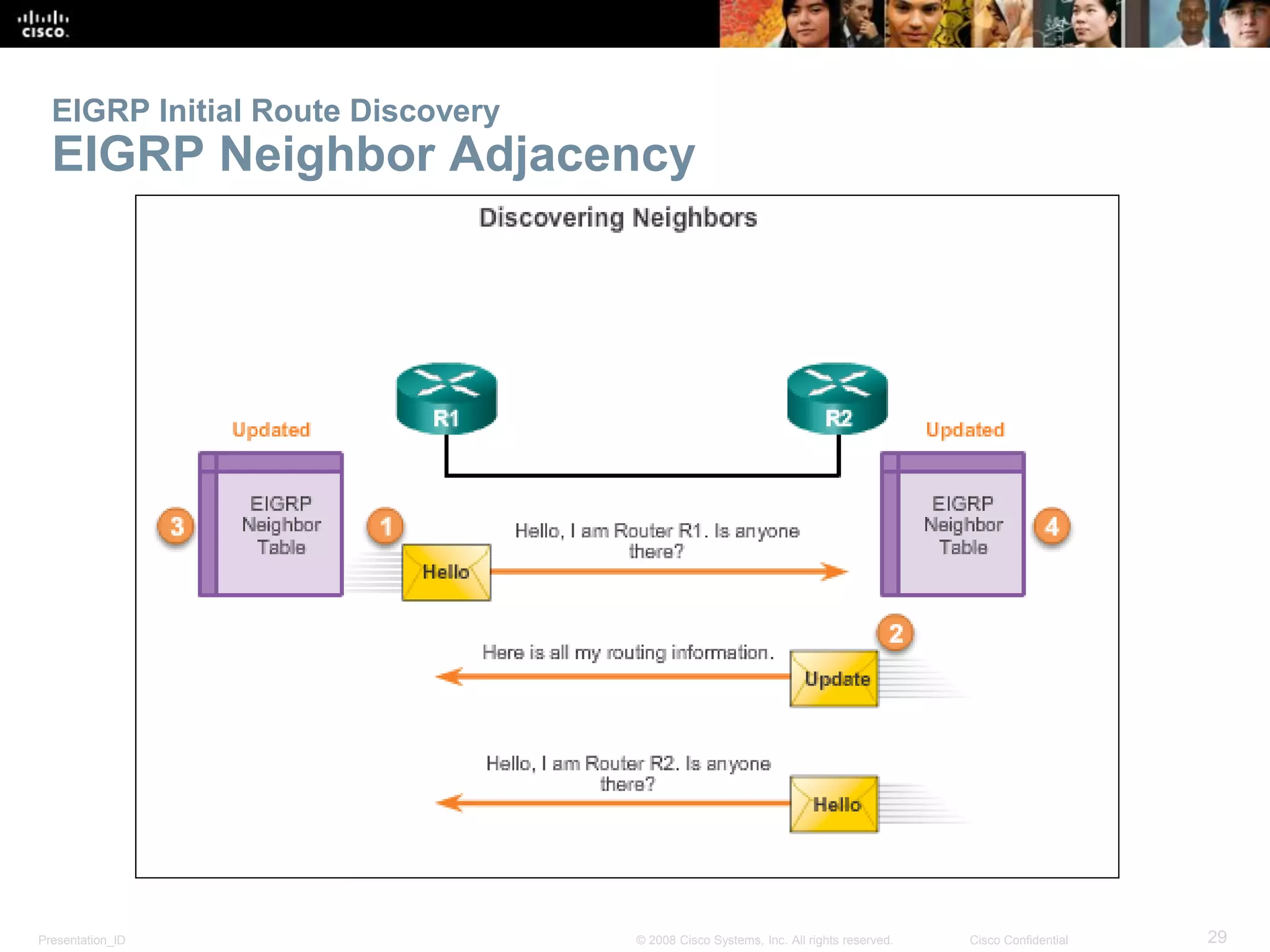
EIGRP Initial Route Discovery
EIGRP Neighbor Adjacency
Presentation_ID 30© 2008 Cisco Systems, Inc. All rights reserved. Cisco Confidential
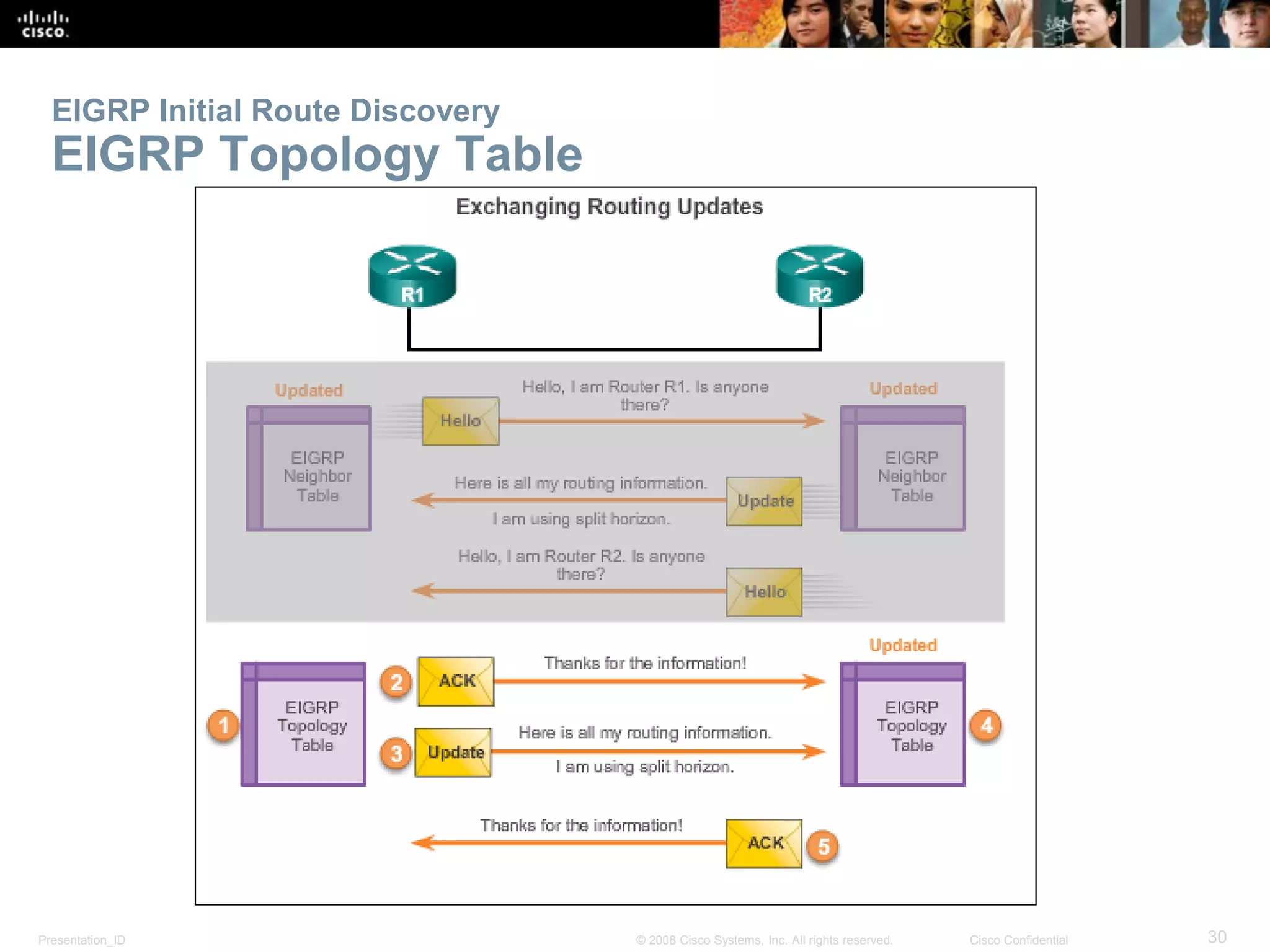
EIGRP Initial Route Discovery
EIGRP Topology Table
Presentation_ID 31© 2008 Cisco Systems, Inc. All rights reserved. Cisco Confidential
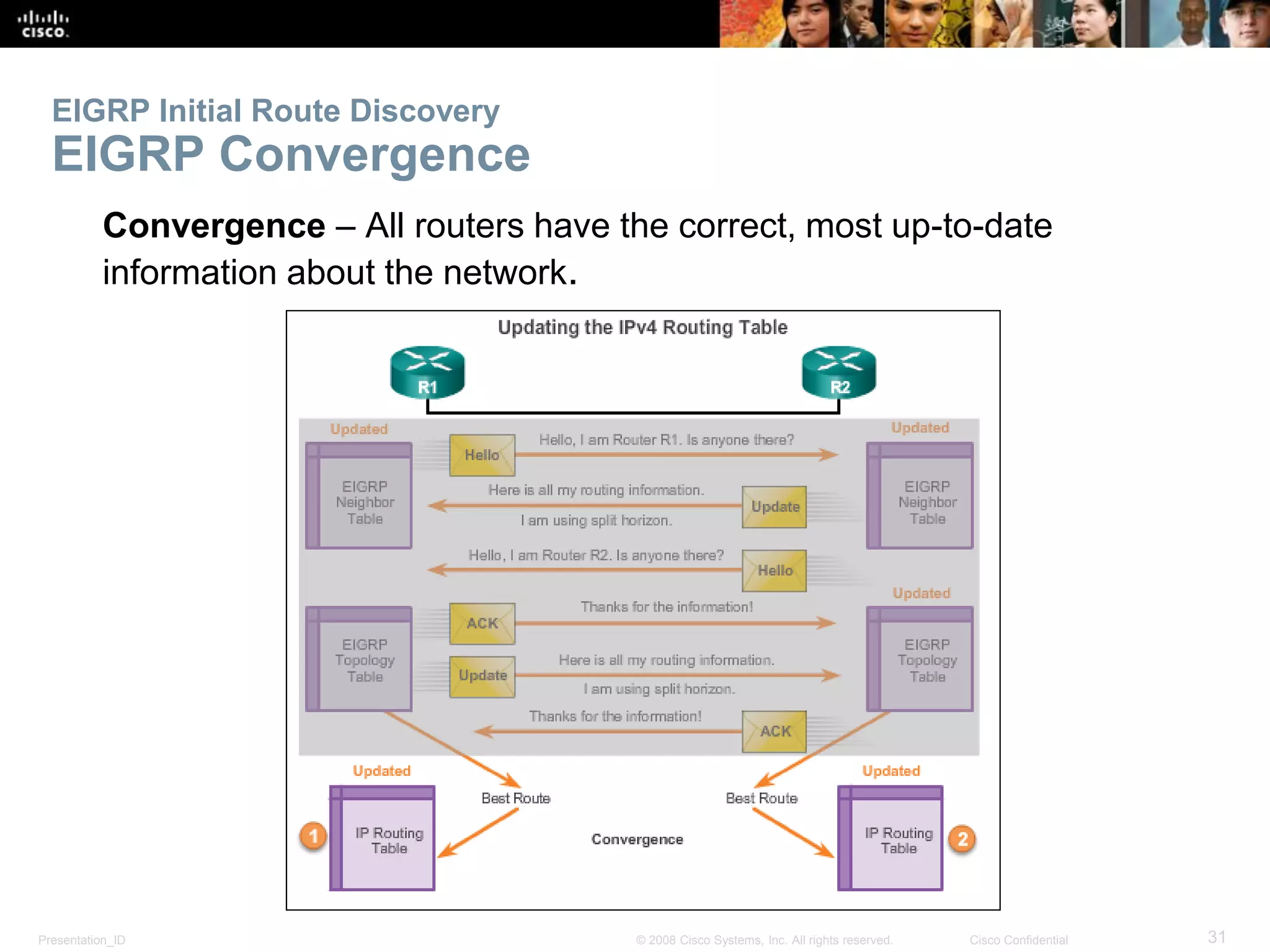
EIGRP Initial Route Discovery
EIGRP Convergence
Convergence – All routers have the correct, most up-to-date
information about the network.
Presentation_ID 32© 2008 Cisco Systems, Inc. All rights reserved. Cisco Confidential
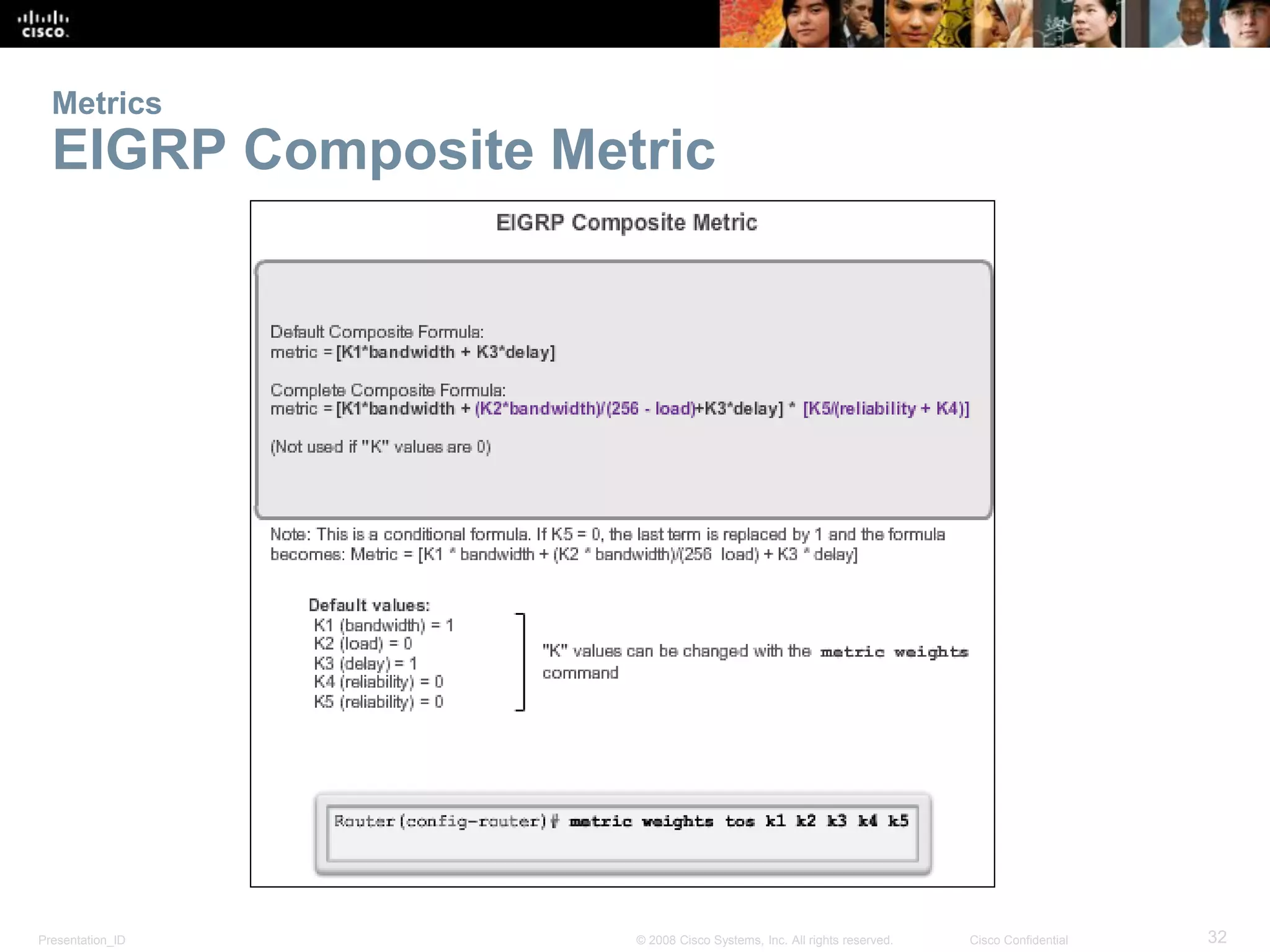
Metrics
EIGRP Composite Metric
Presentation_ID 33© 2008 Cisco Systems, Inc. All rights reserved. Cisco Confidential
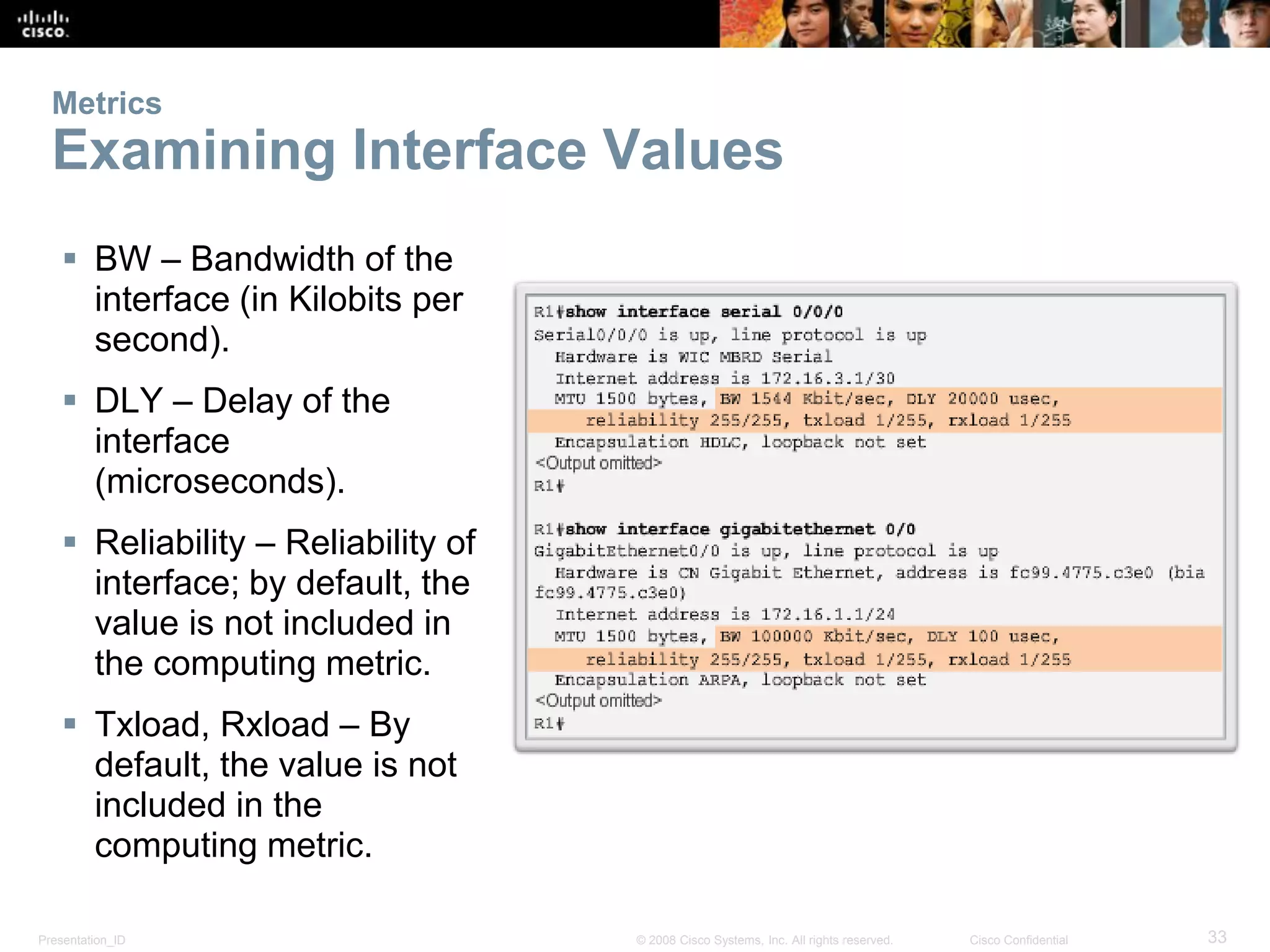
Metrics
Examining Interface Values
 BW – Bandwidth of the
interface (in Kilobits per
second).
 DLY – Delay of the
interface
(microseconds).
 Reliability – Reliability of
interface; by default, the
value is not included in
the computing metric.
 Txload, Rxload – By
default, the value is not
included in the
computing metric.
Presentation_ID 34© 2008 Cisco Systems, Inc. All rights reserved. Cisco Confidential
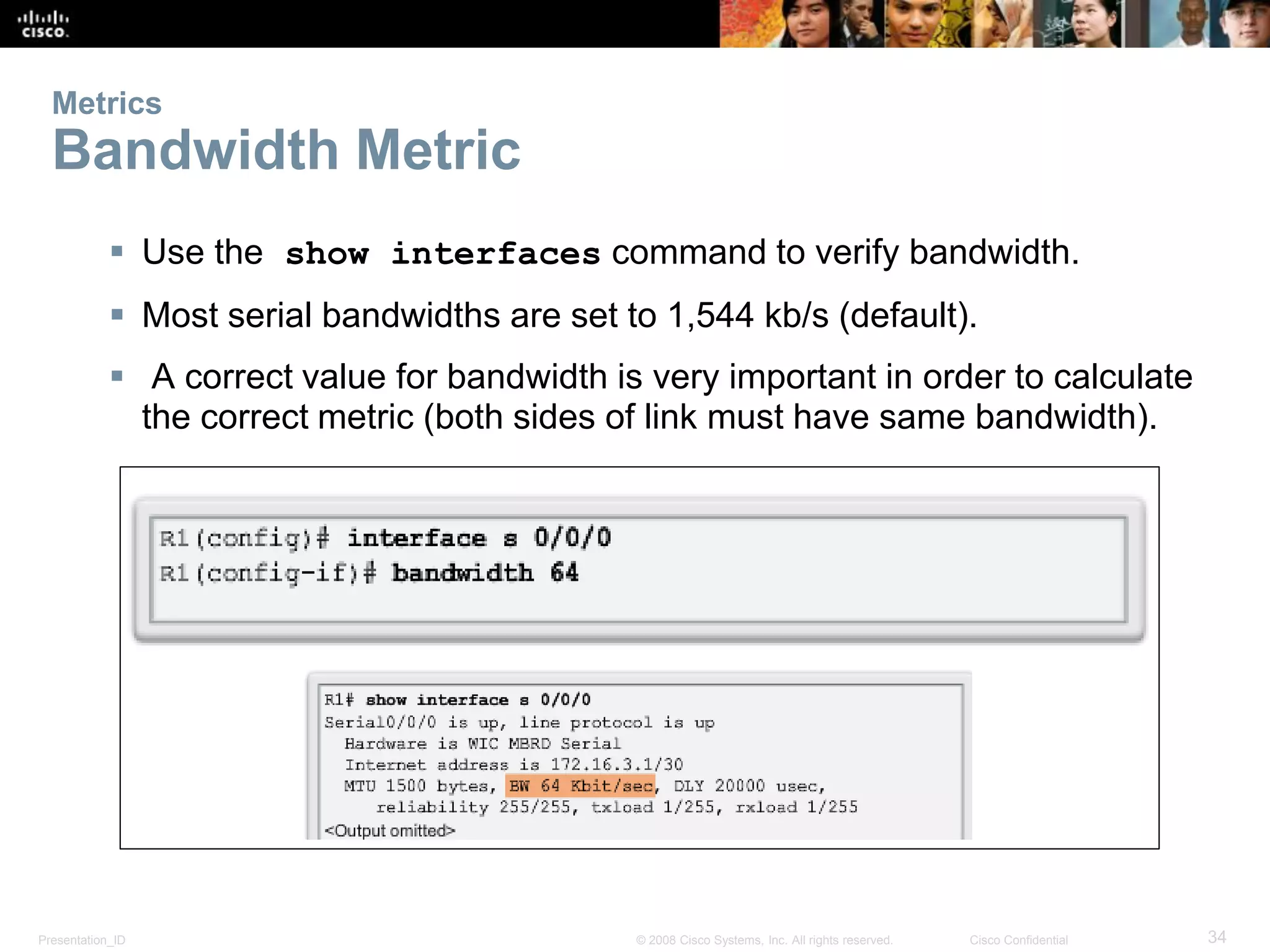
Metrics
Bandwidth Metric
 Use the show interfaces command to verify bandwidth.
 Most serial bandwidths are set to 1,544 kb/s (default).
 A correct value for bandwidth is very important in order to calculate
the correct metric (both sides of link must have same bandwidth).
Presentation_ID 35© 2008 Cisco Systems, Inc. All rights reserved. Cisco Confidential
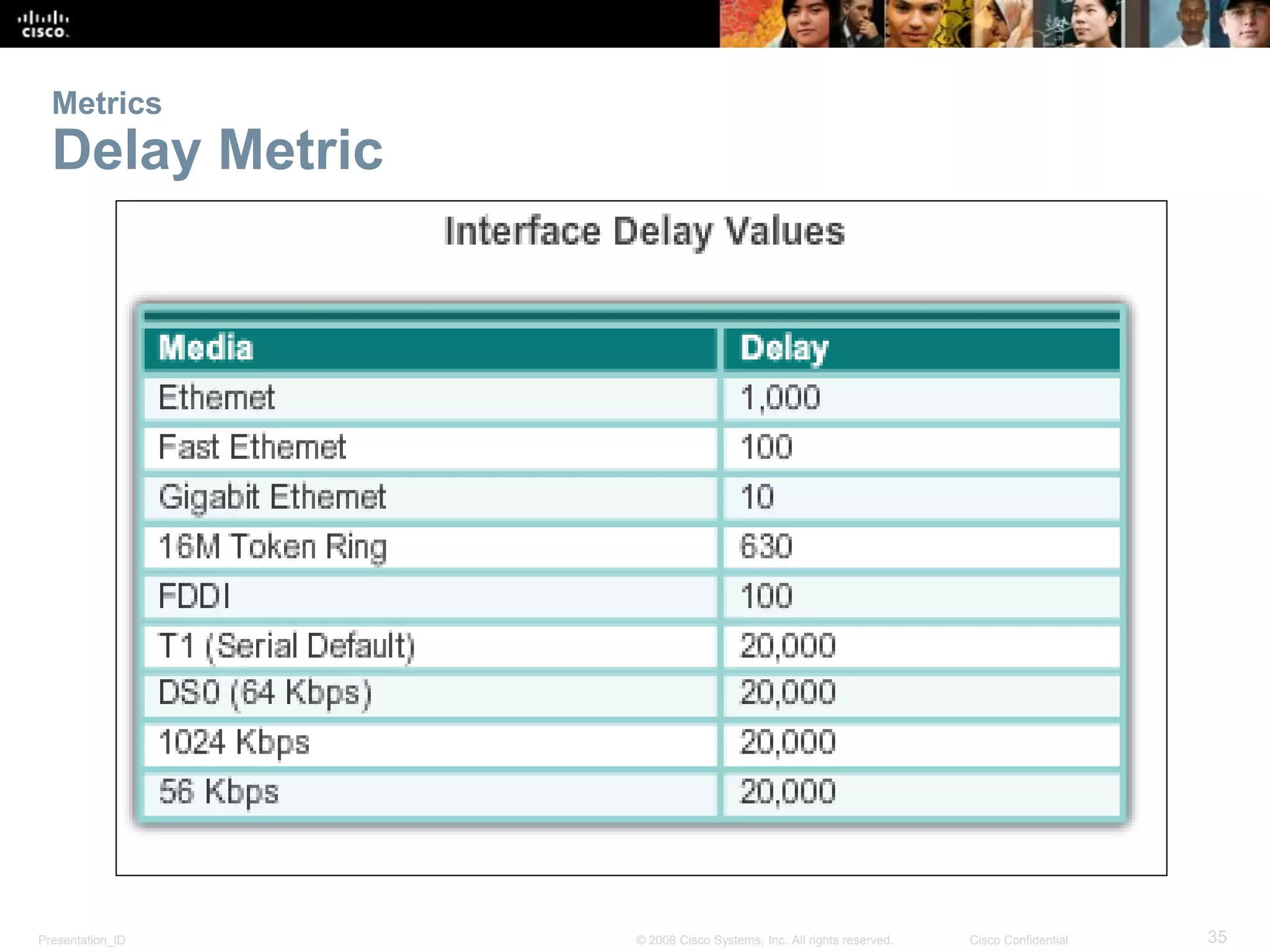
Metrics
Delay Metric
Presentation_ID 36© 2008 Cisco Systems, Inc. All rights reserved. Cisco Confidential
Metrics
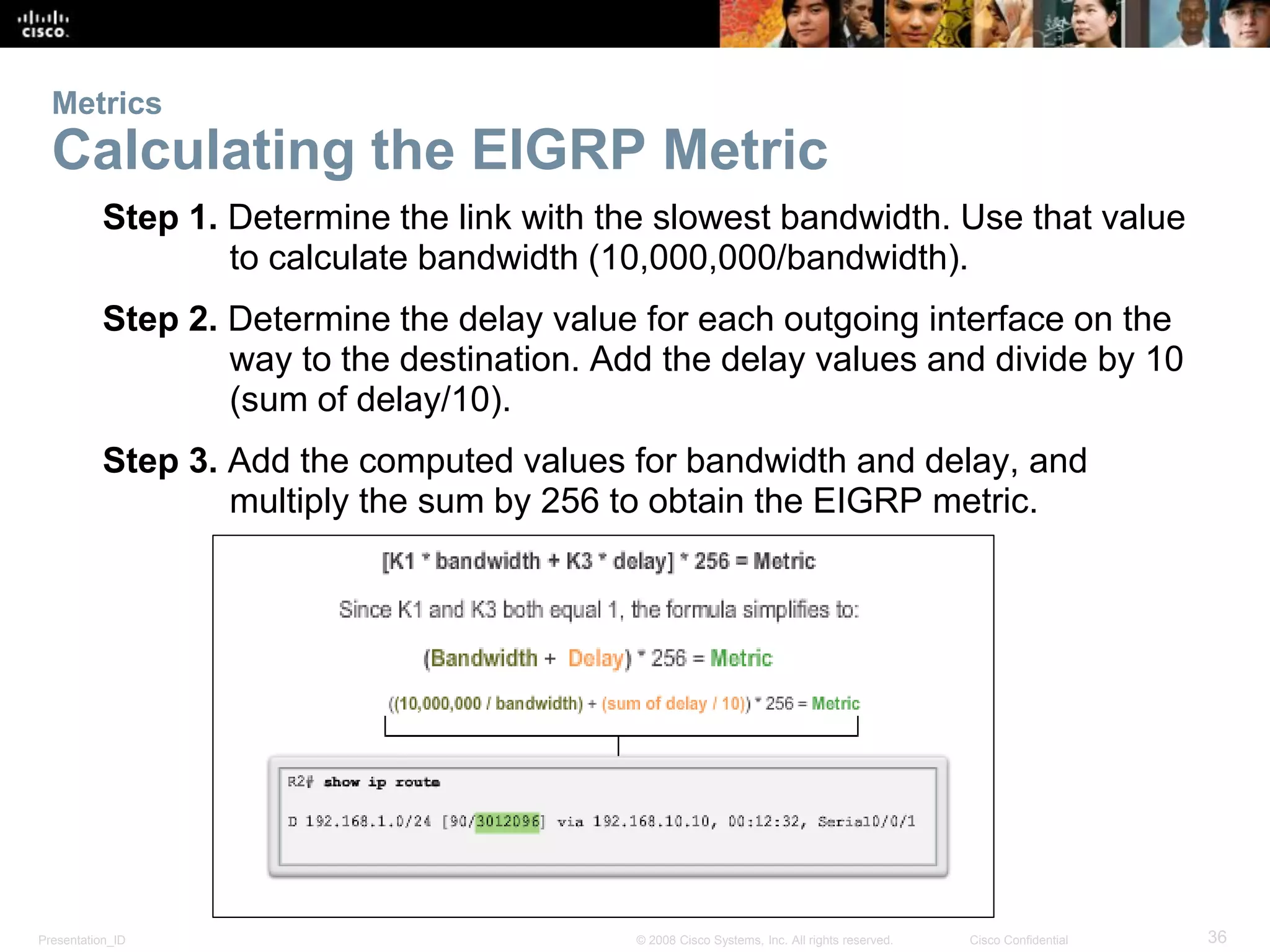
Calculating the EIGRP Metric
Step 1. Determine the link with the slowest bandwidth. Use that value
to calculate bandwidth (10,000,000/bandwidth).
Step 2. Determine the delay value for each outgoing interface on the
way to the destination. Add the delay values and divide by 10
(sum of delay/10).
Step 3. Add the computed values for bandwidth and delay, and
multiply the sum by 256 to obtain the EIGRP metric.
Presentation_ID 37© 2008 Cisco Systems, Inc. All rights reserved. Cisco Confidential
DUAL and the Topology Table
DUAL Concepts
 Diffusing Update ALgorithm (DUAL) provides the following:
 Loop-free paths and loop-free backup paths
 Fast convergence
 Minimum bandwidth usage with bounded updates
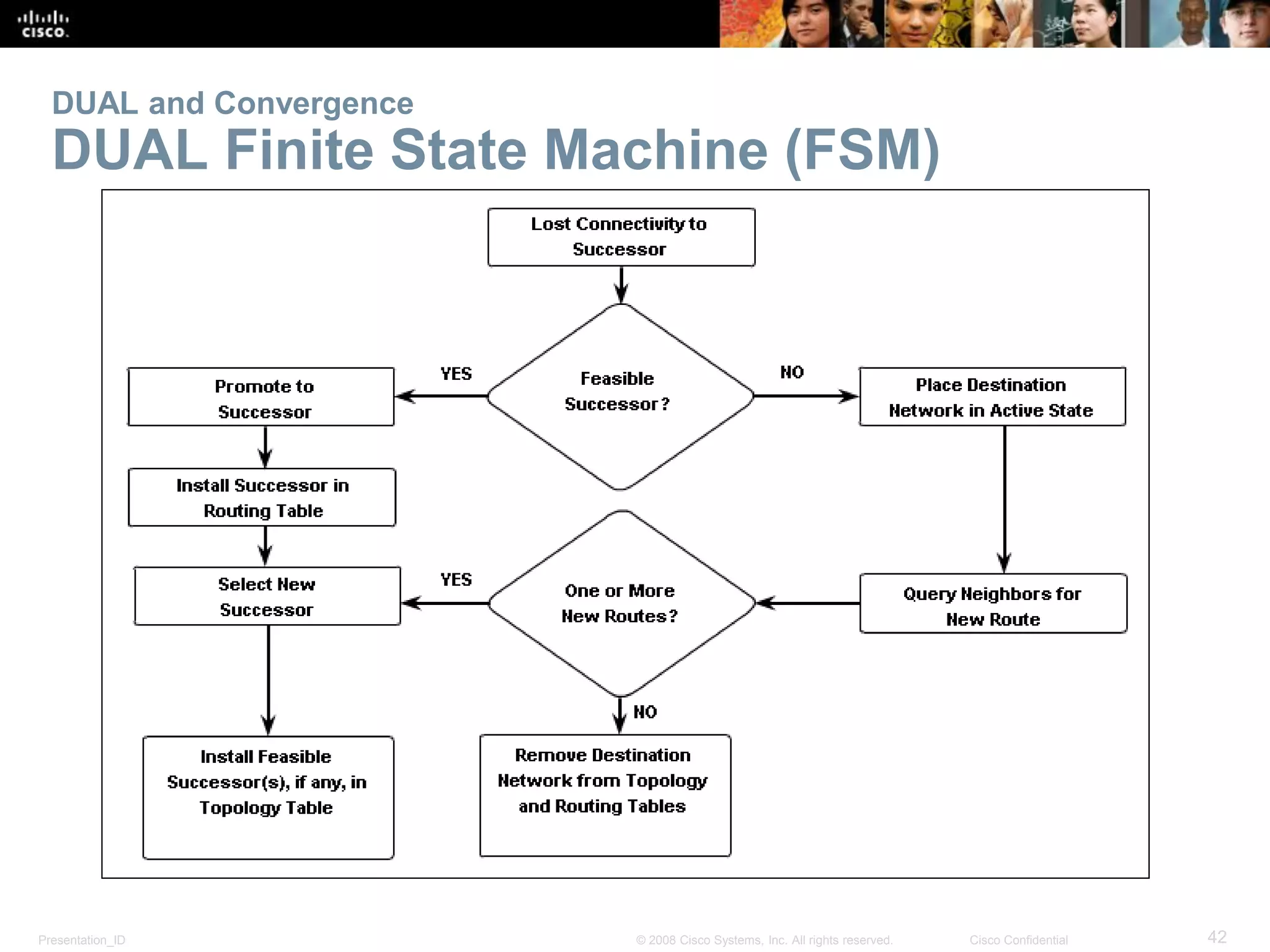
 The decision process for all route computations is done by the
DUAL Finite State Machine (FSM)
 DUAL FSM tracks all routes.
 Uses EIGRP metrics to select efficient, loop-free paths.
 Identifies the routes with the least-cost path to be inserted into
the routing table.
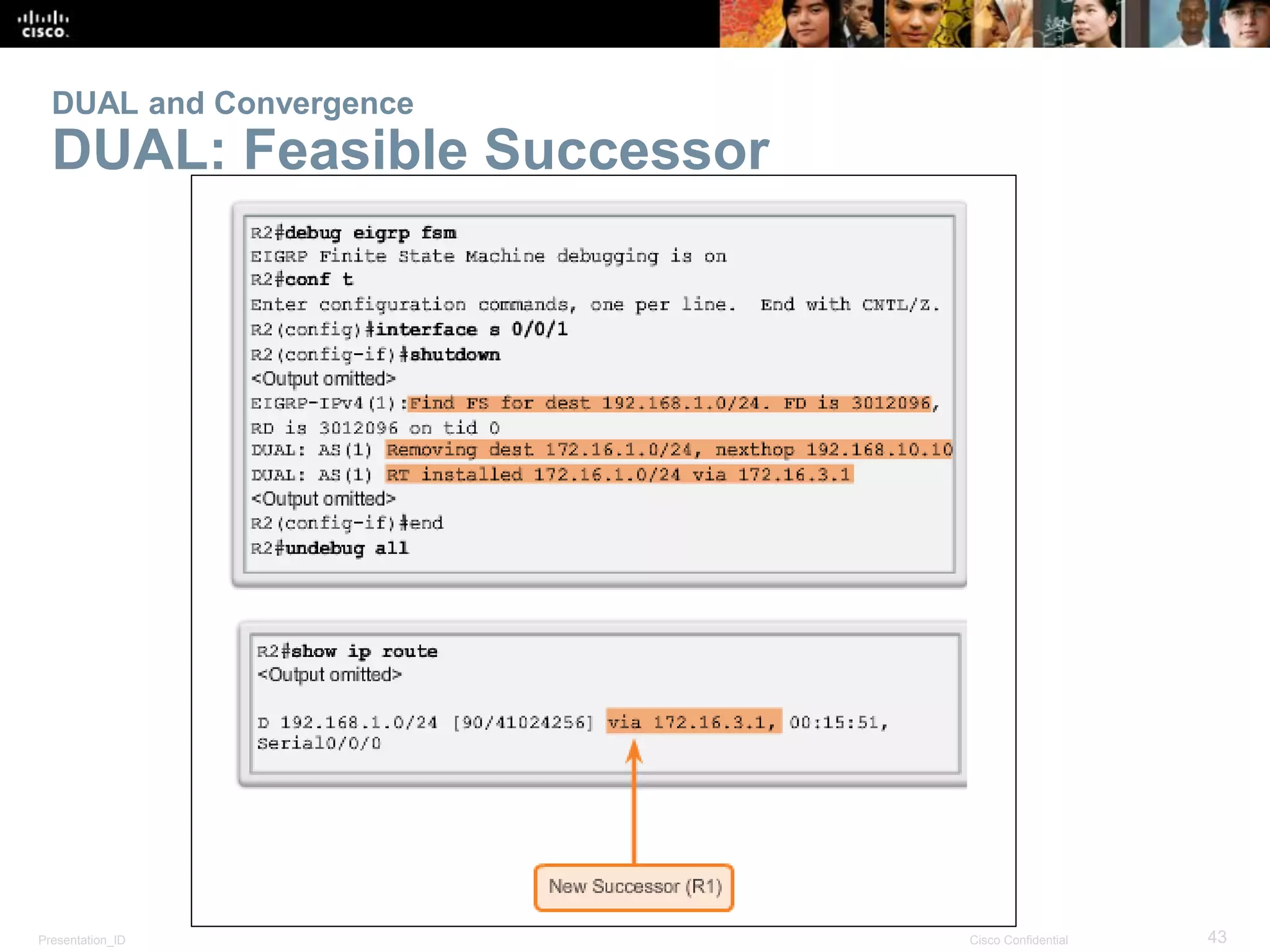
 EIGRP maintains a list of backup routes that DUAL has already
determined that can be used immediately if the primary path fails.
Presentation_ID 38© 2008 Cisco Systems, Inc. All rights reserved. Cisco Confidential
DUAL and the Topology Table
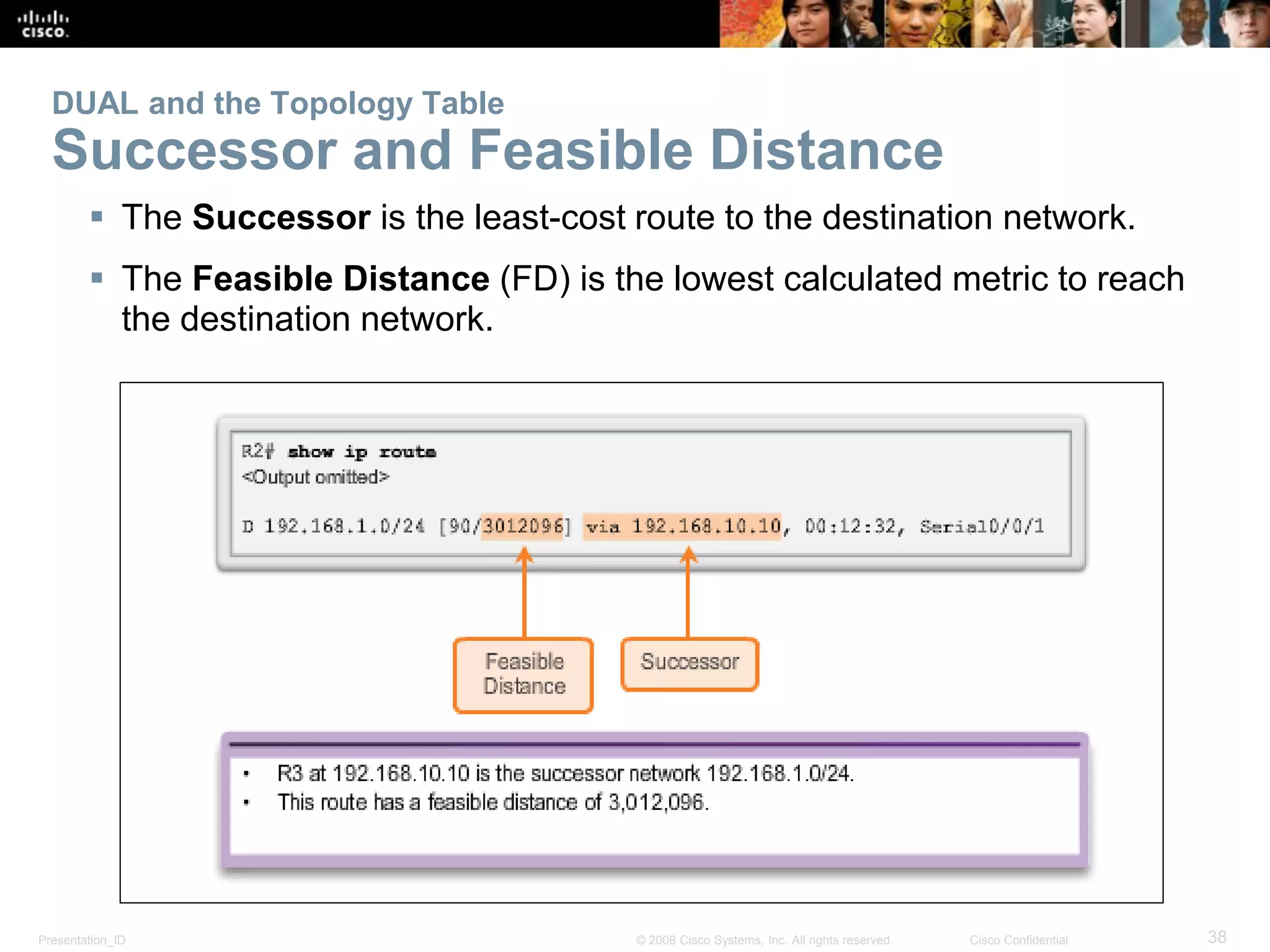
Successor and Feasible Distance
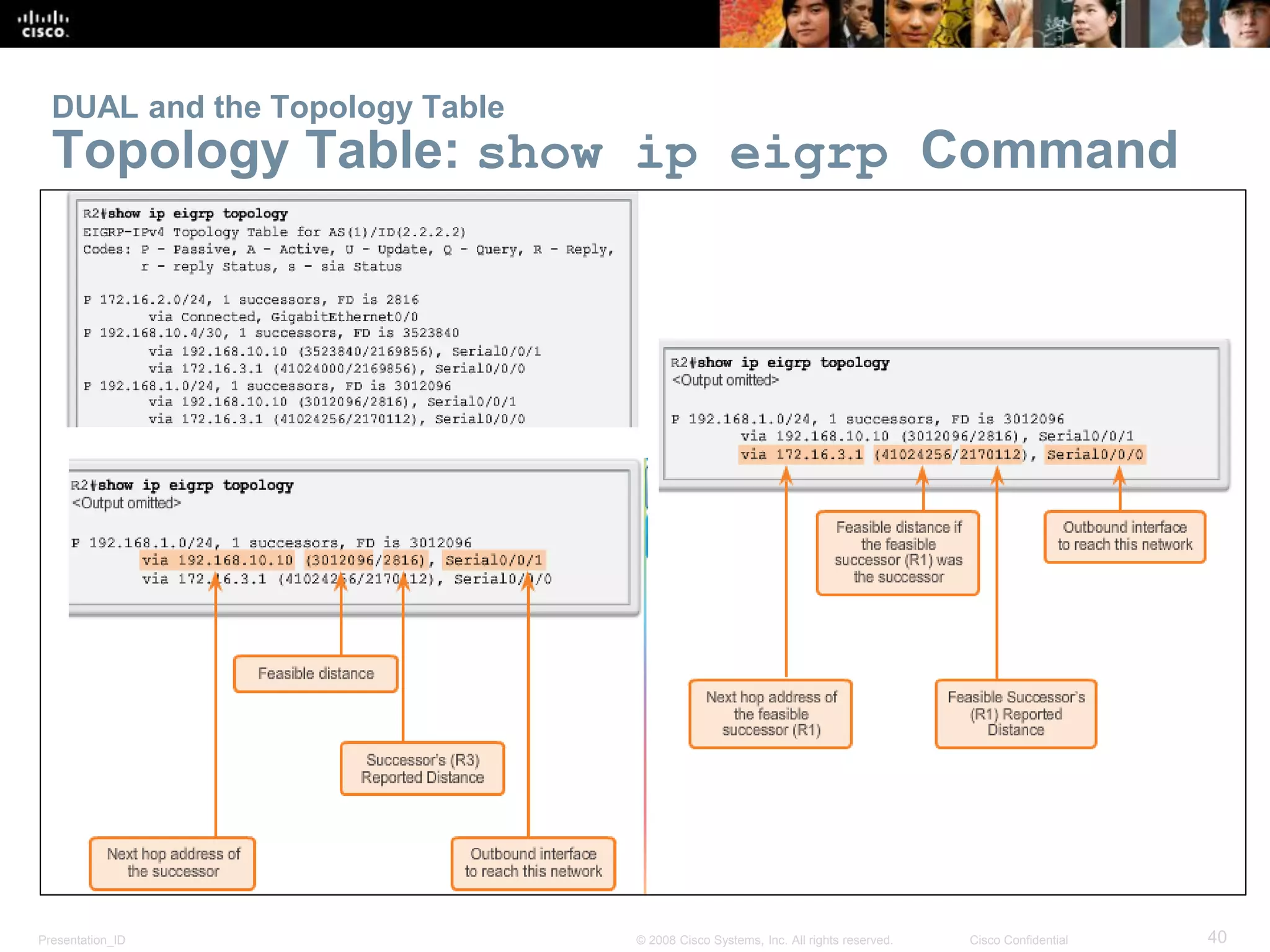
 The Successor is the least-cost route to the destination network.
 The Feasible Distance (FD) is the lowest calculated metric to reach
the destination network.
Presentation_ID 39© 2008 Cisco Systems, Inc. All rights reserved. Cisco Confidential
Feasible Successors, Feasibility Condition,
and Reported Distance
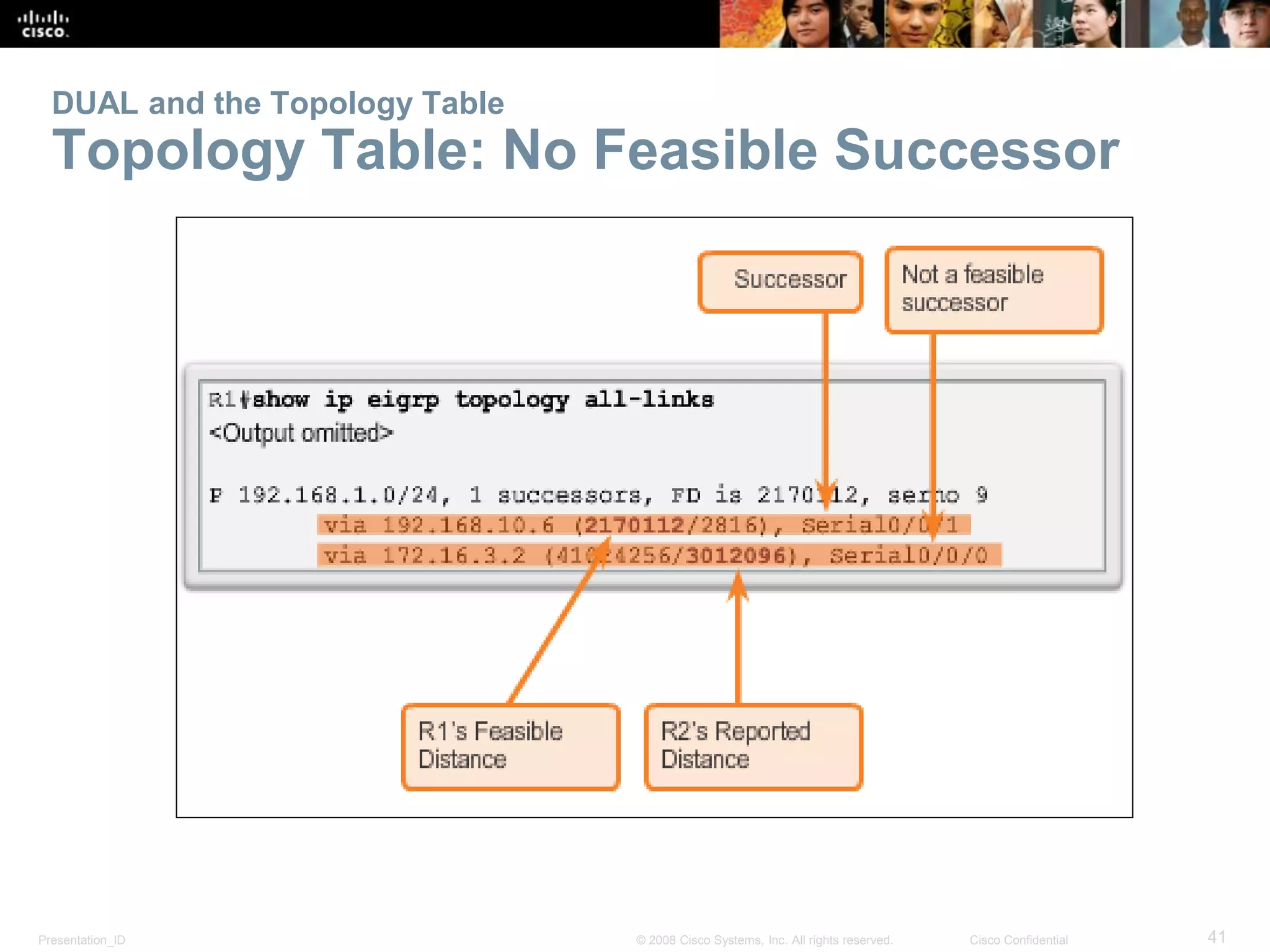
 Feasible Successor (FS) is a neighbor that has a loop-free backup
path to the same network as the successor, and it satisfies the
Feasibility Condition (FC).
 Feasibility Condition (FC) is met when a neighbor’s Reported
Distance (RD) to a network is less than the local router’s feasible
distance to the same destination network.
 Reported Distance (RD) is an EIGRP neighbor’s feasible distance
to the same destination network.
Presentation_ID 40© 2008 Cisco Systems, Inc. All rights reserved. Cisco Confidential
DUAL and the Topology Table
Topology Table: show ip eigrp Command
Presentation_ID 41© 2008 Cisco Systems, Inc. All rights reserved. Cisco Confidential
DUAL and the Topology Table
Topology Table: No Feasible Successor
Presentation_ID 42© 2008 Cisco Systems, Inc. All rights reserved. Cisco Confidential
DUAL and Convergence
DUAL Finite State Machine (FSM)
Presentation_ID 43© 2008 Cisco Systems, Inc. All rights reserved. Cisco Confidential
DUAL and Convergence
DUAL: Feasible Successor
Presentation_ID 44© 2008 Cisco Systems, Inc. All rights reserved. Cisco Confidential
DUAL and Convergence
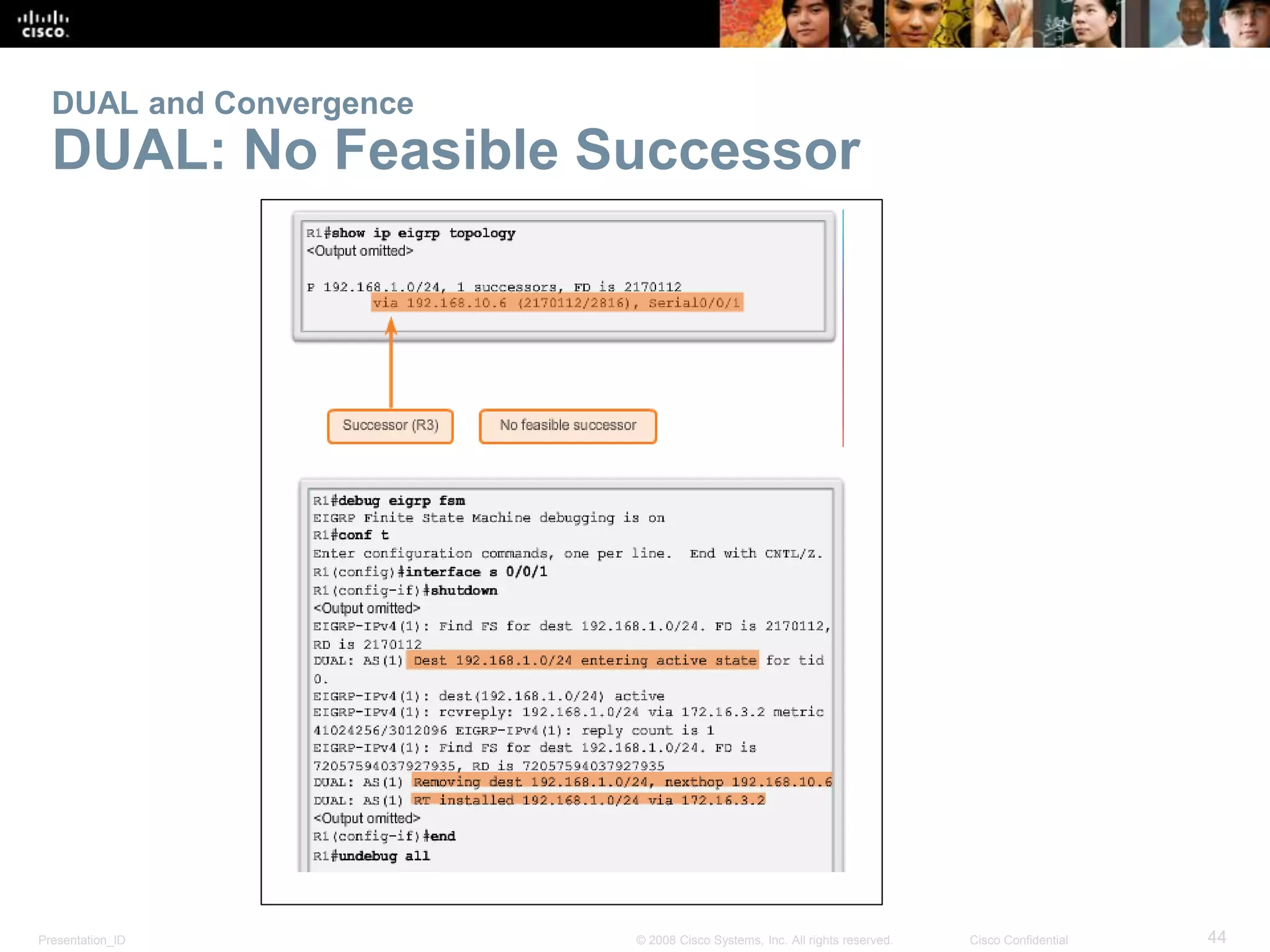
DUAL: No Feasible Successor
© 2008 Cisco Systems, Inc. All rights reserved. Cisco ConfidentialPresentation_ID 45
7.4 Configuration of EIGRP for IPv6
Presentation_ID 46© 2008 Cisco Systems, Inc. All rights reserved. Cisco Confidential
EIGRP for IPv4 vs. IPv6
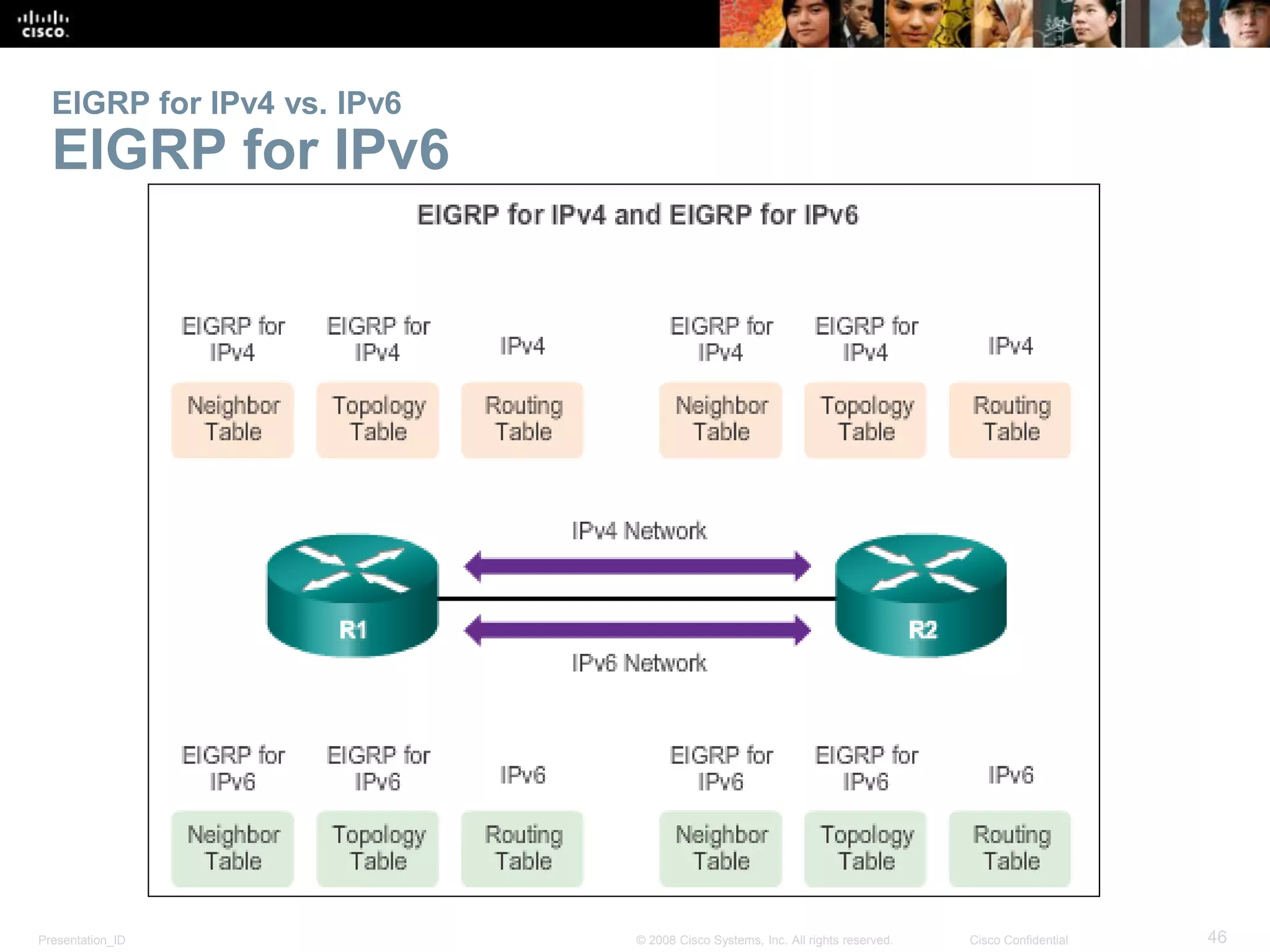
EIGRP for IPv6
Presentation_ID 47© 2008 Cisco Systems, Inc. All rights reserved. Cisco Confidential
EIGRP for IPv4 vs. IPv6
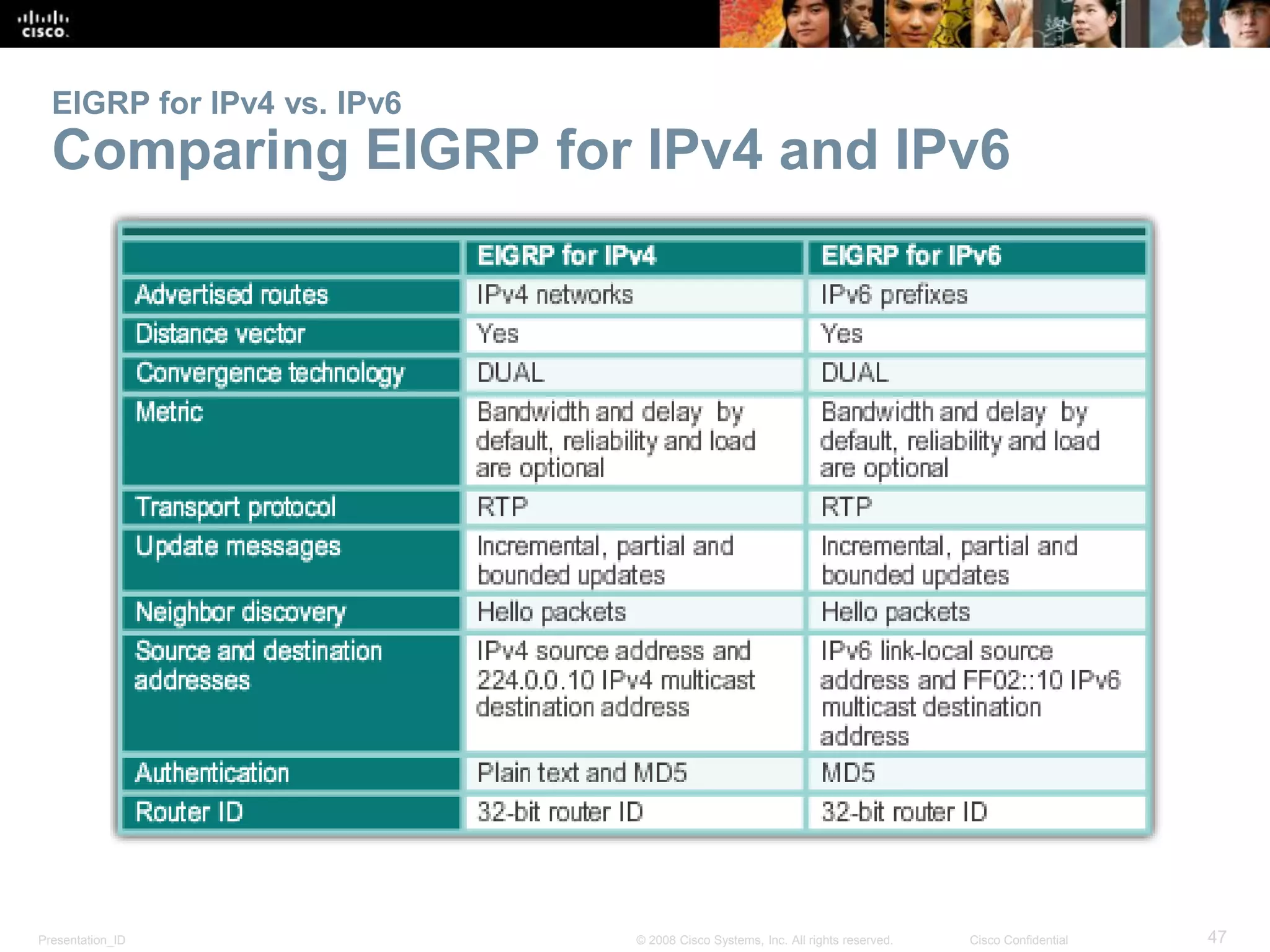
Comparing EIGRP for IPv4 and IPv6
Presentation_ID 48© 2008 Cisco Systems, Inc. All rights reserved. Cisco Confidential
EIGRP for IPv4 vs. IPv6
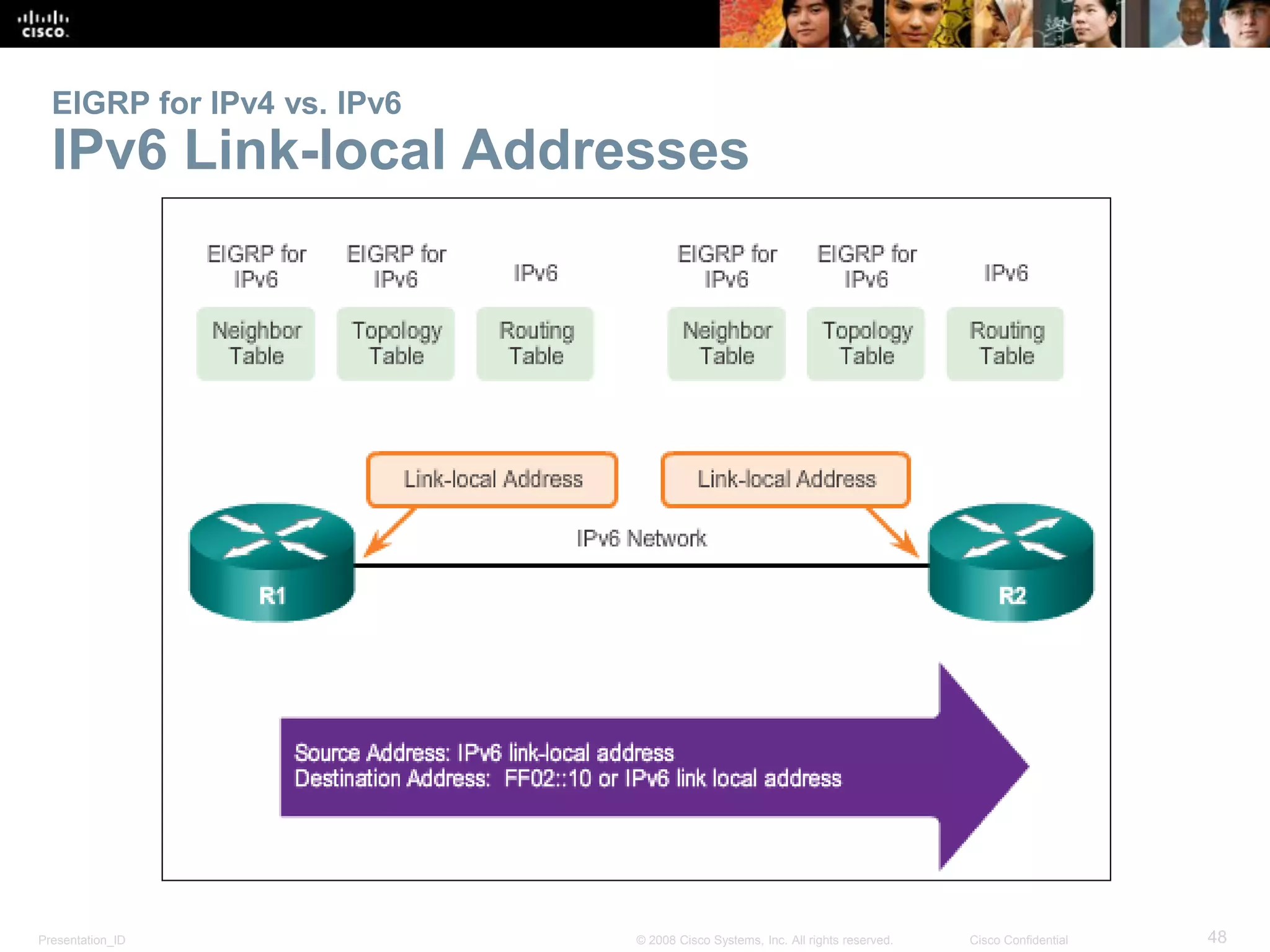
IPv6 Link-local Addresses
Presentation_ID 49© 2008 Cisco Systems, Inc. All rights reserved. Cisco Confidential
Configuring EIGRP for IPv6
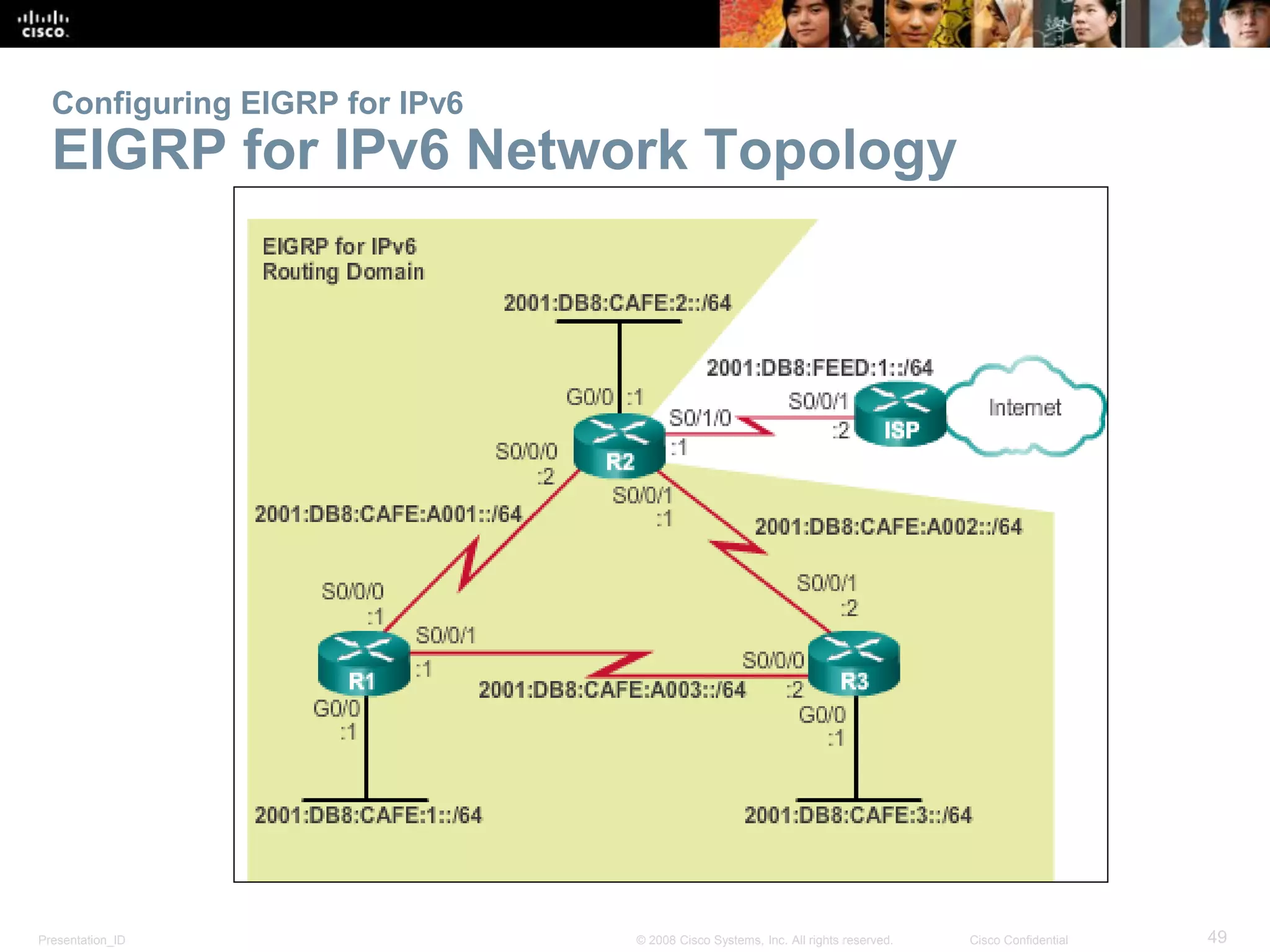
EIGRP for IPv6 Network Topology
Presentation_ID 50© 2008 Cisco Systems, Inc. All rights reserved. Cisco Confidential
Configuring EIGRP for IPv6
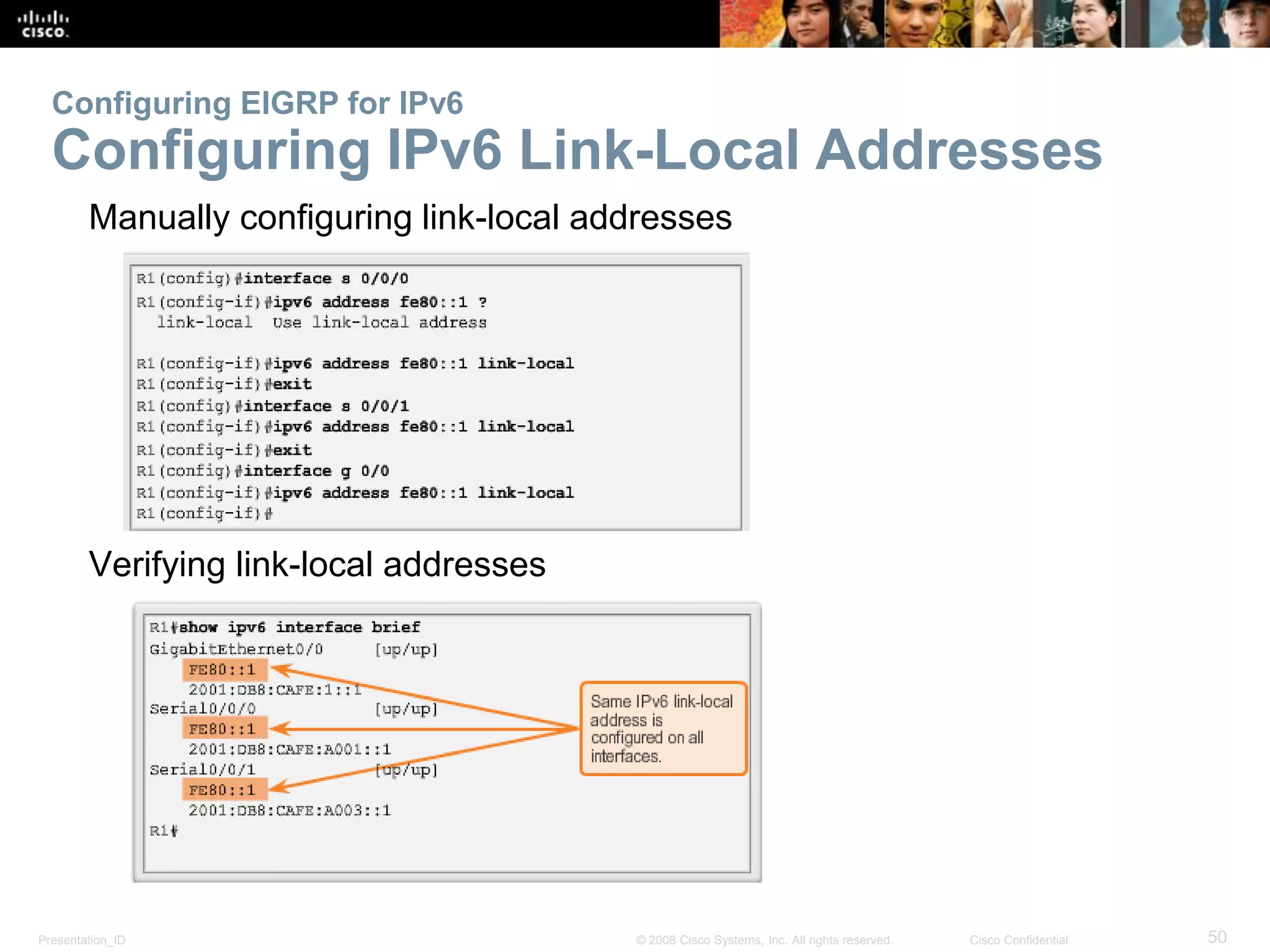
Configuring IPv6 Link-Local Addresses
Manually configuring link-local addresses
Verifying link-local addresses
Presentation_ID 51© 2008 Cisco Systems, Inc. All rights reserved. Cisco Confidential
Configuring EIGRP for IPv6
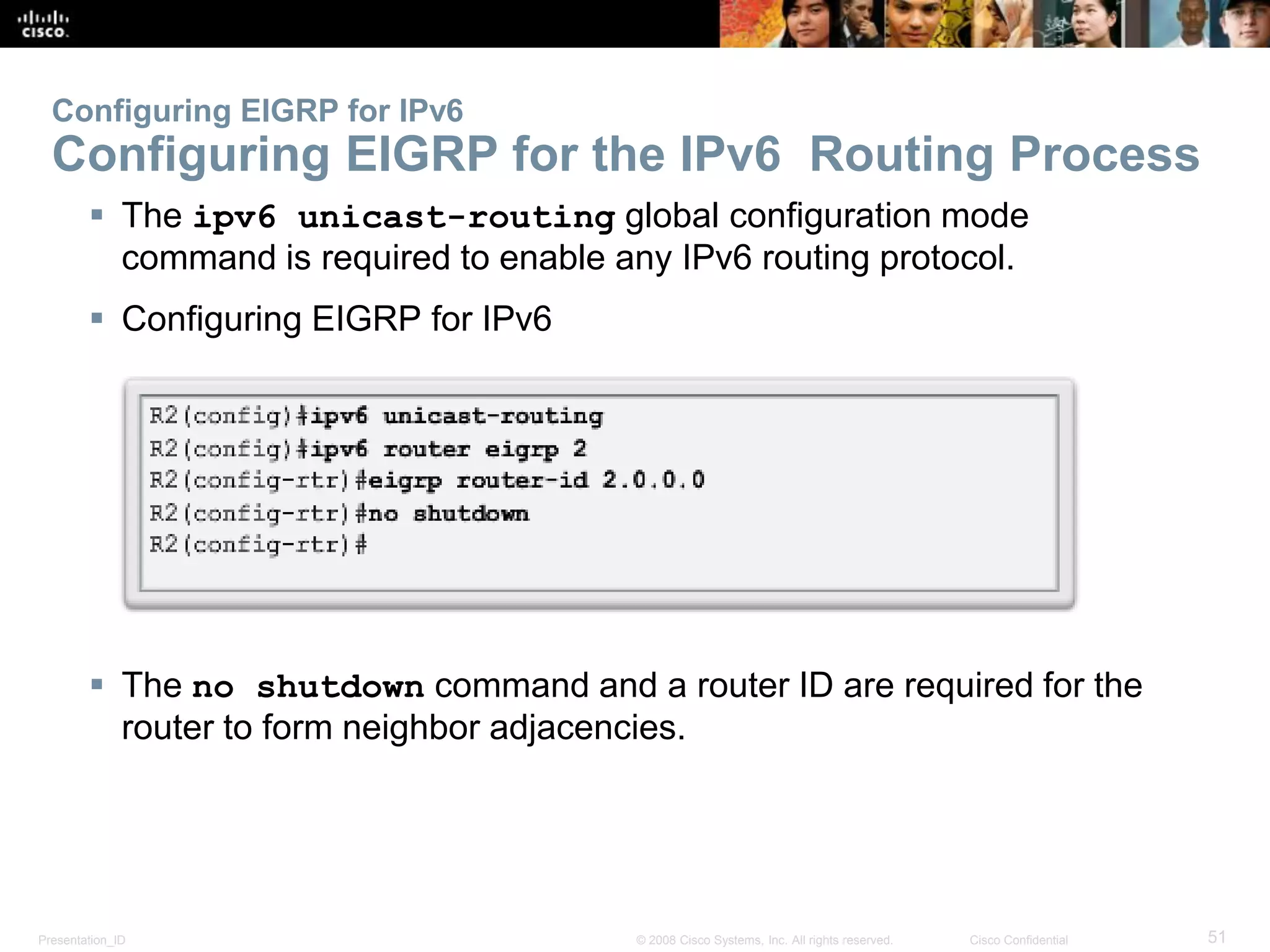
Configuring EIGRP for the IPv6 Routing Process
 The ipv6 unicast-routing global configuration mode
command is required to enable any IPv6 routing protocol.
 Configuring EIGRP for IPv6
 The no shutdown command and a router ID are required for the
router to form neighbor adjacencies.
Presentation_ID 52© 2008 Cisco Systems, Inc. All rights reserved. Cisco Confidential
Configuring EIGRP for IPv6
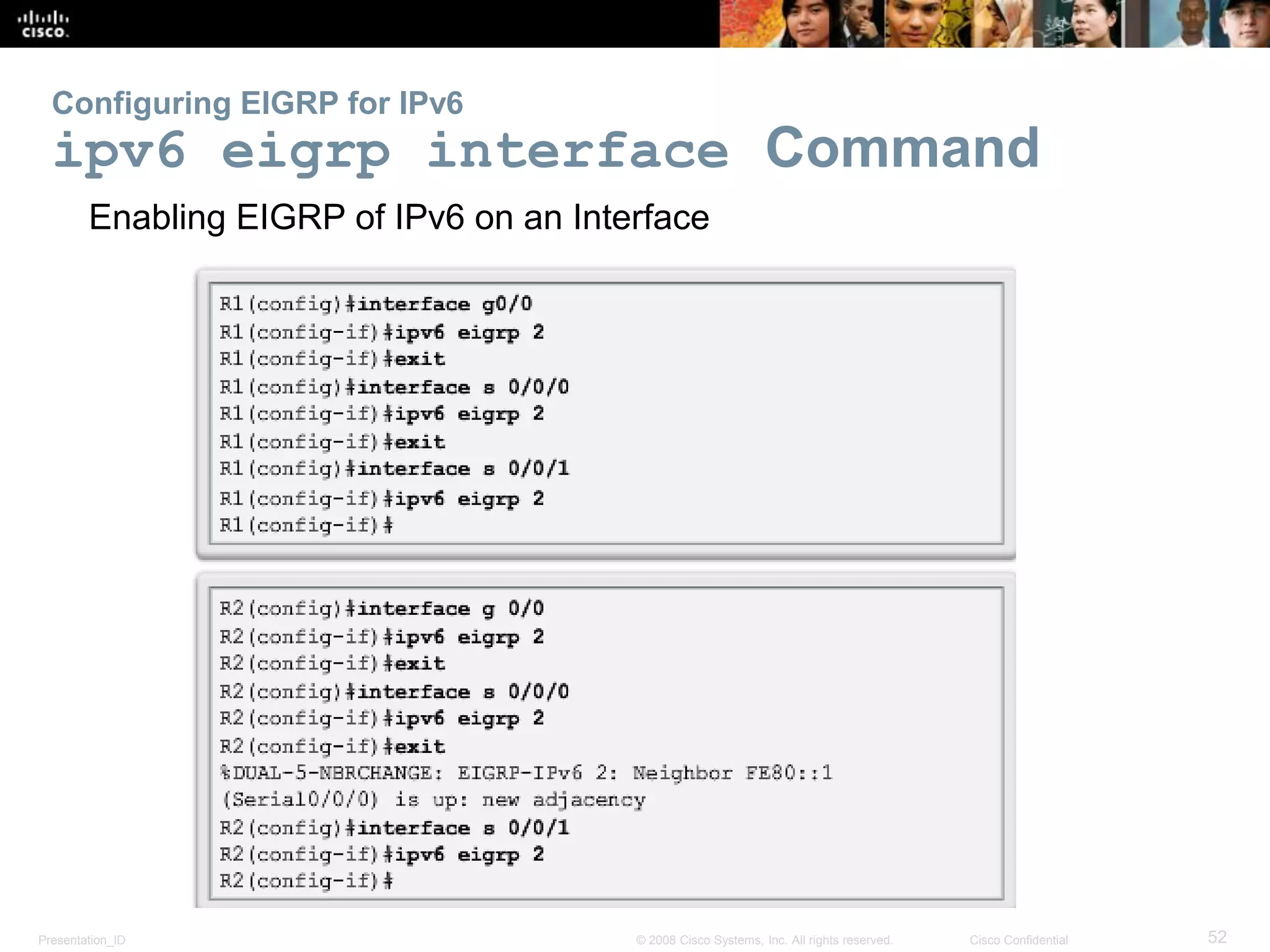
ipv6 eigrp interface Command
Enabling EIGRP of IPv6 on an Interface
Presentation_ID 53© 2008 Cisco Systems, Inc. All rights reserved. Cisco Confidential
Verifying EIGRP for IPv6
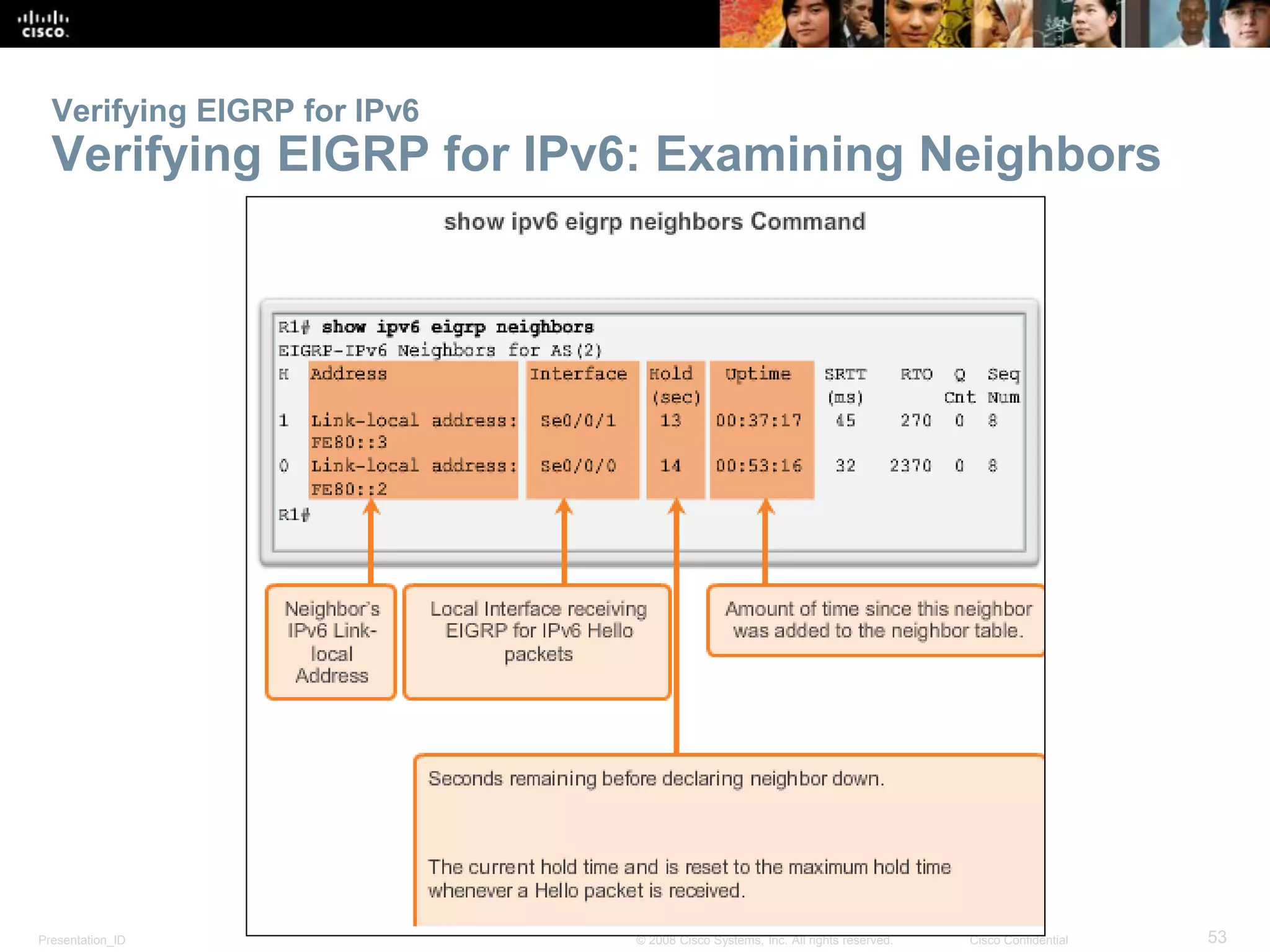
Verifying EIGRP for IPv6: Examining Neighbors
Presentation_ID 54© 2008 Cisco Systems, Inc. All rights reserved. Cisco Confidential
Verifying EIGRP for IPv6
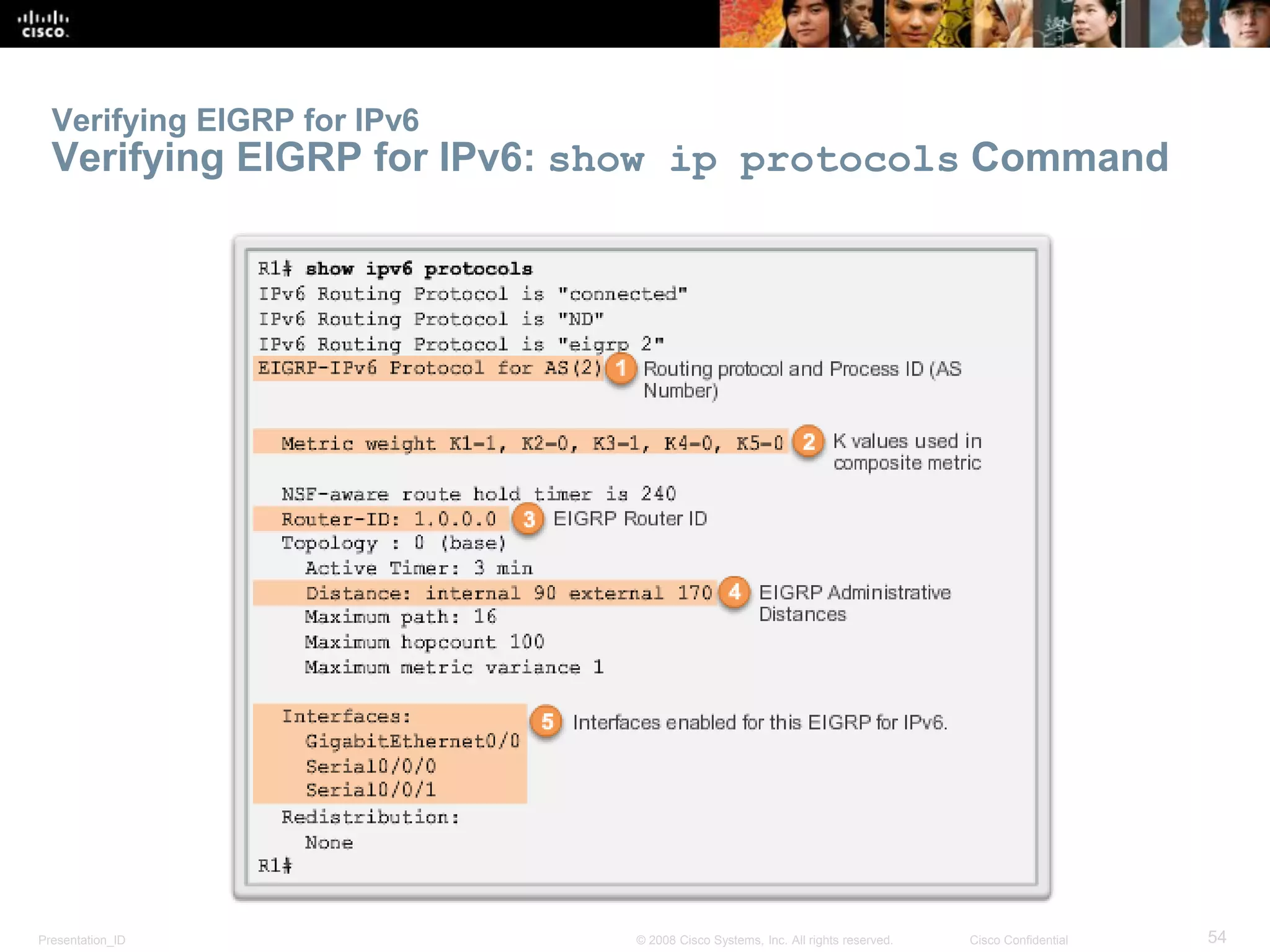
Verifying EIGRP for IPv6: show ip protocols Command
Presentation_ID 55© 2008 Cisco Systems, Inc. All rights reserved. Cisco Confidential
Verifying EIGRP for IPv6
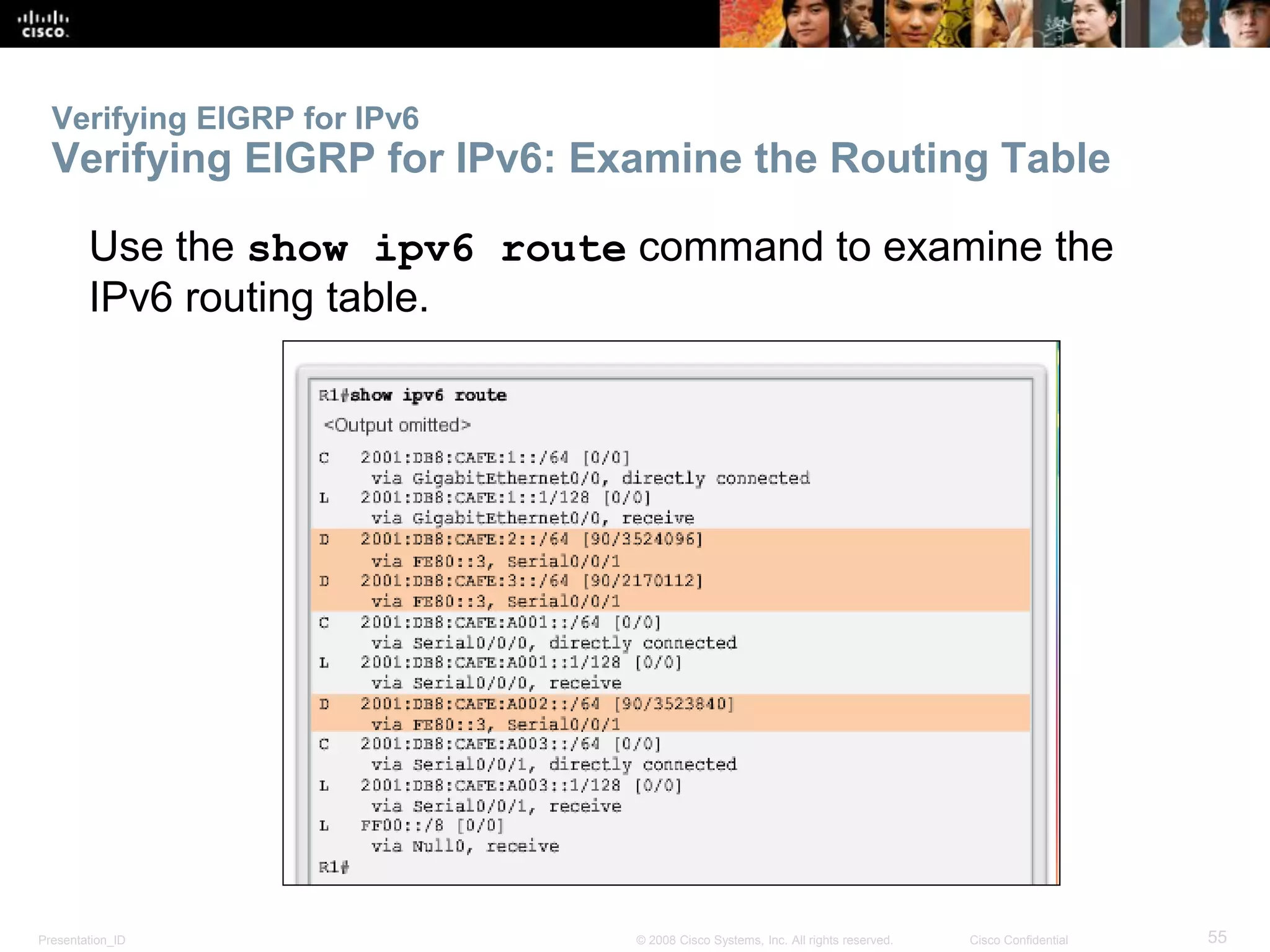
Verifying EIGRP for IPv6: Examine the Routing Table
Use the show ipv6 route command to examine the
IPv6 routing table.
Presentation_ID 56© 2008 Cisco Systems, Inc. All rights reserved. Cisco Confidential
Chapter 7: Summary
 EIGRP is a classless, advanced distance vector routing protocol.
 EIGRP uses the source code of “D” for DUAL in the routing table.
 The default administrative distance of 90 is used for internal routes
and 170 for routes imported from an external source.
 Advanced features include DUAL, establishing neighbor
adjacencies, RTP, partial and bounded updates, and equal and
unequal cost load balancing.
 PDMs give EIGRP the capability to support different Layer 3
protocols.
 EIGRP Hello packets are used to discover neighbors.
 The show ip eigrp neighbors command is used to view
neighbor table and verify adjacencies.
Presentation_ID 57© 2008 Cisco Systems, Inc. All rights reserved. Cisco Confidential
Chapter 7: Summary (cont.)
 EIGRP sends partial bounded updates when a change occurs on
network.
 EIGRP composite metric uses bandwidth, delay, reliability and load
to determine the best path (by default, only bandwidth and delay are
used).
 DUAL FSM is used to determine best path; Successor and potential
backup path, FS to every destination network.
Presentation_ID 58© 2008 Cisco Systems, Inc. All rights reserved. Cisco Confidential

CCNAv5 - S3: Chapter 7 EIGRP

  • 1.
    © 2008 CiscoSystems, Inc. All rights reserved. Cisco ConfidentialPresentation_ID 1 Chapter 7: Enhanced Interior Gateway Protocol (EIGRP) Scaling Networks
  • 2.
    Presentation_ID 2© 2008Cisco Systems, Inc. All rights reserved. Cisco Confidential Chapter 7 7.0 Introduction 7.1 Characteristics of EIGRP 7.2 Configuring EIGRP for IPv4 7.3 Operation of EIGRP 7.4 Configuration of EIGRP for IPv6 7.5 Summary
  • 3.
    Presentation_ID 3© 2008Cisco Systems, Inc. All rights reserved. Cisco Confidential Chapter 7: Objectives  Describe the features and operation of EIGRP.  Examine the different EIGRP packet formats.  Calculate the composite metric used by the Diffusing Update Algorithm (DUAL).  Describe the concepts and operation of DUAL.  Examine the commands to configure and verify basic EIGRP operations for IPv4 and IPv6.
  • 4.
    © 2008 CiscoSystems, Inc. All rights reserved. Cisco ConfidentialPresentation_ID 4 7.1 Characteristics of EIGRP
  • 5.
    Presentation_ID 5© 2008Cisco Systems, Inc. All rights reserved. Cisco Confidential Basic Features of EIGRP Features of EIGRP  Released in 1992 as a Cisco proprietary protocol.  2013 basic functionality of EIGRP released as an open standard.  Advanced Distance Vector routing protocol.  Uses the Diffusing Update Algorithm (DUAL) to calculate paths and back-up paths.  Establishes Neighbor Adjacencies.  Uses the Reliable Transport Protocol to provide delivery of EIGRP packets to neighbors.  Partial and Bounded Updates. Send updates only when there is a change and only to the routers that need the information.  Supports Equal and Unequal Cost Load Balancing.
  • 6.
    Presentation_ID 6© 2008Cisco Systems, Inc. All rights reserved. Cisco Confidential Basic Features of EIGRP Protocol Dependent Modules
  • 7.
    Presentation_ID 7© 2008Cisco Systems, Inc. All rights reserved. Cisco Confidential Basic Features of EIGRP Reliable Transport Protocol
  • 8.
    Presentation_ID 8© 2008Cisco Systems, Inc. All rights reserved. Cisco Confidential Basic Features of EIGRP Authentication  EIGRP can be configured to authenticate routing information.  Ensures routers only accept updates from routers that have been configured with the correct authentication information.
  • 9.
    Presentation_ID 9© 2008Cisco Systems, Inc. All rights reserved. Cisco Confidential Types of EIGRP Packets EIGRP Packet Types
  • 10.
    Presentation_ID 10© 2008Cisco Systems, Inc. All rights reserved. Cisco Confidential Types of EIGRP Packets EIGRP Hello Packets  Used to discover EIGRP neighbors.  Used to form and maintain EIGRP neighbor adjacencies.  Sent as IPv4 or IPv6 multicasts.  IPv4 multicast address 224.0.0.10.  IPv6 multicast address FF02::A.  Unreliable delivery.  Sent every 5 seconds (every 60 seconds on low-speed NBMA networks).  EIGRP uses a default Hold timer of three times the Hello interval before declaring neighbor unreachable.
  • 11.
    Presentation_ID 11© 2008Cisco Systems, Inc. All rights reserved. Cisco Confidential Types of EIGRP Packets EIGRP Update & Acknowledgement Packets  Update packets are sent to propagate routing information, only when necessary.  Sends Partial updates – only contains information about route changes.  Sends Bounded updates- sent only to routers affected by the change.  Updates use reliable delivery, therefore, require an acknowledgement.
  • 12.
    Presentation_ID 12© 2008Cisco Systems, Inc. All rights reserved. Cisco Confidential Types of EIGRP Packets EIGRP Query and Reply Packets  Used when searching for networks.  Queries use reliable delivery, which can be multicast or unicast.  Replies use reliable delivery.
  • 13.
    Presentation_ID 13© 2008Cisco Systems, Inc. All rights reserved. Cisco Confidential EIGRP Messages Encapsulating EIGRP Messages
  • 14.
    Presentation_ID 14© 2008Cisco Systems, Inc. All rights reserved. Cisco Confidential EIGRP Messages EIGRP Packet Header and TLV
  • 15.
    © 2008 CiscoSystems, Inc. All rights reserved. Cisco ConfidentialPresentation_ID 15 7.2 Configuring EIGRP for IPv4
  • 16.
    Presentation_ID 16© 2008Cisco Systems, Inc. All rights reserved. Cisco Confidential Configuring EIGRP with IPv4 EIGRP Network Topology This course uses the topology that configures EIGRP with IPv4.
  • 17.
    Presentation_ID 17© 2008Cisco Systems, Inc. All rights reserved. Cisco Confidential Configuring EIGRP with IPv4 Autonomous System Numbers  The router eigrp autonomous-system command enables the EIGRP process.  The autonomous system number is only significant to the EIGRP routing domain.  The EIGRP autonomous system number is not associated with the Internet Assigned Numbers Authority (IANA) globally assigned autonomous system numbers used by external routing protocols.  Internet Service Providers (ISPs) require an autonomous system number from IANA.  ISPs often use the Border Gateway Protocol (BGP), which does use the IANA autonomous system number in its configuration.
  • 18.
    Presentation_ID 18© 2008Cisco Systems, Inc. All rights reserved. Cisco Confidential Configuring EIGRP with IPv4 Router EIGRP Command Router(config)# router eigrp autonomous-system To completely remove the EIGRP routing process from a device, use the no router eigrp autonomous-system command.
  • 19.
    Presentation_ID 19© 2008Cisco Systems, Inc. All rights reserved. Cisco Confidential Configuring EIGRP with IPv4 EIGRP Router ID Used in both EIGRP and OSPF routing protocols, the router ID’s role is more significant in OSPF.
  • 20.
    Presentation_ID 20© 2008Cisco Systems, Inc. All rights reserved. Cisco Confidential Configuring EIGRP with IPv4 Configuring the EIGRP Router ID  Configuring the EIGRP router ID Router(config)# router eigrp autonomous-system Router(config-router)# eigrp router-id ipv4-address  The IPv4 loopback address can be used as the router ID.  If the eigrp router-id value is not configured, the highest loopback address is selected as the router ID.  Configuring a loopback interface Router(config)# interface loopback number Router(config-if)# ip addressipv4-address subnet-mask
  • 21.
    Presentation_ID 21© 2008Cisco Systems, Inc. All rights reserved. Cisco Confidential Configuring EIGRP with IPv4 Network Command  Enables any interface on this router that matches the network address in the network router configuration mode command to send and receive EIGRP updates.  These networks are included in EIGRP routing updates.
  • 22.
    Presentation_ID 22© 2008Cisco Systems, Inc. All rights reserved. Cisco Confidential Configuring EIGRP with IPv4 Network Command The eigrp log-neighbor-changes router configuration mode • On by default • Displays changes in neighbor adjacencies • Verifies neighbor adjacencies during configuration • Indicates when any adjacencies have been removed
  • 23.
    Presentation_ID 23© 2008Cisco Systems, Inc. All rights reserved. Cisco Confidential Configuring EIGRP with IPv4 The Network Command and Wildcard Mask  To configure EIGRP to advertise specific subnets only, use the wildcard-mask option with the network command. Router(config-router)# network network address [wildcard-mask]  The wildcard mask is the inverse of the subnet mask.  To calculate the wildcard mask, subtract the subnet mask from 255.255.255.255: 255.255.255.255 -- 255.255.255.252 0. 0. 0. 3 wildcard mask  Note: Some IOS versions also let you enter the subnet mask instead of a wildcard mask.
  • 24.
    Presentation_ID 24© 2008Cisco Systems, Inc. All rights reserved. Cisco Confidential Configuring EIGRP with IPv4 Passive Interface  Use the passive-interface command to:  Prevent neighbor adjacencies  Suppress unnecessary update traffic  Increase security controls, such as preventing unknown rogue routing devices from receiving EIGRP updates  To configure: Router(config)# router eigrp as-number Router(config-router)# passive- interface interface-type interface-number  To verify: Router# show ip protocols
  • 25.
    Presentation_ID 25© 2008Cisco Systems, Inc. All rights reserved. Cisco Confidential Configuring EIGRP with IPv4 Verifying EIGRP: Examining Neighbors 
  • 26.
    Presentation_ID 26© 2008Cisco Systems, Inc. All rights reserved. Cisco Confidential Configuring EIGRP with IPv4 Verifying EIGRP: show ip protocols Command
  • 27.
    Presentation_ID 27© 2008Cisco Systems, Inc. All rights reserved. Cisco Confidential Configuring EIGRP with IPv4 Verifying EIGRP: Examine the IPv4 Routing Table
  • 28.
    © 2008 CiscoSystems, Inc. All rights reserved. Cisco ConfidentialPresentation_ID 28 7.3 Operation of EIGRP
  • 29.
    Presentation_ID 29© 2008Cisco Systems, Inc. All rights reserved. Cisco Confidential EIGRP Initial Route Discovery EIGRP Neighbor Adjacency
  • 30.
    Presentation_ID 30© 2008Cisco Systems, Inc. All rights reserved. Cisco Confidential EIGRP Initial Route Discovery EIGRP Topology Table
  • 31.
    Presentation_ID 31© 2008Cisco Systems, Inc. All rights reserved. Cisco Confidential EIGRP Initial Route Discovery EIGRP Convergence Convergence – All routers have the correct, most up-to-date information about the network.
  • 32.
    Presentation_ID 32© 2008Cisco Systems, Inc. All rights reserved. Cisco Confidential Metrics EIGRP Composite Metric
  • 33.
    Presentation_ID 33© 2008Cisco Systems, Inc. All rights reserved. Cisco Confidential Metrics Examining Interface Values  BW – Bandwidth of the interface (in Kilobits per second).  DLY – Delay of the interface (microseconds).  Reliability – Reliability of interface; by default, the value is not included in the computing metric.  Txload, Rxload – By default, the value is not included in the computing metric.
  • 34.
    Presentation_ID 34© 2008Cisco Systems, Inc. All rights reserved. Cisco Confidential Metrics Bandwidth Metric  Use the show interfaces command to verify bandwidth.  Most serial bandwidths are set to 1,544 kb/s (default).  A correct value for bandwidth is very important in order to calculate the correct metric (both sides of link must have same bandwidth).
  • 35.
    Presentation_ID 35© 2008Cisco Systems, Inc. All rights reserved. Cisco Confidential Metrics Delay Metric
  • 36.
    Presentation_ID 36© 2008Cisco Systems, Inc. All rights reserved. Cisco Confidential Metrics Calculating the EIGRP Metric Step 1. Determine the link with the slowest bandwidth. Use that value to calculate bandwidth (10,000,000/bandwidth). Step 2. Determine the delay value for each outgoing interface on the way to the destination. Add the delay values and divide by 10 (sum of delay/10). Step 3. Add the computed values for bandwidth and delay, and multiply the sum by 256 to obtain the EIGRP metric.
  • 37.
    Presentation_ID 37© 2008Cisco Systems, Inc. All rights reserved. Cisco Confidential DUAL and the Topology Table DUAL Concepts  Diffusing Update ALgorithm (DUAL) provides the following:  Loop-free paths and loop-free backup paths  Fast convergence  Minimum bandwidth usage with bounded updates  The decision process for all route computations is done by the DUAL Finite State Machine (FSM)  DUAL FSM tracks all routes.  Uses EIGRP metrics to select efficient, loop-free paths.  Identifies the routes with the least-cost path to be inserted into the routing table.  EIGRP maintains a list of backup routes that DUAL has already determined that can be used immediately if the primary path fails.
  • 38.
    Presentation_ID 38© 2008Cisco Systems, Inc. All rights reserved. Cisco Confidential DUAL and the Topology Table Successor and Feasible Distance  The Successor is the least-cost route to the destination network.  The Feasible Distance (FD) is the lowest calculated metric to reach the destination network.
  • 39.
    Presentation_ID 39© 2008Cisco Systems, Inc. All rights reserved. Cisco Confidential Feasible Successors, Feasibility Condition, and Reported Distance  Feasible Successor (FS) is a neighbor that has a loop-free backup path to the same network as the successor, and it satisfies the Feasibility Condition (FC).  Feasibility Condition (FC) is met when a neighbor’s Reported Distance (RD) to a network is less than the local router’s feasible distance to the same destination network.  Reported Distance (RD) is an EIGRP neighbor’s feasible distance to the same destination network.
  • 40.
    Presentation_ID 40© 2008Cisco Systems, Inc. All rights reserved. Cisco Confidential DUAL and the Topology Table Topology Table: show ip eigrp Command
  • 41.
    Presentation_ID 41© 2008Cisco Systems, Inc. All rights reserved. Cisco Confidential DUAL and the Topology Table Topology Table: No Feasible Successor
  • 42.
    Presentation_ID 42© 2008Cisco Systems, Inc. All rights reserved. Cisco Confidential DUAL and Convergence DUAL Finite State Machine (FSM)
  • 43.
    Presentation_ID 43© 2008Cisco Systems, Inc. All rights reserved. Cisco Confidential DUAL and Convergence DUAL: Feasible Successor
  • 44.
    Presentation_ID 44© 2008Cisco Systems, Inc. All rights reserved. Cisco Confidential DUAL and Convergence DUAL: No Feasible Successor
  • 45.
    © 2008 CiscoSystems, Inc. All rights reserved. Cisco ConfidentialPresentation_ID 45 7.4 Configuration of EIGRP for IPv6
  • 46.
    Presentation_ID 46© 2008Cisco Systems, Inc. All rights reserved. Cisco Confidential EIGRP for IPv4 vs. IPv6 EIGRP for IPv6
  • 47.
    Presentation_ID 47© 2008Cisco Systems, Inc. All rights reserved. Cisco Confidential EIGRP for IPv4 vs. IPv6 Comparing EIGRP for IPv4 and IPv6
  • 48.
    Presentation_ID 48© 2008Cisco Systems, Inc. All rights reserved. Cisco Confidential EIGRP for IPv4 vs. IPv6 IPv6 Link-local Addresses
  • 49.
    Presentation_ID 49© 2008Cisco Systems, Inc. All rights reserved. Cisco Confidential Configuring EIGRP for IPv6 EIGRP for IPv6 Network Topology
  • 50.
    Presentation_ID 50© 2008Cisco Systems, Inc. All rights reserved. Cisco Confidential Configuring EIGRP for IPv6 Configuring IPv6 Link-Local Addresses Manually configuring link-local addresses Verifying link-local addresses
  • 51.
    Presentation_ID 51© 2008Cisco Systems, Inc. All rights reserved. Cisco Confidential Configuring EIGRP for IPv6 Configuring EIGRP for the IPv6 Routing Process  The ipv6 unicast-routing global configuration mode command is required to enable any IPv6 routing protocol.  Configuring EIGRP for IPv6  The no shutdown command and a router ID are required for the router to form neighbor adjacencies.
  • 52.
    Presentation_ID 52© 2008Cisco Systems, Inc. All rights reserved. Cisco Confidential Configuring EIGRP for IPv6 ipv6 eigrp interface Command Enabling EIGRP of IPv6 on an Interface
  • 53.
    Presentation_ID 53© 2008Cisco Systems, Inc. All rights reserved. Cisco Confidential Verifying EIGRP for IPv6 Verifying EIGRP for IPv6: Examining Neighbors
  • 54.
    Presentation_ID 54© 2008Cisco Systems, Inc. All rights reserved. Cisco Confidential Verifying EIGRP for IPv6 Verifying EIGRP for IPv6: show ip protocols Command
  • 55.
    Presentation_ID 55© 2008Cisco Systems, Inc. All rights reserved. Cisco Confidential Verifying EIGRP for IPv6 Verifying EIGRP for IPv6: Examine the Routing Table Use the show ipv6 route command to examine the IPv6 routing table.
  • 56.
    Presentation_ID 56© 2008Cisco Systems, Inc. All rights reserved. Cisco Confidential Chapter 7: Summary  EIGRP is a classless, advanced distance vector routing protocol.  EIGRP uses the source code of “D” for DUAL in the routing table.  The default administrative distance of 90 is used for internal routes and 170 for routes imported from an external source.  Advanced features include DUAL, establishing neighbor adjacencies, RTP, partial and bounded updates, and equal and unequal cost load balancing.  PDMs give EIGRP the capability to support different Layer 3 protocols.  EIGRP Hello packets are used to discover neighbors.  The show ip eigrp neighbors command is used to view neighbor table and verify adjacencies.
  • 57.
    Presentation_ID 57© 2008Cisco Systems, Inc. All rights reserved. Cisco Confidential Chapter 7: Summary (cont.)  EIGRP sends partial bounded updates when a change occurs on network.  EIGRP composite metric uses bandwidth, delay, reliability and load to determine the best path (by default, only bandwidth and delay are used).  DUAL FSM is used to determine best path; Successor and potential backup path, FS to every destination network.
  • 58.
    Presentation_ID 58© 2008Cisco Systems, Inc. All rights reserved. Cisco Confidential