Governing IT
Do or Die?
Eryk Budi Pratama
Advisory Consultant
KPMG
23 Feb 2019
Executive Briefing for CISA, CISM, CRISC Program
@Binus JWC
Is IT works as needed?
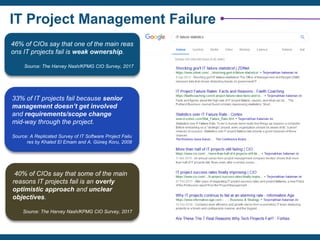
IT Project Management Failure
46% of CIOs say that one of the main reas
ons IT projects fail is weak ownership.
Source: The Harvey Nash/KPMG CIO Survey, 2017
33% of IT projects fail because senior
management doesn’t get involved
and requirements/scope change
mid-way through the project.
Source: A Replicated Survey of IT Software Project Failu
res by Khaled El Emam and A. Güneş Koru, 2008
40% of CIOs say that some of the main
reasons IT projects fail is an overly
optimistic approach and unclear
objectives.
Source: The Harvey Nash/KPMG CIO Survey, 2017
Business Expectations of IT
What does management expect from IT?
How to be sure everything works as needed?
What is an IT at all?
How to use it?
How to manage it?
How to measure results?
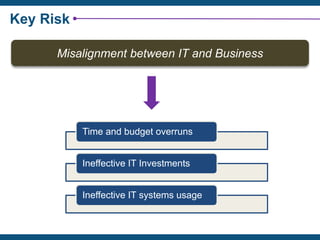
Key Risk
Misalignment between IT and Business
Time and budget overruns
Ineffective IT Investments
Ineffective IT systems usage
What is IT Governance?
Definition and Coverage
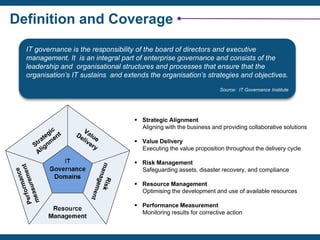
IT governance is the responsibility of the board of directors and executive
management. It is an integral part of enterprise governance and consists of the
leadership and organisational structures and processes that ensure that the
organisation’s IT sustains and extends the organisation’s strategies and objectives.
Source: IT Governance Institute
 Strategic Alignment
Aligning with the business and providing collaborative solutions
 Value Delivery
Executing the value proposition throughout the delivery cycle
 Risk Management
Safeguarding assets, disaster recovery, and compliance
 Resource Management
Optimising the development and use of available resources
 Performance Measurement
Monitoring results for corrective action
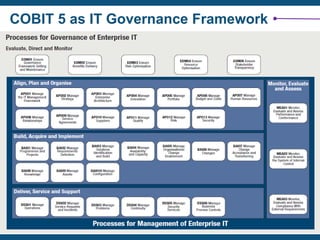
COBIT 5 as IT Governance Framework
Why IT Governence is
important?
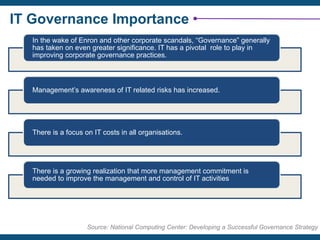
IT Governance Importance
In the wake of Enron and other corporate scandals, “Governance” generally
has taken on even greater significance. IT has a pivotal role to play in
improving corporate governance practices.
Management’s awareness of IT related risks has increased.
There is a focus on IT costs in all organisations.
There is a growing realization that more management commitment is
needed to improve the management and control of IT activities
Source: National Computing Center: Developing a Successful Governance Strategy
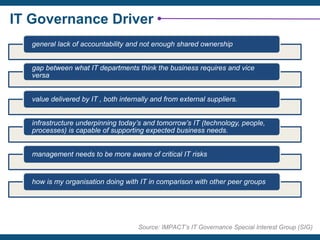
IT Governance Driver
Source: IMPACT’s IT Governance Special Interest Group (SIG)
general lack of accountability and not enough shared ownership
gap between what IT departments think the business requires and vice
versa
value delivered by IT , both internally and from external suppliers.
infrastructure underpinning today’s and tomorrow’s IT (technology, people,
processes) is capable of supporting expected business needs.
management needs to be more aware of critical IT risks
how is my organisation doing with IT in comparison with other peer groups
Case Study
“Owned-state company”
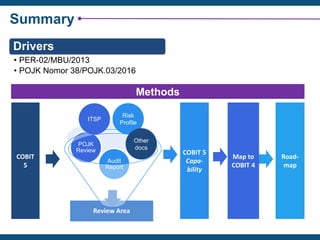
Summary
Drivers
• PER-02/MBU/2013
• POJK Nomor 38/POJK.03/2016
Review Area
Audit
Report
POJK
Review
ITSP
COBIT 5
Capa-
bility
COBIT
5
Map to
COBIT 4
Road-
map
Risk
Profile
Other
docs
Methods
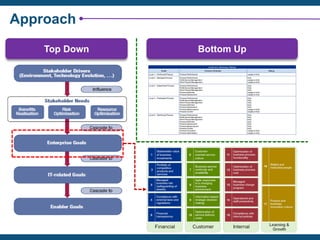
Approach
Levels and Necessary Ratings
Scale Process Attributes Rating
Level 1 – Performed Process Process Performance Largely or fully
Level 2 – Managed Process Process Performance
Performance Management
Work ProductManagement
Fully
Largely or fully
Largely or fully
Level 3 – Established Process Process Performance
Performance Management
Work ProductManagement
Process Definition
Process Deployment
Fully
Fully
Fully
Largely or fully
Largely or fully
Level 4 – Predictable Process Process Performance
Performance Management
Work ProductManagement
Process Definition
Process Deployment
Process Measurement
Process Control
Fully
Fully
Fully
Fully
Fully
Largely or fully
Largely or fully
Level 5 – Optimizing Process Process Performance
Performance Management
Work ProductManagement
Process Definition
Process Deployment
Process Measurement
Process Control
Process Innovation
Process Optimization
Fully
Fully
Fully
Fully
Fully
Fully
Fully
Largely or fully
Largely or fully
Top Down Bottom Up
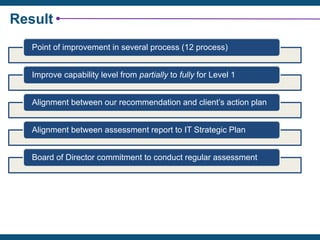
Result
Point of improvement in several process (12 process)
Improve capability level from partially to fully for Level 1
Alignment between our recommendation and client’s action plan
Alignment between assessment report to IT Strategic Plan
Board of Director commitment to conduct regular assessment
Key Success Factor?
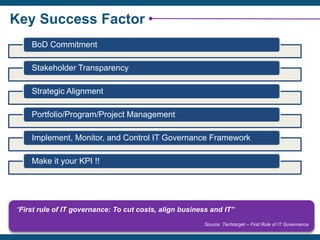
Key Success Factor
BoD Commitment
Stakeholder Transparency
Strategic Alignment
Portfolio/Program/Project Management
Implement, Monitor, and Control IT Governance Framework
Make it your KPI !!
“First rule of IT governance: To cut costs, align business and IT”
Source: Techtarget – First Rule of IT Governance
Thank You
eryk.pratama@gmail.com
https://proferyk.blogspot.co.id

IT Governance - Governing IT: Do or Die?

  • 1.
    Governing IT Do orDie? Eryk Budi Pratama Advisory Consultant KPMG 23 Feb 2019 Executive Briefing for CISA, CISM, CRISC Program @Binus JWC
  • 2.
    Is IT worksas needed?
  • 3.
    IT Project ManagementFailure 46% of CIOs say that one of the main reas ons IT projects fail is weak ownership. Source: The Harvey Nash/KPMG CIO Survey, 2017 33% of IT projects fail because senior management doesn’t get involved and requirements/scope change mid-way through the project. Source: A Replicated Survey of IT Software Project Failu res by Khaled El Emam and A. Güneş Koru, 2008 40% of CIOs say that some of the main reasons IT projects fail is an overly optimistic approach and unclear objectives. Source: The Harvey Nash/KPMG CIO Survey, 2017
  • 4.
    Business Expectations ofIT What does management expect from IT? How to be sure everything works as needed? What is an IT at all? How to use it? How to manage it? How to measure results?
  • 5.
    Key Risk Misalignment betweenIT and Business Time and budget overruns Ineffective IT Investments Ineffective IT systems usage
  • 6.
    What is ITGovernance?
  • 7.
    Definition and Coverage ITgovernance is the responsibility of the board of directors and executive management. It is an integral part of enterprise governance and consists of the leadership and organisational structures and processes that ensure that the organisation’s IT sustains and extends the organisation’s strategies and objectives. Source: IT Governance Institute  Strategic Alignment Aligning with the business and providing collaborative solutions  Value Delivery Executing the value proposition throughout the delivery cycle  Risk Management Safeguarding assets, disaster recovery, and compliance  Resource Management Optimising the development and use of available resources  Performance Measurement Monitoring results for corrective action
  • 8.
    COBIT 5 asIT Governance Framework
  • 9.
    Why IT Governenceis important?
  • 10.
    IT Governance Importance Inthe wake of Enron and other corporate scandals, “Governance” generally has taken on even greater significance. IT has a pivotal role to play in improving corporate governance practices. Management’s awareness of IT related risks has increased. There is a focus on IT costs in all organisations. There is a growing realization that more management commitment is needed to improve the management and control of IT activities Source: National Computing Center: Developing a Successful Governance Strategy
  • 11.
    IT Governance Driver Source:IMPACT’s IT Governance Special Interest Group (SIG) general lack of accountability and not enough shared ownership gap between what IT departments think the business requires and vice versa value delivered by IT , both internally and from external suppliers. infrastructure underpinning today’s and tomorrow’s IT (technology, people, processes) is capable of supporting expected business needs. management needs to be more aware of critical IT risks how is my organisation doing with IT in comparison with other peer groups
  • 12.
  • 13.
    Summary Drivers • PER-02/MBU/2013 • POJKNomor 38/POJK.03/2016 Review Area Audit Report POJK Review ITSP COBIT 5 Capa- bility COBIT 5 Map to COBIT 4 Road- map Risk Profile Other docs Methods
  • 14.
    Approach Levels and NecessaryRatings Scale Process Attributes Rating Level 1 – Performed Process Process Performance Largely or fully Level 2 – Managed Process Process Performance Performance Management Work ProductManagement Fully Largely or fully Largely or fully Level 3 – Established Process Process Performance Performance Management Work ProductManagement Process Definition Process Deployment Fully Fully Fully Largely or fully Largely or fully Level 4 – Predictable Process Process Performance Performance Management Work ProductManagement Process Definition Process Deployment Process Measurement Process Control Fully Fully Fully Fully Fully Largely or fully Largely or fully Level 5 – Optimizing Process Process Performance Performance Management Work ProductManagement Process Definition Process Deployment Process Measurement Process Control Process Innovation Process Optimization Fully Fully Fully Fully Fully Fully Fully Largely or fully Largely or fully Top Down Bottom Up
  • 15.
    Result Point of improvementin several process (12 process) Improve capability level from partially to fully for Level 1 Alignment between our recommendation and client’s action plan Alignment between assessment report to IT Strategic Plan Board of Director commitment to conduct regular assessment
  • 16.
  • 17.
    Key Success Factor BoDCommitment Stakeholder Transparency Strategic Alignment Portfolio/Program/Project Management Implement, Monitor, and Control IT Governance Framework Make it your KPI !! “First rule of IT governance: To cut costs, align business and IT” Source: Techtarget – First Rule of IT Governance
  • 18.