USAID Finance for Economic Development 
(FED) Program 
Workshop: “IT Governance in Banks” 
May 27, 2014
IT Governance: 
Why, How, When… 
Komitas Stepanyan, PhD, CRISC, CMRM 
CobIT Foundation Certificate 
YEREVAN - 2014
Agenda 
Introduction 
 The problem 
 Management Expectations of IT 
 IT management challenges 
 Key risk 
Framework 
Implementation Guidance
Is IT Works as needed??? Statistics… 
Over 80% of IT project are delivered late and over budget. (Standish 
Group – Oct 2006) 
Nearly 60% of all IT projects are delivered with less functionality that 
originally promised. (Standish Group – Mar 2007) 
More than 25% of the IT projects usually fail (Gartner Group – May 2006) 
Less than 5% of project fail due to technical reasons – Nearly all 
obstacles are related to poorly defined requirements, poor 
sponsorship, weak management controls or all of the above. (Gartner 
Group – May 2006) 
The IT aspects of CG are one of things that CEO’s think they don’t have to 
understand-until it bites them! (Piter Morriss - KPMG)
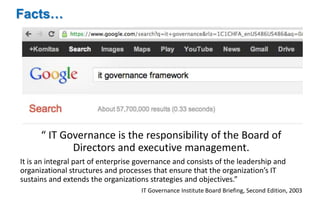
Facts… 
“ IT Governance is the responsibility of the Board of 
Directors and executive management. 
It is an integral part of enterprise governance and consists of the leadership and 
organizational structures and processes that ensure that the organization’s IT 
sustains and extends the organizations strategies and objectives.” 
IT Governance Institute Board Briefing, Second Edition, 2003
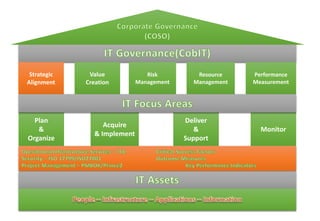
Strategic 
Alignment 
Value 
Creation 
Risk 
Management 
Resource 
Management 
Performance 
Measurement 
Plan 
& 
Organize 
Acquire 
& Implement 
Deliver 
& 
Support 
Monitor
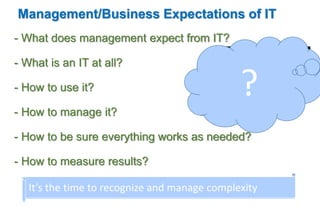
Management/Business Expectations of IT 
- What does management expect from IT? 
? 
Information 
Technologies 
- What is an IT at all? 
- How to use it? 
- How to manage it? 
- How to be sure everything works as needed? 
- How to measure results? 
It’s the time to recognize and manage complexity 
It’s the time to open “Black Box” …
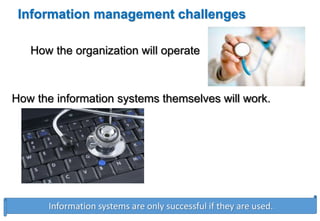
Information management challenges 
How the organization will operate 
How the information systems themselves will work. 
Information systems are only successful if they are used.
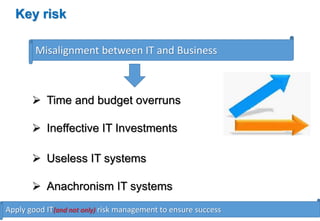
Key risk 
Misalignment between IT and Business 
 Time and budget overruns 
 Ineffective IT Investments 
 Useless IT systems 
 Anachronism IT systems 
Apply good IT(and not only) risk management to ensure success
Agenda 
Introduction 
 The problem 
 Management Expectations of IT 
 Information management challenges 
 Key risk 
Framework 
Implementation Guidance
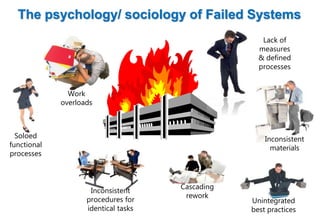
The psychology/ sociology of Failed Systems 
Inconsistent 
materials 
Work 
overloads 
Lack of 
measures 
& defined 
processes 
Cascading 
rework 
Soloed 
functional 
processes 
Inconsistent 
procedures for 
identical tasks 
Unintegrated 
best practices
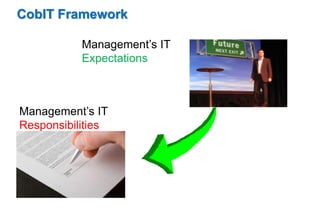
CobIT Framework 
Management’s IT 
Expectations 
Management’s IT 
Responsibilities
Management Needs COBIT 
To Evaluate IT Investment Decisions 
To Balance Risk and Control of Investment 
To Benchmark Existing and Future IT Environment 
76% of various CEOs and CIOs are aware of the 
benefits offered by IT governance frameworks, yet 
only 42% of them had any intention of implementing 
such a framework” (Loggerenberg 2006)
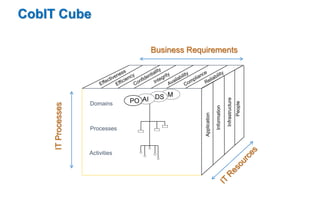
Business Requirements 
CobIT Cube 
IT Processes 
DS M PO AI Domains 
Processes 
Activities 
People 
Application 
Information 
Infrastructure
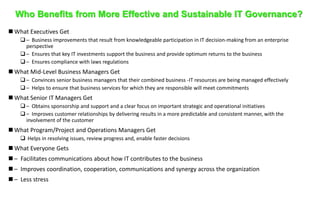
Who Benefits from More Effective and Sustainable IT Governance? 
 What Executives Get 
 – Business improvements that result from knowledgeable participation in IT decision-making from an enterprise 
perspective 
 – Ensures that key IT investments support the business and provide optimum returns to the business 
 – Ensures compliance with laws regulations 
 What Mid-Level Business Managers Get 
 – Convinces senior business managers that their combined business -IT resources are being managed effectively 
 – Helps to ensure that business services for which they are responsible will meet commitments 
 What Senior IT Managers Get 
 – Obtains sponsorship and support and a clear focus on important strategic and operational initiatives 
 – Improves customer relationships by delivering results in a more predictable and consistent manner, with the 
involvement of the customer 
 What Program/Project and Operations Managers Get 
 Helps in resolving issues, review progress and, enable faster decisions 
 What Everyone Gets 
 – Facilitates communications about how IT contributes to the business 
 – Improves coordination, cooperation, communications and synergy across the organization 
 – Less stress
Agenda 
Introduction 
 The problem 
 Management Expectations of IT 
 Information management challenges 
 Key risk 
Framework 
Implementation Guidance
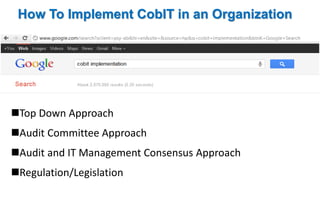
How To Implement CobIT in an Organization 
Top Down Approach 
Audit Committee Approach 
Audit and IT Management Consensus Approach 
Regulation/Legislation
Getting Started – Board and Executive Questions for IT 
Does the IT strategy align with the business strategy? 
Is the IT investment justified based on its contributions to the business? 
How likely will IT meet or exceed its plans, objectives and initiatives? 
Is IT being managed prudent, effectively? How is that measured? 
How is IT delivering value? 
Is IT developing and maintaining constructive relationships with customers, vendors and 
others? 
Is IT delivering projects and services on time, within scope, within budget and with high 
quality? 
Is IT staffed adequately, wit the right skills and competencies? 
How does IT management and operations compare to other best practice organizations 
How is IT managing and planning for contingencies, disasters, security, and back- up? 
How is IT measuring its performance? What key performance measures? 
Does the Board review and possibly approve the IT strategy? 
Is a risk management policy, assessment and mitigation practice followed for IT?
To Adopt CobIT, Who Needs To Be Influenced? 
 Chief Executive (e.g., CEO) 
 Senior IT Executive (CIO or VP of IT) 
 IT Steering Committee 
 IT Management 
 Business managers
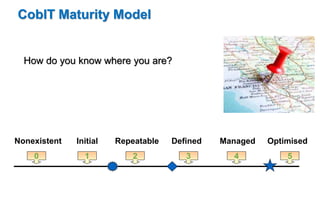
CobIT Maturity Model 
How do you know where you are? 
Nonexistent Initial Repeatable Defined Managed Optimised 
0 1 2 3 4 5
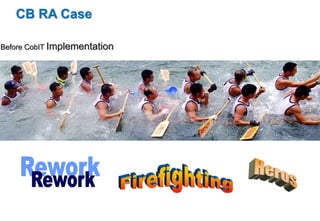
CB RA Case 
Before CobIT Implementation
CB RA Case 
After CobIT Implementation
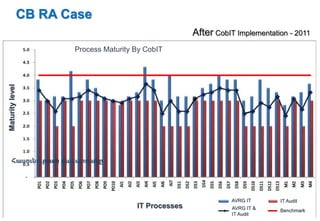
CB RA Case 
After CobIT Implementation - 2011 
Process Maturity By CobIT 
IT Processes 
Maturity level 
AVRG IT 
AVRG IT & 
IT Audit 
IT Audit 
Benchmark
Summary 
• IT governance is a broad and complex topic with many parts 
• Clearly defined roles, ownership and accountability 
• IT governance is integral part of corporate governance 
• IT governance is a journey and not only destination
To be or NOT to be? 
D I s c u s s I o n 
IT Governance or NOT IT Governance?
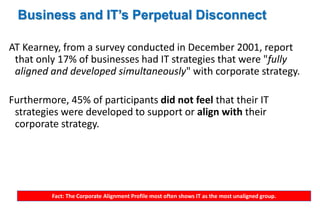
Business and IT’s Perpetual Disconnect 
AT Kearney, from a survey conducted in December 2001, report 
that only 17% of businesses had IT strategies that were "fully 
aligned and developed simultaneously" with corporate strategy. 
Furthermore, 45% of participants did not feel that their IT 
strategies were developed to support or align with their 
corporate strategy. 
Fact: The Corporate Alignment Profile most often shows IT as the most unaligned group.
CEOs Seeking a Solution 
The IT Governance Global Status Report (2004) found that 80%+ 
of CEOs recognised that “IT Governance or some form thereof is 
required” to resolve “IT issues”. 
The Report also found that 57% of CEOs looked to IT Governance 
to align IT strategy (and 53% to manage IT risks). 
However the Report concluded that “solutions in this domain are 
not yet available”.
What CIOs Want ? 
The top benefits CIOs were hoping to achieve: 
Increased IT credibility with the business (81%); 
Closer alignment between IT and business objectives (69%); 
Improved teamwork between IT and internal business partners (68%); 
Improved ability for CIO to influence the business (46%). 
#CIO Research Reports. June 1, 2005. Turning IT Doubters into True Believers 
http://www2.cio.com/research/index.cfm
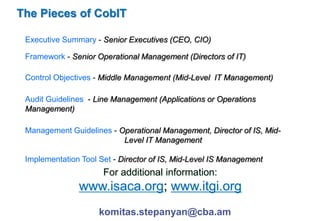
The Pieces of CobIT 
Executive Summary - Senior Executives (CEO, CIO) 
Framework - Senior Operational Management (Directors of IT) 
Control Objectives - Middle Management (Mid-Level IT Management) 
Audit Guidelines - Line Management (Applications or Operations 
Management) 
Management Guidelines - Operational Management, Director of IS, Mid- 
Level IT Management 
Implementation Tool Set - Director of IS, Mid-Level IS Management 
For additional information: 
www.isaca.org; www.itgi.org 
komitas.stepanyan@cba.am

IT Governance in Banks, May, 2014

  • 1.
    USAID Finance forEconomic Development (FED) Program Workshop: “IT Governance in Banks” May 27, 2014
  • 2.
    IT Governance: Why,How, When… Komitas Stepanyan, PhD, CRISC, CMRM CobIT Foundation Certificate YEREVAN - 2014
  • 3.
    Agenda Introduction The problem  Management Expectations of IT  IT management challenges  Key risk Framework Implementation Guidance
  • 4.
    Is IT Worksas needed??? Statistics… Over 80% of IT project are delivered late and over budget. (Standish Group – Oct 2006) Nearly 60% of all IT projects are delivered with less functionality that originally promised. (Standish Group – Mar 2007) More than 25% of the IT projects usually fail (Gartner Group – May 2006) Less than 5% of project fail due to technical reasons – Nearly all obstacles are related to poorly defined requirements, poor sponsorship, weak management controls or all of the above. (Gartner Group – May 2006) The IT aspects of CG are one of things that CEO’s think they don’t have to understand-until it bites them! (Piter Morriss - KPMG)
  • 5.
    Facts… “ ITGovernance is the responsibility of the Board of Directors and executive management. It is an integral part of enterprise governance and consists of the leadership and organizational structures and processes that ensure that the organization’s IT sustains and extends the organizations strategies and objectives.” IT Governance Institute Board Briefing, Second Edition, 2003
  • 6.
    Strategic Alignment Value Creation Risk Management Resource Management Performance Measurement Plan & Organize Acquire & Implement Deliver & Support Monitor
  • 7.
    Management/Business Expectations ofIT - What does management expect from IT? ? Information Technologies - What is an IT at all? - How to use it? - How to manage it? - How to be sure everything works as needed? - How to measure results? It’s the time to recognize and manage complexity It’s the time to open “Black Box” …
  • 8.
    Information management challenges How the organization will operate How the information systems themselves will work. Information systems are only successful if they are used.
  • 9.
    Key risk Misalignmentbetween IT and Business  Time and budget overruns  Ineffective IT Investments  Useless IT systems  Anachronism IT systems Apply good IT(and not only) risk management to ensure success
  • 10.
    Agenda Introduction The problem  Management Expectations of IT  Information management challenges  Key risk Framework Implementation Guidance
  • 11.
    The psychology/ sociologyof Failed Systems Inconsistent materials Work overloads Lack of measures & defined processes Cascading rework Soloed functional processes Inconsistent procedures for identical tasks Unintegrated best practices
  • 12.
    CobIT Framework Management’sIT Expectations Management’s IT Responsibilities
  • 13.
    Management Needs COBIT To Evaluate IT Investment Decisions To Balance Risk and Control of Investment To Benchmark Existing and Future IT Environment 76% of various CEOs and CIOs are aware of the benefits offered by IT governance frameworks, yet only 42% of them had any intention of implementing such a framework” (Loggerenberg 2006)
  • 14.
    Business Requirements CobITCube IT Processes DS M PO AI Domains Processes Activities People Application Information Infrastructure
  • 15.
    Who Benefits fromMore Effective and Sustainable IT Governance?  What Executives Get  – Business improvements that result from knowledgeable participation in IT decision-making from an enterprise perspective  – Ensures that key IT investments support the business and provide optimum returns to the business  – Ensures compliance with laws regulations  What Mid-Level Business Managers Get  – Convinces senior business managers that their combined business -IT resources are being managed effectively  – Helps to ensure that business services for which they are responsible will meet commitments  What Senior IT Managers Get  – Obtains sponsorship and support and a clear focus on important strategic and operational initiatives  – Improves customer relationships by delivering results in a more predictable and consistent manner, with the involvement of the customer  What Program/Project and Operations Managers Get  Helps in resolving issues, review progress and, enable faster decisions  What Everyone Gets  – Facilitates communications about how IT contributes to the business  – Improves coordination, cooperation, communications and synergy across the organization  – Less stress
  • 16.
    Agenda Introduction The problem  Management Expectations of IT  Information management challenges  Key risk Framework Implementation Guidance
  • 17.
    How To ImplementCobIT in an Organization Top Down Approach Audit Committee Approach Audit and IT Management Consensus Approach Regulation/Legislation
  • 18.
    Getting Started –Board and Executive Questions for IT Does the IT strategy align with the business strategy? Is the IT investment justified based on its contributions to the business? How likely will IT meet or exceed its plans, objectives and initiatives? Is IT being managed prudent, effectively? How is that measured? How is IT delivering value? Is IT developing and maintaining constructive relationships with customers, vendors and others? Is IT delivering projects and services on time, within scope, within budget and with high quality? Is IT staffed adequately, wit the right skills and competencies? How does IT management and operations compare to other best practice organizations How is IT managing and planning for contingencies, disasters, security, and back- up? How is IT measuring its performance? What key performance measures? Does the Board review and possibly approve the IT strategy? Is a risk management policy, assessment and mitigation practice followed for IT?
  • 19.
    To Adopt CobIT,Who Needs To Be Influenced?  Chief Executive (e.g., CEO)  Senior IT Executive (CIO or VP of IT)  IT Steering Committee  IT Management  Business managers
  • 20.
    CobIT Maturity Model How do you know where you are? Nonexistent Initial Repeatable Defined Managed Optimised 0 1 2 3 4 5
  • 21.
    CB RA Case Before CobIT Implementation
  • 22.
    CB RA Case After CobIT Implementation
  • 23.
    CB RA Case After CobIT Implementation - 2011 Process Maturity By CobIT IT Processes Maturity level AVRG IT AVRG IT & IT Audit IT Audit Benchmark
  • 24.
    Summary • ITgovernance is a broad and complex topic with many parts • Clearly defined roles, ownership and accountability • IT governance is integral part of corporate governance • IT governance is a journey and not only destination
  • 25.
    To be orNOT to be? D I s c u s s I o n IT Governance or NOT IT Governance?
  • 27.
    Business and IT’sPerpetual Disconnect AT Kearney, from a survey conducted in December 2001, report that only 17% of businesses had IT strategies that were "fully aligned and developed simultaneously" with corporate strategy. Furthermore, 45% of participants did not feel that their IT strategies were developed to support or align with their corporate strategy. Fact: The Corporate Alignment Profile most often shows IT as the most unaligned group.
  • 28.
    CEOs Seeking aSolution The IT Governance Global Status Report (2004) found that 80%+ of CEOs recognised that “IT Governance or some form thereof is required” to resolve “IT issues”. The Report also found that 57% of CEOs looked to IT Governance to align IT strategy (and 53% to manage IT risks). However the Report concluded that “solutions in this domain are not yet available”.
  • 29.
    What CIOs Want? The top benefits CIOs were hoping to achieve: Increased IT credibility with the business (81%); Closer alignment between IT and business objectives (69%); Improved teamwork between IT and internal business partners (68%); Improved ability for CIO to influence the business (46%). #CIO Research Reports. June 1, 2005. Turning IT Doubters into True Believers http://www2.cio.com/research/index.cfm
  • 30.
    The Pieces ofCobIT Executive Summary - Senior Executives (CEO, CIO) Framework - Senior Operational Management (Directors of IT) Control Objectives - Middle Management (Mid-Level IT Management) Audit Guidelines - Line Management (Applications or Operations Management) Management Guidelines - Operational Management, Director of IS, Mid- Level IT Management Implementation Tool Set - Director of IS, Mid-Level IS Management For additional information: www.isaca.org; www.itgi.org komitas.stepanyan@cba.am