Motivating Employees
Group Members
Contents
• Motivational Strategies
• Incentive Schemes
• Job Enrichment
• Employee Empowerment
• Job Satisfaction
• Morale
Motivation
• ‘Motivation’ is derived from the word ‘motive’.
• It is the driving force within individuals that
propels them into action.
• Types of Motivation
o Positive Vs Negative Motivation
o Rational Vs Emotional Motivation
o Intrinsic Vs Extrinsic Motivation
o Financial Vs Non-Financial Motivation
Motivational Strategies
• Among the most popular motivational
strategies today are as follows:
Motivational
Strategies
Employee
Empowerment
Job Enrichment
Incentive
Schemes
Other Motivational Strategies
• Positive reinforcement
• Effective discipline
• Treating people fairly
• Satisfying employees needs
• Setting work related goals
• Base rewards on job performance
Incentive Schemes
• “An incentive scheme is a plan or programmes
to motivate individual for good performance.
An incentive is most frequently built on
monetary rewards, but may also include a
variety of non-monetary rewards or
prizes”(Burrack and Smith)
Types of Incentives
1. Financial Incentives:
i. Individual Incentives
ii. Group Incentives
iii. Enterprise Incentives
2. Non- Financial Incentives:
1. Job Security
2. Recognition
3. Better Designation
4. Job Rotation
Advantages
• Motivation to workers
• Increase in productivity
• Attractive Proposition for Management
• Increase in Earnings of Employees
Disadvantages
• Increased Expenses
• Lead to Higher Labour Cost
• Feeling of Jealousy among workers
• Danger of Accidents
Job Enrichment
• Job enrichment was first coined by Herzberg.
• It is a motivational technique which
emphasizes the need for challenging and
interesting work
• Job enrichment involves providing an
employee with more responsibility for a job
and challenges the individual’s skills at work.
Advantages of Job Enrichment
• The importance or merits or advantages of job enrichment are:-
 Job enrichment is useful to both the workers and the organization.
 The worker gets achievement, recognition and self-actualization.
 The worker gets a sense of belonging to the organization.
 The worker finds the job meaningful.
 Job enrichment reduces absenteeism, labour-turnover and grievances.
 It motivates the workers to give best performance.
Limitations Of Job Enrichment
The shortcomings or demerits or limitations of job enrichment are:-
 In many cases, job enrichment does not give the expected results.
 It makes many changes in the job. So many workers oppose it.
 It has limited use for highly skilled managers and professionals.
 The consent of workers is not taken before implementing job enrichment.
 Managers force the workers to accept job enrichment, which is not
good.
Employee Empowerment
• “Empowerment is the process of sharing
power with employees”(Bateman & Snell)
• “Empowerment is any process that provides
greater autonomy through the sharing of
relevant information and the provision of
control over factors affecting job
performance”(Newstrom & Davis)
Process Of Employee Empowerment
Determining the Goals
Orienting the employees
Transferring Authority
Assigning Responsibility
Ensuring Accountability
Maintaining
Communication
Following-Up & Feedback
Strategies of Employee Empowerment
• Delegating Authority
• Expanding Skills
• Employee Input
• Cross-Training
• Open-Door Policy
• Team-Building
• Communication
Job Satisfaction
• “Job Satisfaction is an employee’s judgement
of how well his job has satisfied his various
needs”(Smith)
• Motivation of employees is influenced by job
satisfaction.
• Generally, motivated employees are more
satisfied and involved in their work.
Job satisfaction is
an attitude rather
than a behavior.
In addition to attitudes
about a job as a whole,
people can have attitudes
about various aspects of
their jobs, such as the kind of
work, pay, relationship with
their supervisor, the quality
of the physical environment
in which they work, degree
of fulfillment in their work,
etc.
Job Satisfaction is an emotional response
to a job situation. It determined by how
well outcomes meet or exceed
expectations. Job Satisfaction represents
several related attitudes.
Determinants of Job Satisfaction
Individual factors
•Level of Education
•Age
•Other factors
Nature Of Job
•Occupational level
•Job Content
Situational
Variables
•Working Conditions
•Opportunity For
Promotion
•Work group
Impact Of Job Satisfaction
Morale
• Morale is the degree of enthusiasm and
willingness with which individual workers of a
group set out to perform the assigned work
with zeal and sincerity, resulting in good team-
work.
Types of Morale
1. High Morale: Basic sense of satisfaction with oneself
Advantages:
i. Willing cooperation towards objectives of the
organization
ii. Loyalty to the organization and its leadership
iii. Good Leadership
iv. Sound superior subordinate relations
v. High degree of employee’s interest in their job and
organization.
vi. Reduction in grievance
vii. Team building
viii. Employee empowerment
• Low Morale: Indicates presence of mental
unrest.
• Low Morale exists when doubt and suspicion
are common and when individuals are
depressed and discouraged.
• Adverse consequences are:
i. High absenteeism
ii. Decreased quality
iii. Decreased productivity
iv. Excessive complaints
v. Frustration among workers
vi. Lack of discipline
Importance of Morale
• Boosts Motivation
• Maintains a Good Organizational Atmosphere
• Enhances Productivity
• Provides Total Satisfaction
• Retains Employees
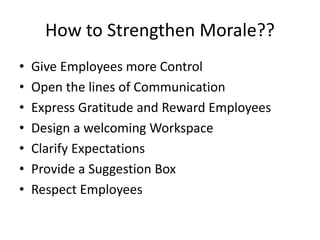
How to Strengthen Morale??
• Give Employees more Control
• Open the lines of Communication
• Express Gratitude and Reward Employees
• Design a welcoming Workspace
• Clarify Expectations
• Provide a Suggestion Box
• Respect Employees

Hrm

  • 1.
  • 2.
  • 3.
    Contents • Motivational Strategies •Incentive Schemes • Job Enrichment • Employee Empowerment • Job Satisfaction • Morale
  • 4.
    Motivation • ‘Motivation’ isderived from the word ‘motive’. • It is the driving force within individuals that propels them into action. • Types of Motivation o Positive Vs Negative Motivation o Rational Vs Emotional Motivation o Intrinsic Vs Extrinsic Motivation o Financial Vs Non-Financial Motivation
  • 5.
    Motivational Strategies • Amongthe most popular motivational strategies today are as follows: Motivational Strategies Employee Empowerment Job Enrichment Incentive Schemes
  • 6.
    Other Motivational Strategies •Positive reinforcement • Effective discipline • Treating people fairly • Satisfying employees needs • Setting work related goals • Base rewards on job performance
  • 7.
    Incentive Schemes • “Anincentive scheme is a plan or programmes to motivate individual for good performance. An incentive is most frequently built on monetary rewards, but may also include a variety of non-monetary rewards or prizes”(Burrack and Smith)
  • 8.
    Types of Incentives 1.Financial Incentives: i. Individual Incentives ii. Group Incentives iii. Enterprise Incentives 2. Non- Financial Incentives: 1. Job Security 2. Recognition 3. Better Designation 4. Job Rotation
  • 9.
    Advantages • Motivation toworkers • Increase in productivity • Attractive Proposition for Management • Increase in Earnings of Employees
  • 10.
    Disadvantages • Increased Expenses •Lead to Higher Labour Cost • Feeling of Jealousy among workers • Danger of Accidents
  • 11.
    Job Enrichment • Jobenrichment was first coined by Herzberg. • It is a motivational technique which emphasizes the need for challenging and interesting work • Job enrichment involves providing an employee with more responsibility for a job and challenges the individual’s skills at work.
  • 13.
    Advantages of JobEnrichment • The importance or merits or advantages of job enrichment are:-  Job enrichment is useful to both the workers and the organization.  The worker gets achievement, recognition and self-actualization.  The worker gets a sense of belonging to the organization.  The worker finds the job meaningful.  Job enrichment reduces absenteeism, labour-turnover and grievances.  It motivates the workers to give best performance.
  • 14.
    Limitations Of JobEnrichment The shortcomings or demerits or limitations of job enrichment are:-  In many cases, job enrichment does not give the expected results.  It makes many changes in the job. So many workers oppose it.  It has limited use for highly skilled managers and professionals.  The consent of workers is not taken before implementing job enrichment.  Managers force the workers to accept job enrichment, which is not good.
  • 15.
    Employee Empowerment • “Empowermentis the process of sharing power with employees”(Bateman & Snell) • “Empowerment is any process that provides greater autonomy through the sharing of relevant information and the provision of control over factors affecting job performance”(Newstrom & Davis)
  • 16.
    Process Of EmployeeEmpowerment Determining the Goals Orienting the employees Transferring Authority Assigning Responsibility Ensuring Accountability Maintaining Communication Following-Up & Feedback
  • 17.
    Strategies of EmployeeEmpowerment • Delegating Authority • Expanding Skills • Employee Input • Cross-Training • Open-Door Policy • Team-Building • Communication
  • 18.
    Job Satisfaction • “JobSatisfaction is an employee’s judgement of how well his job has satisfied his various needs”(Smith) • Motivation of employees is influenced by job satisfaction. • Generally, motivated employees are more satisfied and involved in their work.
  • 19.
    Job satisfaction is anattitude rather than a behavior. In addition to attitudes about a job as a whole, people can have attitudes about various aspects of their jobs, such as the kind of work, pay, relationship with their supervisor, the quality of the physical environment in which they work, degree of fulfillment in their work, etc. Job Satisfaction is an emotional response to a job situation. It determined by how well outcomes meet or exceed expectations. Job Satisfaction represents several related attitudes.
  • 20.
    Determinants of JobSatisfaction Individual factors •Level of Education •Age •Other factors Nature Of Job •Occupational level •Job Content Situational Variables •Working Conditions •Opportunity For Promotion •Work group
  • 21.
    Impact Of JobSatisfaction
  • 22.
    Morale • Morale isthe degree of enthusiasm and willingness with which individual workers of a group set out to perform the assigned work with zeal and sincerity, resulting in good team- work.
  • 23.
    Types of Morale 1.High Morale: Basic sense of satisfaction with oneself Advantages: i. Willing cooperation towards objectives of the organization ii. Loyalty to the organization and its leadership iii. Good Leadership iv. Sound superior subordinate relations v. High degree of employee’s interest in their job and organization. vi. Reduction in grievance vii. Team building viii. Employee empowerment
  • 24.
    • Low Morale:Indicates presence of mental unrest. • Low Morale exists when doubt and suspicion are common and when individuals are depressed and discouraged. • Adverse consequences are: i. High absenteeism ii. Decreased quality iii. Decreased productivity iv. Excessive complaints v. Frustration among workers vi. Lack of discipline
  • 25.
    Importance of Morale •Boosts Motivation • Maintains a Good Organizational Atmosphere • Enhances Productivity • Provides Total Satisfaction • Retains Employees
  • 26.
    How to StrengthenMorale?? • Give Employees more Control • Open the lines of Communication • Express Gratitude and Reward Employees • Design a welcoming Workspace • Clarify Expectations • Provide a Suggestion Box • Respect Employees