Evaluation, Feedback, and Rewards 7 Chapter
Introduction Organizations use a variety of rewards to attract and retain people and to motivate them to achieve their personal and organizational goals The manner and timing of distributing rewards are important issues for managers To distribute rewards equitably, it is necessary to evaluate employee performance
Purposes of Evaluation:  Judgmental Provide a basis for reward allocation (e.g., raises, promotions, transfers, etc.) Identify high-potential employees Validate the effectiveness of employee selection procedures Evaluate previous training programs
Purposes of Evaluation:  Developmental Stimulate performance improvement Develop ways of overcoming obstacles and performance barriers Identify training and development opportunities Establish supervisor-employee agreement on performance expectations
Focus of Evaluation Evaluations should focus on translating the position responsibilities into each employee’s day-to-day activities Performance evaluations should focus on job performance, not individuals Evaluations should have proper weighting of relevant behaviors
Relevancy of Evaluation Deficiency  – occurs when the evaluation does not focus on all aspects of the job Contamination  – occurs when activities  not  part of the job are included in the evaluation Distortion  – occurs in the evaluation process when an improper emphasis is given to various job elements
Improving Evaluations  (1 of 3) Higher levels of  employee participation  in the evaluation process lead to more satisfaction with the system Setting  specific performance goals  to be met results in greater performance improvement than discussions of more general goals
Improving Evaluations  (2 of 3) Supervisors should  receive training  in how to evaluate employee performance They should be evaluated on  how effectively  they do this Systematic evaluation of performance does little good if the results are not  communicated  to employees
Improving Evaluations  (3 of 3) Performance evaluation feedback should not focus solely on problem areas Good performance should be  actively recognized and reinforced Effective performance evaluation is a  continuous,  ongoing process
Performance Evaluation Feedback The need for feedback among people on and off the job is significant People want to know: how they are doing how they are being perceived by others how they can make adjustments to perform better Delivering feedback to a poor performing employee is a difficult experience for a manager
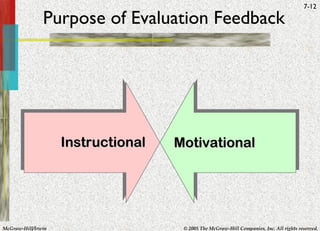
Purpose of Evaluation Feedback Instructional Motivational
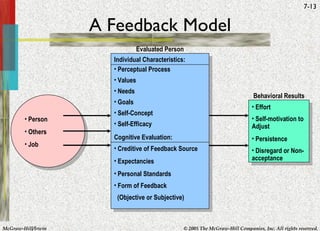
A Feedback Model Person Others Job Behavioral Results Effort Self-motivation to Adjust Persistence Disregard or Non-acceptance Evaluated Person Individual Characteristics: Perceptual Process Values Needs Goals Self-Concept Self-Efficacy Cognitive Evaluation: Creditive of Feedback Source Expectancies Personal Standards Form of Feedback (Objective or Subjective)
Multisource Feedback: A 360-Degree Approach 90 percent of  Fortune 1000  firms use some form of multisource program The increasing use of multisource programs is the result of calls for more fairness clarity credibility Everyone in the person’s full domain could serve as an evaluator
Best Practices to Improve 360-Degree Feedback Programs  (1 of 2) Use 360-degree feedback primarily for individual development Link the feedback process with the overall strategy and direction of the firm Exert administrative control over every aspect of the 360-degree process
Best Practices to Improve 360-Degree Feedback Programs  (2 of 2) Use senior management as role models Use highly trained internal coaches to leverage the investment Evaluate the effectiveness or return on investment of the process
Reinforcement Theory Reinforcement is the most important principle of learning Desirable or reinforcing consequences will increase the strength of a behavior and increase the probability of being repeated Undesirable or punishment consequences will decrease the strength of a response and decrease its probability of being repeated
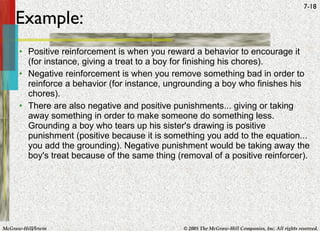
Example: Positive reinforcement is when you reward a behavior to encourage it (for instance, giving a treat to a boy for finishing his chores).  Negative reinforcement is when you remove something bad in order to reinforce a behavior (for instance, ungrounding a boy who finishes his chores).  There are also negative and positive punishments... giving or taking away something in order to make someone do something less. Grounding a boy who tears up his sister's drawing is positive punishment (positive because it is something you add to the equation... you add the grounding). Negative punishment would be taking away the boy's treat because of the same thing (removal of a positive reinforcer).
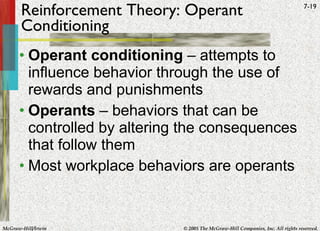
Reinforcement Theory: Operant Conditioning Operant conditioning  – attempts to influence behavior through the use of rewards and punishments Operants  – behaviors that can be controlled by altering the consequences that follow them Most workplace behaviors are operants
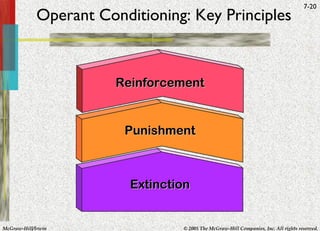
Operant Conditioning: Key Principles Reinforcement Punishment Extinction
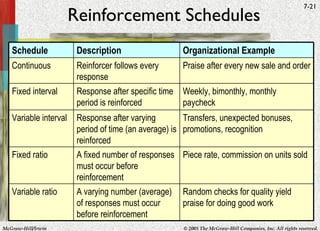
Reinforcement Schedules Schedule Description Organizational Example Continuous Reinforcer follows every response Praise after every new sale and order Fixed interval Response after specific time period is reinforced Weekly, bimonthly, monthly paycheck Variable interval Response after varying period of time (an average) is reinforced Transfers, unexpected bonuses, promotions, recognition Fixed ratio A fixed number of responses must occur before reinforcement Piece rate, commission on units sold Variable ratio A varying number (average) of responses must occur before reinforcement Random checks for quality yield praise for doing good work
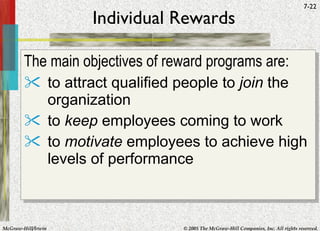
Individual Rewards The main objectives of reward programs are: to attract qualified people to  join  the organization to  keep  employees coming to work to  motivate  employees to achieve high levels of performance
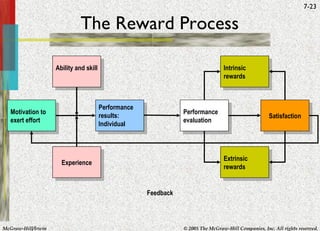
The Reward Process Feedback Motivation to exert effort Ability and skill Experience Performance results: Individual Performance evaluation Intrinsic rewards Extrinsic rewards Satisfaction
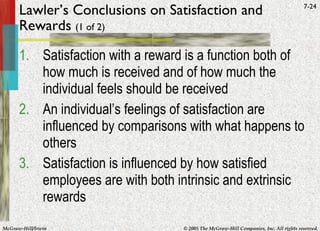
Lawler’s Conclusions on Satisfaction and Rewards  (1 of 2) Satisfaction with a reward is a function both of how much is received and of how much the individual feels should be received An individual’s feelings of satisfaction are influenced by comparisons with what happens to others Satisfaction is influenced by how satisfied employees are with both intrinsic and extrinsic rewards
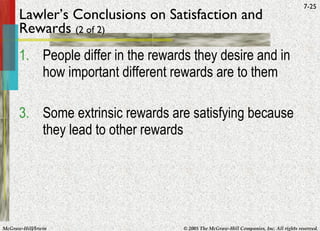
Lawler’s Conclusions on Satisfaction and Rewards  (2 of 2) People differ in the rewards they desire and in how important different rewards are to them Some extrinsic rewards are satisfying because they lead to other rewards
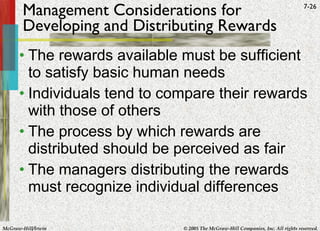
Management Considerations for Developing and Distributing Rewards The rewards available must be sufficient to satisfy basic human needs Individuals tend to compare their rewards with those of others The process by which rewards are distributed should be perceived as fair The managers distributing the rewards must recognize individual differences
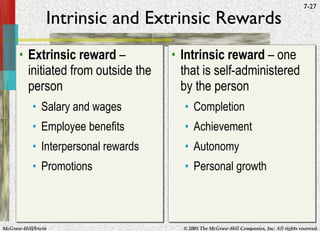
Intrinsic and Extrinsic Rewards Extrinsic reward  – initiated from outside the person Salary and wages Employee benefits Interpersonal rewards Promotions Intrinsic reward  – one that is self-administered by the person Completion Achievement Autonomy Personal growth
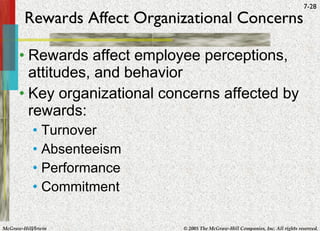
Rewards Affect Organizational Concerns Rewards affect employee perceptions, attitudes, and behavior Key organizational concerns affected by rewards: Turnover Absenteeism Performance Commitment
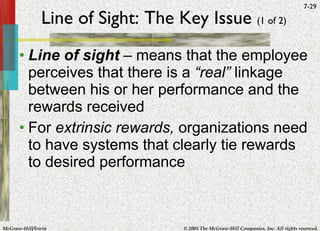
Line of Sight: The Key Issue  (1 of 2) Line of sight  – means that the employee perceives that there is a  “real”  linkage between his or her performance and the rewards received For  extrinsic rewards,  organizations need to have systems that clearly tie rewards to desired performance
Line of Sight: The Key Issue  (2 of 2) Organizations can influence  intrinsic rewards  by: providing jobs that are challenging providing clear feedback on job performance

HBO Handout Chapter 7 (Evaluation, Feedback, and Rewards)

  • 1.
  • 2.
    Evaluation, Feedback, andRewards 7 Chapter
  • 3.
    Introduction Organizations usea variety of rewards to attract and retain people and to motivate them to achieve their personal and organizational goals The manner and timing of distributing rewards are important issues for managers To distribute rewards equitably, it is necessary to evaluate employee performance
  • 4.
    Purposes of Evaluation: Judgmental Provide a basis for reward allocation (e.g., raises, promotions, transfers, etc.) Identify high-potential employees Validate the effectiveness of employee selection procedures Evaluate previous training programs
  • 5.
    Purposes of Evaluation: Developmental Stimulate performance improvement Develop ways of overcoming obstacles and performance barriers Identify training and development opportunities Establish supervisor-employee agreement on performance expectations
  • 6.
    Focus of EvaluationEvaluations should focus on translating the position responsibilities into each employee’s day-to-day activities Performance evaluations should focus on job performance, not individuals Evaluations should have proper weighting of relevant behaviors
  • 7.
    Relevancy of EvaluationDeficiency – occurs when the evaluation does not focus on all aspects of the job Contamination – occurs when activities not part of the job are included in the evaluation Distortion – occurs in the evaluation process when an improper emphasis is given to various job elements
  • 8.
    Improving Evaluations (1 of 3) Higher levels of employee participation in the evaluation process lead to more satisfaction with the system Setting specific performance goals to be met results in greater performance improvement than discussions of more general goals
  • 9.
    Improving Evaluations (2 of 3) Supervisors should receive training in how to evaluate employee performance They should be evaluated on how effectively they do this Systematic evaluation of performance does little good if the results are not communicated to employees
  • 10.
    Improving Evaluations (3 of 3) Performance evaluation feedback should not focus solely on problem areas Good performance should be actively recognized and reinforced Effective performance evaluation is a continuous, ongoing process
  • 11.
    Performance Evaluation FeedbackThe need for feedback among people on and off the job is significant People want to know: how they are doing how they are being perceived by others how they can make adjustments to perform better Delivering feedback to a poor performing employee is a difficult experience for a manager
  • 12.
    Purpose of EvaluationFeedback Instructional Motivational
  • 13.
    A Feedback ModelPerson Others Job Behavioral Results Effort Self-motivation to Adjust Persistence Disregard or Non-acceptance Evaluated Person Individual Characteristics: Perceptual Process Values Needs Goals Self-Concept Self-Efficacy Cognitive Evaluation: Creditive of Feedback Source Expectancies Personal Standards Form of Feedback (Objective or Subjective)
  • 14.
    Multisource Feedback: A360-Degree Approach 90 percent of Fortune 1000 firms use some form of multisource program The increasing use of multisource programs is the result of calls for more fairness clarity credibility Everyone in the person’s full domain could serve as an evaluator
  • 15.
    Best Practices toImprove 360-Degree Feedback Programs (1 of 2) Use 360-degree feedback primarily for individual development Link the feedback process with the overall strategy and direction of the firm Exert administrative control over every aspect of the 360-degree process
  • 16.
    Best Practices toImprove 360-Degree Feedback Programs (2 of 2) Use senior management as role models Use highly trained internal coaches to leverage the investment Evaluate the effectiveness or return on investment of the process
  • 17.
    Reinforcement Theory Reinforcementis the most important principle of learning Desirable or reinforcing consequences will increase the strength of a behavior and increase the probability of being repeated Undesirable or punishment consequences will decrease the strength of a response and decrease its probability of being repeated
  • 18.
    Example: Positive reinforcementis when you reward a behavior to encourage it (for instance, giving a treat to a boy for finishing his chores). Negative reinforcement is when you remove something bad in order to reinforce a behavior (for instance, ungrounding a boy who finishes his chores). There are also negative and positive punishments... giving or taking away something in order to make someone do something less. Grounding a boy who tears up his sister's drawing is positive punishment (positive because it is something you add to the equation... you add the grounding). Negative punishment would be taking away the boy's treat because of the same thing (removal of a positive reinforcer).
  • 19.
    Reinforcement Theory: OperantConditioning Operant conditioning – attempts to influence behavior through the use of rewards and punishments Operants – behaviors that can be controlled by altering the consequences that follow them Most workplace behaviors are operants
  • 20.
    Operant Conditioning: KeyPrinciples Reinforcement Punishment Extinction
  • 21.
    Reinforcement Schedules ScheduleDescription Organizational Example Continuous Reinforcer follows every response Praise after every new sale and order Fixed interval Response after specific time period is reinforced Weekly, bimonthly, monthly paycheck Variable interval Response after varying period of time (an average) is reinforced Transfers, unexpected bonuses, promotions, recognition Fixed ratio A fixed number of responses must occur before reinforcement Piece rate, commission on units sold Variable ratio A varying number (average) of responses must occur before reinforcement Random checks for quality yield praise for doing good work
  • 22.
    Individual Rewards Themain objectives of reward programs are: to attract qualified people to join the organization to keep employees coming to work to motivate employees to achieve high levels of performance
  • 23.
    The Reward ProcessFeedback Motivation to exert effort Ability and skill Experience Performance results: Individual Performance evaluation Intrinsic rewards Extrinsic rewards Satisfaction
  • 24.
    Lawler’s Conclusions onSatisfaction and Rewards (1 of 2) Satisfaction with a reward is a function both of how much is received and of how much the individual feels should be received An individual’s feelings of satisfaction are influenced by comparisons with what happens to others Satisfaction is influenced by how satisfied employees are with both intrinsic and extrinsic rewards
  • 25.
    Lawler’s Conclusions onSatisfaction and Rewards (2 of 2) People differ in the rewards they desire and in how important different rewards are to them Some extrinsic rewards are satisfying because they lead to other rewards
  • 26.
    Management Considerations forDeveloping and Distributing Rewards The rewards available must be sufficient to satisfy basic human needs Individuals tend to compare their rewards with those of others The process by which rewards are distributed should be perceived as fair The managers distributing the rewards must recognize individual differences
  • 27.
    Intrinsic and ExtrinsicRewards Extrinsic reward – initiated from outside the person Salary and wages Employee benefits Interpersonal rewards Promotions Intrinsic reward – one that is self-administered by the person Completion Achievement Autonomy Personal growth
  • 28.
    Rewards Affect OrganizationalConcerns Rewards affect employee perceptions, attitudes, and behavior Key organizational concerns affected by rewards: Turnover Absenteeism Performance Commitment
  • 29.
    Line of Sight:The Key Issue (1 of 2) Line of sight – means that the employee perceives that there is a “real” linkage between his or her performance and the rewards received For extrinsic rewards, organizations need to have systems that clearly tie rewards to desired performance
  • 30.
    Line of Sight:The Key Issue (2 of 2) Organizations can influence intrinsic rewards by: providing jobs that are challenging providing clear feedback on job performance