Assigned by : Mr. Sultan
Presented by:
Zerish and Maryam Noor
21-Jan-2019 1By Maryam and Zerish
Objectives:
At the end of this this presentation you will be able to:
• Define solution, solvent and solute.
• Define isotonic, hypertonic and hypotonic solutions.
• Define their causes and signs & symptoms.
• Discuss the various types of fluids are administered.
• Discuss the importance of these fluids.
• Identify the osmolarity of various fluids.
21-Jan-2019 2By Maryam and Zerish
Solution
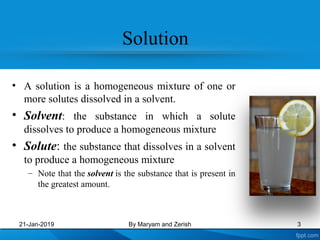
• A solution is a homogeneous mixture of one or
more solutes dissolved in a solvent.
• Solvent: the substance in which a solute
dissolves to produce a homogeneous mixture
• Solute: the substance that dissolves in a solvent
to produce a homogeneous mixture
– Note that the solvent is the substance that is present in
the greatest amount.
21-Jan-2019 By Maryam and Zerish 3
Solution
21-Jan-2019 By Maryam and Zerish 4
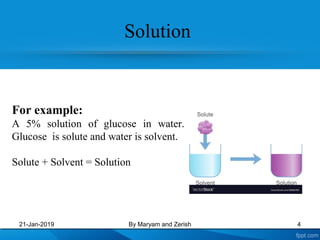
For example:
A 5% solution of glucose in water.
Glucose is solute and water is solvent.
Solute + Solvent = Solution
Osmolarity
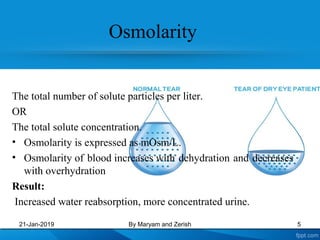
The total number of solute particles per liter.
OR
The total solute concentration.
• Osmolarity is expressed as mOsm/L.
• Osmolarity of blood increases with dehydration and decreases
with overhydration
Result:
Increased water reabsorption, more concentrated urine.
21-Jan-2019 By Maryam and Zerish 5
Solutions
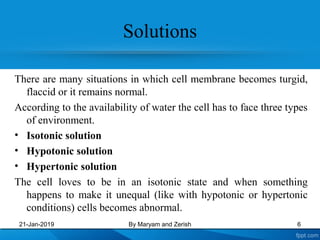
There are many situations in which cell membrane becomes turgid,
flaccid or it remains normal.
According to the availability of water the cell has to face three types
of environment.
• Isotonic solution
• Hypotonic solution
• Hypertonic solution
The cell loves to be in an isotonic state and when something
happens to make it unequal (like with hypotonic or hypertonic
conditions) cells becomes abnormal.
21-Jan-2019 6By Maryam and Zerish
Isotonic solution
• Iso: same/equal
• Tonic: concentration of a solution
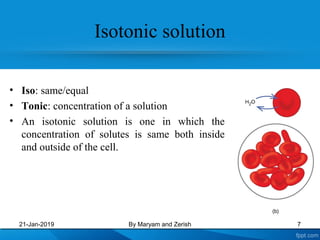
• An isotonic solution is one in which the
concentration of solutes is same both inside
and outside of the cell.
21-Jan-2019 7By Maryam and Zerish
cont..
Result
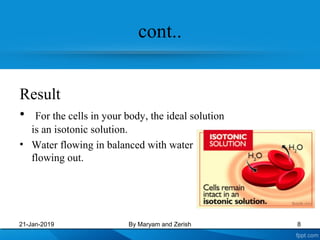
• For the cells in your body, the ideal solution
is an isotonic solution.
• Water flowing in balanced with water
flowing out.
21-Jan-2019 By Maryam and Zerish 8
Isotonic fluids
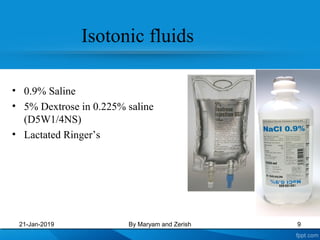
• 0.9% Saline
• 5% Dextrose in 0.225% saline
(D5W1/4NS)
• Lactated Ringer’s
21-Jan-2019 By Maryam and Zerish 9
Uses
Isotonic solutions are used:
To increase the extracellular fluid volume due to
• Blood loss
• Surgery
• Dehydration
• Fluid loss that has been loss extracellularly
21-Jan-2019 By Maryam and Zerish 10
Normal Blood Osmolarity
• The osmolarity of blood is about 300-310 mOsm/L.
• 0.9 NaCl is isotonic with blood serum and that means that it will
diffuse out of the blood vessel after IV injection in a similar
fashion to the components of the blood serum itself.
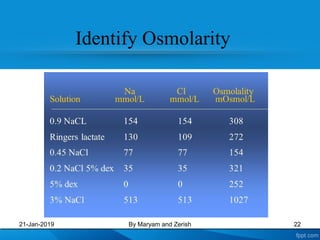
• 0.9NaCl contains:
– 154 mOsm/L of Na
– 154 mOsm/L of Cl
Giving the solution an osmolarity of 308 mOsm/L.
The American Heart Association recommends no more than 2,300
milligrams (mg) a day=1 teaspoon of salt
21-Jan-2019 By Maryam and Zerish 11
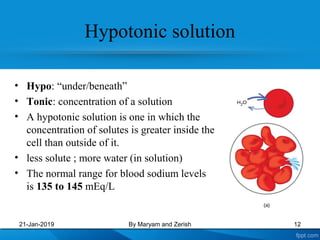
Hypotonic solution
• Hypo: “under/beneath”
• Tonic: concentration of a solution
• A hypotonic solution is one in which the
concentration of solutes is greater inside the
cell than outside of it.
• less solute ; more water (in solution)
• The normal range for blood sodium levels
is 135 to 145 mEq/L
21-Jan-2019 12By Maryam and Zerish
Hypotonic
Result
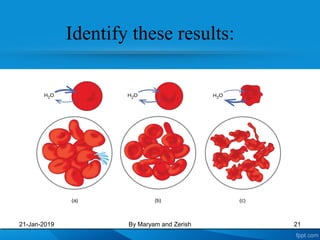
• Water is transported into the cell.
• A cell placed in hypotonic solution will burst.
Hypotonic fluids
• 0.45% Saline (1/2 NS)
• 0.225% Saline (1/4 NS)
• 0.33% saline (1/3 NS)
21-Jan-2019 By Maryam and Zerish 13
Causes
• Hyponatremia or hypotonia occurs when the sodium in your
blood falls below 135 mEq/L.
• Heart diseases
• Kidney failure
• Drinking too much water
• Decreased salt intake.
21-Jan-2019 By Maryam and Zerish 14
Signs and symptoms
Hypotonicity causes:
• Nausea and vomiting
• Putting edema
• Headache
• Confusion
• Loss of energy, drowsiness and fatigue
• Muscle weakness, spasms or cramps
• Seizures
• Coma
21-Jan-2019 By Maryam and Zerish 15
Uses
Hypotonic solutions are used
• When the cell is dehydrated and fluids need to be put back
intracellular.
• This happens when patients develop diabetic ketoacidosis
(DKA) or hyperosmolar hyperglycemia.
21-Jan-2019 By Maryam and Zerish 16
Hypertonic
• Hyper: excessive
• Tonic: concentration of a solution
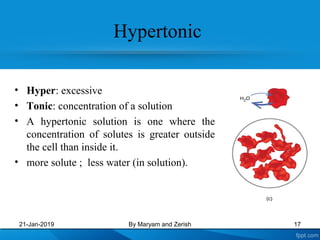
• A hypertonic solution is one where the
concentration of solutes is greater outside
the cell than inside it.
• more solute ; less water (in solution).
21-Jan-2019 17By Maryam and Zerish
Causes
• Severe, watery diarrhea vomiting
• Fever
• Certain medications
• Poorly controlled diabetes
• Larger burn areas on the skin
• Kidney disease
21-Jan-2019 By Maryam and Zerish 18
Hypertonic cont..
Result
• Water is transported out from the cell.
• A cell placed in hypertonic solution will lose water and shrink.
Hypertonic fluids
• 3% Saline
• 5% Saline
• 10% Dextrose in Water (D10W)
• 5% Dextrose in 0.9% Saline
• 5% Dextrose in 0.45% saline
21-Jan-2019 19By Maryam and Zerish
• Decreased urine out put
• Thirst and dry mouth
• Fluid retention
• Muscle twitching or spasm
• Seizures and coma may occur (in severe)
• Brain dysfunction
21-Jan-2019 By Maryam and Zerish 20
Signs and symptoms
Identify these results:
21-Jan-2019 21By Maryam and Zerish
Identify Osmolarity
21-Jan-2019 By Maryam and Zerish 22
Patient scenarios
• Your patient has had nausea, vomiting, and diarrhea for 4 days.
The blood work shows this patient is dehydrated but their
electrolytes have managed to stay within normal limits.
• What kind of solution is this patients blood?
– Hypertonic
• What kind of fluid would you give this patient?
– Isotonic at first such as 0.9% NaCl (expand their volume and
give them more to move or shift around)
– Hypotonic second, usually 0.45% NaCl (shift the fluid into the
cells)
21-Jan-2019 By Maryam and Zerish 23
Cont..
• Your patient comes in with pitting edema on the lower
extremities. The blood work confirms congestive heart failure
(CHF).
• What kind of solution is this patients blood?
– Hypotonic
• What kind of fluid would you give this patient?
– Hypertonic (shifts fluid out of the extracellular space and
into the vein, to be filtered out in the kidneys)
21-Jan-2019 By Maryam and Zerish 24
Cont..
• You patient is hypotensive, dizzy, weak, and reports abdominal
pain. The blood work confirms adrenal insufficiency.
• What kind of solution is this patients blood?
– Isotonic
• Adrenal insufficiency leads to loss of volume and loss of
sodium leaving the patient hypovolemic and hyponatremic.
• What kind of fluid would you give this patient?
– Isotonic to help treat the hypotension by expanding the volume
of fluid in the veins.
21-Jan-2019 By Maryam and Zerish 25
References:
If you want to get further knowledge you may follow these
references:
• https://www.nursingcenter.com/journalarticle?
Article_ID=652137&Journal_ID=54016&Issue_ID=652101
• www.chem.purdue.edu
• https://www.mayoclinic.org/diseases-
conditions/hyponatremia/symptoms-causes/syc-20373711
21-Jan-2019 26By Maryam and Zerish
21-Jan-2019 By Maryam and Zerish 27
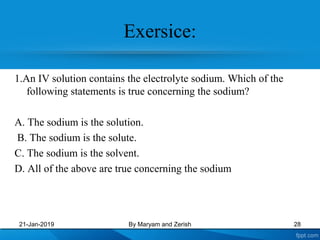
Exersice:
1.An IV solution contains the electrolyte sodium. Which of the
following statements is true concerning the sodium?
A. The sodium is the solution.
B. The sodium is the solute.
C. The sodium is the solvent.
D. All of the above are true concerning the sodium
21-Jan-2019 By Maryam and Zerish 28
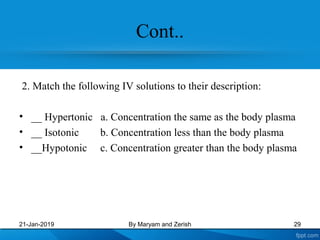
Cont..
2. Match the following IV solutions to their description:
• __ Hypertonic a. Concentration the same as the body plasma
• __ Isotonic b. Concentration less than the body plasma
• __Hypotonic c. Concentration greater than the body plasma
21-Jan-2019 By Maryam and Zerish 29
Cont..
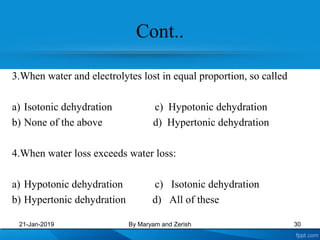
21-Jan-2019 By Maryam and Zerish 30
3.When water and electrolytes lost in equal proportion, so called
a) Isotonic dehydration c) Hypotonic dehydration
b) None of the above d) Hypertonic dehydration
4.When water loss exceeds water loss:
a) Hypotonic dehydration c) Isotonic dehydration
b) Hypertonic dehydration d) All of these
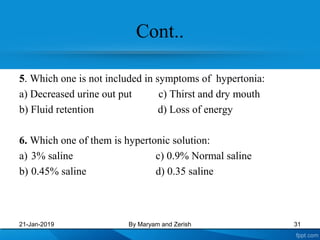
Cont..
5. Which one is not included in symptoms of hypertonia:
a) Decreased urine out put c) Thirst and dry mouth
b) Fluid retention d) Loss of energy
6. Which one of them is hypertonic solution:
a) 3% saline c) 0.9% Normal saline
b) 0.45% saline d) 0.35 saline
21-Jan-2019 By Maryam and Zerish 31
21-Jan-2019 By Maryam and Zerish 32

Isotonic, hypotonic and hypertonic solutions.

  • 1.
    Assigned by :Mr. Sultan Presented by: Zerish and Maryam Noor 21-Jan-2019 1By Maryam and Zerish
  • 2.
    Objectives: At the endof this this presentation you will be able to: • Define solution, solvent and solute. • Define isotonic, hypertonic and hypotonic solutions. • Define their causes and signs & symptoms. • Discuss the various types of fluids are administered. • Discuss the importance of these fluids. • Identify the osmolarity of various fluids. 21-Jan-2019 2By Maryam and Zerish
  • 3.
    Solution • A solutionis a homogeneous mixture of one or more solutes dissolved in a solvent. • Solvent: the substance in which a solute dissolves to produce a homogeneous mixture • Solute: the substance that dissolves in a solvent to produce a homogeneous mixture – Note that the solvent is the substance that is present in the greatest amount. 21-Jan-2019 By Maryam and Zerish 3
  • 4.
    Solution 21-Jan-2019 By Maryamand Zerish 4 For example: A 5% solution of glucose in water. Glucose is solute and water is solvent. Solute + Solvent = Solution
  • 5.
    Osmolarity The total numberof solute particles per liter. OR The total solute concentration. • Osmolarity is expressed as mOsm/L. • Osmolarity of blood increases with dehydration and decreases with overhydration Result: Increased water reabsorption, more concentrated urine. 21-Jan-2019 By Maryam and Zerish 5
  • 6.
    Solutions There are manysituations in which cell membrane becomes turgid, flaccid or it remains normal. According to the availability of water the cell has to face three types of environment. • Isotonic solution • Hypotonic solution • Hypertonic solution The cell loves to be in an isotonic state and when something happens to make it unequal (like with hypotonic or hypertonic conditions) cells becomes abnormal. 21-Jan-2019 6By Maryam and Zerish
  • 7.
    Isotonic solution • Iso:same/equal • Tonic: concentration of a solution • An isotonic solution is one in which the concentration of solutes is same both inside and outside of the cell. 21-Jan-2019 7By Maryam and Zerish
  • 8.
    cont.. Result • For thecells in your body, the ideal solution is an isotonic solution. • Water flowing in balanced with water flowing out. 21-Jan-2019 By Maryam and Zerish 8
  • 9.
    Isotonic fluids • 0.9%Saline • 5% Dextrose in 0.225% saline (D5W1/4NS) • Lactated Ringer’s 21-Jan-2019 By Maryam and Zerish 9
  • 10.
    Uses Isotonic solutions areused: To increase the extracellular fluid volume due to • Blood loss • Surgery • Dehydration • Fluid loss that has been loss extracellularly 21-Jan-2019 By Maryam and Zerish 10
  • 11.
    Normal Blood Osmolarity •The osmolarity of blood is about 300-310 mOsm/L. • 0.9 NaCl is isotonic with blood serum and that means that it will diffuse out of the blood vessel after IV injection in a similar fashion to the components of the blood serum itself. • 0.9NaCl contains: – 154 mOsm/L of Na – 154 mOsm/L of Cl Giving the solution an osmolarity of 308 mOsm/L. The American Heart Association recommends no more than 2,300 milligrams (mg) a day=1 teaspoon of salt 21-Jan-2019 By Maryam and Zerish 11
  • 12.
    Hypotonic solution • Hypo:“under/beneath” • Tonic: concentration of a solution • A hypotonic solution is one in which the concentration of solutes is greater inside the cell than outside of it. • less solute ; more water (in solution) • The normal range for blood sodium levels is 135 to 145 mEq/L 21-Jan-2019 12By Maryam and Zerish
  • 13.
    Hypotonic Result • Water istransported into the cell. • A cell placed in hypotonic solution will burst. Hypotonic fluids • 0.45% Saline (1/2 NS) • 0.225% Saline (1/4 NS) • 0.33% saline (1/3 NS) 21-Jan-2019 By Maryam and Zerish 13
  • 14.
    Causes • Hyponatremia orhypotonia occurs when the sodium in your blood falls below 135 mEq/L. • Heart diseases • Kidney failure • Drinking too much water • Decreased salt intake. 21-Jan-2019 By Maryam and Zerish 14
  • 15.
    Signs and symptoms Hypotonicitycauses: • Nausea and vomiting • Putting edema • Headache • Confusion • Loss of energy, drowsiness and fatigue • Muscle weakness, spasms or cramps • Seizures • Coma 21-Jan-2019 By Maryam and Zerish 15
  • 16.
    Uses Hypotonic solutions areused • When the cell is dehydrated and fluids need to be put back intracellular. • This happens when patients develop diabetic ketoacidosis (DKA) or hyperosmolar hyperglycemia. 21-Jan-2019 By Maryam and Zerish 16
  • 17.
    Hypertonic • Hyper: excessive •Tonic: concentration of a solution • A hypertonic solution is one where the concentration of solutes is greater outside the cell than inside it. • more solute ; less water (in solution). 21-Jan-2019 17By Maryam and Zerish
  • 18.
    Causes • Severe, waterydiarrhea vomiting • Fever • Certain medications • Poorly controlled diabetes • Larger burn areas on the skin • Kidney disease 21-Jan-2019 By Maryam and Zerish 18
  • 19.
    Hypertonic cont.. Result • Wateris transported out from the cell. • A cell placed in hypertonic solution will lose water and shrink. Hypertonic fluids • 3% Saline • 5% Saline • 10% Dextrose in Water (D10W) • 5% Dextrose in 0.9% Saline • 5% Dextrose in 0.45% saline 21-Jan-2019 19By Maryam and Zerish
  • 20.
    • Decreased urineout put • Thirst and dry mouth • Fluid retention • Muscle twitching or spasm • Seizures and coma may occur (in severe) • Brain dysfunction 21-Jan-2019 By Maryam and Zerish 20 Signs and symptoms
  • 21.
  • 22.
  • 23.
    Patient scenarios • Yourpatient has had nausea, vomiting, and diarrhea for 4 days. The blood work shows this patient is dehydrated but their electrolytes have managed to stay within normal limits. • What kind of solution is this patients blood? – Hypertonic • What kind of fluid would you give this patient? – Isotonic at first such as 0.9% NaCl (expand their volume and give them more to move or shift around) – Hypotonic second, usually 0.45% NaCl (shift the fluid into the cells) 21-Jan-2019 By Maryam and Zerish 23
  • 24.
    Cont.. • Your patientcomes in with pitting edema on the lower extremities. The blood work confirms congestive heart failure (CHF). • What kind of solution is this patients blood? – Hypotonic • What kind of fluid would you give this patient? – Hypertonic (shifts fluid out of the extracellular space and into the vein, to be filtered out in the kidneys) 21-Jan-2019 By Maryam and Zerish 24
  • 25.
    Cont.. • You patientis hypotensive, dizzy, weak, and reports abdominal pain. The blood work confirms adrenal insufficiency. • What kind of solution is this patients blood? – Isotonic • Adrenal insufficiency leads to loss of volume and loss of sodium leaving the patient hypovolemic and hyponatremic. • What kind of fluid would you give this patient? – Isotonic to help treat the hypotension by expanding the volume of fluid in the veins. 21-Jan-2019 By Maryam and Zerish 25
  • 26.
    References: If you wantto get further knowledge you may follow these references: • https://www.nursingcenter.com/journalarticle? Article_ID=652137&Journal_ID=54016&Issue_ID=652101 • www.chem.purdue.edu • https://www.mayoclinic.org/diseases- conditions/hyponatremia/symptoms-causes/syc-20373711 21-Jan-2019 26By Maryam and Zerish
  • 27.
    21-Jan-2019 By Maryamand Zerish 27
  • 28.
    Exersice: 1.An IV solutioncontains the electrolyte sodium. Which of the following statements is true concerning the sodium? A. The sodium is the solution. B. The sodium is the solute. C. The sodium is the solvent. D. All of the above are true concerning the sodium 21-Jan-2019 By Maryam and Zerish 28
  • 29.
    Cont.. 2. Match thefollowing IV solutions to their description: • __ Hypertonic a. Concentration the same as the body plasma • __ Isotonic b. Concentration less than the body plasma • __Hypotonic c. Concentration greater than the body plasma 21-Jan-2019 By Maryam and Zerish 29
  • 30.
    Cont.. 21-Jan-2019 By Maryamand Zerish 30 3.When water and electrolytes lost in equal proportion, so called a) Isotonic dehydration c) Hypotonic dehydration b) None of the above d) Hypertonic dehydration 4.When water loss exceeds water loss: a) Hypotonic dehydration c) Isotonic dehydration b) Hypertonic dehydration d) All of these
  • 31.
    Cont.. 5. Which oneis not included in symptoms of hypertonia: a) Decreased urine out put c) Thirst and dry mouth b) Fluid retention d) Loss of energy 6. Which one of them is hypertonic solution: a) 3% saline c) 0.9% Normal saline b) 0.45% saline d) 0.35 saline 21-Jan-2019 By Maryam and Zerish 31
  • 32.
    21-Jan-2019 By Maryamand Zerish 32