Normal Body Fluids and
Electrolytes
with fluids used in surgery
Dr. Sunil K S Gaur (MS)
Senior Resident, Surgery,
HIMS, Varanasi
Introduction
Fluid and electrolyte balance is a dynamic
process that is crucial for life.
It plays an important role in homeostasis.
Imbalance may result from manyfactors,
and it is associated with the illness
Bodyfluids/Water
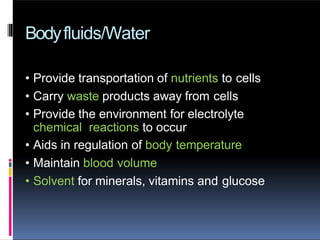
• Provide transportation of nutrients to cells
• Carry waste products away from cells
• Provide the environment for electrolyte
chemical reactions to occur
• Aids in regulation of body temperature
• Maintain blood volume
• Solvent for minerals, vitamins and glucose
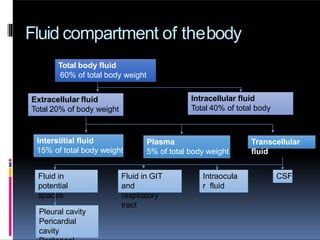
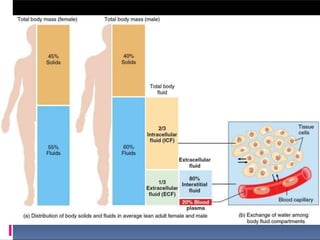
Fluid compartment of thebody
Total body fluid
60% of total body weight
Extracellular fluid
Total 20% of body weight
Intracellular fluid
Total 40% of total body
weight
Interstitial fluid
15% of total body weight
Plasma
5% of total body weight
Transcellular
fluid
Fluid in
potential
spaces
Fluid in GIT
and
respiratory
tract
Intraocula
r fluid
CSF
Pleural cavity
Pericardial
cavity
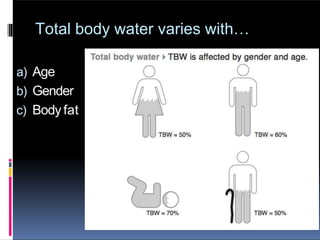
Total body water varies with…
a) Age
b) Gender
c) Bodyfat
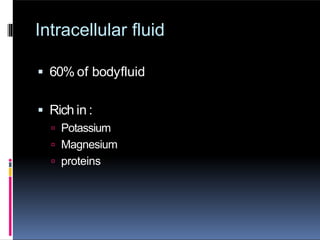
Intracellular fluid
 60% of bodyfluid
 Rich in :
 Potassium
 Magnesium
 proteins
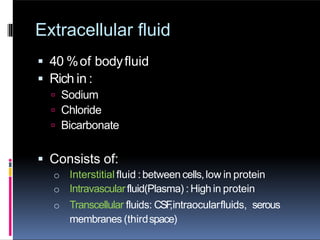
Extracellular fluid
 40 %of bodyfluid
 Rich in :
 Sodium
 Chloride
 Bicarbonate
 Consists of:
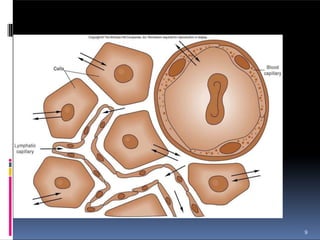
o Interstitial fluid :between cells,low in protein
o Intravascularfluid(Plasma) : High in protein
o Transcellular fluids: CSF,intraocularfluids, serous
membranes (thirdspace)
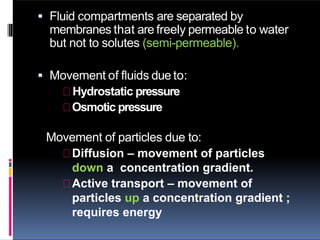
 Fluid compartments are separated by
membranes that are freely permeable to water
but not to solutes (semi-permeable).
 Movement of fluids due to:
Hydrostatic pressure
Osmotic pressure
Movement of particles due to:
Diffusion – movement of particles
down a concentration gradient.
Active transport – movement of
particles up a concentration gradient ;
requires energy
9
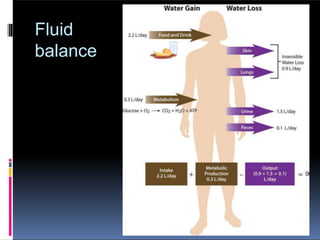
Fluid
balance
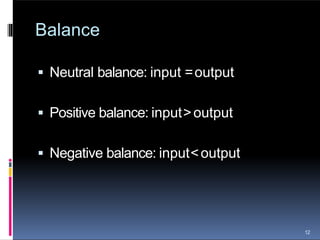
Balance
12
 Neutral balance: input =output
 Positive balance: input>output
 Negative balance: input<output
Solutes – dissolved
particles
15
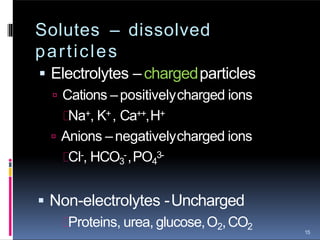
 Electrolytes –chargedparticles
 Cations –positivelycharged ions
Na+, K+, Ca++,H+
 Anions –negativelycharged ions
Cl-, HCO3
-,PO4
3-
 Non-electrolytes -Uncharged
Proteins, urea, glucose,O2,CO2
Definitions
• Solute: a particle, usually a salt
• Solvent: liquid, usually water
• Solution: solute and solvent mixed
together
16
Definitions
 MW (Molecular Weight) =sum of theweights
of atoms in a molecule
 mEq(milliequivalents) =MW (in mg)/ valence
 mOsm (milliosmoles) =number of particles in
asolution
Definitions
• Osmolarity: the concentration of a
solution expressed as the total
number of solute particles per litre.
• Osmolality: the concentration of a
solution expressed as the total
number of solute particles per
kilogram
• Tonicity: is a measure of the effective
osmotic pressure gradient, as defined
by the water potential of two solutions
separated by a semipermeable
membrane
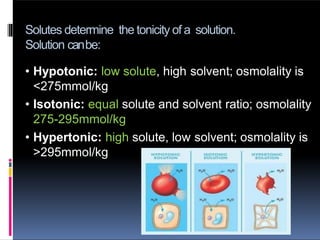
Solutes determine the tonicity of a solution.
Solution canbe:
• Hypotonic: low solute, high solvent; osmolality is
<275mmol/kg
• Isotonic: equal solute and solvent ratio; osmolality
275-295mmol/kg
• Hypertonic: high solute, low solvent; osmolality is
>295mmol/kg
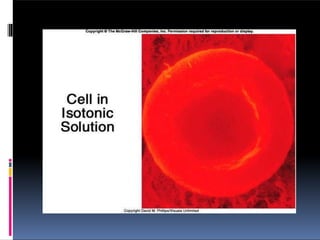
Isotonic
• Iso: same/equal
• Tonic: concentration of a solution
• The cell has the same concentration on the
inside and outside.
• Isotonic solutions are used to increase
the extracellular fluid volume in
oblood loss
osurgery
odehydration
Isotonicfluids
1) 0.9% NaCl (Normal Saline)
2) 5% dextrose in water (D5W) (In the bag)
also used as a hypotonic solution after it is administered
because the body absorbs the dextrose BUT it is
considered isotonic
3) 5% Dextrose in 0.225% saline (D5W1/4NS)
4) Lactated Ringer’s
Hypertonic
• Hyper: excessive
• Tonic: concentration of a solution
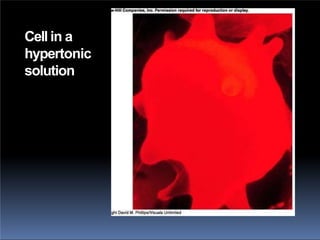
• The cell has an excessive amount of solute extra-
cellularly and osmosis is causing water to rush out
of the cell which will cause the cell to shrink.
• Hypertonic solutions are used very cautiously.
(most likely to be given in the ICU due to quickly
arising side effects of pulmonary edema/fluid over
load).
• In addition, it is preferred to give hypertonic
solutions
via a central line due to the hypertonic solution
being vesicant on the veins and the risk of
Hypertonicsolutions
1) 3% Saline
2) 5% Saline
3) 10% Dextrose in Water
(D10W)
4) 5% Dextrose in 0.9% Saline
5) 5% Dextrose in 0.45% saline
6) 5% Dextrose in Lactated
Ringer’s
Cell in a
hypertonic
solution
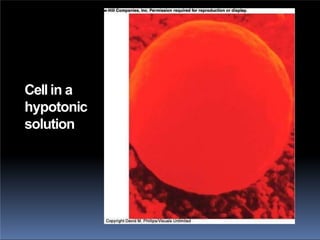
Hypotonic
• Hypo: ”under/beneath”
• Tonic: concentration of a solution
• The cell has a low amount of solute extracellularly
and fluid shifts inside the cell to get everything
back to normal via osmosis. This will cause cell
swelling which can cause the cell to burst or lyses.
• Hypotonic solutions are used when the
cell is dehydrated and fluids need to be
put back intracellularly.
o diabetic ketoacidosis (DKA)
o hyperosmolar hyperglycemia
Hypotonicsolutions
1) D5W (in the body)
2) 0.25% NaCl
3) 0.45% NaCl (half normal
saline)
4) 2.5% Dextrose
Cell in a
hypotonic
solution
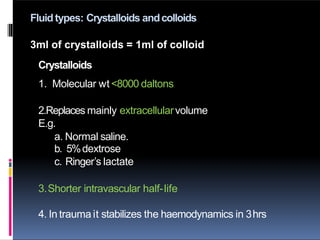
Fluidtypes: Crystalloids andcolloids
3ml of crystalloids = 1ml of colloid
Crystalloids
1. Molecular wt<8000 daltons
2.Replaces mainly extracellularvolume
E.g.
a. Normal saline.
b. 5%dextrose
c. Ringer’s lactate
3.Shorter intravascular half-life
4. In trauma it stabilizes the haemodynamics in 3hrs
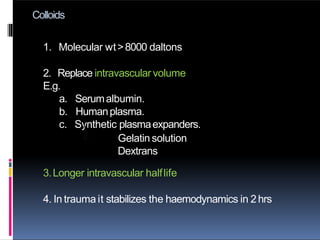
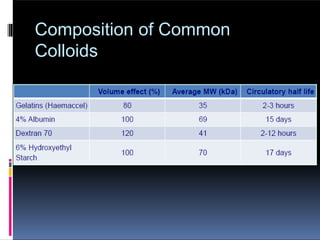
Colloids
1. Molecular wt>8000 daltons
2. Replace intravascular volume
E.g.
a. Serumalbumin.
b. Humanplasma.
c. Synthetic plasmaexpanders.i.
ii. Gelatin solution
Dextrans
3.Longer intravascular halflife
4. In trauma it stabilizes the haemodynamics in 2 hrs
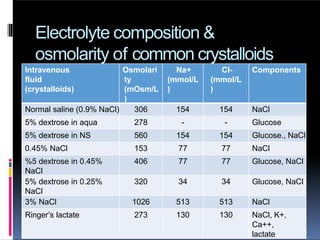
Electrolyte composition &
osmolarity of common crystalloids
Intravenous
fluid
(crystalloids)
Osmolari
ty
(mOsm/L
)
Na+
(mmol/L
)
Cl-
(mmol/L
)
Components
Normal saline (0.9% NaCl) 306 154 154 NaCl
5% dextrose in aqua 278 - - Glucose
5% dextrose in NS 560 154 154 Glucose., NaCl
0.45% NaCl 153 77 77 NaCl
%5 dextrose in 0.45%
NaCl
406 77 77 Glucose, NaCl
5% dextrose in 0.25%
NaCl
320 34 34 Glucose, NaCl
3% NaCl 1026 513 513 NaCl
Ringer’s lactate 273 130 130 NaCl, K+,
Ca++,
lactate
Composition of Common
Colloids
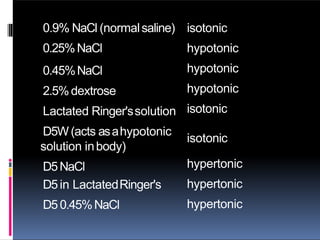
0.9% NaCl (normalsaline)
0.25%NaCl
0.45%NaCl
2.5%dextrose
Lactated Ringer'ssolution
D5W(acts asahypotonic
solution inbody)
D5NaCl
D5in LactatedRinger's
D50.45%NaCl
isotonic
hypotonic
hypotonic
hypotonic
isotonic
isotonic
hypertonic
hypertonic
hypertonic
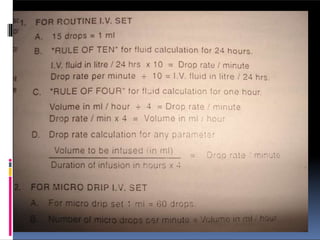
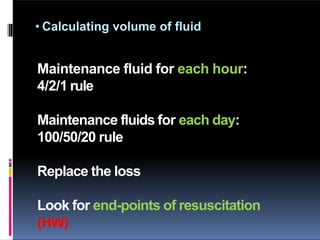
• Calculating volume of fluid
Maintenance fluid for each hour:
4/2/1 rule
Maintenance fluids for each day:
100/50/20 rule
Replace the loss
Look for end-points of resuscitation
(HW)
What I hear, I forget;
What I see, I
remember. What I do,
I understand.
- Confusius, 451
BC
Normal fluid and electrolytes: with commonly used fluids

Normal fluid and electrolytes: with commonly used fluids

  • 1.
    Normal Body Fluidsand Electrolytes with fluids used in surgery Dr. Sunil K S Gaur (MS) Senior Resident, Surgery, HIMS, Varanasi
  • 2.
    Introduction Fluid and electrolytebalance is a dynamic process that is crucial for life. It plays an important role in homeostasis. Imbalance may result from manyfactors, and it is associated with the illness
  • 3.
    Bodyfluids/Water • Provide transportationof nutrients to cells • Carry waste products away from cells • Provide the environment for electrolyte chemical reactions to occur • Aids in regulation of body temperature • Maintain blood volume • Solvent for minerals, vitamins and glucose
  • 4.
    Fluid compartment ofthebody Total body fluid 60% of total body weight Extracellular fluid Total 20% of body weight Intracellular fluid Total 40% of total body weight Interstitial fluid 15% of total body weight Plasma 5% of total body weight Transcellular fluid Fluid in potential spaces Fluid in GIT and respiratory tract Intraocula r fluid CSF Pleural cavity Pericardial cavity
  • 6.
    Total body watervaries with… a) Age b) Gender c) Bodyfat
  • 7.
    Intracellular fluid  60%of bodyfluid  Rich in :  Potassium  Magnesium  proteins
  • 8.
    Extracellular fluid  40%of bodyfluid  Rich in :  Sodium  Chloride  Bicarbonate  Consists of: o Interstitial fluid :between cells,low in protein o Intravascularfluid(Plasma) : High in protein o Transcellular fluids: CSF,intraocularfluids, serous membranes (thirdspace)
  • 9.
     Fluid compartmentsare separated by membranes that are freely permeable to water but not to solutes (semi-permeable).  Movement of fluids due to: Hydrostatic pressure Osmotic pressure Movement of particles due to: Diffusion – movement of particles down a concentration gradient. Active transport – movement of particles up a concentration gradient ; requires energy
  • 10.
  • 11.
  • 12.
    Balance 12  Neutral balance:input =output  Positive balance: input>output  Negative balance: input<output
  • 13.
    Solutes – dissolved particles 15 Electrolytes –chargedparticles  Cations –positivelycharged ions Na+, K+, Ca++,H+  Anions –negativelycharged ions Cl-, HCO3 -,PO4 3-  Non-electrolytes -Uncharged Proteins, urea, glucose,O2,CO2
  • 14.
    Definitions • Solute: aparticle, usually a salt • Solvent: liquid, usually water • Solution: solute and solvent mixed together
  • 15.
    16 Definitions  MW (MolecularWeight) =sum of theweights of atoms in a molecule  mEq(milliequivalents) =MW (in mg)/ valence  mOsm (milliosmoles) =number of particles in asolution
  • 16.
    Definitions • Osmolarity: theconcentration of a solution expressed as the total number of solute particles per litre. • Osmolality: the concentration of a solution expressed as the total number of solute particles per kilogram • Tonicity: is a measure of the effective osmotic pressure gradient, as defined by the water potential of two solutions separated by a semipermeable membrane
  • 17.
    Solutes determine thetonicity of a solution. Solution canbe: • Hypotonic: low solute, high solvent; osmolality is <275mmol/kg • Isotonic: equal solute and solvent ratio; osmolality 275-295mmol/kg • Hypertonic: high solute, low solvent; osmolality is >295mmol/kg

  • 18.
    Isotonic • Iso: same/equal •Tonic: concentration of a solution • The cell has the same concentration on the inside and outside. • Isotonic solutions are used to increase the extracellular fluid volume in oblood loss osurgery odehydration
  • 19.
    Isotonicfluids 1) 0.9% NaCl(Normal Saline) 2) 5% dextrose in water (D5W) (In the bag) also used as a hypotonic solution after it is administered because the body absorbs the dextrose BUT it is considered isotonic 3) 5% Dextrose in 0.225% saline (D5W1/4NS) 4) Lactated Ringer’s
  • 21.
    Hypertonic • Hyper: excessive •Tonic: concentration of a solution • The cell has an excessive amount of solute extra- cellularly and osmosis is causing water to rush out of the cell which will cause the cell to shrink. • Hypertonic solutions are used very cautiously. (most likely to be given in the ICU due to quickly arising side effects of pulmonary edema/fluid over load). • In addition, it is preferred to give hypertonic solutions via a central line due to the hypertonic solution being vesicant on the veins and the risk of
  • 22.
    Hypertonicsolutions 1) 3% Saline 2)5% Saline 3) 10% Dextrose in Water (D10W) 4) 5% Dextrose in 0.9% Saline 5) 5% Dextrose in 0.45% saline 6) 5% Dextrose in Lactated Ringer’s
  • 23.
  • 24.
    Hypotonic • Hypo: ”under/beneath” •Tonic: concentration of a solution • The cell has a low amount of solute extracellularly and fluid shifts inside the cell to get everything back to normal via osmosis. This will cause cell swelling which can cause the cell to burst or lyses. • Hypotonic solutions are used when the cell is dehydrated and fluids need to be put back intracellularly. o diabetic ketoacidosis (DKA) o hyperosmolar hyperglycemia
  • 25.
    Hypotonicsolutions 1) D5W (inthe body) 2) 0.25% NaCl 3) 0.45% NaCl (half normal saline) 4) 2.5% Dextrose
  • 26.
  • 27.
    Fluidtypes: Crystalloids andcolloids 3mlof crystalloids = 1ml of colloid Crystalloids 1. Molecular wt<8000 daltons 2.Replaces mainly extracellularvolume E.g. a. Normal saline. b. 5%dextrose c. Ringer’s lactate 3.Shorter intravascular half-life 4. In trauma it stabilizes the haemodynamics in 3hrs
  • 28.
    Colloids 1. Molecular wt>8000daltons 2. Replace intravascular volume E.g. a. Serumalbumin. b. Humanplasma. c. Synthetic plasmaexpanders.i. ii. Gelatin solution Dextrans 3.Longer intravascular halflife 4. In trauma it stabilizes the haemodynamics in 2 hrs
  • 29.
    Electrolyte composition & osmolarityof common crystalloids Intravenous fluid (crystalloids) Osmolari ty (mOsm/L ) Na+ (mmol/L ) Cl- (mmol/L ) Components Normal saline (0.9% NaCl) 306 154 154 NaCl 5% dextrose in aqua 278 - - Glucose 5% dextrose in NS 560 154 154 Glucose., NaCl 0.45% NaCl 153 77 77 NaCl %5 dextrose in 0.45% NaCl 406 77 77 Glucose, NaCl 5% dextrose in 0.25% NaCl 320 34 34 Glucose, NaCl 3% NaCl 1026 513 513 NaCl Ringer’s lactate 273 130 130 NaCl, K+, Ca++, lactate
  • 30.
  • 31.
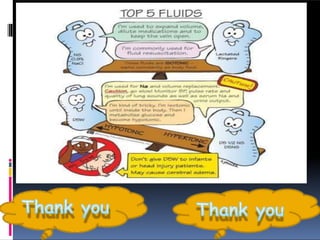
    0.9% NaCl (normalsaline) 0.25%NaCl 0.45%NaCl 2.5%dextrose LactatedRinger'ssolution D5W(acts asahypotonic solution inbody) D5NaCl D5in LactatedRinger's D50.45%NaCl isotonic hypotonic hypotonic hypotonic isotonic isotonic hypertonic hypertonic hypertonic
  • 34.
    • Calculating volumeof fluid Maintenance fluid for each hour: 4/2/1 rule Maintenance fluids for each day: 100/50/20 rule Replace the loss Look for end-points of resuscitation (HW)
  • 36.
    What I hear,I forget; What I see, I remember. What I do, I understand. - Confusius, 451 BC