Dr: TAHIRAAGHANI
 most important Body constituent
 Constitutes 60% Of the total body weight in male
 Constitutes 50% Of the total body weight in female
 The lesser percentage in females because of larger fat content. Fat cells have
minimal ICF.
 Elderly less water because of less muscle mass.
 Water is found in each and every tissue of the body, including bones and
cartilages!
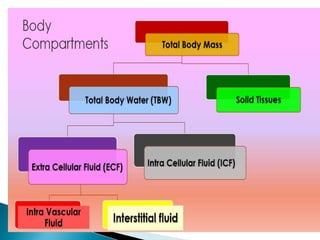
 Total Body Water (TBW) :
 The sum of intracellular water and extracellular water (volume)
 The latter consisting of
 the interstitial or tissue fluid
 the intravascular fluid or plasma.
 The Extra-Cellular Fluid (ECF): The water content found outside the
 body cells
 Constitutes two major compartments
 Intra-vascular & interstitial

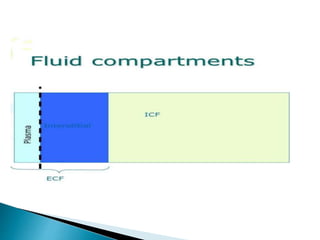
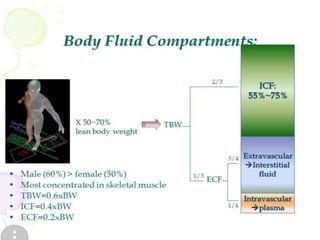
 Intravascular space/: is 1/4th of ECF.
 Interstitial fluid is 3/4th of ECF
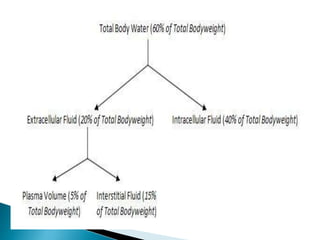
 60-40-20 rule:
 TBW =60% Of body weight.
 ICF= 40% Of body weight.
 ECF =20% Of body weight.
 Eg in 75 kg person
TBW 75 x 0.6= 45
 ICF= 75 x 0.4= 30
 ECF=75 x 0.2= 15L
 15 L of ECF= 10L of interstitail fluid+ 5 L of intravacular compartment
 Intra Cellular Fluid ( ICF):
 a fluid within cell membranes of the tissue cells, throughout
 most of the body
 Interstitial Fluid :
 fluid between the cells and interspaces of tissues.
 Intravascular Fluid :
 within the vessels
 Third Space:
 space in which fluid does not collect in body in large amount
 Eg pleural and peritoneal cavity.
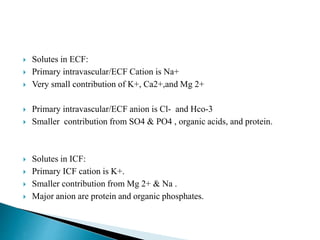
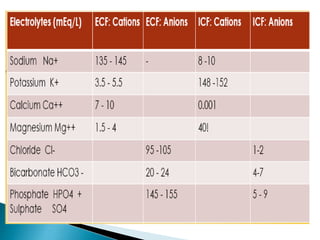
 Solutes in ECF:
 Primary intravascular/ECF Cation is Na+
 Very small contribution of K+, Ca2+,and Mg 2+
 Primary intravascular/ECF anion is Cl- and Hco-3
 Smaller contribution from SO4 & PO4 , organic acids, and protein.
 Solutes in ICF:
 Primary ICF cation is K+.
 Smaller contribution from Mg 2+ & Na .
 Major anion are protein and organic phosphates.

 Osmolality :
 No of osmotically active particles of solute per kg of solvent ( m
Osmol/Kg).
 Osmolarity:
 No of osmotically active particles of solute per liter of solvent.( m
Osmol/L)
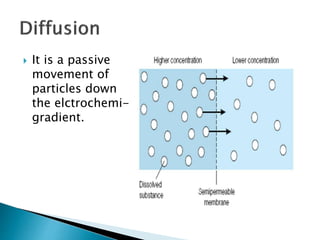
 It is a passive
movement of
particles down
the elctrochemi-
gradient.
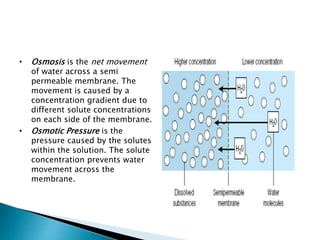
• Osmosis is the net movement
of water across a semi
permeable membrane. The
movement is caused by a
concentration gradient due to
different solute concentrations
on each side of the membrane.
• Osmotic Pressure is the
pressure caused by the solutes
within the solution. The solute
concentration prevents water
movement across the
membrane.
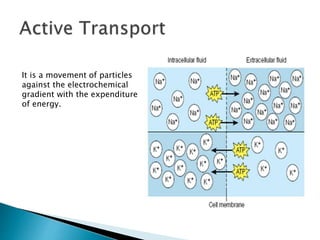
It is a movement of particles
against the electrochemical
gradient with the expenditure
of energy.
 Tonicity:
 Tonicity is the term used to compare the osmotic pressure of different
solutions.
 Is equal to the sum of the concentrations of the solutes which have the
capacity to exert an osmotic force across the membrane.
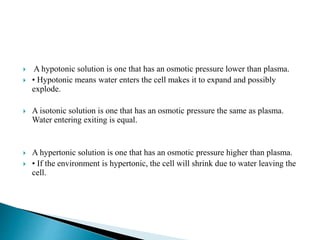
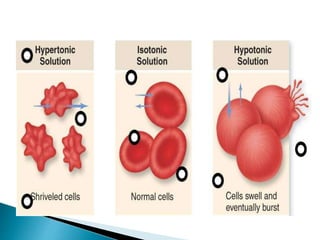
 A hypotonic solution is one that has an osmotic pressure lower than plasma.
 • Hypotonic means water enters the cell makes it to expand and possibly
explode.
 A isotonic solution is one that has an osmotic pressure the same as plasma.
Water entering exiting is equal.
 A hypertonic solution is one that has an osmotic pressure higher than plasma.
 • If the environment is hypertonic, the cell will shrink due to water leaving the
cell.
 Plasma or Serum Osmolality is Number of solutes dissolved in plasma.
 Normal range is : 275 -295 m Osmols/ Kg of Plasma.
 Calculated serum Osmolality = 2(Na)+glucose/18+urea/2.8.
 Oliguria is urine output < 500 mL in 24 h (0.5 mL/kg/h) in an
adult
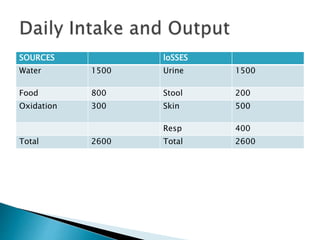
SOURCES loSSES
Water 1500 Urine 1500
Food 800 Stool 200
Oxidation 300 Skin 500
Resp 400
Total 2600 Total 2600
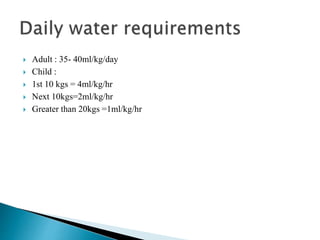
 Adult : 35- 40ml/kg/day
 Child :
 1st 10 kgs = 4ml/kg/hr
 Next 10kgs=2ml/kg/hr
 Greater than 20kgs =1ml/kg/hr
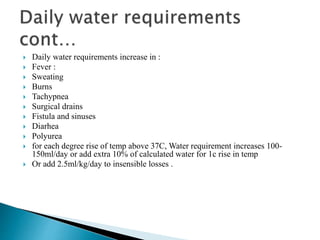
 Daily water requirements increase in :
 Fever :
 Sweating
 Burns
 Tachypnea
 Surgical drains
 Fistula and sinuses
 Diarhea
 Polyurea
 for each degree rise of temp above 37C, Water requirement increases 100-
150ml/day or add extra 10% of calculated water for 1c rise in temp
 Or add 2.5ml/kg/day to insensible losses .
 Decreased water intake is required in:
 oliguric renal failure
 the use of humidified air
 edematous states,
 hypothyroidism.
 Na =1.5-2mmol/kg/day
 K=1-1.5mmoml/kg/day
 Ca 0.2-0.3mmol/kg/day
 Mg 0.35-0.45mmol/kg/day
 Loss of isotonic fluid:
 E.g hemorrhage,isotonic urine, vomiting, diachrea.
 a) ECF volume contarct
 b) No fluid change in compartments as there is no change in osmolarity between
compartments
 c) HCT increases
 d) BP decreases
 Infusion Of Isotonic Fluid:
 a)Expansion Of ECF volume
 b)No change in osmolarity Of ECF
 c) No fluid shift between the compartments
 d) HCT decreases
 e)Bp rises
 Loss Of Hypotonic Fluid: eg sweating, DI
 A) decrease in volume of ECF
 b )increase in osmolarity Of ECF
 C) fluid shift from ICF to ECF
 D volume decreases overall , HCT increases
 E) osmolarity increases , HCT increases
 F) net > no effect on hct.
 Gain of hypotonic fluid :
 Eg tape water infusion, water intoxication, SIADH
 a) osmoloarity of ECF decreases
 b volume Of ECF increases
 b) Fluid shift from ECF to Icf
 d) volume increases ,HCT decreases
 E) osmolarity decreases, HCT increases
 F) as net effecr > noeffect on hct.
 Loss OF Hypertonic saline: eg Primary adrenal insufficiency
 a) decrease in volume of ECF
 B) decrease in osmolarity Of ECF
 C) Fluid shift from ECF to ICF
 D) osmolarity decreses
 E) volume decreses
 Gain of Hypertonic saline
 a)Osmolarity Of ECF increases
 b)Fluid shift from ICF to Ecf
 c)Volume of ECF increases > hct decreases
 d)Volume of ICF decreases
 E) cells shrink> hct decreases
 Crystalloid:
 Balanced salt/electrolyte solution; forms a true solution and is capable of
passing through semipermeable membranes.
 May be isotonic, hypertonic, or hypotonic.
 Normal Saline (0.9% NaCl NaCl),
 Lactated Ringer s,
 Hypertonic saline (3, 5, & 7.5%),
 Ringer solution.
 Useful for volume expansion (mainly interstitial ).
 For maintanance infusion
 Correcting electrolyte abnormality.
 No risk of allergic reactions.
 Because an isotonic solution stays in the intravascular space, it expands the
intravascular compartment.
 Only 25% remain intravascularly.
 Osmolarity is the same as serum osmolarity
 0.9% NaCl (Normal Saline)
 Lactated Ringers
 D5W (In the bag)
 •A hypotonic solution shifts fluid out of the intravascular compartment,
hydrating the cells and the interstitial compartments. Osmolarity is lower
than serum osmolarity .
 Less than 10% remain intravascularly, inadequate for fluid resuscitation.
 D5W (in the body)
 0.25% NaCl
 0.45% NaCl (half normal saline)
 •A hypertonic solution draws fluid into the intravascular compartment from
the cells and the interstitial compartments.
 Osmolarity is higher than serum osmolarity .
 D5 NaCl
 D5 in Lactated ringers
 D5 0.45% NaCl
 Colloid Solutions:
 High-molecular-molecular weight solutions, do not readily migrate across
capillary walls.
 draw fluid into intravascular compartment via oncotic pressure .
 Plasma expanders, as they are composed of macromolecules, and are retained
in the intravascular space.
 •They remain in blood vessels longer and increase intravascular volume
 •They attract water from the cells into the blood vessels
 •But this is a short term benefit and
 •Prolonged movement can cause the cells to lose too much water and
become dehydrated .
 May exacerbate hypovolumia after 24-36 hrs when it moves into 3rd space
itself.
 Albumin, Hetastarch Hetastarch, Plasma, Dextran .
 Albumin:
 5% and 20%.
 It is a naturally occuring colloid prepared from human plasma.
 5% albumin is used in hypovolumia.
 20% is used to treat severe hypoalbuminaemia.
 Dextran:
 It is a artificial colloid composed of branched chain polysaccharides.
 It can interfere with platelete function.
 Can induce anaphylactic shock.
 Hydroxyethyl starches:
 Composed of chains of glucose and are produced from maize.

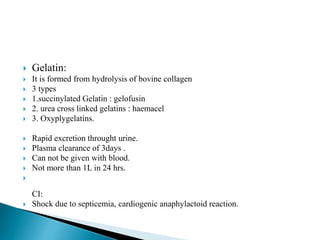
 Gelatin:
 It is formed from hydrolysis of bovine collagen
 3 types
 1.succinylated Gelatin : gelofusin
 2. urea cross linked gelatins : haemacel
 3. Oxyplygelatins.
 Rapid excretion throught urine.
 Plasma clearance of 3days .
 Can not be given with blood.
 Not more than 1L in 24 hrs.

CI:
 Shock due to septicemia, cardiogenic anaphylactoid reaction.
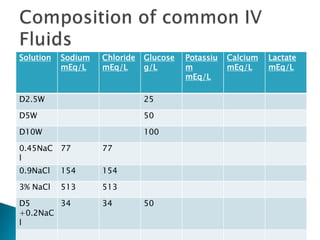
Solution Sodium
mEq/L
Chloride
mEq/L
Glucose
g/L
Potassiu
m
mEq/L
Calcium
mEq/L
Lactate
mEq/L
D2.5W 25
D5W 50
D10W 100
0.45NaC
l
77 77
0.9NaCl 154 154
3% NaCl 513 513
D5
+0.2NaC
l
34 34 50
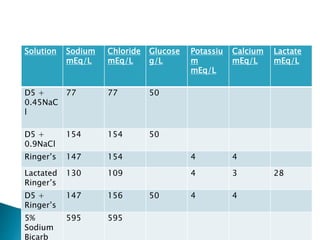
Solution Sodium
mEq/L
Chloride
mEq/L
Glucose
g/L
Potassiu
m
mEq/L
Calcium
mEq/L
Lactate
mEq/L
D5 +
0.45NaC
l
77 77 50
D5 +
0.9NaCl
154 154 50
Ringer’s 147 154 4 4
Lactated
Ringer’s
130 109 4 3 28
D5 +
Ringer’s
147 156 50 4 4
5%
Sodium
Bicarb
595 595
 Isotonic salt water.
 154mEq/Na+, 154 mEq /L Cl , 308mosl/L;
 Cheapest and most commonly used resuscitative crystalloid.
 High [ Cl-] above the normal serum 103 mEq /L imposes on
the kidneys an appreciable load of excess Cl that cannot be
rapidly excreted.
 A dilutional acidosis may develop by reducing base bicarb
relative to carbonic acid. Thus exist the risk of
hyperchloremic acidosis.

 Only solution that may be administered with blood products.
 Does not provide free water or calories.
 Restores NaCl deficits
 Normal saline is hyperchlremic (154)as compared to body (95-105).
 NacCl +H20>>>>>Hcl + NaOH .
 Strong acid (hcl) and strong base (NaOH) should cancel eachother with no
effect on PH.
 Normal concentration of Na (145) and Cl( 105), addinf saline causes Cl to
increase more than Na, this causes acid base balance more towards HCl
than Na .
 Causing metabolic acidosis.
 Isotonic, 273 mOsm/L
 Contains 130 mEq/L of Na, 109mEq/L of Cl, 28mEq/L of lactate and
4mEq/L K.
 Lactate is used instead of bicarb because it s more stable in IVF during
storage.
 as minimal effects on normal body fluid composition and pH.
 More closely resembles the electrolyte composition of normal blood serum.
Does not provide calories.
 Lactate is converted readily to bicarb by the liver.
 It is given to patients who have metabolic acidosis not lactic acidosis.
 Don’t give in liver diseases.
 Be cautious in pts with severe renal failure because of potassium.
 Do not give to pt with pH > 7.5.
 It is considered isotonic solution when in bag.
 In the body dextrose is metabolized and becomes hypotonic and
causes fluids shift into the cells.
 It provides free water and expands both compartments.
 It provides calories, no elctrolytes.
 Can cause fluid overload in pt with cardiac and renal failure.
 It can increases cerebral edema.
 Never mix with blood causes blood to hemolyse.
 Hypertonic, 406 mOsm /L
 Provides 170 calories/L from 5% dextrose .
 Provides free water for insensible losses and some Na to promote renal
function and excretion.
 With added K this is an excellent maintenance fluid in postop period.
 Prevents excess catabolism and limits proteolysis.
 1026 mOsm /L & 513 mEq /L Na .
 Increases plasma osmolality and thereby acts as a plasma expander,
increasing circulatory volume via movement of intracellular and interstitial
water into the intravascular space.
 Risk of hypernatremia thus careful neuro monitoring .
 Hyper tonic fluid should be infused in large vein with large blood volume
to dilute to dilute fluid.
 Volume deficits are best estimated by acute changes in weight.
 Less than 5% loss is very difficult to detect clinically.
 loss of 15+% will be associated with severe circulatory compromise.
 Mild deficit represents a loss of ~ 4% body wt.
 Moderate deficit --- a loss of ~ 6-8% body wt.
 Severe deficit --- a loss of ~ >10% body wt.
 Assess previous limited intake, thirst, abnormal losses, comorbidities.
 Indicators that a patient may need urgent fluid resuscitation include:
 systolic blood pressure is less than 100 mmHg
 heart rate is more than 90 beats per minute
 capillary refill time is more than 2 seconds or peripheries are cold to
touch
 respiratory rate is more than 20 breaths per minute
 National Early Warning Score (NEWS) is 5 or more
 passive leg raising suggests fluid responsiveness[2].
 Laboratory assessments: FBC, urea, creatinine and electrolytes
 If patients need IV fluid resuscitation, use crystalloids that contain sodium
in the range 130–154 mmol/l, with a bolus of 500 ml over less than 15
minutes.
 Reassess the patient using the ABCDE approach .
 Give a further fluid bolus of 250–500 ml of crystalloid if the patient still
need fluid resuscitation
 Seek expert help when >2000 ml given or patient have signs of shock?
 Do not use tetrastarch for fluid resuscitation.
 Consider human albumin solution 4–5% for fluid resuscitation only in
patients with severe sepsis.
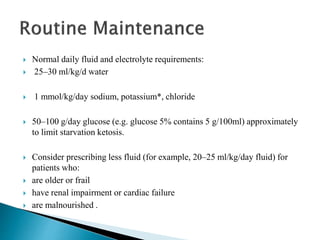
 Normal daily fluid and electrolyte requirements:
 25–30 ml/kg/d water
 1 mmol/kg/day sodium, potassium*, chloride
 50–100 g/day glucose (e.g. glucose 5% contains 5 g/100ml) approximately
to limit starvation ketosis.
 Consider prescribing less fluid (for example, 20–25 ml/kg/day fluid) for
patients who:
 are older or frail
 have renal impairment or cardiac failure
 are malnourished .
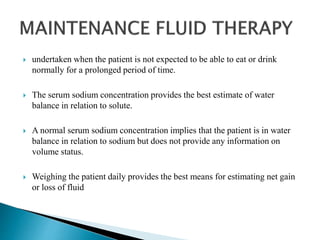
 undertaken when the patient is not expected to be able to eat or drink
normally for a prolonged period of time.
 The serum sodium concentration provides the best estimate of water
balance in relation to solute.
 A normal serum sodium concentration implies that the patient is in water
balance in relation to sodium but does not provide any information on
volume status.
 Weighing the patient daily provides the best means for estimating net gain
or loss of fluid
 When prescribing for routine maintenance alone, consider using 25–30
ml/kg/ day sodium chloride 0.18% in 4% glucose with 27 mmol/l
potassium[3] on day 1 (there are other regimens to achieve this).
 Prescribing more than 2.5 litres per day increases the risk of
hyponatraemia.
 These are initial prescriptions and further prescriptions should be guided by
monitoring.
 Consider delivering IV fluids for routine maintenance during daytime
hours to promote sleep and wellbeing.
 Reassess and monitor the patient
 Stop IV fluids when no longer needed.
 Nasogastric fluids or enteral feeding are preferable when maintenance
needs are more than 3 days
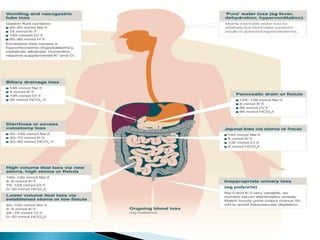
 Vomitus contain Na+, H+ ,Cl, K
 It leads to metabolic alkalosis.
 Increased aldosterone>> > increased K and H excretion.
 Increased renal losses of HCO3, which leads to hyponatremia.
 To cmpensate hyponatremia renal absorbtion of Na along with loss of H ion, which
worsens alkalosis.> Hypokalemic Metabolic Alkalosis with paradoxical aciduria.
 Fluid of choice: 0.9%Nacl + k supplementation
 In diarrhoea, hco3 rich small gut, pancreatic and biliary secretions are lost.
 So
 Metabolic acidosis
 Hypokalemia
 Hyponatremia
 Fluid of choice:
 Ringers lactate
 As it contain Na, K and lactate which is converted to bicarbonate.
 Also supplemental K.
 Well acclimitized person
 Oral fluid / 5% D/w as it will be distributed throughout the
body.
 Not well acclimatized person :
 Oral fluids with electrolyte supplementation.
 Ns or R/L
 Every 1L loss of pancreatic fluid 1L of fluid along with 50mmol of sodium
bicarb should be replaced.
Fluid therapy

Fluid therapy

  • 1.
  • 2.
     most importantBody constituent  Constitutes 60% Of the total body weight in male  Constitutes 50% Of the total body weight in female  The lesser percentage in females because of larger fat content. Fat cells have minimal ICF.  Elderly less water because of less muscle mass.  Water is found in each and every tissue of the body, including bones and cartilages!
  • 6.
     Total BodyWater (TBW) :  The sum of intracellular water and extracellular water (volume)  The latter consisting of  the interstitial or tissue fluid  the intravascular fluid or plasma.
  • 7.
     The Extra-CellularFluid (ECF): The water content found outside the  body cells  Constitutes two major compartments  Intra-vascular & interstitial   Intravascular space/: is 1/4th of ECF.  Interstitial fluid is 3/4th of ECF
  • 8.
     60-40-20 rule: TBW =60% Of body weight.  ICF= 40% Of body weight.  ECF =20% Of body weight.  Eg in 75 kg person TBW 75 x 0.6= 45  ICF= 75 x 0.4= 30  ECF=75 x 0.2= 15L  15 L of ECF= 10L of interstitail fluid+ 5 L of intravacular compartment
  • 9.
     Intra CellularFluid ( ICF):  a fluid within cell membranes of the tissue cells, throughout  most of the body  Interstitial Fluid :  fluid between the cells and interspaces of tissues.  Intravascular Fluid :  within the vessels  Third Space:  space in which fluid does not collect in body in large amount  Eg pleural and peritoneal cavity.
  • 12.
     Solutes inECF:  Primary intravascular/ECF Cation is Na+  Very small contribution of K+, Ca2+,and Mg 2+  Primary intravascular/ECF anion is Cl- and Hco-3  Smaller contribution from SO4 & PO4 , organic acids, and protein.  Solutes in ICF:  Primary ICF cation is K+.  Smaller contribution from Mg 2+ & Na .  Major anion are protein and organic phosphates. 
  • 13.
     Osmolality : No of osmotically active particles of solute per kg of solvent ( m Osmol/Kg).  Osmolarity:  No of osmotically active particles of solute per liter of solvent.( m Osmol/L)
  • 15.
     It isa passive movement of particles down the elctrochemi- gradient.
  • 16.
    • Osmosis isthe net movement of water across a semi permeable membrane. The movement is caused by a concentration gradient due to different solute concentrations on each side of the membrane. • Osmotic Pressure is the pressure caused by the solutes within the solution. The solute concentration prevents water movement across the membrane.
  • 17.
    It is amovement of particles against the electrochemical gradient with the expenditure of energy.
  • 18.
     Tonicity:  Tonicityis the term used to compare the osmotic pressure of different solutions.  Is equal to the sum of the concentrations of the solutes which have the capacity to exert an osmotic force across the membrane.
  • 19.
     A hypotonicsolution is one that has an osmotic pressure lower than plasma.  • Hypotonic means water enters the cell makes it to expand and possibly explode.  A isotonic solution is one that has an osmotic pressure the same as plasma. Water entering exiting is equal.  A hypertonic solution is one that has an osmotic pressure higher than plasma.  • If the environment is hypertonic, the cell will shrink due to water leaving the cell.
  • 21.
     Plasma orSerum Osmolality is Number of solutes dissolved in plasma.  Normal range is : 275 -295 m Osmols/ Kg of Plasma.  Calculated serum Osmolality = 2(Na)+glucose/18+urea/2.8.  Oliguria is urine output < 500 mL in 24 h (0.5 mL/kg/h) in an adult
  • 23.
    SOURCES loSSES Water 1500Urine 1500 Food 800 Stool 200 Oxidation 300 Skin 500 Resp 400 Total 2600 Total 2600
  • 24.
     Adult :35- 40ml/kg/day  Child :  1st 10 kgs = 4ml/kg/hr  Next 10kgs=2ml/kg/hr  Greater than 20kgs =1ml/kg/hr
  • 25.
     Daily waterrequirements increase in :  Fever :  Sweating  Burns  Tachypnea  Surgical drains  Fistula and sinuses  Diarhea  Polyurea  for each degree rise of temp above 37C, Water requirement increases 100- 150ml/day or add extra 10% of calculated water for 1c rise in temp  Or add 2.5ml/kg/day to insensible losses .
  • 26.
     Decreased waterintake is required in:  oliguric renal failure  the use of humidified air  edematous states,  hypothyroidism.
  • 27.
     Na =1.5-2mmol/kg/day K=1-1.5mmoml/kg/day  Ca 0.2-0.3mmol/kg/day  Mg 0.35-0.45mmol/kg/day
  • 28.
     Loss ofisotonic fluid:  E.g hemorrhage,isotonic urine, vomiting, diachrea.  a) ECF volume contarct  b) No fluid change in compartments as there is no change in osmolarity between compartments  c) HCT increases  d) BP decreases  Infusion Of Isotonic Fluid:  a)Expansion Of ECF volume  b)No change in osmolarity Of ECF  c) No fluid shift between the compartments  d) HCT decreases  e)Bp rises
  • 29.
     Loss OfHypotonic Fluid: eg sweating, DI  A) decrease in volume of ECF  b )increase in osmolarity Of ECF  C) fluid shift from ICF to ECF  D volume decreases overall , HCT increases  E) osmolarity increases , HCT increases  F) net > no effect on hct.  Gain of hypotonic fluid :  Eg tape water infusion, water intoxication, SIADH  a) osmoloarity of ECF decreases  b volume Of ECF increases  b) Fluid shift from ECF to Icf  d) volume increases ,HCT decreases  E) osmolarity decreases, HCT increases  F) as net effecr > noeffect on hct.
  • 30.
     Loss OFHypertonic saline: eg Primary adrenal insufficiency  a) decrease in volume of ECF  B) decrease in osmolarity Of ECF  C) Fluid shift from ECF to ICF  D) osmolarity decreses  E) volume decreses  Gain of Hypertonic saline  a)Osmolarity Of ECF increases  b)Fluid shift from ICF to Ecf  c)Volume of ECF increases > hct decreases  d)Volume of ICF decreases  E) cells shrink> hct decreases
  • 31.
     Crystalloid:  Balancedsalt/electrolyte solution; forms a true solution and is capable of passing through semipermeable membranes.  May be isotonic, hypertonic, or hypotonic.  Normal Saline (0.9% NaCl NaCl),  Lactated Ringer s,  Hypertonic saline (3, 5, & 7.5%),  Ringer solution.
  • 32.
     Useful forvolume expansion (mainly interstitial ).  For maintanance infusion  Correcting electrolyte abnormality.  No risk of allergic reactions.
  • 33.
     Because anisotonic solution stays in the intravascular space, it expands the intravascular compartment.  Only 25% remain intravascularly.  Osmolarity is the same as serum osmolarity  0.9% NaCl (Normal Saline)  Lactated Ringers  D5W (In the bag)
  • 34.
     •A hypotonicsolution shifts fluid out of the intravascular compartment, hydrating the cells and the interstitial compartments. Osmolarity is lower than serum osmolarity .  Less than 10% remain intravascularly, inadequate for fluid resuscitation.  D5W (in the body)  0.25% NaCl  0.45% NaCl (half normal saline)
  • 35.
     •A hypertonicsolution draws fluid into the intravascular compartment from the cells and the interstitial compartments.  Osmolarity is higher than serum osmolarity .  D5 NaCl  D5 in Lactated ringers  D5 0.45% NaCl
  • 36.
     Colloid Solutions: High-molecular-molecular weight solutions, do not readily migrate across capillary walls.  draw fluid into intravascular compartment via oncotic pressure .  Plasma expanders, as they are composed of macromolecules, and are retained in the intravascular space.  •They remain in blood vessels longer and increase intravascular volume  •They attract water from the cells into the blood vessels
  • 37.
     •But thisis a short term benefit and  •Prolonged movement can cause the cells to lose too much water and become dehydrated .  May exacerbate hypovolumia after 24-36 hrs when it moves into 3rd space itself.  Albumin, Hetastarch Hetastarch, Plasma, Dextran .
  • 38.
     Albumin:  5%and 20%.  It is a naturally occuring colloid prepared from human plasma.  5% albumin is used in hypovolumia.  20% is used to treat severe hypoalbuminaemia.
  • 39.
     Dextran:  Itis a artificial colloid composed of branched chain polysaccharides.  It can interfere with platelete function.  Can induce anaphylactic shock.  Hydroxyethyl starches:  Composed of chains of glucose and are produced from maize. 
  • 40.
     Gelatin:  Itis formed from hydrolysis of bovine collagen  3 types  1.succinylated Gelatin : gelofusin  2. urea cross linked gelatins : haemacel  3. Oxyplygelatins.  Rapid excretion throught urine.  Plasma clearance of 3days .  Can not be given with blood.  Not more than 1L in 24 hrs.  CI:  Shock due to septicemia, cardiogenic anaphylactoid reaction.
  • 41.
    Solution Sodium mEq/L Chloride mEq/L Glucose g/L Potassiu m mEq/L Calcium mEq/L Lactate mEq/L D2.5W 25 D5W50 D10W 100 0.45NaC l 77 77 0.9NaCl 154 154 3% NaCl 513 513 D5 +0.2NaC l 34 34 50
  • 42.
    Solution Sodium mEq/L Chloride mEq/L Glucose g/L Potassiu m mEq/L Calcium mEq/L Lactate mEq/L D5 + 0.45NaC l 7777 50 D5 + 0.9NaCl 154 154 50 Ringer’s 147 154 4 4 Lactated Ringer’s 130 109 4 3 28 D5 + Ringer’s 147 156 50 4 4 5% Sodium Bicarb 595 595
  • 44.
     Isotonic saltwater.  154mEq/Na+, 154 mEq /L Cl , 308mosl/L;  Cheapest and most commonly used resuscitative crystalloid.  High [ Cl-] above the normal serum 103 mEq /L imposes on the kidneys an appreciable load of excess Cl that cannot be rapidly excreted.  A dilutional acidosis may develop by reducing base bicarb relative to carbonic acid. Thus exist the risk of hyperchloremic acidosis.   Only solution that may be administered with blood products.  Does not provide free water or calories.  Restores NaCl deficits
  • 45.
     Normal salineis hyperchlremic (154)as compared to body (95-105).  NacCl +H20>>>>>Hcl + NaOH .  Strong acid (hcl) and strong base (NaOH) should cancel eachother with no effect on PH.  Normal concentration of Na (145) and Cl( 105), addinf saline causes Cl to increase more than Na, this causes acid base balance more towards HCl than Na .  Causing metabolic acidosis.
  • 46.
     Isotonic, 273mOsm/L  Contains 130 mEq/L of Na, 109mEq/L of Cl, 28mEq/L of lactate and 4mEq/L K.  Lactate is used instead of bicarb because it s more stable in IVF during storage.  as minimal effects on normal body fluid composition and pH.  More closely resembles the electrolyte composition of normal blood serum. Does not provide calories.
  • 47.
     Lactate isconverted readily to bicarb by the liver.  It is given to patients who have metabolic acidosis not lactic acidosis.  Don’t give in liver diseases.  Be cautious in pts with severe renal failure because of potassium.  Do not give to pt with pH > 7.5.
  • 48.
     It isconsidered isotonic solution when in bag.  In the body dextrose is metabolized and becomes hypotonic and causes fluids shift into the cells.  It provides free water and expands both compartments.  It provides calories, no elctrolytes.  Can cause fluid overload in pt with cardiac and renal failure.  It can increases cerebral edema.  Never mix with blood causes blood to hemolyse.
  • 49.
     Hypertonic, 406mOsm /L  Provides 170 calories/L from 5% dextrose .  Provides free water for insensible losses and some Na to promote renal function and excretion.  With added K this is an excellent maintenance fluid in postop period.  Prevents excess catabolism and limits proteolysis.
  • 50.
     1026 mOsm/L & 513 mEq /L Na .  Increases plasma osmolality and thereby acts as a plasma expander, increasing circulatory volume via movement of intracellular and interstitial water into the intravascular space.  Risk of hypernatremia thus careful neuro monitoring .  Hyper tonic fluid should be infused in large vein with large blood volume to dilute to dilute fluid.
  • 51.
     Volume deficitsare best estimated by acute changes in weight.  Less than 5% loss is very difficult to detect clinically.  loss of 15+% will be associated with severe circulatory compromise.  Mild deficit represents a loss of ~ 4% body wt.  Moderate deficit --- a loss of ~ 6-8% body wt.  Severe deficit --- a loss of ~ >10% body wt.
  • 52.
     Assess previouslimited intake, thirst, abnormal losses, comorbidities.  Indicators that a patient may need urgent fluid resuscitation include:  systolic blood pressure is less than 100 mmHg  heart rate is more than 90 beats per minute  capillary refill time is more than 2 seconds or peripheries are cold to touch  respiratory rate is more than 20 breaths per minute  National Early Warning Score (NEWS) is 5 or more  passive leg raising suggests fluid responsiveness[2].  Laboratory assessments: FBC, urea, creatinine and electrolytes
  • 53.
     If patientsneed IV fluid resuscitation, use crystalloids that contain sodium in the range 130–154 mmol/l, with a bolus of 500 ml over less than 15 minutes.  Reassess the patient using the ABCDE approach .  Give a further fluid bolus of 250–500 ml of crystalloid if the patient still need fluid resuscitation  Seek expert help when >2000 ml given or patient have signs of shock?  Do not use tetrastarch for fluid resuscitation.  Consider human albumin solution 4–5% for fluid resuscitation only in patients with severe sepsis.
  • 54.
     Normal dailyfluid and electrolyte requirements:  25–30 ml/kg/d water  1 mmol/kg/day sodium, potassium*, chloride  50–100 g/day glucose (e.g. glucose 5% contains 5 g/100ml) approximately to limit starvation ketosis.  Consider prescribing less fluid (for example, 20–25 ml/kg/day fluid) for patients who:  are older or frail  have renal impairment or cardiac failure  are malnourished .
  • 55.
     undertaken whenthe patient is not expected to be able to eat or drink normally for a prolonged period of time.  The serum sodium concentration provides the best estimate of water balance in relation to solute.  A normal serum sodium concentration implies that the patient is in water balance in relation to sodium but does not provide any information on volume status.  Weighing the patient daily provides the best means for estimating net gain or loss of fluid
  • 56.
     When prescribingfor routine maintenance alone, consider using 25–30 ml/kg/ day sodium chloride 0.18% in 4% glucose with 27 mmol/l potassium[3] on day 1 (there are other regimens to achieve this).  Prescribing more than 2.5 litres per day increases the risk of hyponatraemia.  These are initial prescriptions and further prescriptions should be guided by monitoring.  Consider delivering IV fluids for routine maintenance during daytime hours to promote sleep and wellbeing.
  • 58.
     Reassess andmonitor the patient  Stop IV fluids when no longer needed.  Nasogastric fluids or enteral feeding are preferable when maintenance needs are more than 3 days
  • 59.
     Vomitus containNa+, H+ ,Cl, K  It leads to metabolic alkalosis.  Increased aldosterone>> > increased K and H excretion.  Increased renal losses of HCO3, which leads to hyponatremia.  To cmpensate hyponatremia renal absorbtion of Na along with loss of H ion, which worsens alkalosis.> Hypokalemic Metabolic Alkalosis with paradoxical aciduria.  Fluid of choice: 0.9%Nacl + k supplementation
  • 60.
     In diarrhoea,hco3 rich small gut, pancreatic and biliary secretions are lost.  So  Metabolic acidosis  Hypokalemia  Hyponatremia  Fluid of choice:  Ringers lactate  As it contain Na, K and lactate which is converted to bicarbonate.  Also supplemental K.
  • 61.
     Well acclimitizedperson  Oral fluid / 5% D/w as it will be distributed throughout the body.  Not well acclimatized person :  Oral fluids with electrolyte supplementation.  Ns or R/L
  • 62.
     Every 1Lloss of pancreatic fluid 1L of fluid along with 50mmol of sodium bicarb should be replaced.