Isothiocyanate glycosides These glycosides upon hydrolysis, yield  Mustard oil. Plants containing these glycosides posses non-specific resistance against infection.  These agents posses following properties; Vesicant Rubefacient
Black Mustard Botanical origin: Brassica nigra Brassica juncea Family: Brassicaceae Part used: Dried seeds
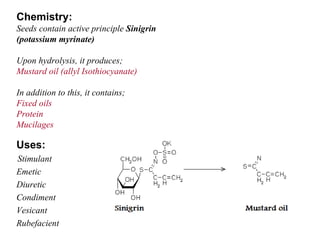
Chemistry: Seeds contain active principle  Sinigrin (potassium myrinate) Upon hydrolysis, it produces; Mustard oil (allyl Isothiocyanate) In addition to this, it contains; Fixed oils Protein Mucilages Uses: Stimulant Emetic Diuretic Condiment Vesicant Rubefacient
Lactone Glycosides
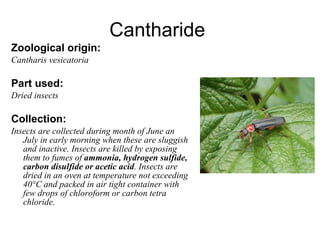
Cantharide  Zoological origin: Cantharis vesicatoria Part used: Dried insects Collection: Insects are collected during month of June an July in early morning when these are sluggish and inactive. Insects are killed by exposing them to fumes of  ammonia, hydrogen sulfide, carbon disulfide or acetic acid . Insects are dried in an oven at temperature not exceeding 40°C and packed in air tight container with few drops of chloroform or carbon tetra chloride.
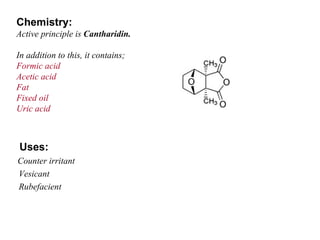
Chemistry: Active principle is  Cantharidin. In addition to this, it contains; Formic acid Acetic acid Fat Fixed oil Uric acid Uses: Counter irritant Vesicant Rubefacient
Aldehyde glycosides
Vanilla Botanical origin: Vanilla planifolia Family: Orchidaceae Part used: Vanilla beans Collection: Fruit is collected when it is ripen to a yellow color. It is cured by dipping in warm water. Fruit is sun dried by placing it between woolen blankets in the sun during day and packing them in woolen blankets during night. After 2 months, 70-80% of original weight of fruit is lost and it takes a characteristic odor and color of vanilla i.e. Color ….. Violet black Odor …... Aromatic
Chemistry: Before curing, vanilla contains 2 glycosides; Glucovanillin Glucovanillic acid After curing, active principle is obtained i.e.  Vanillin Uses: Flavoring agent
Miscellaneous glycosides
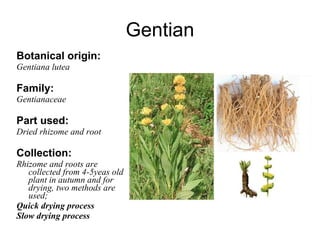
Gentian Botanical origin: Gentiana lutea Family: Gentianaceae Part used: Dried rhizome and root Collection: Rhizome and roots are collected from 4-5yeas old plant in autumn and for drying, two methods are used; Quick drying process Slow drying process
Quick drying process Drying is done immediately after collection, in sunlight. This drug contains bitter principle  Gentiopicrin. Slow drying process Drying is done in open air. It takes 4-6 months for drug to dry completely.  In this process, drug is allowed to ferment and loss most of its bitter principle and acquire aromatic quality that is desirable.
Chemistry: Active principle is  Gentiopicrin. After hydrolysis, it produces; Gentiogenin Glucose Uses: Flavoring agent
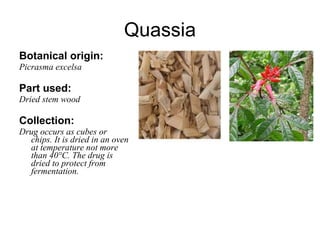
Quassia Botanical origin: Picrasma excelsa Part used: Dried stem wood Collection: Drug occurs as cubes or chips. It is dried in an oven at temperature not more than 40°C. The drug is dried to protect from fermentation.
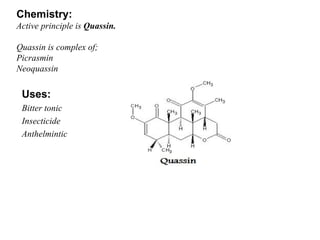
Chemistry: Active principle is  Quassin. Quassin is complex of; Picrasmin Neoquassin Uses: Bitter tonic Insecticide Anthelmintic
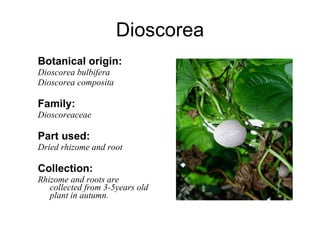
Dioscorea Botanical origin: Dioscorea bulbifera Dioscorea composita Family: Dioscoreaceae Part used: Dried rhizome and root Collection: Rhizome and roots are collected from 3-5years old plant in autumn.
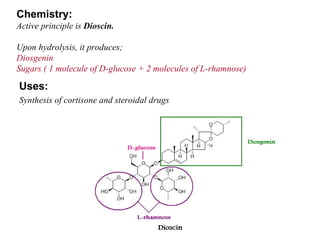
Chemistry: Active principle is  Dioscin. Upon hydrolysis, it produces; Diosgenin Sugars ( 1 molecule of D-glucose + 2 molecules of L-rhamnose) Uses: Synthesis of cortisone and steroidal drugs

Isothiocynate glycosides

  • 1.
    Isothiocyanate glycosides Theseglycosides upon hydrolysis, yield Mustard oil. Plants containing these glycosides posses non-specific resistance against infection. These agents posses following properties; Vesicant Rubefacient
  • 2.
    Black Mustard Botanicalorigin: Brassica nigra Brassica juncea Family: Brassicaceae Part used: Dried seeds
  • 3.
    Chemistry: Seeds containactive principle Sinigrin (potassium myrinate) Upon hydrolysis, it produces; Mustard oil (allyl Isothiocyanate) In addition to this, it contains; Fixed oils Protein Mucilages Uses: Stimulant Emetic Diuretic Condiment Vesicant Rubefacient
  • 4.
  • 5.
    Cantharide Zoologicalorigin: Cantharis vesicatoria Part used: Dried insects Collection: Insects are collected during month of June an July in early morning when these are sluggish and inactive. Insects are killed by exposing them to fumes of ammonia, hydrogen sulfide, carbon disulfide or acetic acid . Insects are dried in an oven at temperature not exceeding 40°C and packed in air tight container with few drops of chloroform or carbon tetra chloride.
  • 6.
    Chemistry: Active principleis Cantharidin. In addition to this, it contains; Formic acid Acetic acid Fat Fixed oil Uric acid Uses: Counter irritant Vesicant Rubefacient
  • 7.
  • 8.
    Vanilla Botanical origin:Vanilla planifolia Family: Orchidaceae Part used: Vanilla beans Collection: Fruit is collected when it is ripen to a yellow color. It is cured by dipping in warm water. Fruit is sun dried by placing it between woolen blankets in the sun during day and packing them in woolen blankets during night. After 2 months, 70-80% of original weight of fruit is lost and it takes a characteristic odor and color of vanilla i.e. Color ….. Violet black Odor …... Aromatic
  • 9.
    Chemistry: Before curing,vanilla contains 2 glycosides; Glucovanillin Glucovanillic acid After curing, active principle is obtained i.e. Vanillin Uses: Flavoring agent
  • 10.
  • 11.
    Gentian Botanical origin:Gentiana lutea Family: Gentianaceae Part used: Dried rhizome and root Collection: Rhizome and roots are collected from 4-5yeas old plant in autumn and for drying, two methods are used; Quick drying process Slow drying process
  • 12.
    Quick drying processDrying is done immediately after collection, in sunlight. This drug contains bitter principle Gentiopicrin. Slow drying process Drying is done in open air. It takes 4-6 months for drug to dry completely. In this process, drug is allowed to ferment and loss most of its bitter principle and acquire aromatic quality that is desirable.
  • 13.
    Chemistry: Active principleis Gentiopicrin. After hydrolysis, it produces; Gentiogenin Glucose Uses: Flavoring agent
  • 14.
    Quassia Botanical origin:Picrasma excelsa Part used: Dried stem wood Collection: Drug occurs as cubes or chips. It is dried in an oven at temperature not more than 40°C. The drug is dried to protect from fermentation.
  • 15.
    Chemistry: Active principleis Quassin. Quassin is complex of; Picrasmin Neoquassin Uses: Bitter tonic Insecticide Anthelmintic
  • 16.
    Dioscorea Botanical origin:Dioscorea bulbifera Dioscorea composita Family: Dioscoreaceae Part used: Dried rhizome and root Collection: Rhizome and roots are collected from 3-5years old plant in autumn.
  • 17.
    Chemistry: Active principleis Dioscin. Upon hydrolysis, it produces; Diosgenin Sugars ( 1 molecule of D-glucose + 2 molecules of L-rhamnose) Uses: Synthesis of cortisone and steroidal drugs