DIGITALIS GLYCOSIDE
   Kratika Daniel (Ph.D)
   Assistant professor
   MANDSAUR INSTITUTE OF PHARMACY,
   Mandsaur
INTRODUCTION
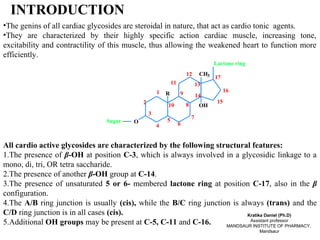
•The genins of all cardiac glycosides are steroidal in nature, that act as cardio tonic agents.
•They are characterized by their highly specific action cardiac muscle, increasing tone,
excitability and contractility of this muscle, thus allowing the weakened heart to function more
efficiently.
                                                                                     Lactone ring
                                                                      12       CH3
                                                                                     17
                                                             11               13
                                                     1                                    16
                                                         R        9           14
                                             2                                        15
                                                         10           8        OH
                                                 3
                                                                          7
                                Sugar    O               5
                                                     4            6


All cardio active glycosides are characterized by the following structural features:
1.The presence of β-OH at position C-3, which is always involved in a glycosidic linkage to a
mono, di, tri, OR tetra saccharide.
2.The presence of another β-OH group at C-14.
3.The presence of unsaturated 5 or 6- membered lactone ring at position C-17, also in the β
configuration.
4.The A/B ring junction is usually (cis), while the B/C ring junction is always (trans) and the
C/D ring junction is in all cases (cis).                                   Kratika Daniel (Ph.D)
5.Additional OH groups may be present at C-5, C-11 and C-16.                Assistant professor
                                                                    MANDSAUR INSTITUTE OF PHARMACY,
                                                                                                    Mandsaur
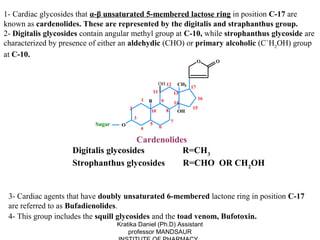
1- Cardiac glycosides that α-β unsaturated 5-membered lactose ring in position C-17 are
known as cardenolides. These are represented by the digitalis and straphanthus group.
2- Digitalis glycosides contain angular methyl group at C-10, while strophanthus glycoside are
characterized by presence of either an aldehydic (CHO) or primary alcoholic (C`H2OH) group
at C-10.
                                                                                      O    O


                                                             OH 12         CH3
                                                                                 17
                                                        11                13
                                                1                                     16
                                                    R         9           14
                                        2                                        15
                                                    10            8        OH
                                            3
                                                                      7
                           Sugar    O               5
                                                             6
                                                4

                                      Cardenolides
                    Digitalis glycosides         R=CH3
                    Strophanthus glycosides      R=CHO OR CH 2OH


 3- Cardiac agents that have doubly unsaturated 6-membered lactone ring in position C-17
 are referred to as Bufadienolides.
 4- This group includes the squill glycosides and the toad venom, Bufotoxin.
                                   Kratika Daniel (Ph.D) Assistant
                                       professor MANDSAUR
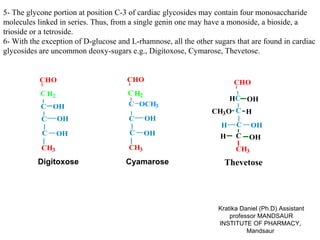
5- The glycone portion at position C-3 of cardiac glycosides may contain four monosaccharide
molecules linked in series. Thus, from a single genin one may have a monoside, a bioside, a
trioside or a tetroside.
6- With the exception of D-glucose and L-rhamnose, all the other sugars that are found in cardiac
glycosides are uncommon deoxy-sugars e.g., Digitoxose, Cymarose, Thevetose.


           CHO                        CHO                              CHO
           C H2                       C H2
                                                                       HC OH
           C OH                       C OCH3
                                                                CH3 O C H
           C      OH                   C     OH
                                                                   H    C     OH
            C     OH                   C     OH                    H    C    OH
           CH3                         CH3                              CH3
          Digitoxose                  Cyamarose                     Thevetose


                                                                  Kratika Daniel (Ph.D) Assistant
                                                                      professor MANDSAUR
                                                                  INSTITUTE OF PHARMACY,
                                                                            Mandsaur
SOURCE
D. purpurea, D. lanata, D. lutea and D. thapsi. Family – Scrophularaceae.
The structures of the common aglycones of the digitalis group are: -

                                                                            O        O


                                                         R1

                                                                       17
                                                11       12
                                                                 13
                                       1                               16       R2
                                                     9           14
                               2                                        15
                                             10          8        OH
                                   3
                                                             7
                       H   O                5
                                       4             6


                Compounds                                    R1                      R2
                Digitoxigenin                                H                       H
                Gitoxigenin                                  H                       OH
                Digoxigenin                                  OH                      H


                                           Kratika Daniel (Ph.D) Assistant
                                               professor MANDSAUR                         kratika
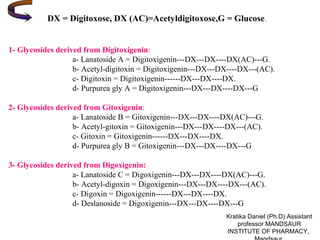
DX = Digitoxose, DX (AC)=Acetyldigitoxose,G = Glucose .


1- Glycosides derived from Digitoxigenin:
                   a- Lanatoside A = Digitoxigenin---DX---DX----DX(AC)---G.
                   b- Acetyl-digitoxin = Digitoxigenin---DX---DX----DX---(AC).
                   c- Digitoxin = Digitoxigenin------DX---DX----DX.
                   d- Purpurea gly A = Digitoxigenin---DX---DX----DX---G

2- Glycosides derived from Gitoxigenin:
                   a- Lanatoside B = Gitoxigenin---DX---DX----DX(AC)---G.
                   b- Acetyl-gitoxin = Gitoxigenin---DX---DX----DX---(AC).
                   c- Gitoxin = Gitoxigenin------DX---DX----DX.
                   d- Purpurea gly B = Gitoxigenin---DX---DX----DX---G

3- Glycosides derived from Digoxigenin:
                   a- Lanatoside C = Digoxigenin---DX---DX----DX(AC)---G.
                   b- Acetyl-digoxin = Digoxigenin---DX---DX----DX---(AC).
                   c- Digoxin = Digoxigenin------DX---DX----DX.
                   d- Deslanoside = Digoxigenin---DX---DX----DX---G
                                                               Kratika Daniel (Ph.D) Assistant
                                                                   professor MANDSAUR
                                                               INSTITUTE OF PHARMACY,
1.The primary glycosides Lanatoside A, Lanatoside B, Lanatoside C are acted by specific
enzyme which split the terminal glucose, give the secondary glycosides acetyldigitoxin,
acetylgitoxin and acetyldigoxin respectively.
2.The deacetyl-lanatosides A, B and C can be obtained by the alkaline hydrolysis of the
corresponding lanatosides.
3.Digitoxin, gitoxin and digoxin are obtained by the action of alkali on their acetyl-
derivatives.

                                             Lanatoside A

                               Alkaline               Specific
purpurea gly. A                                                     Acetyldigitoxin
                               hydrolysis             enzyme

                Specific                                         Alkaline
                                   Digitoxin
                enzyme                                           hydrolysis
                                 Acid hydrolysis

                                   Digitoxigenin + 3 digitoxose
                               Kratika Daniel (Ph.D) Assistant
                                   professor MANDSAUR
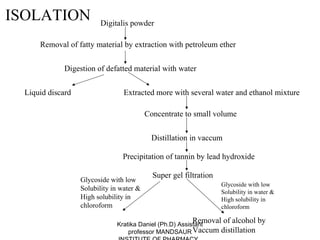
ISOLATION                Digitalis powder

      Removal of fatty material by extraction with petroleum ether


              Digestion of defatted material with water


  Liquid discard                  Extracted more with several water and ethanol mixture

                                           Concentrate to small volume


                                             Distillation in vaccum

                                 Precipitation of tannin by lead hydroxide

                                             Super gel filtration
                   Glycoside with low
                                                                    Glycoside with low
                   Solubility in water &                            Solubility in water &
                   High solubility in                               High solubility in
                   chloroform                                       chloroform

                                                          Removal of alcohol by
                               Kratika Daniel (Ph.D) Assistant
                                   professor MANDSAUR Vaccum     distillation
Adjust filtrate to pH 6

                                                                 Aqueous solution
     Successive washing with chloroform                                    Extraction with
     Ether. ethanol                                                        chloroform

                   Discard washing                        Washing with chloroform with water
                                                          2N HCl, 2N Na2CO3.
   Into aqueous phase add
   Sodium sulfate to saturation                                             Discard washing
                                                            Separation of glycoside by
                                                            chromatography
 Extraction with chloroform ethanol mixture


 Acetylation/ benzoylation                                     Elution with chloroform
                                       Less polar
 of more polar glycoside                                       & chloroform containing graded
                                       glycoside               proportion of methanol
          KHCO3
Separation of individual glycoside
By chromatography


                                     Kratika Daniel (Ph.D) Assistant
                                         professor MANDSAUR
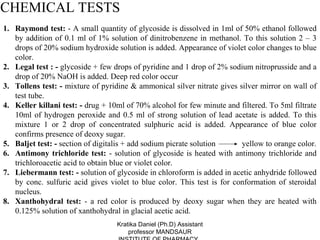
CHEMICAL TESTS
1. Raymond test: - A small quantity of glycoside is dissolved in 1ml of 50% ethanol followed
   by addition of 0.1 ml of 1% solution of dinitrobenzene in methanol. To this solution 2 – 3
   drops of 20% sodium hydroxide solution is added. Appearance of violet color changes to blue
   color.
2. Legal test : - glycoside + few drops of pyridine and 1 drop of 2% sodium nitroprusside and a
   drop of 20% NaOH is added. Deep red color occur
3. Tollens test: - mixture of pyridine & ammonical silver nitrate gives silver mirror on wall of
   test tube.
4. Keller killani test: - drug + 10ml of 70% alcohol for few minute and filtered. To 5ml filtrate
   10ml of hydrogen peroxide and 0.5 ml of strong solution of lead acetate is added. To this
   mixture 1 or 2 drop of concentrated sulphuric acid is added. Appearance of blue color
   confirms presence of deoxy sugar.
5. Baljet test: - section of digitalis + add sodium picrate solution     yellow to orange color.
6. Antimony trichloride test: - solution of glycoside is heated with antimony trichloride and
   trichloroacetic acid to obtain blue or violet color.
7. Liebermann test: - solution of glycoside in chloroform is added in acetic anhydride followed
   by conc. sulfuric acid gives violet to blue color. This test is for conformation of steroidal
   nucleus.
8. Xanthohydral test: - a red color is produced by deoxy sugar when they are heated with
   0.125% solution of xanthohydral in glacial acetic acid.
                                   Kratika Daniel (Ph.D) Assistant
                                       professor MANDSAUR
TLC
Solvent system: - ethyl acetate : chloroform : ethanol (9 : 5 : 0.5)
                      cyclohexane : acetone : acetic acid (49 : 49 : 2)
Detecting reagent: - antimony tri chloride.

PROPERTIES
 SOLUBILITY: -
 •The different cardiac glycosides show different solubilities in aqueous and organic solvents.
 They are usually soluble in water or aqueous alcohol and insoluble in the fat solvents with
 exception of chloroform and ethylacetate.
 •The higher number of sugar units in the molecule, the greater solubility in water but lower
 soluble in chloroform.
 •Alcohols are good solvents for both the glycosides and the aglycones.
 •pet.ether and ether are used for defatting process of drug.


 STABILITY: -
 •Acid hydrolysis cleavage of the glycosides into aglycones and sugar residues.
 •Specific enzyme usually coexist with CG in plants, which may split the primary G into G with
 less sugar units. Thus, CG deteriorate during drying and storage. These drugs should be stored
 in sealed containers over dehydrating agents.
                                    Kratika Daniel (Ph.D) Assistant
                                        professor MANDSAUR
•It is recommended to heat stabilize these CG, by destroying the enzymes at higher
temperatures. At higher temperature, the tertiary OH gp at C-14 may split off as water,
leading to formation of an inactive anhydro-form of CG
                                                            O      O                                                                       O    O


                                        12       CH3                                                                   12       CH3
                                                       17                                                                             17
                               11               13                                                            11               13
                       1                                    16      -H2O                                                                   16
                           R        9           14                                                    1   R        9           14
               2                                       15                                     2                                       15
                           10           8        OH                                                       10           8
                   3                                                                              3
                                            7
   Sugar   O               5
                                    6                                           Sugar     O               5
                                                                                                                           7
                       4                                                                              4            6


•The gitoxin has in addition to tertiary OH at C-14 another secondary OH at C-16. Both OH
gps split as water by the action of H2SO4 with the formation of two additional double bonds.
These with the double bond of the lactone ring from a conjugated double bond system that
makes the compound fluorescent in UV light.
•The detection of gitoxin in other digitalis G is based on the above mentioned reaction.
•Molecular formula – C27H44O5
•Melting point – 230 – 265oC


                                                            Kratika Daniel (Ph.D) Assistant
                                                                professor MANDSAUR
BIOSYNTHESIS                                                                                  HO          OH


                                                              O2
                                                            NADPH 2

                    HO
                          cholestrol                                    HO                                       NADPH2
                                                                                                            O2

                                                                                                                                        O
                                       O                                       O


                                                                H
                                                                                                   HO
        O                                       O                                                           PREGNENLONE
                PROGESTRONE
                                           O                                             O
                                                                                                                                O


                                                                                                                     OH
            O                                                                                                              OH
             5 - β − Pregnane 3,2 dione                     PREGNENALONE                     HO
                                                                                                           DIOL                     O
                                                             O

                                                    O                        acetyl CoA


                                                                                                                      OH

                                                                                              HO
                                                    OH                                                  TRIOL
                                                                16 - β − hydroxylation
                                                                                                                 oxalo acetyl CoA
                            HO
                                                                                              O
                                                                                                    O      bufalin
                   12 - β − hydroxylation               O                                                        C - 2 - unit
                                                                O
                                                                                   H
                                            H                                                           strophanthadin
                                                                                                   OH
                                                            H                            OH

                            Kratika Daniel (Ph.D) HO
                                            OH
                                                  Assistant
                       HO       professor MANDSAUR gitoxigenin
                               digitoxigenin
SAR
1. The glycone part displays a great influence on the solubility and the rate of
   absorption and distribution of the glycosides to the site of action.
2. Small change in the molecules such as a change of the location of the OH gp,
   modify the cardiac activity or even eliminate it completely.
3. The saturation and/or cleavage of the lactone ring, destroys the cardiac
   activity.Therefore, the closely related CG, differ greatly in the rate of
   absorption, duration of action and their cumulative effect.


                              Kratika Daniel (Ph.D) Assistant
                                  professor MANDSAUR
USES & ACTION
Main action on heart. The primary action may be divided into 3 parts
          1. +ive inotropic effect on heart.
          2. Partial blockade of A.V. conduction.
          3. Reduction in heart rate.
• Direct stimulation of myocardium & increased contractility with a resultant increase in
   cardiac output, reduction in heart size, improved, cardiac efficiency.
• Depression of conduction, especially in A. V. node, which protects the ventricles from
   excessive bombardment by auricular impulses in auricular arrythmias. Due to this effect
   bradycardia occurs.
• Increased vagal activity, which decrease the auricular refractory period with conversion of
   flutter to fibrillation. The delay in A. V. conduction & bradycardia is also vagal origin.
• Increased in cardiac excitability makes heart more vulnerable to arrythmias
• It has direct constrictor action on vascular smooth muscle. It may diminished clotting
   time.
• GIT – it causes emetic action due to stimulation of chemoreceptor trigger zone in medulla.
USES        • Heart failure with sinus rhythm or atrial fibrilation.
            • Atrial flutter.
            • Paroxysmal atrial tachcardia.
            • Prevention of paroxysmal atrial arrythmias.
                                                                  Kratika Daniel (Ph.D) Assistant
            • Prophylactically before cardiac surgery.                professor MANDSAUR
                                                                      INSTITUTE OF PHARMACY,
                                                                              Mandsaur

Digitalis glycoside

  • 1.
    DIGITALIS GLYCOSIDE Kratika Daniel (Ph.D) Assistant professor MANDSAUR INSTITUTE OF PHARMACY, Mandsaur
  • 2.
    INTRODUCTION •The genins ofall cardiac glycosides are steroidal in nature, that act as cardio tonic agents. •They are characterized by their highly specific action cardiac muscle, increasing tone, excitability and contractility of this muscle, thus allowing the weakened heart to function more efficiently. Lactone ring 12 CH3 17 11 13 1 16 R 9 14 2 15 10 8 OH 3 7 Sugar O 5 4 6 All cardio active glycosides are characterized by the following structural features: 1.The presence of β-OH at position C-3, which is always involved in a glycosidic linkage to a mono, di, tri, OR tetra saccharide. 2.The presence of another β-OH group at C-14. 3.The presence of unsaturated 5 or 6- membered lactone ring at position C-17, also in the β configuration. 4.The A/B ring junction is usually (cis), while the B/C ring junction is always (trans) and the C/D ring junction is in all cases (cis). Kratika Daniel (Ph.D) 5.Additional OH groups may be present at C-5, C-11 and C-16. Assistant professor MANDSAUR INSTITUTE OF PHARMACY, Mandsaur
  • 3.
    1- Cardiac glycosidesthat α-β unsaturated 5-membered lactose ring in position C-17 are known as cardenolides. These are represented by the digitalis and straphanthus group. 2- Digitalis glycosides contain angular methyl group at C-10, while strophanthus glycoside are characterized by presence of either an aldehydic (CHO) or primary alcoholic (C`H2OH) group at C-10. O O OH 12 CH3 17 11 13 1 16 R 9 14 2 15 10 8 OH 3 7 Sugar O 5 6 4 Cardenolides Digitalis glycosides R=CH3 Strophanthus glycosides R=CHO OR CH 2OH 3- Cardiac agents that have doubly unsaturated 6-membered lactone ring in position C-17 are referred to as Bufadienolides. 4- This group includes the squill glycosides and the toad venom, Bufotoxin. Kratika Daniel (Ph.D) Assistant professor MANDSAUR
  • 4.
    5- The glyconeportion at position C-3 of cardiac glycosides may contain four monosaccharide molecules linked in series. Thus, from a single genin one may have a monoside, a bioside, a trioside or a tetroside. 6- With the exception of D-glucose and L-rhamnose, all the other sugars that are found in cardiac glycosides are uncommon deoxy-sugars e.g., Digitoxose, Cymarose, Thevetose. CHO CHO CHO C H2 C H2 HC OH C OH C OCH3 CH3 O C H C OH C OH H C OH C OH C OH H C OH CH3 CH3 CH3 Digitoxose Cyamarose Thevetose Kratika Daniel (Ph.D) Assistant professor MANDSAUR INSTITUTE OF PHARMACY, Mandsaur
  • 5.
    SOURCE D. purpurea, D.lanata, D. lutea and D. thapsi. Family – Scrophularaceae. The structures of the common aglycones of the digitalis group are: - O O R1 17 11 12 13 1 16 R2 9 14 2 15 10 8 OH 3 7 H O 5 4 6 Compounds R1 R2 Digitoxigenin H H Gitoxigenin H OH Digoxigenin OH H Kratika Daniel (Ph.D) Assistant professor MANDSAUR kratika
  • 6.
    DX = Digitoxose,DX (AC)=Acetyldigitoxose,G = Glucose . 1- Glycosides derived from Digitoxigenin: a- Lanatoside A = Digitoxigenin---DX---DX----DX(AC)---G. b- Acetyl-digitoxin = Digitoxigenin---DX---DX----DX---(AC). c- Digitoxin = Digitoxigenin------DX---DX----DX. d- Purpurea gly A = Digitoxigenin---DX---DX----DX---G 2- Glycosides derived from Gitoxigenin: a- Lanatoside B = Gitoxigenin---DX---DX----DX(AC)---G. b- Acetyl-gitoxin = Gitoxigenin---DX---DX----DX---(AC). c- Gitoxin = Gitoxigenin------DX---DX----DX. d- Purpurea gly B = Gitoxigenin---DX---DX----DX---G 3- Glycosides derived from Digoxigenin: a- Lanatoside C = Digoxigenin---DX---DX----DX(AC)---G. b- Acetyl-digoxin = Digoxigenin---DX---DX----DX---(AC). c- Digoxin = Digoxigenin------DX---DX----DX. d- Deslanoside = Digoxigenin---DX---DX----DX---G Kratika Daniel (Ph.D) Assistant professor MANDSAUR INSTITUTE OF PHARMACY,
  • 7.
    1.The primary glycosidesLanatoside A, Lanatoside B, Lanatoside C are acted by specific enzyme which split the terminal glucose, give the secondary glycosides acetyldigitoxin, acetylgitoxin and acetyldigoxin respectively. 2.The deacetyl-lanatosides A, B and C can be obtained by the alkaline hydrolysis of the corresponding lanatosides. 3.Digitoxin, gitoxin and digoxin are obtained by the action of alkali on their acetyl- derivatives. Lanatoside A Alkaline Specific purpurea gly. A Acetyldigitoxin hydrolysis enzyme Specific Alkaline Digitoxin enzyme hydrolysis Acid hydrolysis Digitoxigenin + 3 digitoxose Kratika Daniel (Ph.D) Assistant professor MANDSAUR
  • 8.
    ISOLATION Digitalis powder Removal of fatty material by extraction with petroleum ether Digestion of defatted material with water Liquid discard Extracted more with several water and ethanol mixture Concentrate to small volume Distillation in vaccum Precipitation of tannin by lead hydroxide Super gel filtration Glycoside with low Glycoside with low Solubility in water & Solubility in water & High solubility in High solubility in chloroform chloroform Removal of alcohol by Kratika Daniel (Ph.D) Assistant professor MANDSAUR Vaccum distillation
  • 9.
    Adjust filtrate topH 6 Aqueous solution Successive washing with chloroform Extraction with Ether. ethanol chloroform Discard washing Washing with chloroform with water 2N HCl, 2N Na2CO3. Into aqueous phase add Sodium sulfate to saturation Discard washing Separation of glycoside by chromatography Extraction with chloroform ethanol mixture Acetylation/ benzoylation Elution with chloroform Less polar of more polar glycoside & chloroform containing graded glycoside proportion of methanol KHCO3 Separation of individual glycoside By chromatography Kratika Daniel (Ph.D) Assistant professor MANDSAUR
  • 10.
    CHEMICAL TESTS 1. Raymondtest: - A small quantity of glycoside is dissolved in 1ml of 50% ethanol followed by addition of 0.1 ml of 1% solution of dinitrobenzene in methanol. To this solution 2 – 3 drops of 20% sodium hydroxide solution is added. Appearance of violet color changes to blue color. 2. Legal test : - glycoside + few drops of pyridine and 1 drop of 2% sodium nitroprusside and a drop of 20% NaOH is added. Deep red color occur 3. Tollens test: - mixture of pyridine & ammonical silver nitrate gives silver mirror on wall of test tube. 4. Keller killani test: - drug + 10ml of 70% alcohol for few minute and filtered. To 5ml filtrate 10ml of hydrogen peroxide and 0.5 ml of strong solution of lead acetate is added. To this mixture 1 or 2 drop of concentrated sulphuric acid is added. Appearance of blue color confirms presence of deoxy sugar. 5. Baljet test: - section of digitalis + add sodium picrate solution yellow to orange color. 6. Antimony trichloride test: - solution of glycoside is heated with antimony trichloride and trichloroacetic acid to obtain blue or violet color. 7. Liebermann test: - solution of glycoside in chloroform is added in acetic anhydride followed by conc. sulfuric acid gives violet to blue color. This test is for conformation of steroidal nucleus. 8. Xanthohydral test: - a red color is produced by deoxy sugar when they are heated with 0.125% solution of xanthohydral in glacial acetic acid. Kratika Daniel (Ph.D) Assistant professor MANDSAUR
  • 11.
    TLC Solvent system: -ethyl acetate : chloroform : ethanol (9 : 5 : 0.5) cyclohexane : acetone : acetic acid (49 : 49 : 2) Detecting reagent: - antimony tri chloride. PROPERTIES SOLUBILITY: - •The different cardiac glycosides show different solubilities in aqueous and organic solvents. They are usually soluble in water or aqueous alcohol and insoluble in the fat solvents with exception of chloroform and ethylacetate. •The higher number of sugar units in the molecule, the greater solubility in water but lower soluble in chloroform. •Alcohols are good solvents for both the glycosides and the aglycones. •pet.ether and ether are used for defatting process of drug. STABILITY: - •Acid hydrolysis cleavage of the glycosides into aglycones and sugar residues. •Specific enzyme usually coexist with CG in plants, which may split the primary G into G with less sugar units. Thus, CG deteriorate during drying and storage. These drugs should be stored in sealed containers over dehydrating agents. Kratika Daniel (Ph.D) Assistant professor MANDSAUR
  • 12.
    •It is recommendedto heat stabilize these CG, by destroying the enzymes at higher temperatures. At higher temperature, the tertiary OH gp at C-14 may split off as water, leading to formation of an inactive anhydro-form of CG O O O O 12 CH3 12 CH3 17 17 11 13 11 13 1 16 -H2O 16 R 9 14 1 R 9 14 2 15 2 15 10 8 OH 10 8 3 3 7 Sugar O 5 6 Sugar O 5 7 4 4 6 •The gitoxin has in addition to tertiary OH at C-14 another secondary OH at C-16. Both OH gps split as water by the action of H2SO4 with the formation of two additional double bonds. These with the double bond of the lactone ring from a conjugated double bond system that makes the compound fluorescent in UV light. •The detection of gitoxin in other digitalis G is based on the above mentioned reaction. •Molecular formula – C27H44O5 •Melting point – 230 – 265oC Kratika Daniel (Ph.D) Assistant professor MANDSAUR
  • 13.
    BIOSYNTHESIS HO OH O2 NADPH 2 HO cholestrol HO NADPH2 O2 O O O H HO O O PREGNENLONE PROGESTRONE O O O OH O OH 5 - β − Pregnane 3,2 dione PREGNENALONE HO DIOL O O O acetyl CoA OH HO OH TRIOL 16 - β − hydroxylation oxalo acetyl CoA HO O O bufalin 12 - β − hydroxylation O C - 2 - unit O H H strophanthadin OH H OH Kratika Daniel (Ph.D) HO OH Assistant HO professor MANDSAUR gitoxigenin digitoxigenin
  • 14.
    SAR 1. The glyconepart displays a great influence on the solubility and the rate of absorption and distribution of the glycosides to the site of action. 2. Small change in the molecules such as a change of the location of the OH gp, modify the cardiac activity or even eliminate it completely. 3. The saturation and/or cleavage of the lactone ring, destroys the cardiac activity.Therefore, the closely related CG, differ greatly in the rate of absorption, duration of action and their cumulative effect. Kratika Daniel (Ph.D) Assistant professor MANDSAUR
  • 15.
    USES & ACTION Mainaction on heart. The primary action may be divided into 3 parts 1. +ive inotropic effect on heart. 2. Partial blockade of A.V. conduction. 3. Reduction in heart rate. • Direct stimulation of myocardium & increased contractility with a resultant increase in cardiac output, reduction in heart size, improved, cardiac efficiency. • Depression of conduction, especially in A. V. node, which protects the ventricles from excessive bombardment by auricular impulses in auricular arrythmias. Due to this effect bradycardia occurs. • Increased vagal activity, which decrease the auricular refractory period with conversion of flutter to fibrillation. The delay in A. V. conduction & bradycardia is also vagal origin. • Increased in cardiac excitability makes heart more vulnerable to arrythmias • It has direct constrictor action on vascular smooth muscle. It may diminished clotting time. • GIT – it causes emetic action due to stimulation of chemoreceptor trigger zone in medulla. USES • Heart failure with sinus rhythm or atrial fibrilation. • Atrial flutter. • Paroxysmal atrial tachcardia. • Prevention of paroxysmal atrial arrythmias. Kratika Daniel (Ph.D) Assistant • Prophylactically before cardiac surgery. professor MANDSAUR INSTITUTE OF PHARMACY, Mandsaur