Anthraquinone Glycosides Most of agents are used as laxatives and purgatives. Cochineal is a dye. Mechanism: The glycosides are absorbed from the small intestine and re-excreted in the large intestine where they increase the motility so produce laxation. Aglycons produce griping effect so it is recommended to prescribe antispasmodic with them.
Chemistry: Chemically these are  related to  anthracene.
a) Aloe Botanical origin: Aloe barbadensis Aloe ferox Aloe perryi Aloe vera Family: Asphodelaceae Part used: Dried juice of leaves
Collection: Leaves are cut from 9-12 years old plant and placed in v-shaped trough which in turn is placed on incline so that juice can be collected in receiver. It is allowed to evaporate, finally thickened juice is placed in metal box for drying. Chemistry: Barbaloin is active ingredient. Upon hydrolysis, it yields; Aloe emodin Uses: Laxatives and purgatives Emollient Ingredient of benzoin tincture
b) Cascara Botanical Origin: Cascara sagrada Rhamnus purshiana  Family: Rhamnaceae Part used: Dried bark Collection: Bark is collected from April to August when it can be readily separated from wood. It is dried in shade.
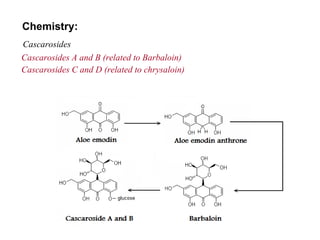
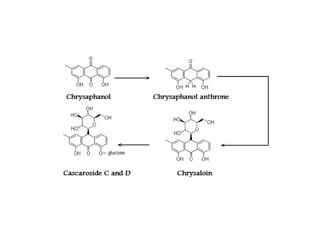
Chemistry:  Cascarosides Cascarosides A and B (related to Barbaloin) Cascarosides C and D (related to chrysaloin)
 
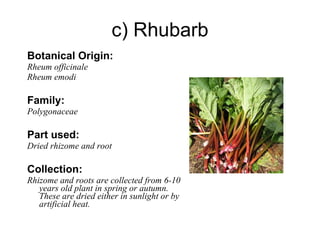
c) Rhubarb Botanical Origin: Rheum officinale Rheum emodi Family: Polygonaceae Part used: Dried rhizome and root Collection: Rhizome and roots are collected from 6-10 years old plant in spring or autumn. These are dried either in sunlight or by artificial heat.
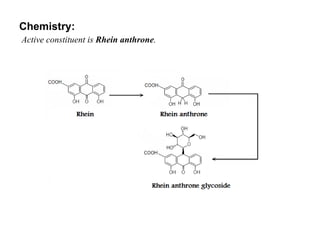
Chemistry: Active constituent is  Rhein anthrone .
d) Senna Botanical Origin: Cassia angustifolia Cassia acutifolia Family: Febaceae Part used: Dried leaflets
Chemistry: It contains; Sennoside A and B Sennoside C and D
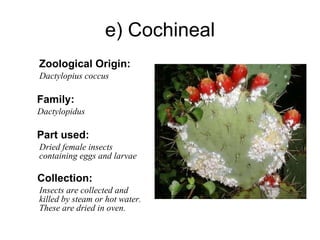
e) Cochineal Zoological Origin: Dactylopius coccus Family: Dactylopidus Part used: Dried female insects  containing eggs and larvae Collection: Insects are collected and killed by steam or hot water. These are dried in oven.
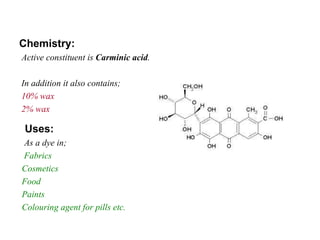
Chemistry: Active constituent is  Carminic acid . In addition it also contains; 10% wax 2% wax Uses: As a dye in; Fabrics Cosmetics Food Paints Colouring agent for pills etc.

Anthraquinone glycosides

  • 1.
    Anthraquinone Glycosides Mostof agents are used as laxatives and purgatives. Cochineal is a dye. Mechanism: The glycosides are absorbed from the small intestine and re-excreted in the large intestine where they increase the motility so produce laxation. Aglycons produce griping effect so it is recommended to prescribe antispasmodic with them.
  • 2.
    Chemistry: Chemically theseare related to anthracene.
  • 3.
    a) Aloe Botanicalorigin: Aloe barbadensis Aloe ferox Aloe perryi Aloe vera Family: Asphodelaceae Part used: Dried juice of leaves
  • 4.
    Collection: Leaves arecut from 9-12 years old plant and placed in v-shaped trough which in turn is placed on incline so that juice can be collected in receiver. It is allowed to evaporate, finally thickened juice is placed in metal box for drying. Chemistry: Barbaloin is active ingredient. Upon hydrolysis, it yields; Aloe emodin Uses: Laxatives and purgatives Emollient Ingredient of benzoin tincture
  • 5.
    b) Cascara BotanicalOrigin: Cascara sagrada Rhamnus purshiana Family: Rhamnaceae Part used: Dried bark Collection: Bark is collected from April to August when it can be readily separated from wood. It is dried in shade.
  • 6.
    Chemistry: CascarosidesCascarosides A and B (related to Barbaloin) Cascarosides C and D (related to chrysaloin)
  • 7.
  • 8.
    c) Rhubarb BotanicalOrigin: Rheum officinale Rheum emodi Family: Polygonaceae Part used: Dried rhizome and root Collection: Rhizome and roots are collected from 6-10 years old plant in spring or autumn. These are dried either in sunlight or by artificial heat.
  • 9.
    Chemistry: Active constituentis Rhein anthrone .
  • 10.
    d) Senna BotanicalOrigin: Cassia angustifolia Cassia acutifolia Family: Febaceae Part used: Dried leaflets
  • 11.
    Chemistry: It contains;Sennoside A and B Sennoside C and D
  • 12.
    e) Cochineal ZoologicalOrigin: Dactylopius coccus Family: Dactylopidus Part used: Dried female insects containing eggs and larvae Collection: Insects are collected and killed by steam or hot water. These are dried in oven.
  • 13.
    Chemistry: Active constituentis Carminic acid . In addition it also contains; 10% wax 2% wax Uses: As a dye in; Fabrics Cosmetics Food Paints Colouring agent for pills etc.