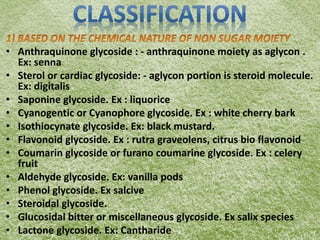
• Anthraquinone glycoside : - anthraquinone moiety as aglycon .
Ex: senna
• Sterol or cardiac glycoside: - aglycon portion is steroid molecule.
Ex: digitalis
• Saponine glycoside. Ex : liquorice
• Cyanogentic or Cyanophore glycoside. Ex : white cherry bark
• Isothiocynate glycoside. Ex: black mustard.
• Flavonoid glycoside. Ex : rutra graveolens, citrus bio flavonoid
• Coumarin glycoside or furano coumarine glycoside. Ex : celery
fruit
• Aldehyde glycoside. Ex: vanilla pods
• Phenol glycoside. Ex salcive
• Steroidal glycoside.
• Glucosidal bitter or miscellaneous glycoside. Ex salix species
• Lactone glycoside. Ex: Cantharide
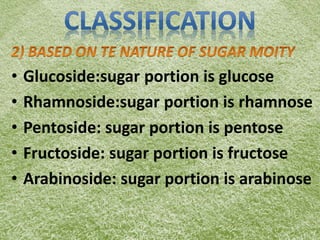
• Glucoside:sugar portion is glucose
• Rhamnoside:sugar portion is rhamnose
• Pentoside: sugar portion is pentose
• Fructoside: sugar portion is fructose
• Arabinoside: sugar portion is arabinose
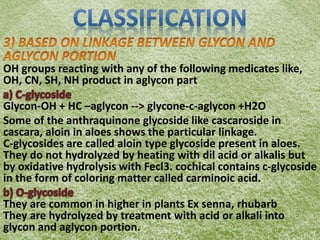
OH groups reacting with any of the following medicates like,
OH, CN, SH, NH product in aglycon part
Glycon-OH + HC –aglycon --> glycone-c-aglycon +H2O
Some of the anthraquinone glycoside like cascaroside in
cascara, aloin in aloes shows the particular linkage.
C-glycosides are called aloin type glycoside present in aloes.
They do not hydrolyzed by heating with dil acid or alkalis but
by oxidative hydrolysis with Fecl3. cochical contains c-glycoside
in the form of coloring matter called carminoic acid.
They are common in higher in plants Ex senna, rhubarb
They are hydrolyzed by treatment with acid or alkali into
glycon and aglycon portion.
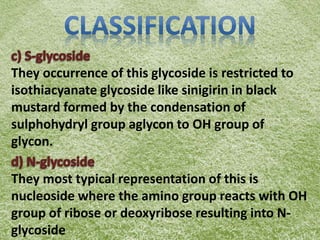
They occurrence of this glycoside is restricted to
isothiacyanate glycoside like sinigirin in black
mustard formed by the condensation of
sulphohydryl group aglycon to OH group of
glycon.
They most typical representation of this is
nucleoside where the amino group reacts with OH
group of ribose or deoxyribose resulting into N-
glycoside
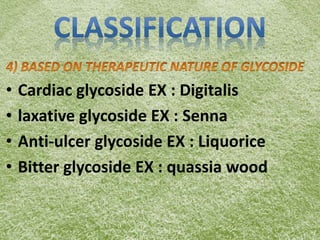
• Cardiac glycoside EX : Digitalis
• laxative glycoside EX : Senna
• Anti-ulcer glycoside EX : Liquorice
• Bitter glycoside EX : quassia wood
THANK YOU 

Classification of Glycosides

  • 2.
    • Anthraquinone glycoside: - anthraquinone moiety as aglycon . Ex: senna • Sterol or cardiac glycoside: - aglycon portion is steroid molecule. Ex: digitalis • Saponine glycoside. Ex : liquorice • Cyanogentic or Cyanophore glycoside. Ex : white cherry bark • Isothiocynate glycoside. Ex: black mustard. • Flavonoid glycoside. Ex : rutra graveolens, citrus bio flavonoid • Coumarin glycoside or furano coumarine glycoside. Ex : celery fruit • Aldehyde glycoside. Ex: vanilla pods • Phenol glycoside. Ex salcive • Steroidal glycoside. • Glucosidal bitter or miscellaneous glycoside. Ex salix species • Lactone glycoside. Ex: Cantharide
  • 3.
    • Glucoside:sugar portionis glucose • Rhamnoside:sugar portion is rhamnose • Pentoside: sugar portion is pentose • Fructoside: sugar portion is fructose • Arabinoside: sugar portion is arabinose
  • 4.
    OH groups reactingwith any of the following medicates like, OH, CN, SH, NH product in aglycon part Glycon-OH + HC –aglycon --> glycone-c-aglycon +H2O Some of the anthraquinone glycoside like cascaroside in cascara, aloin in aloes shows the particular linkage. C-glycosides are called aloin type glycoside present in aloes. They do not hydrolyzed by heating with dil acid or alkalis but by oxidative hydrolysis with Fecl3. cochical contains c-glycoside in the form of coloring matter called carminoic acid. They are common in higher in plants Ex senna, rhubarb They are hydrolyzed by treatment with acid or alkali into glycon and aglycon portion.
  • 5.
    They occurrence ofthis glycoside is restricted to isothiacyanate glycoside like sinigirin in black mustard formed by the condensation of sulphohydryl group aglycon to OH group of glycon. They most typical representation of this is nucleoside where the amino group reacts with OH group of ribose or deoxyribose resulting into N- glycoside
  • 6.
    • Cardiac glycosideEX : Digitalis • laxative glycoside EX : Senna • Anti-ulcer glycoside EX : Liquorice • Bitter glycoside EX : quassia wood
  • 7.