T.ANANTHAKUMAR
BMS14312
 The isolation of RNA with high quality is a
crucial step required to perform various
molecular biology experiment.
 TRIzol Reagent is a ready-to-use reagent used
for RNA isolation from cells and tissues.
 TRIzol works by maintaining RNA integrity
during tissue homogenization, while at the
same time disrupting and breaking down cells
and cell components.
 Addition of chloroform, after the
centrifugation, separates the solution into
aqueous and organic phases.
 RNA remains only in the aqueous phase. After
transferring the aqueous phase, RNA can be
recovered by precipitation with isopropyl
alcohol.
 But the DNA and proteins can recover by
sequential separation after the removal of
aqueous phase
 Total RNA extracted by TRIzol Reagent is free
from the contamination of protein and DNA.
 This RNA can be used in Northern blot
analysis, in vitro translation, poly (A) selection,
RNase protection assay, and molecular cloning
 RNA will be rapidly degraded by RNases,
which are EVERYWHERE, especially on your
skin.
 To prevent RNase contamination, you must
wear gloves and use only RNase-free tips and
microcentrifuge tubes.
 All solutions have also been specially treated
with agents that deactivate RNase, like
diethylpyrocarbonate (DEPC)
 Be especially careful to keep the RNase-free
tips covered when not in use
REAGENTS
 Chloroform (without any additives, such as
isoamyl alcohol)
 Isopropyl alcohol
 75% Ethanol (in DEPC-treated water)
 RNase-free water or 0.5% SDS solution
HOMOGENIZATION
 Growth medium on the cells was discarded
and cells were washed with ice cold 1X PBS
 The monolayer was then covered with 1 ml of
TRIzol and the cells were lysed and
homogenized by repeated pipetting.
 The homogenized samples were incubated for
5 minutes at 15 to 30°C for the complete
dissociation of nucleoprotein complexes.
 0.2 ml (200 microliters)of chloroform per 0.75
ml of TRIZOL LS Reagent was added.
 The tubes were shaked vigorously by hand for
15 seconds and incubated them at 15 to 30°C
for 2 minutes.
 The samples were centrifuged for 15 minutes
at no more than 12,000 g (4°C).
 The aqueous phase was transferred to other
tubes.
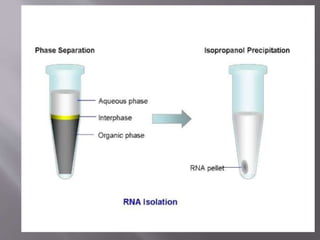
 Following centrifugation, the mixture separates
into a lower red, phenolchloroform phase, an
interphase, and a colorless upper aqueous
phase.
 RNA remains only in the aqueous phase.
 The volume of the aqueous phase is about 70%
of the volume of TRIZOL LS Reagent used for
homogenization.
 The RNA was precipitated from the aqueous
phase by mixing with 3 microlitre of glycogen
and 500 microlitre of isopropyl alcohol.
 The mixture was centrifuged for 30 minutes at
12,000 × g (2 to 8°C).
 ( The RNA precipitate forms a gel-like pellet on
the side of the tube at bottom).
 The supernatant was removed.
 The RNA pellet was washed once with 75%
ethanol, adding 900 microlitre of 75% ethanol
per 0.75 ml of TRIZOL LS Reagent used for the
initial homogenization.
 The sample were inverted and mixed and
centrifuged at 12,000 rpm for 30 minutes at 4
degree.
 RNA was dissolved in RNase-free water (or
0.5% SDS solution) by passing the solution
through the pipette tip for a few times, and
incubating for 10 minutes at 55 to 60°C.
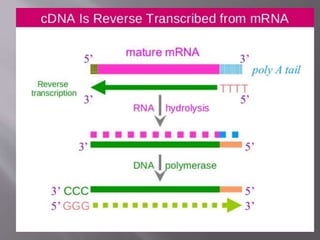
 cDNA is created from a mature mRNA from a
eukaryotic cell with the use of an enzyme
known as reverse transcriptase.
 In eukaryotes, a poly-(A) tail (consisting of a
long sequence of adenine nucleotides)
distinguishes mRNA from tRNA and rRNA
and can therefore be used as a primer site for
reverse transcription
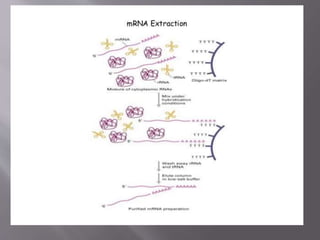
 Firstly, the mRNA is obtained and purified
from the rest of the RNAs.
 Several methods exist for purifying RNA such
as trizol extraction and column purification .
 Column purification is done by using
oligomeric dT nucleotide coated resins where
only the mRNA having the poly-A tail will
bind.
 The rest of the RNAs are eluted out.
 The mRNA is eluted by using eluting buffer
and some heat to separate the mRNA strands
from oligo-dT
 Purification can be performed by binding
mRNAs on a solid matrix to which short
strings of thymidylate residues are attached
(oligo dT matrix).
 The mRNAs are removed again by washing in
a low salt buffer.
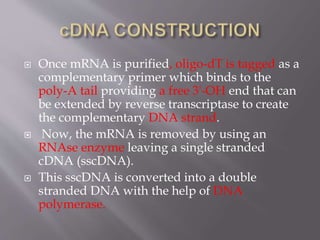
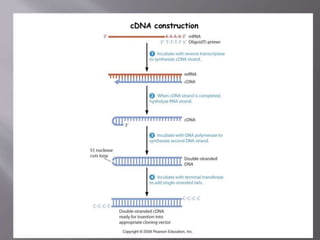
 Once mRNA is purified, oligo-dT is tagged as a
complementary primer which binds to the
poly-A tail providing a free 3'-OH end that can
be extended by reverse transcriptase to create
the complementary DNA strand.
 Now, the mRNA is removed by using an
RNAse enzyme leaving a single stranded
cDNA (sscDNA).
 This sscDNA is converted into a double
stranded DNA with the help of DNA
polymerase.
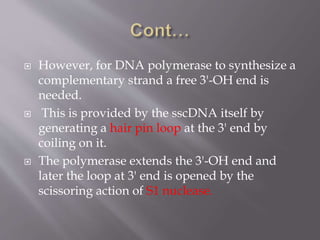
 However, for DNA polymerase to synthesize a
complementary strand a free 3'-OH end is
needed.
 This is provided by the sscDNA itself by
generating a hair pin loop at the 3' end by
coiling on it.
 The polymerase extends the 3'-OH end and
later the loop at 3' end is opened by the
scissoring action of S1 nuclease.
 cDNA libraries are commonly used when
reproducing eukaryotic genomes, as the amount of
information is reduced to remove the large
numbers of non-coding regions from the library.
 cDNA libraries are used to express eukaryotic
genes in prokaryotes.
 Prokaryotes do not have introns in their DNA and
therefore do not possess any enzymes that can cut
it out during transcription process.
 cDNA do not have introns and therefore can be
expressed in prokaryotic cells.
 Also, it is useful for subsequently isolating the
gene that codes for that mRNA.
 Discovery of novel genes.
 Clonning of full length cDNA molecules for in
vitro study of gene function.
 Study of the repertoire if mRNAs expressed in
different cells or tissues.
RNA ISOLATION AND cDNA PREPARATION

RNA ISOLATION AND cDNA PREPARATION

  • 1.
  • 2.
     The isolationof RNA with high quality is a crucial step required to perform various molecular biology experiment.  TRIzol Reagent is a ready-to-use reagent used for RNA isolation from cells and tissues.  TRIzol works by maintaining RNA integrity during tissue homogenization, while at the same time disrupting and breaking down cells and cell components.
  • 3.
     Addition ofchloroform, after the centrifugation, separates the solution into aqueous and organic phases.  RNA remains only in the aqueous phase. After transferring the aqueous phase, RNA can be recovered by precipitation with isopropyl alcohol.  But the DNA and proteins can recover by sequential separation after the removal of aqueous phase
  • 4.
     Total RNAextracted by TRIzol Reagent is free from the contamination of protein and DNA.  This RNA can be used in Northern blot analysis, in vitro translation, poly (A) selection, RNase protection assay, and molecular cloning
  • 5.
     RNA willbe rapidly degraded by RNases, which are EVERYWHERE, especially on your skin.  To prevent RNase contamination, you must wear gloves and use only RNase-free tips and microcentrifuge tubes.  All solutions have also been specially treated with agents that deactivate RNase, like diethylpyrocarbonate (DEPC)  Be especially careful to keep the RNase-free tips covered when not in use
  • 6.
    REAGENTS  Chloroform (withoutany additives, such as isoamyl alcohol)  Isopropyl alcohol  75% Ethanol (in DEPC-treated water)  RNase-free water or 0.5% SDS solution
  • 7.
    HOMOGENIZATION  Growth mediumon the cells was discarded and cells were washed with ice cold 1X PBS  The monolayer was then covered with 1 ml of TRIzol and the cells were lysed and homogenized by repeated pipetting.
  • 8.
     The homogenizedsamples were incubated for 5 minutes at 15 to 30°C for the complete dissociation of nucleoprotein complexes.  0.2 ml (200 microliters)of chloroform per 0.75 ml of TRIZOL LS Reagent was added.  The tubes were shaked vigorously by hand for 15 seconds and incubated them at 15 to 30°C for 2 minutes.
  • 10.
     The sampleswere centrifuged for 15 minutes at no more than 12,000 g (4°C).  The aqueous phase was transferred to other tubes.  Following centrifugation, the mixture separates into a lower red, phenolchloroform phase, an interphase, and a colorless upper aqueous phase.
  • 11.
     RNA remainsonly in the aqueous phase.  The volume of the aqueous phase is about 70% of the volume of TRIZOL LS Reagent used for homogenization.
  • 12.
     The RNAwas precipitated from the aqueous phase by mixing with 3 microlitre of glycogen and 500 microlitre of isopropyl alcohol.  The mixture was centrifuged for 30 minutes at 12,000 × g (2 to 8°C).  ( The RNA precipitate forms a gel-like pellet on the side of the tube at bottom).
  • 13.
     The supernatantwas removed.  The RNA pellet was washed once with 75% ethanol, adding 900 microlitre of 75% ethanol per 0.75 ml of TRIZOL LS Reagent used for the initial homogenization.  The sample were inverted and mixed and centrifuged at 12,000 rpm for 30 minutes at 4 degree.
  • 14.
     RNA wasdissolved in RNase-free water (or 0.5% SDS solution) by passing the solution through the pipette tip for a few times, and incubating for 10 minutes at 55 to 60°C.
  • 15.
     cDNA iscreated from a mature mRNA from a eukaryotic cell with the use of an enzyme known as reverse transcriptase.  In eukaryotes, a poly-(A) tail (consisting of a long sequence of adenine nucleotides) distinguishes mRNA from tRNA and rRNA and can therefore be used as a primer site for reverse transcription
  • 16.
     Firstly, themRNA is obtained and purified from the rest of the RNAs.  Several methods exist for purifying RNA such as trizol extraction and column purification .  Column purification is done by using oligomeric dT nucleotide coated resins where only the mRNA having the poly-A tail will bind.
  • 17.
     The restof the RNAs are eluted out.  The mRNA is eluted by using eluting buffer and some heat to separate the mRNA strands from oligo-dT  Purification can be performed by binding mRNAs on a solid matrix to which short strings of thymidylate residues are attached (oligo dT matrix).  The mRNAs are removed again by washing in a low salt buffer.
  • 19.
     Once mRNAis purified, oligo-dT is tagged as a complementary primer which binds to the poly-A tail providing a free 3'-OH end that can be extended by reverse transcriptase to create the complementary DNA strand.  Now, the mRNA is removed by using an RNAse enzyme leaving a single stranded cDNA (sscDNA).  This sscDNA is converted into a double stranded DNA with the help of DNA polymerase.
  • 20.
     However, forDNA polymerase to synthesize a complementary strand a free 3'-OH end is needed.  This is provided by the sscDNA itself by generating a hair pin loop at the 3' end by coiling on it.  The polymerase extends the 3'-OH end and later the loop at 3' end is opened by the scissoring action of S1 nuclease.
  • 23.
     cDNA librariesare commonly used when reproducing eukaryotic genomes, as the amount of information is reduced to remove the large numbers of non-coding regions from the library.  cDNA libraries are used to express eukaryotic genes in prokaryotes.  Prokaryotes do not have introns in their DNA and therefore do not possess any enzymes that can cut it out during transcription process.  cDNA do not have introns and therefore can be expressed in prokaryotic cells.
  • 24.
     Also, itis useful for subsequently isolating the gene that codes for that mRNA.  Discovery of novel genes.  Clonning of full length cDNA molecules for in vitro study of gene function.  Study of the repertoire if mRNAs expressed in different cells or tissues.